



Abstract



Johns Hopkins Medicine (JHM) brings the Johns Hopkins Health System and the Johns Hopkins University School of Medicine together. Johns Hopkins Health System includes 6 hospitals (4 in Maryland, 1 in Washington, DC and 1 in Florida), the largest primary care network in the state of Maryland, Johns Hopkins International, a home care company, 4 health insurance plans and many other assets. Johns Hopkins Medicine is a complex organization with many different cultures varying by geographic region, business, and profession. In 2013, JHM issued a 5 year strategic plan to “actively support a healthy workforce.” As a result of its complex structure, it was vital for JHM to identify and meet the needs of its subcultures in order to fully support healthy lifestyles across the enterprise. This article describes the processes enacted within entity, job responsibility, team, and peer subcultures to create a sustainable culture of health, along with a description of JHM measurement strategies. It highlights features that are not particularly common within published literature.
Guiding Framework
Johns Hopkins Medicine utilized Judd Allen’s health framework, depicted in Figure 1, as a guide to identify and address opportunities for enhancing our approach to creating a healthy culture. 1 Inclusion of a strategic objective to support a healthy workforce throughout JHM demonstrates our shared values. Johns Hopkins Medicine integrated elements from Allen’s other 4 pillars (norms, touch points, social climate, and peer support) to create a health culture on macro and micro level, some of which are highlighted in the remaining sections of this article.
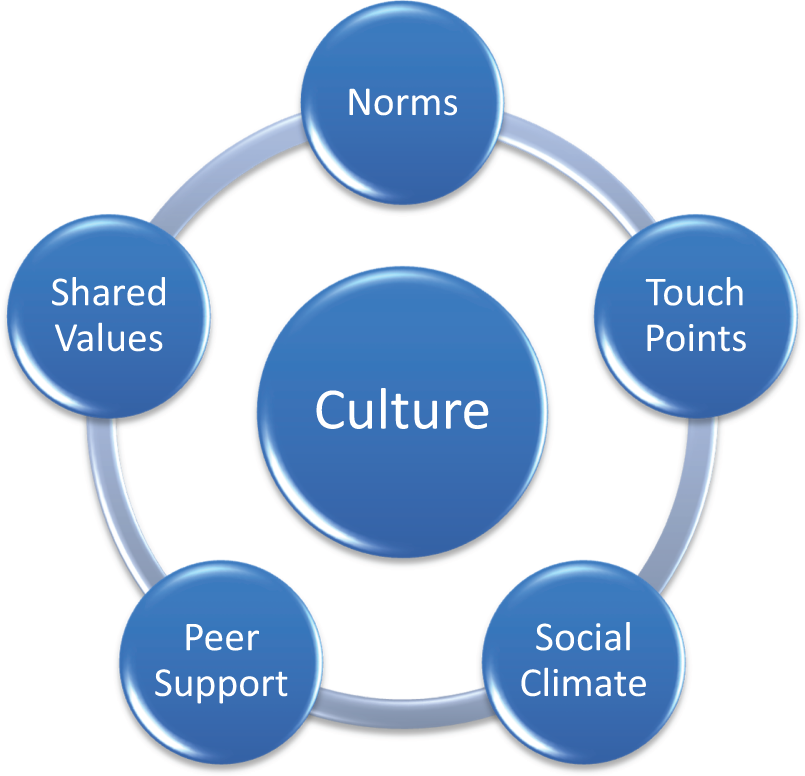
Judd Allen’s framework.
Entity Subculture
Johns Hopkins Medicine is comprised of 12 entities. Since most of JHM grew by acquisition and each entity has its own president, various subcultures exist. These entities have a large amount of independence and this semiautonomy is part of their culture. Finding a framework to pursue employee health whereby entities could enjoy a high degree of autonomy, yet still work toward a common goal, and change the health culture, was supported by the CDC Worksite Health ScoreCard (WHSC). 2
The CDC WHSC is an evidence-based tool constructed on the social ecological model of behavior, which consists of the complimentary influence of 4 spheres: environmental, organizational, interpersonal, and individual resources. The CDC WHSC is composed of 15 categories, including, for example, physical activity, diabetes, and tobacco cessation. Each category includes questions about available resources, policies, and health promotion strategies with assigned point values based on the strength of the underlying evidence of that question as well as the impact of having that item in place. Johns Hopkins Medicine positioned the completion of the CDC WHSC as part of its fiscal year 2016 strategic objectives for all 12 of the JHM entities in order to gather baseline measures. This ensured accountability amongst the executive teams, as their annual performance evaluation is tied to each objective. In the subsequent 2 years, JHM tied improvement in entity scores to its strategic objectives. However, entities were provided flexibility in determining which topic areas in the CDC WHSC to improve upon, as well as how to make that improvement, based on their own employee needs and available resources. As such, JHM allowed each entity’s subculture to flourish through targeted improvement of evidence-based health promotion programs. In order to ensure accuracy and fairness of scoring across the organization, JHM instituted a validation process. The validation process involved review of policies, communication material, and other documents supporting the entity submission, as well as an onsite assessment with each entity to verify environmental supports (ie, lactation room, exercise facility).
While the general approach of the CDC WHSC supports the shared values in creating a healthy culture within the workplace, its application also addresses other elements of the healthy culture framework. For example, for the past 2 years, JHM has implemented a Race the Globe Steps Challenge. Employees can sign up to race the globe, tracking steps and contributing to their entities’ total. This effort fundamentally rests on peer support (another arm of the health culture framework), as entity total steps are visible on the Healthy at Hopkins web portal and group walks are organized to both rally enthusiasm and to encourage each other to take steps. Examples of how “Touchpoints”, ”Social Climate,” and ”Norms” are also supported in the CDC WHSC. 2
The organizational supports section of the CDC WHSC has the most number of questions and is worth the most points of all the sections in the tool. This prominence is consistent with the level of importance organizational support plays in creating a healthy workplace culture. In the second and third year of the CDC WHSC implementation, JHM placed additional parameters that incorporated specific leadership responsibilities for each question within the organizational supports section. Examples of the added components include having leaders participate in one health promotion activity per quarter, adding employee health as a standing agenda item on executive meetings, and regularly attending wellness committee meetings. While additional parameters were given, each entity had the flexibility to determine the implementation plan for each component that best met the needs of their culture. The framework JHM adopted to create a solid foundation of organizational support also allowed each JHM’s entity specific culture to be respected.
Job Responsibility Subculture
Clinicians have a unique set of job responsibilities that differ from the general health-care employee population. In particular, doctors and nurses have been living in a culture of stress and fatigue resulting in burnout and early retirement. 3 This has become such a notable problem in the health-care industry, that some employers, such as JHM, are taking specific steps to bring back the “Joy in Medicine”. The Dean of the School of Medicine convened a Joy in Medicine task force in the fall of 2016 to identify “factors that adversely affect joy in the delivery of health-care.” As a result of this task force, resources are being allocated to address stressors such as staffing models, continuing education, regulatory compliance, and electronic medical records. In fact, specific champions are being recruited to represent the interests of the physician and nursing cohorts.
Predating the assembly of the Joy In Medicine task force, a group of nurses started resilience training for their peers, with hundreds already having participated. One of our faculty members is leading mindfulness based stress reduction sessions. There are even dedicated resources to address the well-being of our graduate students and resident physicians.
Team Subculture
Social networks play an immense role in influencing behavior. 4 To support team-health culture, JHM is currently in the pilot phase of Healthy at Hopkins Zones. This is a voluntary program in which teams implement specific practices unique to them by adopting new “norms” in the areas of physical activity, nutrition, and stress. Examples include leaving only healthy food out in open work areas, conducting walking meetings, and not checking work email before or after work hours. Teams also had the option of creating their own health norms. By including an “other” category, the Healthy at Hopkins Zones is a program that can be tailored to meet group needs, decided upon by the employees themselves. Once the team makes progress in adopting the norm, they are recognized by the organization and given a Healthy at Hopkins Zones certificate and a 6 foot Healthy at Hopkins Zones flag that they display prominently within their department. The concept of recognition reinforces health as a “shared value” and can influence other teams to participate.
Peer Subculture
Peer support is a main ingredient in a healthy work culture and specifically identified in Allen’s model. While the Healthy at Hopkins Zones encourages peer support, there are many other processes in place to encourage peer support that aren’t delivered in the framework of a team. For example, the CDC WHSC includes the following: providing a champion network (advocates for participation), providing free or subsidized breast feeding support groups, and making health promotion programs available to family members. Johns Hopkins Medicine also features success stories of peers adopting healthy lifestyle behaviors on the JHM landing webpage as a means to improve the social climate and foster inspiration from their colleagues. Many onsite educational classes are available to employees’ family members since health behaviors at work are often influenced by home cultures.
Given the uniqueness of each individual’s health journey, JHM provided a resource to make it easier for each individual to ask their peers for specific support. Currently being rolled out at one of our administrative sites (not directly delivering care), every employee is offered a dry erase board with the phrase “Please support my health by” printed on the board. Employees then complete the remaining portion of the phrase by writing down exactly what they need help with from their peers. These boards are hung in each employee’s workspace for others to see. Examples include “please support my health by making me laugh”, “asking me to take a walk”, and “encouraging me to drink more water” (see Figure 2.) All levels of the organization are participating in adopting this resource, including directors and executives.

Sample workspace dry erase board.
Measurement
Measuring JHM’s health promotion efforts was integral in determining strengths and identifying areas of need. Results of the CDC WHSC are analyzed annually and reports are created for each organizational entity to provide information on their year over year improvement, along with how they compared to JHM at large. However, the CDC WHSC is an organizational assessment tool and doesn’t provide insight on how employees perceive JHM’s progress in creating a healthy workplace culture. Thus, in 2016, JHM collected the first year of data on its workplace health culture. A 7 question survey was created that reflects on various relevant aspects, such as “the leaders at my organization are role models for health and wellness” and “my supervisor encourages me to take care of my health.” Similar to the CDC WHSC reporting, results of the culture survey are analyzed by entity and by JHM as a whole. Some entities see their culture moving in a positive direction after 2 years, whereas it will take longer to turn the direction of the ship for some of the larger entities. Regardless, the results of the survey have helped shape JHM’s strategy. For example, as a result of seeing lower scores than expected on how the leaders are perceived as role models of health, JHM created a series of communication articles featuring how leaders bring health and wellness into their daily practice, as well as strategies they are employing within their teams to encourage the adoption of healthy habits during the workday.
Conclusion
Johns Hopkins Medicine has deployed an evidenced based tool, the CDC WHSC, as a framework for positively impacting the health and the health culture of the population. It has also augmented this tool with strategies to support subcultures related to specific professions as well as launched programs to help support teams. Furthermore, JHM recognizes that every individual has peers that don’t always fall into professions or teams and has thus created ways to foster a healthy culture amongst individuals. We’re using data to test effectiveness of our approach and generate solutions where needed. A conversation around employee health and wellness has become part of our culture.
Both authors are affiliated with Johns Hopkins HealthCare LLC. Dr. Richard Safeer, MD, FAAFP is Medical Director of Employee Health & Wellness and Wendy Bowen, MPH, is Health Promotion Specialist in the Employee Health & Wellness Department.