




Abstract
Purpose:
Less than half of US adults meet the recommended guidelines of 150 minutes of exercise each week. Health promotion messages are frequently used to promote physical activity (PA); however, this messaging may be ineffective if it does not resonate with the target audience. The purpose of this exploratory study is to understand how women respond to examples of PA promotion messages.
Approach/Design:
A qualitative study.
Setting:
Washington DC Metro Area.
Participants:
Forty women, stratified by race/ethnicity (white, black, Latina) and level of self-reported PA (active, inactive).
Method:
Eight focus groups were conducted in which participants were shown 3 PA promotion messages representative of typical messaging strategies. Three researchers conducted a thematic analysis to code the data for emergent themes.
Results:
Current PA promotion messaging strategies do not resonate with women. Women want to see individuals with “realistic” bodies who look similar to them (eg, body shape, age, race/ethnicity), and for PA messaging to include daily activities as a way to be active.
Conclusions:
Public health practitioners who promote PA to women should consider developing messages that better resonate with women’s dynamic roles and lifestyles. Successful strategies may include depicting busy lifestyles that PA may be physically and logistically difficult to fit into and using models with diverse body shapes.
Introduction
Engaging in regular physical activity (PA) is important for disease prevention and good health. Regular moderate-intensity PA has physical health, mental health, and social benefits, 1 –7 including the prevention of illnesses such as obesity, diabetes, heart disease, 8 and some cancers, including breast, colorectal, and endometrial. 9 A recent study with 1.4 million participants found that higher levels of leisure-time PA (activities done at an individual’s discretion that improve or maintain fitness/health) was associated with lower risk of 13 cancers. 10
Despite these benefits, only 20% of US adults meet the 2008 Physical Activity Guidelines of at least 150 minutes of moderate-intensity aerobic activity each week. 8 Men (54%) are more likely than women (46%) to meet these guidelines. 11 Differences in PA also exist between different racial/ethnic groups. Non-Hispanic black, Hispanic, and non-Hispanic Asian women are less likely to meet the guidelines for PA (9.4%, 9.5%, and 10.3%, respectively) compared to non-Hispanic white women (16.9%). 12
There are a number of potential reasons why women do not engage in PA at the same rates as men, and why women from ethnic and racial minority groups show lower rates of PA than white women. Research shows that women face different barriers to PA than men, including caretaking responsibilities and socioeconomic and environmental barriers that may differ by ethnic and cultural background. 13 –15
Health promotion messages are one tool that can be used to encourage PA; however, mass media campaigns to promote health have shown only limited success. 16 –18 One potential reason for their limited effectiveness could be that campaign messages function as prescriptions for how women should look and take care of themselves; however, if these prescriptions create unrealistic standards that do not reflect the realities of the barriers that women face, they may be ineffective. 19 The purpose of this exploratory focus group study is to understand how women respond to messages about PA. Findings from this study can inform the design of campaigns that have the potential to better resonate with women and may more effectively encourage them to engage in regular PA.
Many barriers to PA among women have been documented and include environmental, social, and personal barriers. Not having accessible and/or safe spaces in which to be active is a well-documented barrier to PA. 13 –15 Multiple studies report that women perceive little time to exercise because of social barriers that include working, caregiving, and housework. 13–14,20 This literature has also highlighted lack of motivation as a personal barrier—PA is often not a priority and is not perceived as an enjoyable way to spend limited leisure time. 13–14,21 These studies support the notion that women face barriers to engaging in PA at multiple levels.
Different perceptions about what constitutes PA may be related to lower rates of PA among specific ethnic groups of women. In a focus group study with a diverse group of women, participants expressed that they did not engage in “exercise,” such as jogging, swimming, bicycling, and other “traditional” forms of exercise, but that they meet daily recommendations for PA if daily housework such as walking to the market, picking up children from school, raking leaves, and other daily errands count. 14 These focus group findings suggest that cultural depictions and beliefs about what entails PA may differ. Current approaches to PA promotion tend to emphasize “exercising,” which may exclude alternative views on what counts as PA.
Content analysis studies reveal the dominant themes found in current PA messaging. A study of print PA messages reported that current messages did not highlight many benefits of PA and instead tended to frame PA as a positive outcome that can be achieved through purchasing some type of product. 22 The majority of messages found in print media were corporate-funded advertisements that have the intention to sell products and promote brand recognition, while public health promotion messages were limited in comparison. 22 Appearance frames, which encourage women to follow health advice to look better, are the most commonly used in health magazines. 23 –25 These appearance frames are followed by health frames (instruct women to follow health advice to feel better), while body competence frames (instruct women to follow health advice to perform better) are used the least frequently. 19
Although messages about PA and health generally are presented in terms of improving appearance and promoting health, there is a lack of attention on the more proximal benefits such as improved mood, a sense of accomplishment, increased energy, and mental clarity. 26 Although disease prevention is an important public health outcome, messages may be more effective if they are framed in a way that connects with people’s daily desires, priorities, and responsibilities. 21,26 A 3-arm randomized trial testing different message frames for PA showed that framing PA as a way to enhance daily well-being (vs weight loss or better health) positively influenced women’s perceptions about being physically active. 27 Using message frames that resonate with target audiences’ daily lives should lead to greater success of messages promoting PA.
There is a gap in the literature with regard to our understanding of what types of PA messages best resonate with women—no published studies have looked specifically at this issue. This extends to women from different ethnic groups. Social-ecological models propose that we cannot understand how to create sustainable behavioral changes without understanding the target behavior within women’s life transitions and multiple roles, social support and social networks, and gender-specific norms and expectations. 28 In targeting women to increase their PA, it is important to understand whether current PA promotion messages resonate with women’s dynamic roles and lifestyles and how these messages can be improved so that they more effectively promote PA.
Design
Given the potential of health promotion messages and the barriers to PA for women that have been identified, the present study explores black, Hispanic, and white women’s responses to current messaging about PA and elicits their input about and recommendations for PA promotion strategies through focus groups. This study has 2 research questions: First, how do women (black, Hispanic, and white) respond to examples of current PA messaging? Second, what recommendations do women (black, Hispanic, and white) have regarding the improvement of PA promotion messages for women? To our knowledge, this is one of the first studies to elicit responses to PA promotion messages among an ethnically diverse group of women. Our exploratory study will provide a descriptive analysis of how ethnically diverse women respond to current health promotion messages about PA.
Setting
This study was part of a larger investigation on women’s goals and priorities in their lives and how PA aligns with these goals. 21 Participants were recruited from August to October 2014 in the Washington DC Metro Area by a commercial marketing firm using fliers, Craigslist, newspaper advertisements, the firm’s internal recruiting database, and social media outlets. Interested parties contacted the firm and were screened for eligibility based on gender (female only), age (between 20 and 50), race/ethnicity, and levels of self-reported PA per week.
Participants
Forty white, Hispanic, and black women participated in 1 of eight 90-minute focus groups in October 2014. Participants were compensated $30 for participation. Participants provided informed consent and completed a short questionnaire assessing demographic information (height, weight, race/ethnicity, and education) and PA levels (see Table 1). In an attempt to facilitate more candid conversation as participants tend to feel safer and prefer being with others who share similar characteristics, 29 the groups were clustered by race/ethnicity (black, Hispanic, and white) as well as by activity level (high active/low active) and assigned moderators who best matched each group’s characteristics. High active women were defined as those who reported being physically active 3 or more times per week or for more than 120 min/wk. Low active women were those who were physically active less than 3 times/wk or for less than 120 min/wk. The active women comprised 2 focus groups in which participants were not grouped by race/ethnicity, resulting in the following groups: 2 low active black (n = 11), 2 low active Hispanic (n = 8), 2 low active white (n = 10), 2 active mixed race/ethnicity (n = 11). Each focus group was led by 1 of 3 trained moderators and was audio-taped (with participant permission) and transcribed.
Sample Characteristics.
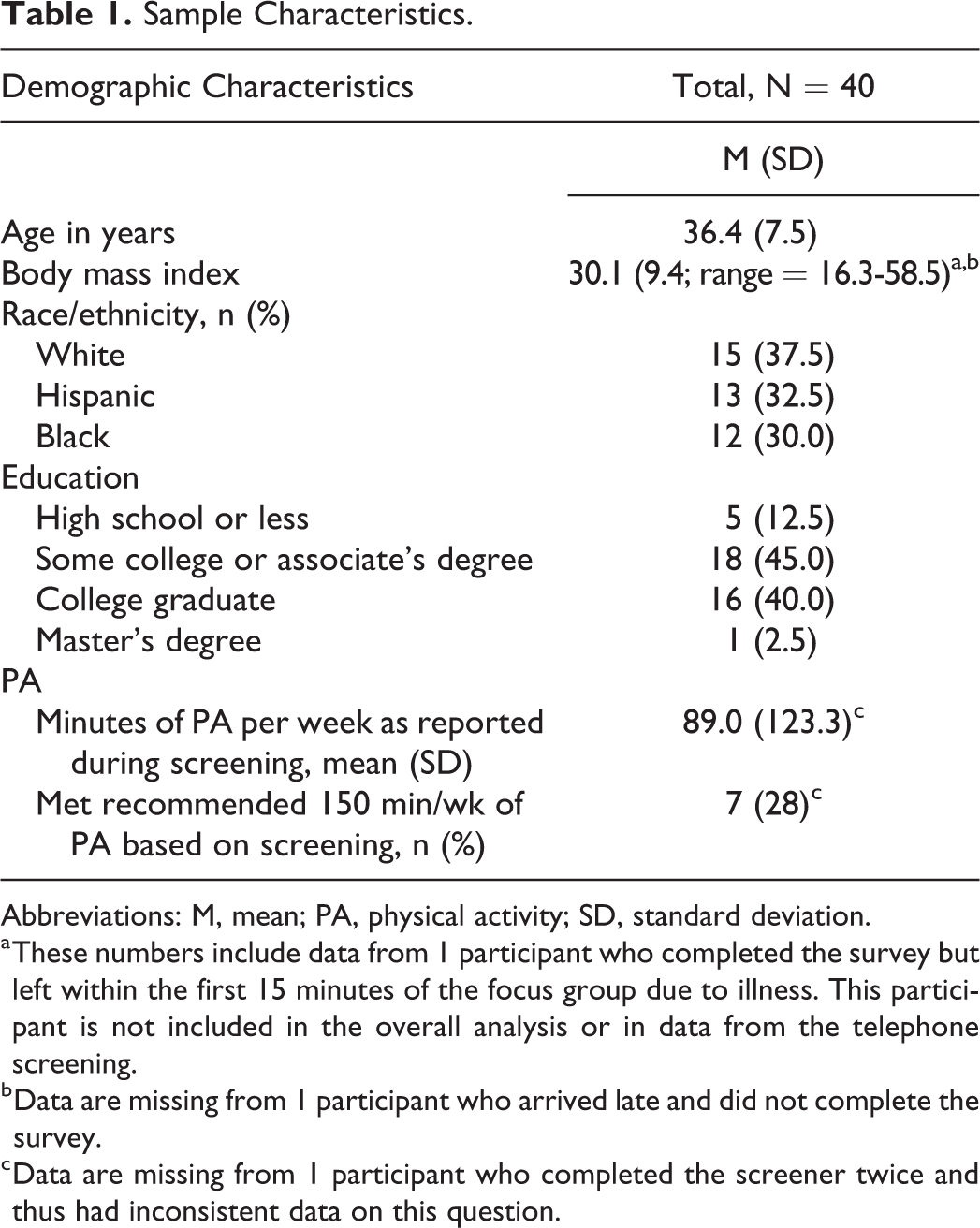
Abbreviations: M, mean; PA, physical activity; SD, standard deviation.
a These numbers include data from 1 participant who completed the survey but left within the first 15 minutes of the focus group due to illness. This participant is not included in the overall analysis or in data from the telephone screening.
b Data are missing from 1 participant who arrived late and did not complete the survey.
c Data are missing from 1 participant who completed the screener twice and thus had inconsistent data on this question.
Method
Moderators followed a focus group guide and engaged participants in a discussion on women’s goals and priorities in their lives and how PA aligns with these goals (parent study), followed by a discussion on participants’ reactions to the 4 PA-related messages (present study; for interview guide, see Table 2). Each focus group was audio-recorded (with participants’ permission) and transcribed. The study was approved by the research firm as well as the National Cancer Institute’s institutional review board. The study was approved by The Office for Human Research Protections: OHSR #12257.
Interview Guide for PA Advertisements.
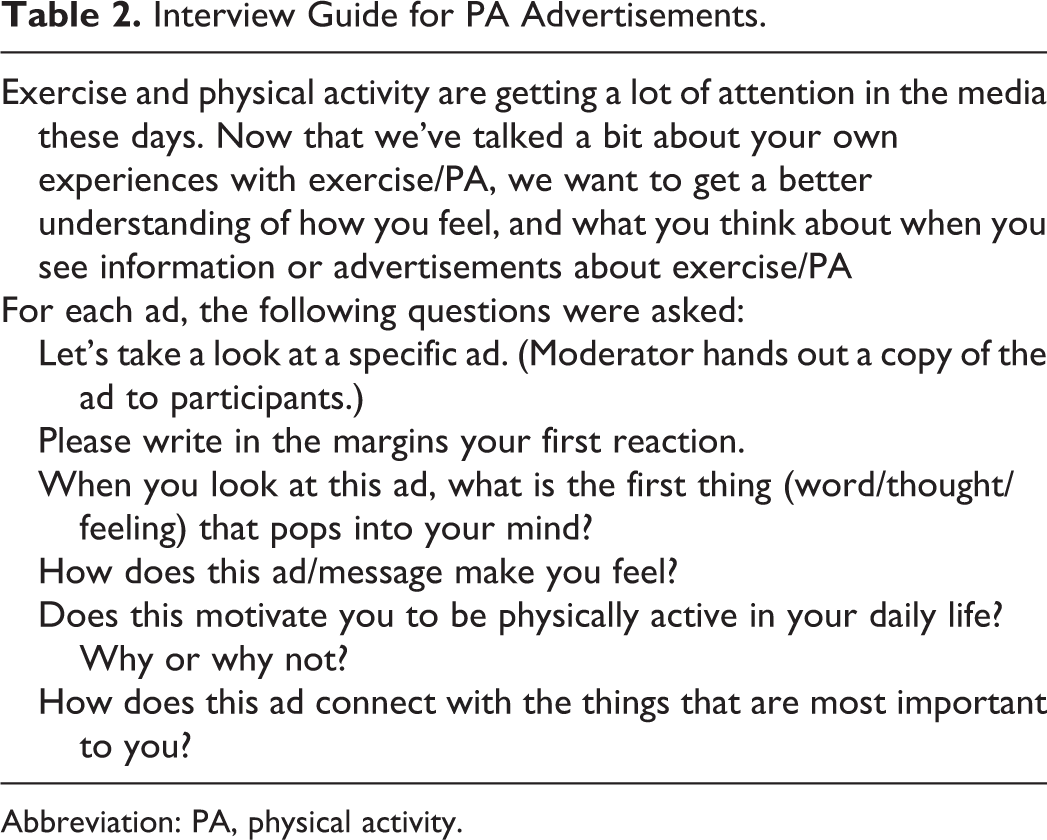
Abbreviation: PA, physical activity.
Physical Activity Goals
Physical activity promotion messages were shown to the focus group participants. In selecting the PA promotion messages, the primary goal was to identify messages that represented “traditional” messaging strategies. One author (M.S.) created an initial list of websites for another author (J.T.) to search for ads/images. The websites reviewed included health advocacy agencies (eg, American Cancer Society), PA organizations (eg, walkboston.org), industry sites (eg, curves.com), and magazines (eg, fitnessmagazine.com). J.T. searched these sites and created an initial database of 25 to 30 possible images. Three authors (M.S., J.T., and H.P.) reviewed and discussed the options, then narrowed this initial list to 10 by discarding options that had a large amount of text (which would take too long to read) or very little text. Four final messages were selected in February 2014 to broadly represent appearance, health (disease prevention), and body competence frames, 19 as well as newer strategies (ie, children encouraging parents to exercise).
The first message (message #1) depicted a middle-aged white couple running and smiling broadly with messaging that encouraged PA for health benefits (avoiding cardiovascular disease and increasing life expectancy) and recommendations to get at least 30 minutes of exercise each day (health frame). The second message (message #2) featured an outline of a nondescript gender-neutral figure walking with physical and mental health benefits from walking written next to the respective parts of the body (eg, “increases attention and decision making” on the head, “reduces lower back pain” on the torso). This message suggested that walking 30 minutes a day would result in numerous physical and mental health benefits (body competence). The 2 remaining messages included one focused on appearance, featuring an image of 2 thin, young women stretching (1 white, 1 multiethnic; message #3), and the other depicted children acting as “coaches” encouraging their mothers to be more active through phrases like “O.K. Mom, crunch those abs!” (message #4; nontraditional messaging strategy). Messages #1, #2, and #4 were used by health advocacy groups and message #3 by a fitness publication.
Consideration was given to whether the race/ethnicity of the people in ads should be tailored to the race/ethnicity of the focus groups. However, in order to get feedback on typical PA promotion strategies, we decided that the messages should reflect the current state of messaging, which tend to feature white individuals. 30 While the intention was to show the participants 4 advertisements, due to time constraints, not every group was exposed to message #4; thus, only data gathered on responses to the first 3 messages (messages #1-#3) were analyzed and presented here.
Data Analysis
A qualitative thematic analysis was used to analyze the data. 31 The transcriptions of the focus groups were transferred into 3 spreadsheets (1 for each of the 3 messages participants saw) grouped by responses to each of the 4 prompts (for interview guide, see Table 2). Data analysis entailed a 3-step process. The first step involved the independent review of the data by 2 of the investigators (C.T., A.O.) for overarching themes 32–33 while cognizant to remain open-minded and let the themes emerge naturally. The researchers then discussed these overarching themes with one another using the constant comparison method 34 to develop the themes and their properties. This revealed recurring themes surrounding physical appearance, lifestyle, and how realistic portrayals of PA were for the lives of the participants. In the second step, the data were reexamined by 2 of the investigators (C.T., J.T.) and grouped into these themes with a focus on identifying subthemes and tensions within each theme. Step 3 entailed a series of discussions between 2 of the investigators (C.T., J.T.) moving back and forth between the main themes and subthemes and the data until a nuanced analysis of participants’ perceptions of PA, their recommendations for PA messaging, and the tensions among and between these was achieved. The data were analyzed without direct comparisons between the high/low active participants and between the racial/ethnic groups, but the activity level and racial/ethnic group of the participant was noted throughout the coding process to allow us to identify any differences that emerged. These themes are presented below.
Results
Results revealed a range of reactions to the messages, insights about how women think about PA fitting (or not fitting) into their lives, and suggestions for how to improve messaging to make PA more relevant to participants’ dynamic lives, fitness levels, and lifestyle goals. Although we initially set out to understand ethnic minority women who were inactive, we found that the responses to the messages were generally consistent across the white, black, and Hispanic participants, regardless of racial/ethnic group and activity level. Three overarching themes and 4 key recommendations emerged. Results are presented by theme followed by participants’ recommendations for addressing that particular theme.
Theme 1: PA Doesn’t Fit Neatly Into My Life That Way
One main complaint participants had about the messages was that the portrayals of PA were not realistic for their own lives. In reference to message #1, 1 participant shared: For a large majority of people I know this [couple walking in the afternoon] is not going to be a picture that’s going to get people exercising…First of all, you need childcare. You’re not going to have both partners out running. One partner has to stay with the kids while the other one goes out. (Active) When I see people riding their bikes in the middle of the day, I’m like, ‘they clearly must be unemployed.’ What do they do for a living that they can just take a walk on a Wednesday afternoon at three o’clock? I’m looking at them like, if it’s real, they’re retired and have a lot of time on their hands.(White, Inactive) …you see two people that are smiling as they’re working out, when realistically, you probably have this face that you’re exhausted, and you know you have X weight or minutes to go…. (Hispanic, Inactive)
Recommendation #1: Show me how I can incorporate PA into my busy life
Participants perceived the messages as portraying PA as fun and enjoyable but personally perceive PA as work and suggested it should be depicted accordingly. Participants also expressed that finding time to engage in PA is difficult in their busy lives and would be more motivated if PA was portrayed as an activity that could be integrated into their busy schedules. Maybe it’s my demographic, my lifestyle…rather than seeing chirpy, older people in the park, on a trail, show me somebody who’s got their suit on with their gym shoes because they’re walking…to and from the [subway]…This [message] says to me these people either have the time, or carved out all this time to go on [a walk]…Show me someone who’s infusing it into their regular, ‘We don’t really have time, but we’re going to get in what we can get in’ [schedule]…If I’m on the train and I see that, I’m, “All right. I’ll go ahead.” Maybe I won’t be able to walk up the whole escalator, but let me walk up the steps I can. (Black, Inactive) Target a specific group in a smarter way, like activities with your kids, things that you can do with your kids…Target more family, have fun with the family, with simple things. [PA] doesn’t have to be so formal. (Hispanic, Inactive) I can spend the time connecting with my children while doing this. We can take a walk around the block together, and talk about the day. I would still be getting in my priority (spending time with my kids), and getting something good out of it, too. (Black, Inactive)
Theme 2: “Real People Aren’t That Skinny”
Another recurring theme was the body size of the models. In response to message #3, participants had strong negative reactions to the 2 models featured: Why did they put such skinny people with perfect tummies on these ads? It’s the first thing I saw. Let’s be a little bit more realistic about what your average person looks like. But they do that all the time. (Active) Ok, they look really good. I don’t think I can get that. I’m not going to be motivated to get this level, to look that fit. I want to look that good and have these flat abs and hot legs, but it’s not realistic to me. (White, Inactive)
Recommendation #2: Show me someone who looks like me, or at least isn’t a skinny white lady
One of the recommendations was to use models who were more diverse, both in body size and in racial/ethnic makeup. The participants recommend using people with a more “realistic” body size, Use realistic looking people. If I’m not mistaken, the average size in America is, like a size 12 or 14. If that’s the average size of the average woman, we are not even close in these ads…But if they maybe want to include a size 10 or a size 12 or a size 14 in these pictures of running or walking – to me, that might actually get you a bit more attention paid to the ad itself because then it’s “Oh, I guess I could maybe do that.” Because sometimes, we have to see it to believe it. She looks like me. (Black, Inactive) Don’t use people who are model thin or anything. Use a regular person who has…a little bit more on them. Maybe incorporate pictures of not necessarily just one person. Maybe [include] a family, or dogs. Use a group [of] people, like in a park. (Hispanic, Inactive) To me, a lot of people who don’t look [super skinny] would be better motivated by having a variety of people, whether it’s size, ethnicity, or whatever. Not just happy, shiny people who look and fit a certain mold. People would look at the ads and be like, “that’s actually me.” (Black, Inactive)
Theme 3: My Body Can’t Do That
Participants also commented on the feasibility of the activities portrayed in the messages for their own physical abilities. In response to message #1, Running outside on the sidewalk, or even walking, is totally out for me because it’s almost like, the impact with the pavement, with my heels and feet, it’s painful. (Black, Inactive) I can’t go running. I mean, I can, but I’m going need something to hold up the girls [breasts], so this is not for me. I am a large-breasted woman, so running is somewhat difficult for me. (Black, Inactive)
Recommendation #3: Show me activities that I can do with my body
Walking was perceived to be more feasible than running for the participants. The many benefits of walking [message #2] motivated the participants, both active and inactive, and from all racial/ethnic groups. …when you stop and look at these little bubbles, then you say, “Oh really, it could improve my blood pressure, or limit colon cancer”…I didn’t realize…that only 30 minutes of walking actually helps all of that. (Active)
Recommendation #4: Teach me new information about why PA is good for me
The participants expressed that PA promotion messages shouldn’t focus on appearance because they don’t find these benefits motivational as achieving a smaller body size was not perceived as realistic for them. Participants shared that focusing on the health benefits of PA would be more effective. What grabs my attention is that walking helps depression and fatigue. I’ve had depression in the past…I didn’t know that walking could help that; I think that showing how people can benefit from this beyond just the exercise would motivate people to do it.(Hispanic, Inactive) I had no idea that just walking 30 minutes a day would decrease the risk of Alzheimer’s…I had no idea on the colon cancer risk, the lower back pains. Showing this is much more effective.(Active)
Conclusions
In our exploration of ethnically diverse women’s responses to a nonrepresentative sample of current PA promotion messages, we found that these messages did not align and resonate with women’s dynamic lifestyles. Focus group participants in this study suggested strategies to improve these messages, emphasizing the need for messages to be more realistic; to promote PA in ways that could be more easily integrated into their lives; and to reflect the actual body shapes of different types of women.
Our findings reveal that current PA messaging, which employs appearance, weight loss, health (disease prevention), and/or body competence frames to present PA as a stand-alone activity that is separate from other daily-life routines and priorities, does not resonate well with most women. These findings align with social-environmental framework proposed by Vrazel et al, 28 which posits that women are more successful at engaging in PA when recognition is given to their dynamic life transitions and multiple roles, the importance of social support and social networks, and the gender-specific norms and expectations they face. 28
Contextualizing the focus group findings within this social-ecological framework suggests that health promotion messaging targeting PA among women has been developed with incorrect assumptions about what will make PA appealing to women. Current messaging suggests that women should structure PA in ways that do not permit them to integrate it into their dynamic and constantly changing lives. Additionally, counter to the cultural norm of using thin models to promote the value of PA, participants explicitly stated that they are not motivated to be physically active by seeing thin models that do not reflect their diverse range of body sizes. This finding aligns with research showing that being physically active for weight loss and/or body shaping is associated with lower levels of participation compared to doing it to immediately feel better. 26 The focus group participants wanted to see people who look like them in PA promotion messages, engaging in PA in ways that they can relate to and that align with their daily priorities. For example, they specifically discussed wanting to take a walk with their families and friends. Physical activity increases when there is an opportunity to build social support for women. 28 Having others to engage in PA presents an opportunity to be social and connect with others, which may be a strong motivator to being physically active. 35,36
Rather than emphasizing appearance, participants recommended highlighting the combined physical, psychological, and social benefits of PA, which would allow them to both feel and perform their roles better (body competence) 19 ; they believe that these benefits of PA would be more relevant and also better motivate them than images of the culturally ideal fit bodies that they do not believe they can achieve. This is also consistent with the social-ecological framework proposed by Vrazel et al 28 and with previous work emphasizing the use of women’s priorities and values to motivate their engagement in PA. 21 Participants wanted to see messages that recommended ways they could be active that fit into rather than conflicted with their actual daily lives, including chaotic schedules and their need to prioritize their jobs taking care of their families. They did not want to have to set aside time to engage in PA separate from their other daily responsibilities—it needed to be depicted as a part of their dynamic and constantly changing lives.
Taken together, the results of the current study and previous research explicitly challenge our conventional approach to promoting PA to women and ask our field to think differently about how to more effectively engage women in valuing and engaging in PA. Rather than defining a target group based on demographic characteristics and health behavior risk profiles (ie, level of inactivity), 37 –40 perhaps we should consider targeting based on the peer-crowd value approach, which emphasizes value-based targeting rather than demographic targeting. 41 Defined as “macro-level subcultures” that have distinct beliefs, values, and norms, peer-crowds transcend immediate friends, geography, and other standard demographic categories. 41 The findings from this study suggest that focusing on a woman’s values of connectedness with others, caring for friends and family, building and maintaining relationships, all while having a dynamic and busy lifestyle juggling multiple roles may yield more success in increasing PA among women compared to a targeting by a demographics approach. By grouping target audiences based on values, messages may have greater impact in changing health-related behaviors, as has been shown with smoking behaviors among young adults. 42,43
Given that exposure to public health PA promotion is minimal compared to exposure to commercial messaging, 18,22 public health PA promotion should be designed to maximize attention and resonance by integrating the beliefs, attitudes, values, and lifestyle of the target audience to increase effectiveness. 21,44,45 Public health practitioners targeting women in PA promotion should develop messages that reflect the values and life circumstances of busy women juggling multiple roles, such as framing PA as an activity that will incorporate into their other life priorities and spending time with family and friends. Our findings and recommendations are consistent with studies that have investigated how to encourage low-income women to walk more. 46
There are limitations to this study that should be noted. Limitations include the small sample size. Additionally, generalizability from focus groups may be limited. Our sample included women from 3 racial ethnic groups (white, black, and Hispanic) from a specific geographic area in the United States; the information gathered for this study may not reflect other women from these ethnic/racial groups and from this geographic area, nor they may be generalized for other ethnic/racial groups and women outside the immediate geographic area from which the participants were recruited. Our initial goal was to understand ethnic minority women who were inactive; thus, though we grouped inactive focus group participants by race/ethnicity and this may have primed racial stereotypes and schemas, understanding racial/ethnic identity or the intersection of racial/ethnic and gender identity was not the primary focus of the study. We found that the responses to the messages were generally consistent across the participants, regardless of racial/ethnic group and activity level; thus, we did not analyze the data to assess for differences by racial/ethnic group. This analytical approach may have led to results that do not fully capture differences between specific racial/ethnic group and between participants who reported varying activity levels. Additionally, the 4 messages selected do not represent the full range of frames that are used in PA health promotion messages and not all participants saw all 4 of the messages. Despite these limitations, our study has generated a rich set of new findings that can inform more impactful ways to promote PA among women.
So What?
Previous research has shown that health promotion messages frame PA in particular ways that emphasize appearance and consumerism. 19,22 The participants in the present study perceived current depictions of PA as suggesting that PA is a fun stand-alone activity separate from other aspects of their daily lives, with the specific purpose to achieve a particular appearance. Our findings support social-ecological frameworks for understanding PA behavior among women: That women are more successful at engaging in PA when they have and can build social support in doing it; PA needs to fit into their dynamic life transitions and multiple roles; and current cultural gender-specific norms and expectations do not align with the realities of women’s physical bodies. 28 These findings can be used to reframe and design PA promotion messaging to better resonate with women who juggle multiple roles. As the evidence mounts that women face unique challenges to engaging in PA, we can maximize the potential of public health PA promotion messages for this target audience by ensuring that they reflect women’s values and lifestyles and do not create or reinforce the barriers that women have to being active.
Footnotes
Authors’ Note
Dr Thai conceptualized and designed the study, conducted the initial analyses, and drafted the manuscript. Dr Taber and Dr Oh participated in data analysis, assisted with drafting the manuscript, and reviewed and revised the manuscript. Dr Segar designed the data collection instruments and provided crucial feedback in the conceptualization and design of the study. Dr Blake and Dr Patrick designed the data collection instruments, coordinated data collection, and provided feedback on the manuscript. All authors approved the final manuscript as submitted and agree to be accountable for all aspects of the work.
Declaration of Conflicting Interests
The author(s) declared no potential conflicts of interest with respect to the research, authorship, and/or publication of this article.
Funding
The author(s) disclosed receipt of the following financial support for the research, authorship, and/or publication of this article: The National Cancer Institute internally funded this study.