



Abstract
Purpose:
To characterize plant-based dietary practices and examine their relationship with body mass index (BMI) in Hispanic/Latino Seventh-day Adventists (SDA).
Design:
Cross-sectional analyses of data among Hispanics/Latinos in the Adventist Health Study-2 (AHS-2).
Setting:
The AHS-2 is a cohort of SDA adults (n = 96 592) in North America.
Participants:
A total of 3475 Hispanics/Latinos who provided demographic, dietary, anthropometric, and lifestyle data at enrollment.
Measures:
Plant-based dietary practices were determined from food frequency questionnaire; BMI, demographic, and lifestyle data were assessed by questionnaire.
Analysis:
In linear regression analysis, plant-based diets were modeled as dummy variables with nonvegetarian as the referent group and log(BMI) as the outcome adjusted for age, sex, education, exercise, nativity, alcohol use, smoking, and energy intake.
Results:
We identified 202 vegans, 664 vegetarians, 409 pesco-vegetarians, 227 semi-vegetarians, and 1973 nonvegetarians. Compared to the nonvegetarian referent (BMI = 27.50), estimated BMI were lower among vegans (23.58, P < .0001), vegetarians (25.24, P < .0001), pesco-vegetarians (26.36, P = .0002), and semi-vegetarians (26.69, P = .130). Other factors associated with lower BMI were being female (P = .001), nativity (Mexico, P = .002; South America, P < .0001; Caribbean, P = .004), having a college degree or higher (P = .01), exercise (P < .0001), and never smoked (P = .0006).
Conclusion:
Hispanic/Latino SDAs who consumed plant-based diets had lower BMI than nonvegetarians. The application of a plant-based diet as practiced by the Hispanic/Latino Adventists in this population may have public health impact on US Hispanic/Latinos.
Purpose
A report from the 2011 to 2014 US National Health and Nutrition Examination Survey estimates prevalence of obesity among Hispanics (42.5%) to be second after non-Hispanic blacks (48.1%). 1 By gender, Hispanic men have the highest obesity rate as compared to other ethnicities. Moreover, Hispanic men born in the United States are likely to be more obese than foreign-born men. 2 Among the lifestyle behaviors shown to influence obesity, diet has received the greatest attention perhaps because diet modification represents a behavior that is accessible, measurable, and translatable. Observational studies and dietary interventions using a dietary pattern approach with healthy food options (eg, Mediterranean diet and variations of plant-based diets) are gaining momentum. These studies suggest an advantage of plant-based diets on obesity- or body weight–related outcomes primarily in non-Hispanic populations 3 -6 ; however, little is known about their application in Hispanic/Latinos and other health disparity populations in the United States. Among Latinos or Hispanics in the United States specifically, studies that relate some aspect of diet with obesity measures have mixed results, and dietary patterns in these studies are determined using data reduction techniques, or quantified using healthy eating index or nutrition transition scores 7 -10 ; none examine the association of plant-based diets with obesity-related outcomes in observational studies or interventions. Given the growth of and high prevalence of obesity among Hispanic/Latino populations in the United States, research that assesses the benefits of vegetarian diets on overweight and obesity in this ethnic group has the potential to make a great public health impact.
The purpose of the current report was to examine in a sample of Hispanic/Latino adults whether plant-based diet patterns are associated with healthy weight (ie, as measured by the body mass index [BMI]) as compared to the nonvegetarian diet pattern. For our study, we are focusing on the 3475 Hispanic/Latino adults in a national sample of Seventh-day Adventists in the National Institutes of Health–funded Adventist Health Study-2 (AHS-2) cohort. We note that lifestyle practices in these cohort members are influenced by culture, socioeconomic status, religious beliefs, and health. Due to church recommendations to follow a vegetarian diet, and avoid smoking and drinking alcohol, the AHS-2 cohort members have been shown to have about a 50% prevalence of vegetarianism, and less than 8% currently use tobacco or alcohol. 11 -13 The AHS-2 cohort is a rich source of dietary data on specific plant-based diet choices, and the impact of our work on Hispanic/Latinos in this cohort has the potential to identify culturally tailored choices of plant foods that can help inform future interventions.
Methods
Design
We conducted cross-sectional analyses of data among Hispanics/Latinos in the AHS-2 cohort.
Study Sample
The AHS-2 is a prospective population-based cohort study of Seventh-day Adventist adults (n = 96 592) geographically spread throughout North America, whose main goal is to examine the associations between lifestyle practices and risk of breast, colon, and prostate cancers. Details of the study protocol used to establish the cohort have been described previously. 14 Briefly, adults who completed a self-administered comprehensive lifestyle questionnaire between 2002 and 2007 were enrolled. The lifestyle questionnaire queried participants about their medical history, demographic information, dietary intake from a food frequency questionnaire (FFQ), physical activity, and other lifestyle behaviors. For the present study, we selected participants who self-identified as Hispanic/Latino (n = 3739). The institutional review board of Loma Linda University approved the study, and written consent was obtained from all participants.
Participants
We excluded participants (n = 264) who did not complete an FFQ, or had missing data on height, weight, demographics, exercise, smoking, or alcohol use. After these exclusions, 3475 Hispanics/Latinos remained for analysis.
Measures
Dietary practices
Diet was assessed between 2002 and 2007 using a quantitative FFQ, which includes a comprehensive list of foods (eg, fruits, vegetables, legumes, grains, oils, dairy, fish, eggs, beverages, dry cereals, and vegetarian protein products). Each respondent was asked to report on his or her intake of these foods over the previous 1-year relative to the year the FFQ was completed. Variations of plant-based dietary practices were determined according to participants’ reported intake frequency of animal-based foods. These include meats (red meats + poultry), fish, and dairy (dairy products + eggs). We then used the following definitions to classify 4 plant-based (vegan, vegetarian, pesco-vegetarian, and semi-vegetarian) and nonvegetarian dietary practices: Vegans never or rarely consumed meats, fish, and dairy; vegetarians ate meats and fish never or rarely, and dairy ≥1 per month; pesco-vegetarians consumed meat never or rarely, fish ≥1 per month, and no limits on dairy; semi-vegetarians ate meat 1 per month to 1 per week, and no limits on dairy; and nonvegetarians ate meat and fish >1 per week with no limits on dairy. 13 The performance of the FFQ to estimate intake of selected foods/food groups was previously assessed using 6 telephone 24-hour dietary recalls as reference. The validation correlation coefficients of the meat and dairy items that comprise the indices (as compared to six 24 recalls) for measuring usual diet ranged from 0.5 to 0.7, indicating moderate to high validity. 15
Body mass index
Body weight and height were self-reported in the lifestyle questionnaire at enrollment. The BMI was calculated as weight/height2 using body weight (kilograms) and height (meters), and categorized as underweight (BMI <18.5 kg/m2), normal (BMI = 18.5 kg/m2 or BMI <25 kg/m2), overweight (BMI = 25 kg/m2 or BMI <30 kg/m2), or obese (BMI ≥30 kg/m2) as defined by the Centers for Disease Control and Prevention. 16
Covariates
Demographic and lifestyle information were also obtained from the lifestyle questionnaire at enrollment. These include age (in 10-year increments), gender, nativity (born in the United States, Mexico/Central America, South America, Caribbean Islands, or other country), education (high school, some college, or bachelor’s degree or higher), exercise (in 30 min/wk increments of moderate, or vigorous activity), smoking (never smoked or ever smoked [inclusive of current smokers]), alcohol use (never used or ever used [inclusive of current alcohol users]), and energy intake (in 100 kcal increments).
Analysis
Subject characteristics were compared across categories of dietary practices. To determine the relationship between diet and BMI, we modeled the plant-based diets (vegan, vegetarian, pesco-vegetarian, semi-vegetarian) as dummy variables relative to the nonvegetarian category as the main exposure, with log(BMI) as the outcome variable in linear regression analysis. Since the literature indicates that dietary habits are associated with other factors such as acculturation, education, age, gender, and exercise, 17,18 we checked for this association. In correlational analysis in the study sample, we found that diet type was correlated, albeit weakly, with nativity, education, smoking, alcohol use, age, and exercise (data not shown). These variables and energy intake have also been shown to be associated with BMI. 19 -21 In a separate analysis of our data, we found no evidence of a gender-related effect on BMI; we modeled gender as well as the aforementioned variables as confounders. Estimated marginal means were then computed on the fully adjusted model with correction for multiplicity by the Tukey method.
Prior to analysis, we applied guided multiple-imputation approach to complete the few missing data on the dietary variables of the 3475 participants who remained for analysis. 22 Ten imputed data sets were produced, and each data set was analyzed to obtain parameter estimates using the fully adjusted model. We then applied Rubin rules to combine the estimates from each of the imputed data sets into one overall estimate and variance, incorporating within- and between-imputation variability. 23 Analyses were carried out using SAS Software package release 9.3 (SAS Institute, Inc, Cary, North Carolina). The R package emmeans version 1.3.0 (https://cran.r-project.org/web/packages/emmeans/index.html) was used to calculate estimated marginal means from the multiply-imputed data sets.
Results
We identified 202 vegans (6%), 664 vegetarians (19%), 409 pesco-vegetarians (12%), 227 semi-vegetarians (6%), and 1973 nonvegetarians (57%; Table 1). Average age was just above 50 years across diet practices; 67% were female; average exercise was lowest among nonvegetarians and highest among vegans; participants predominantly never smoked, never used alcohol, or were foreign born (particularly vegans and pesco-vegetarians). Nonvegetarians tended to have lower education, whereas participants practicing plant-based diets proportionately had higher education. Overall, 36% were overweight and 22% were obese, with the highest proportion coming from nonvegetarians. Vegans and vegetarians had the highest proportion of individuals with normal BMI.
Sample Descriptive Statistics According to Variations of Dietary Practices Among Hispanic/Latino Seventh-Day Adventists.

Abbreviations: BMI, body mass index; HS, high school; SD, standard deviation.
We examined the relation between a log-transformed BMI outcome variable and plant-based diet in a linear regression model that included indicator variables for plant-based diet patterns (relative to the nonvegetarian diet pattern). Percent differences in BMI relative to the nonvegetarian referent were as follows: −15.07% for vegans (P < .0001), −8.92% for vegetarians (P < .0001), −5.34% for pesco-vegetarians (P < .0001), and −4.89% for semi-vegetarians (P = .011).
We further adjusted these means for pertinent confounders and found some attenuation in the means (Figure 1). The percent differences in estimated marginal mean BMI between the plant-based and the nonvegetarian referent diets were −14.26% for the vegans (P < .0001), −8.20% for the vegetarians (P < .0001), −4.16% for the pesco-vegetarians (P = .0002), and −2.96% for the semi-vegetarians (P = .130). Thus, compared to a nonvegetarian with BMI = 27.50 kg/m2, the estimated BMI for a vegan, vegetarian, pesco-vegetarian, and semi-vegetarian would be 23.58, 25.24, 26.36, and 26.69 kg/m2, respectively. Using the fully adjusted model, other factors associated with lower BMI were being female (P = .001), born in Mexico (P = .002), South America (P < .0001), or Caribbean Islands (P = .004), having a college degree (P = .013), never smoked (P = .0006), exercise (P < .0001), and lower energy intake (P = .046).
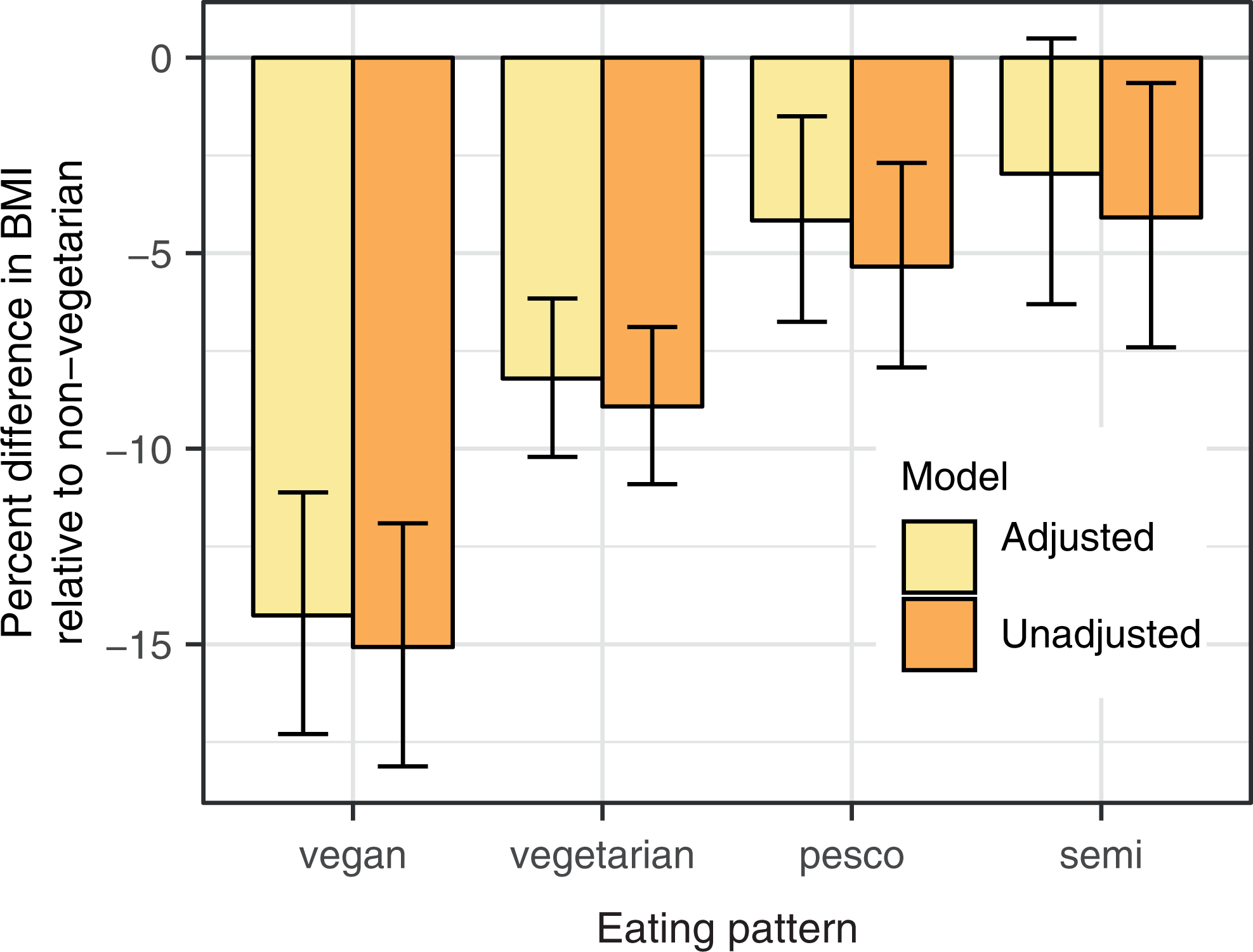
Percentage difference in estimated marginal mean BMI between the plant-based and nonvegetarian diets, as calculated using linear regression, where diet was modeled as indicator variables with nonvegetarian as the reference group and log(BMI) as the outcome adjusted for age, gender, education, nativity, exercise, smoking, alcohol use, and energy intake. BMI indicates body mass index.
Discussion
Summary
In this sample of Hispanic/Latino Adventists, we identified individuals who are vegans, vegetarians, pesco-vegetarians, semi-vegetarians, and nonvegetarians. Further, the first 4 dietary groups (plant-based diets), when compared to the nonvegetarians, were associated with lower BMI. This association persisted for the vegans, vegetarians, and pesco-vegetarians after adjusting for other factors known to be related to diet and BMI. In our analysis, these included age, gender, education, nativity, exercise, smoking, alcohol use, and energy intake. These findings support our hypothesis and are consistent with the association between vegetarian diet patterns—particularly the vegan pattern—and lower BMI seen in white Adventists, 24 -26 black/African American Adventists, 25,27 and Asian Adventists. 28 The association between plant-based eating and lower adiposity has also been shown in non-Adventist cohorts in the United Kingdom 29 and France, 17 as well as in vegetarian diet interventions. 3,5-6
There are several potential mechanisms that support the biologic plausibility of lower BMI associated with plant-based diets. One possible explanation is the large amounts of fruits, vegetables, whole grains, legumes, and nuts in plant-based diets. This composition produces diets that have low-energy density and high fiber content, dietary qualities which contribute to the healthy BMI levels observed among individuals who consume such diets. 30,31 In a recent review, Smethers and Rolls identify energy density as the unifying factor of multiple weight loss diets and suggest eating patterns that improve diet quality and contain low-energy-dense foods for weight management. 30 The consumption of legumes/pulses 32 and grains, 33 and diets with high carbohydrate quality index, 34 all of which have benefits on body weight, are strategies to increase dietary fiber and produce low-energy-density eating patterns, which can be achieved with plant-based diets.
Other possible mechanisms are the higher resting energy expenditure associated with vegetarian diets and vegetable fats, 35 or the strong satiety effects, inefficient energy utilization, and improved diet quality due to nutrient displacement, which result from the consumption of tree nuts. 36 -38 Previous studies from AHS-2 report higher intakes of fruits, vegetables, whole grains, nuts and fiber, and generally lower energy density and lower meat intake in the diets of vegans, lacto-ovo vegetarians, pesco-vegetarians, and semi-vegetarians compared to nonvegetarians. 13,28,39 In the same study, Rizzo et al report that the animal protein intake (as percent of energy) among the 4 plant-based diets is statistically significantly lower compared to the nonvegetarian diet. Specifically, the animal protein intake per 2000 kcal is 6.4% in nonvegetarians, 3.5% in semi-vegetarians, 3.2% in pesco-vegetarians, 2.4% in lacto-ovo vegetarians, and only 0.6% in vegans. 13 The magnitude of the difference (from nonvegetarians) in animal protein intake is largest among the vegans, and becomes progressively smaller as the diet progresses toward a higher intake of animal foods (vegan > vegetarian > pesco-vegetarian > semi-vegetarian). This pattern paralleled what we found with our BMI results, which may explain the appearance of a threshold effect of the plant-based diets on BMI with regard to the consumption of animal-based foods.
Published reports consistently show an increase in overweight and obesity prevalence among individuals who migrate from Mexico, Central/South America, and other Hispanic countries to the United States. 20,21,40 The findings for non-US nativity may be concordant with data, indicating that increasing duration of residence in the United States 20,21 can lead to the adoption of Western lifestyles that are associated with unfavorable risk factors. 41 In a national sample of Hispanics/Latinos in the United States, Commodore-Mensah et al report a 71.5% prevalence of overweight/obesity among immigrants from Mexico, Central America, and Caribbean. 42 By comparison, the overall prevalence of overweight and obesity in our sample of Adventists is 58%, which includes both immigrants and US-born Hispanics/Latinos. Further, our data indicate that non-US nativity was associated with low BMI, but despite this effect, the vegetarian diet was associated with independent protection.
We note that our findings are from Hispanic/Latino Seventh-day Adventists whose choice of plant-based diets is part of faith-based recommendations from their church. The engagement of health promoting activities within the church combined with the strong and supportive community of like-minded Adventists are attributes of the Adventist experience that likely contribute to the dietary choices of this population. As these unique features were not measured in our sample, they need further exploration within the context of plant-based diets and lower adiposity in the broader Hispanic/Latino population. Despite this, we note that faith is a strong component of Hispanic/Latino life in the United States, and our findings may lend support to including the use of faith-based initiatives to promote dietary change in the Hispanic/Latino community.
Limitations
Estimates from FFQs generally are associated with measurement error; however, validation of the AHS-2 FFQ indicates that the intake of animal-based foods we used to classify vegan, vegetarian, pesco-vegetarian, semi-vegetarian, and nonvegetarian diets from the FFQ have moderate to high correlations with 24-hour dietary recalls. 15 As with dietary intake, self-reported measures of body weight and height can lead to systematic bias in estimating BMI. For example, overweight/obese individuals might tend to underreport their body weight, and individuals of short stature might overreport their height. As a consequence, obesity prevalence may be underestimated using self-reported anthropometric measures. However, in a validation study of anthropometric measures in a representative subsample of the AHS-2 cohort, we report a high validity of self-reported anthropometric data (intraclass correlation coefficient = 0.97). 43 The cross-sectional approach prevents conclusions about the temporal relationship between plant-based diets and BMI; further, the possible occurrence of reverse causality may have led to weak or null associations.
We also acknowledge potential issues as regard the generalizability of our study results to the Hispanic/Latino population in North America. Compared to a nationally representative probability sample of Hispanic adults in the United States, 18 our study sample is older, has a higher proportion of females, individuals who are US born, or has higher education; however, we have no evidence of a biological difference in response to these and other environmental factors.
Significance
We demonstrated that plant-based dietary practices are associated with healthier BMI, independent of the effect of important factors such as nativity, education, physical activity, and smoking. This suggests that while education and healthy lifestyle behaviors, such as no smoking and regular exercise, are beneficial to BMI, plant-based diets may contribute additional benefits to BMI and chronic disease risk. Other studies are needed to better understand the mechanisms that underlie the benefits of plant-based diets on BMI. Longitudinal observational studies among Adventists and non-Adventists are warranted, and future studies should consider the attributes of the Adventist experience when designing culturally tailored plant-based interventions in Hispanic/Latino populations.
So What? Implications for Health Promotion Practitioners and Researchers
What is already known on this topic?
We know from short-term clinical trials and observational studies among primarily non-Hispanic populations that plant-based diets promote favorable changes in body weight.
What does this article add?
This article provides evidence that plant-based diets of Hispanic Adventists are associated with lower BMI when compared to nonvegetarian diets.
What are the implications for health promotion practice or research?
Given the high rates of obesity in Hispanics/Latinos, the promotion of plant-based diets in this ethnic population has the potential to make a great public health impact.
Footnotes
Acknowledgment
The authors thank Andrew Mashchak for his statistical assistance.
Declaration of Conflicting Interests
The author(s) declared no potential conflicts of interest with respect to the research, authorship, and/or publication of this article.
Funding
The author(s) disclosed receipt of the following financial support for the research, authorship, and/or publication of this article: This study was supported by Center for Hispanic Health of the White Memorial Medical Center Foundation. Establishment of AHS-2 cohort was supported by the National Institutes of Health Grant 1RO1-CA-94594.
