



Abstract

| Paul E. Terry |
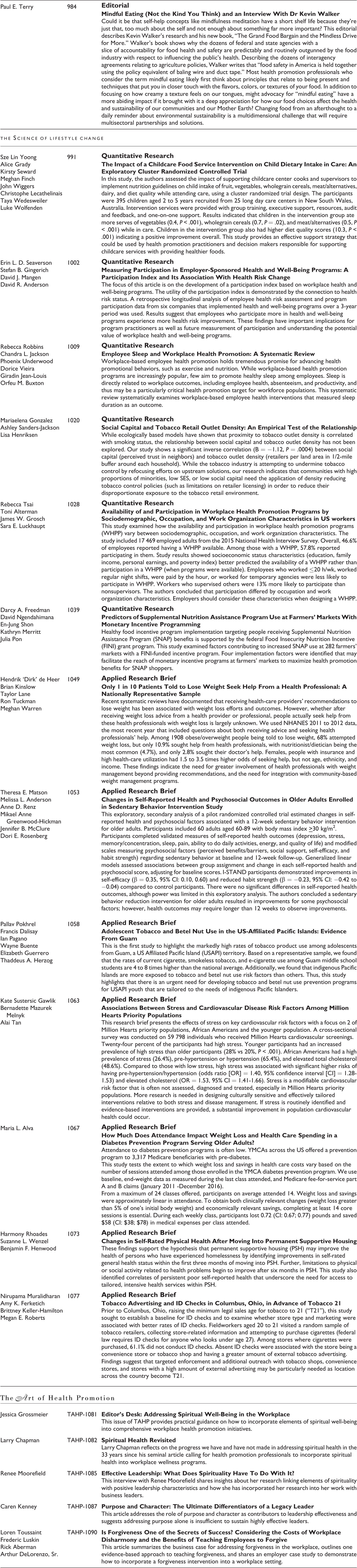
984 | Could it be that self-help concepts like mindfulness meditation have a short shelf life because they’re just that, too much about the self and not enough about something far more important? This editorial describes Kevin Walker’s research and his new book, “The Grand Food Bargain and the Mindless Drive for More.” Walker’s book shows why the dozens of federal and state agencies with a slice of accountability for food health and safety are predictably and routinely outgunned by the food industry with respect to influencing the public’s health. Describing the dozens of interagency agreements relating to agriculture policies, Walker writes that “food safety in America is held together using the policy equivalent of baling wire and duct tape.” Most health promotion professionals who consider the term mindful eating likely first think about principles that relate to being present and techniques that put you in closer touch with the flavors, colors, or textures of your food. In addition to focusing on how creamy a texture feels on our tongues, might advocacy for “mindful eating” have a more abiding impact if it brought with it a deep appreciation for how our food choices affect the health and sustainability of our communities and our Mother Earth? Changing food from an afterthought to a daily reminder about environmental sustainability is a multidimensional challenge that will require multisectoral partnerships and solutions. |
|
|
||
| Sze Lin Yoong Alice Grady Kirsty Seward Meghan Finch John Wiggers Christophe Lecathelinais Taya Wedesweiler Luke Wolfenden |
991 | In this study, the authors assessed the impact of supporting childcare center cooks and supervisors to implement nutrition guidelines on child intake of fruit, vegetables, wholegrain cereals, meat/alternatives, dairy, and diet quality while attending care, using a cluster randomized trial design. The participants were 395 children aged 2 to 5 years recruited from 25 long day care centers in New South Wales, Australia. Intervention services were provided with group training, executive support, resources, audit and feedback, and one-on-one support. Results indicated that children in the intervention group ate more serves of vegetables (0.4, P < .001), wholegrain cereals (0.7, P = .02), and meat/alternatives (0.5, P < .001) while in care. Children in the intervention group also had higher diet quality scores (10.3, P < .001) indicating a positive improvement overall. This study provides an effective support strategy that could be used by health promotion practitioners and decision makers responsible for supporting childcare services with providing healthier foods. |
| Erin L. D. Seaverson Stefan B. Gingerich David J. Mangen David R. Anderson |
1002 | The focus of this article is on the development of a participation index based on workplace health and well-being programs. The utility of the participation index is demonstrated by the connection to health risk status. A retrospective longitudinal analysis of employee health risk assessment and program participation data from six companies that implemented health and well-being programs over a 3-year period was used. Results suggest that employees who participate more in health and well-being programs experience more health risk improvement. These findings have important implications for program practitioners as well as future measurement of participation and understanding the potential value of workplace health and well-being programs. |
| Rebecca Robbins Chandra L. Jackson Phoenix Underwood Dorice Vieira Giradin Jean-Louis Orfeu M. Buxton |
1009 | Workplace-based employee health promotion holds tremendous promise for advancing health promotional behaviors, such as exercise and nutrition. While workplace-based health promotion programs are increasingly popular, few aim to promote healthy sleep among employees. Sleep is directly related to workplace outcomes, including employee health, absenteeism, and productivity, and thus may be a particularly critical health promotion target for workforce populations. This systematic review systematically examines workplace-based employee health interventions that measured sleep duration as an outcome. |
| Mariaelena Gonzalez Ashley Sanders-Jackson Lisa Henriksen |
1020 | While ecologically based models have shown that proximity to tobacco outlet density is correlated with smoking status, the relationship between social capital and tobacco outlet density has not been explored. Our study shows a significant inverse correlation (B = −1.12, P = .0004) between social capital (perceived trust in neighbors) and tobacco outlet density (retailers per land area in 1/2-mile buffer around each household). While the tobacco industry is attempting to undermine tobacco control by refocusing efforts on upstream solutions, our research indicates that communities with high proportions of minorities, low SES, or low social capital need the application of density reducing tobacco control policies (such as limitations on retailer licensing) in order to reduce their disproportionate exposure to the tobacco retail environment. |
| Rebecca Tsai Toni Alterman James W. Grosch Sara E. Luckhaupt |
1028 | This study examined how the availability and participation in workplace health promotion programs (WHPP) vary between sociodemographic, occupation, and work organization characteristics. The study included 17 469 employed adults from the 2015 National Health Interview Survey. Overall, 46.6% of employees reported having a WHPP available. Among those with a WHPP, 57.8% reported participating in them. Study results showed socioeconomic status characteristics (education, family income, personal earnings, and poverty index) better predicted the availability of a WHPP rather than participation in a WHPP (when programs were available). Employees who worked ≤20 h/wk, worked regular night shifts, were paid by the hour, or worked for temporary agencies were less likely to participate in WHPP. Workers who supervised others were 13% more likely to participate than nonsupervisors. The authors concluded that participation differed by occupation and work organization characteristics. Employers should consider these characteristics when designing a WHPP. |
| Darcy A. Freedman David Ngendahimana En-Jung Shon Kathryn Merritt Julia Pon |
1039 | Healthy food incentive program implementation targeting people receiving Supplemental Nutrition Assistance Program (SNAP) benefits is supported by the federal Food Insecurity Nutrition Incentive (FINI) grant program. This study examined factors contributing to increased SNAP use at 282 farmers’ markets with a FINI-funded incentive program. Four implementation factors were identified that may facilitate the reach of monetary incentive programs at farmers’ markets to maximize health promotion benefits for SNAP shoppers. |
| Hendrik ‘Dirk’ de Heer Brian Kinslow Taylor Lane Ron Tuckman Meghan Warren |
1049 | Recent systematic reviews have documented that receiving health-care providers’ recommendations to lose weight has been associated with weight loss efforts and outcomes. However, whether after receiving weight loss advice from a health provider or professional, people actually seek help from these health professionals with weight loss is largely unknown. We used NHANES 2011 to 2012 data, the most recent year that included questions about both receiving advice and seeking health professionals’ help. Among 1908 obese/overweight people being told to lose weight, 68% attempted weight loss, but only 10.9% sought help from health professionals, with nutritionist/dietician being the most common (4.7%), and only 2.8% sought their doctor’s help. Females, people with insurance and high health-care utilization had 1.5 to 3.5 times higher odds of seeking help, but not age, ethnicity, and income. These findings indicate the need for greater involvement of health professionals with weight management beyond providing recommendations, and the need for integration with community-based weight management programs. |
| Theresa E. Matson Melissa L. Anderson Anne D. Renz Mikael Anne Greenwood-Hickman Jennifer B. McClure Dori E. Rosenberg |
1053 | This exploratory, secondary analysis of a pilot randomized controlled trial estimated changes in self-reported health and psychosocial factors associated with a 12-week sedentary behavior intervention for older adults. Participants included 60 adults aged 60-89 with body mass index |
| Pallav Pokhrel Francis Dalisay Ian Pagano Wayne Buente Elizabeth Guerrero Thaddeus A. Herzog |
1058 | This is the first study to highlight the markedly high rates of tobacco product use among adolescents from Guam, a US Affiliated Pacific Island (USAPI) territory. Based on a representative sample, we found that the rates of current cigarette, smokeless tobacco, and e-cigarette use among Guam middle school students are 4 to 8 times higher than the national average. Additionally, we found that indigenous Pacific Islands are more exposed to tobacco and betel nut use risk factors than others. Thus, this study highlights that there is an urgent need for developing tobacco and betel nut use prevention programs for USAPI youth that are tailored to the needs of indigenous Pacific Islanders. |
| Kate Sustersic Gawlik Bernadette Mazurek Melnyk Alai Tan |
1063 | This research brief presents the effects of stress on key cardiovascular risk factors with a focus on 2 of Million Hearts priority populations, African Americans and the younger population. A cross-sectional survey was conducted on 59 798 individuals who received Million Hearts cardiovascular screenings. Twenty-four percent of the participants had high stress. Younger participants had an increased prevalence of high stress than older participants (28% vs 20%, P < .001). African Americans had a high prevalence of stress (26.4%), pre-hypertension or hypertension (65.4%), and elevated total cholesterol (48.6%). Compared to those with low stress, high stress was associated with significant higher risks of having pre-hypertension/hypertension (odds ratio [OR] = 1.40, 95% confidence interval [CI] = 1.28-1.53) and elevated cholesterol (OR = 1.53, 95% CI = 1.41-1.66). Stress is a modifiable cardiovascular risk factor that is often not assessed, diagnosed and treated, especially in Million Hearts priority populations. More research is needed in designing culturally sensitive and effectively tailored interventions relative to both stress and disease management. If stress is routinely identified and evidence-based interventions are provided, a substantial improvement in population cardiovascular health could occur. |
| Maria L. Alva | 1067 | Attendance to diabetes prevention programs is often low. YMCAs across the US offered a prevention program to 3,317 Medicare beneficiaries with pre-diabetes. This study tests the extent to which weight loss and savings in health care costs vary based on the number of sessions attended among those enrolled in the YMCA diabetes prevention program. We use baseline, end-weight data as measured during the last class attended, and Medicare fee-for-service part A and B claims (January 2011 -December 2016). From a maximum of 24 classes offered, participants on average attended 14. Weight loss and savings were approximately linear in attendance. To obtain both clinically relevant changes (weight loss greater than 5% of one’s initial body weight) and economically relevant savings, completing at least 14 core sessions is essential. During each weekly class, participants lost 0.72 (CI: 0.67; 0.77) pounds and saved $58 (CI: $38; $78) in medical expenses per class attended. |
| Harmony Rhoades Suzanne L. Wenzel Benjamin F. Henwood |
1073 | These findings support the hypothesis that permanent supportive housing (PSH) may improve the health of persons who have experienced homelessness by identifying improvements in self-rated general health status within the first three months of moving into PSH. Further, limitations to physical or social activity related to health problems begin to improve after six months in PSH. This study also identified correlates of persistent poor self-reported health that underscore the need for access to tailored, intensive health services within PSH. |
| Nirupama Muralidharan Amy K. Ferketich Brittney Keller-Hamilton Megan E. Roberts |
1077 | Prior to Columbus, Ohio, raising the minimum legal sales age for tobacco to 21 (“T21”), this study sought to establish a baseline for ID checks and to examine whether store type and marketing were associated with better rates of ID checks. Fieldworkers aged 20 to 21 visited a random sample of tobacco retailers, collecting store-related information and attempting to purchase cigarettes (federal law requires ID checks for anyone who looks under age 27). Among stores where cigarettes were purchased, 61.1% did not conduct ID checks. Absent ID checks were associated with the store being a convenience store or tobacco shop and having a greater amount of external tobacco advertising. Findings suggest that targeted enforcement and additional outreach with tobacco shops, convenience stores, and stores with a high amount of external advertising may be particularly needed as location across the country become T21. |
| Jessica Grossmeier | TAHP-1081 | This issue of TAHP provides practical guidance on how to incorporate elements of spiritual well-being into comprehensive workplace health promotion initiatives. |
| Larry Chapman |
TAHP-1082 | Larry Chapman reflects on the progress we have and have not made in addressing spiritual health in the 33 years since his seminal article calling for health promotion professionals to incorporate spiritual health into workplace wellness programs. |
| Renee Moorefield |
TAHP-1085 | This interview with Renee Moorefield shares insights about her research linking elements of spirituality with positive leadership characteristics and how she has incorporated her research into her work with business leaders. |
| Caren Kenney |
TAHP-1087 | This article addresses the role of purpose and character as contributors to leadership effectiveness and suggests addressing purpose alone is insufficient to sustain highly effective leaders. |
| Loren Toussaint Frederic Luskin Rick Aberman Arthur DeLorenzo, Sr. |
TAHP-1090 | This article summarizes the business case for addressing forgiveness in the workplace, outlines one evidence-based approach to teaching forgiveness, and shares an employer case study to demonstrate how to incorporate a forgiveness intervention into a workplace setting. |