Abstract
Practicing mindfulness is usually characterized as being “in the moment” and is most often associated with an effort to manage individual illness, stress, or well-being. This editorial memorializes my dear friend Pete Erickson who was an exemplar to making every moment count. But more importantly, moments he made with others were “just moments” in service to his community, moments that made others experience their community and their health system as more just places. In defining “just moments,” I cite the paper “Collective Well-being to Improve Population Health Outcomes” where the authors argued that well-being is a function of a group and that domains such as “connectedness” and “contribution” may have as much to do with well-being as does our usual focus on individual self-care practices.
Keywords
The first thing you said the last time we spoke was, “I’ve been thinking about you a lot lately, Paul.” I didn’t make much of it at the time, but now that you’ve died, my mind has returned often to that lovely moment and meaningful connection. Though it was just a moment, it was one of those moments that, on reflection, did justice to our friendship. I know that thinking about me inevitably meant you were thinking about us. After all, we grew up together, and ever since, we shared so many of our lives’ simple pleasures and grand adventures together. My fondest moments with you attest to the epigram that “there is no joy as great as joy that is shared.” I also know “thinking about you” is bro speak for “I’ve always loved you Paul.”
I’ve always loved you too Pete.
Harriet and I have had some chances to muse about what it’s been like to be your muse. I can’t presume to fathom what it’s like for your wife to lose you. But I’m reminded that bereavement can be crushing. “I don’t know how you’re able to do this Harriet,” I said to her when we had some time away from your memorial gatherings. The next day, when I was sobbing on her shoulder she said, “I don’t know how you’re able to do this Paul.” There’s a Swedish proverb: “Shared joy is a double joy; shared sorrow is half sorrow.” I do know that sharing my sorrow with Harriet has made the crush feel less smothering. Harriet offered me the most loving and thoughtful tribute to our life-long friendship: When I thought Peter was being obstinate or not willing to look at my view you know what I would say? I’d say, “What would Paul say, how would he respond to this?” Pete would think about it, smile at me and sigh, and he’d say, “Well, that’s because Paul was my better half.”
Nevertheless, here’s a picture of you, with really lousy form, windsurfing. It’s about the only thing I got better at than you. So there. But it’s your inimitable happiness while taking on yet another physical challenge that makes me share in your smile.
Maybe in time I’ll begrudge you for some of those moments when you were downright insufferable. For now, for reasons cognitive dissonance researchers likely understand, it seems to me that memories of your happiness and goodness will forever prevail.
It’s a phenomenon I wish I could bounce off of you now. When we weren’t planning another adventure, most of our phone chats were like book club discussions. Your reading was tilted toward science, anthropology, and historic accounts that vindicated your atheism. What Harriet and I are reading now would give you ample fodder for your love of reflection and, for sure, of arguing. Did you know, for example, that the Kubler-Ross model of the 5 stages of grief is derived from clinical observations rather than from quantitative research methods? In his book, “The Other Side of Sadness: What the New Science of Bereavement Tells Us about Life after Loss,” George Bonanno offers an edifying and comforting reminder that there is seldom a usual path for dealing with loss. Bonanno seems to equate grieving with most any other mental health stressor that draws on our resiliency. 1 He offers many compelling examples of some who bounce back fairly readily from loss, some who even grow because of it, but also of others who just can’t find a way forward.

I was asked to speak at your first memorial gathering in your beloved Port Angeles. I tried to connect your early love of books, like Heinlein’s “Stranger in a Strange Land” and Persig’s “Zen and the Art of Motorcycle Maintenance,” to the trait of mindfulness that fostered your success as a nationally ranked gymnast and to the philosophical views that shaped your career in medicine. I felt I didn’t do you justice, so I declined a second chance to speak to the rest of your family at your memorial in Minnesota. As much as I longed to convey how much you meant to me, after the first try, I fretted that I’d come up short again. In retrospect, I feel I should have tried anyway because after these celebrations of your life, I realized that we did to you justice with the moment we created together. That is, the moment we shared collectively was poignantly comprised of the many moments we spoke of that we had separately shared with you.
The moment we shared collectively was comprised of the many poignant moments we spoke of that we had separately shared with you.
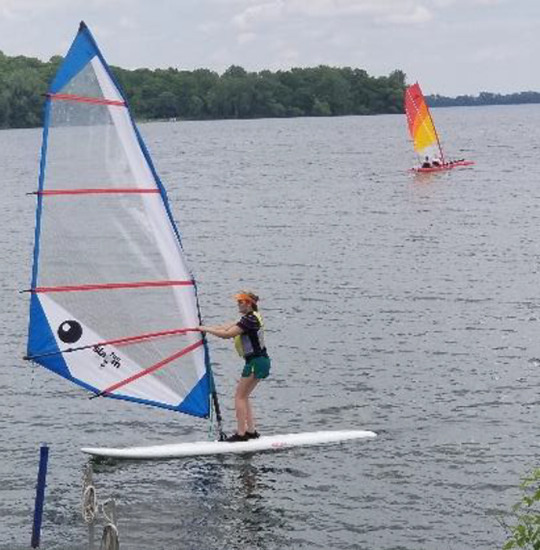
There was at least one moment in the memorial where I think I did you proud. Before I spoke I kicked up into a handstand and turned some handstand pirouettes. That got a pretty good rise out of the young gymnasts in the room. Here’s a picture of your daughter Tarah demonstrating much better windsurfing form than yours. So, as always, she’s also doing you proud.
It’s funny what our brains keep stored deep underground to be at the ready when we’re mining for meaningful moments. When I read the preamble to Max Porter’s “Grief is the Thing with Feathers,” 2 I remembered how as a teenager you sometimes recited the passage from Heinlein’s book where the main character, Mike Smith, said, “We will wait until waiting is filled.” Where Bonanno’s book suggests that awaiting predictable stages of grief to unfold won’t be productive, Porter’s book points more distinctively at the value and inevitability of waiting. “Feathers” is described by one reviewer as “part novella, part polyphonic fable, part essay on grief” and, coincidentally, the “sentimental bird” that comes to the aid of a grieving family has many similarities to Heinlein’s Smith. They both “grok” the nature of grief, as I’m sure would you. If only you were here to help us to better “be with it” and “drink of it.”
The moment that was created in your honor was woven together through individual stories, but more than that it was a moment illuminating how you had become a part of everyone there and how everyone there had become a part of each other.
During the month after you died, Gail and I bicycled around Lake Superior and we called the ride our “Tour de Pete” as a reminder to practice mindfulness. We’d come upon a stunning vista and, in your honor, we’d ask, “What would Pete do?” It is the perfect question for sojourners because the answers invariably related to spontaneity, risk taking, creativity, and being fully immersed. And as much as you were an exemplar for making moments memorable, I’ve been thinking more about how the moments you made with others were “just moments” in service to your community, moments that made others experience their community or health system or gymnastics gym as a more just place. Indeed, the many who spoke at your memorials made me mindful of a conceptual model and literature review this journal recognized as a “Paper of the Year.” Titled: “Collective Well-being to Improve Population Health Outcomes,” the authors argued that well-being is a function of a group and that domains such as “connectedness” and “contribution” may have as much to do with well-being as does our usual focus on individual self-care practices. 3
I suppose it stands to reason that when your health-care colleagues came together, a community of professional caregivers that I would feel so profoundly supported by people who I just met. And it makes sense that when I was also communing with a team of passionate athletes that I would experience positivity, energy, and connection. Your memorials were an outpouring of moments, one after another. Funny moments, touching moments, weighty moments and, of course, scary moments when you were pushing so many of us out of our comfort zones. And as much as I appreciated the heartfelt individual gestures of support, it was your community, this wondrous collective that was able to bring such a sustained and warm embrace to Harriet and Tarah and those of us visiting. The just moment that was created in your honor was woven together through individual stories, jokes, and reflections about you and the difference you made in the lives of each who spoke. But more than that it became a moment illuminating how you had become a part of everyone there and how everyone there had become a part of each other.
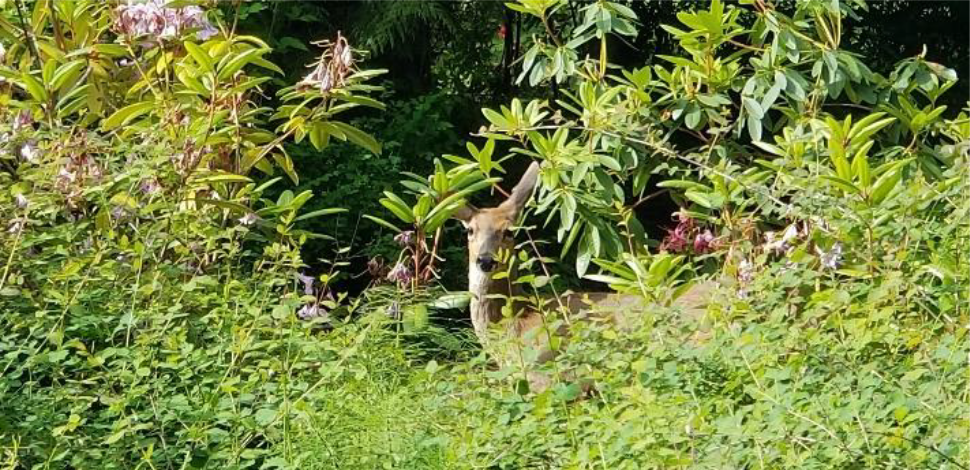
Early in the morning after your memorial in Port Angeles, I walked over to your house and as I turned into the driveway I was met by an exquisite young deer. My immediate thought was that you sent a spirit animal to offer a sunrise greeting from you. Pantheism was as close as you got to spiritual matters so I played along and said: “Okay smart guy, if you’re really Pete’s spirit animal, go pose for me in front of those Rhododendrons, Pete’s favorite plant.” And with that, the deer sauntered over and paused long enough for me to get a nicely framed picture.
I’ve been thinking about you a lot lately Pete. In the end, our times together were just moments. And I do mean “just moments” as a double entendre. Just moments are the kind of moments that I’ll be striving to become better at having and sharing. I know we had countless moments, one after another, where we were just there being present with each other. And that’s great. What’s more, among those moments, there were times when the moments did justice to our communities or our planet or our love for each other. And that’s greater still.