




Abstract
Background
Human well-being is under attack in the United States, as evidenced, in large part, by the all-time high incidence of chronic disease and mental illness. Chronic stress is a significant contributor to both. Since human well-being is an antecedent to human performance, which in turn can circularly increase well-being,
1
-3
chronic stress also has a negative impact on human performance of all types, including professional or workplace performance, and it cannot be siloed in employees’ personal or professional lives. Stress in one part of life affects the other parts. Employers are concerned about the state of employees’ well-being, and the related effect on their professional or workplace performance. For example, the negative impacts of chronic stress include the following:
4
It impacts approximately 83% of American employees. It accounts for approximately US$300 billion in lost annual productivity. It increases worker health-care costs by 46%. It accounts for 20% of direct costs associated with high job turnover, strikes, work stoppages, and absenteeism. It affects high blood pressure, which prompts more doctor visits than any other condition. It contributes to depression, which increases health-care costs more than obesity, smoking, and high blood pressure combined. It accounts for 55% of absences associated with family-related issues.
The culminating state of chronic stress is known as burnout, and it has reached crisis proportions in the United States. Burnout is “physical, emotional, and mental exhaustion caused by long-term involvement in emotionally-demanding situations.” 5 Burnout is now officially recognized by the World Health Organization as an “organizational phenomenon” and is defined in the International Classification of Diseases, 11th edition as “a syndrome conceptualized as resulting from chronic, workplace stress that has not been successfully managed.” 6
The magnitude of the burnout crisis is far reaching. Seemingly, no person is exempt. Far too many people are experiencing chronic stress and burnout (see Figure 1). 7 -11 Further, 46% of human resource leaders say employee burnout is responsible for up to half of their annual workforce turnover. 12 To make matters worse, 20% of even highly engaged employees face burnout. 13

Percentage of people in various US groups who experience chronic stress and burnout.
Although these statistics may be daunting, addressing them does not need to be. In fact, solutions to chronic stress and burnout, as well as general human well-being can be surprisingly accessible, and they are not traditionally biomedical. Rather, they include every day, self-care and lifestyle habits, and behavioral-health practices, 14 -16 especially those oriented toward solutions, as opposed to oriented away from problems. This is a seemingly subtle distinction of perspective, yet it can make a significant difference in process and outcome. Where we once believed we needed to be healthy in order to be happy, the opposite has been shown to be true. We actually need to be happy in order to be healthy. Among a wide range of benefits, happiness also propels personal and organizational performance. 17
Leaders cannot make anyone happy, yet they can champion human well-being by providing and supporting evidence-based, every day, self-care and lifestyle habits, and behavioral-health practices. In fact, employers are increasingly making these kind of human well-being offerings available to employees in an effort to effectively mitigate rising health-care costs associated with employees’ poor well-being, decrease the cost of doing business, and improve employees’ professional or workplace performance. Employers can accelerate and even increase the effectiveness of said mitigations, decreases, and improvements by orienting their offerings toward what they want—happy, productive employees—as opposed to what they do not want—chronically stressed, burned out employees. The former can resolve the latter. 18 For 9 months in 2018 to 2019, a collaboration took place between two, human well-being services organizations, Experience Happiness, LLC (EH), and R3 Continuum, LLC (R3c), to do just that.
The collaboration between EH and R3c was primarily based on their shared vision of helping all people thrive, championing professional or workplace well-being, and making human well-being offerings available to the clients they serve. Secondarily, and given EH’s beneficial results with previous clients, R3c wanted to explore the potential of adding a particular, happiness-oriented, EH offering to its own client suite of offerings.
The intent of this case report is to share (1) a happiness-oriented practice for human well-being and performance, (2) a case report experience for adult employees in a professional organization who themselves provide human well-being offerings in the workplace, and (3) the impact of the experience on the larger organization.
Experience Happiness
Based in Minneapolis, Minnesota, EH is a human well-being services company founded in 2008 to heal people through happiness, as opposed to through stress management. After more than 10 years of research coupled with extensive work with individuals, groups, and organizations in a variety of US and international industries (ie, health care, behavioral-health, education, hospitality, corrections, and technology), EH developed The Happiness Practice (THP), its signature offering. The Happiness Practice™ is an evidence-based, scalable, measurable, and sustainable behavioral-health practice, which has demonstrated the ability to increase comprehensive human well-being (eg, physical-health, emotional-health, and behavioral-health) while simultaneously increasing happiness, as well as its by-products of innovation, resilience, and sustainability, and improving human performance. A network of Certified THP Sherpas™, who live this lifelong practice, facilitates the delivery of THP. As demand for THP increases and recipients continue to vary, EH responds with innovative delivery methods, such as 1:1 coaching, in-person, and/or online facilitator-led sessions, and self-paced. EH also offers THP Sherpa training.
R3 Continuum
R3c is an innovative, human well-being, workplace services company based in Minneapolis, Minnesota, with additional offices in Grand Rapids, Michigan. Founded in 1988, R3c provides a spectrum of services organized around the idea that people have a right to lead productive, meaningful lives, and that work effects behavioral-health and vice versa. These services include disruptive event management, crisis preparedness, planning, response, claims evaluation, and return-to-work planning.
The R3c’s team of psychologists, social workers, and behavioral-health specialists, along with its external network of over 4500 providers, are the people who immediately go wherever and whenever to respond to the occurrence of disruptive and traumatic events. R3c responds to approximately 18 000 incidents annually. From 2017 to mid-2019, R3c impacted over 410 000 lives and prevented over 280 acts of violence in the workplace.
Based on the above, and in response to the increase in the number of suicides and violent acts across all segments of society, which R3c internally tracks, R3c propels itself, as a provider of human well-being services, to continually innovate and expand its client service offerings. The nature of R3c’s work is emotionally demanding, and its employees are not exempt from feeling the effects of this caring work. Therefore, R3c has an in-house, well-being committee, and it provides its employees with the same well-being service offerings that it provides its clients. Thus, R3c’s interest in THP.
The Happiness Practice
The definition of happiness, as defined by EH (see Figure 2), was inspired by the inborn purity and innocence of children, and by the desire to take the mystery out of cultivating this emotional state of happiness as people grow and age.

Experience Happiness, LLC's definition of happiness.
THP is comprised of the 5-Principles of Happiness (5PH) and EH’s proprietary Return-On-Happiness (ROH) measurement system. THP participants learn and practice the 5PH over the course of a 6-month journey (see Figure 3). Each of the 5PH are learned separately over a 30-day period, which honors the time it can take for neuroplasticity to occur in the brain. Just as existing habits were learned over time, new habits are also learned over time with consistent, frequent practice. The typical time it takes for a habit to hold is 66 days, but it can vary between 18 and 254 days. 19 Participants tap into what they already know is inside them, and they unlearn or overcome what is holding them back from the happiness with which each was born and which they each deserve to reclaim in their lives.

5-Principles of Happiness™ (5PH).
The 5PH are simple, but not simplistic. Although learned separately, they work together as a system to cultivate a new way of being rather than being one more thing to do. Each of the 5PH builds upon each other over the 6-month journey.
Early in the THP journey, participants self-assess how they feel (physically and emotionally) and behave when they are in opposition to serenity and excitement, which are the components that comprise the emotional state of happiness, as defined above. Participants then compare their self-assessments to established signs and symptoms of burnout. 20 The resulting awareness that burnout is the opposite of happiness is often significant and catalyzes the inspiration and motivation for participants to fully engage in THP. Furthermore, participants typically experience hope that there is something lasting that they can do for themselves to feel better. Upon learning about the 5PH, Dr George L. Vergolias, PsyD, who is a specialist in clinical psychology and is R3c’s medical director, remarked, “I can identify the specific area of the brain affected by each of the 5PH.” This reinforces the premise that the ingredients of happiness are already inside each of us. The Happiness Practice helps to draw out innate happiness. One distinguishing aspect of THP is that it is a lifelong, personal practice. It is not an externally applied program. It is personal and internal, and it viscerally resonates with the authentic core of one’s natural state of being.
In each month of the 6-month journey, participants engage in two 45-minute gatherings, known as Learning Sessions (LS) and Happiness Huddles (HH). An LS begins each given month and serves as a gathering in which participants learn about a single principle and how to practice it. Later in that month, an HH takes place and serves as a gathering in which participants share their experiences to date as students and emerging teachers of the practice. The HHs can be supportive and affirming for participants, as well as a source of group bonding, which has added benefits within an organization. As participants practice each of the 5PH, they have access to a variety of materials, tools, and reminders, including hardcopy or digitized booklets, visual wearable aids, and automated social media prompts.
At the end of the 6-month journey, participants begin a maintenance phase. As an ever-evolving, lifelong practice with enduring benefits, all THP participants continue to receive weekly practice reflection communications for 1 to 2 years or more, and they are encouraged to continue to engage in THP on their own. To keep the practice front and center, participants are further encouraged to use THP in their work and home lives, in particular. Participants can also engage with other THP practitioners in ongoing, periodic, telephonic, and/or electronic gatherings to keep the practice active with a supportive community.
THP is applicable to anyone and anywhere—from individuals and family units, to organizations of all types and sizes. No matter one’s age, THP is designed to optimize one’s personal, life experience, and then emanate that optimization out to enhance the groups, organizations, and communities with which one is associated. In a business setting, for example, the optimized personal life experience of an employee or employee population can emanate out to build engaged, high-performance well-being cultures, which are empowered to attract, retain, and optimize talent, as well as address key performance indicators (KPIs), such as turnover, engagement, and productivity.
R3c’s THP Experience
The R3c’s THP experience took place from October 2018 to June 2019. R3c chose an online, facilitator-led, group session delivery option. Two THP Sherpas led the THP experience. Sixty-six of R3c’s 84 employees (∼80%) in staggered cohort groups across all areas of R3c’s organization, including senior leaders, middle managers, and frontline employees (Participants), voluntarily engaged in the experience. The experience began with R3c’s senior leaders, who embraced, endorsed, and modeled THP, which built trust, belief, appreciation, and loyalty in the balance of employees.
The LSs were recorded so Participants could stay in sync with their cohort group if they missed an LS. According to participant feedback, this delivery option worked well for most. Feedback also suggested that a mix of facilitator-led, in-person group sessions, as well as self-paced sessions would have been welcomed. To encourage more Participants to share their experiences in the HHs, it was determined that such sessions would not be recorded. Some cohort groups might have benefited by including participants who represented different departments in order to help participants get to know other employees in different parts of the R3c organization. It was also suggested that cohorts comprised of Participants at the same level, such as middle managers, could use the 5PH’s to collaborate on specific situations.
Return-On-Happiness
THP has demonstrated the ability to measurably optimize human well-being and performance, as well as workplace performance and business results. Among others, THP measurably impacts 3 critical aspects of human well-being: physical-health, emotional-health, and behavioral-health. Simultaneously, THP impacts 3 critical aspects of human performance: innovation, resilience, and sustainability. This unique combination can collectively impact the larger organization, including KPIs and overall business results.
Using open-ended questions to obtain short answer and 1 to 5 scaled responses in its proprietary self-assessment survey process, THP anonymously measures the Participant experience at multiple levels. In a business setting, for example, the levels include individual, team/departmental, and organizational. Prior to participants learning and practicing the 5PH in such an example setting, pertinent representatives from EH and its THP client meet to determine the client’s KPIs to track and to cocreate tailored, self-assessment survey content. In the case of R3c, EH’s founders met with R3c’s president and R3c’s vice president of human resources and marketing.
On an individual level, burnout, happiness, innovation, resiliency, and sustainability were the KPIs that Participants self-reported through EH’s self-assessment survey process. On an organizational level, the KPIs that mattered most to R3c related to the impact of THP (ie, a Participant’s reduced burnout and increased happiness) on one’s ability to meet deadlines tied to client service agreements, which directly impact revenue and client retention, employee engagement, which directly ties to one’s commitment to R3c’s mission and culture, and the ability to fill shifts, which directly impacts the speed of delivery and profit margin.
All data were reviewed, analyzed, and collaboratively interpreted between the same pertinent representatives from EH and R3c in order to maintain continuity, to understand the relationship between the various data points and their impact to R3c’s business and culture, and to consider variables, if any, that might have occurred during R3c’s THP experience and that might have influenced the outcomes.
Individual Outcomes
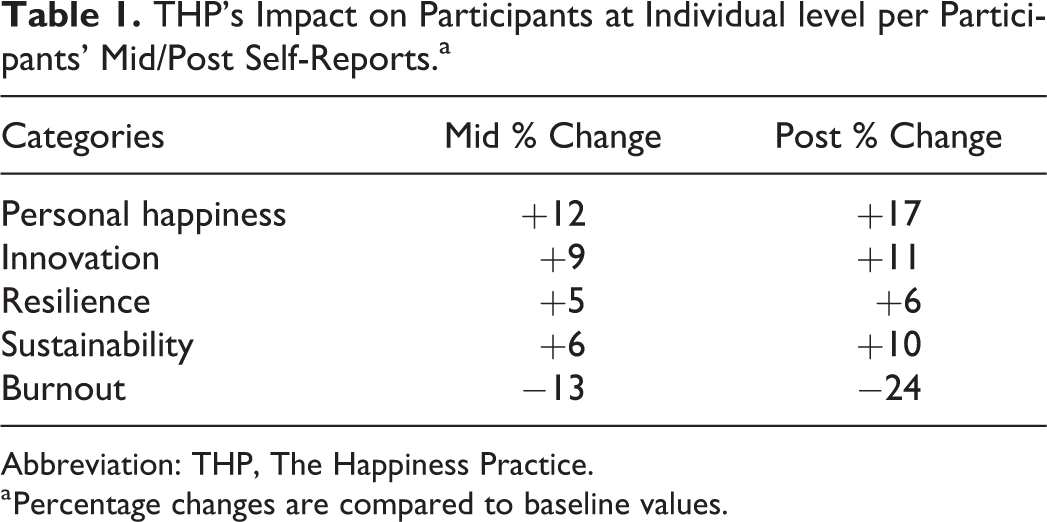
On an individual level, data from the Participants’ self-reports showed a beneficial impact on all KPIs (see Table 1).
THP’s Impact on Participants at Individual level per Participants’ Mid/Post Self-Reports.a
Abbreviation: THP, The Happiness Practice.
a Percentage changes are compared to baseline values.
Participants described THP as a straightforward, applicable, holistic practice that helped them in all aspects of life, and provided a different perspective for relating to other people, especially at work and home. The emotional intelligence aspect was transformative for Participants. It taught them to accept that people are imperfect, that they are meant to make mistakes, that mistakes are how they learn and grow, and that they can, therefore, be kinder, more empathetic, and more compassionate to self and others. These characteristics were noted as strengths, not weaknesses. Participants reported that learning to be conscious, aware, and present allowed them to enjoy everyday life, and provided space to patiently and thoughtfully respond, not just react, to other people and events around them. Participants shared that their self-talk and interpersonal communication became much more positive, productive, and forgiving. Learning to let go of things beyond their control and to back off of perfectionistic tendencies created a sense of healthy control and greatly reduced participants’ stress, tension, and anxiety, as well as created a greater sense of calm and peace. Participants shared that working with others became easier, more enjoyable, more encouraging, and more productive. Mostly, participants stated that THP rose to the top of R3c’s employee well-being offerings. The Participants found it personal, internal, and core to who they truly are, as opposed to impersonal and externally applied. THP opened participants up to identify their barriers and to work to overcome them so that they could be the best version of who they want to be. In the words of one Participant,
THP is empowering. We have control of our well-being. Happiness is a decision, a choice we get to make that impacts a lot of things—our performance, how we impact our family, being at work and on the road. Things happen around us, and we get to decide how we respond to them, and whether or not we are going to let them steal our joy.
Organizational Outcomes
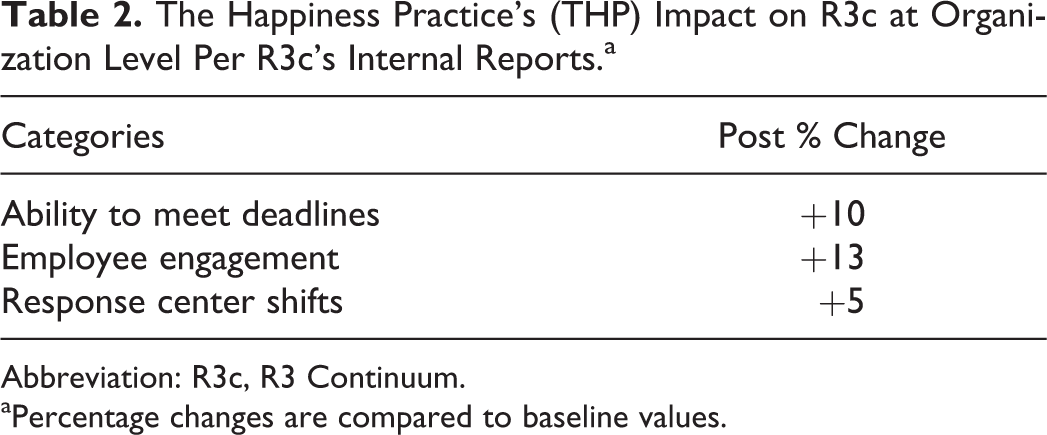
On an organizational level, data from R3c’s internal reports showed a beneficial impact on the KPIs that mattered most (see Table 2).
The Happiness Practice’s (THP) Impact on R3c at Organization Level Per R3c’s Internal Reports.a
Abbreviation: R3c, R3 Continuum.
aPercentage changes are compared to baseline values.
The pertinent R3c representatives interpreted and described the THP outcomes as follows:
Participants handled more business with less internal expense. Business volume and quality of delivery increased simultaneously. Revenue and net income were better than plan (3.5% and 21×, respectively), and internal operation costs were below plan (5%) for the 1 to 5 months of the year.
2% increase in Client-On-Time Rate while average turn-around times shortened an average of 5 days. 5% increase in Response Center Shifts translate to higher quality of service when shifts were filled quickly with known resources.
The 13% increase in engagement was substantiated by the 86% score of the recently administered Best-of-the Best survey of which the national average was 40% to 50%. Engagement was a direct reflection of Participant’s levels of reduced stress, increased happiness, and their commitment to R3c’s mission.
Positive impact on participants’ individual behavior and their response to stressors Collaboration among peers increased Participants appreciated that the organization valued them enough to offer THP.
THP has a direct impact on individuals’ behavior and their response to perceived stressors. The ROH results show that business volume and quality of delivery are both higher, and the culture has never been better. People are happier. This is a well-being offering that a CFO will love! (R3c president)
THP is more than just about happiness. It is a holistic practice that facilitates well-being in your personal life. It impacts everything you do, and it gives you a different perspective in relating to everyone in your life. (R3c Vice President of Human Resources and Marketing)
Summary
The outcomes of R3c's THP experience appeared to validate the general value of THP for human well-being and performance, particularly for employees in a professional organization, as well as for the larger organization itself. These outcomes also appeared to demonstrate the specific value of THP for employees who themselves provide human well-being offerings in the workplace. Lastly, these outcomes appeared to reveal a positive return on investment for the larger organization.
Going forward, R3c decided to include THP in its suite of client offerings. Doing so will continue to balance its service offerings as both preparatory and responsive. Additionally, R3c wants to maintain and even surpass the beneficial impact of its initial THP experience. As such, R3c’s employees continue to practice THP for their own benefit, as well as for that of the larger organization, which is also in keeping with R3c’s commitment to provide its employees with the same well-being service offerings that it provides its clients.
Everyone wants happiness in their lives. Given the state of well-being in the United States, it would appear that the majority of people need happiness in their lives. Happiness is a both/and proposition. It propels both human well-being and performance. As shown in this case report, happiness, and THP in particular, measurably propels human well-being and performance, as well as workplace performance and business results.
While the world continues to spin and challenges arise outside ourselves, it is important to remember that we are well equipped inside ourselves to meet and exceed those challenges. THP is about tapping into our innate capabilities and reclaiming our authentic state of happiness. The alternative is unsustainable.