



Abstract
Purpose:
To describe items purchased during a shopping trip by families enrolled in the Special Supplemental Nutrition Program for Women, Infants and Children (WIC).
Design:
Cross-sectional, quantitative, observational study.
Setting:
Grocery stores in the Newark, Delaware area.
Participants:
A convenience sample of mothers (n = 35) were recruited from a local WIC Clinic waiting room.
Measures:
The number of items categorized into 12 food groups, (baby food, beverages, dairy, fats/oils, fruit, vegetables, grains, protein, preprepared, seasonings, sweets, and other) extracted from grocery receipts.
Analysis:
Means and frequencies were used to analyze continuous and categorical data, respectively, for receipt data and demographics.
Results:
The most common foods purchased not included as part of the WIC food package included protein (1.0 [standard deviation, SD 3.0]), preprepared foods (0.9 [SD 2.0]), and other foods (1.0 [SD 1.9]). The most frequent foods purchased included as part of the WIC food package included fruit (2.3 [SD 1.5]), grains (1.7 [SD 1.6]), and dairy (1.5 [SD 0.8]).
Conclusions:
Further investigation of foods purchased that were not part of the WIC food package is warranted, as understanding food purchases particularly among low-income mothers may inform nutrition education practices.
Purpose
The Special Supplemental Nutrition Program for Women, Infants, and Children (WIC) was established to improve and preserve the health of low-income families 1 by providing supplemental food packages, nutrition education, breast-feeding promotion and support, immunization screening, and referrals to other health and social services to women and their young children. The food packages provide specific WIC-eligible foods that are purchased using an eWIC card, similar to a debit card, at the grocery store. The specific food packages provided to families depend upon pregnancy or lactation status of mothers, child/infant age, and presence of a nutrition risk, which is defined based upon a medical-based or dietary-based condition. Food packages provide a dollar amount for fresh fruits and vegetables (referred to as a cash value benefit) and specific quantities of legumes, milk, cheese, yogurt, whole wheat bread or tortillas, peanut butter, tofu, soy-based beverages, juice, eggs, canned fish, cereal, baby food, and/or baby formula.
It is unknown what types of foods WIC participants purchase that are not included in the WIC food package but are purchased in conjunction with the utilization of WIC benefits. The purpose of this study was to describe the WIC-eligible and non-WIC-eligible foods purchased during a shopping trip.
Methods
Design
This was a cross-sectional, quantitative, observational study in which receipts were collected from participants during 1 grocery shopping trip as part of a qualitative research study 2 examining the influences on parent decision-making while food shopping. Participants were asked to engage in a “typical” shopping trip. Receipts were collected at the end of the trip and analyzed for this study.
Sample
Thirty-five mothers who had a preschool-aged child enrolled in WIC were recruited from 1 WIC clinic waiting room in Newark, Delaware. This WIC clinic predominantly services residents in the Newark area and Newark is a small city of nearly 34 000 residents. Twenty-eight mothers were included in this study based upon submitting a grocery shopping receipt. The study was approved by the Institutional Review Board at the University of Delaware.
Measures
Demographic information was collected via a self-report questionnaire. Receipts were collected immediately following 1 grocery-shopping trip when WIC benefits were used for the purchase of all or some of the items purchased by the participant. The store was selected by the participant, and all stores were WIC-approved vendors given the shopping trip had to include the use of WIC benefits. Grocery shopping trips occurred between January 2017 and July 2017. Data recorded from each receipt included date, time, total number of items, and total cost. Each food item listed was coded as WIC-eligible or non-WIC eligible based upon WIC food package eligibility and categorized into 1 of 12 food/item groups (baby food, beverages, dairy, fats/oils, fruit, vegetables, grains, protein, preprepared foods, seasonings, sweets, and other). The WIC food package provides a specific dollar amount for fresh fruits and vegetables or a specific quantity of an item (eg, 1 loaf of bread); however, information as to how much of the item was in fact covered by the WIC benefits of each individual was indecipherable from receipts, and any item that would be included in the WIC food package was coded as a WIC-eligible food. For example, if a family purchased $12 USD of fresh fruit, even if all $12 USD were not covered by WIC benefits the fruit was still coded as WIC eligible.
Statistical Analysis
Data were analyzed using SPSS version 26.0 (IBM Corporation, Armonk NY) at a significance level of P < .05. Means and frequencies were used to analyze continuous and categorical data, respectively, for demographics and receipts. Receipt data were analyzed by subgroups (WIC eligible and non-WIC eligible).
Results
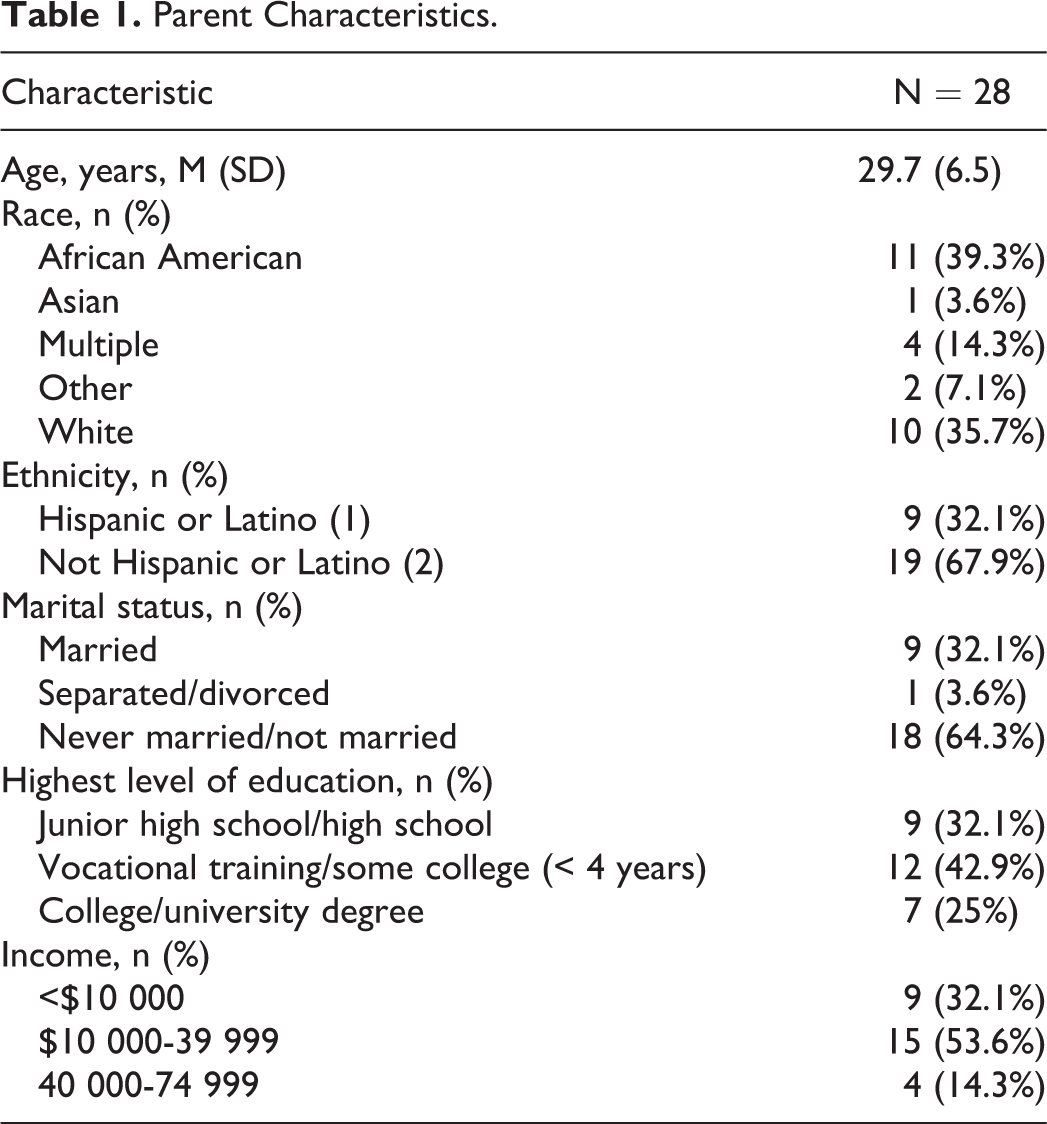
Twenty-eight mothers (29.7 [standard deviation, SD 6.5] years-old; 39.3% African American; 32.1% Hispanic/Latino) completed a shopping trip and turned in their shopping receipt. Full demographic data are provided in Table 1.
Parent Characteristics.
Among WIC-eligible items, the most frequently purchased items included fruit (2.3 [±1.5] items), dairy (1.5 [±0.8] items), and grains (1.7 [±1.6] items) categories. Among non-WIC-eligible items, the most frequently purchased items included protein (1.0 [±3.0] items), preprepared foods (0.9 [±2.0] items), and other food (1.0 [±1.9] items). The “preprepared” food category included items such as frozen foods (defined as foods found in the freezer section of the grocery store such as waffles, pizza, French fries) and ramen noodles, while the “other” food category included items such as dry mixes (ie, pancake mix), fruit snacks, and sauces. The median grocery bill was $38.21 (interquartile range $44.36), with the most frequent payment method (35.7%, n = 10) being a combination of eWIC and Supplemental Nutrition Assistance Program benefits.
Discussion
The most common WIC-eligible items purchased were fruits, grains, and dairy. As information collected from receipts has been shown to be moderately reflective of diet quality, 3,4 the lack of vegetable purchases may be reflective of lower vegetable intake by individuals in the home. Only 3 individuals purchased sugar-sweetened beverages, adding to recent the literature that has demonstrated the positive effects of the WIC food package on healthy beverage consumption. 1,5 One of the most common non-WIC-eligible foods purchased were protein foods such as canned beans (the WIC food package only permits dried beans) and meats. The WIC food package does not cover these items, and the associated qualitative study indicated mothers desired to have protein items included in the WIC food package. 2 While the WIC food package does offer canned fish which was a recommendation of the National Academies of Sciences, 6 in this study, no participants purchased it indicating a low uptake.
The frequency of purchasing non-WIC-eligible foods such as preprepared foods (ie, frozen foods and ramen noodles) and other foods (ie, dry mixes, fruit snacks, and sauces) substantiates the findings from the qualitative study which indicated that children often requested energy-dense, nutrient-poor foods, with child requests being the primary influence of parent purchases. 2
It is unknown whether individuals meal planned in preparation for the grocery shopping trip; however, in the qualitative study, 2 a rationale for purchases were based upon a preplanned recipe, meal or snack, and understanding use of planning or creation of a shopping list offers future research opportunities. Indeed, a need for nutrition education in the area of food purchasing has been identified for the WIC population. 6
While this study is one of few to characterize the foods purchased by WIC participants, there are several limitations. Information from the grocery receipt was limited (eg, item listed on receipt was less decipherable) to what was on the printed receipt. While several studies 3,4,7 -10 have collected and successfully implemented information extracted from grocery store receipts, the methodology or best practices are unclear. 7,8,10 Some studies have trained participants to annotate the receipt to clarify unidentifiable items 3,9 ; however, there is no standardized methodology for extracting data from receipts, and receipts in this study were not annotated. In the original study research personnel followed participants as they shopped and were aware of the need to turn in their receipt; thus, observational bias could have occurred causing participants to change their purchases. It was unknown how much of the food package was available to use at the grocery shopping trip, and this could have limited purchasing. Grocery shopping receipts were only collected from 1 shopping trip and while participants were requested to engage in a “typical” shopping trip, this cannot be certain. The sample size was small and from a convenience sample in Newark, Delaware, limiting the generalizability of the results.
So What?
What is already known on this topic?
The WIC food package encourages purchase of nutrient-dense foods among low-income families by providing supplemental food packages meant to support a diet that aligns with the Dietary Guidelines for Americans.
What does this article add?
Given the types of non-WIC-eligible foods purchased in this study, further investigation of non-WIC-eligible food purchases may be warranted. Understanding both WIC- and non-WIC-eligible food purchases may inform nutrition education practices around food purchasing. For example, none of the participants purchased fish indicating a need for education on preparation/use of this item, and frequent purchase of energy-dense, nutrient-poor items may demonstrate a lack of knowledge about planning meals in order to avoid the need to purchase quick and easy options such as preprepared foods.
What are the implications for health promotion practice or research?
Additional education and use of behavioral strategies such as making a grocery list or meal planning with WIC clients may further encourage purchase of nutrient-dense non-WIC-eligible foods and fewer energy-dense, nutrient-poor items such as preprepared foods.
Footnotes
Declaration of Conflicting Interests
The author(s) declared no potential conflicts of interest with respect to the research, authorship, and/or publication of this article.
Funding
The author(s) disclosed receipt of the following financial support for the research, authorship, and/or publication of this article: This work was partially supported by the Delaware Department of Health and Human Services, Division of Public Health.
