



Abstract
Purpose:
Flourishing and mental health in the prediction of health behaviors such as exercise has been understudied. Positive emotions may promote, and negative emotions hinder protective health behaviors; however, the direction of these associations is unclear. The objective here was to investigate possible associations prospectively.
Design:
Longitudinal cohort study.
Setting:
National
Sample:
The Biopsychosocial Religion and Health Study of Seventh-day Adventists provided longitudinal data from 2006 to 2007 and 2010 to 2011 (n = 5789).
Measures:
Flourishing was based on 6 measures of social functioning (positive social exchanges, negative social exchanges, religious emotional support given, received, and anticipated, and negative interactions) and 4 measures of psychological functioning (mastery, self-esteem, spiritual meaning, and perceived stress). The positivity ratio was the ratio of positive to negative emotions assessed with the Positive and Negative Affect Schedule.
Analysis:
Linear multiple regression and mediation.
Results:
Flourishing worked indirectly through the positivity ratio to predict a later increase in exercise over the course of 3 to 5 years. Tests of mediation suggest that the association of flourishing with later exercise was indirect through an increased ratio of positive to negative affect. Initial exercise frequency was also associated with later improved flourishing and positivity ratio scores over the same period.
Conclusion:
The association of mental health and exercise is likely bidirectional. Exercise improves mental health, and those that have better psychosocial functioning have better mood and are more likely to increase exercise behaviors over time. Exercise is likely integral to mental health in mid to late life.
Keywords
Purpose
A sedentary lifestyle predicts poor health outcomes including early morbidity and mortality rates worldwide. 1,2 More than 80% of US adults do not meet the physical activity recommendations of Centers for Disease Control and Prevention (weekly 150 minutes of moderate or 75 minutes of vigorous intensity activity) though the beneficial effects of physical activity are well established. 3,4 Morton et al 5 note that in Seventh-day Adventists, religious affiliation contributes to longevity likely by promoting healthy behaviors such as exercise and healthy diet. In particular, they found exercise had a direct effect on mortality and that exercise was associated with other mental health and diet pattern factors. Further, many studies have been published on Seventh-day Adventists healthy lifestyle that is rooted in religious doctrinal beliefs and that this lifestyle increases longevity. As a result of these studies, a robust public health literature has developed from the Adventist Health Studies based on 4 major US National Institutes of Health–funded studies and research across at least 10 other countries. 6 As such, Adventists are a good study population to examine mental health and exercise as they also have low rates of smoking and alcohol intake. This provides a naturally occurring experiment to examine lifestyle change over the life span.
Kelsey et al 7 suggest that positive emotion may predict improved physical activity. Positive mood may motivate exercise by increasing goal-directed behaviors. 8 Sirois and Hirsch 9 report cross-sectional and longitudinal evidence for a self-regulation resource model that predicts positive affect improves self-regulation to foster a “future-oriented mindset” leading to health-promoting behaviors.
Conversely, negative emotions are associated with low levels of exercise. Strine et al 10 report a dose–response relationship between physical activity and depression. Individuals who had a lifetime diagnosis of depression or anxiety were more likely to be sedentary, to smoke, overeat, drink more alcohol, and sleep less. 11 As such, these authors report negative emotionality is associated with chronic physical illness and poor physical health outcomes.
In sum, more positive and less negative affect is associated with moderate-to-vigorous physical activity at longer durations. However, higher negative affect is related to low-intensity physical activity and less time in moderate-to-vigorous physical activity. 12 There may be a bidirectional effect, with happier people being more active or active people being happier; however, the evidence is mixed, with some studies showing a relationship and others showing no relationship indicating a need for further study. 2
Positive and negative emotions likely also co-occur. 13 Thus, the positivity ratio (PR, the ratio of positive to negative affect) may be predictive of exercise. Higher PRs predict improved subjective well-being and affective quality of life. 14,15 However, Fredrickson and Losada claimed that a PR above a cut point of 2.9 was associated with optimal functioning called “flourishing,” though Brown et al 16 showed that the mathematics of this cut score were faulty. However, Fredrickson and Losada 15 later argued that there is still strong support for a higher PR being associated with flourishing and health behavior, though suggesting a possible curvilinear relationship.
Flourishing studies 17 -19 describe a mental health continuum from mental illness to mental health ranging from (1) languishing and depression, (2) depression, (3) languishing, (4) moderate mental health, and (5) flourishing as the optimal and highest level of mental health. Flourishing is composed of healthy psychological (self-acceptance, purpose in life, mastery, positive relations with others, personal growth, autonomy) and social (social coherence, social integration, social acceptance, social contribution, social actualization) functioning. Hone et al 20 note that researchers do agree that flourishing includes engagement, meaning, self-esteem, competence, and optimism. As such, PR is a ratio of positive to negative affect that reveals emotional regulation. Flourishing, however, is composed of both social and personal actualization that undergird overall mental health. It seems reasonable that the basic emotional regulation processes (PR) may underlie mental health (flourishing).
We do know that mental health is related to exercise behavior. However, what we do not know is how this relationship operates over time in mid to late life. We address this here by examining how PR and flourishing work together to promote exercise behavior concurrently or over time and whether the relationship is bidirectional (ie, whether exercise behavior also may work to promote mental health) in mid to late adulthood. Very little research to date examines the underlying components of mental health and their relationships to exercise over time and almost no research examines exercise behavior in older adults. We hypothesize that after controls: Flourishing will predict later exercise behavior and exercise behavior will also predict later flourishing. Emotional regulation functioning assessed as the PR will predict later exercise and exercise behavior will also predict later PR. Positivity ratio will mediate the flourishing and later exercise behavior relationship.
Methods
Design and Sample
The Adventist Health Study-2 (AHS-2) is a prospective study of approximately 96 000 Seventh-day Adventists from North America. 21 The Biopsychosocial Religion and Health Study 22 was a substudy of AHS-2 that randomly sampled 21 000 US AHS-2 participants to receive the BRHS questionnaire in 2006 to 2007; of these, 10 988 responded. Of these, 9540 who were still living were sent a similar questionnaire in 2010 to 2011 and 6450 responded. The second questionnaire had some new questions but was identical for all scales in the present study. Those who were not Seventh-day Adventists in this second wave (n = 7) and not white or black (n = 275) were excluded because they were outside the original AHS-2 sampling frame. Individuals who currently drank alcohol (n = 204) or who smoked (n = 16) were also excluded because they were atypical of Seventh-day Adventists and because these health behaviors may be confounded with the primary outcome of exercise. Seventh-day Adventists, a Protestant, Evangelical Christian denomination, promotes a healthy lifestyle as part of the doctrinal beliefs and almost half are vegetarian. Those missing more than 20% of the variables for multiple imputation were excluded (n = 218). This left 5789 participants for study analyses. See Table 1 for sample characteristics and the means of flourishing, the PR, and exercise. Although the questionnaires were all mailed out at similar time frames, participants were reminded several times to return the questionnaires and could have taken up to a year to do so. As such, if the participants returned the questionnaire early in time 1 and later in time 2, then the lag between their questionnaires could be up to 5 years, whereas if the participant was late in returning one questionnaire and earlier in responding to the second questionnaire, then the lag between their questionnaires could be only 3 years. As such, the time lag between questionnaires varies between 3 and 5 years.
Comparison of Flourishing Scales.

Measures
Flourishing
Keyes 19 and Fredrickson and Losada 15 use a variety of scales to assess social and psychological functioning in flourishing. In the present study, Keyes’ 2 constructs (social and psychological functioning) are conceptually matched with scales which are available in BRHS. In the next 2 sections, the measures used to assess these two constructs are described. However, following Fredrickson and Losada, emotional functioning is treated as a separate construct assessed as the PR. The scales, their Cronbach’s α in our sample, and the calculation of the PR are described below. The flourishing scales used in this study are outlined in Table 1.
Social functioning
Six measures of social functioning taken from 2 different scales were used to assess social coherence, integration, and acceptance.
Positive and Negative Social Exchanges
The Positive and Negative Social Exchanges 23 assesses 2 broad domains of social exchanges—positive (α = .87) and negative (α = .86)—each assessed with 8 items regarding how often these events occurred over the last month. Responses were from never to very often on a 5-point scale. The scale read as “This set of questions consists of a number of words and phrases that describe different feelings and emotions. Mark a bubble to show to what extent you have felt this way during the past year.” Both positive and negative words that describe a feeling were presented to rate (eg, inspired, excited, determined, scared, nervous, distressed).
Religious Support Scale
Four, 3-item subscales of emotional support received, emotional support given, anticipated support, and negative interactions were used to assess social integration within a congregation on a 5-point scale (never to always; α = .78, .82, .91 and .74, respectively). 24
Religious social support was chosen because it is highly relevant in this sample of Seventh-day Adventists. On average, the participants in our sample attend worship services weekly or more than weekly indicating a major source of social interaction. Sample question in scale is “If you had a problem or were faced with a difficult situation, how much comfort would the people in your congregation be willing to give you?”
Psychological functioning
Psychological functioning was measured with 4 scales.
Mastery
The mastery scale measures the degree of which individuals believe they can influence their environment and cause a desired outcome to occur. 25 Respondents rated 4 items on a 7-point scale (not true to true; α = .73). Sample question is “I have little control over the things that happen to me.”
Rosenberg Self-Esteem Scale
This 4-item short form is a measure of self-worth and acceptance 26 rated on a 7-point scale (not true to very true; α = .77). Sample question is “I take a positive attitude toward myself.”
Spiritual Meaning Scale
Mascaro et al 27 developed the 14-item Spiritual Meaning Scale to assess purpose in life; the 5 items with the highest factor loadings were included in the BRHS questionnaire (α = .71) and rated on a 3-point scale (not true, to very true). Sample question is “I see a special purpose for myself in this world.”
Perceived Stress Scale
The 4-item Perceived Stress Scale of Cohen et al 28 assessed the degree that situations in one’s life are perceived as stressful with ratings on a 5-point scale (never to very often; α = .77). Sample question is “In the last 4 weeks, how often have you felt difficulties were piling up so high that you could not overcome them?”
Calculation of the flourishing score
The 6 measures of social functioning and 4 measures of psychological functioning were factor analyzed to create flourishing scores. The factor structure of the flourishing scales was first examined based on minimum rank factor analysis followed by parallel analysis. 29 The parallel analysis suggested that it was reasonable to consider a single factor for the data. Latent trait factor scores were created using expected a posteriori estimators with hot deck multiple imputation for missing data. 30
Positivity ratio/emotional functioning
Similar to the study by Fredrickson and Losada, 15 emotional functioning was assessed with the concept of the PR separately from flourishing.
Measures of emotions
Positive and negative emotions were measured with the 10-item short form of the Positive and Negative Affect Schedule 31 using 5 positive emotion items—inspired, alert, excited, enthusiastic, and determined—and 5 negative emotions items—afraid, upset, nervous, scared, and distressed. Each adjective was rated as to “what extent you have felt this way during the past year.” Alphas in the BRHS sample were .85 for positive affect and .87 for negative affect. Positive and negative affect were calculated as the mean of the individual responses to all 5 items on each affect scale rated as very slightly or not at all (1), a little (2), moderately (3), quite a bit (4), or extremely (5). Thus, a maximum score of 5 and minimum score of 1 was possible for positive and negative affect.
Calculation of the PR
The PR was calculated as the ratio between the positive affect score and the negative affect score. This method differed from Fredrickson and Losada who took a count of the number of times over each of 28 days the participant reported experiencing a positive emotion and then divided that by the number of times they reported experiencing a negative emotion. Since we did not have multiple days of measure, we had to take a different approach. Our approach is similar to Shira et al 32 who used the Affect Balance Scale and divided the mean reported frequency of positive affect in the last week by the mean frequency of negative affect to obtain a PR.
Exercise
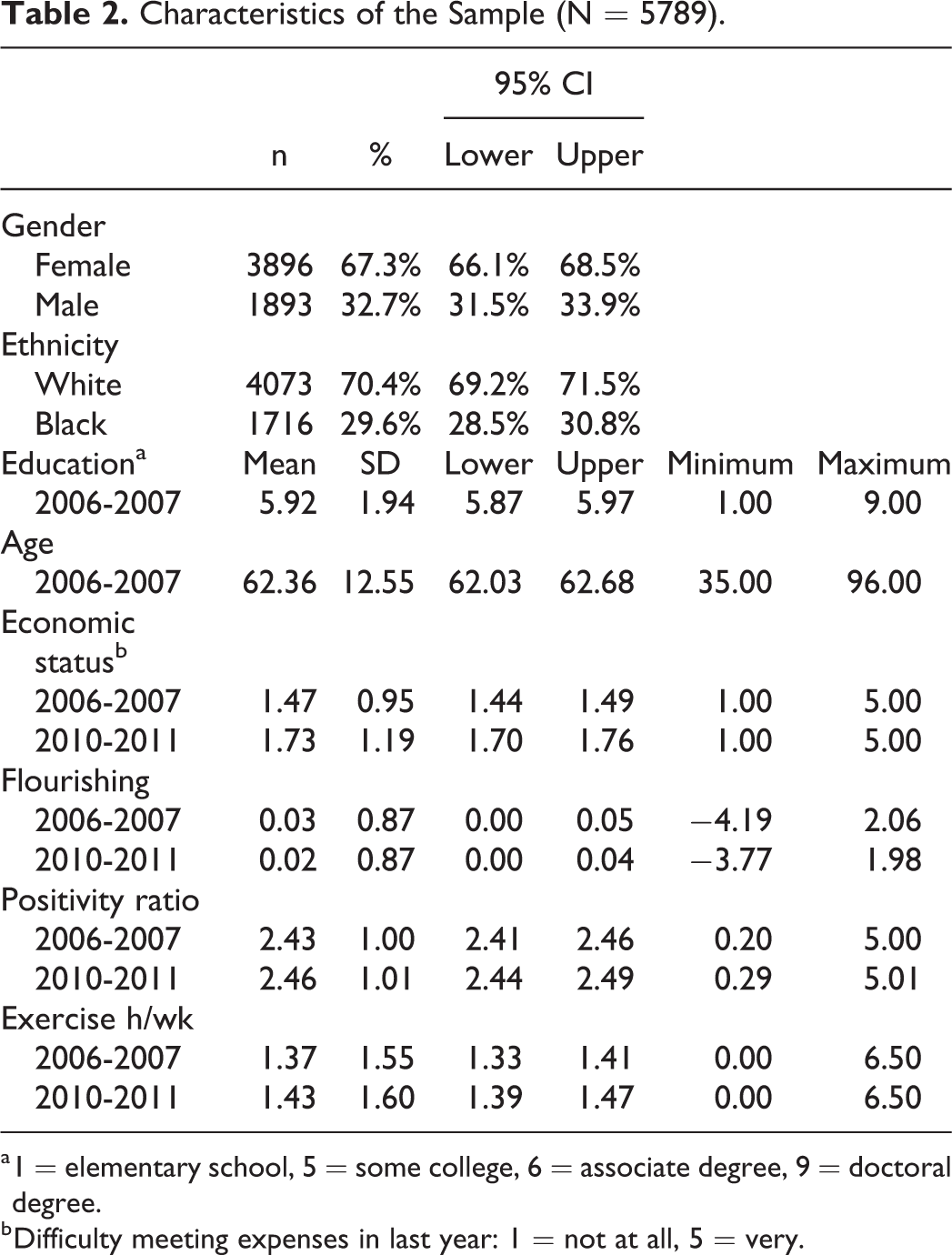
The exercise questions have been validated in Seventh-day Adventist and non-Seventh-day Adventist participants. 33 Exercise was assessed as days per week and amount of time each day exercised vigorously—that is, brisk walking, jogging, bicycling, and so on. Minutes of exercise per session were weighted as: none = 0 minutes; ≤10 minutes = 5; 11 to 20 minutes = 15; 21 to 30 minutes = 25; 31 to 40 minutes = 35; 41 to 50 minutes = 45; 51 to 60 minutes = 55; ≥1 hour = 65. Frequency per week categories were weighted as: never engage in activities this vigorous = 0; less than once per week = .5; 1 time per week = 1; 2 times per week = 2; 3 times per week = 3; 4 times per week = 4; 5 times per week = 5; 6 or more times per week = 6.5. Items on the questionnaire were transformed into and analyzed as a single scale by multiplying the midpoint value of the weighted minutes per exercise session with the weighted frequency to obtain an estimate of minutes of vigorous exercise per week. Then these were transformed into hours of exercise per week by dividing by 60. See Table 2 for mean and 95% confidence limits for exercise.
Characteristics of the Sample (N = 5789).
a 1 = elementary school, 5 = some college, 6 = associate degree, 9 = doctoral degree.
b Difficulty meeting expenses in last year: 1 = not at all, 5 = very.
Control variables
Control variables included gender, age, education, economic status, and ethnicity (black or white; see Table 2). Economic status was assessed by the question, “How difficult was it for your family to meet expenses for basic needs like food, clothing, and housing, in the past year,” to which individuals responded on a 5-point rating scale (not at all to very). 25
Analysis
The SPSS 25 multiple imputation procedure was used to impute 5 data sets with no missing data. Following Schafer and Graham, 34 all available demographic and study variables were used as helper variables in this imputation allowing information from other data in the data set to provide information for variables that were correlated with them. As noted earlier, flourishing scores were created through factor analysis using the FACTOR program developed by Seva and Ferrando. 35
The SPSS generalized linear regression module with the robust covariance matrix was used to examine relationships among the variables. Age, economic status, ethnicity (black or white), gender, and education were used as control variables and flourishing, the PR, and hours per week of exercise as the substantive variables. The regression analysis suggested that the PR might mediate the relationship between flourishing and exercise. This mediation was tested using the PROCESS macro for SPSS. 36,37 Finally, interactions of flourishing, PR, and exercise with gender and ethnicity in predicting later levels of flourishing, PR, and exercise were tested in the generalized linear model. However, none of these interactions were significant and are not shown.
Humans
Informed consent was based on cover letters included in both the original AHS-2 questionnaires and the later BRHS questionnaires and consent assumed if the participant completed and returned the questionnaires. All procedures were approved by the institutional review board of Loma Linda University.
Results
Characteristics of the Sample
Table 1 shows selected characteristics for the sample. The sample is predominantly female, white, and well educated with 58.1% having an associate degree or higher. The population is also older with a median age of 62 years. The sample on average had no difficulty meeting expenses for basic needs. The mean for flourishing is necessarily close to 0 since the scale was formed from factor scores.
Prediction of 2010 to 2011 Exercise from 2006 to 2007 Flourishing and PR
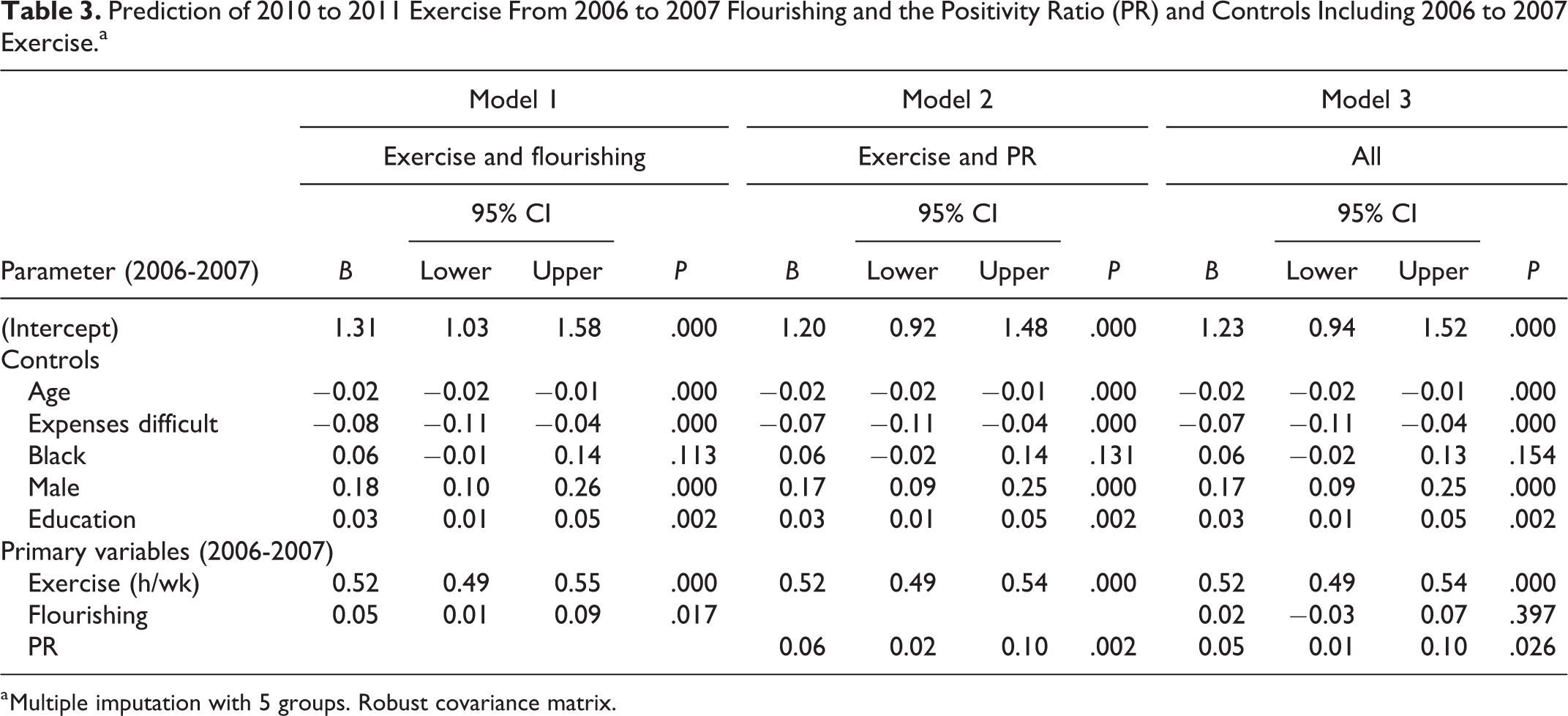
Table 3 shows 3 models predicting 2010 to 2011 exercise from other variables after controls (age, economic status, ethnicity, gender, education). All models control 2006 to 2007 exercise to predict later exercise; thus, flourishing and the PR are predicting the change in exercise between 2006 and 2007 and 2010 and 2011. Model 1 shows that 2006 to 2007 flourishing predicts a later increase in exercise. Model 2 shows that the PR predicts a later increase in exercise. However, model 3 shows that when flourishing and PR are entered simultaneously, only PR predicts a later increase in exercise indicating possible mediation. To test for possible curvilinear effects, a separate model included the square of the PR, but the squared term was not significant and these results are not shown.
Indirect Prediction of 2010 to 2011 Exercise From 2006 to 2007 Flourishing
Table 3 shows that while flourishing did predict a later increase in exercise, that prediction disappeared once PR was included and PR did predict increased exercise. This suggested the possibility that flourishing did have an impact in predicting later exercise but that it did so by influencing PR, that is, PR may mediate effects of flourishing on later exercise.
Prediction of 2010 to 2011 Exercise From 2006 to 2007 Flourishing and the Positivity Ratio (PR) and Controls Including 2006 to 2007 Exercise.a
a Multiple imputation with 5 groups. Robust covariance matrix.
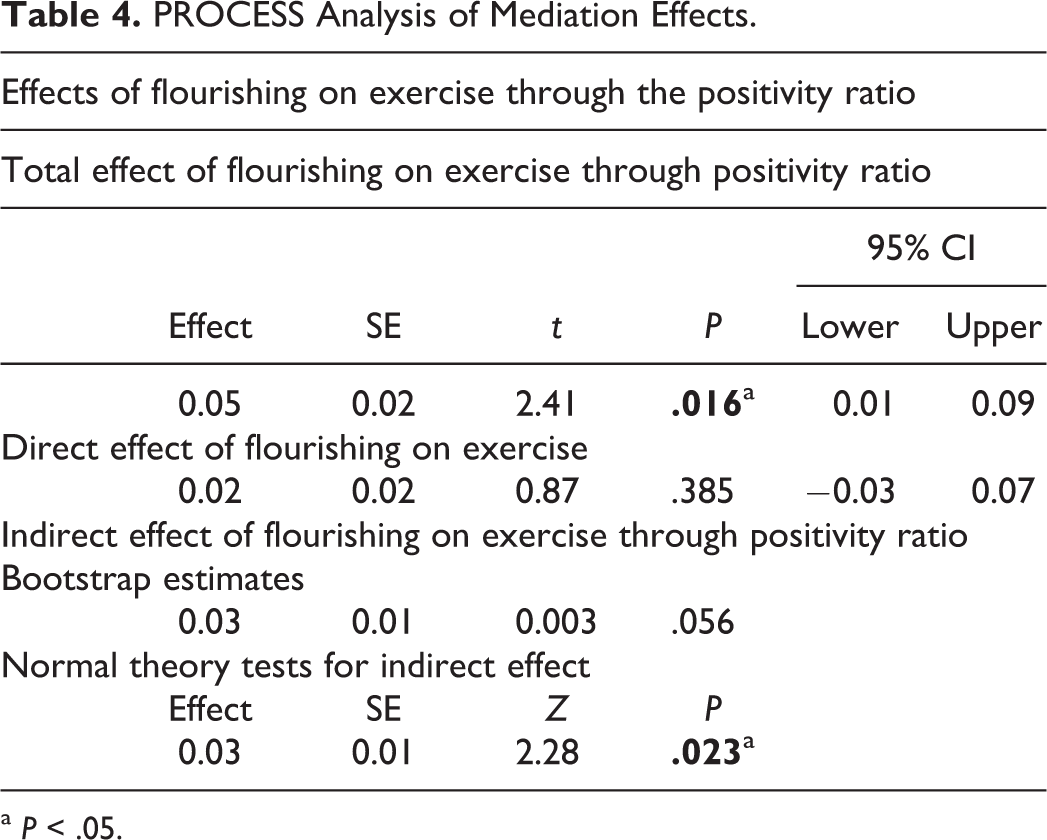
Table 4 shows the results of mediation tests using Hayes PROCESS macro for SPSS. 37 There was an effect of flourishing on exercise, but the effect was indirect. Flourishing predicted exercise 3 to 5 years later indirectly through PR. That is, flourishing predicted an increase in PR and, through that association, predicted later exercise.
PROCESS Analysis of Mediation Effects.
a P < .05.
Prediction of 2010 to 2011 Flourishing and PR From 2006 to 2007 Exercise
To examine bidirectional effects, Table 5 examines whether 2006 to 2007 exercise predicts a later increase in flourishing or PR. Exercise in 2006 to 2007 did predict a later improvement in both flourishing and PR.
Predicting 2010 to 2011 Flourishing and PR From 2006 to 2007 Flourishing, PR, and Exercise.

a P < .05.
Discussion
In this study, the aims were to first determine the relationship of flourishing with later exercise behavior and to examine potential bidirectional effects to also determine whether initial exercise behavior predicted later changes in PR and flourishing. There is little known about the effects of PR and flourishing on exercise in late life and whether exercise may also influence PR and flourishing over time. Overall, emotional functioning assessed as the PR and flourishing did independently predict increased exercise 3 to 5 years later in separate models. However, when both were entered into a model after demographic and baseline exercise controls, only PR predicted later exercise. After mediation effects were tested, it was clear that flourishing operates indirectly through PR to predict changes in exercise. Thus, PR as emotional functioning may be the mechanism by which flourishing (psychosocial functioning) influences increases or decreases in exercise behavior over time.
A likely reason for a direct PR relationship with increased exercise would be that positive affect leads to improved self-regulation 38 and may increase motivation to engage in exercise. 39 -41 Additionally, positive emotions are generally associated with health-promoting behaviors. 42 Further, increased physical activity levels lower negative affect, while increasing positive affect. 43 Our findings also find that the psychosocial/emotional factors predict exercise changes, while the exercise also predicts changes in psychosocial/emotional factors. This is a similar finding to several other studies linking exercise to mental health. 44 -46 The indirect effects of flourishing through PR on increased exercise 3 to 5 years later is a unique finding that adds to this literature by exploring the complex theoretical relationship of psychosocial and emotional functioning that motivates exercise behavior over time. Exercise behaviors in turn can provide positive feedback to facilitate psychosocial and emotional functioning. The key to promoting health behaviors may likely be rooted in facets of mental health, and ignoring these components may lead to less effective health promotion programs. Health promotion programs must address the strong connection between health behavior change and underlying facets of mental health including social, psychological, and emotional factors that may hinder health behavior change such as increased exercise. In addition, during health behavior change processes, the benefits of exercise should be detailed to potentially include changes in aspects of mental health. Although further study is needed, it may be that the mental health components are required to be addressed to make health behavior change such as exercise a true, lasting, lifestyle change.
Strengths
This longitudinal cohort study allowed the examination of how flourishing and PR are associated with exercise changes over time in a large cohort of healthy middle aged to older adults. The BRHS constructs we assessed were based on validated scales to provide reliable measurements of the variables examined here. In addition, the study of Adventists allows us to rule out other typical confounding variables such as smoking and alcohol consumption.
Limitations
The study is limited by the self-report nature of the data in which participants may have over- or underrepresented their mental health and/or exercise levels, though this is not likely to be a systematic bias by any demographic group as relationships remained after controlling for these variables. The study sample has limited generalizability as only blacks and whites who were Seventh-day Adventist were included. The abbreviated Physical Activity Questionnaire only assesses a limited definition of physical activity and may underestimate these effects. The sample included only Seventh-day Adventists, who generally subscribe to healthy lifestyles. Exercise levels were therefore higher than those of the general population. Lastly, similar to other longitudinal studies, there may be an attrition bias such that healthier adults remained in the study over time to decrease external validity.
New Information
Nevertheless, this study provides new information in several ways. First, flourishing and PR work together to predict later increased exercise in a sample of older adults. Previous research has only linked mental health or positive emotions to exercise, while this study indicates that several facets of mental health work together to promote physical activity increases in later life. Flourishing specifically works to increase the PR to ultimately increase later exercise behaviors over the course of 3 to 5 years. This finding is consistent with other work on flourishing that indicates it promotes positive affect to potentially influence. 15,47 The flourishing measure used may be specific to other samples with a religious orientation as religious support was included to assess psychosocial functioning. However, these facets of mental health may be similarly important in other populations and may add to the definition of flourishing by broadening the assessment of mental health 48 as religiosity has been shown to be associated with enhanced mental health and social integration within faith-based communities. 49,50 Finally, these data are longitudinal and allowed us to examine the bidirectional nature of the mental health and exercise relationship in mid to late life. Mental health does, in fact, influence exercise behavior over time and exercise does enhance mental health over time. The impact of this finding highlights the influence of mental health factors on the promotion of exercise and potentially reduce the risk of acquiring various chronic medical conditions, as well as lessening the effects of these conditions. Future research on PR, flourishing, and health behavior could focus on non-Seventh-day Adventist population to determine their generalizability. In addition, more research on PR and physical activity and health behaviors would be advantageous.
So What? (Implications for Health Promotion Practitioners and Researchers)
What is already known on this topic?
We know that mental health is related to exercise behavior. However, what we do not know is how this relationship operates over time and the bidirectional nature of this relationship.
What does this article add?
Flourishing and the positivity ratio (PR) work together to predict later increased exercise in mid to late life. Flourishing specifically works to increase the PR to ultimately increase later exercise behaviors over the course of 3 to 5 years.
What are the implications for health promotion practice or research?
The indirect effects of flourishing on increased exercise 3 to 5 years later through PR is a unique finding that adds to this literature by exploring the complex theoretical relationship of psychosocial functioning effects on emotional functioning that may motivate exercise behavior over time. Promoting physical activity in schools, communities, and workplaces may lead to a higher level of positivity and decreased levels of depression and anxiety. For example, having increased social events, mentor programs, team building, and improved monitoring of burnout in the workplace could improve flourishing and PR to lead to improved health behaviors like exercise. These outcomes could be communicated to leadership so that implementation of various psychosocial and physical activity programs can be emphasized as critical to optimizing the human experience.
Footnotes
Declaration of Conflicting Interests
The author(s) declared no potential conflicts of interest with respect to the research, authorship, and/or publication of this article.
Funding
The author(s) disclosed receipt of the following financial support for the research, authorship, and/or publication of this article: This research was supported by grants from the National Institute on Aging (Biopsychosocial Religion and Health Study, 1R01AG026348) and the National Cancer Institute (Adventist Health Study 2, 5R01 CA094594).
