




Abstract
The secret to longevity and healthier communities lies in a systems-level lifestyle-based approach. There are currently 5 regions across the world where people live relatively longer, healthier, and happier lives. Taking lessons from these areas, dubbed “blue zones,” we can help improve health and wellness at the population level. There are already cases of these Blue Zones Projects implemented in communities across the United States, which have had demonstrable, positive impacts on public health. Collaboration between the public and private sectors at the local level can make these changes to improve lifestyles and reduce the burden of chronic diseases on the healthcare system.
For over 20 years, my life’s work has been identifying the world’s healthiest, longest-lived populations around the world and then studying their secrets to longevity and happiness. I led expeditions, some funded by National Geographic, to these hotspots of longevity I called “blue zones” regions. The current blue zones regions are: the Barbagia region of Sardinia, Italy; Ikaria, Greece; Okinawa, Japan; the Nicoya Peninsula in Costa Rica; and Loma Linda, California.
People in these regions are living longer, but they are also living better. Besides having the world’s highest concentration of centenarians they enjoy some of the lowest rates of middle age mortality; the aging population also remains active into their 80 s and 90 s, with low rates of the chronic diseases that plague us in the United States. With a team of demographers and scientists and a grant from the National Institute on Aging, we then set out to reverse-engineer longevity, or establish why these populations live the healthiest and longest lives in the world.
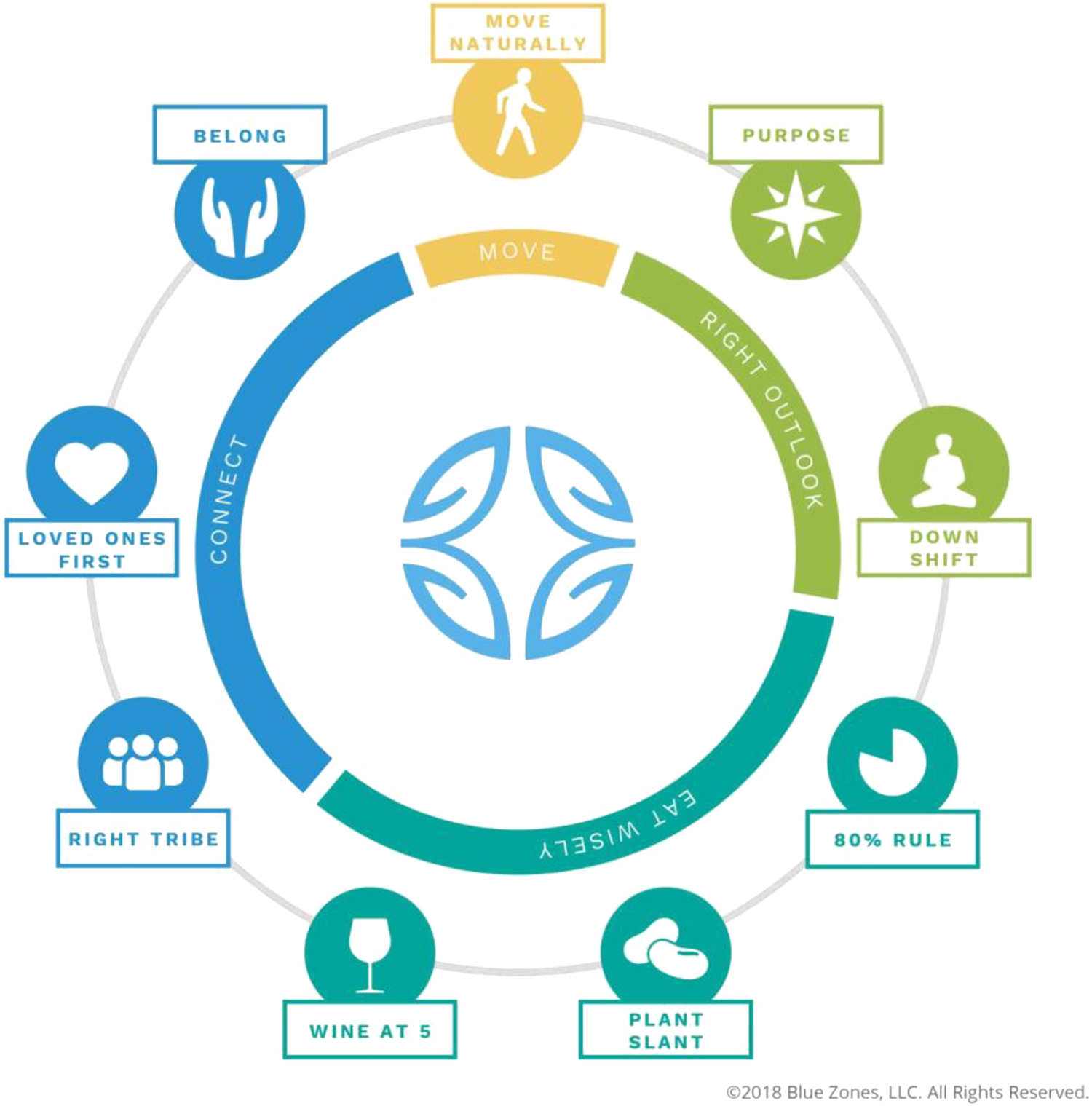
With my team of researchers, demographers, epidemiologists, and anthropologists and surveys of the centenarians there, we found the evidence-based common denominators of the world’s blue zones. We call them the Power 9.
Many of these things are now widely accepted in terms of the medical research and literature as having a direct connection to our health and well-being, but it wasn’t common knowledge when I wrote my first cover story, “The Secrets of Living Longer” for National Geographic in 2004. Our research showed there was no magic pill or silver bullet for longevity; instead, it was a lifestyle that included moving throughout the day, eating mostly plants, managing stress, a strong real-life social network, and having a sense of purpose and belonging. At the time, talking about stress and sleep and purpose in relation to longevity was looked at as questionable if not borderline quackery.
After spending so much time in blue zones areas and traveling around the world lecturing and presenting my research, I wanted to find a way to bring these longevity lessons home to the United States. How could we apply these ancient traditions to our discontented, rushed, and sedentary Western lives?
One thing we knew for sure was that their longevity can’t be chalked up to just “good genes.” This was the finding of a study comparing the longevity of Danish identical twins with that of Danish fraternal twins, and served to determine that longevity is less heritable than intelligence and height. Indeed, only about 20% of how long that average person lives is dictated by genes; the rest is largely determined by lifestyle and environment. The Danish twin study shows us that genes only explains about 20% of how long the average person lives. Lifestyle and environment account for the rest. During my time in all the blue zones regions, I saw, firsthand, how the environment dictated the lifestyle of the world’s healthiest people. They weren’t trying to be healthy. Instead, their surroundings, their villages, their culture, and their social networks created the right environment—a healthy swarm of micro nudges—to support a healthy lifestyle.
Systems Approach: Better Health by Design
In 2009, I got the chance to try to apply my Blue Zones research to an American city with a grant from the AARP and United Health Foundation. Instead of focusing on individual behavior change, we took a systems approach and helped Albert Lea, MN make sustainable changes that would improve life for current residents but also future generations. This included improving sidewalks and roads, creating social groups to combat loneliness and create more community cohesion, using a mixed-use strategy to revitalize the historic downtown area, optimizing tobacco policies, and working with schools, workplaces, and other organizations so that healthy food and lifestyle choices were easier.
In one year, the residents of Albert Lea lost an average of 2.6 pounds and health care claims for city employees dropped 49%. Participating businesses saw a 21 percent decline in absenteeism. The Albert Lea pilot was the blueprint for Blue Zones Project, which is now at work in over 50 communities in the United States. While well-being and overall life satisfaction has been on the decline across the country, these communities have either improved or have managed to hold steady. Many have experienced double digit drops in obesity and smoking and healthcare savings in the hundreds of millions. Fort Worth, TX has seen a 17 percent reduction in tobacco use since 2015, and this reduction has pumped $110 million back into the city’s economy. California’s Beach Cities have seen double digit drops in obesity and significant improvements in cardiac risk factors.
A Neighborly Approach: Community-Led and Community-Run
The key to improving health at a population level is multi-factored, and the Blue Zones approach is a broad initiative including public policies, the places people spend the most time (schools, workplaces, parks, stores), and individual engagement. However, Blue Zones has been able to drive widespread change with a few foundational principles. First, we don’t swoop into a city and force people to change things. The interest, will, and readiness to improve the health of a community must come from within. Hundreds more cities apply than are ready to start this kind of project. Communities have to be ready and willing to invest the time and resources it takes to move the needle. This kind of project, which usually takes 5 to 10 years, needs local funders, visionary leaders including elected and appointed officials and CEOs, and local champions that will advance the cause. It takes a lot of civic will to take on something as bold as reshaping your entire city or county to favor health and well-being.
A good example of the type of extraordinary collaboration between public and private sectors that can drive this type of community-wide intervention is our Blue Zones Project in Fort Worth, TX. In 2014, Mayor Betsy Price, Texas Health Resources (the city’s big hospital system), and the Chamber of Commerce all came together and decided they wanted to help Fort Worth get healthier. In 5 years, they went from being one of the unhealthiest cities in the country to one of the best. The city is now saving about a quarter of a billion dollars a year in projected healthcare and productivity costs.
Moving Communities Forward Together
Because private sponsors fund Blue Zones Project, we can focus on community health at no cost to individuals, local organizations, businesses, or the city. Local sponsors want their city to continue to be into a place where people want to live, and companies want to relocate. Forward-thinking hospital chains and health insurers fund Blue Zones Project because they know the future of healthcare is investing in prevention, which saves them millions in costs. (Blue Zones is now part of Adventist Health, a West Coast hospital system that’s mission is to move from a healthcare company to a health company and redefine the role of hospitals in this country.)
Since Blue Zones has no local agenda except to help the community get healthier and the work is measured objectively by the Gallup Well-Being Index, the local team (hired from within the community) benefits from a position as impartial and trusted convener. Blue Zones Project teams have been able to bring even competing organizations together to form a new working relationship based on a shared goal of helping their city get healthier.
Covid-19 Puts Zip Code Effect in the Spotlight
Now, more than ever, health policy experts are focused on the “zip code effect,” which shows that where we live matters more to our health than our genetic code. We’ve known for some time that in some counties in America, life expectancies for babies can vary as much as 25 years and by over 10 years for adults. We also know that in 2021, the biggest predictor of Covid-19 hospitalization is your zip code, not your genetic code.
This pandemic highlights our country’s glaring health disparities, and it also sheds light on how our own well-being depends on the health of our friends, neighbors, coworkers, and community members. Leaders all over the country are suddenly looking for comprehensive ways to improve the health and economies of their towns and cities. During the pandemic, Blue Zones Project work has expanded in California and in Oklahoma. A new Blue Zones Project launched in Durant, OK in partnership with Texoma Health Foundation, the Choctaw Nation, the Massey Family Foundation, and First United Bank. The proven Blue Zones “healthy swarm of micro-nudge” approach of bringing disparate people and organizations together in a shared goal is an essential model as the country battles and then begins to recover from this pandemic.