




Abstract

Most organizations today utilize teams to accomplish their goals to at least some degree. 1 Teams are the driving force behind critical elements of our society, such as products and services, the airline industry, military operations, education systems, healthcare, and as recently highlighted during the global pandemic, the development of vaccines. Because teams help us tackle complex issues, they are perhaps more critical now than ever before, as the world grapples with various unprecedented challenges. Teams do not operate without issue, however. They often struggle to work together effectively, and sometimes even fail with disastrous consequences (e.g., the Challenger space shuttle accident). 2 These challenges can be magnified and take new forms when teams work together virtually, 3 as is increasingly common in current times, and likely will be for years to come. Fortunately, there is a strong foundation of literature that informs how team functioning and performance can be facilitated. We draw from the science of teams to highlight key takeaways for optimizing team effectiveness at different points throughout a team’s lifespan. Specifically, we organize our discussion around 3 overarching stages of team development—forming, functioning, and finishing. 4 Within each stage, we discuss primary contributors to team effectiveness, describe factors specific to virtual team settings, and identify constructs that can serve as indicators of team success (see Figure 1 for a summary of our discussion).
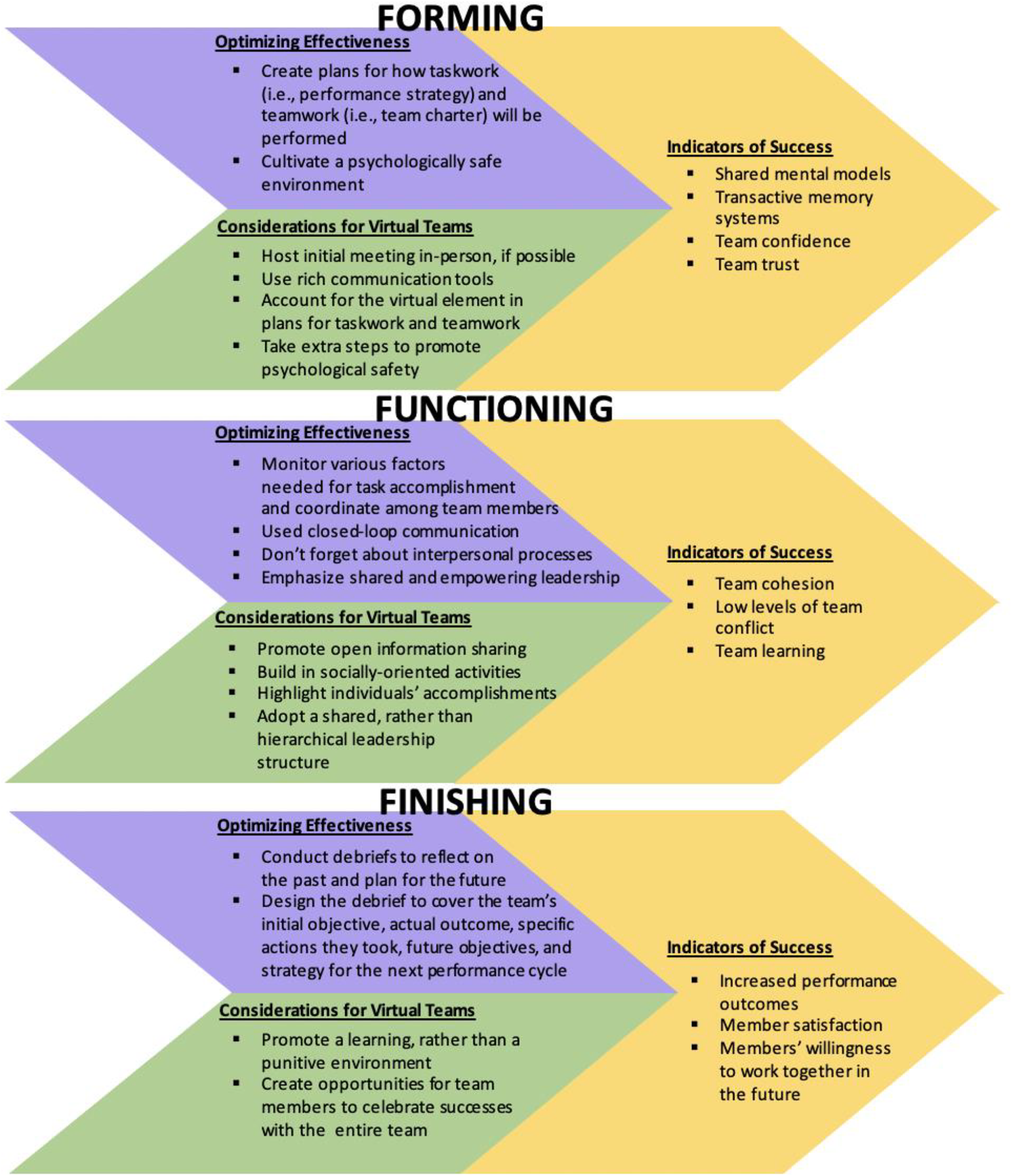
Summary of key takeaways.
Forming
Optimizing Effectiveness
The forming stage of team development reflects the initial period when the team comes together and focuses on navigating who they are and what they’re doing. 4,5 This process can be greatly facilitated if teams take the time to generate performance strategies and team charters, which are specific plans for how they will handle taskwork and teamwork, respectively. 6 Developing a performance strategy involves creating a plan for carrying out taskwork, which is the team’s core activity, or what they’re doing. This could include specifying objectives, identifying ways to monitor progress, and mapping out contingency plans. Charters, in contrast, are focused on planning for teamwork, or how team members will work together to perform their task. For example, a charter could delineate who will do what, how team members will coordinate, what the timing and sequencing of activities will be, and how interpersonal dynamics will be handled. These plans are generated through formal discussions and often documented for the team to refer back to. Research supports the value of quality strategies and charters for promoting team performance. 1,6
Another important construct to cultivate during team formation is psychological safety, a shared feeling that team members can take interpersonal risks, such as speaking up, without consequence. 7 Establishing such a climate up front 4 is beneficial because it encourages open information sharing and reduces conflict during taskwork and teamwork processes, ultimately facilitating team learning, decision making, and performance outcomes. 8 Psychological safety can be nurtured through supportive team structures (e.g., clear direction, resources) and strong leadership (e.g., inclusiveness, accessibility), among other things.
Considerations for Virtual Teams
Virtual teams, those who use some degree of technology and asynchronous communication to work together due to some or all team members being remote, may struggle to develop a common objective and sense of purpose since interactions between team members are diminished in these contexts. 9 Devoting attention to planning activities and developing psychological safety during the formation stage is therefore especially critical. An initial in-person meeting is ideal for setting virtual teams up for future success, 10,3 but if that’s not possible, using rich communication tools (e.g., video chat vs. audio or email) can greatly facilitate the team’s ability to carry out planning processes effectively. 11 Plans for taskwork and teamwork should incorporate the virtual element. For example, will the team use particular software or websites to perform their task and monitor progress? What will be the norms for the format of team meetings (e.g., Zoom meetings—video on or off?)? What will be the policies guiding team interactions (e.g., Should team members be present on Slack or a similar platform to respond to instant messaging during working hours? Will there be an expectation that emails will be responded to within a specified period of time?)? Collaboratively planning for these things up front can help get all team members on the same page and reduce miscommunication and conflict down the road.
Psychological safety is paramount in virtual teams, particularly since leaders have fewer opportunities to observe what’s happening, hence need to rely on team members to ask questions and speak up. 12 With limited in-person interactions, special care should be taken to foster its development in virtual settings. For instance, team members should adopt the practice of considering the pros and cons of everyone’s ideas, including their own, and should devote specific time to ensuring every person has the chance to speak up. 13 This can be enacted during the initial planning period and subsequently built into team norms to guide interactions. Incorporating more socially-oriented activities, such as virtual coffee chats or happy hours, is also beneficial. This provides an opportunity for team members to forge interpersonal connections and better understand each other’s personal situations and constraints, creating a more inclusive and psychologically safe climate. 13
Indicators of Success
Following the team formation period and initial efforts to cultivate psychological safety, some key indicators that teams are on the right track include shared mental models, transactive memory, team confidence, and team trust. A shared mental model is a shared understanding and mental representation of knowledge pertaining to various factors relevant to team functioning. 14 Also a type of team knowledge structure, a transactive memory system reflects the collective awareness of which team members know what. 15 Developing performance strategies and team charters should result in team members being on the same page about what the goals are, how tasks will be accomplished, what resources are available, what the norms for communication will be, what each team member’s roles and working styles are, etc. (i.e., shared mental models). This entails also developing a common understanding of each person’s expertise, past experiences, strengths and weaknesses, and social networks (i.e., transactive memory system).
Equipped with this knowledge, teams should feel more confident in their ability to work together and execute the course of action necessary for accomplishing their goal (referred to as collective efficacy). 16 Related, effective team formation processes should contribute to the team’s broader belief that they have the ability to be successful in general. Team confidence of both types is beneficial for team performance because it prompts team members to exert more effort toward goal accomplishment and to persist when experiencing challenges. 17 Finally, team trust, which is critical for team performance, 18 reflects a shared willingness among team members to accept vulnerability because they have positive expectations of one another. 19 Following team formation processes, team members should have a better understanding of each other’s capabilities and personalities, which can serve as a foundation for them to trust that each person can perform the task effectively and will act in the best interests of the rest of the team. Higher levels of team trust can also indicate that a climate of psychological safety has successfully been cultivated within the team. 8
Functioning
Optimizing Effectiveness
During the functioning phase, teams are progressing toward goal accomplishment and gaining more experience working together as a team. 4 Several factors have been identified as foundational to success during this period. For instance, when the team is focused on the task itself, performance is optimized when specific action processes are utilized. 20 These include monitoring progress toward goals (i.e., tracking task progress, identifying what remains to be done), systems monitoring (i.e., staying apprised of team resources and environmental conditions in relation to mission accomplishment), team monitoring and backup (i.e., helping teammates with their tasks), and coordination (i.e., managing the sequence and timing of interdependent actions). Engaging in these processes supports both team performance and team satisfaction. 21
Communication is another major pillar of effective teams. 22 In its simplest form, communication is a process of team members sending and receiving information back and forth, and is particularly effective when closed-loop procedures are utilized. This involves confirming that information has been received and interpreted correctly. 23 First, the sender initiates a message; the receiver then acknowledges receipt and conveys how they have interpreted the message; finally, the original sender confirms the message was understood as intended. Communication helps determine the team’s attitudes, behaviors, and cognitions, ultimately playing an important role in promoting team performance. 24,25
As teams work together and encounter varying working conditions over time, it is not uncommon for them to experience conflict, stress, frustration, and depleted motivation. Interpersonal processes, those that shape relational dynamics and affective states within the team, 20 are therefore also critical. Successful teams engage in processes focused on motivating and building confidence, as well as managing conflict and member emotions. For example, this might entail efforts to highlight past accomplishments, encourage high standards for performance, and communicate beliefs about the team’s ability to be effective. Further, regularly checking in on members’ emotions and personal situations can boost morale and contribute to cohesive bonding among team members. When conflicts arise, approaches to handling it that emphasize openness and collaboration are more effective than those that rely on avoidance and competition. 26 Such interpersonal processes benefit several important aspects of team functioning, including cohesion, potency, member satisfaction, and ultimately, team performance. 21
Finally, strong leadership can further support each component of the functioning period. Leader behaviors focused on both tasks (e.g., guiding task processes) and people (e.g., inspiring and creating a shared vision) are positively related to a team’s productivity, adaptability, and broader effectiveness. 27 Leadership that emphasizes empowerment, or team member development and self-management, is particularly effective. Related, leadership need not come from a formal hierarchical leader, but can be shared among team members to optimize team effectiveness. 28
Considerations for Virtual Teams
When teams work together virtually, there are several important considerations for aiding team functioning. First, action processes and broader communication can be hindered in virtual teams, due to the reduced availability of social cues. 10,3 The overall amount of information shared tends to be diminished because of the extra effort that is often required to communicate virtually (e.g., typing it out in an email, or even setting up a Zoom meeting). In an interesting paradox, virtual teams share more unique information (information all team members don’t already have access to) but less information overall (i.e., open information sharing), even though open information-sharing is actually more important for their performance. 29 That said, there are also opportunities to benefit in virtual teams—virtual communication encourages greater participation from the whole team since status dynamics become less salient, and allows for archives to be generated that teams can refer back to (e.g., copies of emails or communication history in project management software). 3 Thus, teams who take advantage of technology and build structures for promoting information sharing can avoid some of the pitfalls associated with virtual communication.
Given the reduction in social cues, it is no surprise that interpersonal processes often suffer in virtual settings. Virtual teams tend to focus on task—as opposed to social—processes, while miscommunications and less inhibited behavior that sometimes occurs behind a computer screen can make them more prone to conflict. 3 Further, there is a weaker foundation for developing social connections and team members may feel disconnected from both each other and the broader purpose of the team. Like the team formation phase, it is therefore critical to build in opportunities for social activities during the functioning period. This might entail virtual happy hours, game nights where family members can get involved, or even just a few minutes of each meeting devoted to checking in on a personal level. As a morale booster, this time can also be used to highlight accomplishments and acknowledge the contributions of individual team members, 12 particularly since the team can’t readily observe everyone’s work when they’re not face-to-face. Creating smaller projects that all team members are a part of can also help them get to know each other better, facilitating connections. 13
Leaders are important for the functioning of virtual teams, in part because they help establish the structures and practices needed to mitigate the challenges they face. 10 Interestingly, hierarchical leadership, when there is a formal, designated leader, becomes less effective in virtual teams, whereas leadership shared among team members becomes more effective for promoting team performance. All members of virtual teams should therefore be empowered to engage in leadership behaviors that are beneficial to team functioning.
Indicators of Success
Some primary indicators of success at this stage include team cohesion, low levels of conflict, and team learning. Cohesion reflects a shared attraction and bonding driven by both commitment to the team’s tasks and interpersonal liking among team members. 30 Effective action and communication processes can increase members’ engagement in team tasks by reducing the confusion that often comes with working in teams, making the experience less burdensome. Empowering leadership behaviors and interpersonal processes focused on team morale can further rally team members around the task. Social activities can help team members get to know each other on a personal level, while conflict management processes will ultimately reduce the amount of conflict between members, both facilitating social bonding. As teams gain more experience working together and enacting these processes, they should also demonstrate learning, or changes in their knowledge and behaviors over time. 4 Teams who create mechanisms for hearing from, and getting to know every team member will be more receptive to learning from each other. Additionally, strong leadership and interpersonal processes can better equip them to learn from mistakes made along the way rather than disengaging from the team.
Finishing
Optimizing Effectiveness
Although the finishing stage often involves the team disbanding, we discuss finishing as the period when the team has completed an episode, or performance cycle. 20 At this point the team has moved through the initial planning period (i.e., transition phase), the action phase, when they worked on performing the task itself, and is now cycling back to another transition phase, or planning period for the next task. Engaging in a formal debriefing or reflection period is an essential part of this process for ensuring the team is on a path for future success. 31
Debriefing consists of the feedback, reflection, and discussion that takes place after an action phase. 32 These debriefs allow team members to turn the recent action phase into a learning opportunity by reflecting on where they’ve been and where they’re going. Formal debriefs or after action reviews cover 5 dimensions: the team’s initial objective, their actual outcome, the specific actions they took, their future objectives, and their strategy for moving into the next phase. 32 First the team reviews what they initially set out to accomplish, then examines what outcomes they actually achieved. Next, the team examines the actions they took that both aided and hindered their ability to achieve the outcome they originally intended. This allows them to celebrate their successes while also learning from their failures. The team then develops the next goal, and finally, develops strategies for the next action phase. By taking the information they learned from their reflection on past actions, they can identify futures actions that are most likely to contribute to success and develop strategies accordingly. 32 Following these steps helps the team improve their taskwork processes both directly, and indirectly, by boosting their efficacy and psychological safety. 12
Considerations for Virtual Teams
Because members of virtual teams often feel disconnected from each other and perform their tasks asynchronously, debriefs are particularly important for ensuring everyone is on the same page about what’s working and what needs to change moving forward. A formal period of reflection that is grounded in a learning perspective rather than a punitive perspective can foster the climate of trust and psychological safety that is necessary for team members to be open to feedback about any adjustments that need to be made during the next action phase, ultimately enabling the team to become more adaptable. 33 Due to their dynamic and ambiguous nature, virtual teams are more likely to experience the triggers that require a team to adapt, making team adaptability essential for their success. 10 Debriefs can also give team members the opportunity to celebrate their successes with the entire team. This allows members that may not have been present at the time of the success to share in it. When a team can celebrate their prior accomplishments together, it promotes cohesive bonding and builds greater trust among members, 12 things that are generally considered challenging to develop in virtual contexts. 34
Indicators of Success
At the conclusion of the finishing phase, the team’s performance outcome is of course the ultimate indicator of how successful they have been. This can take many forms such as an evaluation of their behaviors or outputs, consideration of the costs associated with their performance, or a broader assessment of the extent to which they met particular team objectives. 16 Members’ satisfaction and willingness to continue working together are also significant benchmarks of the team’s effectiveness. Furthermore, checking in on the other indicators of success previously mentioned is valuable at this stage, as it is important for them to remain strong in order for the team to continue operating effectively. For example, the team’s performance outcome can feed into subsequent levels of cohesion, conflict and confidence in the team, which then shape team trust and performance in the next transition and action cycle. 35 These aspects of healthy team functioning will be further supported by the debriefing process.
Conclusion
Teams are critical for navigating the complex nature of various aspects of modern-day life. While teams face challenges, many of them unprecedented in our current times, there is a wealth of science to draw from in order to optimize their effectiveness. We have highlighted key takeaways for facilitating team effectiveness across different points in a team’s trajectory, while giving consideration to an increasingly common situation—the need for teams to work together virtually. We encourage anyone who finds themself in a team or in charge of a team to draw from these takeaways as a way to promote team effectiveness and improve the experience overall.