



Abstract
Purpose
This study aims to examine the relationship between cash value benefit (CVB) redemption outcomes in the Special Supplemental Nutrition Program for Women, Infants, and Children (WIC) across food processing types and socio-demographics.
Design
Cross-sectional and panel analyses.
Setting
Virginia.
Subjects
98,067 Virginia WIC households.
Measures
CVB redemption rate.
Results
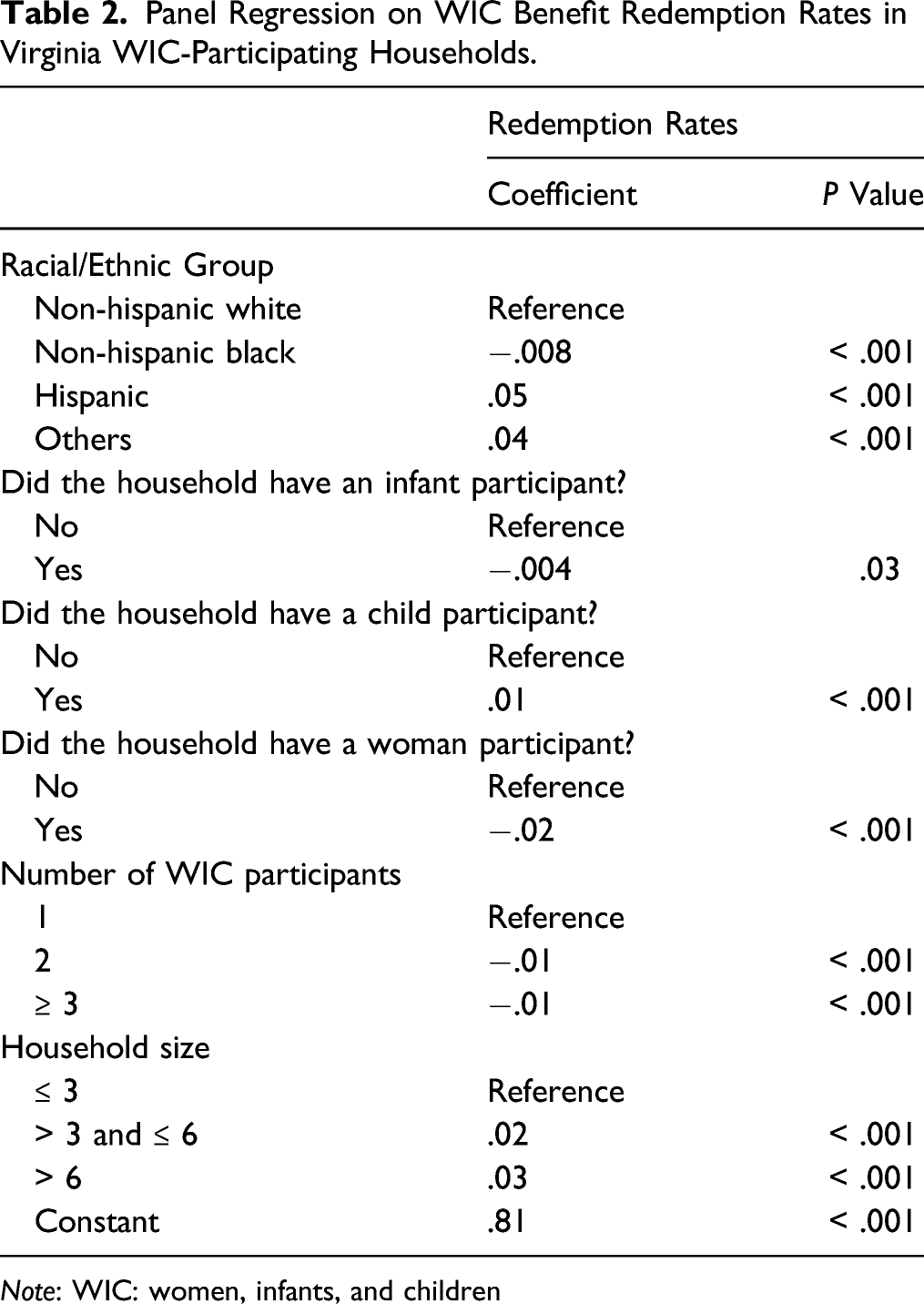
The predominant share of CVB redemption was for fresh produce (77.3%). Non-Hispanic whites and blacks redeemed a smaller share of fresh produce than Hispanic participants (P < .001). Non-Hispanic black WIC households have a significantly lower CVB redemption rate than non-Hispanic white WIC households (β = −.008, P < .001). Households with a child participant tend to have a higher redemption rate (β = .01, P < .001). The redemption rates of fruits and of vegetables were positively correlated with household size.
Conclusions
Minority status and household size were significantly related to CVB redemptions among Virginia WIC participants.
Keywords
Purpose
The Special Supplemental Nutrition Program for Women, Infants, and Children (WIC) provides free food packages to eligible low-income women (pregnant, breastfeeding, and postpartum), infants, and children up to 5 years of age. 1 The 2009 WIC revision added a cash value benefit (CVB), which provides a fixed dollar amount for purchasing fruits and vegetables (F&V). 2 One of the 3 research priorities of the 2017 National Academy of Sciences, Engineering and Medicine (NASEM) WIC review committee was to understand participants’ CVB redemption choices. The recent adoption of Electronic Benefit Transfer (EBT) in the WIC program enabled researchers to achieve this goal, since the EBT system stores detailed transaction-level redemption information.
This is one of the first studies to use state-level EBT data to examine participants’ CVB redemption choices across food processing types (fresh, frozen, and canned) and the relationship between CVB redemption rates and socio-demographics. The processing type is important to participants due to varying nutritional levels,3,4 but is also important to WIC vendors. Identifying socio-demographic predictors helps improve CVB redemptions.
Methods
Design
This study adopted a cross-sectional study design and was approved by the institutional review board at Old Dominion University.
Sample
This study used 2015 Virginia WIC EBT data, the state’s first year using EBT statewide. The data included dates of redemption, product codes (Universal Product Code [UPC] for food products or Price Look-Up [PLU] code for produce), product description, dollar value, and the prescribed food benefit’s first and last use date. The study sample includes 1,526,879 F&V transactions covering 98,067 WIC households that largely encounted non-generic PLU codes in Virginia.
Measures
The primary outcome variable was the CVB redemption rate (= redeemed dollars/prescribed dollars in a month). To ease check-out, WIC allows vendors to enter generic PLU codes, for example, 4469, for CVB transactions if technical glitches prevent approval of a specific food type. 5 The disadvantage of using the generic code is loss of specific information about the item, although PLU code use indicates it is most likely fresh produce. The redemption rates were stratified by food processing type, that is, fresh, frozen, canned, and general. The average redemption rates were estimated per redemption cycle levels. Socio-demographics included race/ethnicity, participation status, household size, and the number of WIC participants in a household.
Analysis
First, the redemption shares of CVB in dollars were estimated across process types (fresh, frozen, canned, and general) and socio-demographics. Kruskal–Wallis tests were applied to test a significant difference. Next, random effects linear regression models of panel data were applied to examine the relationship between the monthly redemption rates and socio-demographics. All analyses were conducted in RStudio. 6
Results
CVB Fruit and Vegetable Redemptions (in Dollar Value) by Storage Types in Virginia WIC-Participating Households a .

aCVB indicates cash value benefit; Statistical tests performed: Kruskal–Wallis test.
Non-Hispanic white and black households redeemed a relatively smaller portion of fresh F&Vs (77.4% and 74.5%, respectively) compared with Hispanics and other groups (80.6% and 81.3%, respectively) (P < .001). Households demonstrated a similar distribution pattern of CVB redemptions across process types regardless of the presence of different participant types. Households with a higher number of participants had a higher proportion of fresh F&V redemptions (P < .001).
Panel Regression on WIC Benefit Redemption Rates in Virginia WIC-Participating Households.
Note: WIC: women, infants, and children
Discussion
Summary
This study examined Virginia WIC participants’ CVB redemption using transaction-level EBT data. The significant differences in redemption rates across processing types and racial/ethnic groups are worth further investigation, as they may indicate systemic disparities in F&V access or availability for low-income WIC participants. 7 Vendors, especially ethnic food stores, may wish to optimize their food stocking to better serve WIC participants. The findings regarding the association between participant characteristics, the number of participants in a household, and household size and CVB redemptions suggest that more in-depth research is needed to understand why different participant characteristics or household structures may influence CVB redemption. For example, having an infant participant may present a time constraint on low-income caregivers, limiting their focus on activities such as redeeming WIC benefits. 8
Limitation
A few limitations of this study need to be acknowledged. First, the characteristics of the vendors patronized by participants were not controlled for, since Virginia WIC EBT data did not include vendor names. Second, the data do not have all household characteristics relevant to CVB redemptions. For example, reporting income is optional for those who join the WIC program due to adjunctive eligibility, such as Medicaid participants who are automatically eligible for WIC, regardless of income. Finally, the study’s cross-sectional design limits the interpretation of causality.
Significance
Despite its limitations, this is one of the first few studies that use EBT data to examine CVB redemption choices at the state level. WIC vendors can provide F&Vs in various forms to meet the demand for CVB redemptions from different WIC participants. More research is needed to understand the socio-demographic differences in CVB redemptions.
So What?
What Is Already Known on This Topic?
The introduction of CVB has been shown to have increased F&V purchases among WIC households.9,10
What Does This Article Add?
This article uncovers WIC participant’s CVB redemption choices across processing types and examines the relationship between CVB redemption rates and socio-demographics.
What Are the Implications for Health Promotion Practice and Research?
Although the CVB redemption rates were relatively high in Virginia, a substantial portion of these benefits go unredeemed. This presents an opportunity for WIC agencies to engage with participants to understand the specific challenges faced in redeeming the CVB. F&V redemption preferences can guide the development of more relevant materials and strategies to help participants better utilize their benefits.
Footnotes
Acknowledgments
The authors thank Mr Michael Welch, Ms Paula Garrett, and other colleagues at the Virginia WIC program for their support for our research.
Authors’ Note
QZ, CT, PM, and BS conceptualized the study. QZ, JZ, KP, and CT developed the statistical analysis plan. QZ secured the funding and the data. JZ and KP performed the data analyses. QZ and KP drafted the manuscript and all authors significantly revised and edited the manuscript.
Declaration of Conflicting Interests
The authors declared no potential conflicts of interest with respect to the research, authorship, and/or publication of this article.
Funding
This research is funded by a USDA/Economic Research Service Co-op Agreement (#58-4000-6-0061-R) and the Duke-UNC USDA Center for Behavioral Economics and Healthy Food Choice Research, which is funded by Grant # 59-5000-4-0062 from the US Department of Agriculture. The findings and conclusions in this presentation are those of the authors and should not be construed to represent any official USDA or U.S. government determination or policy.
Ethics Statement
This study was approved by the institutional review board at Old Dominion University [Approval #: 16-179].

The Special Supplemental Nutrition Program for Women, Infants, and Children (WIC) provided nutritious food packages to 6.4 million low-income women, infants, and children in the U.S. in 2019. The 2009 WIC food package revision added a cash value benefit (CVB) that provides a fixed dollar amount for participants to purchase fruits and vegetables. Recently, the WIC agencies have adopted an electronic benefit transfer (EBT) system that provides detailed transaction information. This study was one of the first studies that used state-level WIC EBT data to examine CVB redemption outcomes across food-processing types and socio-demographics. The results have important policy implications for WIC program administrators and researchers.