



Abstract
Purpose
Evaluation findings from Comprando Rico y Sano (CRS), a culturally relevant, community-based intervention addressing nutrition knowledge and food access are presented.
Design
No-control quasi-experimental intervention with pre, post, and follow-up assessments.
Setting
CRS was promotores-led through UnidosUS's Affiliate Network of community–based partners.
Sample
Low-income Latino adults (N = 966) receiving services at 25 partner sites.
Intervention
CRS was a six-hour intervention focused on nutrition knowledge and consumption of fruits, vegetables, and home-prepared meals. It also provided guidance for health-conscious grocery shopping, Supplemental Nutrition Assistance Program (SNAP) information, and enrollment assistance.
Measures
Self-report surveys assessed nutrition knowledge; intention to change; and frequency of fruit, vegetable, and home-prepared meal consumption. Sites reported monthly SNAP enrollment data.
Analysis
Paired-samples t-tests and repeated-measures ANOVAs assessed changes in knowledge, intentions, and behavior from pre-to-post (n = 960) and pre-to-follow-up (n = 115).
Results
Pre-to-follow-up increases in nutrition knowledge (P < .001) were observed. Intention to consume more vegetables (P = .027) and home-prepared meals (P < .001) also improved between pre- and follow-up. Increases from pre-to-follow-up were observed for frequency of consuming fruits (P = .007), vegetables (P = .001), and home-prepared meals (P < .001). Across 16 months, 24,359 Latinos enrolled for SNAP.
Conclusion
Large-scale community collaborations to deliver culturally relevant nutrition education and SNAP enrollment assistance can increase food access, health literacy, and promote healthful diets for Latinos.
Purpose
Over 35.2 million people in the United States (U.S.) live in food-insecure households; of those, 16% are Hispanic/Latino. 1 Latinos are disproportionately affected by food insecurity (inconsistent access to adequate food) 1 due to poverty, access, and assistance eligibility barriers (e.g., lack of bilingual staff in government offices, public charge rule and anti-immigration policies, distrust of the social services system).2,3 Food insecurity negatively impacts nutrition and contributes to health disparities. 4 Increasing access to nutrition assistance programs is crucial to improving Latino health outcomes.
Nutrition education interventions are associated with various positive impacts among Latinos, including improved nutrition knowledge and dietary behaviors. 5 Interventions that incorporate promotores (community health workers) have facilitated positive health outcomes. 6 Promotores are trusted individuals who serve as liaisons between health-related services and the community, facilitating access and improving the cultural congruence of service delivery. 6
As the U.S. Latino population grows, population-level strategies to improve their nutrition support the nation’s health. UnidosUS, the largest national Latino civil rights and advocacy organization, developed Comprando Rico y Sano (CRS) to address Latino nutritional needs, including food access. This study evaluated whether the promotores-led intervention impacted nutrition knowledge, healthy-eating behaviors, and food access among Latinos.
Methods
Design
CRS employed a quasi-experimental intervention design (pre–post–follow-up test). Assessments were taken at baseline, post-intervention, and 3-month follow-up with no-control group. Demographic and pre-surveys were administered prior to the primary health education session; post-surveys were administered immediately after the 60-minute educational session (all on same day). Participants engaged in an additional 5 hours of health programming after the primary health education session, before follow-up assessments. Follow-up surveying occurred within a 42-day window, ranging from 2 weeks prior to and 4 weeks after the 3-month follow-up due date (based on date of the first health education session). An additional component included assistance with Supplemental Nutrition Assistance Program (SNAP) enrollment; this component occurred after the primary health education session. Data were collected from June 2019 through October 2020.
Sample
Participants were Latino adults recruited from 25 partner sites, including health centers, community organizations, and networks servicing Latinos across the U.S. (representing the West, Midwest, Southeast, Northeast, and Southern regions). Promotores recruited community members using different venues (e.g., individuals attending other programs offered by the organization). A screener was followed to assess participant eligibility and share program information. Individuals who expressed interest in the program and met eligibility requirements (self-identified Hispanic/Latino, 18 years or older) were invited to participate. The Institutional Review Board at California State University Long Beach approved study procedures. Written informed consent was collected from participants prior to data collection. Follow-up evaluation data were collected from a geographically stratified convenience sample of all participants who completed at least 6 hours of intervention programming (i.e., a minimum of 5 participants per partner site provided follow-up data). Based on a-priori power analyses, target enrollment was 1,000 for pre and post, and 100 participants for follow-up.
Measures
All surveys were brief to minimize participant burden and attend to the target population’s literacy levels. Evaluation items were created for the project, modeled after validated measures, when possible. Surveys were available in English and Spanish; paper demographic, pre- and post-surveys were administered in person to participants in their preferred language by promotores, while follow-up surveys were completed via phone by bilingual evaluation staff. The pre- and follow-up surveys assessed participant’s health knowledge (seven true/false items based solely on health education session content), intention to change healthy-eating behavior (frequency of fruit, vegetable, and home-prepared meals; one item per behavior, 4-pt responses ranging from “I am sure I will not” to “I am sure I will”), 7 and their past month frequency of healthy-eating behaviors (one item per behavior, 6-pt responses ranging from “Never” to “5 or more per day”);8,9 the post-survey only included the knowledge and intention items. SNAP enrollment data was collected via monthly logs from partner sites. Promotores at each site assisted participants with enrollment and recertification for all those eligible to receive support within each household (i.e., all children of participant).
Intervention
CRS is a culturally relevant, community-based, promotores-led intervention aimed at increasing nutrition knowledge and food access. Across 2 days, promotores were trained in recruitment, data collection and program implementation according to cultural practices and ethical standards, including lessons learned and best practices for effective intervention delivery. The intervention consisted of 6 hours of programming. This included a 60-minute, face-to-face primary health education session focused on increasing healthful food knowledge, health-conscious grocery shopping, and intent to consume fruits, vegetables, and healthy home-prepared meals. Promotores also provided SNAP information and enrollment assistance after the primary health education session, in the language spoken by the participant to address known language barriers to enrollment. Participants received assistance with creating online accounts, reviewing eligibility criteria, and completing the online application on the SNAP platform. Other program activities included additional nutrition education, grocery store tours, cooking demonstrations, health screenings, and community events like health fairs that were offered within 1-month of the health education session.
Analysis
IBM SPSS v.25 10 was used for data management and analyses. Listwise deletion was used to deal with missing data. Descriptive statistics summarized sample demographic characteristics. Paired-samples t-tests and repeated-measures ANOVAs (with post hoc tests) assessed pre, post, and follow-up changes in knowledge, intentions, and behavior.
Results
Sample Characteristics
The sample was primarily female (85.9%) and the average age was 43.5±13.5 years. The majority of participants were foreign-born (90.2%) with over half born in Mexico (59.2%). Other countries of origin included El Salvador (4.8%), Guatemala (4.8%), Dominican Republic (4%), Puerto Rico (3.5%), and Venezuela (3.5%). The average number of years in the U.S. was 18.1±11.6. Over 40% of the sample had less than a high school education. Half of the participants were married and had an average of 2.6±1.7 children.
Of 997 community members recruited, 989 (99.2%) completed pre-surveys and 990 (99.3%) completed post-surveys. Of 274 participants with follow-up call attempts, 132 (48.2%) completed evaluation. Attrition analyses indicated there were no demographic differences between those who did and did not complete follow-up assessment.
Changes in Knowledge and Intent
Pre–Post–Follow-Up Changes in Knowledge and Intent.
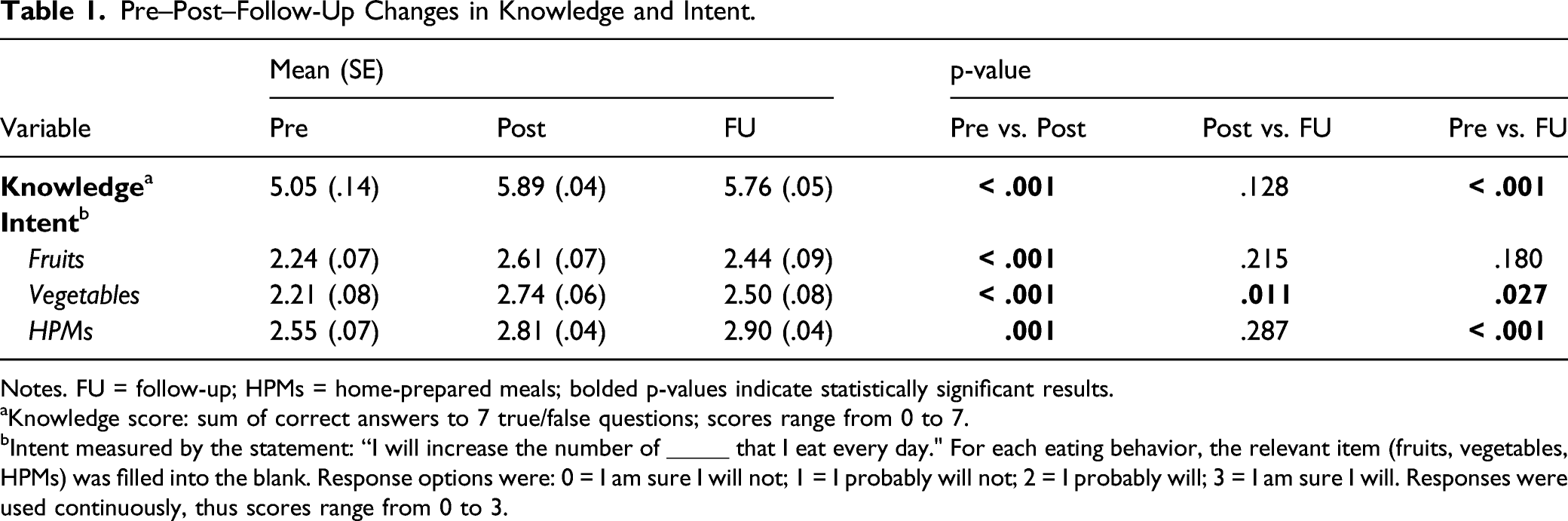
Notes. FU = follow-up; HPMs = home-prepared meals; bolded p-values indicate statistically significant results.
aKnowledge score: sum of correct answers to 7 true/false questions; scores range from 0 to 7.
bIntent measured by the statement: “I will increase the number of _____ that I eat every day." For each eating behavior, the relevant item (fruits, vegetables, HPMs) was filled into the blank. Response options were: 0 = I am sure I will not; 1 = I probably will not; 2 = I probably will; 3 = I am sure I will. Responses were used continuously, thus scores range from 0 to 3.
Behavioral Changes
Figure 1 displays changes in healthy-eating behaviors from pre-to-follow-up. Results show a significant increase in frequency of consuming fruits, vegetables, and home-prepared meals. Pre–follow-up changes in frequency of healthy-eating behaviors. Notes. HPMs = home-prepared meals. Each eating behavior measured by the statement: “Over the last month, how many times did you eat _____.” For each eating behavior, the relevant item (fruits, vegetables, HPMs) was filled into the blank. Response options were: 0 = Never; 1 = 1–3 times per week; 2 = 4–6 times per week; 3 = 1–2 times per day; 4 = 3–4 times per day; 5 = 5 or more times per day. Responses were used continuously, thus scores range from 0 to 5.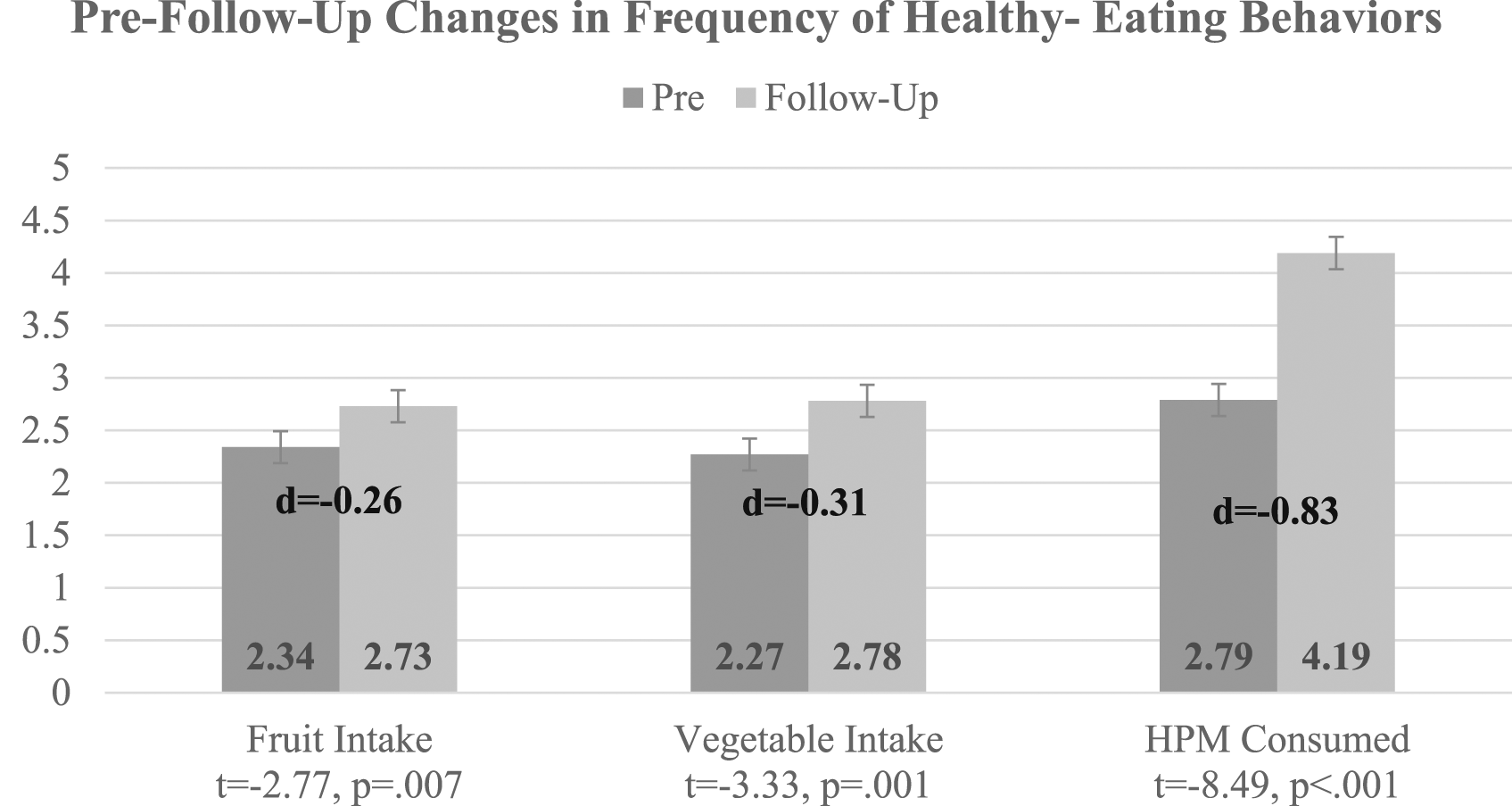
SNAP Enrollment
From 16 out of 25 sites, 10,502 households were provided with SNAP enrollment/recertification assistance. Each household could have received assistance for more than one person, this support resulted in a total of 24,359 Latinos benefitting from this service, with 6,356 new applications and 4,416 recertifications.
Discussion
The promotores-led, culturally tailored intervention resulted in significant increases in nutrition knowledge and more frequent self-reported consumption of fruits, vegetables, and home-prepared meals. Access to food was also enhanced by SNAP enrollments/recertifications. The need among Latinos in the U.S. for education and enrollment in nutrition assistance programs is well-documented. 3
Research shows that Latino households may not enroll in SNAP due to barriers in eligibility and access (e.g., immigration status, limited access to bilingual and bicultural staff at application centers, inadequate outreach and dissemination of accurate information that leads to misconceptions about the program, lack of transportation).2,11 Continued efforts to enroll families in need are vital. The intervention led to over 20,000 Latinos receiving food assistance; these results may be attributed to offering culturally relevant SNAP information and enrollment assistance from trusted Spanish-speaking promotores, which addressed barriers cited in the literature.2,3
The sample was primarily female and of Mexican descent, limiting generalizability. Limitations on in-person activities due to COVID-19 impacted study procedures. Notably, recruitment and data collection goals were still met; however, testing culturally aligned virtual methods of intervention, including telehealth and online activities, is warranted. Data collection across 25 sites presented challenges that impacted evaluation, such as missing contact information for follow-up. Given the priority placed on the community’s needs, use of extensive psychometrically sound measures was not possible. Limited measures reduced reliability and validity of data which may have contributed to observed ceiling effects for knowledge and intent, and single-item self-reported eating behavior is subject to recall bias and reduced representativeness of typical diet. Further, any self-report evaluation is subject to social desirability bias. In this study, social desirability bias may have occurred given that in some cases promotores who recruited participants may have also delivered health education and/or administered evaluation. Lastly, the lack of a control group negates ability to attribute changes solely to the intervention.
Latinos in the U.S. face significant health disparities due to anti-immigrant sentiment, low educational attainment, economic disadvantage, and limited health service access.
12
By engaging community partners in implementing culturally relevant health programming (e.g., promotores-led, low-burden evaluation instruments, culturally tailored materials), a brief intervention, such as CRS, is feasible within the context of the lives of Latinos (e.g., long work hours and/or multiple jobs). Findings indicate that CRS can have population-level impact that supports the health of Latinos so that they may thrive—no matter where they were born or where they live—while continuing to contribute to the success and well-being of our nation. Latinos are at high risk for food insecurity and unhealthy-eating behaviors. An extensive network of community partnerships that employ promotores to serve the health needs of Latinos through culturally relevant methods is conducive to increasing healthful food knowledge; intentions and frequency of consuming fruits, vegetables, and home-prepared meals; as well as food access through SNAP enrollment assistance. Improving Latino health requires that researchers and practitioners engage community collaborators in every stage of development and programming and the need for flexibility in balancing research and community needs.So What?
• What is already known on this topic?
• What does this article add?
• What are the implications for health promotion practice or research?
Footnotes
Acknowledgments
The authors thank the 25 affiliate partner sites, staff, and student assistants who contributed to the success of the program.
Author contributions
All authors contributed to the design and evaluation of the study. Alejandra Gepp, Elizabeth Carrillo, and Rita Carreon oversaw the implementation of the study and provided a critical review of the manuscript. Mayra Rascón and Dr. Selena Nguyen-Rodriguez conducted the statistical analyses, interpreted results, and drafted sections of the manuscript. Drs. Melawhy Garcia and Gino Galvez interpreted results and drafted sections of the manuscript. All authors approved the final manuscript submitted.
Declaration of conflicting interests
The author(s) declared no potential conflicts of interest with respect to the research, authorship, and/or publication of this article.
Funding
The author(s) disclosed receipt of the following financial support for the research, authorship, and/or publication of this article: The study was funded by the Walmart Foundation.
Ethical approval
The study including human subjects’ participation was approved by the California State University Long Beach Institutional Review Board (19-404).
Disclaimer
The views expressed in this study are that of the authors and not an official position of the Walmart Foundation.
