



Abstract
Purpose
To investigate sleep quantity as a moderator of vaping and self-reported suicidality among adolescents.
Design
Cross-sectional. Setting: United States high schools.
Sample
10,520 high-school students with complete data on the primary outcome of suicide attempt in the past year (76.9% response rate).
Measures
2019 Youth Risk Behaviors Survey.
Analysis
Logistic regression to examine main effects and potential moderation.
Results
Students with under seven sleep hours on school nights (OR = 2.6; 95% CI = 2.1-3.3) and who vaped in the past month (OR = 3.0; 95% CI = 2.1-3.9) had higher odds of attempting suicide in the last year. Sleep quantity moderated the relationship between vaping and suicidal thoughts in the past year (P = .01) but did not moderate the relationship between vaping and a suicide plan (P = .15) or suicide attempts (P = .06). Specifically, vaping had a smaller effect on suicidal thoughts among students who slept under seven hours on school nights (OR = 1.8) compared to the descriptively larger effect among participants with more sleep (OR = 2.5).
Conclusions
Students who vape or report low sleep quantity would be ideal participants in suicide prevention interventions as they may be at higher risk for suicidality. Organizations implementing sleep or vaping interventions should incorporate information regarding the higher odds of suicide among students with low sleep quantity or vaping habits.
Purpose
Suicide is the second leading cause of death for U.S. adolescents ages 15-19, 1 and suicide death rates for 15-19 year-olds rose steadily from 2000 to 2019.2,3 Despite prior work to understand suicide, youth suicide interventions have shown limited effectiveness at reducing deaths by suicide.4,5 Therefore, it is critical to examine potential, modifiable risk factors related to adolescent suicide. One potential, but under-researched, factor is vaping. While nicotine use via combustible tobacco is associated with suicide, 6 few studies have examined the impact of vaping on suicidality.
Combustible tobacco (eg, cigarettes) use has a well-documented association with suicidality.6,7 Early initiators of cigarettes are more likely than non-cigarette smokers to report suicidal ideation and attempt suicide later in life, 8 and current smokers of cigarettes have higher incidence of suicidal ideation compared to former and never smokers. 9 However, the relationship between nicotine and suicide may differ between methods of nicotine use. The current generation of U.S. high schoolers use vaping devices (eg, e-cigarettes) with greater frequency than cigarettes. 10 In 2019, 40.6% of U.S. high school seniors reported ever using a vaping product, and 35.3% of high school seniors reported ever vaping nicotine. 10 Student use of vaping devices differs from cigarettes and traditional drug use in that vaping devices are far more discreet and easier to use in schools or other locations where cigarette smoking is not allowed, including at home at night. 11 Use of nicotine late at night has the potential to negatively influence the sleep of students.
Sleep is critically important to neurological development and emotional regulation for adolescents. 12 However, there is growing concern over the prevalence of sleep problems among teens, 13 and inadequate sleep is associated with increased high-risk behaviors, including both substance use and suicidal ideation. 14 Among adolescents, there is clear evidence that sleep problems lead to increased suicidal thoughts and behaviors. 15 There is also evidence for sleep duration as a risk factor for suicide; specifically, adolescents who sleep less than eight hours per night are at increased risk for suicide. 16 Adolescent sleep duration of less than seven hours is also strongly correlated with increased nicotine use, 17 and a 2019 systematic review found substantial evidence for the negative impact of tobacco use on adolescent sleep health. 18 In a study of Korean adolescents that assessed sleep satisfaction, vaping, and suicidality, researchers found a significant correlation between e-cigarette use and suicidality but did not assess the impact of sleep on suicide. 19 A similar study of Korean adolescents found that users of vaping devices had higher reports of suicidality than non-users; however, there was no focus on sleep-related factors. 20 To our knowledge, no research has examined the intersecting factors of sleep, vaping, and suicidality in an American high school student population.
Due to the correlation between poor sleep and vaping, 19 there is potential that they contribute diminished effects on suicidality when both are present. Specifically, vaping may have a reduced effect on suicidality in adolescents with poor sleep compared to adolescents with good sleep because the correlation between sleep and vaping can influence their combined effects on the outcome of suicide. 21 The purpose of the present study was to examine relationships among adolescent suicidality, vaping, and sleep quantity. We hypothesized that self-reported sleep duration would moderate the relationship between vaping and suicidality, such that adolescents reporting less sleep would experience a diminished effect of vaping on suicidality compared to adolescents who reported more sleep. We hypothesized that sleep hours would moderate the effect of vaping on the primary outcome of suicide attempt and across secondary outcomes: suicidal thoughts and suicide plan.
Methods
Study Design and Sample
Cross-sectional data for this study were secured from the 2019 Youth Risk Behaviors Survey (YRBS) conducted by the Centers for Disease Control and Prevention. Specific information regarding sampling methodology and inclusion criteria for this dataset has been described elsewhere. 22 The YRBS is a bi-annually administered, cross-sectional survey assessing numerous risk behaviors among adolescents. The 2019 YRBS included a nationally representative sample of 13,677 high school students from 46 participating states and the District of Columbia. The YRBS survey is anonymously administered in the classroom setting, and schools are recruited utilizing cluster-randomized and stratification methods to ensure a representative sample of adolescents. Youth Risk Behaviors Survey data are deidentified and publicly available, thus IRB exempt. Participants who reported complete data for the primary outcome of suicide attempt in the past year were included in final analysis (n = 10,520).
Measures
Suicidality
The primary outcome for the present study was a suicide attempt (actually attempt suicide >0), as it is the most serious indicator of potential death while capturing all reported attempts, as 40% of suicide attempts are not medically treated. 23 Suicidal thoughts (seriously consider) and suicidal plans (make a plan) were assessed as outcomes in secondary analyses. The primary outcome of a suicide attempt in the last year was assessed using the question, “During the past 12 months, how many times did you actually attempt suicide?” Secondary outcomes of suicidal ideation and suicide plan were assessed with the following questions: “During the past 12 months, did you ever seriously consider attempting suicide?” and “During the past 12 months, did you make a plan about how you would attempt suicide?”
Sleep time
Sleep time was assessed with the following question: “On an average school night, how many hours of sleep do you get?” Response options included, “4 or less hours”, “5 hours”, “6 hours”, “7 hours”, “8 hours”, “9 hours”, and “10 or more hours”. Participants were categorized into dichotomous categories of less than seven hours of sleep and seven hours or more of sleep, as the National Sleep Foundation does not recommend less than seven hours for teenagers. 24 While sleep quantity is better described as a curvilinear function, 25 the YRBS question response options restrict analysis of students sleeping more than the maximum recommended 10 hours of sleep per night (ie, over sleepers). 26
Vaping
Use of vaping devices in the past 30 days was measured by the following question, “During the past 30 days, on how many days did you use an electronic vapor product?” Responses to vaping device usage in the past 30 days include “0 days”, “1 or 2 days”, “3 to 5 days”, “6 to 9 days”, “10 to 19 days”, “20 to 29 days”, or “all 30 days”. Participants were categorized into students who vape (1-30 days) and students who do not vape (0 days). This distribution is based on adolescent nicotine-use reviews, which indicate that even monthly use of nicotine increases cravings and dependence. 27
Demographic characteristics
General demographic variables were included as potential covariates, determined by their correlations to the primary outcome variable of suicidality: sex, 28 race, 29 ethnicity, 29 and age. 30
Analysis
To explore overall missingness, we conducted missingness frequency assessments of vaping in the past 30 days, sleep hours on school nights, sex, race and ethnicity, and age. Chi-squared analyses were conducted to determine if missingness of these variables correlated with self-reported suicide attempts in the past year.
Complex samples logistic regression was utilized to estimate the main effects of vaping, sleep, and the interaction of vaping and sleep, on suicide attempts (primary outcome) when controlling for sex, race and ethnicity, and age. Significant interactions between vaping and sleep were analyzed by comparing odds ratios between students who reported sleeping less than seven hours and those sleeping for more than seven hours. Variable inclusion in the final model was determined by the 7-step covariate inclusion process. 31 Secondary analyses were conducted replacing suicide attempt with suicidal ideation and suicide plan outcomes. All statistical analyses were performed using complex samples analysis within SPSS statistical software to account for nationally weighted data. All tests were two-sided and P < .05 was considered statistically significant.
Results
Preliminary Analyses
Missingness was assessed for all variables included in the final model by conducting frequency and chi-squared analyses. Vaping in the past 30 days was missing at the highest frequency (5.6%) followed by sleep hours on school nights (3.5%), race and ethnicity (2.9%), sex (1.0%), and age (.5%). Results of the chi-squared analysis indicated vaping (χ2 = 106.49, P < .001), sleep hours on school nights (χ2 = 5.68, P = .02), sex (χ2 = 38.59, P < .001) and race and ethnicity (χ2 = 12.80, P = .001) were significantly more likely to be missing among those who attempted suicide vs those who did not attempt suicide. There was no significant difference in missingness for age depending on suicide attempt status (χ2 = .06, P = .82).
As vaping was missing at greater than 5%, we proceed with multiple imputation under the missing at random assumption. We conducted 100 imputations to improve the power to detect effects. 32 Chi-squared analyses were conducted between potential influence variables and vaping missingness to determine inclusion as an auxiliary imputation variable. Influence variables were included in the imputation if they were significantly correlated (P < .05) with vaping missingness. Predictors of vaping missingness that were included in the imputations included academic grades, lifetime cigarette use, current cigarette use, smoking of more than 10 cigarettes per day, lifetime vaping use, current smokeless tobacco use, current cigar use, lifetime marijuana use, hopelessness, and difficulties in concentration and memory. Because the YRBS includes an array of risk-behavior questions, it is likely that imputation of additional variables reduced the risk of bias for variables included in the model.33,34 We imputed the outcomes of suicide attempt, suicide ideation, and suicide plan in addition to the covariates of vaping in the last 30 days, sleep hours on school nights, race and ethnicity, sex, and age. In sum, 10 auxiliary variables and 18 total variables were imputed. Post hoc sensitivity analyses revealed no differences in logistic regression results between the imputed and unimputed datasets.
We followed the 7-step inclusion process to determine the status of the covariates in the final model. 31 Univariate analyses indicated sex, race and ethnicity, age, vaping in the last 30 days, and sleep hours on school nights were significantly correlated with suicidality at least the .25 level. Multivariate analyses indicated sex, race and ethnicity, age, vaping in the last 30 days, and sleep hours on school nights provided significant contributions to the multivariable model. In accordance with the hypothesis, we explored potential interaction effects between vaping in the last 30 days and sleep hours on school nights. Sex, race and ethnicity, age, vaping in the last 30 days, sleep hours on school nights, and the interaction between vaping in the last 30 days and sleep hours on school nights were included in the final multivariate logistic regression model.
Unimputed cross-tabulations of weighted demographic and independent variables between students who attempted or did not attempt suicide in the last year.
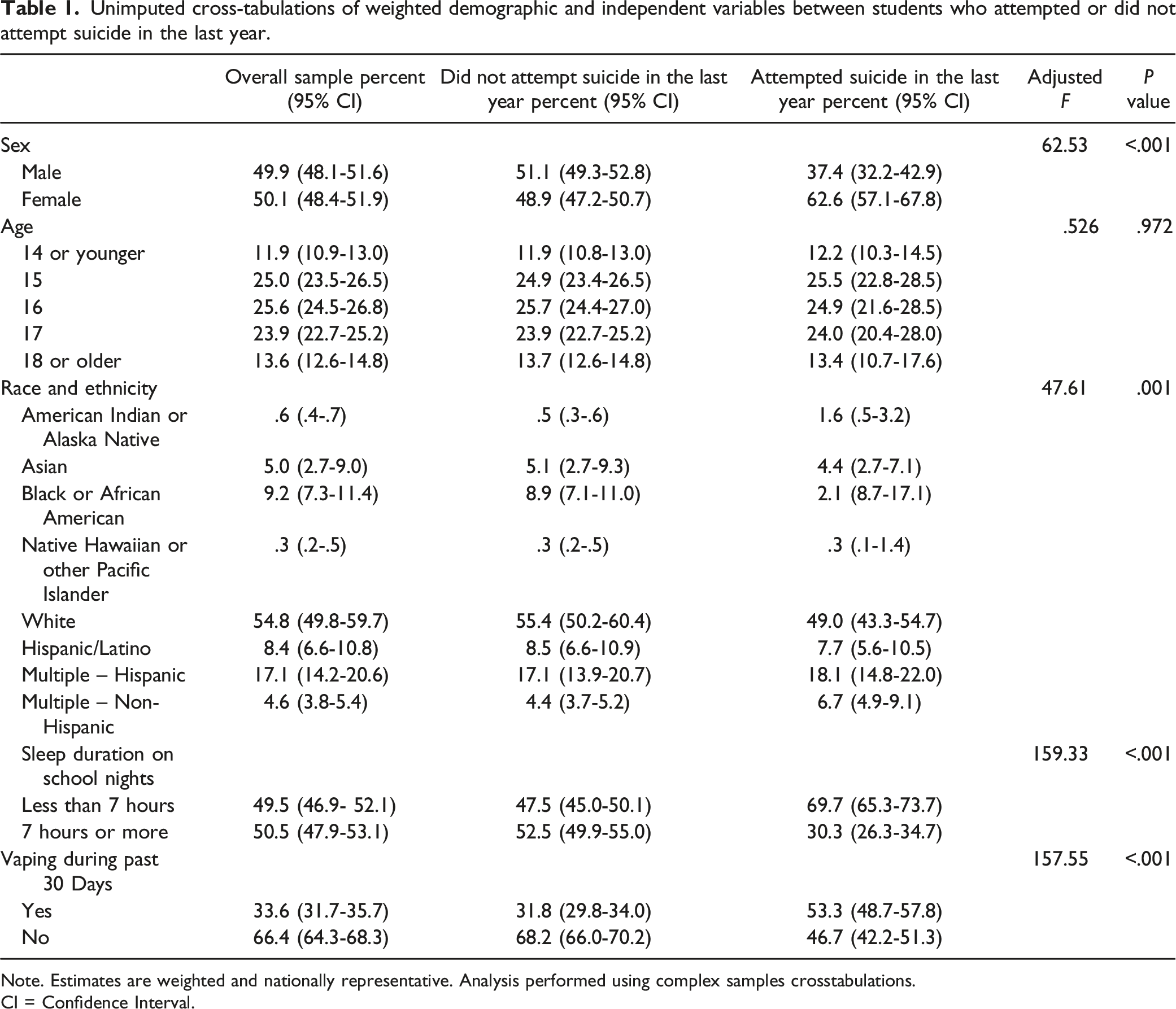
Note. Estimates are weighted and nationally representative. Analysis performed using complex samples crosstabulations.
CI = Confidence Interval.
Suicide Attempt
Logistic regression pooled estimates for dependent variables and covariates on suicide outcomes.
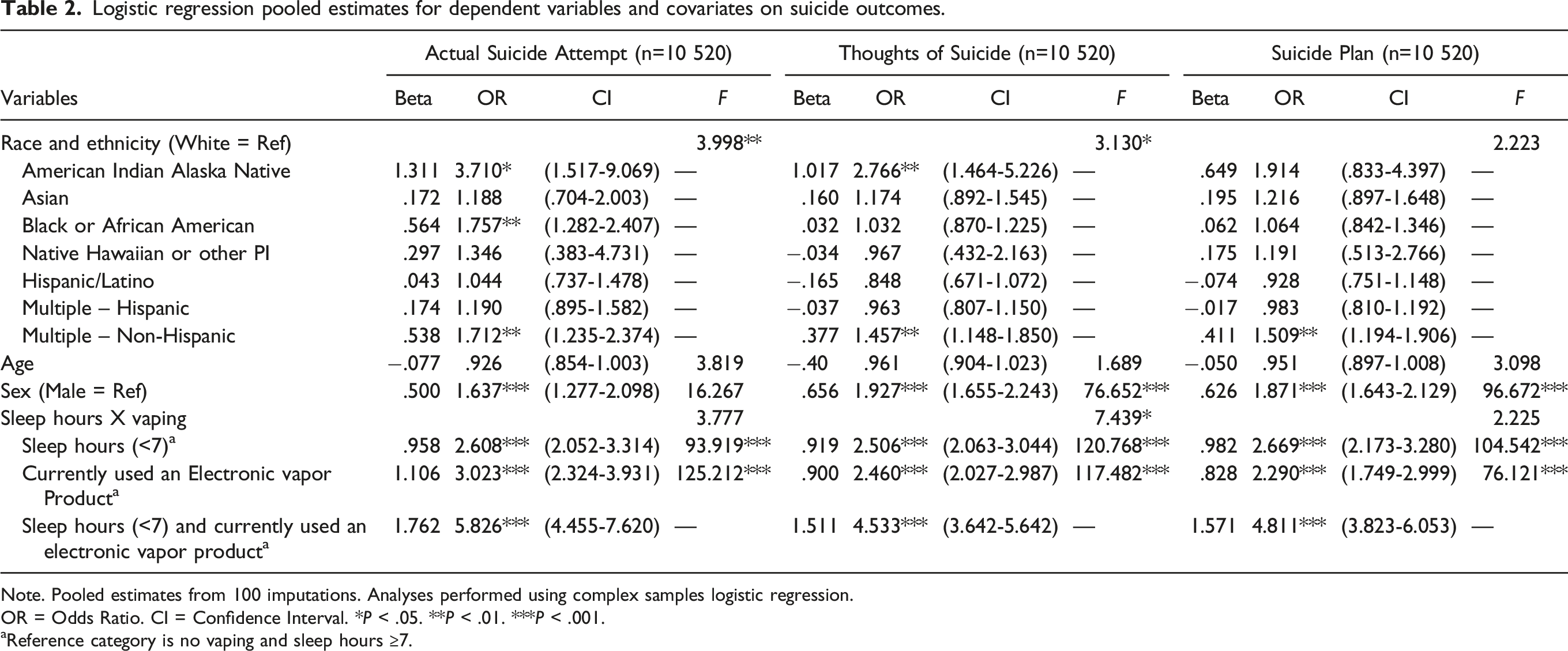
Note. Pooled estimates from 100 imputations. Analyses performed using complex samples logistic regression.
OR = Odds Ratio. CI = Confidence Interval. *P < .05. **P < .01. ***P < .001.
aReference category is no vaping and sleep hours ≥7.
Suicidal Thoughts
We substituted suicidal thoughts in the past year for suicide attempts in the past year as the outcome variable in the logistic regression model. There was a significant interaction between use of a vaping device in the past month and self-reported sleep hours on school nights (F = 7.439 [1, 34], P = .01). Interactions were deconstructed by comparing the odds ratio of vaping in the last 30 days on suicide by students who reported less than seven hours of sleep on school nights and students who reported seven or more hours of sleep on school nights when controlling for sex, age, and race and ethnicity. Among students with less than seven sleep hours on school nights, there was a significant association between vaping in the past month and suicidal thoughts in the past year (β = .574, OR = 1.775, 95% CI = [1.516-2.078]). However, the odds ratio was somewhat higher among students who slept seven or more hours on school nights (β = .825, OR = 2.505, 95% CI = [2.062-3.043]).
Suicide Plan
We then substituted suicide plan in the past year for suicide attempt in the past year as the outcome variable in the logistic regression model. There was no significant interaction between use of a vaping device in the past month and self-reported sleep hours on school nights (F = 2.225 [1, 34], P = .15), but significant main effects emerged. Students with less than seven sleep hours on school nights (β = .982, OR = 2.669, 95% CI = [2.173-3.280]) and students who used vaping devices in the past month (β = .828, OR = 2.290, 95% CI = [1.749-2.999]) had higher odds of suicidal thoughts in the last year when controlling for sex, age, and race and ethnicity.
Discussion
Overall, these results identify student demographics and risk behaviors that indicate higher odds of suicidality in the past year. Results from the multiple logistic regression suggest that while there are significant main effects of vaping and sleep hours on suicide attempts, there is not an interaction between vaping and sleep on the primary outcome of suicide attempts, contrary to the hypothesis. Specifically, adolescents who reported using a vaping device in the last 30 days had higher odds of having a suicide attempt in the last year than adolescents who did not vape. In addition, adolescents who reported sleeping less than seven hours on school nights had significantly higher odds of a suicide attempt in the last year than adolescents who reported sleeping seven or more hours on school nights. These main effect findings held for suicidal thoughts and suicide plan outcomes.
Of note, there was a significant interaction between vaping and suicide for outcome of suicidal thoughts in the last year. While this was a weak interaction, it indicates the strength of the relationship between vaping in the last month and suicidal thoughts is dependent on self-reported hours of sleep on school nights. Specifically, current use of vaping devices was somewhat less predictive of suicidal thoughts in the past year among students who slept less than seven hours on school nights compared to students who slept seven or more hours on school nights. One potential explanation is the correlation between vaping and sleep, which influences their combined effects on suicide. 21 However, an alternative explanation is the shared construct of impulsivity within the context of suicide theory. Impulsivity is a strong predictor of adolescent suicidality and one of the key constructs in the Interpersonal Theory of Suicide. 35 Adolescent drug use 35 and poor sleep 36 are both correlated with impulsivity. Adolescents who are using vaping devices may be more impulsive than adolescents who do not vape and thus at higher risk for other risk behaviors, including suicidality. Regarding sleep, there are neurobiological explanations for some of the effect of sleep on suicidality, 37 but sleep may influence suicidality through impulsivity as well. 38 Because both vaping and sleep impact impulsivity which predicts suicidality, it is possible that vaping and poor sleep contribute these diminished effects when predicting suicidality due to their conceptual overlap. Though the YRBS did not include an indicator of impulsivity, future research on vaping and suicide should explore impulsivity as a potential covariate.
This study is, to our knowledge, the first to examine both vaping and sleep on suicide outcomes on U.S. high-school students. This research contributes to a growing body of nicotine and suicidality research and indicates support for vaping as a potential predictor of suicide. While prior studies have examined vaping and suicidality in adolescents, 39 the present study examined suicide outcomes and controlled for sleep hours on school nights. The main effect findings also contribute to the body of literature examining sleep as a predictor of suicide among adolescents.14,15 This representative sample of adolescents slept far less than the daily recommended 8-10 sleep hours 24 and this finding is consistent across previous years of the YRBS. 40 International studies utilizing their own YRBS found similar results in Korean adolescents.19,20
Limitations
The YRBS is subject to general limitations described in previous publications. 22 Limitations for this study include the cross-sectional sample, which prevents us from addressing temporality or concluding that vaping or sleep are predictive of future suicide attempts. The cross-sectional nature of the YRBS also limits conclusions of directionality, such that there is potential that adolescents who attempted suicide in the past year were more likely to initiate vaping or sleep poorly. Future studies to address the present research questions within cohort samples or short-term longitudinal research are recommended. In addition, only students who responded to the primary outcome variable of suicide attempts in the last year were included. This limits the generalizability of the results to students who are willing to respond to questions about suicidality. However, this may result in an underestimate of the effects in the statistical model, as students who attempted suicide may have not responded because of stigma or fear of repercussions. A third limitation is the self-report nature of the present measures. Neither self-reported sleep hours on school nights nor self-reported vaping use are the best practice measure of adolescent sleep health or vaping use. Further, the 2019 YRBS does not allow for differentiation between vaping of nicotine or marijuana. In this weighted sample, 22.3% of the students reported using marijuana in the past month. Among these students, 79.5% reported using a vaping device in the past month. It is likely that some students vaped marijuana, but the YRBS question structure does not allow for analyses between students who vaped nicotine, vaped marijuana, or vaped both substances. It is also possible that students modified nicotine vaping devices to add THC liquid. Despite the limitations in substance identification, the behavior of vaping is much easier for schools to identify as a risk factor as compared to substance identification, increasing the external validity of these findings. This particularly applies when students use both substances or substances are modified. Future research that aims to understand the contribution of substance use to suicide should utilize best-practice, validated measurements of these variables
Conclusion
The results of this study indicate the potential of vaping and sleep as predictors of adolescent suicide, and these findings have significant implications for high-school students, parents, school staff and leadership, community members, and researchers. The results of this analysis identify students who vape or report poor sleep as ideal participants in suicide prevention interventions as they may be at higher risk for potential suicidality. When implementing suicide prevention education or general mental health education, educators and school leadership should provide special consideration to the relationships between vaping and poor sleep to mental health outcomes. Schools implementing sleep or substance use interventions should provide additional information regarding the higher odds of suicide among students with low sleep or substance use habits. Including the potential reductions in suicidality from sleep or substance use interventions could also improve willingness of schools and communities to implement these interventions. Parents, community members, and school staff should be mindful of student’s vaping and sleep habits and monitor students who report vaping or poor sleep for potential suicidality. Finally, future researchers should expand upon these findings with longitudinal or cohort studies to further explore the impacts of vaping and sleep on adolescent suicide. Suicide is a leading cause of death for high school students. Vaping and low sleep quantity both negatively affect suicidality among adolescents. This study examined adolescent self-reported suicidality, vaping, and sleep quantity. Students who vaped or slept poorly had higher odds of suicidal thoughts, plans, and attempts in the past year. Sleep quantity moderated the relationship between vaping and suicidal thoughts; specifically, vaping was somewhat less predictive of suicidal thoughts among students who sleep fewer than seven hours compared with the larger effect among participants with longer sleep. Those implementing vaping, sleep, or suicide interventions should be mindful of the increased odds of prior suicide attempts among students who vape or report low sleep quantity. Future research should utilize longitudinal methods and validated measures to further examine described relationships.So What?
What is already known on this topic?
What does this article add?
What are the implications for health promotion research or practice?
Footnotes
Author Contributions
Cody W. Welty: Initiated the design, analysis, and write-up of the publication.
Lynn B. Gerald, Uma S. Nair, and Patricia L. Haynes: Assisted in the design and interpretation of the analysis, assisted in the drafting of the manuscript, and approved the final manuscript.
Lynn Gerald: Assisted in the design and interpretation of the analysis, assisted in the drafting of the manuscript, and approved the final manuscript.
Patricia Haynes: Assisted in the design and interpretation of the analysis, assisted in the drafting of the manuscript, and approved the final manuscript.
Declaration of Conflicting Interests
The author(s) declared no potential conflicts of interest with respect to the research, authorship, and/or publication of this article.
Funding
The author(s) received no financial support for the research, authorship, and/or publication of this article.
