



Abstract
Purpose
To examine the associations of current electronic cigarette and cannabis use patterns with depression symptoms and suicidal ideation and behavior overall and stratified by sex among U.S. high school students.
Design
Quantitative, cross-sectional study.
Setting
The 2019 National Youth Risk Behavior Survey.
Subjects
12,401 high school students in 9th−12th grade.
Measures
Dependent variables were depression symptoms, suicidal ideation, suicide plan, suicide attempt, and suicide attempt-related injury. Independent variables were past 30 day e-cigarette and cannabis use patterns. Covariates included demographics, grade level, and other tobacco product use.
Analysis
Multivariable logistic regression models.
Results
Approximately 15.7% of students were exclusive e-cigarette users, 4.5% were exclusive cannabis users, and 16.4% were concurrent e-cigarette and cannabis users. Exclusive e-cigarette and cannabis users, and concurrent users were at increased odds (P < .05) of having depression symptoms, seriously considered attempting suicide, planning suicide, suicide attempt, and having suicide attempt-related injury compared to non-users. Female users, especially concurrent users, had higher odds of reporting depression symptoms (P < .01) and all suicidal ideation and behavior outcomes (P < .01) than female non-users, but results varied for male students.
Conclusion
E-cigarette and cannabis use patterns significantly predicted depression symptomatology and suicidal ideation and behavior, with female students having higher odds. Results suggest the need for tailored interventions to address mental health and suicidality among U.S. adolescents, and especially female students.
Keywords
Introduction
Adolescence is a critical time for neurocognitive development, and the use of electronic cigarettes and/or cannabis during this developmental period is linked with alterations in brain structure, function, and neurocognition. 1 Although the developing brain is resilient, studies have found that exposure to nicotine and cannabis has adverse health effects. Exposure to nicotine and/or cannabis is associated with attention and working memory deficit, 2 neurocognitive abnormalities, including abnormal brain morphometry and function, lower intelligence, sustained attention, verbal memory, and executive function, particularly among those with an early age of use onset.1,3,4
Adolescence is also a period of pubertal and social development, which further increases the likelihood for health-risk behaviors and outcomes such as substance use and depression. 5 Depression is a leading cause of impairment, disability, and suicidal behavior. 6 In recent years, there has been an increased prevalence of depressive disorders among adolescents. 7 Between 2007 and 2018, fatal suicide among adolescents increased by 57.4%, 8 and some of this is attributed to the increased prevalence of depression. Additionally, there was a 12% increase in major depressive episodes from 11.4% in 2009 to 23.4% in 2019 among girls, with the sex-related gap also increasing from 6.4 to 14.8% during the same 11 year period. 6
Due to the high prevalence of e-cigarette and cannabis use, depression, and suicidal behaviors among adolescents, this study will extend current literature by examining the associations of current e-cigarette and cannabis use patterns with mental health (ie, depression symptoms) and suicidal ideation and behaviors overall and stratified by sex among a nationally representative sample of U.S. adolescents.
Methods
Design and Sample
Cross-sectional data were obtained from the 2019 National Youth Risk Behavior Survey (YRBS) conducted by the Centers for Disease Control and Prevention (CDC). Detailed information on the YRBS methodology and sampling procedures are available at www.cdc.gov/yrbs and also published elsewhere. 10 The YRBS surveys students in grades 9-12 at U.S. public and private high schools using a three-stage cluster design to obtain a nationally representative sample of high school students. The 2019 YRBS school and student response rates were 75.1 and 80.3%, respectively; the overall response rate was 60.3%. The CDC’s institutional review board approved the protocol for the YRBS study. The publicly available data has been de-identified; hence, the study was exempt from a university IRB approval.
Measures
Current e-Cigarette and Cannabis Use
Participants were asked 2 questions: “During the past 30 days, on how many days did you use an electronic vapor product?” and “During the past 30 days, how many times did you use marijuana”. Responses to these questions were dichotomized into no current use (ie, 0 times) and current use (ie, ≥1 time/day) and were used to create a composite current e-cigarette and cannabis use independent variable with 4 mutually exclusive categories: (1) no e-cigarette and cannabis use; (2) exclusive e-cigarette use; (3) exclusive cannabis use; and (4) concurrent e-cigarette and cannabis use in the past 30-days.
Mental Health and Suicidal Ideation and Behaviors in The Past 12-months
We examined 5 dependent variables that measured mental health and suicidal ideation and behaviors in the past 12 months: (1) depression symptoms; (2) suicidal ideation; (3) made a suicide plan; (4) suicide attempt; and (5) suicide attempt-related injury that required medical treatment. Participants were asked how many times during the past 12 months they experienced the symptoms or behaviors. Response options were dichotomized into no (ie, 0 times/did not attempt) and yes (ie, ≥1 time) for analytic purposes.
Demographic and other Tobacco Product Use Covariates
We included the following demographic variables as covariates: (1) sex (male, female); (2) race/ethnicity (non-Hispanic White, non-Hispanic Black, Hispanic/Latino, and Other (includes Asian, American Indian/native Hawaiian, multiracial non-Hispanic)); and (3) grade level (ninth, 10th, 11th, and 12th). We also included other tobacco product use (cigarette, smokeless tobacco, cigars, cigarillos, and little cigars) as covariates.
Statistical Analysis
Data were weighted on sex, race/ethnicity, and grade level to allow for survey design and differences in school and student nonresponse and the oversampling of non-Hispanic Black and Hispanic students. In addition to Chi-square test of differences in participant demographics based on their current e-cigarette and cannabis use patterns, separate adjusted logistic regression analyses were conducted for each of the 5 mental health and suicidal ideation and behavior variables (reference category was the no e-cigarette and cannabis use group). Analyses controlled for sex, race/ethnicity, grade level, and other tobacco product use. Stratified adjusted logistic regression analyses were also performed to assess potential sex-based differences. Adjusted odds ratios (aORs) and 95% confidence intervals (CIs) were calculated using the complex samples logistic regression procedure (CSLOGISTIC) in IBM SPSS Statistics 28, and P < .05 indicated statistical significance.
Results
Descriptive Characteristics
Descriptive Characteristics of the Analytic Sample Overall and by Current E-Cigarette and Cannabis Use Patterns, 2019 YRBS.
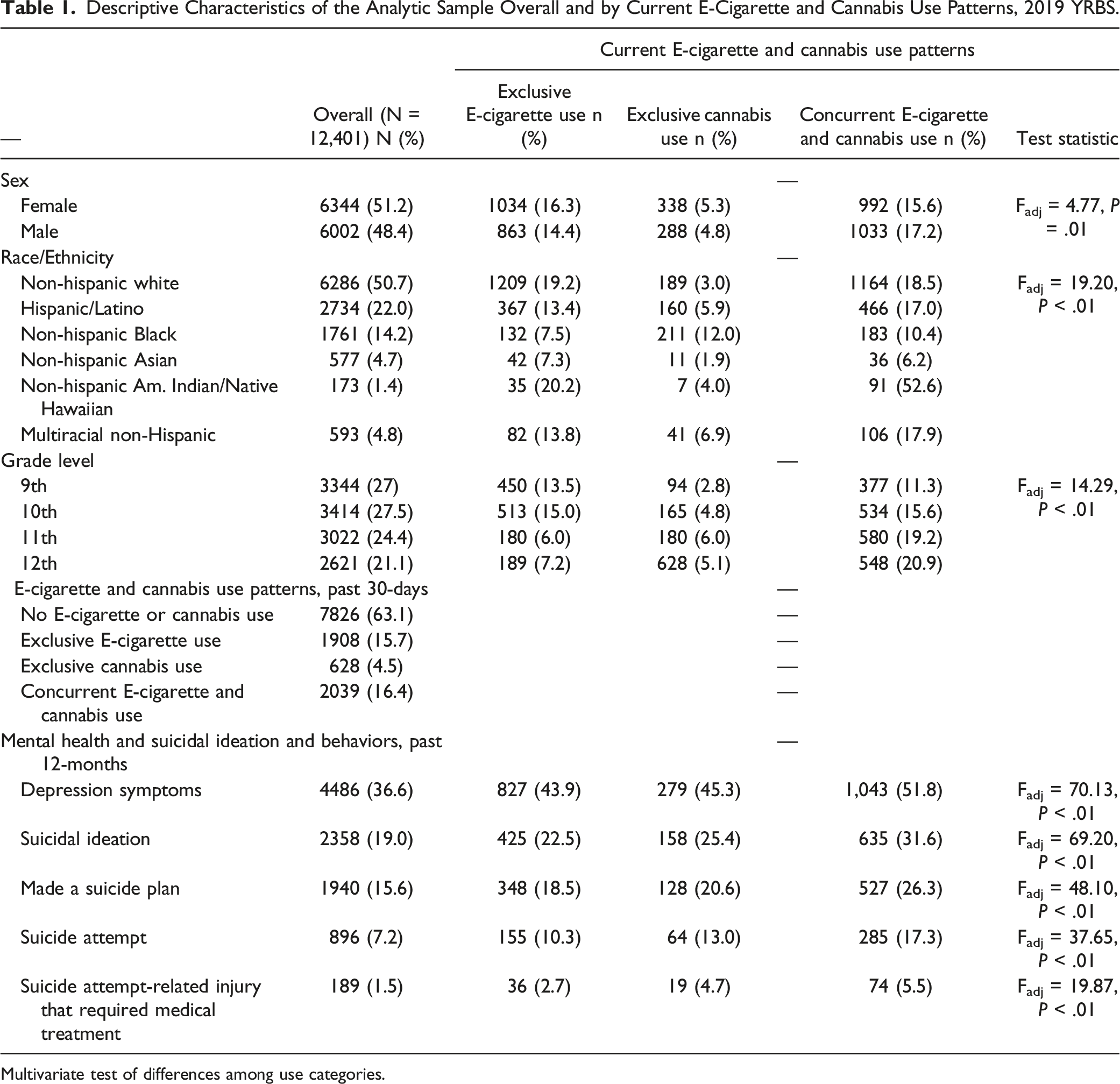
Multivariate test of differences among use categories.
E-Cigarette and Cannabis Use Patterns and Mental Health and Suicidal Ideation and Behaviors among the Overall Sample
Multivariable Logistic Regression Results of the Association Between Current E-Cigarette and Cannabis Use Patterns and Mental Health and Suicidal Ideation and Behaviors, 2019 YRBS.
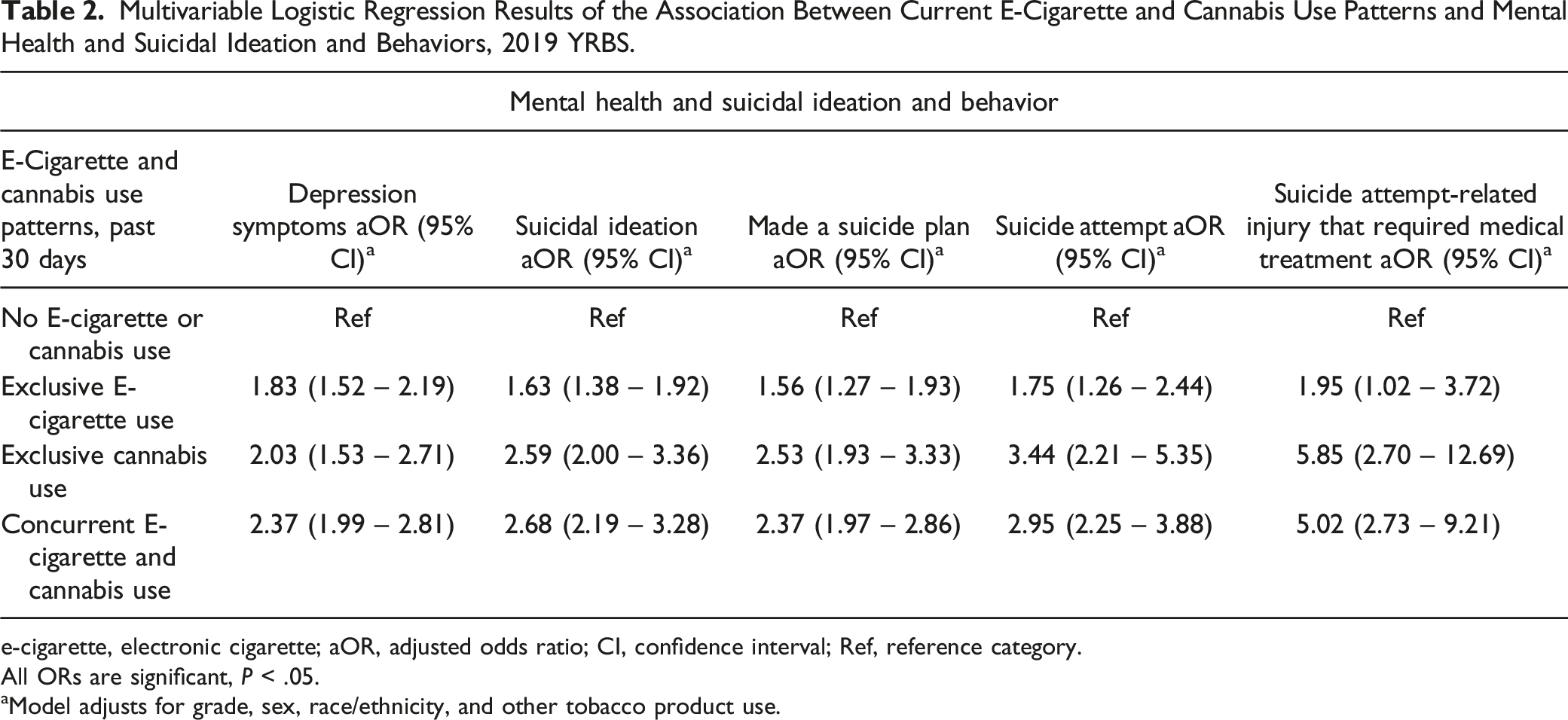
e-cigarette, electronic cigarette; aOR, adjusted odds ratio; CI, confidence interval; Ref, reference category. All ORs are significant, P < .05.
aModel adjusts for grade, sex, race/ethnicity, and other tobacco product use.
E-Cigarette and Cannabis Use Patterns and Mental Health and Suicidal Ideation and Behaviors Stratified by Sex
Multivariable Logistic Regression Results of the Association Between Current E-Cigarette and Cannabis Use Patterns and Mental Health and Suicidal Ideation and Behaviors Stratified by Sex, 2019 YRBS.
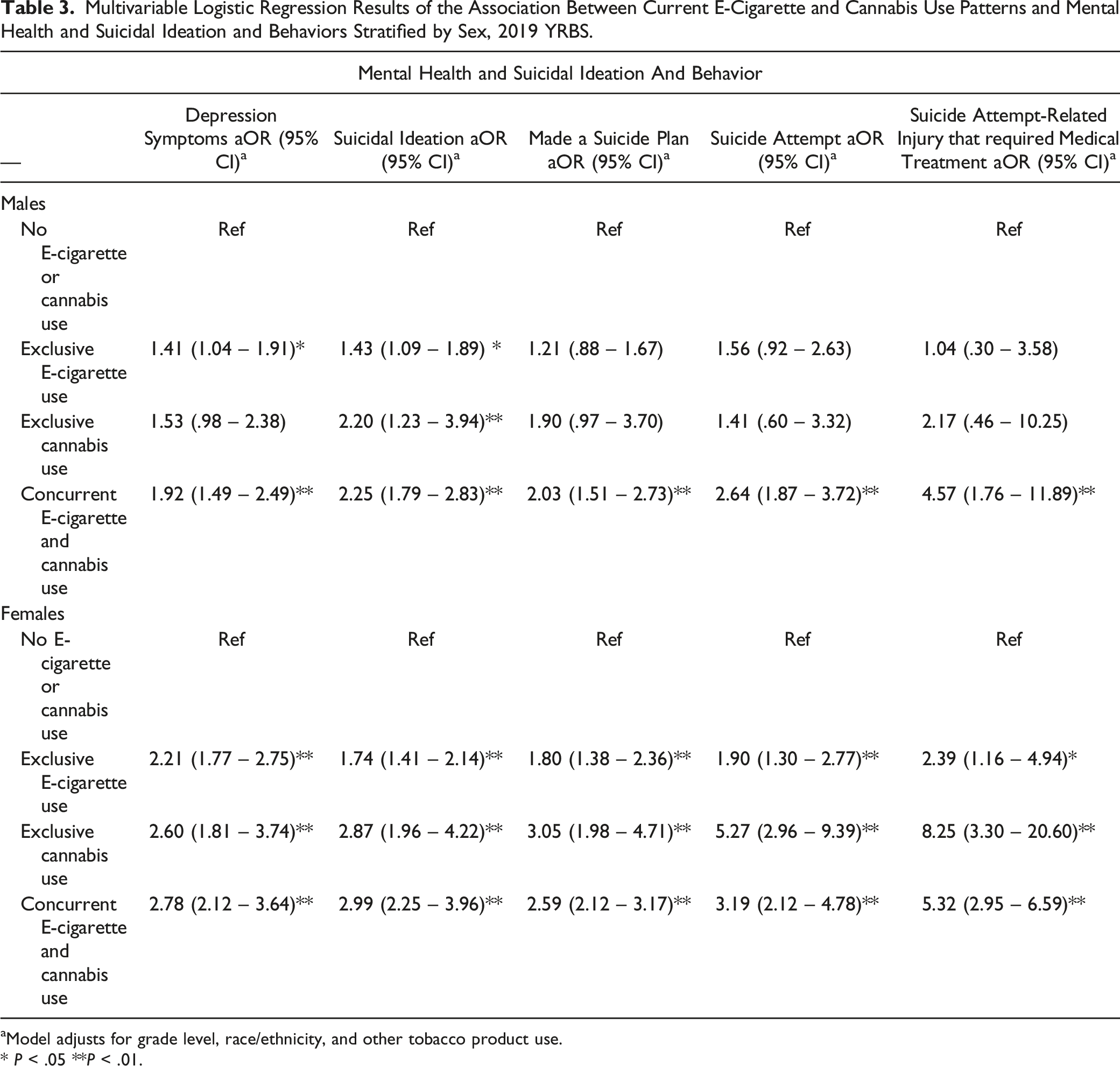
aModel adjusts for grade level, race/ethnicity, and other tobacco product use.* P < .05 **P < .01.
Female exclusive e-cigarette users, exclusive cannabis users, and concurrent e-cigarette and cannabis users were at increased odds of having seriously considered attempting suicide compared to female non-users. Similar patterns were observed for female use behaviors and making a suicide plan, attempting suicide, and sustaining a suicide attempt-related injury that required medical treatment. For males however, only male concurrent users were at significantly increased odds of making a suicide plan; suicide attempt; and having a suicide attempt-related injury that required medical treatment compared to non-users (see Table 3).
Discussion
Overall, this study found that e-cigarette and cannabis use patterns were associated with increased odds of adverse mental health and suicide-related outcomes among U.S. adolescents. It is noteworthy that concurrent users of e-cigarette and cannabis had the highest magnitude of odds followed by exclusive cannabis users and then exclusive e-cigarette users. The current study’s results confirm previous studies, and extends the literature by demonstrating the heightened odds of mental health problems associated with concurrent use of e-cigarette and cannabis.9,11,12
Our sex-stratified analyses also indicate that female exclusive and/or concurrent users were at increased odds for of depression symptoms and suicidal ideation and behaviors relative to female nonusers, but results among male users vs non-users varied. This finding supports and expands on earlier work 5 that highlights sex disparities in the associations between tobacco and cannabis use and adolescent mental health and suicidal ideation and behavior. In the present study, we extend the literature by showing female adolescents who reported concurrent e-cigarette and cannabis use are at significantly increased odds of reporting depression symptoms and suicidal ideation and related behaviors, with very high odds of at least 7 times or higher among female exclusive e-cigarette users and concurrent users.
There are several possible explanations for why female users had higher odds of depression symptoms and suicidal ideation and behaviors. First, previous work found that female adolescents, compared to males adolescent, are generally at higher odds of having mental health symptoms due to menarche, rapid hormonal changes they experience, 13 and emotional stressors associated with forming and maintaining interpersonal relationships during adolescence.14,15 Given this underlying susceptibility, female e-cigarette and/or cannabis users may be more likely to experience higher levels of depression symptoms and suicidality due to substance use being capable of inducing depression-like behavioral consequences in adolescent users. 16 Second, socio-cultural contexts may be another explanation. Particularly for female youth, motivations for using e-cigarettes include weight management and stress relief. 17 Thus, the stronger association could be a result of the inherent mental state of female users in addition to the neuropsychiatric toll that e-cigarette and cannabis use exerts on the growing adolescent brain, which further exacerbates the cognitive, neurological, and behavioral health of female users. Future longitudinal research is needed to assess these potential associations.
Despite this study’s contributions and strengths of using 2019 national YRBS data, the results should be interpreted considering the study limitations. Data examined were cross-sectional; therefore, the temporality and causal nature of current e-cigarette and cannabis use and depression symptoms and suicidal ideation and behaviors could not be determined. Another limitation is that the YRBS measured mental health with a screening tool rather than diagnostic interview. Although the YRBS questions have demonstrated good reliability and have been shown to be nationally representative, 10 the YRBS includes only students enrolled in a public or private high school. Therefore, results might not be representative of out-of-school youth who are more likely than youth attending school to engage in health risk behaviors. 18
The current study highlights the risks associated with e-cigarette and cannabis use among U.S. adolescents, and specifically, the increased odds of mental health and suicidal behavior comorbidities surrounding exclusive and concurrent use of these products. This study also shows that female users are at disproportionately higher odds than male users. Future research is encouraged to assess current e-cigarette and cannabis use patterns and the unique and common vulnerabilities to depression symptoms and suicidal ideation and behaviors for female and male students. More specifically, future investigations are needed to identify potential biological mechanisms that may account for or interact with other factors that were unavailable in the public-use YRBS data set (eg, social and emotional stressors), especially for female students.
Implications for Health Promotion Practitioners and Researcher
What is already known on this topic?
E-cigarette and cannabis use increases the risk for internalizing (e.g., depression) and externalizing (e.g., suicide ideation and other related behaviors) mental health symptoms among adolescents.
What does this article add?
This national study of U.S adolescents shows concurrent users of e-cigarette and cannabis had the highest magnitude of risk for mental health symptoms followed by exclusive cannabis users and then exclusive e-cigarette users. Female users are also at higher risk compared to males who use similar product patterns and female non-users.
What are the implications for health promotion practice or research?
Highlights the need for development of targeted interventions and the adaptation of existing programming for U.S. high school students focused on addressing the comorbidities of e-cigarette and cannabis use and poor mental health outcomes.
Footnotes
Author Roles
All authors met the core 4 ICMJE requirements for authorship. Specifically, W.J designed the study, acquired and analyzed the data, and drafted and revised the manuscript; G. O and G.V. cleaned the data and drafted the manuscript; A.L.M. interpreted and revised the manuscript critically for intellectual content. All authors approved the manuscript; all authors have participated sufficiently in the work to take public responsibility for the content. The data employed publicly available YRBS data and therefore was exempt from institutional review.
Acknowledgments
The authors thank Cynthia Garcia for her contributions to data preparation, cleaning, and analyses.
Declaration of Conflicting Interests
The author(s) declared no potential conflicts of interest with respect to the research, authorship, and/or publication of this article.
Funding
The author(s) received no financial support for the research, authorship, and/or publication of this article.
