




Abstract

Grief is a near-universal painful human experience. The days, weeks, and months following the death of a loved one are among the most painful and life altering times most people will ever face. 1 Common reactions include a sense of disbelief and numbness, intense yearning or pining, and deep sadness and despair. 2 Along with emotional distress, early grief is associated with increased physical symptoms, illnesses, hospitalizations, and a 40-50% increase in rates of mortality.3-5 Recognizing bereavement as an important risk factor for morbidity and mortality, in 2019, the Georgia Department of Public Health, in collaboration with the Centers for Disease Control and Prevention, added three questions to its annual Behavioral Risk Factor Surveillance Survey (BRFSS) to assess the prevalence of new bereavement—defined as experiencing the death of a family member or friend in the past 2 years. The survey, conducted pre-COVID, found that 45.8% respondents had been newly bereaved. 6
The emotional and physical impacts of grief spill over into the workplace. Bereaved employees have higher rates of absenteeism in the year following the death and are more likely to quit their jobs or change careers.7,8 In addition, trouble concentrating, sleep problems, loss of motivation, and shifts in priorities can reduce productivity, sound decision-making, and functioning at work and increase the risk of on-the-job injuries.9-13 Twenty years ago, in ground-breaking research, the Grief Recovery Institute estimated that grief from the death of a loved one cost employers $37.5 billion annually, 13 which equates to $60.5 billion in today’s dollars. The real costs are likely far higher, given the increase in the number of deaths each year and the number of people bereaved. With the additional deaths due to COVID-19 and with our aging population (there were 2.45 million deaths in 2003 and 3.46 million in 2021 14 ), we’re experiencing a “tsunami of bereavement grief” 15 that is unlikely to subside.
Social and community supports during bereavement are generally inadequate.4,16,17 For example, one study found that only a minority of grievers were extremely satisfied with the support they received from online grief groups (39%), counselors and therapists (38%), friends (25%), family (20%), faith leaders (17%), and so on. 18 Many grievers aren’t comfortable reaching out for help, and potential supporters feel ill-equipped to offer it. We live in a society that is “grief-denying” 19 and where “health professionals, friends, and colleagues ‘disappear,’ lack compassion, and offer insensitive comments and platitudes because they do not know how to be supportive.” 20
Most of the research on grief in the workplace has focused on bereavement policies and the extent to which organizations accommodate the instrumental needs of grieving employees–for example, by providing bereavement leave and allowing flexible or reduced work hours as individuals adjust to their new realities.7,21,22 Based on a U.S. Department of Labor survey, 56% of civilian workers have access to paid bereavement leave, but the benefit is linked to income: 81% of the top 10% of wage earners in the U.S. have access to the employer-sponsored benefit, compared to just 19% of the bottom 10% of earners. 23 Furthermore, the average length of bereavement leave in the U.S. is just 3 days, 24 which is inadequate to grieve a major loss. Notable exceptions include Meta, formerly Facebook, which in 2017 expanded its bereavement leave to 20 days for employees who lost an immediate family member and 10 days for employees who lost an extended family member. Since then, a few other companies, including Mastercard, Zillow, and New York Life Insurance Company, have followed suit. 25
While work can serve as a helpful distraction from grief, bereaved employees who return to work too early often “stifle” their grief 26 out of shame or the sense that grief does not belong in the workplace. This results in what the bereavement literature calls “disenfranchised grief”–grief that is unacknowledged and unvalidated–which can make the grief experience more lonely, painful, and debilitating.9,27-29
How can organizations support bereaved employees? Based on in-depth interviews with bereaved individuals who returned to work, Gilbert and colleagues 30 developed the C.A.R.E. model for bereavement support in the workplace. The four components of the model are: (1) two-way communication about the loss, the employee’s needs, and information about the bereavement policies and resources; (2) accommodation and instrumental support to meet the employee’s needs, such as flexible work hours, extra breaks, or a job redesign to reduce stress; (3) recognition of the loss, especially from senior leadership; and (4) emotional support, especially empathy and compassion, and giving the employee opportunities to talk about the loss. Other research31,32 and the trade literature25,33,34 identify similar components for an effective bereavement policy.
With the surge in death and grief, Employee Assistance Programs (EAPs) are seeing a parallel surge in requests from employers for ongoing, expert grief support for bereaved employees. To meet that need, some EAPs are now offering digital solutions such as Help Texts for Grief, a 12-month text message program that delivers twice-weekly text support, information, ideas and small nudges to support engagement in coping behaviors, all tailored to user characteristics. Developed and curated by grief experts, the messages for grievers highlight that often what they’re experiencing is common and that help is available. Help Texts for Grief messages are grounded in contemporary models of grief and coping, especially the Dual Process Model of Coping with bereavement, which posits that adaptation to the death of a significant person involves the oscillation between two types of coping behaviors: those focusing on loss and those focusing on restoration.35-38 Health Texts messages addressing loss suggest, for example, carrying or wearing something that belonged to the deceased and talking to a friend to make sense of what happened. Those addressing restoration include engaging in hobbies, asking for help dealing with financial matters, and transitioning back to work. Figure 1 shows a Help Texts restoration-focused message with strategies for managing the cognitive impacts of grief when returning to work. In addition, to increase grief literacy, friends and family who want to support the grieving employee can receive texts with education on grief and practical tips for how to help the bereaved. Organizations providing the Help Texts for Grief program to clients have the option of delivering one customized, organization-specific text message per month, providing a channel for communicating about organization-specific information, resources, and programs for grief support. With regard to the C.A.R.E. model, the program can empower organizations to meet grievers’ needs for communication, recognition, and emotional support. Help texts message with a restoration orientation.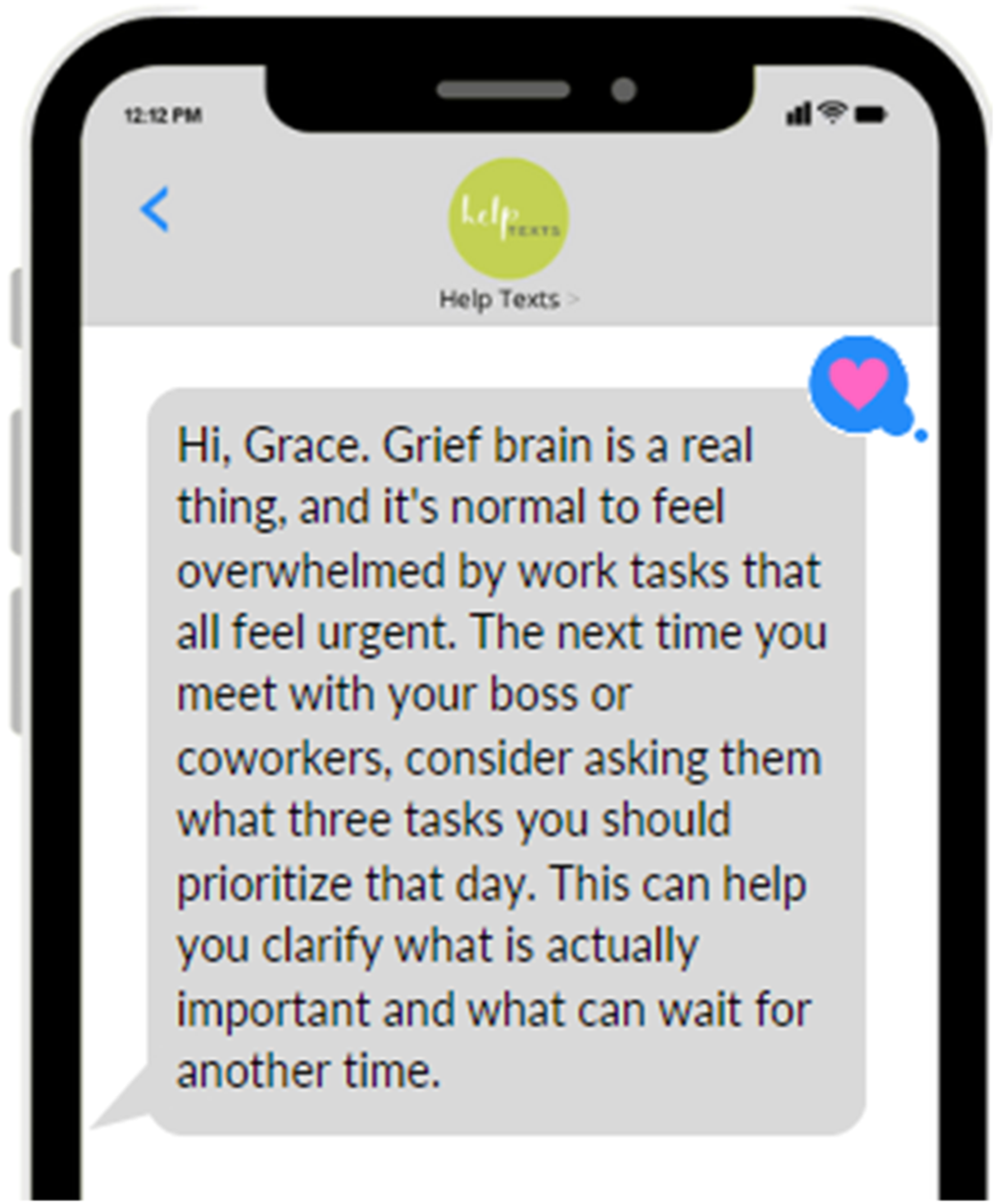
In pilot testing involving a total of 100 grievers who had received Help Texts for Grief as a hospice benefit, the mean rating of program helpfulness, with 1 = ”very unhelpful” and 5 = ”very helpful”, was 4.7 (SD = .5). Eighty-six percent of grievers continued to receive in the program for more than 1 year. 39
It’s easier to think about gym memberships than it is to think about bereavement leave. But employers want to do the best they can for their employees. They’re finding ways to recognize grief in the workplace and to offer a diverse array of personalized and compassionate tools and support options.