



Abstract
Purpose
The COVID-19 pandemic has led to profound changes in the workplace as well as increases in stress, missed preventive care, and other health concerns. There is limited research since the onset of the pandemic on employees’ primary health concerns and their willingness to engage with workplace health promotion (WHP) programs to address these needs. We conducted this survey about employees’ current health priorities as a first step to exploring whether WHP programs need to evolve to be responsive to employees’ needs at this stage of the pandemic.
Design
National cross-sectional survey.
Setting
United States, April 29-May 5, 2022.
Subjects
2053 Americans employed part or full time.
Measures
17-item online survey assessing demographics, health priorities, and impact of the pandemic on health.
Analysis
Descriptive statistics, SPSS Version 19.
Results
Employees’ most common health concerns included work/life balance and stress (each cited by 55%). Nearly half (46%) said their health or well-being was affected by the pandemic; within this group, the most common concerns were stress (66%), anxiety (61%), sleep (49%), and depression (48%). Almost all (94%) indicated they would be open to receiving support from their employers.
Conclusion
This research is a first step in learning about employees’ current health priorities and how they may have changed. WHP researchers and practitioners can determine how their programs align with current priorities. Our future research will explore employees’ preferences, heath behaviors, and their current workplace environments in more depth.
Purpose
There are 164 million employed Americans. 1 The workplace is a uniquely effective place to reach adults “where they are” with evidence-based health promotion interventions.
Concerns about health, and mental health in particular, have increased among employees since the onset of the COVID-19 pandemic and its consequences for society (hereafter “pandemic”).2-4 Employees earning lower than average wages were particularly susceptible to declines in both physical and mental health during the pandemic.5,6
While prior research suggests that employees prioritize healthy eating and physical activity in workplace health promotion (WHP),7,8 we were unable to find any studies that address employees’ health concerns since the pandemic began affecting workplaces in March 2020, including what role WHP might play in addressing them. As little is currently known, this study is intended as a first-look at whether and how preferences may have shifted, and whether there were meaningful differences based on income or other demographic variables.
This applied research brief explores employees’ current health priorities, how the pandemic has impacted those priorities, and how open they are to receiving WHP that addresses their priorities. Future research will be needed to go deeper into how and why shifts have occurred and how best to meet changing needs.
Methods
The University of Washington Institutional Review Board determined that this study was exempt from formal review.
Design
A national cross-sectional survey was fielded online by Drive Research Incorporated, a market research company based in Syracuse, New York.
Sample
The survey was fielded with a sample pool balanced on the outgo (ie, respondents sent survey invitations) on six demographic variables (age, race, gender identity, household income, education, region) to reflect the U.S. population. Sample was drawn from Drive Research’s panel of over 15 million Americans who agree to periodically take surveys in exchange for incentives. Respondents were eligible to participate in the survey if they were employed full or part-time and worked for an organization that employed at least 10 people.
Measures
The 17-item survey covered respondents’ age, current employment status, type and size of the industries for which they work, previous and/or current participation in a workplace wellness program, types of wellness program offerings they have participated in, current concerns related to physical and mental health, the impact of the pandemic on their physical and mental health, and interest in WHP to address their pandemic-related concerns. All questions were multiple choice, and the survey took less than 10 minutes to complete. Respondents’ state of residence, gender identity, race, level of education, and annual household income were collected via Drive Research’s panel pre-screening.
Analysis
Descriptive statistics were calculated using SPSS Version 19. We analyzed data by total respondents and compared respondents with annual household incomes of <$75,000 and $75,000+ (categories chosen because many state and federal poverty levels are set at $55,500 or slightly higher for a family of four) and by age. We also analyzed data for a subset of respondents who reported their health was directly impacted by the pandemic.
Results
The survey was completed by 2053 employed Americans. An abbreviated set of demographics are listed below. Full demographics available upon request of author:
Age
Gender Identification
Race*
* Percentages for Race >100% because respondents could select more than one category.
Household Income
When asked about health topics they consider to be most important to them, employees were most likely to cite work/life balance and stress (each cited by 55%), followed by increasing physical activity (45%), better nutrition (44%), improving sleep (43%), and reducing anxiety (43%). Topics were similar across household income and age.
Among the subgroup of employees (46%) who reported that their health and well-being were directly affected by the pandemic, the two most cited concerns were stress (66%) and anxiety (61%), followed by sleep (49%) and depression (48%). Physical activity and work/life balance were each mentioned by 36% of these employees. The younger the respondent, the more likely they were to say their health was affected by the pandemic (55% among Millennials/Gen Z, 43% among Gen X, 31% among Silent Gen/Baby Boomers), but the concerns cited were similar across age groups. While there were differences by income, none were large (>10%). Ninety-four percent of employees directly affected by the pandemic said they would be open to receiving WHP related to the topics they selected.
Figure 1 presents a fuller set of findings from these two groups. Health among Americans employed part/full-time: 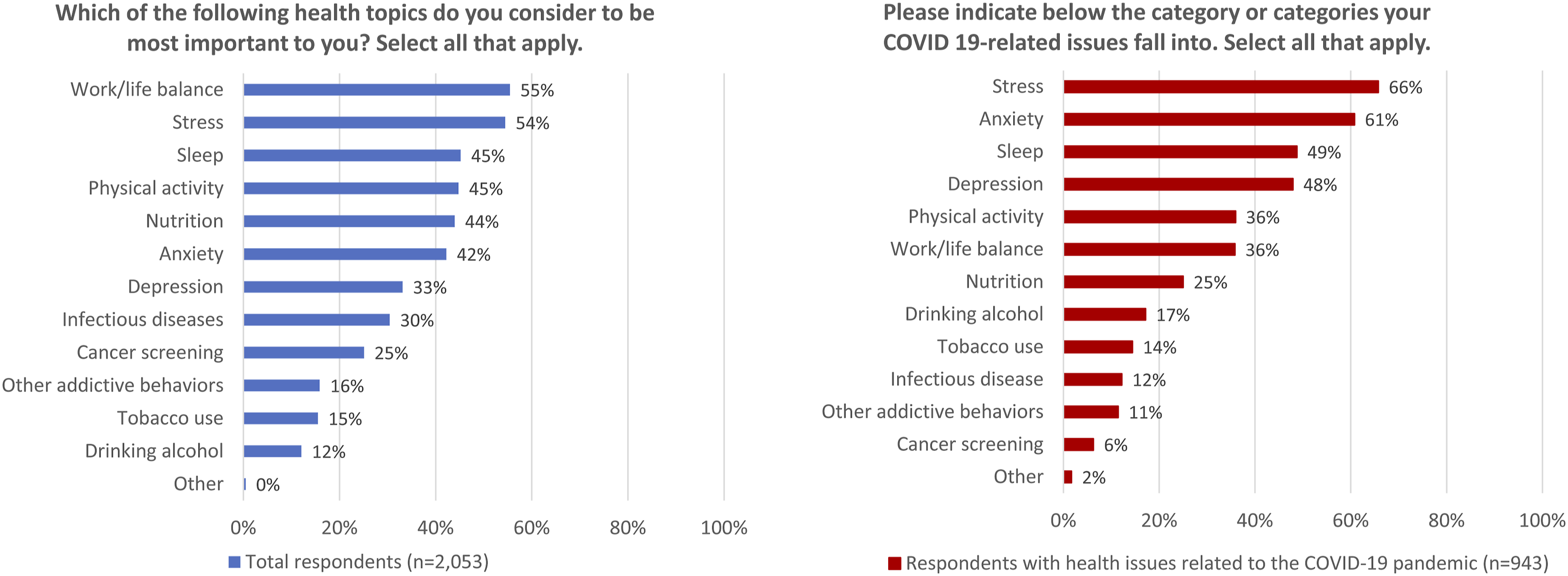
Discussion
Most of what we know about WHP, including what employees need and want WHP to address, is based on data gathered before March 2020. Previous research suggests that physical activity and nutrition were top priorities.7,8 Given the dramatic changes to both the working situations of many Americans and priorities around health unique to the pandemic era, it is vital for public health researchers and practitioners to figure out whether and how existing WHP needs to adapt.
Over half of all employees indicated that stress and work/life balance were among their top health priorities, regardless of income, and these topics were the top concerns among the subset who reported that the pandemic directly affected their health. These results are consistent with health concerns reported by the broader American population during the pandemic.9,10
We are struck by the relative lack of differences between household income groups. Respondents across income groups generally selected the same health priorities. Consistent with other findings, younger employees were more likely to report a direct impact of the pandemic on their health and well-being. 9 Almost all employees whose health was impacted by the pandemic were open to receiving WHP related to their priorities; this did not differ by household income or age. Future research should explore employee WHP needs and preferences in more depth, and employers’ capacity to address stress and work/life balance, especially in smaller or low-wage worksites that generally have less capacity for WHP.11,12
Summary
Our findings reveal that the primary health concerns of American employees include both physical and mental health, with work/life balance and stress of particular concern. For those whose health was directly impacted by the pandemic, priorities focused primarily on mental health issues, including stress, anxiety, sleep (which often negatively reflects increased levels of stress, anxiety and depression that people experience13,14) and depression. Most employees whose health declined during the pandemic are open to receiving support from their employers with their health concerns.
Limitations
This study was conducted via online survey, which does not allow probing on questions that might have benefited from it. There may be differences between individuals who agree to participate in market research panel surveys and those who do not. Questions addressing openness to workplace health promotion did not include the 54% of employees who indicated their health was not directly affected by the pandemic.
Significance
Since the onset of the pandemic, there has been little information on the WHP needs and wants of American employees. This research is a first step toward identifying what employees care about, how likely they would be to accept WHP on those topics from their employers, and how existing WHP might need to evolve to meet the challenges experienced by employees since March 2020. While some is known about the WHP wants and needs of employees, including those earning low-wages, surprisingly little research has been conducted with employees, including those earning low wages, who have been impacted most since the onset of the pandemic. Our research adds vitally important information about what American employees currently want and need from WHP. The survey results, conducted among a demographically balanced group of employees, suggest that traditional WHP may need to be adjusted given workplace and health realities since March 2020. Health promotion researchers in the field of workplace-based approaches to addressing health issues need to consider how the programs they promote might need to evolve given the effects of the pandemic.So What?
What is already known on this topic?
What does this article add?
What are the implications for health promotion practice or research?
Footnotes
Acknowledgments
The authors would like to thank Drive Research for their excellent data collection.
Declaration of Conflicting Interests
The author(s) declared no potential conflicts of interest with respect to the research, authorship, and/or publication of this article.
Funding
The author(s) disclosed receipt of the following financial support for the research, authorship, and/or publication of this article: This project was supported by grant 5R01CA160217 from the National Cancer Institute.
Correction (November 2023)
This article was updated to correct the article type to Applied Research Brief.
