



Abstract
Purpose
To test whether the impact of subjective norms, race/ethnicity-specific descriptive norms, vaccine conspiracy beliefs, and prosocial concern on COVID-19 vaccination intentions differs by race/ethnicity for young adults.
Design
Cross-sectional study.
Setting
May-August 2021 in Texas.
Subjects
Racially/ethnically diverse unvaccinated college students (N = 314).
Measures
COVID-19 vaccination intentions, theory-driven constructs (eg, perceived susceptibility), vaccine conspiracy beliefs, prosocial concern, and social norms.
Analysis
Block-sequential multiple Tobit regression.
Results
Results revealed three significant two-way interactions between race/ethnicity and (1) subjective norms, F (5, 251) = 2.28, P < .05; (2) COVID-19 vaccine conspiracy beliefs, F (5, 251) = 2.88, P < .05; and (3) prosocial concern, F (5, 251) = 2.61, P < .05. There was a positive association between subjective norms and intentions for European and African Americans, a positive association between prosocial concerns and intentions for European and multiracial/multiethnic Americans, and a negative association between conspiracy beliefs and intention for Hispanics. The interaction between race/ethnicity and race/ethnicity-specific descriptive norms was not significant, F (5, 251) = 1.09, P = .37.
Conclusion
Although based on a relatively small sample, our findings suggest the importance of culturally tailoring COVID-19 vaccination messages to correct conspiracy beliefs, signaling a positive subjective norm, and enhancing prosocial concerns for specific racial-ethnic groups.
Keywords
Purpose
COVID-19 vaccination hesitancy and vaccine conspiracy beliefs are closely intertwined, and both appear to be stronger among people of color than European Americans in cross-sectional studies.1,2 However, little research has examined if other predictors of hesitancy also differ by race/ethnicity. Understanding how race/ethnicity impacts perceptions of COVID-19 vaccines is critical for developing culturally tailored vaccination initiatives.
Social norms are often categorized as either descriptive norms—how commonly others perform behaviors, or subjective norms—social pressure and approval of important others. The influence of norms tends to be the strongest for proximal reference groups, like racial-ethnic groups, 3 but the predictive utility of race/ethnicity-specific norms may vary by race/ethnicity. Indeed, influenza vaccination research suggests that race/ethnicity-specific norms tend to be more influential for African Americans than for European Americans. 4 Similarly, the predictive utility of prosocial beliefs may differ by race/ethnicity. For instance, African Americans and Hispanics engage in more COVID-19 prosocial behaviors (eg, distancing) than European Americans due to having stronger prosocial attitudes. 5
The current study examined whether the impact of subjective norms, race/ethnicity-specific descriptive norms, vaccine conspiracy beliefs, and prosocial concern on COVID-19 vaccination intentions varies by race/ethnicity.
Methods
Design
An anonymous Qualtrics survey was conducted online at the University of Houston May-August 2021. Eligible participants were unvaccinated college students recruited through a cloud-based participant pool management system (ie, SONA). All participants provided electronic consent. The protocol was approved by University of Houston’s Institutional Review Board.
Sample
Participants were 314 unvaccinated college students. We excluded 12 participants because they failed to provide their vaccination intentions (n = 6) or had received the COVID-19 vaccine (n = 6). The final sample included 302 participants (77.2% female) with a mean age of 22.17 (SD = 4.10). The sample was racially/ethnically diverse, with 25.8% Hispanic, 22.2% European American, 20.9% Asian American, 12.6% African American, 11.9% multiracial/multiethnic, and 6.6% ‘other.’ Most participants were employed (55.0%) and had never tested positive for COVID-19 (81.1%). See Supplemental Table 1 for additional demographics.
Measures
Complete measures can be found in Supplemental Tables 2-4. The primary outcome variable, COVID-19 vaccination intentions, was adapted from a single-item measure: “All things considered, how likely are you to get a coronavirus (ie, COVID-19) vaccine?” Participants responded on a 5-point Likert-type scale, with higher scores indicating stronger intentions.
Health belief model (HBM) constructs
Participants completed assessments of perceived severity (six items on a 7-point scale, averaged, α = .74), 6 perceived susceptibility (three items on a 7-point scale, averaged, α = .81), 6 and perceived barriers (25 items on a 7-point scale, averaged, α = .94). 7
Theory of planned behavior (TPB) constructs
Participants completed assessments of COVID-19 vaccine knowledge (31 true/false items, sum of correct items), perceived behavioral control (three items on a 7-point scale, averaged, α = .68), 6 self-efficacy (three items on a 5-point scale, averaged, α = .81), 6 anticipated regret for getting vaccinated and subsequently getting COVID-19 (one item on a 7-point scale), attitudes toward COVID-19 vaccination (six items on a 5-point scale, averaged, α = .94), 6 subjective norms (four items on a 5-point scale, averaged, α = .85), 6 and ever received flu vaccine (one categorical item [yes/no/don’t know]).
Additional psychosocial predictors
Participants completed assessments of vaccine conspiracy beliefs (10 items on a 7-point scale, averaged, α = .92), 8 prosocial concern (six items on a 7-point scale, averaged, α = .95), 9 race/ethnicity-specific descriptive norms (assessed as a percentage), and political conservatism (five items on a 7-point scale, averaged, α = .95).
Analysis
Analyses were performed using Stata 15.1. First, we conducted a series of one-way ANOVAs to test for race/ethnicity differences across continuous variables. Second, we used block-sequential multiple regression to test hypothesized predictors and examine race/ethnicity moderation effects. We used Tobit regression because a relatively high percentage (∼35%) of intention scores were right censored. Continuous predictors were mean-centered prior to analysis. Demographics were entered into Block 1. TPB and HBM constructs were entered into Block 2. Hypothesized predictors were entered into Block 3. We tested for moderation in Block 4 by adding interactions between race/ethnicity and each hypothesized predictor. Simple slopes analyses were performed to identify significant race/ethnicity slopes and pairwise differences in slopes across racial-ethnic groups. Tobit coefficients were decomposed into two components: (1) linear effects (LE)—below-threshold change in intentions with a one-unit change in the independent variable, and (2) probability-below-threshold effects (PBT)—probability that the intentions score is below the upper threshold (ie, 4) with a one-unit change in the independent variable. Minimum sample size (250 participants) was calculated using G*Power 3.1, assuming an R2 increase in multiple regression (Block 4: 4 categorical variable X continuous variable interactions above Blocks 1-3 [ie, 25 terms]) as the final and most complex model to be analyzed (46 terms; α = .05; 1-β = .80; f2 = .10).
Results
Univariate statistics and intercorrelations can be found in Supplemental Table 5. Vaccination intentions were moderate (M = 2.51, SD = 1.38, range 0-4), as 47.4% of participants were uncertain or unlikely to vaccinate. Mean differences by race/ethnicity can be found in Supplemental Table 6. Of note, intentions for European Americans were significantly lower, on average, than for Asian Americans.
Primary Analyses
The final model (Supplemental Table 7) fit the data well, χ2 (45) = 266.96, P < .001, and explained ∼77% of the variance in COVID-19 vaccination intentions. The TPB constructs of self-efficacy and attitudes toward COVID-19 vaccination were positively related to vaccination intentions. In contrast, behavioral control and anticipated regret for vaccinating and subsequently getting COVID-19 were negatively related to intentions.
Subjective norms
A significant main effect of subjective norms in Block 3 (LE = .25; PBT = −6%; P < .01) was qualified by an interaction with race/ethnicity in Block 4, F (5, 251) = 2.28, P < .05. Simple slopes analyses revealed that subjective norms were positively associated with intentions for both European Americans and African Americans. Both slopes differed significantly from the non-significant slope for Asian Americans (P < .05; Figure 1A). Interactions Between Race/Ethnicity and Each Predictor of COVID-19 Vaccination Intentions.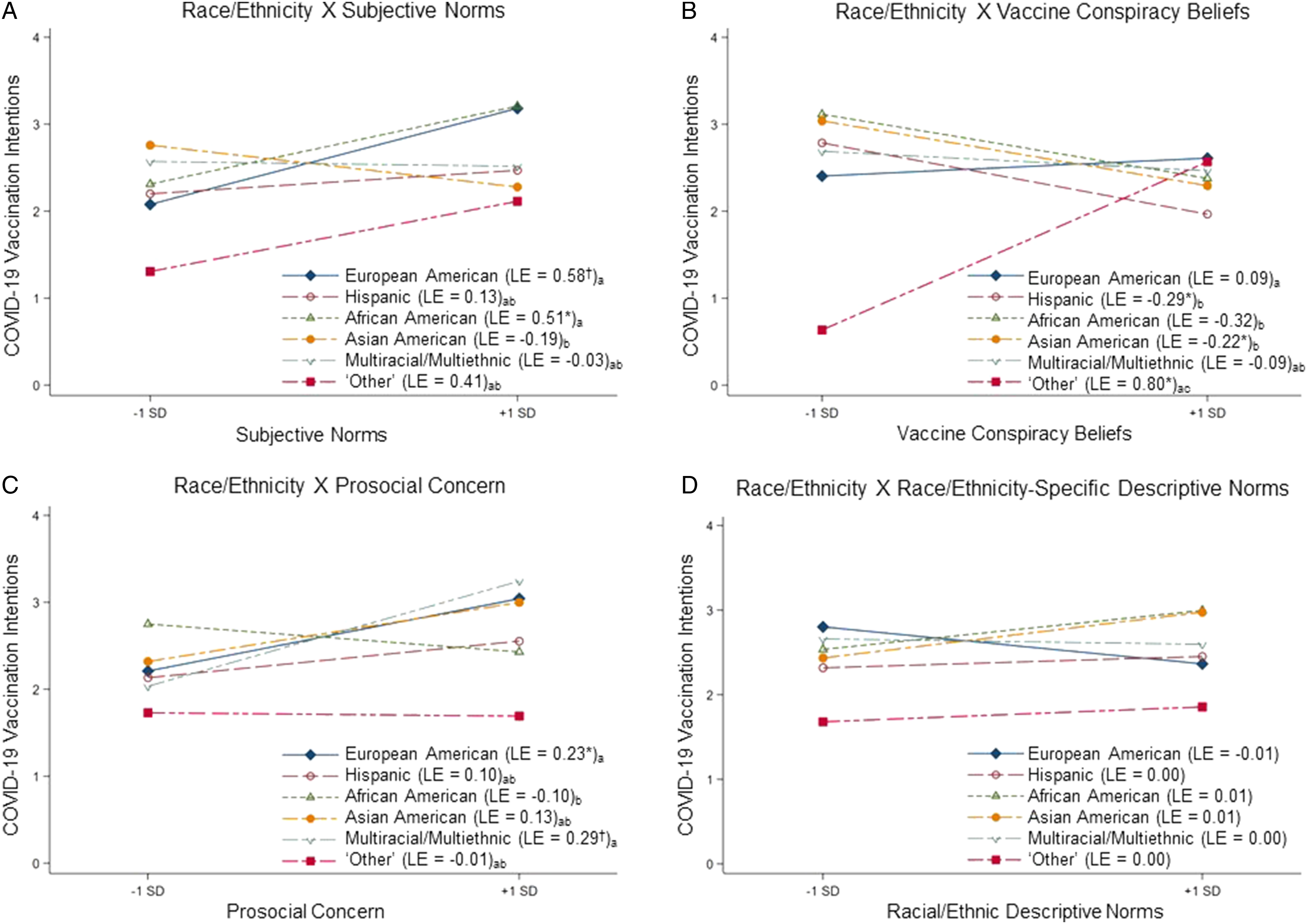
Vaccine conspiracy beliefs
A main effect of vaccine conspiracy beliefs was not significant in Block 3 (LE = −.09; PBT = 2%; P = .21). However, its interaction with race/ethnicity was significant in Block 4, F (5, 251) = 2.88, P < .05. Vaccine conspiracy beliefs were negatively associated with intentions for Hispanics. The slope for Hispanics differed significantly from the non-significant slope for European Americans (P < .05; Figure 1B).
Prosocial concern
A significant main effect of prosocial concern in Block 3 (LE = .11; PBT = −2%; P < .05) was qualified by an interaction with race/ethnicity in Block 4, F (5, 251) = 2.61, P < .05. Prosocial concern was positively associated with intentions for European Americans and Multiracial/Multiethnic Americans. Both slopes differed significantly from the non-significant slope for African Americans (P < .05; Figure 1C).
Race/ethnicity-specific descriptive norms
The main effect for race/ethnicity-specific descriptive norms was not significant in Block 3 (LE = .00; PBT = 0%; P = .89), and its interaction with race/ethnicity was not significant in Block 4, F (5, 251) = 1.09, P = .37 (Figure 1D).
Discussion
Summary
In the current study, subjective norms, vaccine conspiracy beliefs, and prosocial concern predicted COVID-19 vaccination intentions. As expected, we found vaccine conspiracy beliefs to be a stronger predictor of intentions for people of color than European Americans. However, we also found race/ethnicity differences in the predictive utility of other hypothesized constructs, suggesting the importance of culturally tailoring vaccine messages.
Our findings suggest stronger subjective norms are associated with stronger vaccination intentions for European and African Americans but not for other racial-ethnic groups. These racial-ethnic differences could be attributed to acculturation levels. For instance, subjective norms tend to be more salient and influential for Hispanics who are less accultured. 10 Notably, our sample could have been comprised of more accultured individuals, especially since less accultured individuals have unique barriers that affect their ability to pursue higher education. 11
Unexpectedly, race/ethnicity-specific descriptive norms did not predict intentions. It is possible that participants did not strongly identify with their racial-ethnic group. Regardless, all racial-ethnic minority groups’ descriptive norms were lower than their groups’ actual COVID-19 vaccination national percentage. 12 Although our findings suggest normative corrections may not directly increase intentions, such corrections could improve other antecedents of intention (eg, attitudes).
Prosocial concern predicted intentions only for European Americans and multiracial/multiethnic Americans. This could be due to racial-ethnic differences in perceived susceptibility. Specifically, prosocial motivation predicts vaccination intentions more strongly when perceived susceptibility is low. 13 Thus, messages that emphasize the prosocial benefits of vaccination may be particularly impactful for groups with low perceived susceptibility levels (eg, European Americans).
Limitations
There are a few limitations. First, causal interpretations are not possible. Second, unmeasured factors could differentially impact intentions in a racially/ethnically diverse population. For instance, medical mistrust is considered to be an important component of vaccination hesitancy among people of color. 14 Finally, our sample was relatively small and comprised primarily of female students. There are also several strengths. First, the sample was racially/ethnically diverse. Second, this research extended common theoretical frameworks. Finally, Tobit regression accounts for threshold/censored values and does not dichotomize intentions, which reduces information loss and chances of spurious findings.
Significance
Our findings underscore the importance of emphasizing the prosocial benefits of vaccination for racial-ethnic groups with relatively low perceived susceptability levels (eg, European Americans); (2) signaling a positive subjective norm for vaccination, especially among European Americans and African Americans; and (3) correcting vaccination conspiracy beliefs. Our findings have implications for narrative persuasion messages, which use stories tied to audiences’ sociocultural experiences to present factual information and empower informed health choices.
15
Future narrative messages could have story protagonists acquire vaccine information from important others in their racial-ethnic group who express vaccine approval and emphasize family/community needs and expectations. These messages may spark conversations with close others about the importance of COVID-19 vaccination. Both COVID-19 vaccination hesitancy and conspiracy beliefs are often shown in cross-sectional studies to be more common and influential in people of color than European Americans. However, it is unclear if other determinants of vaccination hesitancy, such as social norms and prosocial concern, also differ by race/ethnicity. We found novel race/ethnicity differences in the predictive utility of subjective norms, vaccine conspiracy beliefs, and prosocial concern. Subjective norms appeared to be more influential for European and African Americans, while prosocial concern was more influential for European Americans. In contrast, vaccine conspiracy beliefs appeared to be most impactful for Hispanics. Future COVID-19 vaccine promotion initiatives should be culturally tailored to correct vaccine conspiracy beliefs, signal a positive subjective norm, and highlight the prosocial benefits of vaccination for each unique racial-ethnic group.So What?
What is already known on this topic?
What does this article add?
What are the implications for health promotion practice or research?
Supplemental Material
Supplemental Material - Racial/Ethnic Differences in the Predictive Utility of Psychosocial Determinants of COVID-19 Vaccination Intentions
Supplemental Material for Racial/Ethnic Differences in the Predictive Utility of Psychosocial Determinants of COVID-19 Vaccination Intentions by Jace D. Pierce, Joahana Segundo, and Jaye L. Derrick in American Journal of Health Promotion
Footnotes
Acknowledgments
We thank Khushboo Shukla for their assistance in data acquisition and study administration using the cloud-based participant pool management system (ie, SONA).
Author Contributions
Pierce had full access to all the data in the study and takes responsibility for the integrity of the data and the accuracy of the data analysis. Concept and design: Pierce, Segundo, and Derrick. Acquisition, analysis, or interpretation of data: Pierce and Derrick. Drafting of the manuscript: Pierce. Critical revision of the manuscript for important intellectual content: Pierce, Segundo, and Derrick. Statistical analysis: Pierce and Derrick.
Declaration of Conflicting Interests
The author(s) declared no potential conflicts of interest with respect to the research, authorship, and/or publication of this article.
Funding
The author(s) received no financial support for the research, authorship, and/or publication of this article.
Ethics Statement
All participants provided electronic informed consent. The study was approved by the University of Houston Institutional Review Board (protocol #00002945).

Supplemental Material
Supplemental material for this article is available online.
References
Supplementary Material
Please find the following supplemental material available below.
For Open Access articles published under a Creative Commons License, all supplemental material carries the same license as the article it is associated with.
For non-Open Access articles published, all supplemental material carries a non-exclusive license, and permission requests for re-use of supplemental material or any part of supplemental material shall be sent directly to the copyright owner as specified in the copyright notice associated with the article.
