



Abstract
The COVID-19 pandemic led to unprecedented changes in people’s lifestyles across the United States, but the extent to which the pandemic affected health behaviors of children and adolescents (i.e., physical activity, screen-time, and sleep) is not well understood. These behaviors hold particular significance because of their association with health outcomes.
Purpose
The purpose of this study was to examine whether engagement in health behaviors changed from pre-pandemic (2019) to during the pandemic (2020).
Methods
The combined 2019-2020 National Survey of Children’s Health (NSCH) was used to inform this study. The NSCH is an annual survey designed to provide national estimates of key indicators of childhood health and well-being. Physical activity (number of days/week with >60 min of activity), screen-time (hours/day of TV viewing and computer use), and sleep (hours/day) were assessed by parental report. Adjusted binomial and multinomial logistic regression models were used to determine the association between survey year and health behaviors.
Results
Children and adolescents were 36% more likely to be physically inactive in 2020 compared to 2019. Additionally, children and adolescents were 14% more likely to meet sleep guidelines and 39% less likely to meet screen-time guidelines in 2020 compared to 2019, independent of age, sex, race/ethnicity, and poverty level. Children (6-13 year) and adolescents (14-17 years) were 10% and 15% less likely to get below the recommended amount of sleep in 2020 compared to 2019, respectively.
Conclusion
Prevalence of meeting sleep guidelines increased among children and adolescents in 2020 but decreased for physical activity and screen-time. Initiatives targeting activity and screen-time may be urgently needed. Whether rates of these health behaviors return to pre-pandemic levels over the next few years should be closely assessed.
Introduction
In children and adolescents, there are numerous physical and psychosocial benefits associated with engagement in physical activity (e.g., improvements in cardiovascular and metabolic risk profile, depression, and self-esteem),1,2 reduced engagement in screen time (e.g., decreased risk for obesity and depression), 3 and adequate sleep (e.g., more favorable body mass index [BMI], reduced risk for behavioral issues and emotional problems).4,5 However, guidelines for these health behaviors are often unmet in the United States, with just 8.8% of children and adolescents meeting the guidelines for all three health behaviors in 2016-2017. 6 Moreover, engagement in these health behaviors significantly differ between children and adolescents, with a greater proportion of children meeting physical activity (27.8% vs 18.2%), sleep (88.7% vs 83.2%), and screen time (44.8% vs 20.9%) guidelines in comparison to their adolescent peers. 6
The COVID pandemic disrupted these health behaviors among children and adolescents. 7 Much of the literature points to changes in sleep duration of children and adolescents with the implementation of pandemic lockdown measures.8-10 However, it appears that sleep duration changed differentially across age groups, with one international study by Kaditis et al. finding that adolescents (14-17 years) were more likely to experience an increase in sleep duration on weekdays than children (6-13 years). 11 Conversely, children were more likely to experience an increase in sleep during weekends than adolescents. 11 Another study by López-Bueno et al. found no significant change in total sleep duration among children aged 6-12 years, but a slight increase in sleep duration among adolescents aged 13-16 years in a sample of Spanish adolescents. 12 Thus, further understanding of how sleep duration among children and adolescents changed during the pandemic is warranted.
Additionally, it has also been reported that physical activity engagement has changed as a result of the pandemic. 8 Coinciding with the closure of schools, parks, and sports clubs, physical activity generally decreased across age groups,13,14 with one study showing depressed levels of physical activity even after such facilities reopened with safety restrictions. 15 While physical activity decreased across age groups, multiple studies found older children and adolescents experienced the largest declines in physical activity during the pandemic in Canadian, German, and Australian samples of youth.16-18 However, it is not known if these trends are observed in a nationally representative population of US youth.
Further, screen time also changed during the pandemic, with both children and adolescents spending more time on their devices and screens following the lockdown.15,19 The increase in screen time was found to be driven by a combination of remote screen-based learning and leisure screen time, 16 with 87% of Canadian children reporting increased leisure screen use. 20 Screen time increased across both age groups during the pandemic, but adolescents frequently saw greater increases in screen time in comparison to children.11,21,22 It is unknown if these differences in screen time duration and leisure screen use are consistent in US youth.
Since health behaviors (i.e., sleep, physical activity, and screen time) in childhood and adolescence are associated with health outcomes into adulthood, 23 it is crucial to understand the effect the COVID-19 pandemic had on engagement in these health behaviors among children and adolescents. The 2019-2020 National Survey of Children’s Health provides an opportunity to examine national estimates of engagement in these health behaviors prior to and then during the pandemic. Thus, the purpose of this study was to examine whether engagement in health behaviors (i.e., physical activity, screen time, and sleep) in children and adolescents differed across 2019 and 2020 estimates from the National Survey of Children’s Health (NSCH). Secondarily, we examined engagement in these health behaviors by age group (i.e., within children and within adolescents).
Methods
Data Source
For this study, we utilized the combined 2019-2020 National Survey of Children’s Health (NSCH). The NSCH is an annual survey, designed to provide national estimates of key indicators of childhood health and well-being, administered by the Health Resources and Services Administration’s Maternal and Child Health Bureau within the US Department of Health and Human Services.24,25 The 2019 and 2020 NSCH were administered by mail and online to randomly selected households across the US and was available in both English and in Spanish.24,25 Respondents were the parent or the guardian with the most knowledge of the child’s health.24,25 If more than one child lived in the household, one child from the household was randomly selected.24,25 All study procedures were approved by the National Center for Health Statistics Research Ethics Review Board and the National Opinion Research Center Institutional Review Board. Informed consent was collected from all parents or guardians and full survey sampling and survey procedures are available elsewhere.26,27
Survey response rates among households with children who completed the initial screener in 2019 and 2020 were approximately 52.8% and 54.7%, respectively.24,25 Data were collected for the 2019 and 2020 NSCH between June 2019-January 2020 25 and July 2020-January 2021, 24 respectively. Thus, the 2020 NSCH data were collected after the widespread implementation of COVID-19 mitigation measures (e.g., social distancing, distance learning) in March of 2020, 28 presenting the unique opportunity to examine national estimates of our outcomes of interest prior to and after the COVID-19 pandemic.
Participants
Within the NSCH dataset, we limited our sample to children and adolescents, aged 6-17 years, since data on physical activity were not collected on children <6 years (n = 51 895). Further, we excluded participants from analyses with missing data on our primary outcome measures: physical activity (n = 664); screen time (n = 483); and sleep (n = 33). Thus, a total of 50 715 participants (21 652 children and 29 063 adolescents) were included in our primary analysis.
Outcome Measures
Physical Activity
Parent respondents were asked: “During the past week, on how many days did this child exercise, play a sport, or participate in physical activity for at least 60 minutes.” Response options included: “0 days, 1-3 days, 4-6 days, every day”. We subsequently collapsed the physical activity responses into three categories: (1) no physical activity (i.e., 0 days); (2) some physical activity (i.e., 1-6 days); and (3) meets physical activity guidelines (i.e., everyday). The variable response options were collapsed to reflect the 2018 Physical Activity Guidelines for Americans 29 and previous work utilizing the NSCH. 30
Screen Time
Respondents were asked: “On most weekdays, about how much time did this child spend in front of a TV, computer, cellphone, or other electronic device watching programs, playing games, accessing the internet or using social media? Do not include time spent doing schoolwork.” Response options were: “less than 1 h, 1 h, 2 h, 3 h, 4 or more hours”. Screen time was subsequently dichotomized to: meets screen time guidelines (i.e., ≤ 2 h) 31 and does not meet screen time guidelines (i.e., >2 h). As there are not established guidelines for US youth, our screen time parameters follow those laid out in Canadian and Australian 24-hour movement guidelines.31,32
Sleep
Parent respondents were asked: “During the past week, how many hours of sleep did this child get on most weeknights?” Response options included: “less than 6 h, 6 h, 7 h, 8 h, 9 h, 10 h, or 11 or more hours”. For our analyses, we categorized sleep according to the National Sleep Foundation. 33 For children 6-13 years, the sleep variable was collapsed to: (1) less sleep than recommended (<9 h); (2) meets sleep guidelines (9-11 h); and (3) more sleep than recommended (>11 h). For adolescents 14-17 years, the sleep variable was collapsed to: (1) less sleep than recommended (<8 h); (2) meets sleep guidelines (8-10 h); and (3) more sleep than recommended (>10 h).
Data Analysis
Demographic characteristics, including age, sex, race/ethnicity, household income, and weight status (adolescents only), of the unweighted sample, were computed as frequencies and mean ± standard deviation for categorical and continuous variables, respectively. Demographic characteristics were computed by survey year for children and adolescents collectively and stratified by age group. All analyses were conducted using SPSS Version 27.0 (Armonk, NY: IBM Corporation). Chi-squared tests were used to determine differences in our nominally scaled health behaviors (physical activity, sleep, and screen time) by survey year.
For our primary and secondary analyses, adjusted binomial and multinomial logistic regression models were used to determine the association between survey year and health behaviors. For our secondary analysis, participants were stratified by age group (i.e., children aged 6-11 years and adolescents aged 12-17 years). Models were adjusted for sex, age, race/ethnicity, and household income due to potential to confound. We included BMI as a covariate in our secondary analysis in adolescents as BMI was only available in children and adolescents aged 10-17 years in the NSCH data set. Thus, we further excluded adolescents with missing data on BMI (n = 670), leave a sample of n = 21 652 children and n = 28 393 adolescents for the secondary analysis.
Additionally, we conducted sensitivity analysis using the NSCH 2018-2019 data to confirm the findings in our primary analysis could likely be attributed to the COVID-19 pandemic. We ran the same models as described in our primary and secondary analyses, but within the 2018-2019 NSCH dataset.
Results
Demographic Characteristics by Survey Year.

aAdolescent only demographic breakdown reflects sample after those with missing BMI data (n = 670) were removed.
bIncome is reported as % of federal poverty level (FPL) with missing values imputed by the US census bureau.
cWeight status (BMI) was only available for adolescents.
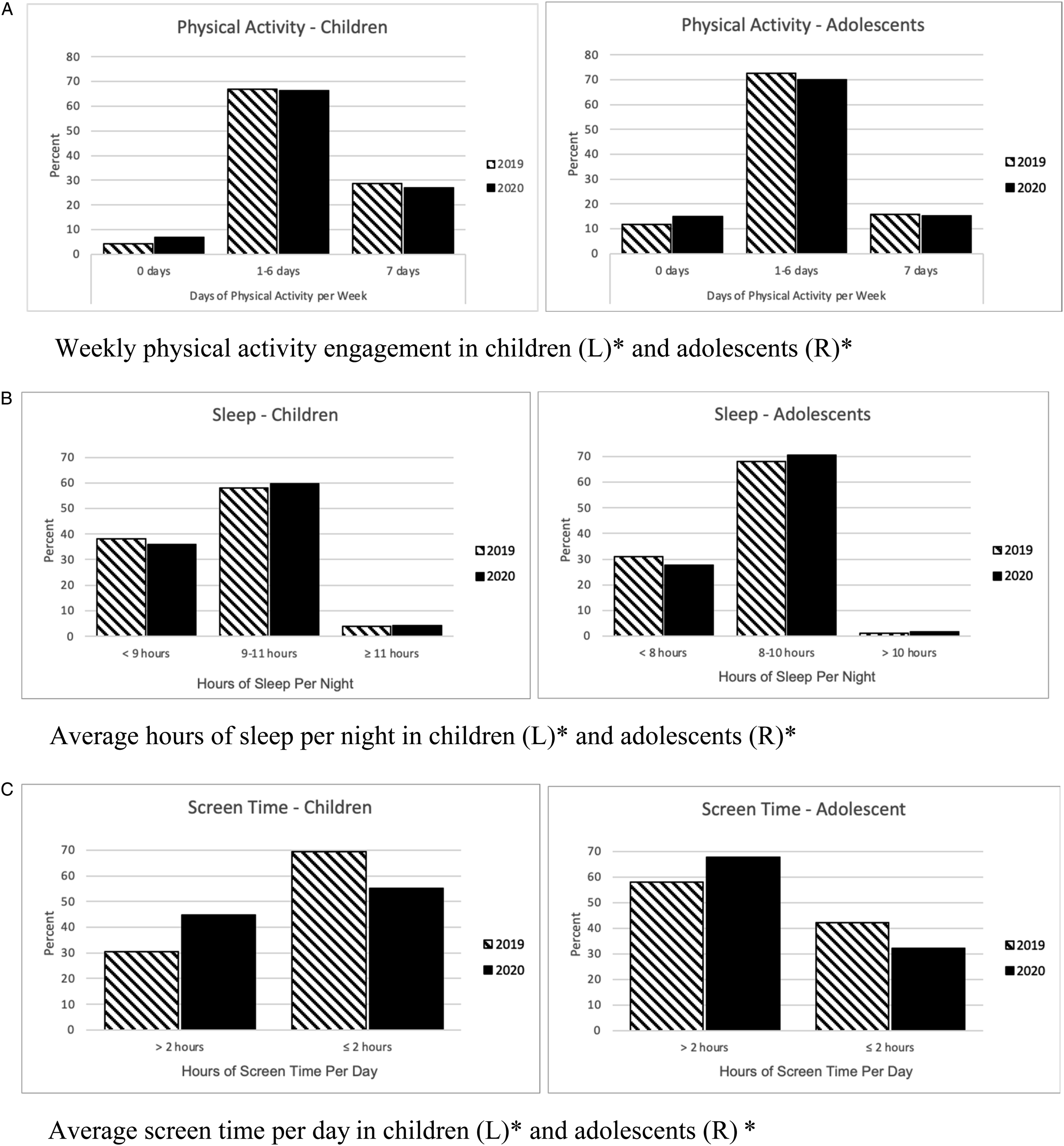
Physical activity, sleep, and screen time by survey year. Note- *indicates P < .05. Data are unadjusted.
Adjusted a Odds Ratios of Physical Activity Level, Sleep, and Screen Time by Survey Year in Children and Adolescents.

Note. AOR = adjusted odds ratio; CI = confidence interval. P < .05 in boldface.
aModels adjusted for age, sex, race/ethnicity, and poverty level.
bPhysical activity level, classified by days/per week of ≥60 mins, as physically inactive (0 days/week), some physical activity (1-6 days/week), and meets physical activity guidelines (7 days/week).
cSample of 30 270.
dSample of 20 445.
eMeets screen time guidelines (i.e., ≤ 2 h) and does not meet screen time guidelines (i.e., >2 h).
Adjusted a Odds Ratios of Physical Activity Level and Screen Time by Survey Year Stratified by Age Group.

Note. AOR = adjusted odds ratio; CI = confidence interval. P < .05 in boldface.
aModels adjusted for age, sex, BMI category (adolescents only), race/ethnicity, and poverty level.
bPhysical activity level, classified by days/per week of ≥60 mins, as physically inactive (0 days/week), some physical activity (1-6 days/week), and meets physical activity guidelines (7 days/week).
cMeets screen time guidelines (i.e., ≤ 2 h) and does not meet screen time guidelines (i.e., >2 h).
To confirm the findings in our primary analysis could likely be attributed to the COVID-19 pandemic, we conducted a sensitivity analysis using the 2018-2019 NSCH. We ran the same models specified in our primary analysis and found no association between survey year (i.e., 2018 vs 2019) and our health behavior outcomes (i.e., physical activity, sleep, or screen time) (Supplemental Table 2).
Discussion
Our analysis of the National Survey of Children’s Health examined how health behaviors (i.e., physical activity, sleep, and screen time) changed among children and adolescents using the 2019 (pre-pandemic) and 2020 (pandemic) estimates of engagement in these behaviors. Compared to 2019, US youth were more likely in 2020 to meet sleep guidelines, but less likely to meet screen time guidelines, and more likely to be physically inactive, which could likely be attributed to the lockdown in place due to the COVID-19 pandemic. Furthermore, on examination of engagement in these health behaviors by age group, children (6-11 years) showed larger increases in physical inactivity and decreases in meeting screen time guidelines than adolescents.
These results confirm findings from studies of health behaviors early in the COVID-19 pandemic, where dramatic reductions in physical activity and increases in sedentary time were seen across all age groups.34,35 Our findings would suggest that the lockdown of schools and playgrounds, and the postponement or cancellation of organized sports led to a void that was not filled by other modes of physical activity, but instead by additional screen time, and to a lesser, extent sleep. While the increase in those meeting sleep guidelines could be interpreted as a positive, the NSCH queries sleep duration but not other potentially relevant factors such as sleep onset or sleep quality. Hale et al (2015) found an association between screen use and delayed bedtime, and Jahrami et al (2022) reported that children and adolescents had much higher rates of sleep disturbances during COVID than adults. So, while some children may be sleeping longer, that is unlikely to completely counter the negative effects of increased physical inactivity, and sleep quality should be assessed. If, as a product of the COVID-19 pandemic, leisure time screen use remains at persistently elevated levels, it is reasonable to assume that physical activity and sleep will be negatively impacted.
Prevalence of these critical health behaviors in children and adolescents were already concerning prior to the pandemic, 6 and these findings highlight the need for close monitoring over coming years to see if this ‘COVID generation’ will return to pre-pandemic levels of health behaviors. The deleterious changes to health behaviors in US youth documented in this study are not unique to US youth, with similar changes in health behaviors during COVID documented among youth in Australia, Canada and China.34,36-38 Longitudinal research has shown that health behaviors during childhood are often carried over into adulthood,39,40 suggesting if health behaviors do not return to pre-pandemic levels in youth, that could translate to potential increases in projected adverse physical (e.g., obesity, cardiovascular disease, diabetes) and mental health (e.g., depression, anxiety) outcomes.
Prior to the pandemic, physical activity, sleep, and screen time had all been identified as being independently associated with depression, anxiety, and ADHD in children and adolescents. 41 A recent paper, also using data from the NSCH, reported significant increases in diagnosed anxiety and depression among young people from 2016 to 2020. 42 Moreover, a study by Tandon et al. found that those children with higher levels of physical activity and lower screen time during COVID had better mental health outcomes (using the Strengths and Difficulties Questionnaire), 43 while Li et al. found that children with higher levels of screen use had significantly higher levels of mental health symptoms compared to their peers with lower screen usage. 44 Thus, the added impact of pandemic-related declines in physical activity, increased screentime, and sleep may contribute to further acceleration in the rates of these mental health diagnoses, which warrants further research.
While this study has many strengths including the use of a nationally representative sample of youth to examine the association between survey year and health behaviors in youth, it also has several limitations that must be considered when interpreting these findings. First, this is a cross-sectional survey utilizing a random sample of households each year, which limits our ability to detect specific changes in these health behaviors over time. However, our sensitivity analysis of the 2018-2019 years did not detect any association between survey year and the specified health behaviors, suggesting the association we identified could likely be attributed to mitigation measures in place during the COVID-19 pandemic. Examination of these health behaviors using similar population-based cohort studies are warranted to broaden our understanding of the impact of the COVID pandemic on young people’s physical activity, sleep and screen time. Additionally, the NSCH is a parent-report survey sample and is therefore subject to participant bias and nonresponse bias. While physical activity was assessed over a typical week (including weekends), only weekday screen time and sleep were queried, which limits our ability to discern how these behaviors changed on an average week. Moreover, COVID-19 mitigation strategies differed across and within states, and it is impossible to ascertain the extent to which each respondent was affected by mitigation measures such as school closures. Further, the 2020 data were collected from July 2020- January 2021, thus not all data were captured during the typical school year, which may have influenced survey responses.
Conclusion
In a nationally representative sample of over 50 000 US youth, children and adolescents were significantly less likely to meet screentime guidelines, and more likely to be physically inactive and meet sleep guidelines in 2020 relative to 2019. No such association was detected using the 2018-2019 NSCH survey years, which suggests deleterious changes in engagement in these health behaviors could likely be attributed to the COVID-19 pandemic. Consequently, if engagement in these behaviors do not return to pre-pandemic levels, there is the potential for an increasing prevalence of adverse physical and mental health outcomes. Thus, addressing declines in physical activity and increased screentime present clear targets for intervention by researchers, clinicians, and policymakers. These findings also highlight the need for public health strategies that facilitate safe means of staying physically active if similar scenarios were to occur again. Whether these lockdown-instigated behaviors endure, and how that may affect the health of US youth as they age, is uncertain, but careful monitoring in coming years is essential.
Supplemental Material
Supplemental Material - Physical Activity, Sleep, and Screen Time in Children and Adolescents Before and During the COVID-19 Pandemic: An Analysis of the 2019-2020 National Survey of Children’s Health
Supplemental Material for Physical Activity, Sleep, and Screen Time in Children and Adolescents Before and During the COVID-19 Pandemic: An Analysis of the 2019-2020 National Survey of Children’s Health by Ciarán P. Friel, Keith M. Diaz, and Kristie Rupp in American Journal of Health Promotion
Footnotes
Author Contributions
CF and KR contributed to the design of this work, analysis and interpretation of data, drafting and revision of the manuscript, and final approval of the version submitted for publication. KD contributed to the drafting and revision of the analysis and manuscript, and gave final approval of the version submitted for publication.
Declaration of Conflicting Interests
The author(s) declared no potential conflicts of interest with respect to the research, authorship, and/or publication of this article.
Funding
The author(s) received no financial support for the research, authorship, and/or publication of this article.
Correction (November 2023):
This article was updated to correct the article type to Quantitative Research.

Supplemental Material
Supplemental material for this article is available online.
References
Supplementary Material
Please find the following supplemental material available below.
For Open Access articles published under a Creative Commons License, all supplemental material carries the same license as the article it is associated with.
For non-Open Access articles published, all supplemental material carries a non-exclusive license, and permission requests for re-use of supplemental material or any part of supplemental material shall be sent directly to the copyright owner as specified in the copyright notice associated with the article.
