




Abstract

Stigma, prejudice, and discrimination contribute to health inequities in the lives of LGBTQ+ (lesbian, gay, bisexual, transgender, queer, and other sexual or gender minorities) people.1-4 Addressing these health inequities is not only a priority for individuals who identify as a sexual and/or gender minority, as these inequities have ripple effects that affects all of society. The unequal treatment of sexual and gender minority communities, for example, may strain or sever loving ties between families and friends, limit their educational and employment opportunities, impede their personal growth and wellness, place them in harm’s way, and hinder their trust in health and social services. In this manuscript, we discuss the importance of addressing LGBTQ+ health inequities and propose an intersectoral approach to foster greater innovation and public health impact.
LGBTQ+ by the Numbers
The most recent Gallup poll 5 finds that 7.2% of the US population identifies as LGBTQ+, with up to 25% of younger generations identifying as LGBTQ+. However, precise estimates regarding the number of LGBTQ+ people in the United States are difficult to obtain, as sexual orientation and gender identity are often not systematically collected in population-level surveys or census data. A 2022 National Academies consensus report 6 emphasized the need to systematically collect sex, gender, and sexual orientation (SOGI) data in order to ensure the counting and representation of diverse gender and sexual orientation identities in our society. Accurate statistics about the LGBTQ+ population are vital to health equity as they can foster a sense of belonging and equality for all individuals and offer insights on how to be more inclusive, just, and supportive.
Understanding the percentage of LGBTQ+ people in society is crucial for several reasons. First, it promotes equitable participation in all facets of society. Knowledge of the LGBTQ+ population’s size allows for the development of policies and initiatives ensuring their fair representation in education, employment, politics, and various social institutions, fostering a more inclusive society. Second, this awareness helps in addressing leaky pipelines concerning social advancement, akin to challenges faced by other minority populations such as racial and ethnic minorities. By identifying the specific barriers faced by LGBTQ+ individuals, targeted interventions can be designed to mitigate disparities and promote equal opportunities for advancement. Third, knowing the percentage of LGBTQ+ people enables the optimization of the delivery of tailored and inclusive social and health services. Understanding the unique needs of this population ensures that services are designed to be culturally competent, sensitive, and effective, enhancing overall well-being. Lastly, this knowledge facilitates effective interactions in clinical and research settings. Healthcare providers and researchers armed with accurate demographic data can offer more personalized care, design relevant studies, and implement interventions that consider the LGBTQ+ community’s distinct requirements, leading to improved health outcomes and a deeper understanding of their specific healthcare needs.
LGBTQ+ Health Disparities
LGBTQ+ individuals in the United States face significant health disparities rooted in societal stigma and discrimination, poor cultural competency, or an absence of tailored interventions and programs to address their needs.2-4 Over the years, researchers and advocates have documented well-established disparities across a myriad of health outcomes including mental health,7,8 suicidal ideation and behavior, 9 substance misuse,10-12 cancer prevention and care,13-15 HIV and other sexually-transmitted infections (STIs),16-18 cardiovascular diseases, 19 violence,20,21 and discrimination.22-24 LGBTQ+ individuals, particularly transgender and gender-nonconforming individuals, also frequently encounter barriers to accessing appropriate and affirming healthcare, leading to delays in necessary interventions.25-27 In fact, the federal public health guidelines, Healthy People 2030, included LGBTQ+ milestones across 7 key areas 28 : (1) bullying among adolescents, (2) cancer, (3) drug and alcohol use; (4) mental health and mental disorders; (5) HIV/STIs; (6) tobacco use; and (7) the inclusion of SOGI data throughout our public health infrastructure. Among the 21 indicators selected as Healthy People 2030 in these areas, 5 are currently noted as improving, 6 have little or no detectable change, and 2 are getting worse. The remaining objectives are noted as only having baseline data to date, or being a new objectives for future evaluation and tracking. Of note, none of the trans specific indicators have progressed.
Addressing these disparities will require structural reforms to our laws and policies, opportunities to advance culturally competent and humble care within healthcare and social services, and greater social engagement across all sectors of society. Consistent with this approach, the recent National Academies of Sciences, Engineering, and Medicine report 3 on LGBTQ+ health emphasized a wider range of structural and community factors needing attention including: ensuring access to adequate healthcare, promoting economic stability, enhancing educational opportunities, strengthening families and social relationships, fostering community and civic engagement, and addressing issues related to public policy and structural stigma. Recognizing the interconnectedness of these factors, the report underscored the need for comprehensive, holistic approaches that address the broader social, economic, and policy contexts in which LGBTQ+ people live as opposed to the focus on individual-level behaviors and outcomes. By addressing these structural and community correlates, we can work towards creating a more inclusive and supportive environment for the LGBTQ+ community, thereby improving the collective public’s health.
How can we Advance LGBTQ+ Health Equity Through Innovation?
Innovative approaches are paramount to advancing LGBTQ+ health equity and to addressing the unique and shared challenges faced by the LGBTQ+ community. Innovations in healthcare delivery, technology development, health research, and policymaking can bridge the existing gaps in the field. In order for these innovations to occur, however, we must ensure that multiple sectors of society are collectively invested in LGBTQ+ health. In other words, we are in dire need of an intersectoral innovation ecosystem committed to address LGBTQ+ health.
At present, however, the primary sectors where innovations in health often spur – academia, philanthropy, and the private sector – are limited in their ability to tackle the challenges facing LGBTQ+ people on their own. Often, innovations in health disparities and health equity are often discovered and tested through federally funded research in academia. The 2021 Portfolio Analysis carried out by the National Institute of Health’s Sexual and Gender Minority Research Office (SGMRO) found that the total number of SGM projects had increased by 80.7% since 2015 (from 301 to 544 projects). 29 While this is exciting traction, this increase still accounts for less than 1% of all NIH research projects. Philanthropy plays a similar role in funding and advancing community-driven programs in our society. At present, however, LGBTQ+ projects account for a miniscule proportion of all giving. A 2023 report 30 revealed that, while philanthropic grew by 46% between 2015 to 2019, the amount given to LGBTQ+ organizations accounted for .13% of charitable giving. Similarly, startup-ups and venture-backed companies are a leading source of innovation. 31 However, of the US$2.1 trillion spent on innovation for startups, only .5% has gone to LGBTQ+ funders according to a recent report by StartOut. 32 Unless insights and investments from all sectors are convened, equitable advances to improve the health and well-being of LGBTQ+ communities will lag and stagnate.
Designing and maintaining an innovation ecosystem for LGBTQ+ health necessitates a shared language and understanding of key concepts across sectors and disciplines such as medicine and nursing, public health, business, engineering, design, communication, social policy and law, and the social sciences and humanities. Creating a collective ecosystem where all stakeholders, including entrepreneurs, researchers, policymakers, advocates, and community members, can speak the same language may help overcome barriers to collaboration. This inclusive approach may also facilitate the sharing of diverse perspectives and skills when designing new solutions and create a culture that foments the exploration of ideas safety through disruptive innovation (i.e., challenging established norms of how things are traditionally done). By questioning existing processes and advancing new methods, the innovation ecosystem can adapt and evolve, leading to more efficient, equitable, and sustainable solutions. Through these practices, an innovative ecosystem might create a more inclusive, adaptable, and forward-thinking environment for innovation and collaboration. Ultimately, it may also help create financial models where research, philanthropic and venture capital can co-exist to advance public health priorities and foment shared and mutual commitment to treating diverse social sectors as equal partners, both intellectually and financially.
Creating an Intersectoral Health Innovation Landscape for LGBTQ+ Health
Universities must play a crucial role in creating and nurturing this innovation ecosystem. By design, universities are tasked with being a safe haven for the exchange of ideas, whereby existing ideas and processes are questioned in order to examine whether innovative methods and technologies can yield more efficient, equitable, and sustainable solutions. Universities can also serve as a safe haven for the exchange of ideas and collaborations among public, private, and nonprofit sectors.33,34
The Eidos LGBTQ+ Health Initiative Strategy.
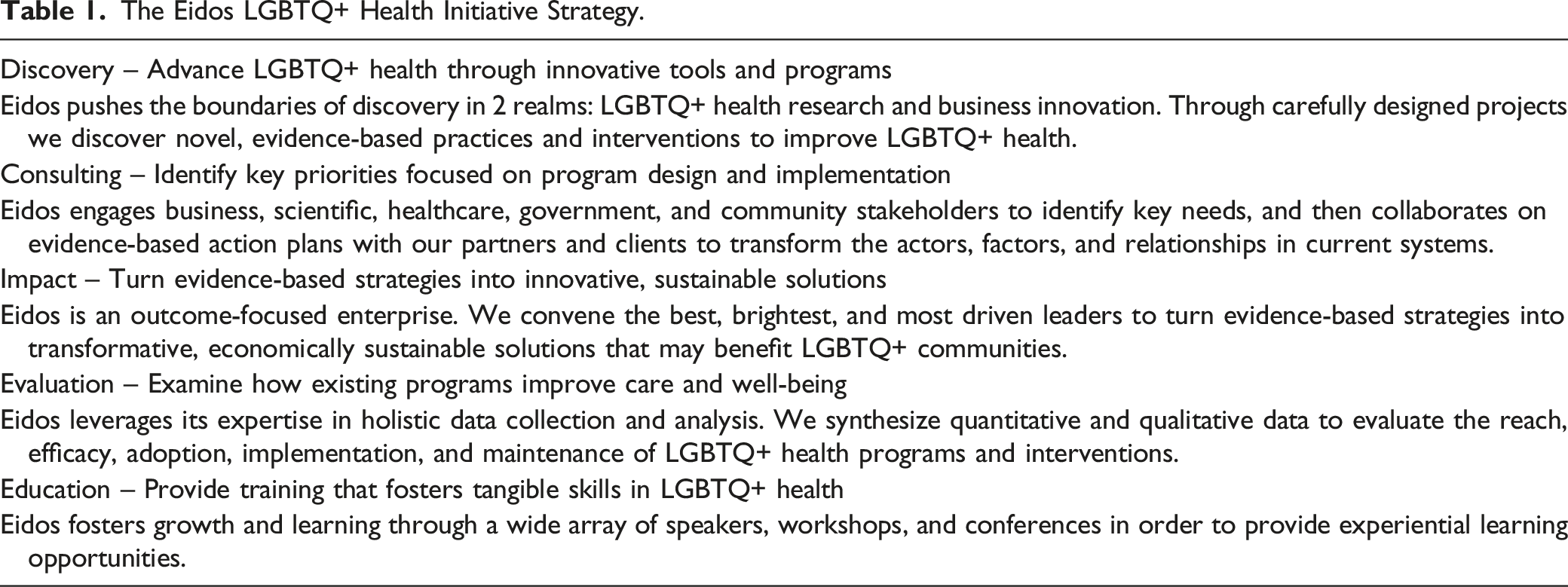
Since its launch in July 2022, Eidos has endeavored to cultivate intersectoral connections and opportunities for collaboration. Using our five-tiered strategy, we have cultivated over 130 conversations with potential partners. As noted in Figure 1, we were overwhelmed by the positive response from every sector that we set out to convene and collaborate with. Eidos initiates every conversation with potential partners with 1 question: “How can we help?” This approach has opened a window on community needs as well as created a pipeline for future development opportunities. Eidos project by sector (2022-2023).
For example, Eidos was approached by Hopelab to test a new self-guided digital mental health tool, imi (pronounced eye-me; accessible at https://imi.guide), created to empower LGBTQ+ youth in their journey of self-discovery and affirmation. As a pioneering social innovation lab and impact investor focused on the intersection of technology and youth mental health, Hopelab also collaborated with leading non-profit LGBTQ+ organizations, CenterLink and the It Gets Better Project, to co-design imi with LGBTQ+ teens themselves. imi offers practical strategies to enhance positive coping skills and foster a supportive mindset, thereby promoting the mental well-being of LGBTQ+ youth. Together, we conducted a rigorous randomized controlled trial involving 270 participants, with 78% identifying as BIPOC and 60% identifying as transgender and/or gender expansive, genderqueer, or gender nonconforming. The study revealed imi’s effectiveness in helping LGBTQ+ youth manage stress and improve their overall well-being. 35 This project exemplified how to engage with different sector of society and accelerate the dissemination of equity-centered innovations to address the health and well-being of LGBTQ+ youth. This collaborative effort was honored at the 2023 Anthem Awards with a Gold Award for a Research Project or Publication in the Health category, a Silver Award in the Health category for Digital and Innovative Experiences/Awareness & Media, and a Silver Award in Diversity, Equity, and Inclusion in the category of Corporate Social Responsibility/Awareness & Media.
Conclusions
Embracing innovation can promote health equity and foster a society where everyone, regardless of their sexual orientation and gender identity, can lead healthier, more fulfilling lives.
Equity-centered innovation is key to addressing LGBTQ+ health disparities, as it may spur creative models to tackle pressing societal issues. Moving such an innovation ecosystem forward, however, will require us to address several key challenges. First and foremost, establishing shared metrics of success across this shared innovation ecosystem is crucial. Defining clear, measurable goals that resonate with all stakeholders can help align efforts and assess progress effectively. Second, engaging stakeholders at every stage of the innovation process, acknowledging their contributions, and demonstrating the impact of their investment fosters a sense of ownership. Creating a collaborative, inclusive ecosystem where diverse perspectives are appreciated and actively integrated ensures that each stakeholder’s role is integral to the overarching innovation agenda, thereby securing their commitment and enthusiasm for future endeavors. Third, we recognize that different sectors may have different project timetables, incentive structures, and decision-making processes. Designing and testing blueprints that acknowledge these differences and encourages a collective mindset shift will be essential. Finally, we will need to convene and coalesce diverse stakeholders from the public and private sectors in order to design sustainable solutions that address the proximal and distal factors contributing to LGBTQ+ health inequities and disparities. In sum, we have opportunities to innovate and should examine how we can foster innovation ecosystems where we can design, iterate and scale solutions emerging from diverse partnerships across sectors in an effort to improve the lives and well-being of LGBTQ+ communities.
Footnotes
Declaration of Conflicting Interests
The author(s) declared no potential conflicts of interest with respect to the research, authorship, and/or publication of this article.
Funding
The author(s) received no financial support for the research, authorship, and/or publication of this article.