



Abstract
Purpose
To identify “headlines” that would engage recipients to consider plant protein over red meat.
Design
Mail and web survey.
Setting
Urban Minnesota community.
Subjects
144 survey respondents from our health plan and community program distribution lists who live with at least 1 other person and eat meat.
Intervention
We asked respondents how likely they would be to click on each of 24 headlines with a motivator (eating plant protein for health vs for environmental reasons) and a barrier (family preferences, knowledge about plant proteins, or cooking skills). 16 headlines contained the word “beans”.
Measures
We created categorical variables for each headline construct: (1) motivator, (2) barrier, and (3) reference to beans. Using a mixed model with random effects, we compared, for each construct, respondents’ self-reported likelihood to click on a headline.
Results
Health-related headlines performed significantly better than environmental headlines (P = .0019, 95% CI .01, .11). Family-oriented headlines performed slightly better than skills-oriented (P = .0927, 95% CI -.01, .11) and knowledge-oriented (P = .0960, 95% CI -.01, .11) headlines. Headlines containing the word “beans” performed significantly worse than those not containing “beans” (P < .0001, 95% CI -.22, -.12).
Conclusions
The population represented by our survey respondents report being most likely to click on headlines that emphasize health and family. They report they are significantly less likely to click on headlines that promote beans.
Keywords
Purpose
Replacing animal protein, especially that from red meat, with plant protein is associated with lower total mortality, 1 and increases environmental sustainability.2,3 Planning a campaign to promote plant protein, we sought to identify constructs that engage a reader to seek more information about plant proteins and their preparation. Individuals we interviewed earlier told us that messages about the benefits to personal health and environmental sustainability would be motivating. They also told us that lack of knowledge about sources of plant proteins, lack of skills to prepare plant proteins as a substitute for meat, and family expectations that meat should be their protein source were barriers to replacing meat with plant proteins. In response, we created 24 “headlines” that promote dietary plant proteins, each addressing both a motivating construct and a barrier construct. We referenced beans in 16 of the headlines because beans are a varied and inexpensive source of high-quality protein and other nutrients. We then tested the headlines with a survey.
Methods
We identified a random sample of adult health plan members or care group patients living in St. Paul, MN, and invited them to complete a survey either by mail or online in summer 2022. In December 2022, we added a web-only convenience sample to increase the number of respondents. We included people on distribution lists of our community health initiative, PowerUp, 4 as well as hospital employees in a slightly broader geographic area. We excluded individuals who reported having only 1 person in their household (as a proxy for “families”) and who reported not eating meat. We did include respondents in the analysis even if these data were missing. Fewer than 4% of questions were missing a response.
We designed the survey to require 10 minutes to complete. We telephoned a subset of invitees to encourage completion. The survey asked about participants’ current household meat and plant-protein consumption, whether they had previously considered reducing their household’s red meat consumption and how willing they were to take this step. We also asked how likely they would be to click on each headline. We provided 4 response options: 1 = “very unlikely”, 2 = “somewhat unlikely”, 3 = “somewhat likely”, and 4 = “very likely”. We calculated the mean response score for each headline and ranked the headlines on these scores. We then created categorical indicators for each headline construct: motivator (eating plant protein for health reasons or environmental reasons), barrier (family preferences, knowledge about plant proteins, or cooking skills) and reference to beans (yes, no). We used 3 separate mixed models with a random effect for respondent to adjust for the multiple responses within individuals to detect differences in their likelihood to click on messages by category for each construct. We calculated least squares means and the differences between them for each category pair.
Results
Our analytic dataset included surveys from 144 eligible individuals (56 random sample, 88 convenience sample; 13 paper completes). 76% of respondents identified as non-Hispanic white, and 89% female. While 57% were age 30-49, 9% were under age 30, and 34% were 50 or older. In addition, 64.1% reported using plants sometimes or regularly as the main source of protein in a meal; 21.5% had never thought about reducing their household’s red meat consumption.
The 24 Headlines Sorted by the 2 Motivators and 3 Barriers (With Rank and Average Score).
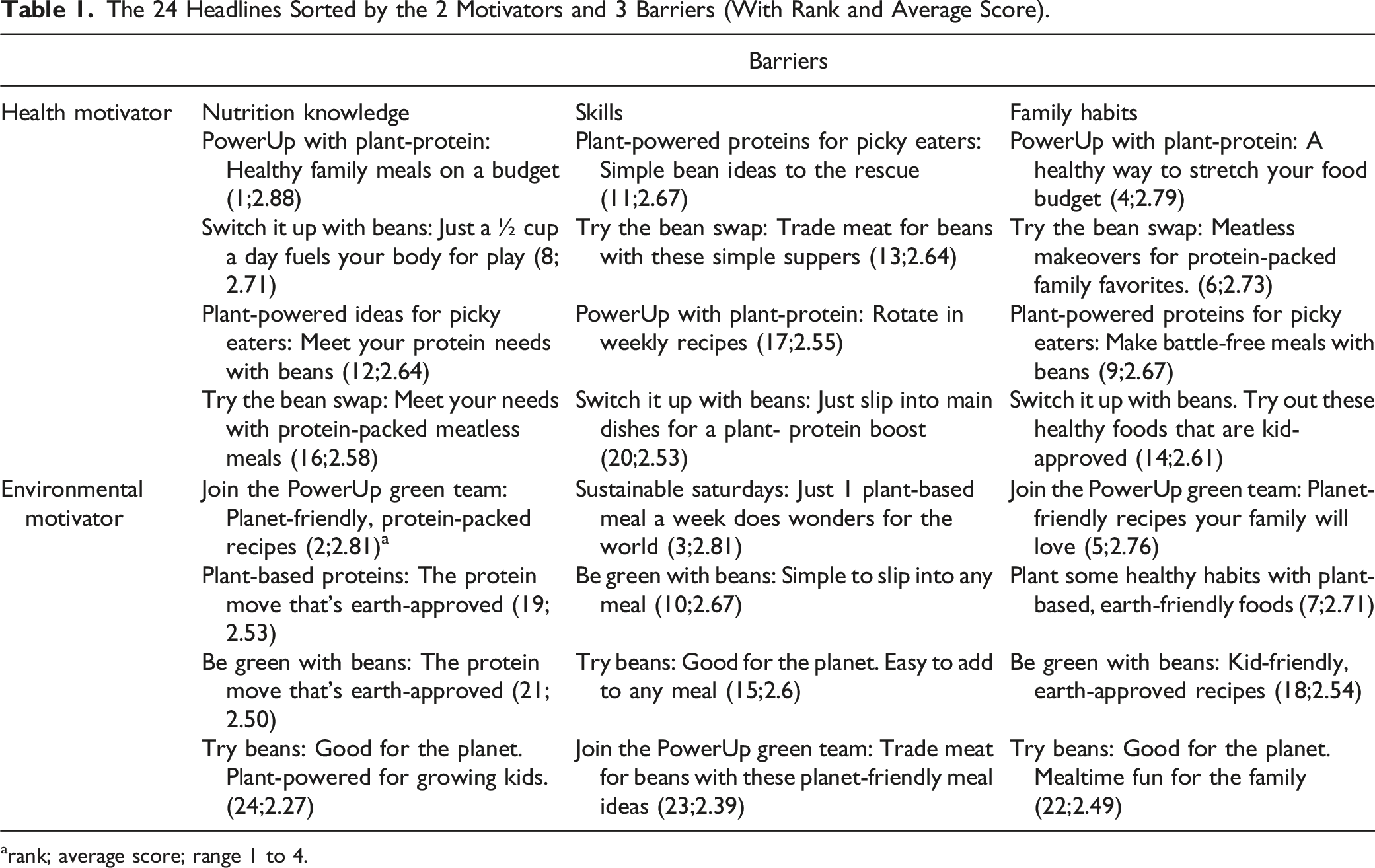
arank; average score; range 1 to 4.
Discussion
In our survey that compared headlines promoting plant-based protein, respondents reported a greater likelihood to click on health-oriented headlines than environmental headlines. They were significantly less likely to click on headlines that contained the word “beans”. Perhaps we should have predicted this negative response to beans because the effects of eating beans have been mocked in ditties, songs, and movies.
Our trial is limited by a small response sample of highly-specified respondents in a limited geographic area at 1 point in time. It also lacks racial and ethnic diversity. We obtained a relatively low response rate which cannot be precisely calculated because we used multiple survey distribution approaches and lack information about the eligibility of non-respondents. We only randomized headline order in the web mode, so there could have been order effects for the 13 surveys completed on paper. Our outcome is self-reported willingness to click for more information; this may not predict actual behavior. That said, it is our impression that the words most compelling for the survey respondents referred to power, protein, family, and budget.
It has been observed that, while Americans are increasingly acknowledging the benefits of dietary fruits and vegetables, adoption of a vegetable-oriented dietary pattern lags far behind intent. 5 For example, in 2000, only about 14% of the US population was eating beans on a given day. 6
Among those who are reducing meat, the most common reasons were cost and health, not environmental sustainability and animal welfare. Individuals who did not reduce meat consumption have commonly agreed with statements suggesting that meat is healthy and 'belongs' in the diet.
7
Reports of trials that have promoted vegetable protein are remarkably sparse: While a transition from red meat to beans as a source of dietary protein has been explored in Nordic countries,8,9 we are not aware of other studies that have tested whether marketing beans as a source of plant protein is appealing. Our findings suggest that, although beans are an inexpensive source of high quality plant protein and other nutrients, the negative images associated with beans are significant. Marketing plant protein would be more successful if featuring recipes that characterize plant proteins as a low cost way to promote health for the entire family. Obtaining dietary protein from plants, rather than red meat, is associated with both positive health effects and greater environmental sustainability. Even so, red meat is the preferred source of dietary protein for many Americans, and many do not meet the dietary recommendation for vegetable and fiber consumption. The survey respondents in our trial responded most positively to headlines that promoted plant proteins as healthy and headlines that were designed to address the barrier of family preferences. The word “beans” in a headline generated significantly fewer positive responses. Our findings suggest that, although beans are an inexpensive source of high quality plant protein and other nutrients, the negative images associated with beans are significant. Marketing plant protein would be more successful if featuring recipes that characterize plant proteins as a low cost way to promote health for the entire family.So What?
What is already known on this topic?
What does this article add?
What are the implications for health promotion practice or research?
Footnotes
Declaration of Conflicting Interests
The author(s) declared no potential conflicts of interest with respect to the research, authorship, and/or publication of this article.
Funding
The author(s) disclosed receipt of the following financial support for the research, authorship, and/or publication of this article: This work was supported by the National Institute of Food and Agriculture, USDA [Award number 2019-67019-30463].
