



Abstract

Introduction
Federally Qualified Health Centers (FQHCs) were established to improve community health, particularly among vulnerable and underserved populations throughout the U.S. FQHCs offer a comprehensive model of care that is associated with demonstrated improved outcomes and reduced costs. They provide integrated preventive and primary care along with behavioral health, dental health, and social supports. With the mission of achieving health equity at its core, FQHCs are a critical part of the community, removing barriers to care for individuals who might otherwise not receive it. A major tenet understood by FQHCs is that social determinants of health—such as where one lives, works, and plays—are key drivers of health. Therefore, it is not enough for FQHCs to only provide health care within their walls; they understand the importance of reaching beyond their walls to improve the health and well-being of their patients.
For the past 15 years, Harmony Healthcare Long Island (HHLI), a FQHC based in Nassau County, New York, has worked to improve health outcomes for some of the county’s most vulnerable residents. HHLI is a not-for-profit community-based organization serving over 44,000 patients per year in Nassau County via various programs and services, regardless of the individual’s ability to pay. As a not-for-profit medical provider whose mission is rooted in supporting underserved communities and improving health equity, HHLI has insight into the needs of our patients, through historic visits, needs assessments and social determinants of health screenings. Many of the patients served live below the federal poverty level and lack basic income and resources for day-to-day living. Some patients have challenges with food insecurity while others are concerned about physical safety, transportation, or environmental issues in the community. By collaborating with various stakeholders, HHLI can more effectively support the needs of our patients and the community.
Background
Nassau County is widely known as “America’s First Suburb.” This iconic community’s population exploded after World War II on the power of the GI Bill and the pent-up demand for new housing, education, and other opportunities for their families. It gave rise to one of the first shopping malls and industrial parks and provided country club-like amenities, such as golf courses, pools and tennis courts for the suburban middle class. Located in the western region of Long Island, Nassau County is home to some 1.395 million residents. 1
Unfortunately, Nassau County is also infamous for racial covenants and other forms of “redlining” that promoted segregation in housing and education for decades and set the stage for the economic, social and health care disparities in the county. Although Nassau County is rapidly becoming more ethnically, racially, and economically diverse, there is an unequal distribution of wealth and well-being within the county. For example, according to the Nassau County 2022-2024 Community Health Assessment and the Community Health Improvement Plan, rates of early and adequate prenatal care among Blacks, Hispanics and Asians were lower compared to Whites. Additionally, Blacks, Hispanics, and Asians had higher rates of premature and low birthweight births compared to Whites. Lastly, Blacks had significantly higher rates of infant mortality compared to all other racial/ethnic groups in Nassau County. 2
The Need for Collaboration
As a not-for-profit medical provider whose mission is rooted in supporting underserved communities, HHLI has health centers located in 6 communities in Nassau County that have high rates of health inequities. Each of the HHLI health centers is located near public transportation and has easy access to major highways. HHLI also operates 3 school-based health centers. Many of the patients served by HHLI live below the federal poverty level and lack basic income and resources for day-to-day living. Some patients have challenges with food insecurity, while others are concerned about physical safety, transportation, or environmental issues. HHLI has insight into the needs of our patients, through historic visits, needs assessments and social determinants of health screenings. By collaborating with various stakeholders, HHLI can more effectively support the needs of our patients and the community.
HHLI directly reflects the community, both through governance that is made up of members from the community (more than 65% of the Board of Directors is comprised of patients who use HHLI services), as well as the providers and staff who also are from the community and understand the needs, culture and languages spoken by the patient population. Additionally, HHLI seeks and fosters relationships with community partners. Community partners are vetted to ensure that (1) they understand the vulnerable patients/clients HHLI serves; (2) they are willing to work with both insured and uninsured patients; (3) they can meet the patients’ needs in a timely manner; (4) they are accessible; and (5) they communicate to close the loop.
In collaboration with key stakeholders, HHLI aims to learn, understand, and implement programs and solutions to address health concerns of our patients. By hosting and participating in community advisory meetings, for example, HHLI is better able to understand the needs of the community. The Outreach team provides education, information about HHLI services, and resources such as screenings, vaccinations and workshops. Partnering with local community-based organizations (CBOs), businesses, faith-based organizations, and school districts also allows HHLI to promote our services in the communities we serve.
The Perinatal Infant Community Health Collaborative (PICHC)
In 2022, HHLI received a 5-year grant from the New York State Department of Health to address maternal and infant mortality in Nassau County. Called the Perinatal Infant Community Health Collaborative (PICHC), HHLI partners with the Women’s Diversity Network, a non-profit organization located in Long Island, and Hofstra University to achieve the following goals: • Improve perinatal and infant health outcomes including preterm birth, low birth weight, infant mortality, and maternal mortality; • Increase access to early and consistent comprehensive prenatal and perinatal care and reduce racial, ethnic, and economic disparities with particular emphasis to those individuals who are at high risk for poor birth outcomes; • Address the social determinants of perinatal health and improve access to community resources; and • Provide health risk assessment to identify individuals who would benefit from supportive services for birth equity, social barrier support, and linkage to care.
The strategy of PICHC is to implement collaborative, community-based strategies to improve the health and well-being of people of reproductive age and their families. PICHC does this by addressing the following issues that are likely to contribute to poor outcomes: health inequities and unjust treatment; low birthweight and preterm birth; unsafe sleeping practices; chronic health conditions and obstetric complications; unintended pregnancies; and mental and behavioral health conditions (Figure 1). Perinatal Infant Community Health Collaborative Strategy.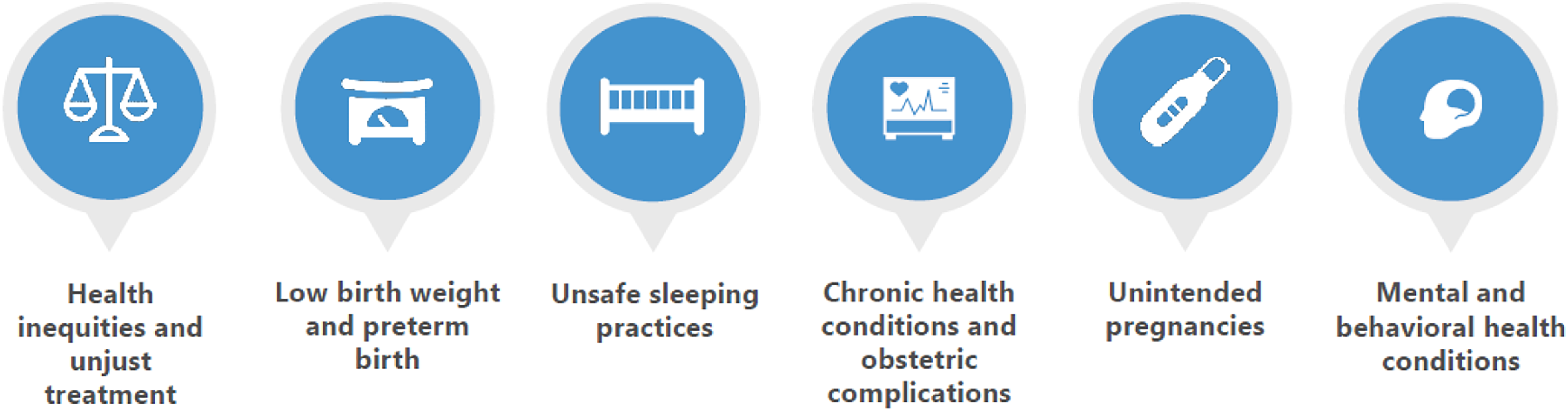
The PICHC program is delivered by Community Health Workers (CHWs) who work in collaboration with other organizations to serve individuals in the prenatal, postpartum, and inter-conception periods, and connect them to available services. More specifically, CHWs provide health risk assessments to identify individuals who would benefit from supportive services for birth equity, social barrier support, and linkage to care. CHWs also facilitate and assist with the development of a birth plan and postpartum care plan, connect families to community resources and supports (e.g., food, clothing, transportation etc.), provide clients with appropriate health information on relevant perinatal health topics, and empower clients to make informed healthcare decisions for themselves and their families and adopt healthy behaviors.
As a partner in the PICHC program, the Women’s Diversity Network offers support and encouragement to pregnant mothers and individuals of childbearing age, facilitates their participation in educational workshops, and ensures access to adequate healthcare. Additionally, they provide comprehensive services encompassing education, advocacy addressing women’s issues, and support groups tailored specifically for pregnant people of color. These support groups serve as a platform for expression and community-building, particularly beneficial for new mothers residing in high morbidity areas. Hofstra University contributes to the PICHC program as a partner by conducting orientation and training sessions for staff members. Moreover, they organize civic engagement activities targeting community residents, with a focus on enhancing self-advocacy and communication skills. Hofstra University also plays a crucial role in providing educational workshops covering topics such as perinatal and infant health issues, low birth weight, infant mortality, hypertension, obesity, and exploring the intersection between race, geography, and health outcomes.
In addition to the partnerships with the Women’s Diversity Network and Hofstra University, HHLI has formal and informal agreements with local hospitals, schools, and community organizations throughout Nassau County to mutually refer clients and better assist with patients’ needs. The PICHC program is provided in English, Spanish, and Haitian Creole and is governed by a Community Action Board (CAB) that meets quarterly. In the first year of the PICHC program, 2841 referrals were completed, and 1386 home visits were conducted.
Additional Partnerships
HHLI engages in several initiatives where community partnerships are crucial. One significant endeavor is the mobile health coach program, made possible through a grant from the New York State Department of Health. HHLI acquired a 40’ RV equipped with 2 medical exam rooms, a handicapped lift, and a restroom. The mobile coach collaborates with various organizations, such as senior centers, soup kitchens, and mental health institutions, to deliver primary care to individuals facing barriers in accessing healthcare. Staffed by a Nurse Practitioner and Medical Assistant, the coach assesses basic healthcare needs on-site, offers routine care, and facilitates referrals to HHLI’s free-standing locations. Removing barriers to care is a central tenet of HHLI, and the mobile health coach plays a pivotal role in achieving this goal by delivering primary care directly to individuals where they are.
HHLI also partners with managed care companies. One such collaboration is with United Health Care (UHC). In this collaboration, HHLI and UHC partnered with Central Nassau Guidance (CNG) to fund stable housing for 10 high-risk, high-cost patients. Funding was provided by UHC, housing was provided by CNG, and HHLI provided the medical care. This partnership not only improved the quality of care for participants in the pilot program, but also generated savings for the payer beyond the costs of housing and treatment.
Lastly, the COVID-19 pandemic strengthened relationships with past partners and fostered new ones. HHLI collaborated with Nassau County through our outreach program, Support Engage Assist and Link (SEAL), to offer nursing and community health worker support at the county’s COVID-19 Isolation Shelter. This initiative aimed to address the needs of individuals who had tested positive for COVID-19 and were experiencing homelessness. Additionally, alongside the American Heart Association and Island Harvest (a local food bank on Long Island), HHLI provided testing and remote patient monitoring to COVID-positive individuals. While conducting COVID-19 tests, HHLI also screened individuals for social determinants of health and facilitated connections to services when necessary. Almost 9000 food boxes from Island Harvest were distributed concurrently with our COVID-19 testing efforts.
Financing Collaborations for a Sustainable Future
HHLI is excited to see how a new investment with Medicaid in primary care and CBOs will improve health outcomes for underserved communities. New York State (NYS) has recently been given permission by the Center for Medicare and Medicaid to embark on an 1115 Demonstration Waiver. The 1115 Demonstration Waiver grants flexibility to states for innovative projects that advance the objectives of the Medicaid program and allows Medicaid funds to be used in ways that are not otherwise allowed under federal rules. 3 The goals of the New York State 1115 Demonstration Waiver aim to improve health outcomes and quality of care by integrating primary care providers with CBOs to address health-related social needs (HRSN). It focuses on regions with longstanding health inequities, offering incentives to safety net providers who serve high-risk populations. The strategy includes improving primary care, behavioral health, and HRSN to benefit vulnerable groups like children, pregnant individuals, the chronically homeless, and those with substance use disorders. Additionally, new value-based programs will promote statewide accountability for health improvements and equity. 4 Funding for the 1115 Demonstration Waiver will be funneled through Medicaid Managed Care Organizations (MCOs).
While NYS is in the early stages of this new initiative, HHLI hopes that the goals listed above will help further enhance existing relationships with community partners and help foster new ones. While HHLI already has value-based payment relationships with MCOs, additional resources for CBOs would enhance the work we do. Some of our MCO partners have invested their resources in working with CBOs for social determinants of health factors such as transportation, medically tailored meals, outreach, initial engagement and more. While investing significant funds into the Medicaid System ($7.5 Billion) in NYS and supporting Primary Care and CBOs to improve health equity is a much-needed goal, achieving that goal will be a challenge due to years of chronic underfunding and historic divestment by government into safety net organizations which have limited the capacity of primary care providers and CBOs. However, if adequate capacity building support is provided by the state, primary care providers and CBOs will be able to accomplish the goals laid out by the 1115 Demonstration Waiver initiative.
Overall, HHLI continues to work towards addressing health equity and improving outcomes for our patients. By hiring staff who live in our communities and represent the individuals we serve, and by continually striving to be a trusted partner, we have seen success in many forms. This includes increased patient referrals to our health centers, improved patient experience feedback on our surveys, better clinical quality outcomes, and new grants solicited by our partners to help us jointly solve these problems. Additionally, we have received investments from both government and private funders to further our mission. There is no silver bullet to addressing the needs of our patients, but we will look to constantly evolve and improve our stewardship as a trusted partner.