




Abstract
Self-esteem represents one of the most important personal resources for workers. However, the value of different forms of self-esteem (i.e., global vs. organization-specific) for work outcomes and their reciprocal associations over time have yet to be examined. This preregistered study examined (1) longitudinal reciprocal relations between global and organizational self-esteem, (2) prospective effects of global and organizational self-esteem on job satisfaction and work engagement, and (3) the role of organizational self-esteem as a mediator of the effects of global self-esteem on job satisfaction and work engagement. Using data on 1014 workers who were assessed annually during the first three years of their careers, we implemented three cross-lagged panel (CLPM) models: the traditional CLPM, the Random Intercept-CLPM, and the Latent State Trait Model. The results from the best fitting model (the Latent State Trait Model), as well as the other two, failed to support our preregistered hypotheses; instead, the findings suggest that global and organizational self-esteem are largely independent, at both the between- and within-person level, and that neither form of self-esteem has important effects on job satisfaction or work engagement.
Keywords
Introduction
Self-esteem is a key personal resource linked to self-regulation (Brown & Zeigler Hill, 2018; Schaubroeck et al., 2012) and adjustment (Judge & Bono, 2001a, 2001b; Orth & Robins, 2022; Pierce & Gardner, 2004; Swann et al., 2007) in organizational settings. High self-esteem workers report being more satisfied (Judge & Bono, 2001a, 2001b; Kuster et al., 2013) and engaged (Bakker & Demerouti, 2008) with their job than low self-esteem workers. This is not surprising given that high self-esteem workers usually obtain higher job performance evaluations (Judge & Bono, 2001a, 2001b), are better able to cope with work-related stressors (Cropanzano & Grandey, 1998; Kuster et al., 2013), and are less prone to engage in counterproductive work behaviors and workplace deviance (Kuster et al., 2013; Vogel & Mitchell, 2017).
In organizational contexts, self-esteem has been studied from two different perspectives (Brown & Ziegler-Hill, 2018; Schaubroeck et al., 2012; see also Donnellan et al., 2011; Marsh, 1990). The first perspective conceptualizes self-esteem as a global construct (i.e., global self-esteem; GSE) and defines it as an individual’s overall subjective evaluation of his or her own worth as a person (Donnellan et al., 2011). The second perspective recognizes the existence of distinct but correlated forms of self-esteem, each regarding different spheres of work life, and each referred to as a domain-specific form of self-esteem (e.g., Pierce & Gardner, 2004). The latter perspective has spurred research on organization-based self-esteem (OBSE), defined as “the degree to which an individual believes him/herself to be capable, significant and worthy as an organizational member” (Pierce & Gardner, 2004, p. 593). OBSE differs from GSE in that it focuses on individuals’ subjective view of their value as members of a particular organization, which may be distinct from their beliefs about their overall value as persons. Both perspectives can be conceptualized within a hierarchical model of self-esteem (e.g., Shavelson & Bolus, 1982; Shavelson et al., 1976), where GSE is posited at the top of a hierarchy while domain-specific self-evaluations such as OBSE are positioned at the bottom. Given the hierarchical structure of self-esteem, there are theoretical reasons to study global and domain-specific forms of self-esteem together rather than treating them as isolated constructs.
In organizational contexts, GSE and OBSE have typically been studied separately and, to the best of our knowledge, only one long-term longitudinal study has simultaneously examined GSE and OBSE in the workplace (Filosa & Alessandri, 2023). This gap in the literature raises several interrelated research questions, including (1) what are the prospective relations between GSE and OBSE (in other words, how are these two levels of the self-esteem hierarchy related)? (2) Does GSE or OBSE matter more in the prediction of organizational outcomes? and (3) Does OBSE mediate the effects of GSE on organizational outcomes?
This preregistered longitudinal study addresses these research questions using longitudinal data from a sample of 1014 young adults, who were assessed annually during the first three years of their first job. Specifically, we used three different longitudinal models to examine (1) longitudinal reciprocal relations between global and organizational self-esteem, (2) the prospective effects of global and organizational self-esteem on job satisfaction and work engagement, and (3) the role of organizational self-esteem as a mediator of the effects of global self-esteem on job satisfaction and work engagement.
Longitudinal Associations between Global and Organization-Based Self-Esteem
GSE and OBSE are both central to most adults’ sense of self (Brown & Ziegler-Hill, 2018; Schaubroeck et al., 2012), and consequently it is important to understand whether, and to what extent, global and organization-based forms of self-esteem influence each other over time.
Although there is no previous research examining prospective, longitudinal relations between GSE and OBSE, Bowling and colleagues’ (2010) meta-analysis found that GSE and OBSE tend to be moderately related (mean r = .40). However, all of the studies in the meta-analysis were cross-sectional, raising questions about the direction of the effects and whether they hold up over time.
Theoretical models of global and domain-specific self-esteem suggest that there might be reciprocal effects. Proponents of top-down processes have argued that GSE influences domain-specific self-evaluations (see Brown & Dutton, 1995; Marsh & Yeung, 1998; Rentzsch & Schröder-Abé, 2022), whereas proponents of bottom-up effects have argued that domain-specific forms of self-esteem influence (and generalize to) GSE (see Rentzsch and Schröder-Abé, 2022; Shavelson et al., 1976). These two perspectives are not mutually exclusive. In fact, meta-analytic results support both bottom-up and top-down effects of self-esteem, suggesting bidirectional relations between global and domain-specific self-esteem (Dapp et al., 2022).
Turning to the organizational literature, to the best of our knowledge, there are no longitudinal studies analyzing top-down versus bottom-up effects between GSE and OBSE. However, there are theoretical arguments supporting both effects in the organizational domain. With regard to top-down effects, it has been argued that individuals who have positive global evaluations of themselves are likely to have positive evaluations of themselves in work settings (Bowling et al., 2010; Pierce et al., 1989; Pierce & Gardner, 2004). According to Pierce and Gardner (2009) this is especially likely for individuals in the early stages of their work career, which is the case for the participants in the present study. Beginning a new job requires individuals to enter a new social (organizational) environment, experience novel situations, and engage in new social relations with colleagues, employers, and the whole organization (Bauer et al., 2007; Hogan & Roberts, 2004; Saks, 2018). According to Pierce and Gardner (2004), during these early phases of organizational socialization OBSE represent a “trait-like rather unstable construct” akin to an “outer conceptualization of the self” that mostly reflects general feelings of self-regard, and thus GSE (see Pierce & Gardner, 2004, p. 593; Campbell, 1990). In other words, this perspective conceptualizes global and work-specific forms of self-esteem as related in a top-down fashion, with GSE driving feelings and evaluations of oneself in the workplace. Moreover, this perspective claims that global feelings of self-worth are less likely to be affected by evaluations of one’s competencies or qualities at work. Thus, this top-down perspective assumes that GSE influences domain-specific self-evaluations in a way that amplifies or buffers the influence of external feedback on these self-evaluations. Therefore, our first preregistered hypothesis stated: H1.1. GSE will be prospectively associated with OBSE.
Other prominent theoretical perspectives highlight the possibility of bottom-up effects and suggest that self-evaluations of competence and acceptance in a new organizational environment will generalize to GSE (Bowling et al., 2010; Pierce & Gardner, 2004). Given that changes in OBSE gauge an individual’s progression in the organization’s status hierarchy, they are naturally expected to impact GSE. That is, workers who feel confident in their role as a worker are likely to have high GSE, whereas workers who lack confidence in their competence at work are likely to have low GSE. These ideas are supported by the influential sociometer theory (Leary, 2012; Leary & Baumeister, 2000), which posits that GSE serves as a gauge of peoples’ perceived social inclusion status, that is, how much they are liked and respected by others. For instance, when worker’s need for social inclusion and acceptance by colleagues is satisfied, GSE is expected to increase. In contrast, when this need remains unfulfilled, and they feel rejected and disrespected by their organization, self-esteem is expected to decrease. Whereas both GSE and OBSE are sensitive to variations in workers’ social status, it is likely that some of this influence can be conveyed on GSE via changes in OBSE, given that this construct represents a proxy of a worker’s self-perceived value as an organizational member. For these reasons, our second preregistered hypothesis stated: H1.2. OBSE will be prospectively associated with GSE.
The Predictive Effects of Global Self-Esteem and Organization-Based Self-Esteem on Work Outcomes
Research suggests that GSE has benefits for many life outcomes including in the work domain (Orth & Robins, 2022). Indeed, theoretical perspectives generally view self-esteem as a pivotal predictor of work adjustment (Brown & Zeigler-Hill, 2018; Judge & Bono, 2001a, 2001b; Schaubroeck et al., 2012). This argument derives mainly from the idea that self-esteem is an important personal resource that workers can use to deal with the demands and stressors at work (Brown & Zeigler-Hill, 2018). Specifically, the conservation of resources theory (COR theory; Hobfoll, 1989) conceives of self-esteem as a key resource for individual adaptability (Hobfoll, 2002). COR theory also states that humans tend to preserve and nourish resources (e.g., self-esteem) because they are crucial to overcome the stress caused by threatening situations (Hobfoll et al., 2018). In this sense, GSE and OBSE assume a motivational value since people can be oriented toward preserving and fostering their global and work-specific self-evaluations to promote their general well-being and adjustment (Hobfoll, 2002).
Self-esteem is also important for its role in shaping employees’ work experiences. Neo-socioanalytic theory (Roberts et al., 2008) proposes that people tend to be attracted to environments that are consistent with their own personality. Thus, self-esteem may influence the individuals’ selection of particular jobs or work environments. In this regard, Korman (1966, 1976) suggested that workers with high self-esteem may have a sense of basic needs satisfaction that helps them in maintaining a positive self-view, that is, to say that workers with high self-esteem tend to respond to work situations with actions that help them to retain a positive view of themselves. Thus, high self-esteem workers tend to show positive attitudes toward their job and work environment and seek to perform better in order to receive favorable feedback and confirm their positive self-views (Bowling et al., 2010; Brown & Zeigler-Hill, 2018). In contrast, low self-esteem workers do not experience this same pressure to perform well, given that eventual failures would be consistent with their negative self-view. Moreover, low self-esteem workers may selectively seek out negative feedback in order to preserve their own negative self-view. The maintenance of these self-consistency and self-verification processes is useful because it increases the predictability of the surrounding world and helps workers experience a greater sense of control (see Swann, 2012). Past research has provided empirical support for these ideas, by showing that self-esteem can predict better working conditions and important organizational outcomes, such as job satisfaction and income (e.g., Kuster et al., 2013; see also Krauss & Orth, 2022 for supporting meta-analytic results).
Having said that, the specificity matching principle (Swann et al., 2007) raises the possibility that GSE and OBSE will not have comparable prospective effects on job outcomes. This principle states that the effect of self-views on outcomes is strongest when the specificity of the predictor (e.g., organizational self-esteem) is matched to the specificity of the outcome (e.g., organizational outcomes) and weakest when there is a mismatch between the predictor and the outcome (e.g., global self-esteem predicting organizational outcomes). Thus, given that OBSE focuses on employees’ sense of worthiness and competence in the workplace, it is expected to show stronger associations with organizational outcomes than GSE (Bowling et al., 2010; Chen et al., 2004; Pierce et al., 1989). The specificity matching principle has been repeatedly confirmed for other domain-specific forms of self-esteem, including academic self-esteem (Marsh & Craven, 2006; Marsh & Martin, 2011) and social relationship self-esteem (Marsh & O'Mara, 2008; see Orth & Robins, 2022 for a review of a wide range of domain-specific forms of self-esteem and life outcomes), so we expect to find the same pattern for OBSE.
We tested these ideas using two key organizational outcomes: job satisfaction and work engagement. Job satisfaction is defined as an affective and cognitive evaluation of one’s job (Brief, 1998), and its concurrent association with self-esteem is well established in the range of about .26 (Judge & Bono, 2001a, 2001b). Previous research highlights several mechanisms that might explain this association. For instance, Locke et al. (1996) found that high self-esteem employees tend to maintain positive expectations in the face of failure, which makes their future success (and thus future satisfaction) more likely (Dodgson & Wood, 1998). Furthermore, self-consistency theory (Korman, 1970) states that high self-esteem employees are more likely than low self-esteem employees to choose occupations that are congruent with their interests, allowing high self-esteem employees to be more satisfied with their job (see also Tharenou, 1979). Finally, Judge and Bono (2001a, 2001b) pointed to self-esteem as a key resource underlying the dispositional basis of job satisfaction.
Work engagement has been defined as “a positive, fulfilling, work-related state of mind that is characterized by vigor, dedication, and absorption” (Schaufeli et al., 2002) and represents a positive affective-motivational state of work-related well-being (Bakker et al., 2008). Employees with high levels of work engagement tend to perform better (Halbesleben & Wheeler, 2008), and to be highly connected with their job tasks active in their work roles (Kahn, 1990), than workers low in work engagement. According to the Job-Demand Resources (JD-R) model, personal resources, such as self-esteem, have a high motivational potential that can lead employees to have a strong engagement with their work. In fact, previous research supported this idea by demonstrating that self-esteem can protect employees from demanding situations, support achievement of their goals, and stimulate their growth and development, even across short periods of time (Ouweneel et al., 2012; Xanthopoulou et al., 2009). Engaged employees tend to be more tenacious and persistent than disengaged employees and are more likely to believe they can achieve future success (Xanthopoulou et al., 2007, 2009). In addition, according to COR theory (Hobfoll, 1989), self-esteem is a key personal resource that supports and promotes the willingness to engage and be persistent at work.
Therefore, our second set of preregistered hypotheses is as follows
1
H2.1. GSE and OBSE will both predict job satisfaction and work engagement H2.2. OBSE will have a stronger association with job satisfaction and work engagement than GSE
Organization-Based Self-Esteem as a Mediator of the Effects of Global Self-Esteem on Organizational Outcomes
Following the abovementioned reasoning, researchers have hypothesized that specific forms of self-evaluations, such as OBSE, may mediate the effect of an individual’s more general self-evaluations (i.e., GSE) on organizational outcomes (Bowling et al., 2010; Chen et al., 2004; Gardner & Pierce, 1998). This layered model, positing general construct expression at the upper level of the putative causal chain and assigning to the more specialized expressions the role of proximal predictors, has received empirical support, for example, in studies focusing on basic personality traits. For example, Heller and colleagues (2009) found that work-specific personality traits (i.e., personality traits pertaining to an individuals’ work life) (a) were more strongly related to organizational outcomes than general personality traits and (most importantly) (b) mediated the relation between general personality traits and organizational outcomes. In addition, Caprara and colleagues (2010) found that feelings of empathic competence (a facet of agreeableness) mediated the relationship between basic agreeable predisposition and the people tendency to behave prosocially. Likewise, Fayard and colleagues (2012) showed that guilt experience (the affective component of conscientiousness) mediated the relationship between conscientiousness and negative affect. Following the same reasoning, one could speculate that through top-down processes, GSE leads to OBSE, which then leads to work outcomes. In other words, OBSE might mediate the relation between GSE and most work outcomes (Bowling et al., 2010; Dapp et al., 2022; see also Pierce & Gardner, 2004, p. 601). This mediation hypothesis is consistent with our predictions that GSE will have prospective effects on OBSE and OBSE will have a stronger effect on organizational outcomes than GSE.
Therefore, our third preregistered hypothesis was
2
H3. The effect of GSE on job satisfaction and work engagement will be mediated by OBSE.
Our hypotheses are based on previous research using trait measures of the above constructs. Thus, it is likely that they would apply only to models (e.g., RI-CLPM or LST-A) that explicitly distinguish trait (between person) and state (within person) effects. Thus, our study will help clarify how two forms of self-esteem—global and organizational—effect organizational outcomes at both the within- and between-person levels.
The Present Study
The present study examined longitudinal relations between GSE and OBSE and tested whether OBSE mediated the longitudinal effect of GSE on job satisfaction and work engagement. We used data from a sample of 1014 workers (65% men), assessed annually for three years after beginning their first job. Our research questions, hypotheses, and a detailed description of the sample, data collection procedures and materials, and overall research plan were all preregistered at the Open Science Framework (https://osf.io/89r3z/?view_only=c2564d41ab054caeb5617474572543e3), where we made available all data and syntax we used.
This study is important for both self-esteem researchers and organizational practitioners. First, both GSE and OBSE are key components of workers’ self-concept (Brown & Ziegler-Hill, 2018; Schaubroeck et al., 2012). Thus, we believe it is essential to gain more insight into whether global and organization-specific evaluations of oneself influence each other over time, whether these influences are reciprocal, and how small or large the associations are. Second, exploring the relation between GSE and OBSE is important for understanding the role of self-esteem at work as well as its development throughout the career span. If, for example, GSE has a stronger influence on OBSE than vice versa, then it is possible that changes in domain-specific self-esteem account for some of the positive effects of GSE. Conversely, if OBSE has a stronger influence on GSE, this provides insight into how GSE is influenced by people’s evaluations of themselves in the workplace and supports bottom-up theories of GSE. Third, results from the present study will clarify the relative importance of global versus domain-specific self-esteem for employers’ work adjustment, for example, by documenting the strength of their associations and whether they differ for the two outcomes examined in the present study (job satisfaction and worker engagement). Thus, the present findings will provide information about which construct—GSE or OBSE—to focus on in order to improve workers’ adjustment and well-being, or organizational practitioners could develop interventions that leverage the effects of both constructs to promote a wider range of positive work outcomes.
Method
Participants
We used data from the Lifelong Learning at Work Project (LLW), a three-wave longitudinal study of newly hired employees at a large organization operating in the public administration sector. Data are part of a larger dataset including other short scales aimed to assess job-related attitudes. At the beginning of the study, participants had just joined the organization after being selected through an open competition. Participants ranged in age from 18 to 31 years (M = 22.50, SD = 2.41); 82.74% had a high school degree, 9.76% a bachelor’s degree, 5.13% a master’s degree, and 2.37% did not report any information about their education.
Sample size adequacy was examined on the basis of a Monte Carlo simulation run in Mplus using the final “number of participants” from the final dataset, and parameter estimates obtained from our best fitting model (i.e., the LST-A model). Results from the 1000 simulated samples demonstrated an adequate average power to detect all hypothesized parameters. Full details on this simulation are available at the online Open Science Framework repository, but, briefly, we examined the proportion of replications for which the 95% confidence interval contains the population parameter value. The results ranged from 91% to 100%, suggesting that our model did well in estimating parameters and their standard errors (Muthén & Muthén, 2018). In general, our model had adequate power in recovering LST-A parameters. Only cross-lagged parameters linking occasions resulted in very low parameters estimates and thus would need a significantly higher sample size to be detected as significant. However, all possible ranges of these values were well covered by our model, suggesting that these effects are very small and likely negligible. Finally, some of the simulations resulted in unidentified models, as it is common when dealing with complex models such as LST-A.
Procedure
Data were collected between 2017 and 2020 (see Preregistration for a detailed description of the data collection plan). The time interval between each wave was approximately one year. The first assessment (Wave 1) occurred two/three months after entry into the organization, with subsequent assessments occurring in the middle of the second (Wave 2) and the third (Wave 3) years. Prior to the beginning of the study, all new employees at the organization received information letters telling them about the purpose of the study and inviting them to participate; they were informed that participation was voluntary and anonymous, and all of contacted employees agreed to participate.
The study procedures were carried out in accordance with the Declaration of Helsinki and were approved by the board of ethics of the Sapienza, University of Rome. Participants completed the assessments in computer rooms, with research assistants (not members of the organization) present to assist when necessary. The research assistants did not interfere in any way with participants, simply explaining the procedures and showing them how to use the computers to complete the test battery. The average completion time was about 30 minutes.
Attrition
Attrition was mainly due to participants’ absence from work on the assessment day. In addition, some employees started participating at Wave 2. Of the total sample of 1014 employees, 92.5% participated in Wave 1, 91.4% participated at Wave 2, and 90.8% participated at Wave 3. A total of 758 (74.8%) employees participated in all three assessments, and 256 (25.2%) participated in two assessments. The comparison between workers who participated at all waves with those who were absent during one wave indicated that the subsamples differed slightly in terms of age (t(1012) = 2.555, p = .011; Cohen’s d = .18), with a lower average age for those who were absent during one assessment (ΔM age = .444). No significant differences were found for gender (𝜒2(1) = 2.971, p = .085) or education (t(988) = 1.550, p = .121; d = .12).
Measures
Global Self-Esteem
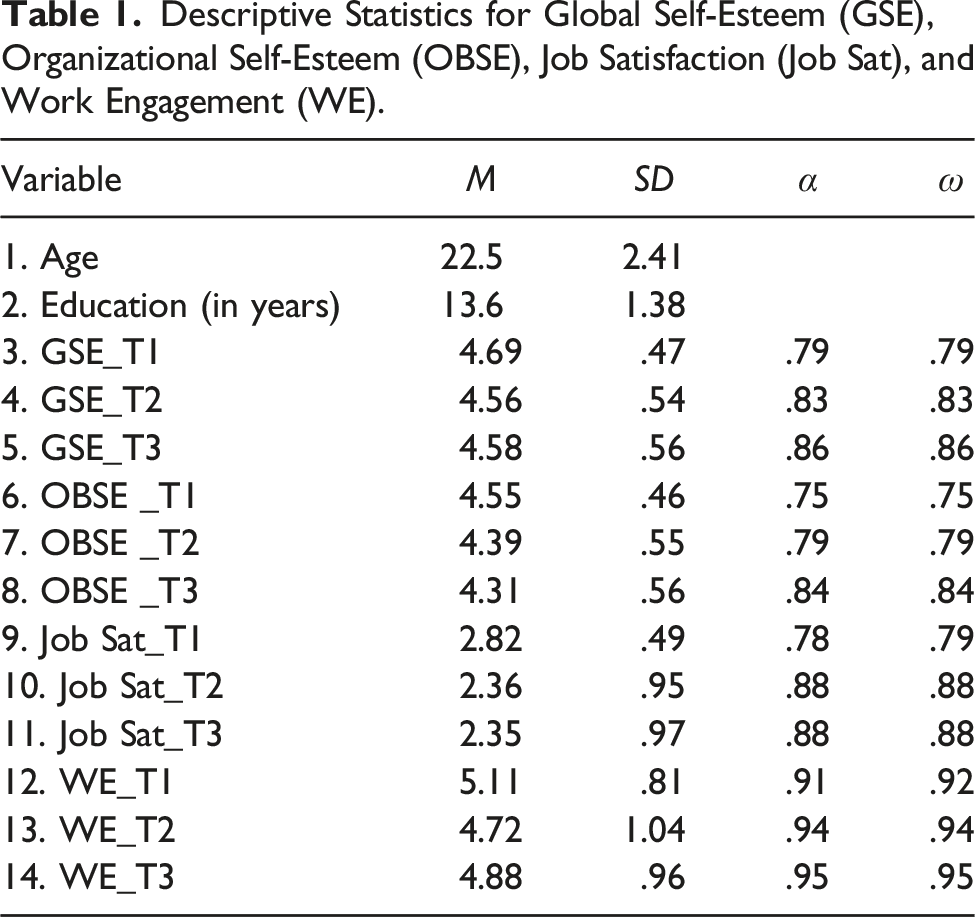
Descriptive Statistics for Global Self-Esteem (GSE), Organizational Self-Esteem (OBSE), Job Satisfaction (Job Sat), and Work Engagement (WE).
Organization-Based Self-Esteem
Workers completed the 6-item Organization-Based Self-Esteem (OBSE) scale developed by Filosa and Alessandri (2022), using a response scale ranging from 1 (“strongly disagree”) to 5 (“strongly agree”). All items were preceded by the statement “In my organization…,” and examples of items from this scale are “…I’m considered an essential part of the workgroup” and “…I feel respected by all my colleagues.” The OBSE scale showed good reliability at all waves (see Table 1).
Job Satisfaction
Workers indicated their level of satisfaction with their present job by responding to the 5-item version of the job satisfaction subscale of the Job Descriptive Index (Stanton et al., 2002). Examples of items (referring to one’s current job) are “gives a sense of accomplishment” and “satisfying.” The response scale was a three-point Likert scale, with zero for each "no" response, 1 for each "?", and 3 for each "yes." Cronbach’s alpha and omega coefficients were adequate (see Table 1).
Work Engagement
We used the 9-item Utrecht Work Engagement Scale (UWES-9; Schaufeli et al., 2006) to assess employees’ work engagement (response scale: zero = never; 6 = always). Cronbach’s alpha and omega coefficients were appropriate (see Table 1).
Cross-Lagged Modeling Strategies
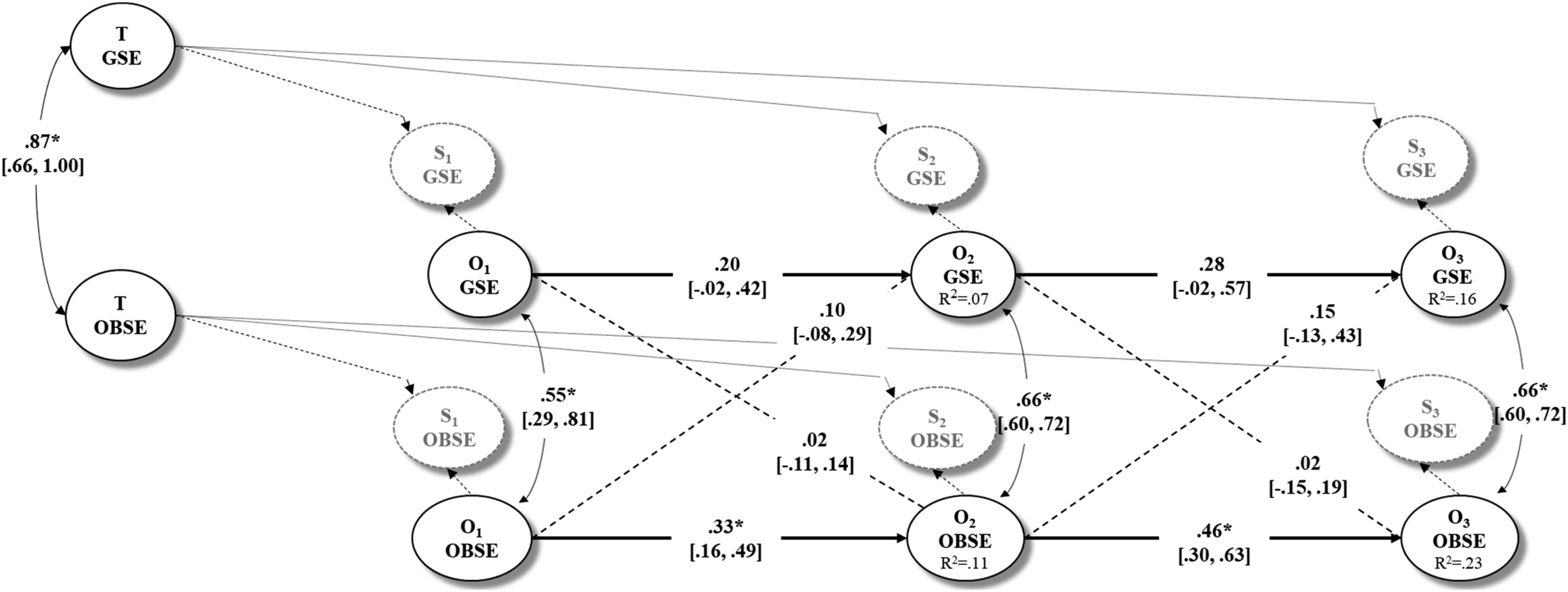
Given current debates about the usefulness of different cross-lagged models (Berry & Willoughby, 2017; Hamaker et al., 2015; Orth et al., 2021), we used three different models to test our hypotheses: (1) the Cross-Lagged Panel Model (CLPM; Zyphur et al., 2020), (2) the Random-Intercept Cross-Lagged Panel Model (RI-CLPM; Hamaker et al., 2015), and (3) a Latent State Trait Model with autoregressive and carryover effects (Eid et al., 2017). These models are represented graphically in Figures 1, 2, and 3. Below, we briefly review the basic characteristics of each model. Bivariate CLPM with GSE and OBSE. Note. Model fit: YBχ2(121, N = 1014) = 256.585, p < .001; SCF = 1.332; CFI = .972; TLI = .964; RMSEA = .033, 90% CI [.028, .039], p = n.s.; AIC = 23,662.070; BIC = 23,996.743. For simplicity, only autoregressive and cross-lagged effects and concurrent correlations are represented. The solid arrows represent the significant results; the dotted arrows represent non-significant results. Confidence intervals of each coefficient are in square brackets. *p < .05. Bivariate RI-CLPM with GSE and OBSE. Note. Model fit: YBχ2(120, N = 1014) = 312.261, p < .001; SCF = 1.315; CFI = .960; TLI = .949; RMSEA = .040, 90% CI [.034, .045], p = n.s.; AIC = 23,732.782; BIC = 24,072.377. For simplicity, only autoregressive and cross-lagged effects and concurrent correlations are represented. The solid arrows represent the significant results; the dotted arrows represent non-significant results. Confidence intervals of each coefficient are in square brackets. *p < .05. Bivariate LST-A with GSE and OBSE. Note. Model fit: YBχ2(120, N = 1014) = 243.313, p < .001; SCF = 1.323; CFI = .974; TLI = .967; RMSEA = .032, 90% CI [.026, .038], p = n.s.; AIC = 23,644.226; BIC = 23,983.820. For simplicity, only autoregressive and cross-lagged effects and concurrent correlations are represented. The solid arrows represent the significant results; the dotted arrows represent non-significant results. Confidence intervals of each coefficient are in square brackets. *p < .05.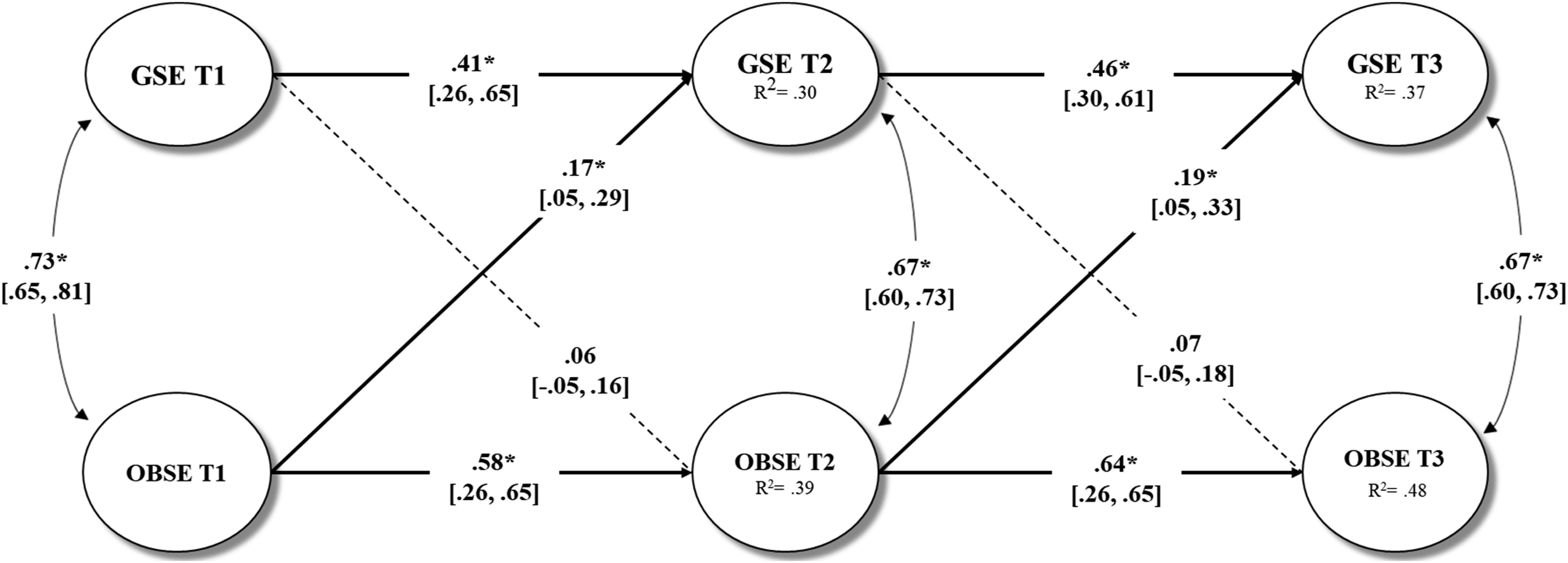

The classical Cross-Lagged Panel Model (CLPM; Zyphur et al., 2020; see Figure 1) statistically controls for concurrent associations and stability over time through the inclusion of autoregressive paths linking the same variable over time. For this reason, it has been used to estimate cross-lagged parameters that provide information about the direction of effects between two variables assessed over time. In our study, we fit both liberal (i.e., a version of the model with all parameters freely estimated) and a restricted version of the model (with parameters fixed to be equal over time—except factor variances and covariances at Wave 1) for estimating the prospective effect of GSE on OBSE (and vice versa), after controlling for both constructs concurrent associations and stability over time.
However, despite their wide popularity, cross-lagged regression models have been criticized because of their inability to distinguish between-person variance (i.e., variance that is predicted by stable, trait-like components) and within-person variance (variance that is dependent upon situations, contingent upon the environment or specific individual actions and choices; see Berry & Willoughby, 2017; Lucas, 2023; Hamaker et al., 2015). Thus, the second model we implemented was a Random-Intercept Cross-Lagged Panel Model (RI-CLPM; Hamaker et al., 2015; see Figure 2), which allowed us to examine within-person reciprocal relations between GSE and OBSE while controlling for stable between-person differences in these constructs. The RI-CLPM decomposes temporal variable variance at each time point, into two parts: (a) a “between-person” factor, also called the “random intercept” and (b) a set of “within-person” variance components. These latter variance proportions are then used to estimate the autoregressive and cross-lagged effects. The result is that only the within-person components can be used to test (1) autoregressive effects, capturing the within-person carry-over effects, referred often as “inertia” and (2) the cross-lagged effect, conceptualized as representing the spill-over of the state in one construct (or domain) influencing the state of another construct.
Finally, we used a third model, the Latent State Trait Model with autoregressive and carryover effects (LST-A; Eid et al., 2017; see Figure 3). The basic idea underlying any LST-A is that by repeatedly assessing individuals on the same construct, it is possible to identify portions of measurement variance that are due to trait-like variance (between-individual differences), occasion-specific residual variance (within-individual variability), and measurement error (Eid et al., 2017). This model allowed us to examine the within-person (i.e., state like) reciprocal relations between GSE and OBSE, while controlling for stable latent variable components (i.e., latent traits).
The variance components estimated by an LST model are the following. The latent trait variance (or T) captures stable ‘‘between-individual” characteristics that distinguish one person from another. It is measured by fixing the loading for the first measurement occasion at unit and then freely estimating factor loadings for latent state variables estimated at subsequent time points. Notice that the parametrization of the latent trait is the most striking difference between the LST-A and the RI-CLPM, and it is critical in the present context because this parametrization of the latent trait has a specific theoretical meaning, namely, that if the latent trait loadings are not homogeneous in the different time occasions then this would indicate that trait changes over time (Eid et al., 2017). The latent state variables (S), in contrast, represent wave-specific estimates of the individual deviation between the observed repeated measure and, as such, are potentially informative about within-person state processes. Each ‘‘S-component” entails an occasion-specific variance part (O), which represents a wave-specific variance component (i.e., it captures the specific variability of one specific variable observed only at one specific wave) connected to the subsequent ‘‘O-variance” by autoregressive coefficients. These coefficients represent the amount of within-person carry-over effect linking previous occasion variance to variance of the subsequent occasion.
Importantly, the temporal stability of occasion-specific residuals can be so high to make them as stable as latent traits, although they differ in terms of susceptibility to external situations (traits are theoretically not affected by situations). Importantly, occasion-specific residual variance characterizing a specific construct (i.e., GSE) can predict occasion-specific residual variance belonging to different constructs (e.g., OBSE). The presence of autoregressive and prospective paths among occasion components makes the LST-A a powerful longitudinal mediational model that (1) helps to avoid attenuation biases in testing mediation when using latent variables (Maxwell & Cole, 2007), (2) allows one to better assess the likely direction of causal influence among variables (due to using the temporally separated assessments; O'Laughlin et al., 2018), and (3) allows one to test alternative theoretical models (Cole & Maxwell, 2003).
Given that these models address somewhat different conceptual questions (Orth et al., 2021), we followed a formal model selection strategy to choose the model that best fits the data in our study. In general, we adopted an approach according to which we broadly compared the results generated by the three models to evaluate the robustness and generality of the findings across different data analytical procedures. However, and most importantly, when discussing our findings, we focused on the meaning of the specific results obtained from the model which (1) fitted the data better than the others and (2) provided the most meaningful theoretical representation of the underlying psychological processes.
General Modeling Strategies
We tested for measurement invariance over time for all study constructs because it represents a preliminary condition for running any latent variable cross-lagged model (Meredith, 1993). Given the potentially large number of parameters implied by the different cross-lagged models, measurement models for OBSE and work engagement were estimated using item-parcels as indicators, in order to reduce the ratio of estimated parameters on degrees of freedom, and thus avoiding unnecessary complexity in the models. Three parcels for each construct were composed following guidelines provided by Little and colleagues (2002): (1) the items of OBSE will be used to define 3 parcels (composed of 2 items each); (2) work engagement was measured using three composite scores each representing a facet of the construct assessed by the scale (i.e., vigor, dedication, and absorption). For GSE and job satisfaction, items were used as observed indicators of latent factors (given their restricted number). The final measurement model, representing the highest level of measurement invariance attestable for our data, was then used for estimating all subsequent structural models.
For testing the third hypothesis, we analyzed the effect of GSE on a single organizational outcome at a time, through the mediation of OBSE, controlling for the autoregressive effects of each construct on the subsequent wave 3 . In this step, in addition to the autoregressive and regular regression paths between the latent factors, we estimated the indirect effects of GSE on the organizational outcomes through the mediation of OBSE. In all models, the items were modelled as continuous variables.
Statistical Analyses
We tested our hypotheses by using Mplus 8.4 statistical software (Muthén & Muthén, 1998–2018). We used the Robust Maximum Likelihood estimator (Mplus estimator = MLR) to take into account the non-normal distributions of the study variables and to handle the missing information. Model fit was evaluated by using the Yuan–Bentler χ2 scaled statistic (YBχ 2 ), the Comparative Fit Index (CFI), the Tucker–Lewis Index (TLI), and the Root-Mean-Square Error of Approximation (RMSEA). We accepted CFI and TLI values >.90 and RMSEA values <.08 as indicators of adequate fit (Kline, 2016). Furthermore, we compared measurement invariance models by using difference in CFI (ΔCFI).
Based on previous literature on measurement invariance (Cheung & Rensvold, 2002; Little, 2013), we consider the steps of invariance tenable when ΔCFI < .010. For evaluating the competitive fit of CLPM, RI-CLPM, and LST-A models, the Akaike Information Criterion (AIC) and the Bayesian Information Criterion (BIC) were used. When comparing models using AIC and BIC, lower values indicate better model fit (Burnham & Anderson, 2004). Accordingly, models were compared by subtracting the AIC and BIC of each competing model from AIC and BIC of the baseline model. Following suggestions by Burnham and Anderson (2004), if the AIC and BIC difference between a competing and baseline model is less than 2, the competing model is considered the best fitting one, otherwise the baseline model remains the reference model to be compared with other competing models.
Mediated effects will be calculated using the procedures outlined by MacKinnon et al. (2002). The values for the upper and lower confidence intervals (CIs) for indirect effects will be tested by using the Monte Carlo Method for Assessing Mediation CI method (Hayes & Scharkow, 2013) with 20,000 replications. Finally, the significance level (alpha) was set to .05, but we also presented and discussed the size of the effects and their confidence intervals.
Results
Correlation Between Global Self-Esteem (GSE), Organizational Self-Esteem (OBSE), Job Satisfaction (Job Sat), and Work Engagement (WE).
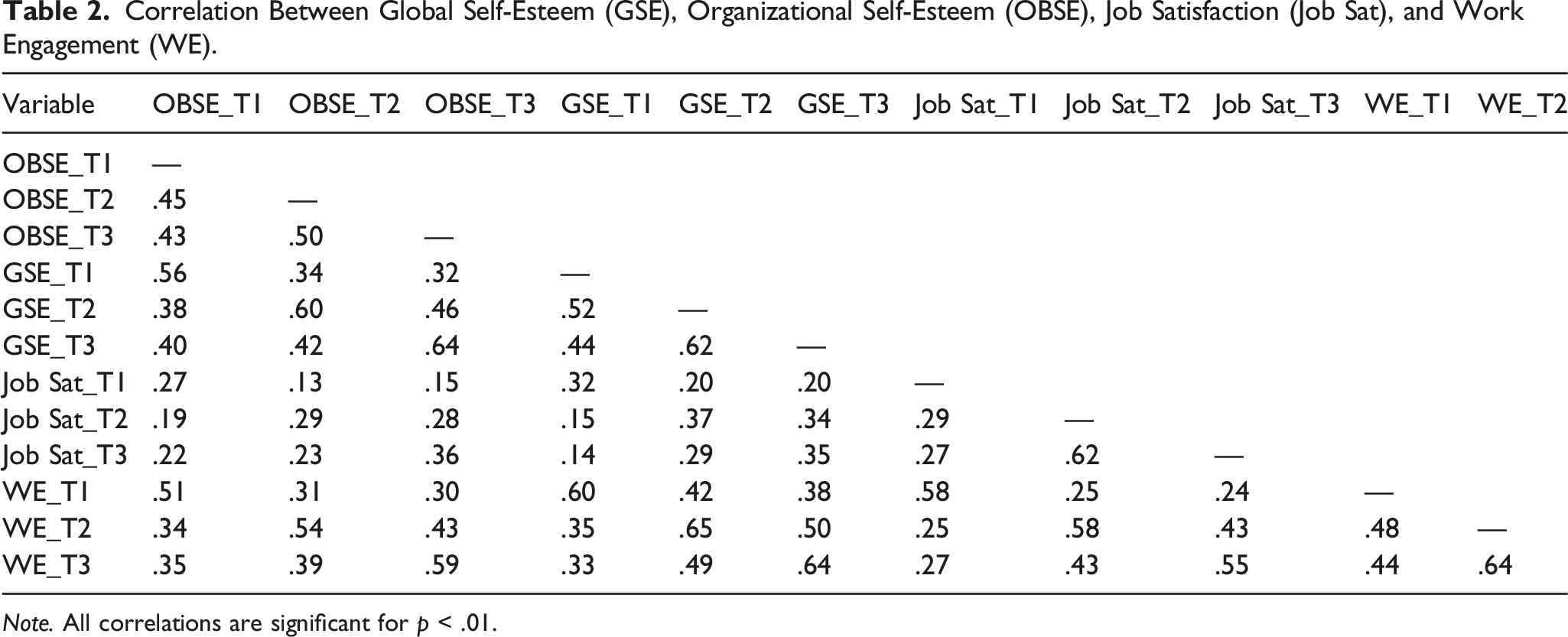
Note. All correlations are significant for p < .01.
Longitudinal Measurement Invariance of Study Variable.
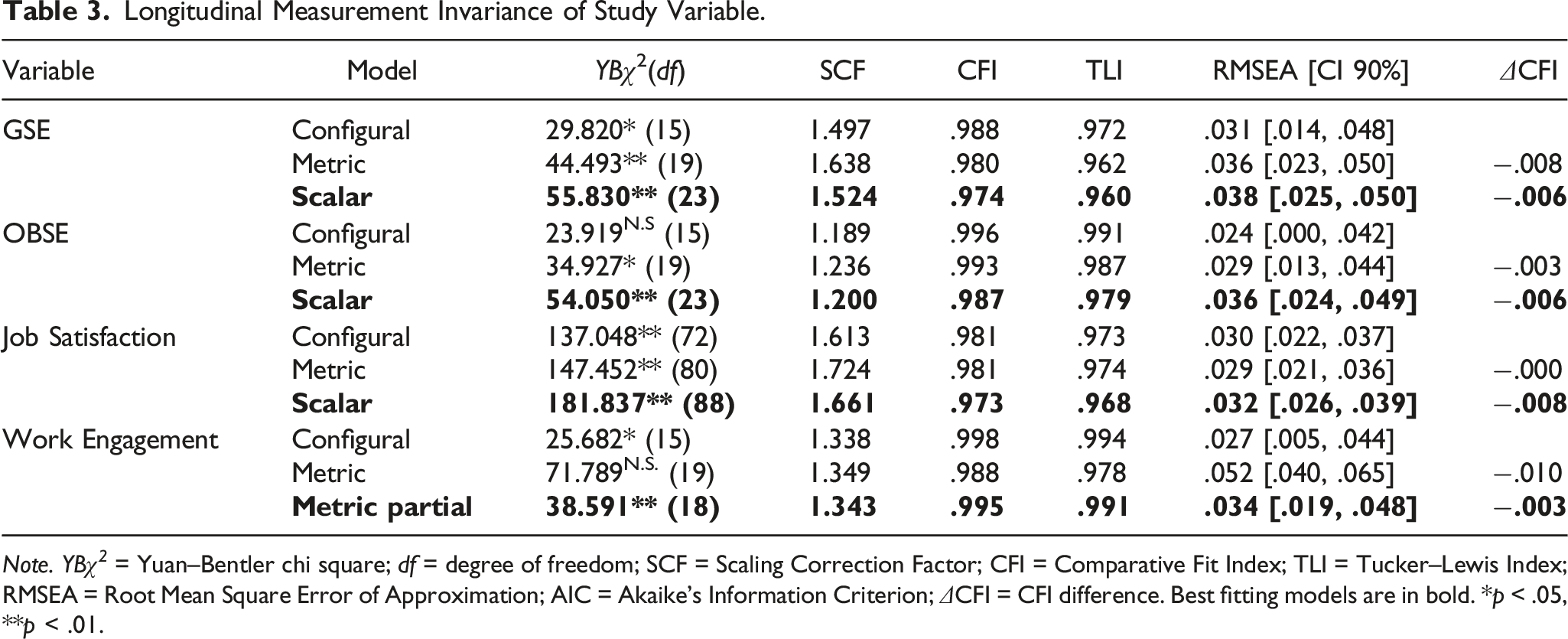
Note. YBχ 2 = Yuan–Bentler chi square; df = degree of freedom; SCF = Scaling Correction Factor; CFI = Comparative Fit Index; TLI = Tucker–Lewis Index; RMSEA = Root Mean Square Error of Approximation; AIC = Akaike’s Information Criterion; ΔCFI = CFI difference. Best fitting models are in bold. *p < .05, **p < .01.
Longitudinal Associations Between Global Self-Esteem and Organization-Based Self-Esteem
All three cross-lagged models demonstrated adequate model fit (see Figures 1, 2, and 3), but, based on AIC values of CLPM (23,662.070), RI-CLPM (23,732.782), and LST-A (23,644.226), the model that best fitted the data was the LST-A. The LST-A also best captures the underlying psychological processes, since it allows the latent trait loadings to be freely estimated, which indicate trait changes over time in case they vary over time. This is the case of our study, where latent trait loadings for both GSE and OBSE differed substantially over time (for GSE, the first trait loading was λ W1 = .767, while the second and the third were λ W2 = .606 and λ W3 = .579, respectively; for OBSE, the first trait loading was λ W1 = .716, while the second and the third were λ W2 = .567 and λ W3 = .549, respectively). For these reasons, we focused on the LST-A model when presenting and interpreting the results. Therefore, beginning with the correlations, results suggested that the GSE and OBSE traits were highly correlated (r = .88), and similar results were found for the concurrent correlations between GSE and OBSE occasions at the same waves (r = .55 at Wave 1, r = .66 at Wave 2, and r = .66 at Wave 3). Turning to the autoregressive and cross-lagged effects, results revealed that only OBSE had a significant autoregressive effect, whereas GSE did not. None of the cross-lagged effects were significant.
Results From Alternative Models
Model Fit, Cross-Lagged Effects, and Concurrent Correlations of the CLPM, RI-CLPM, and LTS-R Models.
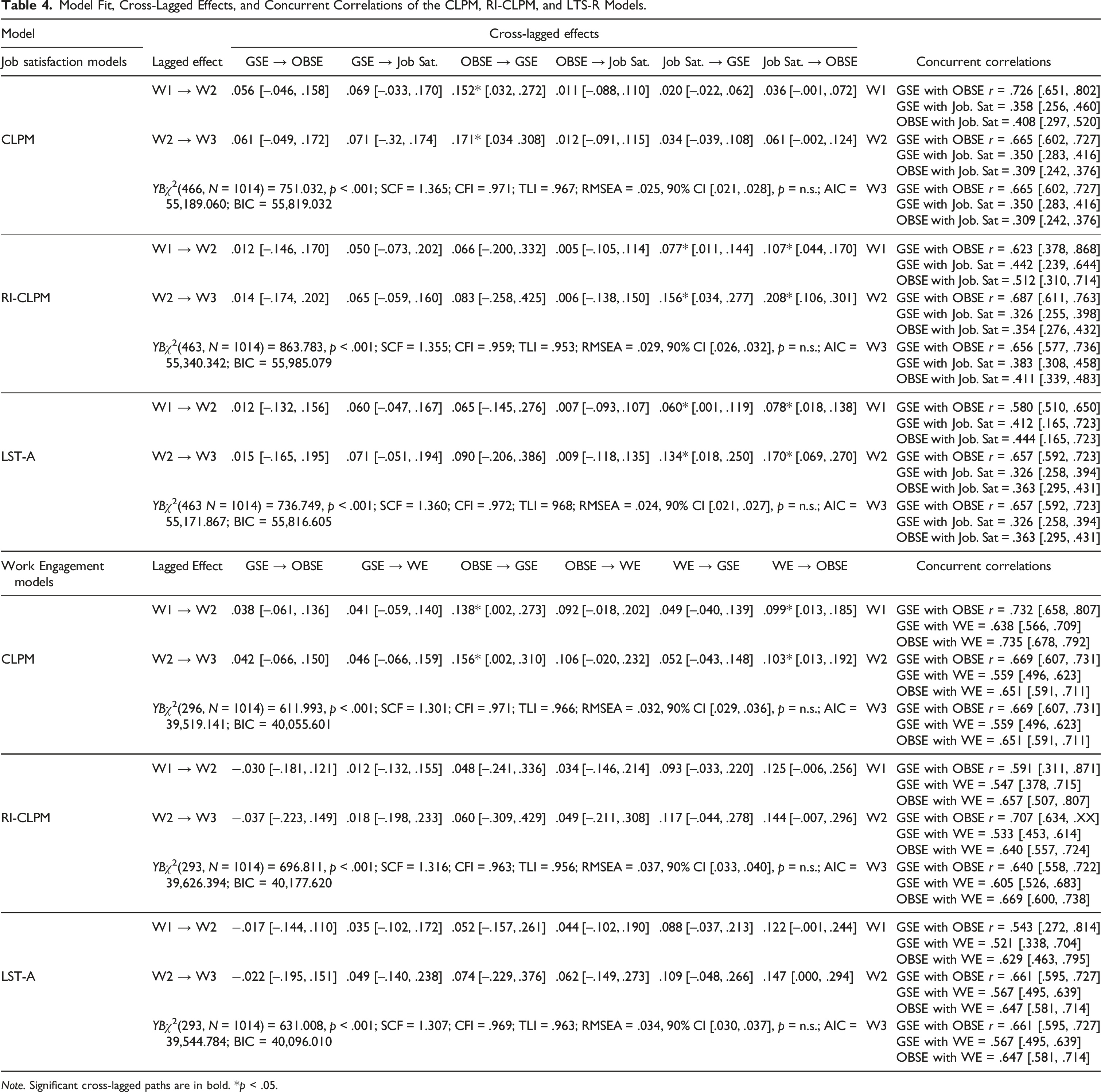
Note. Significant cross-lagged paths are in bold. *p < .05.
Cross-Lagged Effects of Global Self-Esteem and Organization-Based Self-Esteem on Job Satisfaction and Work Engagement
Table 4 presents model fit statistics, results of the cross-lagged effects, and concurrent correlations for the models including GSE, OBSE, and the organizational outcomes; separate models were run for job satisfaction and work engagement.
First, regarding job satisfaction, the LST-A model revealed that all the hypothesized cross-lagged effects from GSE and OBSE to job satisfaction were not significant. These results, although positive (i.e., in the hypothesized direction), were very small and, thus, negligible. Interestingly, the only significant cross-lagged effects were those from job satisfaction to both GSE and OBSE, with βs ranging from .060 (job satisfaction at Wave 1 to GSE at Wave 2) to .170 (job satisfaction at Wave 2 to OBSE at Wave 3). In this model, the GSE and OBSE traits were positively and significantly associated with the job satisfaction trait (r = .30 and r = .40, respectively), while the concurrent associations among states ranged from r = .33 (for GSE and job satisfaction at Wave 2 and Wave 3) to r = .36 (for OBSE and work engagement at Wave 1). Looking at the other models, the only significant (i.e., p < .05) cross-lagged effect in the CLPM was from OBSE to GSE (β = .152 for Wave 1 to Wave 2, and β = .171 for Wave 2 to Wave 3). Instead, as for the LST-A, for the RI-CLPM, the only significant effects were from job satisfaction to GSE and OBSE, with βs ranging from .077 (job satisfaction at Wave 1 to GSE at Wave 2) to .208 (job satisfaction at Wave 2 to OBSE at Wave 3). In general, variables assessed at the same wave were moderately to highly correlated (r m = .47, from .31 to .73) for all three models (see Table 4). Overall, results did not support either of the hypotheses regarding the effects from GSE and OBSE to job satisfaction, nor the mediational longitudinal relations with job satisfaction.
Second, turning to work engagement, the LST-A model revealed that even in this case, all the hypothesized cross-lagged effects from GSE and OBSE to job satisfaction were not significant. None of the effects from work engagement to GSE and OBSE were significant either. All results, although positive (i.e., in the hypothesized direction), were very small and, thus, negligible. Differently from the model with job satisfaction, where the correlations among the trait factors were moderate, the trait factor of work engagement was strongly correlated with the trait factors of GSE and OBSE (r = .75 and r = .84, respectively). Concurrent associations among states ranged from r = .52 (for GSE and work engagement at Wave 1) to r = .65 (for OBSE and work engagement at Wave 2 and Wave 3). For the other models, in the CLPM the only significant cross-lagged effects were from OBSE to GSE (β = .138 for Wave 1 to Wave 2, and β = .156 for Wave 2 to Wave 3), and from work engagement to OBSE (β = .099 for Wave 1 to Wave 2, and β = .103 for Wave 2 to Wave 3). Concurrent associations ranged from r = .56 (for GSE and work engagement at Wave 2 and Wave 3) to r = .74 (for OBSE and work engagement at Wave 1). For both the RI-CLPM, only the autoregressive paths for OBSE and work engagement were significant; no cross-lagged effects were significant. The random intercept factors of work engagement with GSE and OBSE were highly correlated (r = .76 and r = .85, respectively, and similar to the LST-A model). Concurrent correlations between occasions within the same waves were high (see Table 4). As was the case for job satisfaction, the pattern of results for work engagement precluded testing for mediation effects.
Additional (Non-Preregistered) Analyses
In addition to the above analyses, we tested a series of bivariate models including (1) only GSE and each organizational outcome and (2) only OBSE and each outcome. These analyses (with full detail) are presented in Supplementary Materials (Tables S1-S4). In general, results did not deviate substantially from the primary analyses that included both GSE and OBSE in the same model. Specifically, all the autoregressive effects were significant, the associations between traits were high, and all the within-time concurrent correlations between variables were significant. The only noteworthy difference was the significant cross-lagged effect of work engagement on GSE, which held in all three models. Finally, we tested a model that included all GSE, OBSE, and both outcomes together in a single model, and these results did not deviate substantially from the primary analyses (see details in the online OSF repository).
Discussion
A long-standing research tradition highlights self-esteem as a key factor in worker adjustment and well-being (Bowling et al., 2018; Brown & Zeigler Hill, 2018; Judge & Bono, 2001a, 2001b; Orth & Robins, 2022; Pierce & Gardner, 2004; Schaubroeck et al., 2012). However, different lines of research have emerged over the years, each focused on different aspects of self-esteem at work (Brown & Zeigler Hill, 2018). A problematic consequence of this progressively narrowing of analytical focus on specific facets of self-esteem has been that the longitudinal relationship between global self-esteem and work-specific self-esteem has been neglected (Bowling et al., 2010). The aim of the present preregistered study was to explore the longitudinal associations between GSE and OBSE and their relations with two important organizational outcomes, namely, job satisfaction and work engagement. Our hypotheses were mainly based on different theoretical rationales derived from the extant literature, which suggest bidirectional relations between the global and work-specific self-esteem as well as mediational relations with organizational outcomes. However, our results failed to confirm these hypotheses, and most notably, the three cross-lagged models we tested provided rather different results, even if the effects sizes were always in the same direction, and sometimes quite similar across models. Below, we generally discuss the results that most closely matched (or disconfirmed) our hypotheses and those that we did not hypothesize at all, while giving more emphasis to the LTS-A model, which resulted to be the best one both from a model fit and a theoretical perspective.
Hypothesized Findings
First of all, it is worth noting that different cross-lagged models address somewhat different research questions and it is very common to find different results (e.g., Ehm et al., 2019; Orth et al., 2021). This fact inevitably leads to problems in choosing the most appropriate model. However, although we had specific hypotheses, all the three models could have helped us in achieving the general aim of the present study. Therefore, one option to deal with the problem of model selection could be using model fit indices to select the best one (Usami et al., 2015, 2019). In our study, all the tested models fit data well, but the LST-A fits better than the others. Notably, the RI-CLPM, in general, fits worse than the other models in every condition in which it was applied (both bivariate and multivariate), while the CLPM and the LST-A fit the data in similar ways, with a slight advantage for the LST-A. This result is not unexpected given that GSE and OBSE are usually conceptualized as more trait-like than state-like (Alessandri et al., 2013; Donnellan et al., 2012). Consequently, the state components of OBSE and GSE are more difficult to properly capture, and they should be more related at the trait level, as suggested by the results of the CLPM model and the very high correlations between traits (and intercepts) factors in the RI-CLPM and the LST-A. Furthermore, it is important to note that the LTS-A was not only the best fitting model, but it was also the model able to capture more adequately the processes underling GSE and OBSE over time. By attesting differences in latent trait loadings, the LTS-A suggested the presence of non-ignorable changes in GSE and OBSE over the study period. Although analyzing changes in GSE and OBSE was not part of the present study aims, accounting for them is of outmost importance in order not to make the estimates biased 4 (Eid et al., 2017; Lucas, 2023).
In light of the abovementioned reasons, below we mainly discuss results from the LTS-A model. In general, the LTS-A model did not provide evidence for none of our hypotheses. First of all, neither the top-down nor the bottom-up received any empirical support in our data, differently from past research on self-esteem in different, non-work domains (see Dapp et al., 2022). Nonetheless, although unexpected, all of this is important because it shed some light on the interplay between GSE and OBSE over time for employees at the beginning of their career and also on the developmental processes underlining the two forms of self-esteem. In fact, GSE and OBSE seemed to be relatively interdependent from one another, even if highly linked at both trait level and within-time concurrent correlations level. This is informative in that it may suggest that, for newcomers just entered in a new organization, their self-evaluations about themselves as persons in general or about themselves as employees in particular do not influence each other. Thus, one may speculate that the two forms of self-esteem may follow different developmental pathways. Therefore, changes occurring in one form of self-esteem are not accounted for changes on the other from. Furthermore, it is also reasonable to think that GSE and OBSE could be influenced from certain predictors in different ways and with different magnitudes. At the same time, GSE and OBSE can be affected by different predictors which could have some effects on one form of self-esteem and not on the other, and vice versa. This could be, for instance, the case of negative events related to different life domains, like family-related negative events (i.e., divorce and relatives’ illness) which could impact GSE and OBSE differently (or could not impact OBSE at all), while work-related negative events (i.e., conflicts with coworkers and negative feedbacks) could have detrimental effects on how people view themselves as workers, with few or any consequences for their global self-evaluations.
In turns, it is also plausible to think that the different effects of GSE and OBSE, and their implication for workers’ adjustment to their job or for other life domains, can be summative rather than interchangeable. This idea should be explored more in deep in future study, since no particular speculations can be drawn from our data. However, if GSE and OBSE are quite independent from each other (although highly correlated), it seems reasonable to believe that their positive effects could spread toward different outcomes, and in different ways, in a summative manner, accumulating and strengthening each other. This knowledge would be very informative and useful for researchers as well as for practitioners so they could know that it is important to focus on both forms of self-evaluations instead of focusing on just one of the two.
Second, the LTS-A models including the organizational outcomes revealed no prediction from the two forms of self-esteem on job satisfaction and work engagement. Instead, contrary to our expectations, it was job satisfaction which predicted both GSE and OBSE over time. This result shows that when workers are more satisfied with their job, they tend to have more positive self-evaluations as workers and persons in general. This result partially mimicked those from past research (Krauss & Orth, 2022) but at first glance seems to support the idea that working experiences of satisfaction with ones' job is more relevant for employees’ self-evaluations during the early phases of their career. Another noteworthy point is revealed by the LST-A model, in which the trait factors of GSE and OBSE correlated differently with the trait factors of job satisfaction and work engagement such that these correlations were higher for OBSE than GSE, in conformity with specificity matching principle (Swann et al., 2007), and partially supporting the idea that the work-specific form of self-esteem is associated more strongly with the organizational outcomes than the global form.
Finally, to briefly discuss the other models, results from the CLPM revealed that the only significant cross-lagged path was from OBSE to GSE. However, these results did not replicate in the other two models tested. Neither the RI-CLPM nor the LST-A yielded any significant lagged associations between GSE and OBSE, suggesting that, in our data, these two forms of self-esteem, when decomposed into their trait and state components, are relatively independent from each other. One way to interpret this discrepancy between results offered by the CLPM compared to the other two models entails distinguishing the between-person and the within-person level of analysis. In this regard, our results suggest that at a between-person level OBSE (i.e., the level captured by the CLPM) may influence GSE, and not the reciprocal effect (a result that confirms only hypothesis H1.2. but not H1.1.), whereas at the within-person level, the two forms of self-esteem are unrelated (disconfirming both hypotheses H1.1. and H1.2.). This last result could not be necessarily interpreted as a confutation of previous theoretical assertions, but at list, as novel findings attesting the inadequacy in generalizing these assertions at a within-person level of analysis. Unfortunately, at the time of preregistration, we had no possibility to refine our hypotheses at these two levels of analysis, because, in the absence of previous research on the topic, this seemed purely speculative. Thus, given the post hoc nature of our reasoning, future research should investigate this inference more deeply. All in all, contrary to our hypotheses, the idea that during the initial phases of one’s job career OBSE derives more from a general sense of self-worth was not supported by any of our models.
Our study further contributes to the understanding of the processes linking GSE and OBSE at the between- and within-level of analysis. In this regard, the literature has mostly focused on between-individual relationships between GSE and OBSE, and their external correlates, attesting strong and significant associations. These results are mirrored by the significant and strong associations between trait components of GSE, OBSE, and outcome variables. Instead, within-individual processes, concerning occasion-related trait expressions turned out to be different from what one would expect on the basis of classical studies concerned on trait levels. Thus, one important implication of our study is the need of separately investigating processes occurring at different levels of analysis when studying personality processes.
Non-Hypothesized Findings
Results from the multivariate cross-lagged models deviated substantially from our hypotheses and were different across the models. The CLPM with job satisfaction replicated the results found in the bivariate CLPM, so that the only significant paths were those from OBSE to subsequent GSE. Instead, both RI-CLPM and LST-A models revealed a path from job satisfaction to GSE, showing that the direction of the path was opposite to what we hypothesized. This non-hypothesized result may support the idea that newcomers’ self-evaluations are more sensitive to job conditions (see Brown & Zeigler Hill, 2018; Pierce & Gardner, 2004), but it is not consistent with the dispositional perspective (Bowling et al., 2010), which assumes that higher levels of self-esteem predict better future job conditions and attitudes. Finally, none of the hypothesized results for work engagement were significant, surprisingly suggesting no effect of any form of self-esteem on work engagement, contrary to previous research and theory (Bakker & Demerouti, 2008). Instead, the only significant cross-lagged result was found in the CLPM, namely, the effect from work engagement to OBSE. Despite the dearth of significant results, it is worth noting that all of the observed cross-lagged effects were in the predicted direction, highlighting the need for further research in this area.
Limitations and Future Directions
The strengths of our study entail a preregistered analytical plan tested using data from a longitudinal study of a large sample of new employees followed for three years immediately after their entry into the organization, coupled with the use of three different cross-lagged models to evaluate our hypotheses. Nevertheless, several limitations of the present study should be noted. First, the generalizability of our results may be limited to the early stages of employees’ career; the pattern of relations between different forms of self-esteem may differ for long-term employees who worked in the same organization for many years. Thus, to better understand longitudinal relations between GSE and OBSE, future studies should evaluate the present hypotheses using samples of employees with longer tenure in their organization and/or over longer periods of time. Moreover, some effects estimated by our best fitting model were very small and larger samples (>1000) are necessary in order to properly test their significance (assuming that effects as low as .01/.03 may be considered of some meaningful practical value). Second, the study focused only on self-reported organizational outcomes, and future studies should focus on replicating our findings using different kinds of measures (e.g., supervisor or coworker ratings of work engagement) and objective outcomes (e.g., salary and promotions). Finally, most of our hypotheses were not confirmed, and future studies should try to clarify the replicability of our findings and attempt to find moderator variables that might identify subgroups of workers who show the predicted effects. As a suggestion, we would like to speculate about a potential moderating effect of work centrality on the relationship between GSE and OBSE. Indeed, it seems completely likely that the self-evaluations people have about themselves as persons in general and as workers could be mutually dependent only for those workers who invest more on their job, are more career oriented, or assign to their job an important role in their identity or life, than others who may be more focused on other spheres of their personal life (i.e., family and volunteering).
Conclusion
To the best of our knowledge, the present study was the first to empirically test hypotheses about longitudinal reciprocal relations between GSE and OBSE and their prospective effects on two important work outcomes: job satisfaction and work engagement. The main findings of our preregistered study highlight the relative independence of GSE and OBSE and their lack of impact on work outcomes, at least during the early phases of employees’ career. Future research should explore the generalizability of these findings to more experienced workers, to a wider range of work outcomes, and to other national and cultural contexts.
Supplemental Material
Supplemental material - Longitudinal Relations Between Global Self-Esteem and Organizational Self-Esteem and Their Prospective Effects on Job Satisfaction and Work Engagement
Supplemental Material for Longitudinal Relations Between Global Self-Esteem and Organizational Self-Esteem and Their Prospective Effects on Job Satisfaction and Work Engagement by Lorenzo Filosa, Guido Alessandri, and Richard W Robins in European Journal of Personality.
Footnotes
Declaration of Conflicting Interests
The author(s) declared no potential conflicts of interest with respect to the research, authorship, and/or publication of this article.
Funding
The author(s) disclosed receipt of the following financial support for the research, authorship, and/or publication of this article: This work was supported by the Sapienza Università di Roma (RG11816433CBD8D3), (RM11715C809391B1). Guido Alessandri and Lorenzo Filosa were supported by PNRR funds, partnership 8, spoke 4 (Trajectories for active and healthy aging). Richard W Robins was supported by a Visiting Professor Scholarship Awarded by Sapienza (N. 2023).
Correction (October 2023):
The paper was updated to correct the affiliations of Richard W Robins
Open Science Statement

Supplemental Material
Supplemental material for this article is available online.
Notes
References
Supplementary Material
Please find the following supplemental material available below.
For Open Access articles published under a Creative Commons License, all supplemental material carries the same license as the article it is associated with.
For non-Open Access articles published, all supplemental material carries a non-exclusive license, and permission requests for re-use of supplemental material or any part of supplemental material shall be sent directly to the copyright owner as specified in the copyright notice associated with the article.
