




Abstract
Population migration, as one of the most significant activities in human history and current societies, can shape a mobile social ecology entwined with personality traits. In this research, we tested whether the Dark Triad personality traits would adaptively emerge in and self-select into a residentially mobile ecology across eight studies (total N = 6147). Studies 1–2 demonstrated the relationship between residential mobility and the Dark Triad traits. Personal residential mobility was positively related to the Dark Triad traits (Study 1b), and this relationship was detected by lay persons (Study 1a). Residents living in a country (Study 2a) or a province (Study 2b) with a high net population outflow reported a high level of the Dark Triad traits. Studies 3–4 explored the interplay of residential mobility and the Dark Triad traits. Studies 3a–3b revealed the shaping effect of residential mobility, showing that individuals with the mindset of residential mobility (vs. stability) tended to resort to the Dark Triad traits. In contrast, individuals who possess a high level of Dark Triad traits prefer a mobile lifestyle (Study 4a) and a residence with high outflow (Study 4b). Together, this research empirically illuminated the associations and the interactions between residential mobility and personality traits.
Introduction
Humanity has been on the move and will continue to be mobile. For a variety of reasons, we move away from our habitual places of residence to different cities, to other states or provinces, to different countries or across continents. Residential mobility, a critical factor that determines individuals’ objective interpersonal environments, is usually defined as the extent to which people in a given area change their residence in a given period (Buttrick & Oishi, 2021; Choi & Oishi, 2020; Oishi, 2014). Today, more people than ever live in a country, state or city other than that in which they were born. As of 2020, the number of internal migrants in China reached 376 million (migrant rate: 26.21%; China Statistical Yearbook, 2021), and 29.78 million (mover rate: 9.26%) people moved to the United States in 2020 (U.S. Current Population Survey, 2021). Although the great majority of people do not migrate across borders, as of June 2019, the number of international migrants was estimated to be almost 272 million globally, 51 million more than in 2010 (World Migration Report, 2020). In some countries (e.g. the United Arab Emirates), more than 88% of the population are international migrants. Undeniably, residential mobility, whether internal or international, has become a universal backdrop to contemporary society (Choi & Oishi, 2020). Thus, a growing body of research has regarded residential mobility as a socioecological factor that determines an individual’s objective interpersonal environment (e.g. the likelihood of interacting with strangers; Choi & Oishi, 2020) and has revealed its impact on a series of behaviours and mindsets (e.g. increased individualism, optimism, and tolerance; Buttrick & Oishi, 2021; Oishi, 2014).
Personality, as a reflection of all characteristic patterns of thoughts, feelings, strivings and behaviours (Baumert et al., 2017), could also pertain to the environment of residential mobility. Researchers have long discussed and theorized the association between personality and environment (P-E association; Ellis et al., 2011; Kandler & Rauthmann, 2021) and the personality-environment fit (P-E fit, the match between the characteristics of the person and the attributes of the environment; Kandler & Rauthmann, 2021). However, although a voluminous body of literature has documented the consequences of residential mobility for individuals and society (Choi & Oishi, 2020; Oishi, 2014; Oishi & Tsang, 2022), there has been a paucity of empirical research on the potential of residential mobility to determine the emergence of certain personality traits (Jokela, 2020; Rentfrow et al., 2008). In addition, extant evidence has mainly shown that personality traits can be determinants of the propensity to move and the reason for moving (Jokela, 2009, 2021; Jonason, 2018); for example, recent evidence showed that open and extroverted people choose to settle in urban areas (Jokela et al., 2015; Jokela, 2020; Yoshino & Oshio, 2022), and open people may cluster in cities that offer more amenities (Götz et al., 2021). In spite of this, research on whether people with certain personality traits selectively move to or are geographically clustered in areas with certain features is still in its infancy. With these limitations in mind, we asked whether residential mobility shapes personality and whether people with certain personalities favour residential mobility.
Examining whether residential mobility moulds or changes personality is essential because extensive research has indicated that personality traits (such as the Dark Triad, Paulhus & Williams, 2002) influence life outcomes across all domains of human functioning (e.g. work, health, relationships and well-being; Harms & Spain, 2015; Jonason et al., 2015). This research has focused on the Dark Triad (i.e. narcissism, Machiavellianism, and psychopathy; Paulhus & Williams, 2002) for two main reasons. First, despite some positive outcomes, residential mobility was closely related to many personal and societal costs, such as higher crime rates, neighbourhood violence, and antisocial behaviours (Luo et al., 2020; Sampson et al., 1997; Sciandra et al., 2013; Su et al., 2016; Zuo et al., 2018). Since the Dark Triad is a constellation characterized by malevolence, the inclusion of the Dark Triad traits might contribute to explaining these personal and societal costs of residential mobility at the personality level. Second, the Dark Triad-related mindsets and behaviours largely echo the strategic responses attuned to a mobile context. Some negative mindsets and behaviours associated with residential mobility are believed to be adaptive (e.g. antagonism; Zuo et al., 2018, 2023). Coincidentally, the Dark Triad traits come with some undesirable strategies, which can help individuals to adapt to some environments (Jonason et al., 2009, 2010). This type of costly adaptation might link the Dark Triad to residential mobility. Although residential mobility implies a habitat where individuals may experience high unpredictability (Ellis & Del Giudice, 2019; Zuo et al., 2018), the Dark Triad traits may constitute conditional adaptations to solve adaptive problems in an unpredictable world (Jonason et al., 2016). Exploring the association between residential mobility and the Dark Triad could reveal how the environment and personality work together to achieve conditional adaptation.
In hopes of enriching the literature on the personality-environment association and geographical differences in personality, this research sought to explore the following research questions: Does frequent moving indicate or determine what a person is like? Does a mobile environment influence the expression of the Dark Triad traits? Do people with the Dark Triad traits favour relocation? Do people with the Dark Triad traits selectively migrate to mobile places?
Psychology of the personality-environment (P-E) association
Person-environment relations seem to be central to personality psychology (Rauthmann, 2021). Much attention has been paid to the links between socioecological environments and personality (Ellis et al., 2011; Kandler & Rauthmann, 2021; Oishi, 2014). Beyond seeing personality as a product of the environment (Wei et al., 2017), personality’s active selection of the environment has also been placed in the spotlight (Götz et al., 2018, 2020; Kandler et al., 2021; Rentfrow, 2020; Van de Vliert & Van Lange, 2019; Wagner et al., 2020). Drawing on extant perspectives on geographic psychology (Rentfrow, 2020) and personality-environment fit (P-E fit; Kandler & Rauthmann, 2021), regional differences in personality or P-E association can develop via at least three processes: (a) ecological influence; (b) social influence; and (c) active selection.
First, a certain environment facilitates the expression of specific personality traits. Although the forces and processes underlying personality development are disputed (e.g. the endogenous vs. exogenous perspective; Briley & Tucker-Drob, 2014), an increasing number of researchers have held that genetic influences are differentially expressed in specific environmental contexts (i.e. phenotypic plasticity; Johnson, 2007; Krueger & Johnson, 2008). Organisms in different ecological environments face different selection pressures (Wilkinson & Pickett, 2017), and personality differences themselves constitute an evolutionary mechanism to help species to gain reproductive and survival advantages in the environment (Blum et al., 2018; Briley & Tucker-Drob, 2014; Sng et al., 2017). Recently, research on ecological influence has focused on the effect of humans’ physical surroundings on their personality, by looking at factors such as green space (White et al., 2013), climate (Van de Vliert et al., 2013; Wei et al., 2017) and physical topography (Götz et al., 2020; Stieger et al., 2022; Xu et al., 2022). Second, social influence reflects the impact of the environment (e.g. social climate or social norms) on personality traits (Jokela, 2020; Rentfrow, 2020). The attributes of a macro-environment can induce social norms with certain biases, which will encourage specific types of psychological and behavioural patterns (or traits) and prompt individuals to act following such patterns (Gelfand et al., 2011). Behaving in ways that fit a group’s or society’s norms can bring individual acceptance or status and reduce social pressure (Asch, 1951; Harms et al., 2006). That is, social influence encompasses a P-E fitting process. Third, individuals’ active choices of environment promote the formation of a (nonrandom) P-E connection. People are self-determined, not only passive recipients of environmental influences, but they can steer their own development (Wagner et al., 2020). People with certain levels or profiles of traits are attracted or selectively migrate to environments that match them and avoid those that are incompatible (Rentfrow et al., 2008).
Given that personality is directly and indirectly shaped by the environment in the processes of ecological influence and social influence, we subsumed the three mechanisms into two categories and proposed two corresponding hypotheses: residential mobility evokes the Dark Triad traits, and people with Dark Triad traits might prefer residential mobility.
Why does residential mobility shape the Dark Triad?
At the individual level, residential mobility is defined by the number of times that an individual relocates, and at the regional level, it is usually defined as the percentage of people in a given neighbourhood who recently relocated (Choi & Oishi, 2020; Oishi, 2010). Residential mobility is regarded as a socioecological cue insofar as mobility at both levels brings great changes to the environments in which people live. When individuals are constantly on the move, the small environments in which they live are more mobile than environments in which people do not move. In contrast, if one lives in a place where many people are moving, even if the individual is not moving, the surrounding environment is considered highly mobile.
Ecological influence could explain the shaping effect of residential mobility on the Dark Triad. Residential mobility, be it personal or regional, is marked by fewer repeated encounters and unpredictability, making antagonistic strategies more adaptive in survival and reproduction (Chio & Oishi, 2022; Zuo et al., 2018, 2023). Specifically, residential mobility will exacerbate residents’ disconnectedness and decrease the number of interactions with the same target. In this case, cooperation will cause great losses, whereas consistent deception or antagonistic strategies can minimize the potential losses and even generate more profits (Abreu, 1988). In addition, residential mobility increases the unpredictability or uncertainty of resources and opportunities (Belsky et al., 2012; Oishi, 2014). To survive in such an environment, seizing resources is the overriding goal, causing people to be more willing to take risks to extract resources, pursue immediate interests or use antagonistic and dominating strategies (Fumham et al., 2013). That is, residential mobility creates a specific selection pressure under which confrontation outweighs cooperation. It can further influence the expression of personality so that individuals can better adapt to this environment. The Dark Triad traits, as a constellation of malicious personality traits (Paulhus & Williams, 2002), are associated with humans’ mental darkness and a set of interpersonal strategies, such as selfishness (Jonason & Webster, 2012), interpersonal alienation (Stead et al., 2012), cheating (Paulhus & Williams, 2002) and antagonism (Vize et al., 2019). The Dark Triad could be observed as a broader antisocial behavioural syndrome that conflates separate reactions that facilitate fitness in individuals in a mobile context (Međedović, 2018). Presumably, the Dark Triad might be activated and encouraged in a mobile environment through the phenotypic plasticity of personality.
Social influence could also partly explain the shaping effect of residential mobility on the Dark Triad. A mobile environment discourages interdependence because residents of such an environment are likely to move away, and the social relationships from which people can seek help are usually interrupted (Oishi & Tsang, 2022). Low interdependence will further hinder the formation and maintenance of strong-tie relationships but foster weak-tie relationships (Oishi & Kesebir, 2012). Both low interdependence and weak-tie relationships might create a normative climate that devalues interpersonal trust and closeness and imposes normative pressure on individuals (Kammrath et al., 2020; Trivers, 1971). Within such a social climate, antagonistic personality traits, such as the Dark Triad traits, are more likely to develop.
Why does the Dark Triad favour residential mobility?
The Dark Triad traits are marked by ruthless self-advancement (Zuroff et al., 2010) that might exploit most people’s cooperative behaviours and eliminate reciprocity (Cosmides & Tooby, 1992). Employing exploitative and deceptive strategies can help individuals to gain profit or fulfil personal goals. However, there are two qualifications to this tendency.
The first qualification is that niches are suitable for the use of the malicious strategies associated with the Dark Triad. People with high Dark Triad traits are more likely to gain advantages through cheating and exploitation in certain contexts. For example, previous research has shown that narcissists are likely to gain advantages with unacquainted targets, in early-stage relationships, and in short-term contexts (Campbell & Campbell, 2009; Leckelt et al., 2015). A mobile environment is an ideal habitat to satisfy these prerequisites. In a mobile environment, individuals have fewer acquaintances and mainly maintain early-stage relationships (Zuo et al., 2018, 2023). These characteristics of mobile environments can improve the effectiveness of antisocial tactics. In contrast, researchers have found that, if people with high Dark Triad traits settle down in a stable environment, their popularity will decline over time, and they will eventually be disliked (Campbell & Campbell, 2009; Leckelt et al., 2015). Therefore, individuals with high Dark Triad traits are motivated to live in mobile environments. Otherwise, the surrounding individuals might become aware of their wrongdoing and bad reputation, hindering resource extraction.
The second qualification is that the niches are suitable for escaping punishment for immorality. First, the poor monitoring system of a mobile environment enables deception without detection. The monitoring system works through exposure to wrongdoing and conscience (Zuo et al., 2023). Voluntary migrations increase transient and anonymous interactions with strangers, which create a barrier to identifying people who transgress or infringe on others’ rights. With few people knowing them in a mobile environment, people who maliciously exploit and selfishly manipulate others in these niches are unlikely to be judged by their consciences. Ineffective sanction systems in highly mobile environments can help individuals with Dark Triad traits to avoid potential costs. In an environment with high residential mobility, low identifiability can free transgressors from actual sanctions (Zuo et al., 2023). One factor that plays an indispensable role in social sanctions is reputation. Generally, self-gains at the expense of others confer a bad reputation, which is adverse to an individual’s achievement of social support and high status. However, high regional residential mobility hinders reputational information transmission (Zuo et al., 2018). Consequently, aggressive and manipulative acts in such niches carry a lower risk of social sanctions. Because mobile environments satisfy this condition, they may attract individuals with high Dark Triad traits actively migrate there.
In summary, we assume that the Dark Triad traits and residential mobility are intertwined. On the one hand, environments with high residential mobility will encourage the expression of the Dark Triad. On the other hand, high levels of Dark Triad traits push individuals to choose a mobile lifestyle and habitat. However, we do not preclude the possibility that the three Dark Triad traits show different associations with residential mobility since the traits are somewhat distinct from each other (Paulhus & Williams, 2002). Specifically, narcissism is uniquely marked by grandiosity and vanity, Machiavellianism by hypocrisy and calculation, and psychopathy by impulsivity and sensation seeking (Paulhus & Williams, 2002). Research has suggested that psychopathy is more closely related to Machiavellianism (Rauthmann & Kolar, 2013). It is conceivable that the three traits of the Dark Triad show different relationships with residential mobility. Nevertheless, these traits share the feature of manipulative and exploitative strategies (Ok et al., 2021). In our theorizing, the shared features of the Dark Triad, rather than the specific characteristics of each component, form the foundation for the association between the Dark Triad and residential mobility. Thus, all three elements of the Dark Triad are presumably associated with residential mobility.
Present research
Overview of Research and Results.
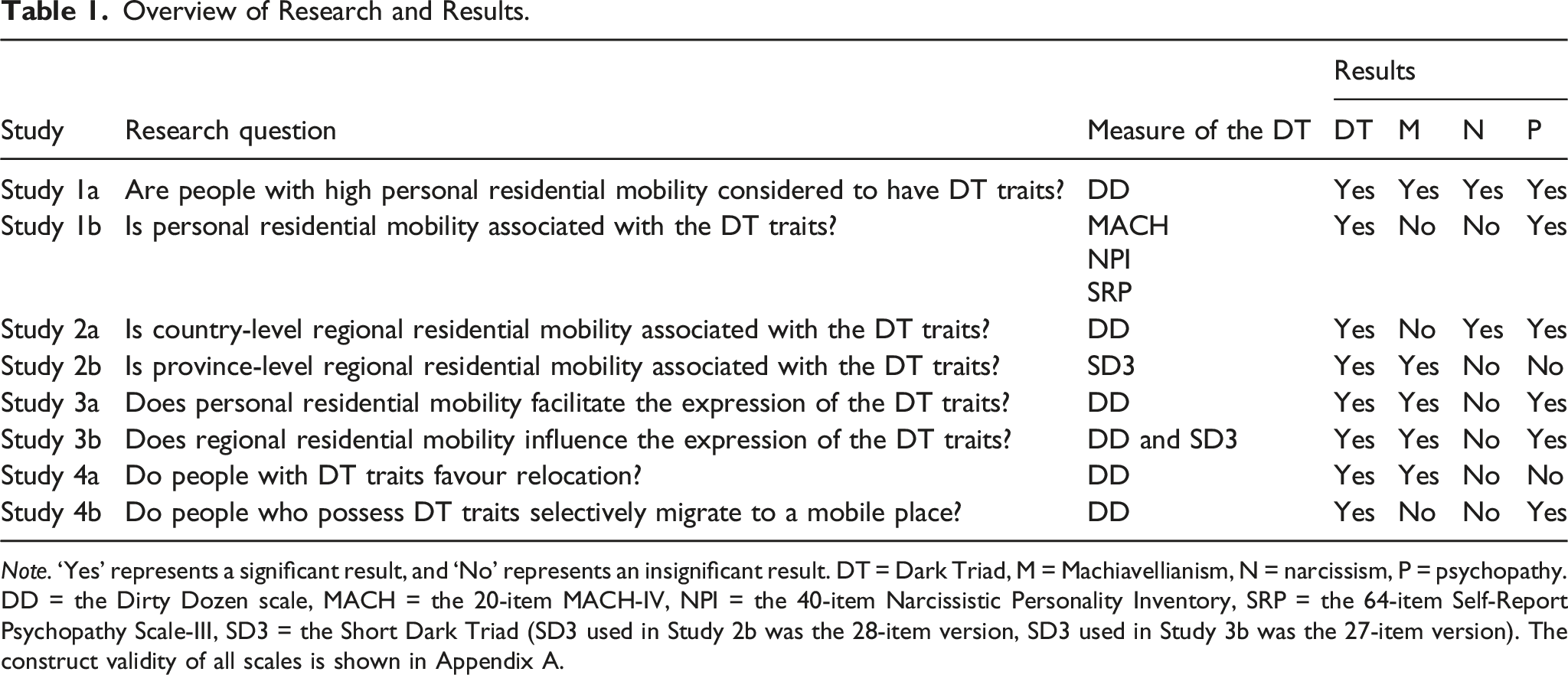
Note. ‘Yes’ represents a significant result, and ‘No’ represents an insignificant result. DT = Dark Triad, M = Machiavellianism, N = narcissism, P = psychopathy. DD = the Dirty Dozen scale, MACH = the 20-item MACH-IV, NPI = the 40-item Narcissistic Personality Inventory, SRP = the 64-item Self-Report Psychopathy Scale-III, SD3 = the Short Dark Triad (SD3 used in Study 2b was the 28-item version, SD3 used in Study 3b was the 27-item version). The construct validity of all scales is shown in Appendix A.
This research was approved by research ethics board at the corresponding author’s university. The hypotheses and analyses were exploratory, not preregistered. All data were collected in alignment with the APA ethics code. For each study, we report any exclusion criteria and a sensitivity power analysis, which determines the smallest observable effect or power given the achieved sample. Participants in all studies (except Study 2a used open data) completed questionnaires or experiments via online platforms. Participants in different sub-studies were compensated between RMB 8 and RMB 12 (approximately USD1.1–1.6). Participants cannot submit their responses with missing data, ensuring that no missing data existed in these studies. In Study 2a, participants with missing responses were excluded from statistical analyses. Analyses in Studies 1, 3, and 4 were performed with SPSS 24, and analyses in Study 2 were performed using the software HLM 6. Data, analysis code, and materials used in this article are available at the OSF repository and can be accessed at https://osf.io/cg98a/.
Study 1a
Humans can accurately detect the personality traits of others (Thielmann et al., 2017). Individuals integrate information about others and form a corresponding personality judgement, and this process can protect individuals from being exploited by others (Thielmann et al., 2017). Thus, we expect that individuals can also detect others’ Dark Triad traits given the close connection between these traits and exploitive behaviours. If residential mobility pertains to the Dark Triad traits, this co-occurrence could be observed by laypeople and help individuals to form a social expectation that people with high personal residential mobility are more likely to possess these traits (Huang et al., 2017). In this study, we tested whether laypersons have such an expectation, testing the hypothesis from an observer’s perspective.
Methods
Participants
In total, 233 Chinese participants were recruited from a campus bulletin board system and received monetary compensation of 8 RMB (approximately USD1.1). Twenty-four participants were excluded for failing to pass an attention test, leaving a final sample of 209 (49 males and 160 females). The participants’ ages ranged from 18 to 62 years old, with a mean of 24.06 (SD = 5.83). A G*power sensitivity analysis (Faul et al., 2009) showed that this sample provides sufficient power (80%) to detect as small as d = .18 for a one-sample t-test.
Procedures and materials
Previous studies have focused on the history of residential mobility, whereas the current state and future intention of mobility, which also embody residential mobility and have psychological effects (Oishi, 2010), have been underestimated. For this reason, the history, state, and intention of residential mobility were all considered and distinguished when we manipulated the level of personal residential mobility. Specifically, two targets (A and B) differed in terms of the history of residential mobility, and the conditions were described as follows. A and B have completely different life histories. Since birth, A has relocated many times and has lived in many different areas so that, in the course of life, A has hardly lived in the same place for an extended period; in contrast, since birth, B has never relocated and has always lived in the same area. Similarly, two targets (C and D) differed in terms of their state of residential mobility, and the conditions were described as follows. C and D have completely different life states. C recently changed residences, moving to the current region from another place; thus, C has lived in the current region for a short time. In contrast, D has not recently changed residences and has lived in the current region for a long time. Finally, two targets (E and F) differed in terms of the intention of residential mobility, and the conditions were described as follows. E wants to change residences and has a detailed plan to move to another area in the future; in contrast, F does not want to change residences and plans to remain in the current area in the future.
The participants completed the task using an online system. The task consisted of three sessions. In each session, the participants were first presented with one of the pairs of descriptions mentioned above. Then, they were required to remember the descriptions and answer a question to check whether they understood the differences in residential mobility between the two targets (e.g. who has relocated many times in the past, A or B?). Participants could continue the task only if they answered the questions correctly. Then, we required the participants to judge the targets’ characteristics, including Dark Triad traits, which were adapted from the 12-item Dirty Dozen scale (Geng et al., 2015; Jonason & Webster, 2010). Four characteristics were used to measure narcissism (e.g., seeking prestige or status), Machiavellianism (e.g. manipulating others to one’s way) and psychopathy (e.g. tending to lack remorse); these characteristics were mixed with unrelated characteristics to conceal the purpose of the research.
Participants were instructed to judge which of the two targets was more likely to exhibit the listed characteristics on a scale ranging from −5 to 5 (−5 = A/C/E is more likely to exhibit the trait, zero = the two targets are equally likely to exhibit the trait, 5 = B/D/F is more likely to exhibit the trait). The characteristics were averaged to create a measure of narcissism (history: M = −1.08, SD = 1.79; α = .67; state: M = −.95, SD = 1.76; α = .80; intention: M = −.97, SD = 1.75; α = .80), Machiavellianism (history: M = −1.25, SD = 1.66; α = .74; state: M = −.98, SD = 1.66; α = .80; intention: M = −1.18, SD = 1.65; α = .88), psychopathy (history: M = −.77, SD = 1.52; α = .64; state: M = −.62, SD = 1.49; α = .69; intention: M = −.59, SD = 1.36; α = .71), and a single Dark Triad index of all the three traits (history: M = −1.03, SD = 1.22; α = .76; state: M = −.85, SD = 1.28; α = .84; intention: M = −.91, SD = 1.22; α = .85). Lower values indicated that the participants believed that the targets in mobile (vs. stable) conditions were more likely to exhibit high levels of Dark Triad traits. Finally, the participants provided their demographic information (age and sex differences in study variables are detailed in Appendix B).
Results and discussion
The participants’ ratings, distinguished by conditions and traits, are presented in Figure 1. We conducted one-sample t tests to examine the difference in Dark Triad traits between two targets in each session, as rated by the participants. The results showed that, in session 1, the scores for narcissism (t(208) = −8.69, p < .001, d = .601), Machiavellianism (t (208) = −10.87, p < .001, d = .752), psychopathy (t (208) = −7.34, p < .001, d = .508), and the Dark Triad (t (208) = −12.26, p < .001, d = .848) were significantly higher than the midpoint 0, indicating that the participants believed that individuals with a history of high residential mobility (target A) were more likely to exhibit high levels of the Dark Triad traits than those with a history of low residential mobility (target B). In session 2, the results showed that the scores for narcissism (t (208) = −7.78, p < .001, d = .538), Machiavellianism (t (208) = −8.53, p < .001, d = .590), psychopathy (t (208) = −6.03, p < .001, d = .417), and the Dark Triad (t (208) = −9.59, p < .001, d = .663) were significantly higher than the midpoint 0, indicating that the participants believed that individuals with a state of high residential mobility (target C) were more likely to have high levels of the Dark Triad traits than those with a state of low residential mobility (target D). Similarly, in session 3, the scores for narcissism (t (208) = −8.00, p < .001, d = .553), Machiavellianism (t (208) = −10.33, p < .001, d = .714), psychopathy (t (208) = −6.29, p < .001, d = .435), and the Dark Triad (t (208) = −10.78, p < .001, d = .745) were significantly higher than the midpoint 0, indicating that the participants believed that individuals with a high intention of residential mobility (target E) were more likely to have high levels of the Dark Triad traits than those with a low intention of residential mobility (target F). Differences between perceived traits across mobile and stable conditions (Study 1a). Note. Values less than zero indicate that residential mobile individuals are more likely to possess Dark Triad traits, and values greater than zero indicate that residential stable individuals are more likely to possess Dark Triad traits.
Considered together, the results of Study 1a show that lay persons have a clear social expectation that individuals living in mobile conditions are more likely to have higher levels of Dark Triad traits than those living in stable conditions. This finding suggests that people believe that high personal residential mobility is an environmental cue related to the Dark Triad traits, supporting our hypothesis from an observer’s perspective. The expectation might derive from general observations in everyday life and reflect people’s naïve psychology of personality development. However, the accuracy of this expectation is unknown, so the findings in Study 1a cannot provide direct evidence of a correlation between residential mobility and the Dark Triad. In Study 1b, we investigated how one’s personal residential mobility relates to one’s Dark Triad traits to test the association directly.
Study 1b
Study 1b aimed to clarify whether individuals’ Dark Triad traits relate to their personal residential mobility. A self-reported scale of personal residential mobility was developed and then used to examine the correlation between personal residential mobility and the Dark Triad. Social desirability was controlled for in this study because people scoring high on the Dark Triad are prone to being dishonest and seek social appreciation (Zuo et al., 2016). We expected that participants with high personal residential mobility would report higher levels of Dark Triad traits.
Methods
Participants and procedures
Three hundred twenty-five Chinese participants (72 males and 253 females; Mage = 27.91, SD = 7.37) were recruited online in exchange for monetary compensation of 10 RMB (approximately USD1.4). The participants completed an online survey consisting of the measures described below and some demographic variables (age and gender). A G*power sensitivity analysis (Faul et al., 2009) showed that the final sample of 325 participants allowed us to detect significant effects (p < .05) as small as f 2 = .02 for a linear regression analysis with a statistical power of 80%.
Measures
Personal residential mobility
The 18-item Scale of Personal Residential Mobility (SPRM; Zuo et al., 2018) was constructed with three dimensions: individuals’ history, current state, and intention of residential mobility. Participants reported their degree of agreement (1 = strongly disagree; 7 = strongly agree) with statements such as ‘I changed my residence many times from birth to now’ (history), ‘I recently moved’ (state), and ‘Moving to other areas is a good idea’ (intention). The average score of all items was used as the index of personal residential mobility (α = .84).
In previous studies, a self-reported frequency of house moves (often assessed by one item) is the most prevalent method for assessing personal residential mobility (e.g. Lun et al., 2013; Oishi et al., 2009). We measured the frequency of house moves in this study as well: participants were asked to count how many times they had moved to a new city or town (Oishi et al., 2009).
The Dark Triad
Narcissism was measured by the 40-item Narcissistic Personality Inventory (NPI; Cai et al., 2012; Raskin & Terry, 1988), wherein participants chose between forced-choice items (0 = non-narcissistic response, 1 = narcissistic response). Machiavellianism and psychopathy were measured by the 20-item MACH-IV (MACH; Christie & Geis, 1970; Shi & Zhang, 2013) and the 64-item Self-Report Psychopathy Scale-III (SRP; Paulhus et al., 2009; the Chinese version was obtained using the translation and back-translation method), respectively, on which participants rated how much they agreed (1 = strongly disagree; 7 = strongly agree) with the statements. These original scales assess the long-developed Dark Triad traits and emphasize the cross-situational consistency of personality. However, residential mobility, especially state and intention, is a situational factor, and the relationship between residential mobility and the Dark Triad traits is an outcome of the dynamic interplay between personality and situations (Bleidorn, 2009). Considering the Dark Triad traits to be personality states, rather than long-developed traits, is more appropriate for capturing the impact of residential mobility on the Dark Triad. We regarded the Dark Triad traits as trait-content manifestations in the short term in this study and adapted the statements of the scales as follows: (a) expressions that emphasize current feelings and thinking were added before each statement, for example, ‘I feel that’ or ‘for the moment’; and (b) statements describing past behaviours on the primary scales were adjusted to describe the pairing attitudes or will in the present. As a result, the items were, for instance, ‘I feel that I have a natural talent for influencing people’ (narcissism; α = .82), ‘for the moment, I believe it is hard to get ahead without cutting corners here and there’ (Machiavellianism; α = .65), and ‘I feel as if I hate the thought of stealing a truck, car, or motorcycle’ (psychopathy; α = .89). The total score of all items for NPI was used to create a measure of narcissism; items for MACH and SRP were averaged to create a measure of Machiavellianism and psychopathy, respectively. We also treated the three Dark Triad measures as a composite measure. We first standardized (z scored) the overall scores on each measure and then averaged all three to create a composite Dark Triad score. All three measures loaded well (>.44) on a single factor that accounted for 49.37% of the variance (Eigen >1.48).
Social desirability
A 20-item version of the Balanced Inventory of Desirable Responding version 6 (Paulhus, 1991) was used to measure social desirability. The participants were asked their agreement (1 = strongly disagree; 7 = strongly agree) with statements such as ‘I never read sexy books or magazines’. According to the recommended scoring method, after reversing the scores, we converted the items with scores of 6 or more to 1 and those with scores of 5 or less to 0. The scores were totalled and averaged to create a measure of social desirability (α = .66).
Results and discussion
Pearson’s Correlations Among Measured Variables in Study 1b.
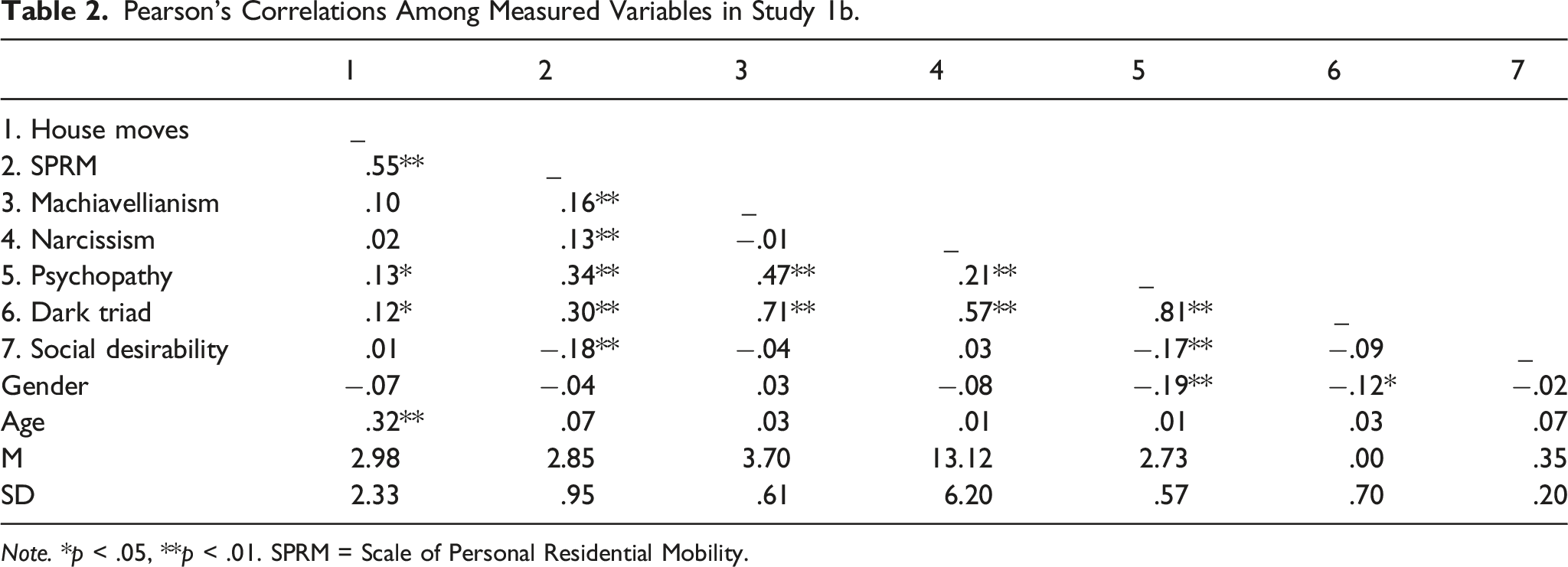
Note. *p < .05, **p < .01. SPRM = Scale of Personal Residential Mobility.
For regression analysis, after controlling for demographic variables (i.e. age and gender) and social desirability, we first entered house moves and SPRM separately as predictor. Results indicated that house moves were positively associated with the Dark Triad (β = .13, t = 2.16, p = .032, 95% CI [.011, .239]) and accounted for 2.4% of the variance independently, and SPRM was positively associated with the Dark Triad (β = .29, t = 5.32, p < .001, 95% CI [.181, .394]) and accounted for 9.0% of the variance independently. For the three Dark Triad traits, house moves were only positively associated with psychopathy (β = .14, t = 2.56, p = .011, 95% CI [.033, .255], R2 = .077), whereas SPRM was positively associated with all traits (βMachiavellianism = .16, t = 2.76, p = .006, 95% CI [.047, .280], R2 = .016; βnarcissism = .13, t = 2.37, p = .019, 95% CI [.024, .257], R2 = .013; βpsychopathy = .31, t = 5.99, p < .001, 95% CI [.221, .437], R2 = .153). Then, we entered both house moves and SPRM as predictors and found that the association between SPRM and the Dark Triad composite (β = .32, t = 4.92, p < .001, 95% CI [.204, .475], R2 = .013) and each trait (βMachiavellianism = .15, t = 2.22, p = .027, 95% CI [.018, .301], R2 = .013; βnarcissism = .18, t = 2.61, p = .009, 95% CI [.046, .329], R2 = .014; βpsychopathy = .34, t = 5.44, p < .001, 95% CI [.231, .493], R2 = .153) remained significant, whereas house moves did not associate with the Dark Triad composite (β = −.06, t = −.94, p = .346, 95% CI [−.085, .030], R2 = .024) and psychopathy (β = −.06, t = −.88, p = .379, 95% CI [−.046, .017], R2 = .077). The results partly supported our hypothesis that individuals with high personal residential mobility scored higher on the Dark Triad than those with low personal residential mobility.
Study 1b found that high personal residential mobility was related to the personality states of the Dark Triad. The results, in a more direct way, provided further evidence for the associations between residential mobility and the Dark Triad traits. Combining the results of Studies 1a and 1b, we demonstrated that personal residential mobility is one environmental cue that entwines individuals’ Dark Triad traits. Nevertheless, mobility at the individual level only represents a micro-environment, and we remain unclear regarding whether an unstable macro-environment is also relevant to the Dark Triad traits. Therefore, in Study 2, we mainly focused on regional residential mobility to provide a more complete picture of the personality-environment association between residential mobility and the Dark Triad.
Study 2
Study 2a aimed to test our hypotheses that people living in countries with high regional residential mobility would report higher Dark Triad traits using cross-national data from 17 European countries. The aims of Study 2b were twofold. The first aim was to retest the association of regional residential mobility and the Dark Triad within China. Although researchers believe that both personal and regional residential mobility are associated with a series of negative outcomes, such as more antisocial behaviours and less pro-environmental behaviours (Zuo et al., 2018, 2023), there has been little research combining the two levels in the same study and exploring their influence. Therefore, the second aim of Study 2b was to consider both personal residential mobility and regional residential mobility in a national sample from China. Together, we hypothesized that personal, regional, and national residential mobility pertain to increased Dark Triad traits.
Study 2a
Methods
Participants and procedures
Data for this study came from the ‘Cross-Cultural Self-Enhancement Project’, which brought together more than 70 academics from 56 countries between April 2016 and October 2017. We adopted the 49-country version (Rogoza et al., 2021), which includes 17 European countries (Austria, Belgium, Bulgaria, Croatia, Czechia, Estonia, France, Hungary, Latvia, North Macedonia, the Netherlands, Poland, Portugal, Romania, Slovakia, Sweden, and the United Kingdom). We included only the participants from European countries (N = 3883) in the analysis because data on residential mobility in other countries were not publicly available. After excluding 31 missing answers, a total of 3852 participants (29.4% male, 70.5% female; Mage = 22.27 years, SD = 4.84) were used for the analysis. The units of data in each country ranged from 152 to 341. Power estimation based on Monte Carlo simulation (1000 repetitions) using the ‘simr’ package in R (Arend & Schäfer, 2019) showed that this sample size provided 98.90% power to detect a standardized level-2 effect of medium size (.30) in two-level models.
The survey measured individuals’ Dark Triad scores using the Dirty Dozen (Geng et al., 2015; Jonason & Webster, 2010; M = 9.22, SD = 3.39; α = .89). Participants reported the extent to which they agreed with the statements on a 7-point Likert scale (1 = strongly disagree; 7 = strongly agree). Examples included ‘I tend to want others to admire me in some cases’ (narcissism; M = 3.39, SD = 1.40; α = .85), ‘I tend to use flattery to get my way in some cases’ (Machiavellianism; M = 3.19, SD = 1.45; α = .84), and ‘I tend to lack remorse in some cases’ (psychopathy; M = 2.64, SD = 1.27; α = .76).
Next, we collected estimates of two residential mobility indicators (immigration and emigration) of European countries in 2017 from the Statistical Office of the European Union (i.e., Eurostat). The data recorded the total number of long-term immigrants arriving and emigrants leaving each European country during 2017 (Eurostat, 2017). We then divided immigration and emigration by the population to calculate the immigration and emigration rates. As controls, we obtained each country’s population, population density, gross domestic product (GDP) per capita, and unemployment rate from the World Bank database (https://data.worldbank.org/), using the data from 2017.
Results and discussion
Standardized Coefficients of the Multilevel Models Estimating the Effects of Cross-National Residential Mobility on the Dark Triad (Study 2a).
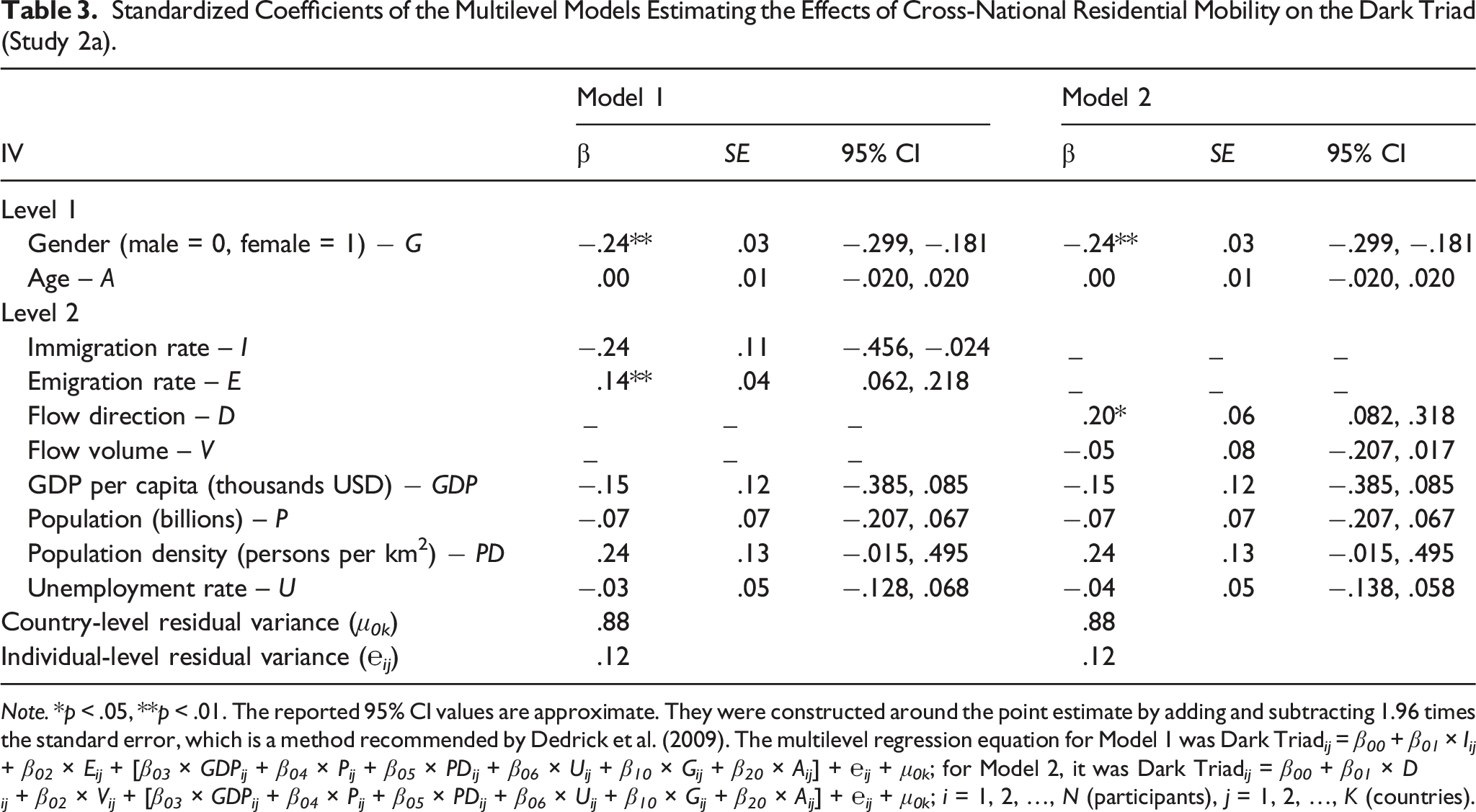
Note. *p < .05, **p < .01. The reported 95% CI values are approximate. They were constructed around the point estimate by adding and subtracting 1.96 times the standard error, which is a method recommended by Dedrick et al. (2009). The multilevel regression equation for Model 1 was Dark Triad ij = β 00 + β 01 × I ij + β 02 × E ij + [β 03 × GDP ij + β 04 × P ij + β 05 × PD ij + β 06 × U ij + β 10 × G ij + β 20 × A ij ] + ℮ ij + μ 0k ; for Model 2, it was Dark Triad ij = β 00 + β 01 × D ij + β 02 × V ij + [β 03 × GDP ij + β 04 × P ij + β 05 × PD ij + β 06 × U ij + β 10 × G ij + β 20 × A ij ] + ℮ ij + μ 0k ; i = 1, 2, …, N (participants), j = 1, 2, …, K (countries).
The immigration and emigration rates describe regional residential mobility from different angles, with the essential distinction being the direction of the relations. Since their effects on the Dark Triad differed, it is possible that the direction of regional residential mobility plays a substantive role in the development of the Dark Triad. Although regional residential mobility volume has been studied extensively (e.g. Oishi et al., 2009), its direction of influence may not have been sufficiently addressed. To explore how the direction and volume of regional residential mobility influence residents’ Dark Triad traits, we further calculated two regional-level variables: flow volume (i.e. gross migration rate; UN DESA, 2017; UNFPA, 1993) and flow direction (i.e. net migration rate; UN DESA, 2017; UNFPA, 1993). The former was calculated as the sum of the immigration rate and the emigration rate, while the latter was calculated as the emigration rate minus the immigration rate.
We again conducted HLM and replaced the immigration rate and emigration rate with flow volume and flow direction. As shown in Table 3, the effect of flow volume on the Dark Triad was insignificant (β = −.05, p = .583), whereas the flow direction was significantly associated with the Dark Triad (β = .20, p = .010). This result suggests that flow direction, rather than flow volume, plays a role in the emergence of the Dark Triad; the net population outflow of certain regions is related to residents’ Dark Triad traits. In addition, flow direction was associated with psychopathy (β = .26, p < .001) and narcissism (β = .13, p = .025) but not Machiavellianism (β = .10, p = .161; see Table C2 in Appendix C).
The effect of regional residential mobility, however, was somewhat unexpected. We found that only the emigration rate was associated with the Dark Triad. Further analysis revealed that the volume of regional residential mobility was unrelated to the Dark Triad, whereas flow direction was associated with residents’ Dark Triad traits. Net population outflow was associated with an increased level of Dark Triad traits among individuals. To provide more support for these findings, a primary goal of Study 2b was to retest Study 2a in a national sample from China.
Study 2b
Methods
Participants
The data of this study were collected from the 31 provinces of mainland China in 2017. A total of 1199 participants were recruited online in exchange for monetary compensation of 12 RMB (approximately USD1.6). All participants were residents of mainland China. Two participants younger than 16 years old and 199 who failed to pass the attention test were excluded. Ultimately, 998 participants (438 males and 560 females; Mage = 28.86, SD = 6.33, ranging from 16 to 64 years old) were included in the analysis. The effective units of data in each province ranged from 31 to 35. Power estimation based on Monte Carlo simulation (1000 repetitions) using the ‘simr’ package in R (Arend & Schäfer, 2019) showed that this sample size provided 37.90% power to detect a standardized level-2 effect of medium size (.30) in two-level models.
Procedures and materials
The participants completed the study using an online system. They were first required to indicate the province where they had lived for the longest time before they were 18 years old, and this province was used to define their region identification. The participants then completed a series of questionnaires, including measures of personal residential mobility and the Dark Triad traits. Some demographic variables (i.e. age and gender) and frequency of house moves (M = 3.04, SD = 1.85) were also collected.
Personal residential mobility
As in Study 1b, the SPRM was used to measure the participants’ personal residential mobility. All of the items were averaged to create an index of personal residential mobility (M = 3.65, SD = 1.02; α = .84).
The Dark Triad
The 28-item version of the Short Dark Triad (SD3; Paulhus & Jones, 2011) was applied to measure the Dark Triad traits. The Chinese version of this scale was obtained using the translation and back-translation method (Zuo et al., 2016). To measure Dark Triad traits, we adapted the original scale based on the same rules used in Study 1b. The participants reported whether they agreed with a number of statements reflecting their current feelings on a 7-point Likert scale (1 = strongly disagree; 7 = strongly agree). Example items included ‘I feel that I should insist on getting the respect I deserve’ (narcissism), ‘I feel that I should make my plans benefit me, not others’ (Machiavellianism), and ‘For the moment, I’d say anything to get what I want’ (psychopathy). Items for each subscale were averaged to create indicators of narcissism (M = 3.50, SD = .88; α = .67), Machiavellianism (M = 3.90, SD = 1.04; α = .77), and psychopathy (M = 3.02, SD = .91; α = .66). We also treated the SD3 as a composite measure and created an index of the Dark Triad (M = 3.47, SD = .72; α = .82).
Next, we collected and calculated regional-level variables, including GDP per capita, unemployment rate, population density, resident population, and regional residential mobility. The data of GDP per capita, unemployment rate, population density, and resident population were obtained from the National Bureau of Statistics of China (http://www.stats.gov.cn). The data from 2017 were used. We controlled for these four variables in the analysis. Regional residential mobility was based on the data reported in the latest 2010 People Census of China. The census used registration data to report the number of people who immigrated into each province and the number of people who emigrated out of each province for 2010. We calculated the population proportions based on registrations and obtained two indices to represent regional residential mobility in this study: immigration rate and emigration rate.
Results and discussion
A correlation analysis indicated that personal residential mobility was positively and significantly correlated with narcissism (r = .27, p < .001), Machiavellianism (r = .15, p < .001), psychopathy (r = .17, p < .001), and the Dark Triad (r = .26, p < .001), consistent with the findings of Study 1b.
Standardized Coefficients of the Multilevel Models Estimating the Effects of National Residential Mobility on the Dark Triad (Study 2b).
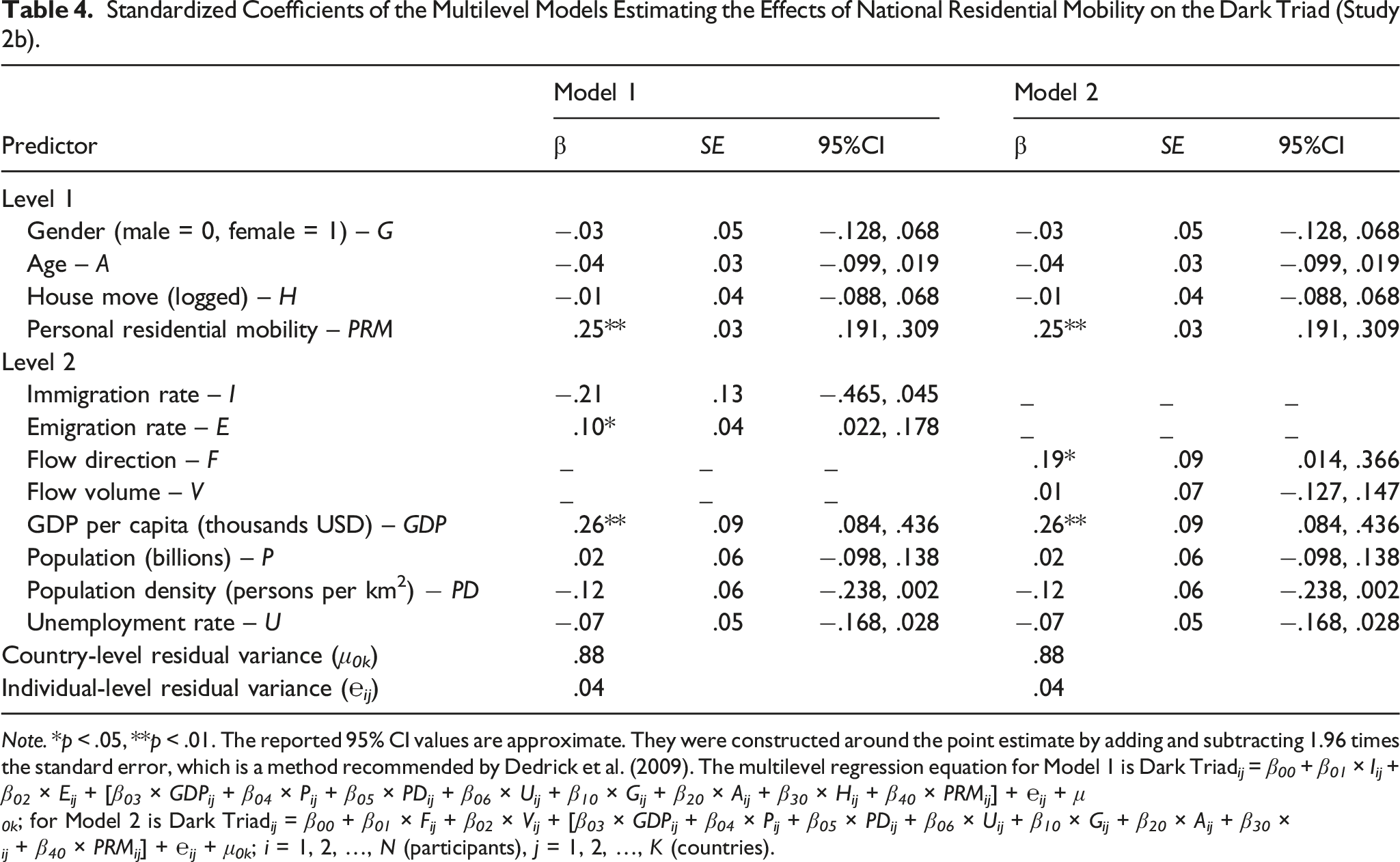
Note. *p < .05, **p < .01. The reported 95% CI values are approximate. They were constructed around the point estimate by adding and subtracting 1.96 times the standard error, which is a method recommended by Dedrick et al. (2009). The multilevel regression equation for Model 1 is Dark Triad ij = β 00 + β 01 × I ij + β 02 × E ij + [β 03 × GDP ij + β 04 × P ij + β 05 × PD ij + β 06 × U ij + β 10 × G ij + β 20 × A ij + β 30 × H ij + β 40 × PRM ij ] + ℮ ij + μ 0k ; for Model 2 is Dark Triad ij = β 00 + β 01 × F ij + β 02 × V ij + [β 03 × GDP ij + β 04 × P ij + β 05 × PD ij + β 06 × U ij + β 10 × G ij + β 20 × A ij + β 30 × H ij + β 40 × PRM ij ] + ℮ ij + μ 0k ; i = 1, 2, …, N (participants), j = 1, 2, …, K (countries).
We again conducted HLM and replaced the immigration rate and emigration rate with flow volume and flow direction. As shown in the full model of Table 4, personal residential mobility (β = .25, p < .001) and GDP (β = .26, p = .006) were significantly related to the Dark Triad; the effect of the flow volume on the Dark Triad was not significant (β = .01, p = .878), whereas the flow direction positively associated with the Dark Triad (β = .19, p = .036). Specifically, the flow direction was only associated with Machiavellianism (β = .25, p = .014; see Table D2 in Appendix D). These results partially support the finding in Study 2a that flow direction, rather than flow volume, was associated with the Dark Triad.
Study 2b found that both personal and regional residential mobility are associated with the Dark Triad state in the national sample. The impact of regional residential mobility exists even when controlling for personal residential mobility. Moreover, this study revealed that GDP was associated with the Dark Triad, which lends more support to existing findings that neighbourhood affluence is related to personality (i.e. openness to experience, conscientiousness, agreeableness, extraversion and emotional stability; Jokela, 2020). This result might suggest that individuals with the Dark Triad traits are likely to live in affluent areas that provide more economic resources.
In sum, Study 2 showed that the Dark Triad is relevant to regional residential mobility. On the one hand, the volume of regional residential mobility did not affect the Dark Triad, whereas net population outflow was associated with increased levels of Dark Triad traits among individuals in both national and cross-national samples. These findings suggest that the direction of regional residential mobility might be an important predictor of certain personalities, and researchers should pay more attention to it, as well as its outcomes in future research. However, despite these intriguing findings in Study 2, an obvious limitation was the lack of causality inference given the cross-sectional nature of the data. Hence, Study 3 seeks to experimentally confirm the predictive effect of residential mobility on the Dark Triad.
Study 3
Although Studies 1–2 initially confirmed the links between both personal and regional residential mobility and the Dark Triad, the correlational nature of those data failed to warrant causal inference. Studies 3a–3b attempted to test our hypothesis that residential mobility shapes Dark Triad personality traits by manipulating personal and regional residential mobility and asking participants to indicate their possession of the Dark Triad traits under their assigned condition. Specifically, Study 3a aimed to test the associations of personal residential mobility and the Dark Triad traits. We expected people to infer that they had higher levels of Dark Triad traits when they imagined having a job that required them to move every other year. Study 3b aimed to test the associations of regional residential mobility with the Dark Triad traits. We created a fictitious society to manipulate the mobility of regions and adapted the Dirty Dozen and Short Dark Triad scales to measure participants’ identification with the Dark Triad traits; we expected that people would infer that they had higher levels of Dark Triad traits when living in a high-outflow city.
Study 3a
Methods
Participants
A total of 150 Chinese adults were recruited in exchange for monetary compensation of 12 RMB (approximately USD1.6) on the Qualtrics survey system. Excluding ten invalid responses, 140 participants were retained in the final sample (58 males, 82 females; Mage = 26.81, SD = 5.98). A G*power sensitivity analysis (Faul et al., 2009) showed that this sample allowed us to detect significant effects (p < .05) as small as f = .24 for an ANOVA with a statistical power of 80%.
Procedures and materials
After providing informed consent, participants were informed that they would be asked to imagine getting a new job and to answer questions about their behaviours in that context. Next, participants completed the residential mobility manipulation (Oishi et al., 2012; Zuo et al., 2018) and responded to the manipulation check. Then, they reported their identification with the Dark Triad traits and demographic information (i.e. gender, age and socioeconomic status/SES). Since this study aimed to explore how manipulated residential mobility influenced the Dark Triad, we excluded the impact of personal residential mobility by controlling for the participants’ histories of, current state of, and future intentions regarding residential mobility.
Manipulating personal residential mobility
First, the participants completed a writing task, in which we manipulated a residential mobility mindset for 10 minutes (Oishi et al., 2012). Participants in the mobile condition were required to imagine being offered a job that they had always wanted. The job involved moving to a different city every other year. In contrast, jobs with a stable condition required living in the same city for at least the next 10 years. To deepen the participants’ perceptions of residential mobility, we asked them to describe their lifestyle in the corresponding scenes with 3 questions: (a) ‘What will it be like to live such a lifestyle?’ (b) ‘What is good and bad about it?’ and (c) ‘How do you think it will affect your relationships with other people?’ Each answer was at least 50 Chinese characters in length. Seventy participants were randomly assigned to the stable condition, and 70 participants were assigned to the mobile condition. Following the manipulation, the participants completed two manipulation check items (‘Will you need to move a lot in the next 10 years?’ 1 = yes, 2 = no; and ‘In the next 10 years, will you hardly need to move?’ 1 = yes, 2 = no). Four participants who answered incorrectly were excluded from the final analysis.
Identification of Dark Triad behavioural strategies
We adapted the Dirty Dozen (Geng et al., 2015; Jonason & Webster, 2010; α = .77), which asks participants to rate the degree to which they agree with 12 descriptions on a 1 (strongly disagree) to 7 (strongly agree) scale. For example, ‘In the next 10 years, I will tend to want others to admire me in some cases’ (narcissism; α = .83); ‘In the next 10 years, I will tend to use flattery to get my way in some cases’ (Machiavellianism; α = .72); and ‘In the next 10 years, I will tend to lack remorse in some cases’ (psychopathy; α = .71). We inserted an attention check item in the scale (‘To ensure the answer quality, please choose the second answer when you see this item’), and six participants who failed it were excluded.
Personal residential mobility
The participants were asked to report their history of residential mobility (i.e. ‘I have changed my residence many times from birth to now’), current state (i.e. ‘I have recently moved’), and future intentions (i.e. ‘Moving to other areas is a good idea’) on a 7-point scale (1 = strongly disagree; 7 = strongly agree).
Results and discussion
Identification with the Dark Triad
Performing ANCOVA (controlling for gender, age, participants’ history, current state, and residential mobility intention) on the participants’ identification with the Dark Triad traits, we found a significant effect of residential mobility (see Figure 2). In general, participants under the mobile condition were more likely to identify with the behavioural strategies of the Dark Triad (M = 3.13, SD = .60) than were those under the stable condition (M = 2.78, SD = .61; F (1, 133) = 10.35, p = .002, ηp2 = .072). Specific to the components of the Dark Triad, participants under the mobile condition also showed a greater tendency to identify with these traits (MMachiavellianism = 2.79, SD = .86; Mnarcissism = 4.39, SD = 1.03; Mpsychopathy = 2.21, SD = .77) than did participants under the stable condition (MMachiavellianism = 2.36, SD = .89; Mnarcissism = 4.03, SD = 1.00; Mpsychopathy = 1.94, SD = .70; FMachiavellianism = 7.07, p = .009, ηp2 = .050; Fnarcissism = 3.54, p = .062, ηp2 = .026; Fpsychopathy = 3.97, p = .048 ηp2 = .029). Dark Triad trait identification under each condition (Study 3a). Note. ns for p ≥ .05, *p < .05, **p < .01.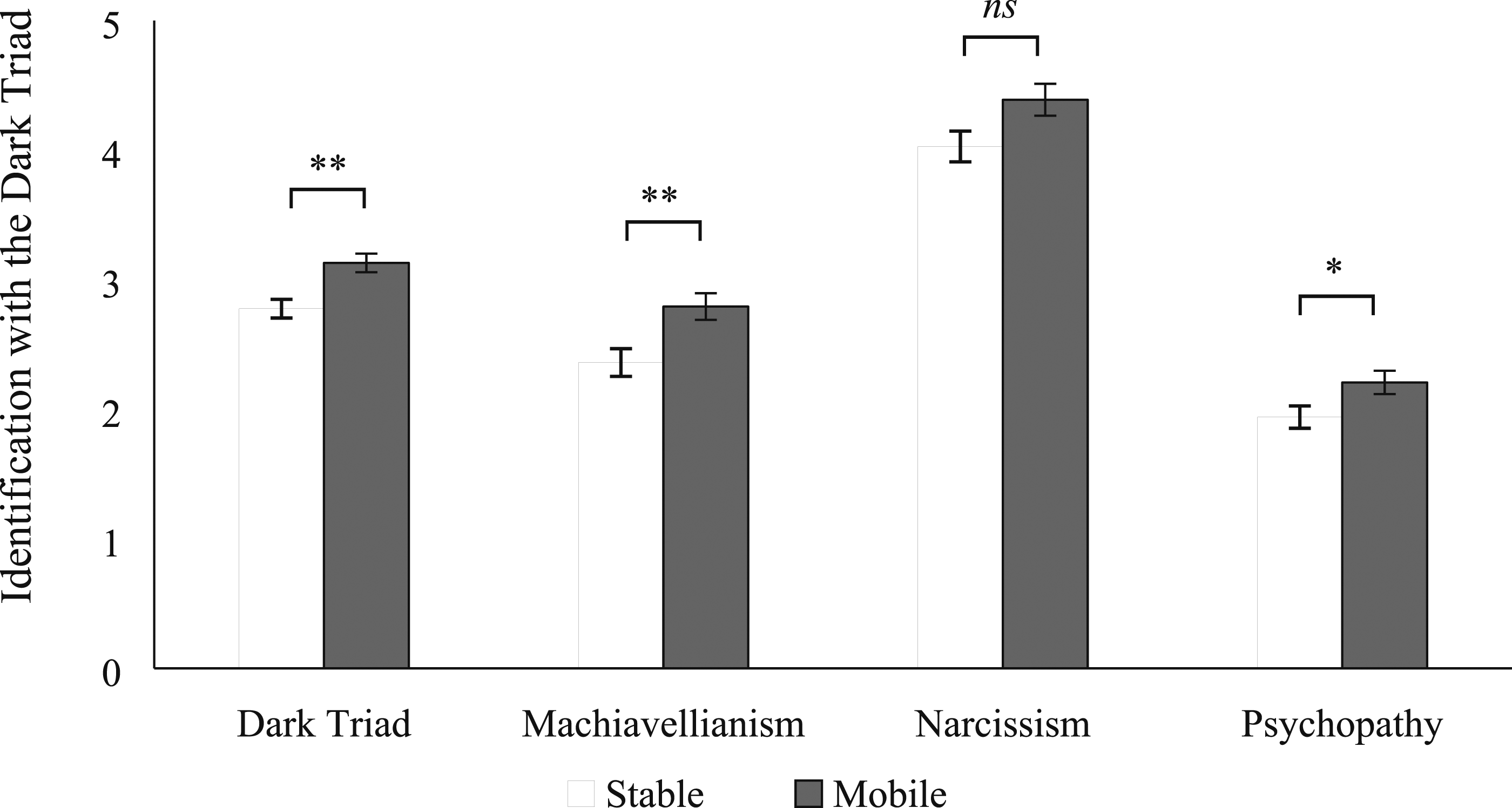
This study provided experimental evidence for the connection between residential mobility and Dark Triad traits. As expected, the participants who imagined living mobile lives (vs. stable lives) exhibited the hallmark behavioural patterns of the Dark Triad, suggesting that an environment of personal residential mobility may facilitate the mindsets and behaviours of the Dark Triad traits.
Study 3b
Methods
Participants
In this study, a total of 140 Chinese adults were recruited in exchange for monetary compensation of 12 RMB (approximately USD1.6) on the Qualtrics survey system. After removing 6 invalid responses, 134 participants were retained in the final sample (59 males, 75 females; Mage = 30.30, SD = 5.64). A G*power sensitivity analysis (Faul et al., 2009) showed that this sample allowed us to detect significant effects (p < .05) as small as f = .24 for an ANOVA with a statistical power of 80%.
Procedures and materials
After providing informed consent, participants were informed that they would be asked to imagine living in a new city and to answer questions about their behaviours in the city. Next, participants completed the residential mobility manipulation and responded to the manipulation check. They then completed the adapted Dark Triad scales and reported their demographic information (i.e. gender, age and SES).
Manipulating regional residential mobility
We manipulated regional residential mobility by adapting the writing task from previous research (Zuo et al., 2023). First, we asked the participants to imagine living in a fictitious society, Yooomhaa, which has two types of cities (represented by city A and city B). They were informed that ‘The two cities have similar populations (approximately 5 million), levels of economic development and climates. The only difference between them is the migration of people’. City A had a high immigration flow and low emigration flow. Every year, 100 thousand immigrants arrived in it, and 20 thousand emigrants left it. In contrast, city B had a low immigration flow and high emigration flow. Every year, 20 thousand immigrants arrived, and 100 thousand emigrants left. The participants were randomly allocated to one of two conditions: high outflow (N = 63) or low outflow (N = 71). They then wrote down how migration flow in city A/B would affect their relationships with friends, colleagues, and neighbours compared with in city B/A and the characteristics of the residents of city A/B compared with those of their counterparts in city B/A. The participants answered a question (‘What are the characteristics of population mobility in city A?’ 1 = lo
Identification of the Dark Triad behavioural strategies
We adapted the 12-item Dirty Dozen (Geng et al., 2015; Jonason & Webster, 2010) and the 27-item Short Dark Triad (Zhang et al., 2020) to measure the participants’ identification with the Dark Triad behavioural strategies. The participants rated the degree to which they related to the descriptions on a 1 (strongly disagree) to 7 (strongly agree) scale. Items in SD3, for example, included ‘Living in this city, I like to get acquainted with important people’ (i.e. narcissism); ‘Living in this city, it’s not wise to tell your secrets’ (i.e. Machiavellianism); and ‘Living in this city, I might want to get revenge on the authorities’ (i.e. psychopathy). We averaged the items and calculated an index of the Dark Triad (αDD = .87; αSD3 = .89), psychopathy (αDD = .87; αSD3 = .84), Machiavellianism (αDD = .88; αSD3 = .90), and narcissism (αDD = .84; αSD3 = .82). We inserted two attention check items in the scale (e.g. ‘To ensure the answer quality, please choose the second answer when you see this item’), and four participants failed and were excluded.
Results and discussion
Identification with the Dark Triad
Performing ANCOVA (controlling for gender and age) on the participants’ identification with the Dark Triad traits, we found a significant effect of residential mobility (see Figure 3). In general, the participants in the high-outflow condition were more apt to identify with the behavioural strategies of the Dark Triad derived from two classic measurements (MDD = 3.73, SD = 1.05; MSD3 = 3.75, SD = .85) than those in the low outflow condition (MDD = 3.40, SD = .74; MSD3 = 3.44, SD = .64; FDD(1, 130) = 4.38, p = .038, ηp2 = .033; FSD3(1, 130) = 5.55, p = .020, ηp2 = .041). Specific to the components of the Dark Triad, participants in the high-outflow condition also reported a greater tendency to identify with Machiavellianism (MDD = 3.33, SD = 1.58; MSD3 = 4.03, SD = 1.19) than did the participants in the low outflow condition (MDD = 2.85, SD = 1.06; MSD3 = 3.54, SD = 1.09; FDD(1, 130) = 4.22, p = .042, ηp2 = .031; FSD3(1, 130) = 6.17, p = .014, ηp2 = .045). Notably, participants in the high-outflow condition were more saliently apt to identify with psychopathy (MDD = 3.02, SD = 1.65; MSD3 = 2.82, SD = 1.15) than those in the low outflow condition (MDD = 2.25, SD = 1.14; MSD3 = 2.32, SD = .62; FDD(1, 130) = 11.33, p = .001, ηp2 = .080; FSD3(1, 130) = 9.91, p = .002, ηp2 = .071). Last, participants in the high-outflow (MDD = 4.84, SD = 1.09; MSD3 = 4.40, SD = .88) and low outflow (MDD = 5.11, SD = 1.06; MSD3 = 4.46, SD = .91) conditions were all prone to identifying with narcissism (FDD(1, 130) = 2.41, p = .123, ηp2 = .018; FSD3(1, 130) = .25, p = .616, ηp2 = .002). Thus, our results suggested that cities with a high population outflow facilitate the expression of the Dark Triad traits. Dark Triad trait identification under each condition (Study 3b). Note. ns for p ≥ .05, *p < .05, **p < .01. DT = Dark Triad, M = Machiavellianism, N = narcissism, P = psychopathy.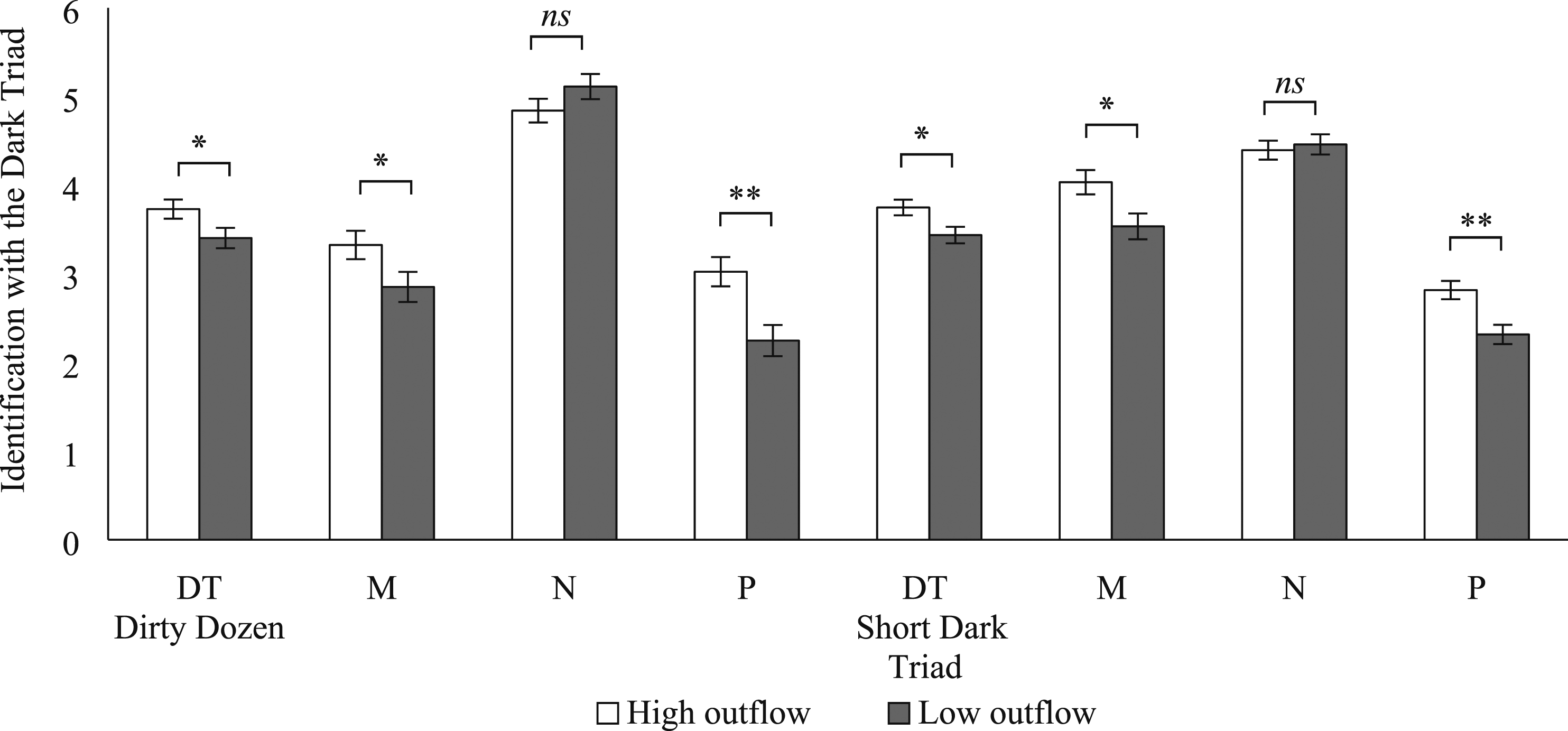
Study 3 provided experimental evidence for the connections between personal and regional residential mobility (featured by high outflow) and Dark Triad traits. The participants who imagined having a mobile job or living in a high-outflow city identified with the behavioural patterns of the Dark Triad. Interestingly, this effect was not consistent across the three elements of the Dark Triad. People who lived in a high-outflow city identified more with psychopathy and Machiavellianism than those who lived in a low outflow city. In terms of narcissism, people in both conditions exhibited a high level of identification with this trait.
Study 4
Study 4 aimed to test our theoretical argument that people who score high on the Dark Triad are more likely to favour residential mobility, either frequently changing their residence (i.e. personal residential mobility) or selectively migrating to mobile places (regional residential mobility). Study 4a sought to examine whether people possessing high levels of the Dark Triad traits were more likely to favour a job that required frequent residential moves over a job that required them to settle for 10 years. Study 4b, using multiple indicators of the willingness to choose, aimed to provide evidence for our claim that residential mobility could attract the Dark Triad personalities to cluster. First, we asked the participants to choose a city in which to settle between a high-population-outflow city and a low-population-outflow city; we expected people scoring high (vs. low) on the Dark Triad traits to be more likely to favour the high population outflow city. Then, the participants reported their likelihood of living in each city and the anticipated salary that could attract them to live in a high-outflow city.
Study 4a
Methods
Participants
A total of 210 Chinese participants were recruited in exchange for monetary compensation of 10 RMB (approximately USD1.4) on the Qualtrics survey system. Excluding the inattentive responses, 201 participants were retained in the final sample (86 males, 115 females; Mage = 27.24, SD = 6.45). A G*power sensitivity analysis (Faul et al., 2009) showed that this sample allowed us to detect significant effects (p < .05) as small as OR = 1.48 for a logistic regression with a statistical power of 80%.
Procedures and materials
After providing informed consent, the participants completed the Dirty Dozen scale and chose a job that they preferred from a mobile option and a stable option. They then reported their demographic information (i.e. gender, age and SES). Considering that individuals’ personal residential mobility could also affect their choices, we controlled for the participants’ history and current state of residential mobility.
The Dark Triad
The Dirty Dozen (Geng et al., 2015; Jonason & Webster, 2010) was applied to measure the Dark Triad traits. The participants reported how much they agreed with the statements on a 7-point Likert scale (1 = strongly disagree; 7 = strongly agree). Example items included ‘I tend to want others to admire me in some cases’ (narcissism), ‘I tend to use flattery to get my way in some cases’ (Machiavellianism), and ‘I tend to lack remorse in some cases’ (psychopathy). Items for each subscale were averaged to create measures of narcissism (α = .83), Machiavellianism (α = .76), and psychopathy (α = .63). We also treated the Dirty Dozen as a composite measure and created an index of the Dark Triad (α = .79). An attention check item was inserted into the scale (‘To ensure the answer quality, please choose the second answer when you see this item’), and eight participants failed and were excluded.
Preference for personal residential mobility
We adapted the manipulation of the residential mobility mindset from Study 3a. Each participant was required to imagine being offered two jobs that they wanted and having to choose one. They were informed that ‘the two jobs have similar work content and salary. The only difference between them is the change of job location’. The mobile job (A) involved moving to a different location every other year, while the stable job (B) involved living in one area for at least the next 10 years. Additionally, to deepen the participants’ perception of residential mobility, we asked them to compare the two jobs in 3 questions: (a) ‘What will it be like to do job A compared to job B?’; (b) ‘What is good and bad about job A and job B?’; and (c) ‘How do you think job A will affect your relationships with other people compared to job B?’ Each answer had to be at least 50 Chinese characters in length. Then, the participants reported their choices (‘All things considered, which job would you choose?’1 = job A, 2 = job B). We also asked them to report their likelihood of choosing each job (on a 0-100 scale). As a comprehension check, we asked the participants to indicate the job mobility of job A (‘Does job A require you to move a lot in the next 10 years?’ 1 = yes, 2 = no). All of the participants passed this check and were retained in the final analysis.
Personal residential mobility
The participants were asked to report their history (i.e. ‘I have changed my residence many times from birth to now’) and current state (i.e. ‘I recently moved’) of residential mobility on a 7-point scale (1 = strongly disagree; 7 = strongly agree).
Results and discussion
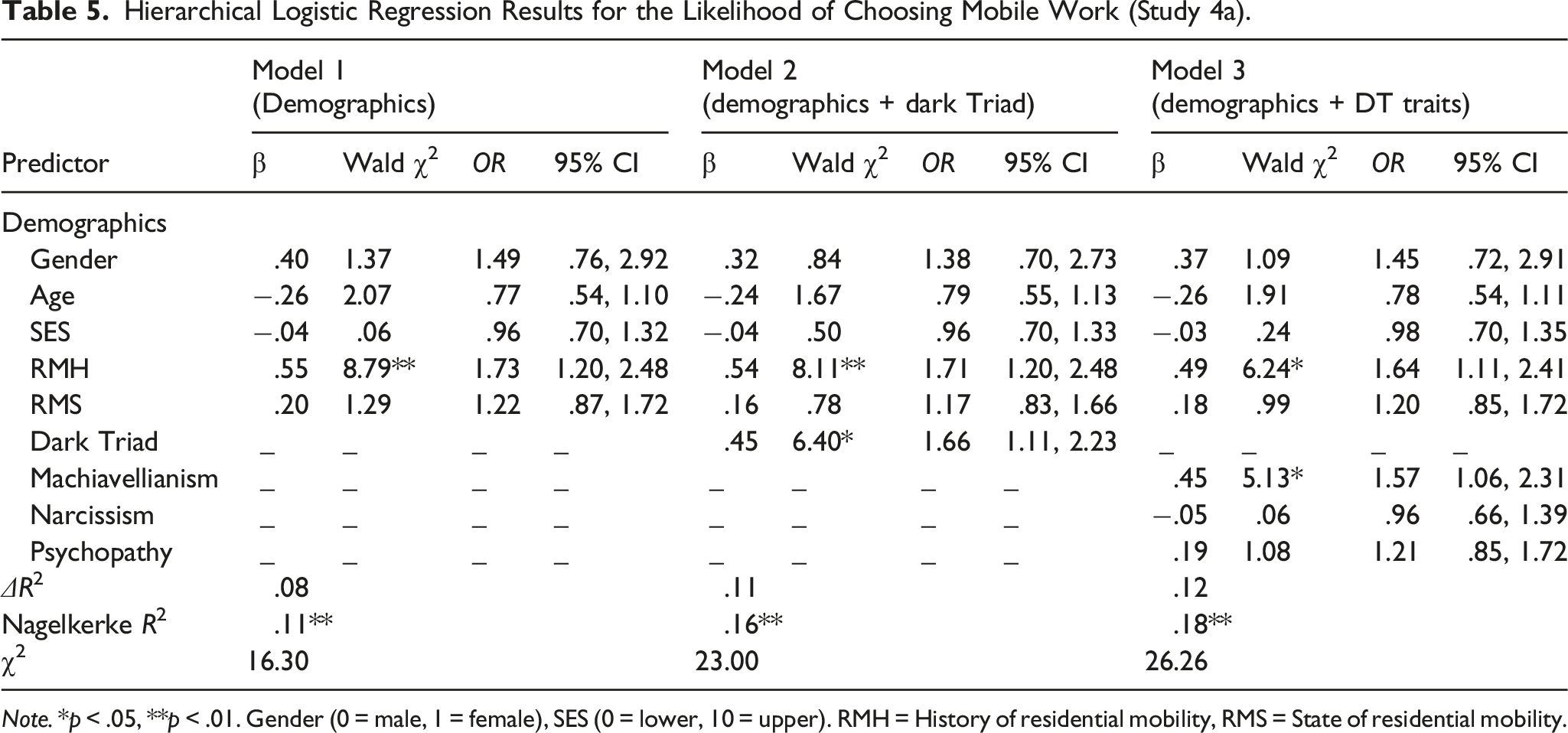
Hierarchical Logistic Regression Results for the Likelihood of Choosing Mobile Work (Study 4a).
Note. *p < .05, **p < .01. Gender (0 = male, 1 = female), SES (0 = lower, 10 = upper). RMH = History of residential mobility, RMS = State of residential mobility.
We also tested the predictive effects of the Dark Triad components (Table 5). Similarly, after adding the composite signalling score in the second step, the model became statistically significant (χ2(8) = 26.26, p = .001), explaining 17.9% of the variance. The Machiavellianism score (β = .45, Wald = 5.13, p = .024, OR = 1.57, 95% CI [1.06, 2.31]) was a significant predictor, whereas the effects of the narcissism (β = −.05, Wald = .06, p = .780, OR = .96, 95% CI [.66, 1.39]) and psychopathy scores (β = .19, Wald = 1.08, p = .30, OR = 1.21, 95% CI [.85, 1.72]) were not significant.
Variable Means and Intercorrelations (Study 4a).

Note. *p < .05, **p < .01.
Therefore, consistent with our assumption, Study 4a showed that individuals who scored high on the Dark Triad traits were more likely to choose a mobile job that required frequent moves, although most participants chose a stable job (73.6%). Regarding the three constructs of Dark Triad traits, Machiavellianism and psychopathy were associated with a preference for personal residential mobility, whereas this association did not hold true for narcissism. That is, narcissists did not show a preference for jobs with different residential mobility. Machiavellians and psychopaths might be more sensitive to the contexts in which they live, which could contribute to their fulfilling their personal goals at others’ expense in a mobile context (Vernon et al., 2008).
Study 4b
Methods
Participants
A total of 265 Chinese participants were recruited in exchange for monetary compensation of 10 RMB (approximately USD1.4) on the Qualtrics survey system. Excluding the invalid responses, 257 participants were retained in the final sample (70 males, 187 females; Mage = 25.00, SD = 6.83). A G*power sensitivity analysis (Faul et al., 2009) showed that this sample allowed us to detect significant effects (p < .05) as small as OR = 1.41 for a logistic regression with a statistical power of 80%.
Procedures and materials
After providing informed consent, the participants completed the adapted Dirty Dozen scale and chose a city to live in between a high-population-outflow and low-population-outflow city. They then reported their demographic information (i.e., gender, age, and SES).
The dark triad
The Dirty Dozen was used as in Study 4a. Items for each subscale were averaged to create measures of narcissism (α = .77), Machiavellianism (α = .79) and psychopathy (α = .64). We also treated the Dirty Dozen as a composite measure and created an index of the Dark Triad (α = .79). An attention check item was inserted into the scale (“To ensure the answer quality, please choose the second answer when you see this item”), and five participants failed and were excluded.
Preference for regional residential mobility
Using the material on regional residential mobility from Study 3b (Zuo et al., 2023), we asked the participants to imagine living in a fictitious society, Yooomhaa, which had two types of cities (represented by city A and city B). City A had high immigration flows and low emigration flows, while city B had low immigration flows and high emigration flows. Each participant was required to select one city from each category in which to live. To deepen their perceptions of the outflow of residents, the participants wrote down how migration flows in cities A and B would affect their relationships with friends, colleagues, and neighbours and what advantages or disadvantages their personality traits would bring if they lived in cities A and B. Each answer had to be at least 50 Chinese characters in length. Then, the participants responded to a comprehension check (“What are the characteristics of population mobility in city A?” 1 = low outflow, 2 = high outflow). Three participants who failed to answer this question were dropped from the study. Then, the participants reported their choice (‘If both jobs pay the same, which city would you choose to work in?’ 1 = city A, 2 = city B).
To fully capture participants’ preferences, we asked them to report their likelihood of living in each city (on a 0–100 scale). Finally, the participants stated their satisfactory salary in city B when city A gave them 4,000Y (Yooomhaa dollars)/8,000Y/16,000Y, with the amount ranging from half of city A’s salary (2,000Y/4,000Y/8,000Y) to double city A’s salary (8,000Y/16,000Y/32,000Y). We divided the expected wage by the anchored salary in city A to create an indicator of choice willingness (ranging from −.5 to 1, with a negative value representing an anticipated salary less than that in city A and a positive value representing a higher expected salary than in city A).
Results and discussion
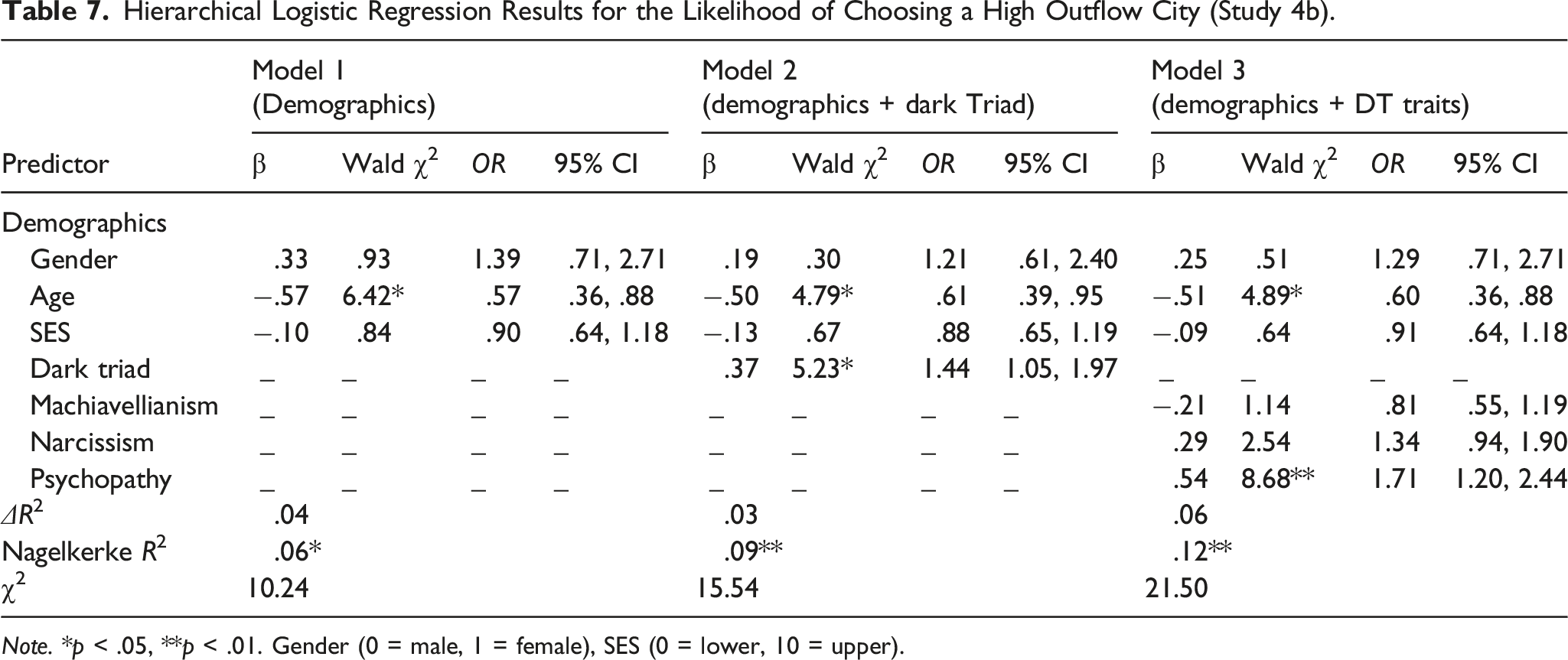
Hierarchical Logistic Regression Results for the Likelihood of Choosing a High Outflow City (Study 4b).
Note. *p < .05, **p < .01. Gender (0 = male, 1 = female), SES (0 = lower, 10 = upper).
Variable Means and Intercorrelations (Study 4b).
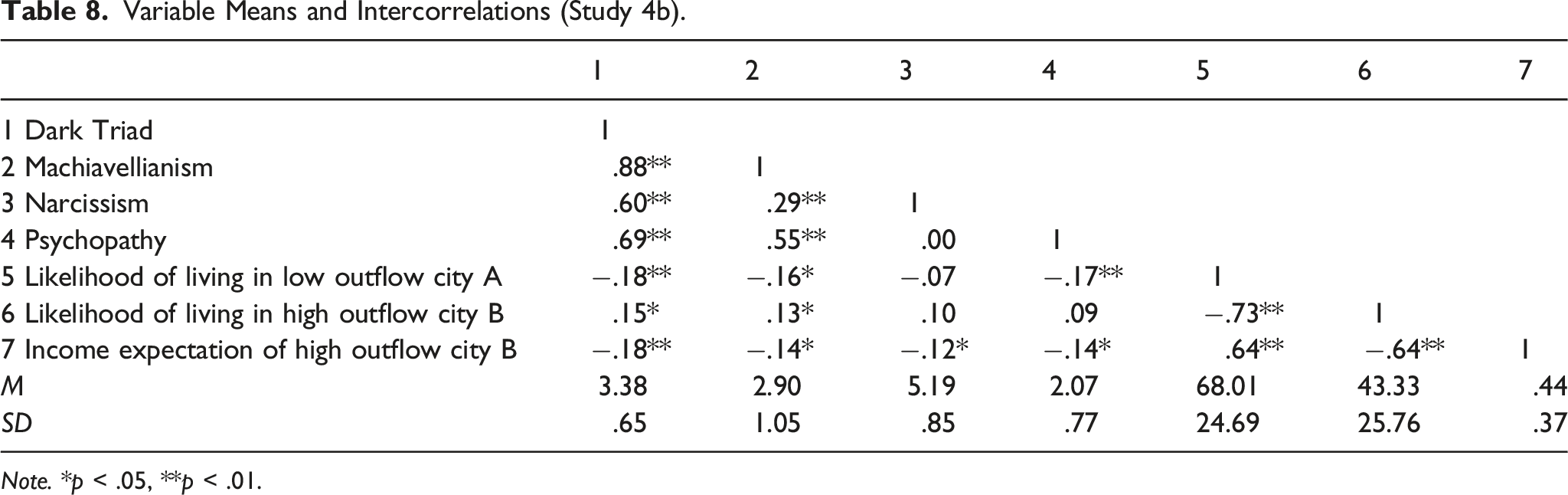
Note. *p < .05, **p < .01.
Finally, the composite Dark Triad score (r = −.18, p = .004) and all of the Dark Triad components (rMachiavellianism = −.14, p = .024; rNarcissism = −.12, p = .048; rpsychopathy = −.18, p = .004) were negatively associated with the expected salary in city B. In other words, cities with high outflow must offer higher salaries to attract people who score lower on the Dark Triad to live there. These results further indicate that a Dark Triad personality is more likely to actively select certain places, such as cities that feature high population outflow.
Together, the findings of this study support our hypothesis that both personal mobility and regional residential mobility are preferred by Dark Triad personalities. Among the three constructs of the Dark Triad, psychopathy and Machiavellianism were associated with preferences for both personal and regional residential mobility, whereas narcissism was irrelevant to both types of mobility. The absence of an association between narcissism and residential mobility (stability) indicates that different environments have equal appeal to people with different levels of narcissism. The associations that psychopathy and Machiavellianism had with residential mobility are in keeping with our theorizing that environments with high residential mobility are characterized by high anonymity and low identifiability, which could free psychopaths and Machiavellians who act selfishly and immorally from judgement by their consciences or sanctions.
General discussion
Given the ever-changing social habitats of humans, it is important for researchers to explore the interactions between the socioecological environment and individuals’ minds and behaviours. From a socioecological psychology standpoint, we have provided a conduit for understanding the associations between residential mobility and the Dark Triad across eight studies. Specifically, we lent support to the associations between personal residential mobility (Studies 1a and 1b) and regional residential mobility (Studies 2a and 2b) and individuals’ Dark Triad personality traits. Then, through two experiments, we found that personal (Study 3a) and regional (Study 3b) residential mobility affected identification with the Dark Triad traits. Last, we corroborated that those with a high score on the Dark Triad are more likely to choose a mobile lifestyle (Study 4a) and an environment with high net population outflow in which to live (Study 4b). This research empirically lend support to previous two-way explanations of P-E associations. The findings increase our understanding of how residential mobility relates to personality, possibly revealing the process of adaptation to this environment.
Theoretical and practical implications
Residential mobility, as an important interpersonal environment, has been found to be associated with personality (Oishi, 2014; Oishi & Tsang, 2022). On the one hand, certain personality traits show a preference for residential mobility (Campbell, 2019). For example, open people have a higher intention to migrate (Campbell, 2019), and extroverts and neurotics are more likely to migrate internally (Jokela, 2021; Yoshino & Oshio, 2022). On the other hand, personal residential mobility can alter an individual’s personality. For example, students who study abroad become more open and agreeable and less neurotic (Zimmermann & Neyer, 2013). Despite this enlightening evidence, empirical evidence for the association between residential mobility and personality has been limited. Therefore, we systematically examined both the influence of environment on personality and personality’s active selection of particular environments using correlational and experimental methods. Our work extends the previous literature in two ways. First, we considered both personal and regional residential mobility. Individuals not only show a propensity to move or migrate but might also prefer places where they would like to live or move. Our findings attested to this assumption and indicated that individuals with certain personality traits exhibited a preference for moving and living in a place with high residential mobility. Second, our work enriches the fledging literature on the shaping effect of residential mobility on personality using an experimental method. The results showed that the mindset of residential mobility (vs. stability) increased people’s identification with certain personality traits. This finding shed light on how social change (e.g. the globalization of population mobility) affects identification with personality traits and enrich the literature exploring the preferences for and the impacts of residential mobility.
Our work provided initial evidence that personal residential mobility was associated with the Dark Triad, which can be understood from the perspective of P-E fit. P-E fit involves the optimal matches between, on the one hand, the needs of traits and the supply in the environment and, on the other hand, the demands of environments and the abilities of traits (Edwards et al., 1998; Kandler & Rauthmann, 2021). This research could map a mechanism of conditional adaptation in which environments with high residential mobility and the Dark Triad traits intertwine to overcome adversity in the environment and give full play to personality advantages.
Although the Dark Triad traits are pertinent to various antisocial behaviours and are believed to be detrimental to society (e.g. Jones & Paulhus, 2010), they can meet the demands of certain environments and confer immediate and evolutionary benefits to individuals there (Book et al., 2015). For example, the Dark Triad encourages people to adopt antagonistic social strategies, thereby maximizing self-interest and critical resources. In a mobile environment, residents’ relationships with others and their surroundings are unstable; thus, residents struggle to gain adequate support for their livelihoods (Lun et al., 2013). In this case, people are less likely to obtain resources and control the environment through mutualistic social strategies. In contrast, antagonistic social strategies, such as cheating and exploitation, might meet the demands of a mobile environment (Book et al., 2015). In other words, the Dark Triad has the ability to meet the demands of a mobile environment. Therefore, the Dark Triad traits are likely to be expressed in an environment with high residential mobility. Migrations have sometimes been perceived as voluntary and opportunity-related processes (Boynton-Jarrett et al., 2013), suggesting that regions with high population inflows have abundant resources and more chances for residents to obtain resources. Regions with high net outflows may be featured by lower predictability and certainty in extracting resources. When resource availability is varying and unpredictable, the Dark Triad may also be adaptive (Jonason et al., 2016). Together, high levels of Dark Triad traits may be effective for obtaining additional resources in areas with high net population outflows, and such adaptiveness is to some extent suggested by our findings.
The shaping effect of residential mobility enriches the literature on the aetiology of the Dark Triad traits. Determinants of the Dark Triad have received far less attention than its characteristics, and the extant literature has predominantly focused on proximal environmental factors. Like other personalities, the Dark Triad is a product of inheritance and the environment (Vernon et al., 2008). Evidence has shown that behaviours related to the Dark Triad are elastic during the growth process, altering with an individual’s experience and environment (Jones & Paulhus, 2010), such as parenting or parental care (Jonason et al., 2014), family socioeconomic environment (Jonason et al., 2016), and family functioning (Láng & Birkás, 2014). However, the literature has continued to neglect the relationships between the Dark Triad and distal socioecological environments. Through eight studies, this investigation enriched our knowledge about the impact of the distal socioecological environment on the Dark Triad personality.
Our findings also lend credence to the power of personality in selective migration and the decision to move (Rentfrow & Jokela, 2016). Mobile environments are ideal for individuals with high levels of Dark Triad traits. Compared to such people, people with low levels of Dark Triad traits have a greater psychological need for human virtues, such as gratitude and altruism (Oda & Matsumoto-Oda, 2022; Puthillam et al., 2020). Since these virtues are likely to be discouraged in areas with high net population outflow (Zuo et al., 2018, 2023), people with low levels of Dark Triad traits are more likely to relocate to other areas where their needs can be satisfied, whereas people with high levels of Dark triad traits might choose to stay. Consequently, the Dark Triad traits are clustered in those regions with high net population outflow. Moreover, the Dark Triad traits render individuals more willing to relocate or become frequent movers, thereby increasing their personal residential mobility. In addition to considering the characteristics of the city, people with Dark Triad traits are more receptive to changing their residence, which is conducive to achieving their personal goals. People have little need to worry about their past wrongdoing or bad reputation when they move frequently. Extensive and shallow interpersonal relationships can help dark personalities (especially Machiavellians and psychopaths) to better manipulate and exploit others and even act immorally without fear of condemnation from others because they can move and start over in a new environment.
This research found that regions with high outflows tend to have residents with higher levels of Dark Triad traits and attract people with these traits to migrate to them. The prevalence of behavioural and psychological manifestations of the Dark Triad traits in such regions may promote social norms that facilitates residents’ identification of the Dark Triad (McCann, 2015), making residents more indifferent, antagonistic, and manipulative in interpersonal interactions (Curtis & Jones, 2020; Dowgwillo & Pincus, 2017; Vize et al., 2019). At the same time, residents may also engage in more antisocial and unethical behaviours, such as fraud and delinquency (Harrison et al., 2018; Pechorro et al., 2022). Thus, this research inspires local authorities to invest more time and energy in promoting and guiding moral construction in such regions, building a more friendly interpersonal environment, and increasing supervision of criminal behaviour. In addition, this research also found that individuals who move frequently are more likely to possess high levels of Dark Triad traits, which may hinder their integration into the community. From a practical point of view, our finding may point out the direction that community work can strive for.
Notably, narcissism’s association with residential mobility was weaker and less stable than Machiavellianism’s and psychopathy’s associations with residential mobility. From Study 3a to Study 4b, neither low mobility was found to lead to less identification of narcissism, nor was it found that high narcissists showed a higher propensity for voluntary migration. Although the Dark Triad is a cluster of socially undesirable personality proclivities, narcissism differs in some ways from Machiavellianism and psychopathy. First, compared to Machiavellianism and psychopathy, narcissism is a much brighter personality trait with less antisocial connotations (Furnham et al., 2013; Zuo et al., 2016). Thus, narcissists might be less motivated to find suitable niches conducive to exploiting others. Moreover, narcissism is motivated by the need for affiliation or intimacy, while psychopathy and Machiavellianism are marked by low affiliation (Dowgwillo & Pincus, 2017). The disruption of relationship ties caused by migration may also hinder narcissists’ willingness to migrate. Second, narcissism exhibits certain advantages in interpersonal interactions. For example, narcissists are often rated as attractive and charismatic (Holtzman & Strube, 2011). Especially during the initial impression formation process, narcissism renders individuals more attractive and favoured (Bevan, 2017; Rauthmann & Kolar, 2013). This allows narcissism to contribute to the establishment of affiliations in both mobile and stable environments.
Limitations and future directions
There are several limitations in the current study that give rise to interesting directions for future research. One important caveat is that we relied heavily on self-report measures of the Dark Triad and residential mobility. Some of these measurements were newly developed or ad-hoc adapted and were not rigorously validated. In particular, there are several instances of sub-par reliability (e.g. Machiavellianism in Study 1b: α = .65; Psychopathy in Study 4a: α = .63). Future studies are therefore required to further validate these measures. Moving forward, research could capture the Dark Triad traits through their typical behavioural characteristics (such as deception and dishonesty) using behavioural metrics (Ok et al., 2021). Moreover, the vignettes in Studies 3 and 4 were based on fictitious contexts, rendering our findings of limited ecological validity. Future research could enhance ecological validity by using a more realistic context and reveal the dynamic personality development in residentially mobile environments using experience sampling methods or longitudinal design.
Second, some of our samples (i.e. Studies 1a, 1b, 2a and 4b) were skewed toward young adults and females. Although we controlled for age and gender in all analyses, our findings may nonetheless differ for more diverse samples. In addition, despite our consideration of international differences in Study 2a, we only obtained migration data for 17 countries in Europe. Future studies could examine the robustness of the relationship between the Dark Triad and residential mobility at the country level by covering more countries in different regions. This attempt also helps to examine the role of cultural factors in the association between the Dark Triad and residential mobility since residential mobility and culture are interrelated (Buttrick & Oishi, 2021). It is valuable to retest the relationship since regional division at this level may be too coarse to capture the exact residential mobility of one’s environment. Future work could reveal more information using high-resolution data on regional residential mobility.
Third, caution is needed when interpreting some results of this research. Of note, the sample size of Study 2b is underpowered for testing a level-2 effect. In this sub-study, we found a significant association between GDP and Dark Triad traits. Further investigation is needed to examine and interpret this association. Besides, the sample size achieved in Studies 3a and 3b is underpowered to detect a medium effect (f = .25) with a power of 80% at .025 level, rendering several significant effects failed to survive the Bonferroni correction for multiple comparisons (.05/2; Bland & Altman, 1995). Future studies with multiple-group design should consider correction for multiple comparisons when estimating sample size.
Forth, we did not explore the extent to which the Dark Triad traits are adaptive in a mobile environment. Although we believe that the combination of high levels of Dark Triad traits and a mobile environment makes evolutionary sense, this belief does not mean that the Dark Triad helps to maximize fitness in mobile environments (Tooby & Cosmides, 1990). Future research could investigate whether the interaction between personality and environmental conditions affects the possibility of success in terms of reproduction, career, and academic performance. In addition, this research did not distinguish the causes of migration flows. Although relocation for different reasons could have different impacts on individuals, all moves are ultimately made for a better life. This study was concerned with a general trend, and future studies could benefit from more detailed exploration.
Fifth, further investigation of the underlying mechanisms is needed to support the association between residential mobility and the Dark Triad. From a perspective of personality-environment fit, multiple mechanisms can link residential mobility and the Dark Triad. In addition to this perspective, the relationship could also be explained by some other variables. For example, agency may partly mediate this association. It is possible that individuals with high Dark Triad traits tend to develop an agentic social style because it helps individuals extract what they want from their environment (Jonason et al., 2010). Moreover, agentic individuals may favour mobile environments that have weak ties and fewer repeated encounters because they are quite independent (Abele & Wojciszke, 2014).
Finally, future studies should consider the potential boundaries of the relationship between residential mobility and the Dark Triad, such as types of migration (see Henry et al., 2003; Zuo et al., 2023), attitudes towards migration at the individual and cultural levels, migration policies (Rindermann & Thompson, 2016), and other attributes of migrants such as age, origin and ethnic group (Rindermann & Thompson, 2016; te Nijenhuis et al., 2004). For example, according to the autonomy of migrants, migration can be divided into forced migration, environmental migration, and voluntary migration (see Henry et al., 2003; Zuo et al., 2023). It needs to be seen whether migration types affect the association between residential mobility and the Dark Triad. Besides, future researchers might want to further investigate the interaction effect of personal mobility background and regional residential mobility on individuals.
Conclusions
Amidst the processes of urbanization and globalization, residential mobility has become a common experience worldwide (Choi & Oishi, 2020). The present contribution indicates that it is positively related to Dark Triad traits. Specifically, in this study, both personal residential mobility and regional net population outflow were positively associated with the Dark Triad. The associations are the results of both environmental shaping and selective migration. Individuals with the mindset of residential mobility (vs. stability) tend to display the Dark Triad, while individuals with high Dark Triad trait levels prefer a mobile lifestyle and a residence with high outflow. This research provided experimental evidence for the bidirectional connection between personality and the environment.
Supplemental Materials
Supplemental Materials - Moving towards darkness: The personality-environment association between the Dark Triad and residential mobility
Supplemental Materials for Moving towards darkness: The personality-environment association between the Dark Triad and residential mobility by Shijiang Zuo, Xueli Zhu, Fang Wang, Niwen Huang, and Pan Cai in European Journal of Personality.
Supplemental Materials
Supplemental Materials - Moving towards darkness: The personality-environment association between the Dark Triad and residential mobility
Supplemental Materials for Moving towards darkness: The personality-environment association between the Dark Triad and residential mobility by Shijiang Zuo, Xueli Zhu, Fang Wang, Niwen Huang, and Pan Cai in European Journal of Personality.
Footnotes
Author’s Note
For transparency, all procedures and measures used in this research can be found via the following link ( ). The analyses were exploratory, not pre-registered. Additional materials, including anonymous data, Syntax, HLM, and R codes for the main and supplementary analyses, can be accessed at the same link as above. The data (except for open data used in Study 2a) have not been used in other papers.
Declaration of Conflicting Interests
The author(s) declared no potential conflicts of interest with respect to the research, authorship, and/or publication of this article.
Funding
The author(s) disclosed receipt of the following financial support for the research, authorship, and/or publication of this article: We would like to thank the support of the National Natural Science Foundation of China [Grant No. 31971012].
Open Science Statement
Supplemental Materials
Supplemental materials for this article is available online.
References
Supplementary Material
Please find the following supplemental material available below.
For Open Access articles published under a Creative Commons License, all supplemental material carries the same license as the article it is associated with.
For non-Open Access articles published, all supplemental material carries a non-exclusive license, and permission requests for re-use of supplemental material or any part of supplemental material shall be sent directly to the copyright owner as specified in the copyright notice associated with the article.
