



Abstract
Birth order differences in personality have been studied for almost a hundred years. However, most studies have been conducted in Western cultural contexts, while few studies have addressed the associations between birth order and personality in East Asian cultural contexts. In this study, we examined how birth order influences the Big Five personality traits using a representative Chinese sample (N = 14,148). Both between- and within-family designs were used to examine the associations between birth order and the Big Five personality traits. The results indicated that the impacts of birth order on the Big Five personality traits were not statistically significant and were negligible. We conclude that birth order has no lasting impact on the Big Five personality traits in the Chinese cultural context.
Plain language summary
What factors cause children in a family to develop different personality traits? One popular belief in society is that birth order plays a significant role in shaping siblings' personality traits. Extensive research conducted by academics over the past century has explored the relationship between birth order and personality traits, but the findings remain inconclusive. It is important to note that most of the existing research has focused on Western cultural contexts. In an effort to shed light on this topic from a different cultural perspective, this study examined the impact of birth order on personality traits within the Chinese cultural context. The findings of this study indicated that birth order did not have any significant effect on Chinese personality traits. Therefore, the effect of birth order on personality traits may just be a social prejudice.
Introduction
Birth order is considered one of the most pervasive and deep-rooted factors in determining who we are (Jaskiewicz et al., 2017). Popular media and bestselling parenting books are full of descriptions of the relationships between birth order and personality. Scholars have long been interested in understanding the role of birth order in explaining personality development (Rohrer et al., 2015). However, most studies have been conducted in Western societies, and results regarding the associations between birth order and personality remain inconclusive and controversial. This study used a representative Chinese sample to explore the associations between birth order and the Big Five personality traits.
Theoretical background of the associations between birth order and personality
Birth order is a recurring topic in social science (De Haan et al., 2014). The argument that birth order affects personality has been discussed by scholars over the past century (Rohrer et al., 2017). Among the most prominent is Sulloway (1996), who proposed the Family Niche Model of Birth Order (FNMBO) to explain how birth order affects personality development.
The FNMBO is rooted in Darwin’s Evolutionary Theory, the central mechanism of which is competition (Sulloway, 1996). According to the FNMBO, there is a set of niches in the family that provide offspring with distinct experiences and viewpoints (Lejarraga et al., 2019). The children in a family develop specific competitive strategies to fill these niches within the family, which helps them maximize their parents’ investment (Sulloway, 1996). These differences in competitive strategies due to birth order cause siblings to develop different personalities (Sulloway, 1996; Sulloway & Zweigenhaft, 2010). Specifically, first-borns are more likely to exhibit dominant behaviours because they are physically stronger than their younger siblings, which make them less agreeable. First-borns often please their parents by acting as surrogate parents for later-borns. These behaviours may increase first-borns’ conscientiousness and sense of responsibility. In addition, first-borns tend to defend their status by developing conservative values and attitudes. In contrast, later-borns tend to find a valued and unoccupied family niche to obtain more parental resources and attention. They expect to differentiate themselves in the eyes of their parents by adopting low-power strategies, such as being humorous, sociable, affectionate, and expedient. Therefore, later-borns are likely to score higher on agreeability, openness, and extraversion.
Empirical evidence on birth order and personality
Research addressing the associations between birth order and personality has been ongoing for almost a century (Rohrer et al., 2015). Most earlier studies were descriptive analyses and had deficiencies in their study design and quality (Beer & Horn, 2000). Sulloway’s (1996) pioneering work opened the way to the systematic analysis of the associations between birth order and personality. Most birth order studies have been organized within the influential Big Five personality model. For example, using a within-family design, Sulloway (1996) found that the maximum absolute correlation coefficient was .10 for extraversion, .20 for neuroticism, .30 for agreeableness, .35 for conscientiousness, and .40 for openness. In a follow-up study using the within-family design, Sulloway (1999) revealed that the absolute correlation coefficient was .14 for extraversion, .04 for neuroticism, .10 for agreeableness, .18 for conscientiousness, and .08 for openness. Since Sulloway’s (1996, 1999) work, studies on the associations between birth order and the Big Five personality traits have yielded conflicting results. Some studies have supported or partially supported Sulloway’s hypotheses (e.g., Beer & Horn, 2000; Healey & Ellis, 2007; Jefferson et al., 1998; Paulhus et al., 1999; Saroglou & Fiasse, 2003), while others have yielded findings that contradicted Sulloway’s hypotheses (e.g., Damian & Roberts, 2015; Michalski & Shackelford, 2002).
The studies conducted by Rohrer et al. (2015) and Black et al. (2018) were two of the most influential and recent studies on the associations between birth order and the Big Five personality traits. Rohrer et al. (2015) used three large representative samples from the United States, Great Britain, and Germany to examine the relationships between birth order and the Big Five personality traits. Neither within- nor between-family designs found birth order effects on any of the five personality dimensions. By combining information from Swedish male registers and military enlistment data, Black et al. (2018) further investigated the effects of birth order on the Big Five personality traits. The within-family analyses found that earlier-born men were more persistent, socially outgoing, emotionally stable, willing to assume responsibility, and able to take initiative than later-born men. They also found that earlier-born men were more likely to be in jobs that required all five personality dimensions. These findings conflicted somewhat with Sulloway’s hypotheses.
Overall, the empirical findings regarding the influences of birth order on the Big Five personality traits remain inconsistent and murky with considerable differences in significance levels and effect sizes.
The present study
Although many empirical studies have investigated the associations between birth order and personality, most studies have been conducted in Western cultural contexts. To our knowledge, no studies have examined the relationships between birth order and personality in East Asian cultural contexts. East Asian societies have long been influenced by Confucian culture (Rozman, 2014), which is an essentially ethical and philosophical system that provides a set of practical rules for people’s daily lives (Yao, 2000). In family life, Confucian culture affects not only reproductive behaviours (Lee et al., 2009) but also sibling interactions (Slote & DeVos, 1998). Filial piety (Xiao), one of the core virtues of Confucianism, is believed to influence reproductive behaviours (Tang, 1995). Filial piety refers to demonstrating obedient respect for parents (Ho, 1994). Mencius, one of the pioneers of Confucianism, claimed that filial piety encompassed three pillars: ensuring the continuation of parents’ lineage by reproducing posterity, showing profound respect to parents, and supporting and waiting upon parents (Tang, 1995). The first pillar is considered the most important. Therefore, Mencius said, “bu xiao you san, wu hou wei da” (among the three nonfilial acts, childlessness is the worst, Shek, 2006). Since Confucian culture believes that only male descendants can carry on the family lineage, this leads to son preference (J. Li & Lavely, 2009). Therefore, many families do not stop reproducing until they have a son (Arnold & Liu, 1986). This leads to a larger number of children in families that are influenced by Confucian culture (Tang, 1995). Even when strict fertility policies are implemented, Confucian culture still plays a role in reproductive behaviours. For example, the deep impact of Confucian culture posed a substantial challenge for the Chinese government when it implemented the one-child policy in the 1970s. In rural areas, numerous families defied the policy’s constraints and had more children (Zhang, 2017). The central government had to relax the policy to allow couples in rural areas to have a second child if their first child was a girl (Wang et al., 2022).
In addition to impacting the number of children, Confucian culture influences sibling interactions within families (Park & Chesla, 2007). Confucian culture provides moral standards for sibling relationships, such as “zhang you you xu” (elders and young have their proper ordering). “Zhang you you xu” reflects both a hierarchical order and an inferior relationship between siblings (Fang, 2003), and siblings in different positions have corresponding role expectations. Specifically, first-borns are expected to act as surrogate parents for their younger siblings and assume greater responsibility for their care, and younger siblings are expected to be respectful and submissive to their older siblings (Park & Chesla, 2007). In Confucian-influenced societies, sibling caretaking is seen as a family obligation for first-borns (K. Wu et al., 2018). Sibling caretaking tasks based on birth order endure into adulthood, even though they may not be as frequent as in childhood. For instance, K. Wu et al. (2018) discovered that among Confucian-heritage Asian American families, first-born adults have a greater moral responsibility for sibling caretaking than their counterparts in European American families. In Confucian-influenced societies, siblings are often assigned enduring nicknames based on their birth order (Watson, 1986), which may continually reinforce their identity and family obligations.
“Zhang you you xu” also highlights the first-borns’ priority to inherit family property and support their parents. Therefore, first-borns have higher legitimacy to obtain more parental resources. They may be more conservative because they do not need to compete against their younger siblings. More resources for first-borns also means that limited family resources are distributed less among later-borns, exacerbating later-borns’ use of risky strategies to compete for their parents’ resources. Later-borns must develop more specific competitive strategies to obtain parental resources. Therefore, the birth order effects may be more pronounced for individuals influenced by Confucian culture. There are stereotypes of birth order effects in Confucian-influenced societies. For example, in China, a popular saying is, “The first-born is stupid, the second-born is clever, and every family has a naughty third-born.” The first-borns are stereotyped as stupid because they tend to be selfless and sacrifice themselves to care for their siblings or parents. There is an ancient poem in China that depicts the personality differences of siblings of different birth orders: “Oldest son is weeding the bean field at east creek. Middle son is building a chicken coop out of bamboo. My favourite little son is mischievous; he is lying beside the brook peeling lotus pods.” In many Chinese movies and TV shows, the first-borns are portrayed as conservative and conscientious, while the later-borns are portrayed as rebellious and outgoing.
Some studies based on East Asian cultural contexts have begun to use the findings of birth order effects on personality to explore behavioural differences among individuals with different birth orders (Campbell et al., 2019; Liu et al., 2021; Wang et al., 2022). However, no studies have directly examined the relationships between birth order and personality in East Asian cultural contexts. The present study used a representative Chinese sample to examine the associations between birth order and the Big Five personality traits. China was chosen as the research context because Confucian culture originated in China and continues to significantly impact contemporary Chinese society (Yang & Tamney, 2011). Based on Sulloway’s (1996, 2001) findings, we predicted that earlier-borns would score higher in conscientiousness and neuroticism, whereas later-borns would score higher in agreeableness, openness, and extraversion.
Method
Participants
Our data were derived from the China Family Panel Studies (CFPS). The CFPS is an ongoing nationwide comprehensive household social tracking survey administered by the Chinese Social Science Survey Centre of Peking University. It includes detailed information on communities, families, all family members in the sampled families, and the respondents’ siblings (Xie & Lu, 2015). The CFPS was launched in 2010 and has been tracked every two years. We used the first wave of the survey as the baseline sample. The first wave of the survey interviewed 33,598 adults and 8990 children from 14,960 households (Xie & Lu, 2015). The adult sample was selected as the study population because their siblings’ basic information (e.g., size, gender, and age) was investigated. For the child sample, we could not obtain information on siblings if their siblings were adults and no longer living in the household. Personality data were collected in the fifth wave of the survey in 2018, which interviewed 14,218 households (37,354 adults and 8735 children). For the baseline sample (i.e., the adult sample in the first wave of the survey), we excluded individuals who had no siblings, were twins, did not answer the number of siblings and information on siblings, had half-, step-, or adoptive-siblings, and had missing values for the control variables. Subsequently, we matched the data from the first wave with the data from the fifth wave. We excluded individuals with family size greater than seven because they were too rare. We finally obtained 14,148 individuals, of whom 13,743 were from different families and 405 were biological siblings. Therefore, the between-family design included 13,743 individuals, and the within-family design included 405 individuals.
Measures
Birth order
In 2010, participants answered several questions about their siblings related to their gender, age, birthdate, sibling relationship (full-, half-, step-, or adoptive-siblings), educational attainment, and employment status. We adopted a narrow definition of birth order that considered only full-siblings, thus excluding participants who were raised with half-, step-, or adoptive-siblings. We determined the birth order by comparing the birth year of the participants with that of their siblings. Following previous research (Botzet et al., 2020; Rohrer et al., 2015), birth order was coded as 1 if the participants were first-borns, 2 if the participants were second-borns, 3 if the participants were third-borns, and so on. In addition, we performed analyses that differentiated between either (a) first- and later-borns or (b) first- and last-borns (Rohrer et al., 2015).
Personality
The Big Five Inventory (BFI, John & Srivastava, 1999) is a widely used self-report instrument to measure the five dimensions of personality. The standard BFI uses a set of 44 short phrases (BFI-44) to evaluate the most prototypical traits linked to the five dimensions of personality (John & Srivastava, 1999). Participants provide responses to each target using a five-point Likert scale ranging from 1 (does not apply to me at all) to 5 (applies to me perfectly). The BFI-44 has been translated into Chinese using the forward–backward procedure (Carciofo et al., 2016). However, as the BFI-44 is lengthy and time-consuming, scholars have extracted some items with high factor loadings from the BFI-44 to develop concise versions. One widely employed concise version is the BFI-15 developed by Gerlitz and Schupp (2005). Each subscale of the BFI-15 is assessed by three items, and there is a reverse-coded item in each of the subscales except for the openness subscale. The BFI-15 has been used in several influential large-sample comprehensive surveys, such as the German Socio-Economic Panel (Lang et al., 2011), the Household, Income, and Labour Dynamics in Australia Survey (Lucas & Donnellan, 2009), and the British Household Pane Study (Yap et al., 2012). The CFPS also used the self-report BFI-15 to measure the five dimensions of personality. Participants completed the BFI-15 in the fifth wave of the CFPS in 2018. The internal consistency coefficients for the five subscales were as follows: openness (α = .60), conscientiousness (α = .35), neuroticism (α = .33), extraversion (α = .29), and agreeableness (α = .26). The values of the internal consistency coefficient were similar to the findings of Hahn et al. (2012) with a German sample (range of internal consistency coefficients: .44–.76) and Botzet et al. (2020) with an Indonesian sample (range of internal consistency coefficients: .33–.46). The low internal consistency coefficients might be the price paid for attempting to preserve content validity with only a small number of items (Gosling et al., 2003). The internal consistency evaluated by Cronbach’s α is usually associated with the number of items (Tavakol & Dennick, 2011). With only three items on each subscale, lower values of Cronbach’s α are expected. Some researchers argued that a low level of Cronbach’s α should not be a serious concern for a brief personality scale designed to measure broad concepts (Wu et al., 2023). Another possible explanation for the low internal consistency coefficients of conscientiousness, neuroticism, extraversion, and agreeableness is that the BFI-15 contains negatively worded items. Previous research has demonstrated that the cultural norms of deference, politeness, and agreeableness are prevalent in Asian societies, which lead to a greater tendency to agree with both positively and negatively worded items (Javeline, 1999). In addition, linguists suggested that counterfactual statements (such as the contradictions commonly in negatively worded items) are not easily accommodated in some East Asian languages, especially Chinese (Bloom, 1981). Therefore, the inclusion of negatively worded items would lessen a scale’s internal consistency and obscure its dimensionality when the scale is translated into Chinese (Wong et al., 2003; Y. Wu et al., 2017). After removing the negatively worded items, the internal consistency coefficients were significantly improved: conscientiousness (α = .42), neuroticism (α = .53), extraversion (α = .54), and agreeableness (α = .52).
Control variable
We controlled for several individual- and family-level variables that may affect personality development. For individual-level variables, we controlled for gender, age, ethnicity, and closest sibling age gap. Gender was coded as 1 if the participants were male and 0 if the participants were female. Ethnicity was measured as a binary variable that took the value of 1 if the participants were Han Chinese and a value of 0 if the participants were minorities. The closest sibling age gap was measured by the age difference between the participants and their closest sibling. All individual-level control variables were derived from the fifth wave of the survey in 2018. For family-level variables, we controlled for family size and the male ratio of siblings. Family size was measured by the total number of children within a family. The male ratio of siblings was calculated by dividing the number of male children in the family by the family size.
Data analysis
Both between- and within-family analyses were conducted to estimate the effects of birth order on the five personality dimensions. Although the between-family analysis has some limitations, it can be improved by using large representative samples and controlling for confounding variables (Damian & Roberts, 2015). Additionally, most existing studies based on birth order effects have been conducted using between-family analysis. Thus, using between-family analysis to examine birth order effects is theoretically meaningful. We ran independent OLS regression analyses for each personality dimension in the present study. In addition to the independent variable (i.e., birth order), four control variables at the individual level (i.e., age, gender, ethnicity, and closest sibling age gap) and two control variables at the family level (i.e., family size and male ratio of siblings) were included in the estimated models. Following previous studies (Damian & Roberts, 2015; Rohrer et al., 2015), we also examined the effects of birth order on the five personality dimensions for each family size.
For within-family analysis, we used the family fixed effects model to examine the effects of birth order on each personality dimension. The family fixed effects model compares individuals within a family and provides more natural control for family-level factors, measured or not. Therefore, additional controls for family-level factors (i.e., family size and male ratio of the siblings) are not necessary (Rohrer et al., 2015). Only gender and age were included as control variables in the within-family analysis. The effects of birth order on five personality dimensions for each family size were also examined. Between- and within-family analyses were conducted with nonoverlapping samples. In each regression model, birth order was treated as a categorical predictor. For the control variables, family size, gender, and ethnicity were treated as categorical predictors, while age, closest sibling age gap, and the male ratio of siblings were treated as linear predictors.
We also performed multiple robustness analyses to ensure the reliability of our findings. For the between-family sample, we first employed three alternative measures of birth order: (1) first-borns versus later-borns; (2) first-borns versus last-borns; and (3) linear effects of birth order. Second, we employed two alternative measures of the Big Five personality traits: (1) age-adjusted personalities and (2) 11-item BFI after deleting the negatively worded items. Third, we restricted the between-family sample to male-only families. For the within-family sample, we did not replace the measure of birth order or restrict it to male-only families due to the small sample size and the fact that the majority of the individuals were from two-child families. We only replaced the measures of the Big Five personality traits to ensure the reliability of our findings.
The abovementioned analyses were performed using Stata 17 (StataCorp, 2021).
Results
Descriptive statistics
Descriptive characteristics of the sample.
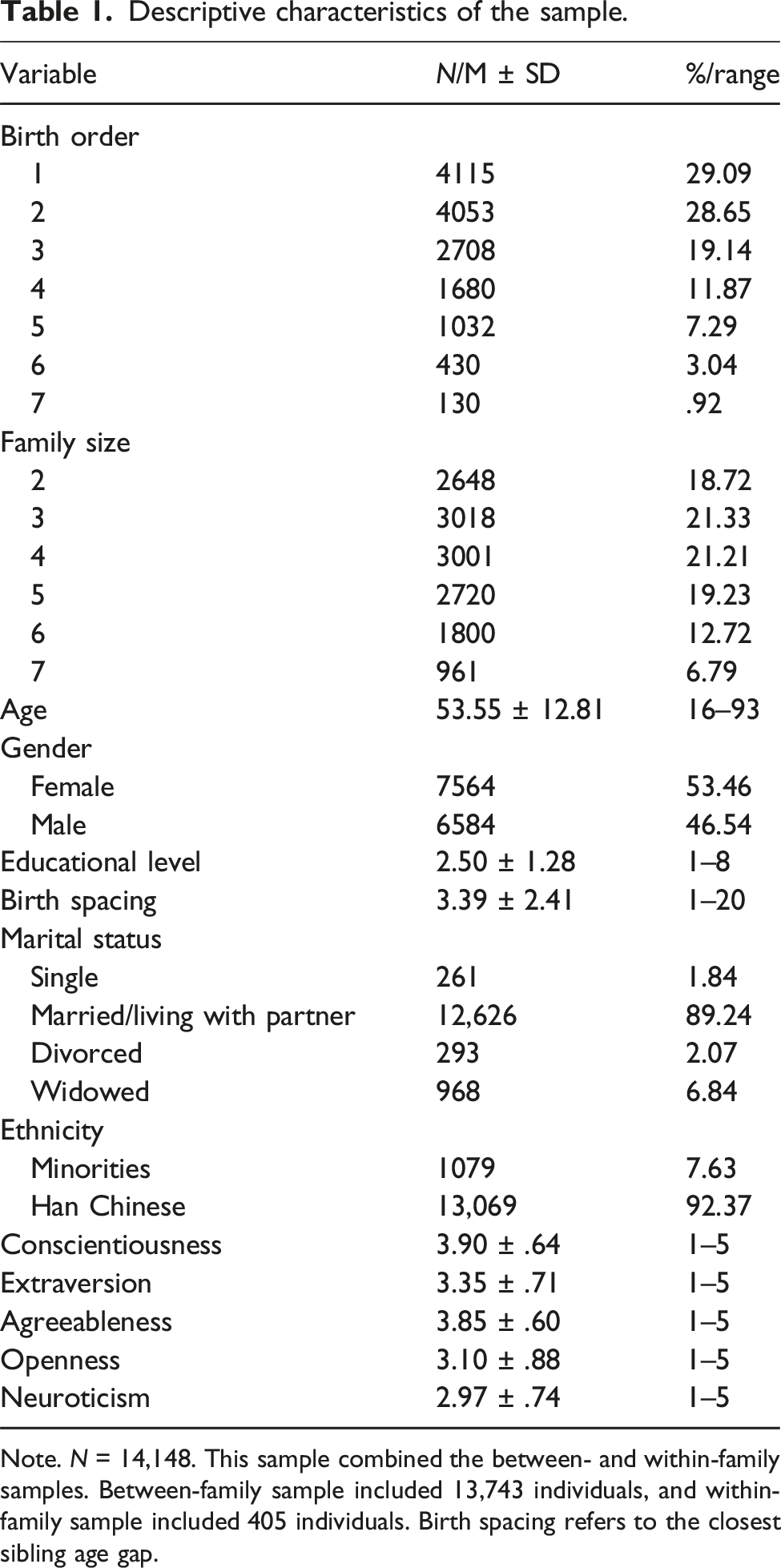
Note. N = 14,148. This sample combined the between- and within-family samples. Between-family sample included 13,743 individuals, and within-family sample included 405 individuals. Birth spacing refers to the closest sibling age gap.
Correlation matrix for birth order, family size, age, gender, education, birth spacing, ethnicity, and the Big Five personality traits.

Note. N = 14,148. Correlations greater than |.017| were statistically significant at p < .05. Birth spacing refers to the closest sibling age gap.
Regression analyses
Between-family analyses
Between-family analyses of the impacts of birth order on the Big Five personality traits.
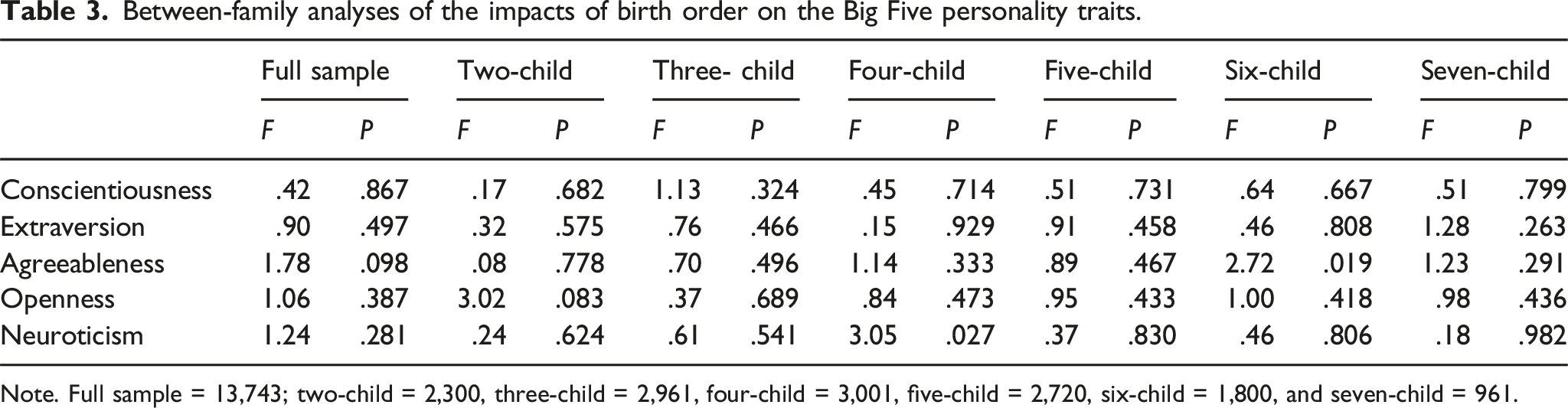
Note. Full sample = 13,743; two-child = 2,300, three-child = 2,961, four-child = 3,001, five-child = 2,720, six-child = 1,800, and seven-child = 961.
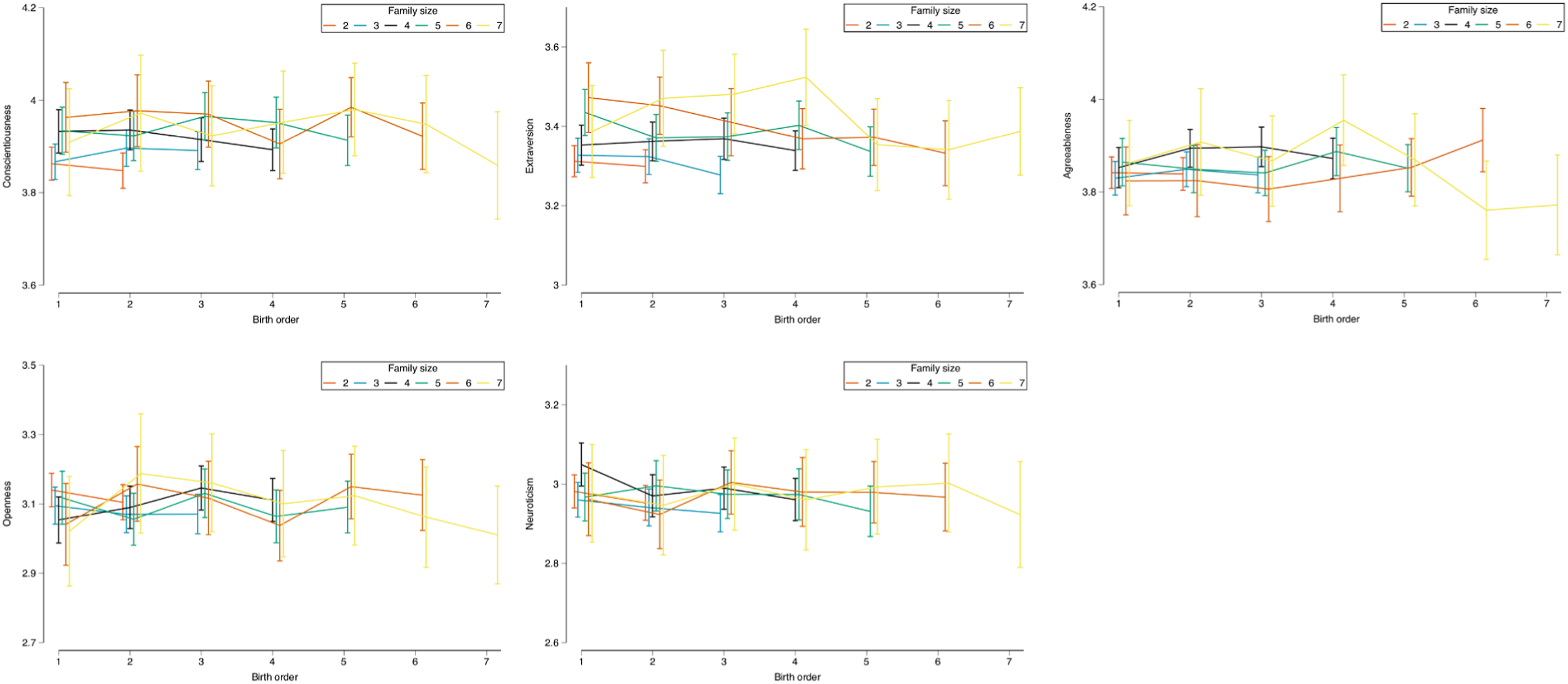
Mean scores and 95% confidence intervals of the Big Five personality traits for each birth order in different family sizes (between-family analyses).
We performed multiple additional analyses to test the robustness of the results of the between-family analysis. First, following Rohrer et al. (2015), we recoded birth order to compare first-borns and later-borns in terms of personality differences. The findings (see Table A2) were similar to the outcomes of our previous analyses: (1) in the full sample (N = 13,743), except for a statistically significant effect of birth order on agreeableness (F = 4.73, p = .030) there were no statistically significant differences between first-borns and later-borns in the other four personality dimensions (all ps > .074); (2) first-borns in four-child families scored slightly higher on neuroticism (F = 6.56, p = .011); however, the birth order effects on conscientiousness, extraversion, agreeableness, openness, and neuroticism in other family sizes were not statistically significant (all ps > .072). Second, we removed middle-borns to compare personality differences between first-borns and last-borns. The middle-borns were removed because their birth order within the family changes over time (Rohrer et al., 2015). The results were similar with those comparing personality differences between first-borns and later-borns. Of the 35 effect sizes, only four were statistically significant (see Table A3 in the Online Appendix). Additionally, previous studies have treated birth order as a linear predictor and examined the linear effects of birth order on personality (Botzet et al., 2020; Salmon et al., 2016) and behaviour outcomes (Campbell et al., 2019; W. H. Li et al., 2021). Therefore, we included birth order as a linear predictor to rerun the between-family analyses. Table A4 in the Online Appendix demonstrates the linear effects of birth order on the five dimensions of personality. The results were similar to those obtained when treating birth order as a categorical predictor: (1) in the full sample (N = 13,743), we found that birth order had a statistically significant effect on agreeableness (B = .012, p = .006) and neuroticism (B = −.013, p = .012); (2) for the linear birth order effects in each family size, we found a statistically significant linear effect of birth order on extraversion in four-child families (B = .007, p = .012), a statistically significant linear effect of birth order on agreeableness in six-child families (B = .031, p = .001), and a statistically significant linear effect of birth order on neuroticism in 4-child families (B = −.034, p = .006), consistent with the findings treating birth order as a categorical predictor.
In addition to replacing the measure of birth order, we used two alternative measures of the Big Five personality traits to further test the effects of birth order. Following Rohrer et al. (2015), we used local regression to convert the Big Five personality traits into age-adjusted T scores (Mean = 50, SD = 10). In the estimated models with age-adjusted T scores as the dependent variable, we did not control for individuals’ age because all age effects had already been removed (Rohrer et al., 2015). The results were consistent with the findings using the original personality scores (see Table A5 in the Online Appendix). Birth order had a statistically significant effect only on agreeableness in six-child families (F = 2.73, p = .018) and on neuroticism in four-child families (F = 2.82, p = .038). In consideration of the possible impact of negatively worded items on model estimation, we re-estimated the impacts of birth order on the Big Five personality traits after removing the negatively worded items. The results using an 11-item BFI were consistent with the findings using a 15-item BFI (see Table A6 in the Online Appendix).
The gender composition of the siblings in a family is an important factor that influences birth order effects (Sulloway, 2001). For example, Williams et al. (2000) found that later-born males with more than one older brother were more likely to be homosexual than first-born males because of their greater exposure to prenatal androgen. The gender composition of the siblings in a family is also assumed to influence sibling rivalry (Campbell et al., 2019), which is the central mechanism of the FNMBO. In Chinese society, which is influenced by Confucian culture, the son preference makes boys more valued (Das Gupta et al., 2003). Therefore, even if a girl is the eldest child, she may not receive as much parental investment, as the FNMBO indicates. However, a second-born boy with an older sister may receive more parental investment and therefore does not need to compete excessively for parental investment. To eliminate the influence of gender composition, we restricted the sample to male-only families and reran the between-family analyses. The results showed only one statistically significant effect on the Big Five personality traits. Second-born sons in male-only families with two children scored lower on openness than first-borns (F = 6.56, p = .011), but this effect contradicted the predictions made by the FNMBO.
Overall, our results indicated that the associations between birth order and personality were not robust when using a between-family design in the Chinese context.
Within-family analyses
Within-family analyses of the impacts of birth order on the Big Five personality traits.
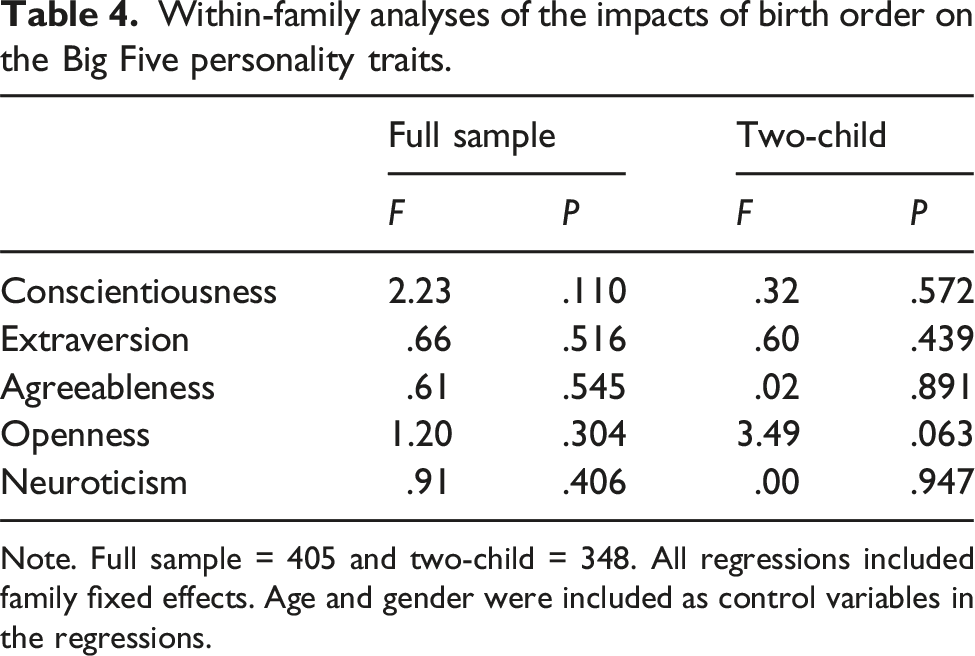
Note. Full sample = 405 and two-child = 348. All regressions included family fixed effects. Age and gender were included as control variables in the regressions.
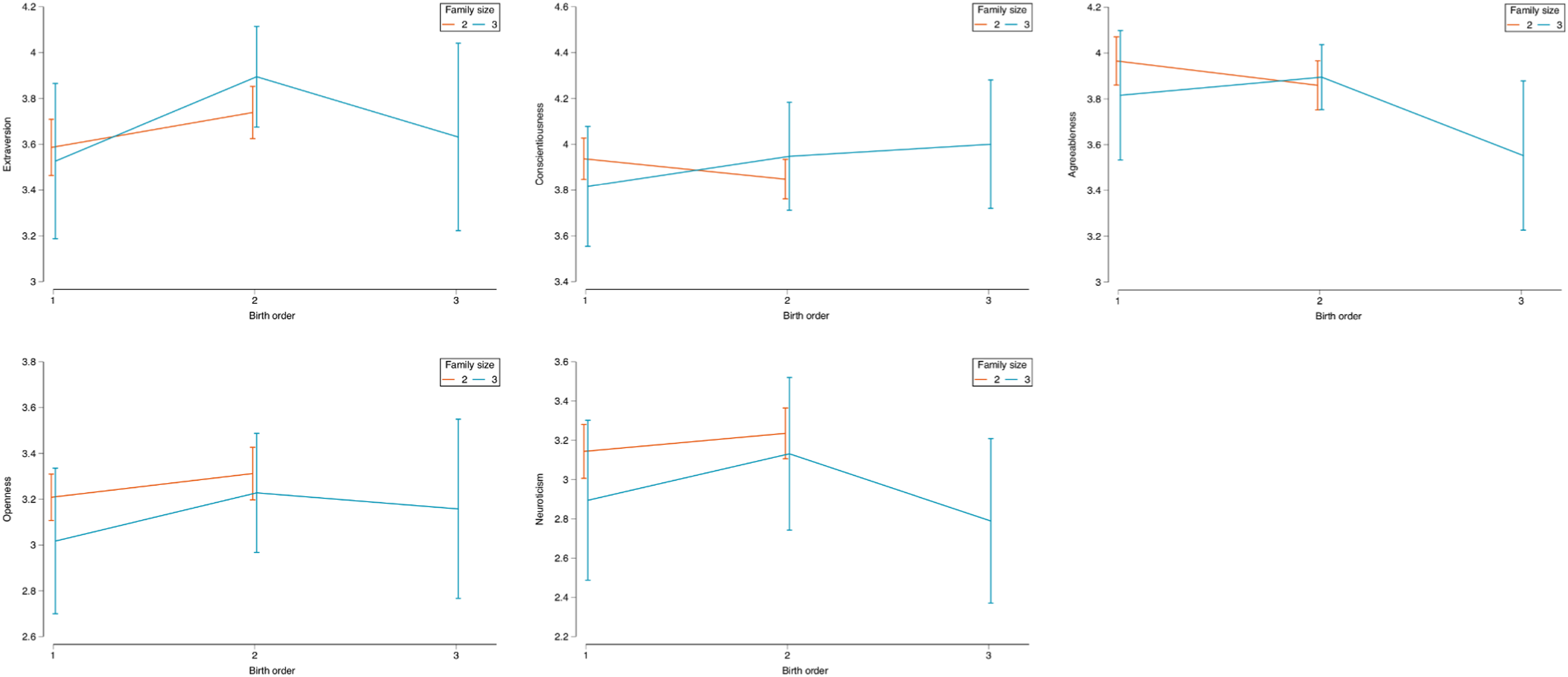
Mean scores and 95% confidence intervals of the Big Five personality traits for each birth order in different family sizes (within-family analyses).
Since 85.93% of the within-family participants were from two-child families, we restricted the sample to two-child families for further analysis. The results also showed that the associations between birth order and the five personality dimensions were not statistically significant (all ps > .063). Tables A9 and A10 in the Online Appendix present the estimated results with age-adjusted personality and the 11-item measure of personality as dependent variables. The results did not reveal any statistically significant effects of birth order on the five personality dimensions (all ps > .053).
To conclude, the within-family analyses indicated that birth order did not have meaningful effects on the five personality dimensions. However, the findings of the within-family analyses should be interpreted with caution because of the low statistical power resulting from a small sample.
Discussion
Research on the associations between birth order and personality development has a long history. In this study, we examined the associations between birth order and five personality dimensions in the Chinese cultural context. Our main analyses examining the effects of birth order on the five personality dimensions yielded consistent results. Birth order had no statistically significant effects on any of the five personality dimensions in either between-family analyses or within-family analyses. When we used between-family analysis to examine birth order effects on the five personality dimensions in different family sizes, no consistent birth order effects were found. The results were consistent with previous research that found negligible effects of birth order on the five personality dimensions using a between-family design (Damian & Roberts, 2015). The within-family analyses to investigate the effects of birth order on the five personality dimensions for different family sizes did not show any statistically significant results (Bleske-Rechek & Kelley, 2014; Botzet et al., 2020). Overall, our findings did not support Sulloway’s (1996, 1999) hypotheses regarding the associations between birth order and the five personality dimensions in the Chinese cultural context.
This study improves two aspects of previous studies regarding the associations between birth order and personality. First, the study investigated the impacts of birth order on personality in the Chinese cultural context. Previous research has primarily explored birth order effects on personality in Western cultural contexts (Damian & Roberts, 2015; Paulhus et al., 1999; Rohrer et al., 2015). Although Botzet et al. (2020) used an Indonesian sample to investigate the impacts of birth order on personality, no studies have examined the effects of birth order on personality in a Chinese cultural context. China is an exciting context to study birth order effects because it is the most populous country in the world and is deeply influenced by Confucian culture. Confucian culture provides moral standards for the relationship between siblings and clearly defines sibling roles in a family, which may influence birth order effects. Therefore, exploring the associations between birth order and personality in the Chinese cultural context adds to the literature on birth order effects. Second, this study used both between- and within-family designs to examine the associations between birth order and personality. Most previous studies used only between- or within-family designs, and a few used both. Using both methods can provide more evidence of the robustness of the findings.
This study also has some limitations, of which we discuss the most salient. First, this study included only adults and did not include adolescents and children. According to Sulloway and Zweigenhaft (2010), the influences of birth order on personality should be particularly evident in adolescence and childhood. Therefore, we cannot exclude the possibility of birth order effects on personality among Chinese adolescents and children. We can only say that if birth order effects on personality exist among Chinese individuals, these effects dissipate with age (Botzet et al., 2020). Second, although this study used independent assessments of personality for each participant to reduce demand effects caused by social stereotypes, the self-reported personality data may result in biased estimates. For example, Sulloway (1999) argued that first-borns would respond to self-evaluation in a more socially desirable manner than later-borns, which might offset the available birth order effects (Botzet et al., 2020). While most studies of birth order effects on personality have used self- or other-reports of personality, future research can evaluate personality using behaviours outcomes, which can reduce the influence of social desirability and social stereotypes. Third, although we used full-siblings to test the hypotheses, we could not confirm whether these siblings had been living together during childhood. The central mechanism of the FNMBO is sibling rivalry, which is more likely to occur when siblings live in the same family. However, if parents divorce, siblings may live in different families, and sibling rivalry may be reduced or even disappear. Therefore, future research should examine birth order effects using siblings who lived in the same family during childhood. Fourth, we acknowledge that the sample size of the within-family design was not large. Therefore, the findings of the within-family analyses should be interpreted with caution. Although we used the method of replacing the measure of personality traits to test the robustness of within-family results, this did not address the low statistical power caused by a small sample size. Future research can establish a large within-family dataset to retest the effects of birth order on personality for Chinese individuals. Finally, our study was limited to the Big Five personality traits framework. Recently, a growing body of research has explored the effects of birth order on individual behaviours based on the assumption that birth order impacts other personality traits (e.g., risk-taking and prosociality) beyond the Big Five. Therefore, testing whether birth order affects other personality traits is important.
Conclusion
Although the birth order effects on personality are assumed to generalize across cultures (Sulloway, 1996), studies that examine the relationships between birth order and personality based on non-Western cultural contexts, especially the East Asian cultural context, are limited. In this study, we investigated the impacts of birth order on the five dimensions of personality in a Chinese cultural context. By analysing a large Chinese sample, we found that the impacts of birth order on the five dimensions of personality were not robust, and in most cases, the associations between birth order and the five dimensions of personality were not statistically significant and were negligible. Therefore, this study reinforces the recent empirical findings that the effects of birth order on personality traits might be a myth.
Supplemental Material
Supplemental Material - Birth order and personality: Evidence from a representative sample of Chinese
Supplemental Material for Birth order and personality: Evidence from a representative sample of Chinese by Wenlong Mu, Yumei Li, Shiyang Cui, Along He, and Tianyuan Liu in European Journal of Personality
Footnotes
Declaration of conflicting interests
The author(s) declared no potential conflicts of interest with respect to the research, authorship, and/or publication of this article.
Funding
The author(s) disclosed receipt of the following financial support for the research, authorship, and/or publication of this article: This research was supported by the National Social Science Found of China (Grant No. 22CSH035).
Open science statement
The study materials and data are publicly available on Peking University Open Research Data (https://doi.org/10.18170/DVN/45LCSO) or China Family Panel Studies Web site (https://www.isss.pku.edu.cn/cfps/index.htm). Before applying for access to the restricted data, researchers need to agree with specific usage conditions and register as an “advanced user.” Be aware that using an institutional email address may shorten the verification process. The analysis scripts can be accessed at  .
.
Supplemental Material
Supplemental material for this article is available online.
References
Supplementary Material
Please find the following supplemental material available below.
For Open Access articles published under a Creative Commons License, all supplemental material carries the same license as the article it is associated with.
For non-Open Access articles published, all supplemental material carries a non-exclusive license, and permission requests for re-use of supplemental material or any part of supplemental material shall be sent directly to the copyright owner as specified in the copyright notice associated with the article.
