



Abstract
Background:
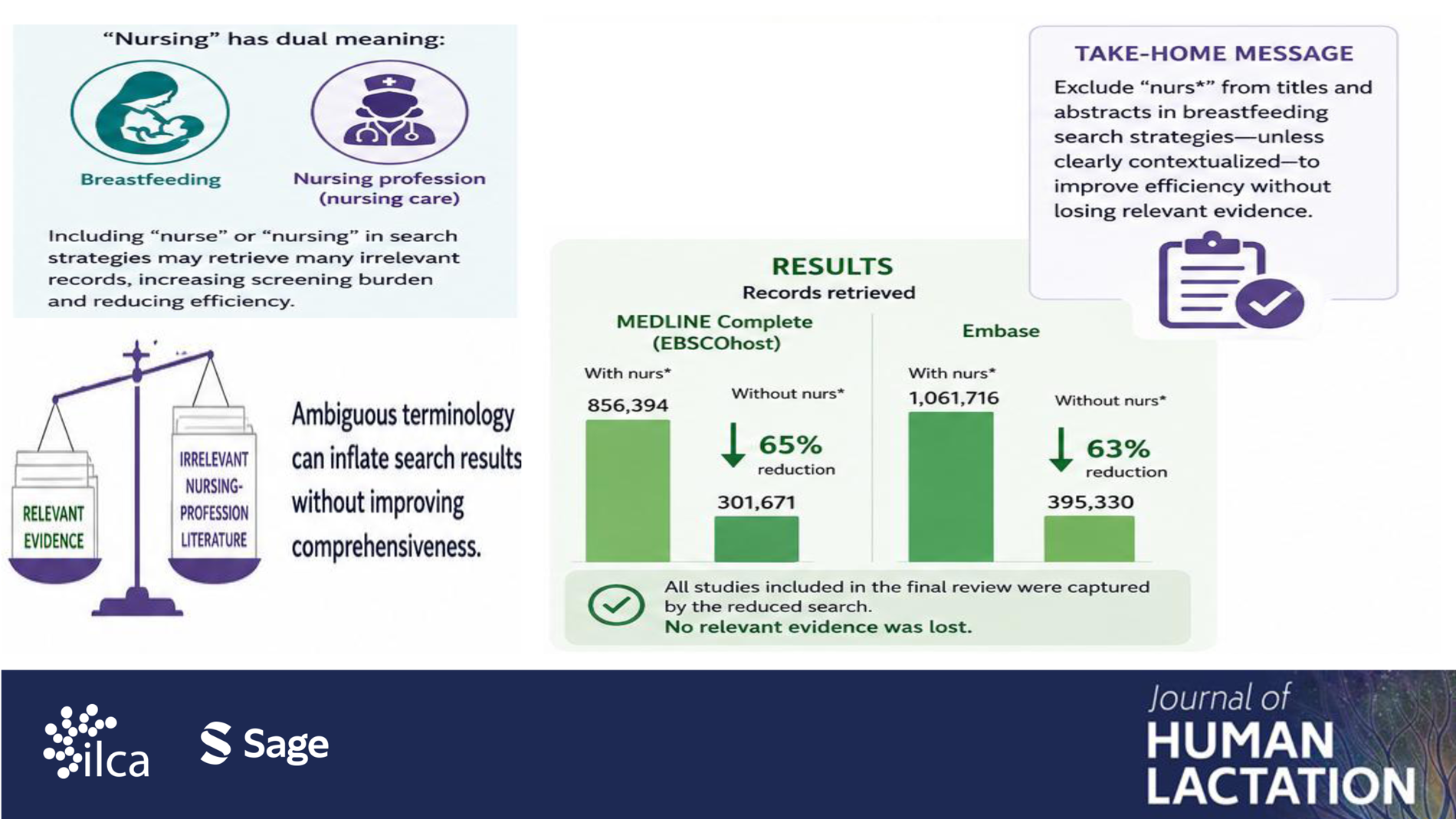
Rigorous systematic reviews in breastfeeding research depend on precise and transparent search strategies. However, the term nursing has dual meaning—referring both to breastfeeding and to the nursing profession—creating potential ambiguity in literature searches.
Research Aim:
To examine the methodological impact of including the terms nurse and nursing in breastfeeding-related search strategies, and to highlight implications for research quality and policy development.
Methods:
During a global systematic review on partner support and breastfeeding self-efficacy, seven databases were searched from inception to January 2025. Screening revealed a substantial number of irrelevant records related to the nursing profession. A modified search excluding the truncation “nurs” from titles and abstracts was subsequently conducted in Medline Complete (EBSCOhost) and Embase to assess its impact on retrieval volume and relevance.
Results:
Initial searches retrieved 21,214 records, with considerable screening burden attributable to irrelevant nursing-profession literature. When “nurs*” was excluded, records in Medline Complete and Embase substantially decreased by 65% and 63%, respectively, without observed loss of relevant breastfeeding studies. The findings demonstrate that ambiguous terminology can substantially inflate retrievals without enhancing comprehensiveness.
Conclusion:
Routine inclusion of nurse and nursing in breastfeeding searches may reduce efficiency and should be carefully considered in relation to the review context.
Implications for Practice and Policy:
Precision in search terminology is essential to maintain methodological rigor. Researchers, librarians, editors, and peer reviewers should critically evaluate term selection and promote validated, breastfeeding-specific search filters to strengthen evidence informing lactation policy and clinical practice.
Background
In the landscape of maternal and child health (MCH) research, breastfeeding remains a critical area of focus. Yet, despite the precision required in evidence synthesis, search strategies for systematic reviews often include the term “nursing”—a word that, depending on context, may refer either to breastfeeding or to nursing as a profession. This dual meaning creates ambiguity that can inflate search results with irrelevant literature, slow down screening, and even skew findings. Based on insights from a recent systematic review on breastfeeding, this article challenges the routine inclusion of “nurse” and “nursing” in search strategies and argues for a more deliberate, context-sensitive approach to terminology.
Argument
Observation
A systematic review titled “The Relationship between Partner Support and Breastfeeding Self-efficacy: A Global Systematic Review” was recently conducted. This parent systematic review was registered in PROSPERO (CRD42025615339) and conducted in line with MECCIR standards. It aimed to examine the evidence on partner support and its impact on breastfeeding self-efficacy. Seven databases (MEDLINE Complete, Embase, CINAHL, Web of Science, Scopus, The Lens, and the Maternal and Child Health Library) were searched from inception to mid-January 2025, with no language restriction, using controlled vocabulary and keywords related to breastfeeding, self-efficacy, and partner support. Two reviewers independently conducted title/abstract and full-text screening using predefined eligibility criteria based on the Population, Concept/s, Context (PCC) framework. A total of 21,214 records were retrieved, out of which 10,122 were eligible to be title and abstract screened after the removal of duplicates. Only 14 citations met inclusion criteria in the parent systematic review.
Critiques of Current Practice
During the screening phase, an overwhelming number of articles that discuss nursing as a profession or nursing care rather than breastfeeding were found—most likely due to the use of “nurse” and “nursing” in the search strategy.
Methods
Two search strategies were conducted at the end of May 2025 on Medline Complete (EBSCOhost) and Embase, one with the keyword “nurs*” and another one eliminating “nurs*” as a keyword from titles, abstracts, and keywords.
Results
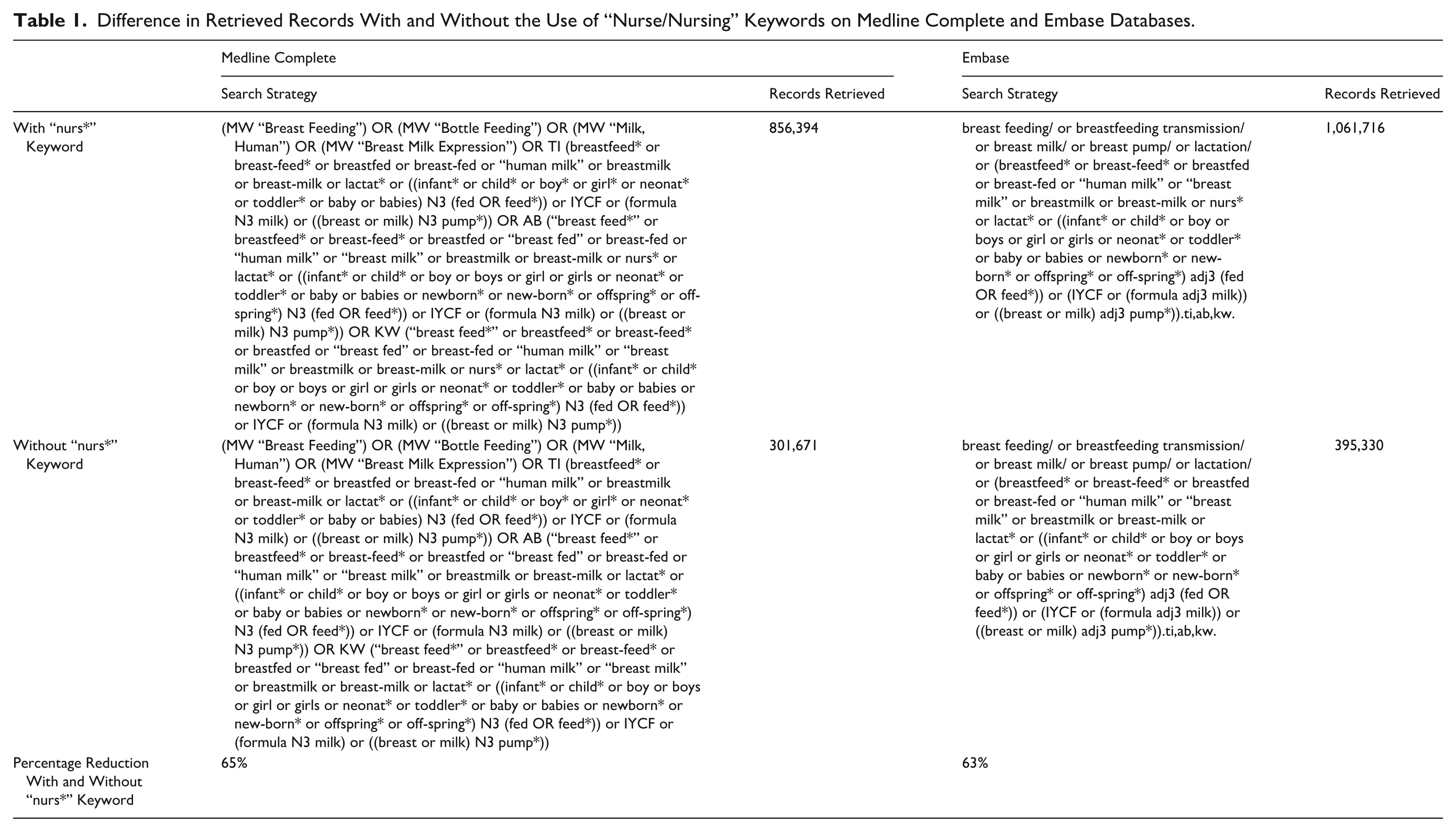
Records retrieved from Medline Complete and Embase decreased substantially when “nurs*” was excluded, from 856,394 and 1,061,716 to 301,671 and 395,330, respectively (Table 1).
Difference in Retrieved Records With and Without the Use of “Nurse/Nursing” Keywords on Medline Complete and Embase Databases.
To assess whether this reduction affected comprehensiveness, we compared the studies included in the final review across both search strategies, based on predefined inclusion criteria. All included studies were captured by the reduced search, suggesting that no relevant evidence was lost.
Limitations
This analysis was based on two databases and one review topic, which may limit generalizability of findings. Search terms and indexing can differ across databases, and in some situations, including “nurs*” may still be necessary to find relevant studies. These results should therefore be interpreted cautiously and viewed as context-specific rather than universal.
Implications for Research and Policy
Including the terms “nurse” or “nursing” in search strategies for breastfeeding research can introduce significant inefficiencies and compromise the quality of evidence. These terms are vague since they commonly refer to nursing as a profession or nursing care settings, rather than infant feeding, especially breastfeeding. Thus, searches yield a high volume of irrelevant literature that requires screening for identifying relevant articles and filtering unrelated results; this is a consumption of both time and effort. Moreover, this increases the risk of overlooking key studies that use more precise terms like “breastfeeding” or “lactation.” Incomplete or skewed evidence bases weaken the validity of systematic reviews that inform public health policies and clinical guidelines. Policies derived from flawed evidence risk inadequate support for lactating parents and create inconsistency in clinical practice. Clear and precise terminology in search strategies is therefore essential, not optional, for producing rigorous research and policy grounded in reliable evidence. Nevertheless, the inclusion of the truncated keyword of nurse and nursing, that is, “nurs*” remains important in reviews focusing on breastfeeding in nursing practices or healthcare delivery.
Key Messages
The inclusion of ambiguous terms such as nurse or nursing in breastfeeding research searches can inflate search results with irrelevant records, leading to inefficiency in systematic reviews and compromising the quality of evidence.
The dual meaning of nursing (referring both to breastfeeding and to the nursing profession) results in an overwhelming volume of irrelevant literature, as demonstrated by substantial reductions in search results when these terms are excluded.
Imprecise search strategies can skew evidence bases, weaken systematic reviews, and misguide public health policies and clinical guidelines regarding lactation support.
Future research should consider the following: (1) including terms such as nurse or nursing only when directly relevant to the review question which refers to nursing as a profession; (2) developing and promoting validated, domain-specific search filters for breastfeeding research; (3) strengthening training for researchers and librarians on strategic, precise term selection; and (4) encouraging journal editors and peer reviewers to critically appraise search strategies for terminological rigor.
Recommendations
To enhance research efficiency and evidence quality in human lactation, future systematic reviews on breastfeeding should follow these recommendations:
1. Authors should adopt greater precision in search strategy design. Terms such as “nurse” or “nursing” should appear only when directly relevant to the review question, such as studies examining breastfeeding support delivered by nurses.
2. Research organizations and librarians should develop and disseminate validated, domain-specific search filters tailored to breastfeeding and lactation research.
3. Graduate training programs and library services must prioritize instruction on strategic term selection and controlled vocabulary use in systematic reviews.
4. Journal editors and peer reviewers should critically evaluate search strategies and require clear justification for terminology to maintain methodological rigor.
Footnotes
Acknowledgements
We would like to thank Lara Chamma and Nour Chamma for double screening and extraction.

Author Contributions
Funding
The authors received no financial support for the research, authorship, and/or publication of this article.
Declaration of Conflicting Interests
The authors declared no potential conflicts of interest with respect to the research, authorship, and/or publication of this article.
Study Protocol Registration
PROSPERO (CRD42025615339) and Campbell Collaboration (cl2.20250036)