




Abstract
Children play a part in family food shopping, but their roles are often underestimated. In contrast to earlier studies focusing on “who wins” in parent/child negotiations, in this study I focus on emotional and cooperative ways of negotiating food in the supermarket. Through unobtrusive observation of Danish and American parent/child groups, I found that children—even from a very young age—also appear interested in and knowledgeable about healthy eating. Just as importantly, I observed parents not only being sensible and focused on healthy eating but also immersed in habits and desire, at times bending their own rules and using their notion of health arbitrarily. The concepts of “healthy” and “unhealthy” were used to decipher food in collaborative ways, and health was a core concept that parents tended to use negatively and children positively. Both children and parents must be considered as competent and incompetent consumers to understand family food negotiations.
Overweight and obesity among children continue to grow in the United States (Dehghan, Akhtar-Danesh, and Merchant 2005); also in the European Union, a considerable proportion of the child population is estimated to have significant weight problems (World Health Organization 2006), even if the speed of this growth has slowed down (Organisation for Economic Co-operation and Development, n.d.). The reasons behind children’s inadequate nutrition and overweight are complex (Reisch and Gwozdz 2011) and have been seen as linked to the advertising of unhealthy products (e.g., Livingstone and Helsper 2006), children’s sedentary lifestyles, and the ubiquitous access to cheap unhealthy food (Kline 2005). There is no doubt that the causes are complex and multifaceted (Tingstad 2009), but family food practices especially are found to be central in instilling healthy food habits in children (Holm 2001). An important event therefore seems to be the recurring visits to the supermarket, where the majority of families in the West buy food.
In supermarkets, decisions are made on what food to buy, and children are found to have a say in family decision making (Belch, Melch, and Ceresino 1985; Ebster, Wagner, and Neumueller 2009). However, the assessment of children’s role in the decision-making process has been criticized for being underestimated (Larsson, Andersson, and Osbeck 2010) and overly simplified (Lawlor and Prothero 2011; Kerrane, Hogg, and Bettany 2012), and gaps are found between how much influence parents think children have and how much influence children themselves think they have and are observed to have in supermarkets (Tinson, Nancarrow, and Brace 2008; Ebster, Wagner, and Neumueller 2009). Few studies have been carried out exploring family negotiation processes in the supermarket (an exception is Noergaard and Brunsoe’s [2011] investigation of family conflicts and resolutions), but several studies focus on “who wins” (as discussed by Commuri and Gentry 2000). The work of Kurz (2002) and Best (2006) underscores the importance of collaborative processes in families’ negotiations, which appears to be an underexplored perspective in parent/child supermarket practice, and this is the perspective taken in this article.
Objects, such as goods in supermarkets, circulate in spheres of meaning, which are also, to a large extent, emotional spheres (Illouz 2009). As parenthood and particularly motherhood are bound to meanings of the priceless child (Zelizer 1985; Illouz 2009) and a fear of not living up to the responsibility of “the good parent,” bringing up a healthy child, this entails a range of feelings related to guilt (Gram and Pedersen 2014) and love (Illouz, 2009), and such emotions are all in play when buying food with the child. The child, however, is also part of an emotional and normative realm with an interest in being “a good child,” as is discussed in the following.
The present article is based on an unobtrusive observational study of parent/child food negotiations, and draws on decision making, family, food, and childhood literature. My aim is to explore parent/child collaboration and interaction in the supermarket with a special focus on how “health” is brought up in relation to food selection. Far from the earlier focus on “pester power,” where children nag parents to get products, or the “win–lose” negotiations, as they are described in much decision-making literature, this study underlines the importance of emotional relations among family members. While earlier studies have focused mainly on negative emotions and aspects such as guilt, conflict, fear of not appearing as a responsible parents, and the child as craving and self-centered (e.g., Holden 1983), this study also points to the importance of positive emotions and cooperative interplay. The roles played by parents and children, as both competent and incompetent, are explored.
Finally, it is discussed how “health,” directly and indirectly, becomes a key notion in deciphering food, and the question is raised whether the quite negative way, which was found in the data, in which parents apply the health concept—in opposition to children—is actually unfortunate.
Review of the Literature
Today the arena of the supermarket is an inherent part of families’ lives with weekly or even daily visits to buy food. The trip to the supermarket has often been described negatively: as a “triple threat,” where parents have to shop; supervise their child, who is exposed to marketing stimuli; and deal with a situation in which parent and child are in the public sphere (Holden 1983). Buying food is furthermore complicated by the fact that choosing food has become more difficult with industrialization, because consumers do not really know what the food consists of and where it comes from, which may give rise to anxiety (Fischler 1988).
Parents and Children Shopping Together
Family decision making has been studied for decades, and children have long been considered influential (Belch, Belch, and Ceresino 1985). Several studies have found that parents and children do not agree on children’s level of influence, and children tend to report that they have more influence than their parents think (Belch, Belch, and Ceresino 1985; Foxman, Tansuhaj and Ekström 1989; Tinson, Nancarrow, and Brace 2008). This is supported by an observation and interview study from Austria, in which Ebster, Wagner, and Neumueller (2009) found that parents tended to underestimate their child’s influence by 50 percent. Reporting what happens when making purchasing decisions is difficult (Commuri and Gentry 2000), and when discrepancies occur between children’s and parents’ responses, these discrepancies are, to some extent, discarded as being due to the child’s lack of overview of the decision-making process (Tinson, Nancarrow, and Brace 2008). It seems to be taken for granted that the adult has this overview and can distinguish between different consecutive stages in what appears to be a linear decision-making process: the adult is seen as competent in contrast to the child.
It appears that parents find it difficult or are perhaps unwilling to account for what takes place when purchasing goods with their children (Flurry and Burns 2009). Tinson and Nancarrow (2007) point to the fact that parents and children may overemphasize their own importance and that parents may influence their child, without the child noticing, or act on what they know their children prefer. These distortions may explain why different family members have different perceptions of how decision making takes place in the family (Tinson, Nancarrow, and Brace 2008). Another explanation could be that they simply do not register what happens because of the everyday habitual nature of buying food. Parents are found to listen to their child’s input when shopping together (Darian 1998), and, furthermore, ideals for upbringing related to independence and autonomy clearly prompt the idea of inviting children to participate, western families being characterized as negotiation families (Du Bois-Reymond, Sunker, and Kruger 2001).
In several studies on intergenerational shopping, a focus has been on conflicts and children’s coercive behavior (Aktin 1978; Buijzen and Valkenburg 2008). However, in observational studies in which researchers watched parents and children shopping together, coercive behavior is not a dominant feature. In 1978, Atkin found that conflicts rarely occurred in the supermarkets, and that parents often listened to children’s requests. Holden (1983) found that mothers used proactive behavior to avoid conflicts in the supermarkets. Ekström (1995) found that the consumption relation between some parents and children seemed to be more like a friendship, and Darian (1998) found that parents and children interacted positively and worked together collaboratively and that positive affective ties were demonstrated as part of the shopping process. Pettersson, Olsson, and Fjellstrom (2004, 324) found that “[t]he observed children seemed to accept when their parents denied them the product and did not continue to ask about it.” Noergaard and Brunsoe (2011) found no pestering or begging, and Buijzen and Valkenburg (2008, 64–65) found that the level of children’s coercive behavior was relatively low and that “children’s influence on family purchase decision making is more multidimensional than previously assumed.” The preceding findings are in line Best’s (2006, 57) findings on family negotiations between parents and teenagers as mostly collaborative and far from always “warring” or “stormy.” Also, Kerrane, Hogg, and Bettany (2012, 823) argue that children’s influence on family decisions should not be seen as an individualist approach, with a child working through specific strategies, but rather as a “highly networked, distributed familial agency where specific consumption acts emerge as a result of collective action.” Kurz (2002) notes that much work on caring and family relationships remains one-dimensional without going into the immanent interactional processes between parents and children. Caring involves multiple activities, emotions, practices and strategies (748), and caring is an important part of parenting, which is, however, also acknowledged by children (Kurz, 2002). This is in line with Kerrane, Hogg, and Bettany (2012), who found that children were indeed able to take parents’ perspective, quite in contrast to earlier views of the child as incompetent ( de la Ville and Tartas 2010).
Food, Emotions, and Dilemmas
Several studies show that even though people know about healthy eating advice, they do not always follow this advice (Warde 1997). Hughner and Maher (2006) report “attitude-behavior inconsistencies,” meaning that although parents claim to be positive toward what they perceive as healthy eating, they still purchase unhealthy food items, which is found to be due to lack of knowledge of nutrients; trust in “healthy snacks,” which sometimes contain significant levels of sugar and fat; and parents being misled by health claims on food packaging (also discussed by Elliott [2008]). Similarly, Hoy and Childers (2012) find a discrepancy between knowledge and behavior among parents in their survey, which they label “confused mind-sets” or “paradoxical indulgence-healthy behavior,” not because parents are misled but because they allow for treats. Children find themselves to be familiar with what healthy and unhealthy food is, but knowing what healthy and unhealthy is perceived to be does not mean that they do not eat what is constructed as unhealthy food, for example, if their parents use unhealthy food as rewards (Johansson et al. 2009). In this study, the focus is on how and in which situations the observed parents and children themselves construct “healthy/unhealthy” and “what is good/bad for you” or otherwise refer to healthy eating.
Warde (1997) describes the health versus indulgence dilemma, referring to the paradox of hedonism versus bodily self-discipline, which often contradicts one another. Warde argues that eating healthily has become an everyday act and a demand to people’s diets, but at the same time, indulgence relates to situations where the individuals allow themselves to bend or break the rules for healthy eating and enjoy unhealthy treats. Warde’s health versus indulgence dilemma seems particularly important in intergenerational food shopping (cf. Hughner and Maher 2006; Hoy and Childers 2012), when adults are concerned not just for themselves, but also for their child or children.
Emotions such as anxiety or hedonism play an important role in consumer culture (Illouz 2009). Illouz (2009, 407) writes that “[i]nasmuch emotion is the ‘energy-laden’ side of action, we may surmise that it compels the subject to act in different ways in different contexts, with the result that action is characterized, as many analysts have repeatedly observed, by a lack of consistency, coherence and unity.” And she continues, stating, “Emotions can not only easily shift from one situation to the other, they can also happily coexist with each other” (408) and even “lie at the heart of consumption” (394). Thus, the consumer at the same time may be torn among contradicting emotions, habitual behavior, and willful priorities. Parenthood—and particularly motherhood—is imbued with emotions such as responsibility, guilt, and love (Eyer 1996; Miller 1998; Tardy 2000), which are claimed to be more intense than previously (Douglas and Michaels, 2004). Consumption is inherent in processes of identity building and maintaining (Illouz 2009), and buying appropriate food for the child is central in parenting, even if this is imbued with health/indulgence trade-offs. The demand for healthy eating has been seen as a reason for anxiety (Fischler 1988).
Both grocery shopping and childrearing are still activities mainly carried out by women (Bugge and Almås 2006; Miller et al. 1998). However, in this study, a significant number of fathers were also observed shopping with their children (cf. Table 1), and in this context, the focus is on the parent/child interactions and not on the gender perspective, which does not imply, however, that the latter is not still very important.
Sample.

Note. DK = Danish.
To sum up, most studies find that parents agree that their children take part in family purchase decisions, but several studies also document that parents and children do not agree on the level of the children’s influence and that children influence their parents more than their parents realize. It is often taken for granted that the adult can distinguish between different stages in the decision-making process, in contrast to the child, which can be seen as an overestimation of the skills of the adult who is considered as competent and conscious about what is being purchased. The child is often considered as incompetent and unable to take the perspective of the parent, particularly at a very young age, in line with the theories of Piaget, and then gradually as more and more competent like the adult, and consequently as increasingly influential (cf. Roedder-John 1999; for a critical discussion, see de la Ville and Tartas 2010). In opposition to the previous view, in which the child is sketched as incompetent, childhood studies argue that children should be understood as competent actors in their own lives (James, Jenks, and Prout 1998) and as part of a network and in collective action (Kerrane, Hogg, and Bettany 2012). In this article, I see children on a continuum from being competent to being incompetent, and parents themselves as not circling only in a “competent” zone (Miller et al. 1998).
Parents and children find themselves to be well informed about healthy eating but do not always act on this knowledge, and food shopping entails a number of health-indulgence dilemmas. Parents are not, at all times, focused on health and price (Götze, Prange, and Uhroska 2009) but are entangled in emotional relationships (Hamilton and Catterall 2006) and their own unhealthy habits and desires. Parents’ behavior has been termed “paradoxical” or “inconsistent” (Hughner and Maher 2006; Hoy and Childers 2012) in recent studies. This points to a need for a more nuanced view on the role of the parent, which has been largely overlooked in family decision-making studies. Finally, I see the family purchasing process as characterized less by conflict and more by negotiation and cooperation than has often been assumed. Family food purchasing is seen to be a complex interplay and is “messy” (Commuri and Gentry 2000). Verbalizations tend to be overestimated, and there is a need for a stronger focus on actual ongoing interaction between parents and children to add on to existing knowledge.
Methodology
To explore the joint grocery shopping of parents and children, I chose to carry out qualitative unobtrusive observation in supermarkets through an interpretive approach. The observational approach provides insight into processes that are not fully conscious and entangled with ideals about responsible parenting (Flurry and Burns 2009; Gram 2010). Because gaps are found in several studies between what parents and children say (Belch, Belch, and Ceresino 1985; Tinson, Nancarrow, and Brace 2008), and between what is observed and what is said (Ebster, Wagner, and Neumueller 2009), the unobtrusive observational approach was chosen to gain insight into ongoing food negotiations and the ways in which “health” is addressed directly and indirectly.
Sample
My sample consisted of fifty observations I carried out in northern Jutland, Denmark, and fifty observations I carried out in Northern California, United States, in 2009 and 2010. It covered children from ages zero to sixteen and their parents and involved in all 258 observations of parents and children. I had to assess children’s ages, and the family relations could not always be ascertained.
The majority of groups observed were mothers (Table 1), in Denmark, most likely with a young child and, in the United States, more likely with an older child, but in both national contexts, a fair share of observed children was found in each age group. Slightly more fathers were found in the Danish sample.
Through nonparticipant observation, my aim was to unobtrusively (Webb et al. 1966) observe parents and children shopping. The observations aimed at seizing negotiation or talks about products and observing other types of interaction. If several parent/child groups were in the supermarket, I chose the first one spotted. The observations were noted immediately after the observation. In my notes, dialogue between parents and children was reconstructed, which might give rise to some imprecision.
During many periods of the day, I found no children in the supermarkets. Several visits to observe were fruitless, because no children were around. To meet a child shopping with his or her parents on a workday, I learned that I needed to be in place between 4 and 5.30 p.m. This could mean that more working parents were observed, which was not an aim in itself in the research design. During weekends, more children were found in the supermarkets. Primarily white, middle-class and upper-middle-class neighborhoods were chosen because these have been less focused on regarding these issues than have working-class parents (Wills et al. 2009). The idea was that these families would typically both be expected to have knowledge about what is considered healthy eating, even though they are sometimes misled, for example, by unclear nutritional health claims (Hughner and Maher 2006), and have the means to buy healthy food, and the assumption was that they still encounter health/indulgence dilemmas, which remain unexplored in family negotiation research. Furthermore, as noted by Francis (2012), this was also my own social location, and it was easy to be just another white, middle-class parent in the supermarkets in these neighborhoods.
Several factors influence parents and children when shopping (for example peers, the media and school), but in this study, my focus is on the interaction and negotiation of single products. The field of observation is sketched in Figure 1. The figure illustrates that shopping does not take place in a vacuum. In some of the examples analyzed in the following, siblings were involved in the negotiations and are therefore included in the analysis.
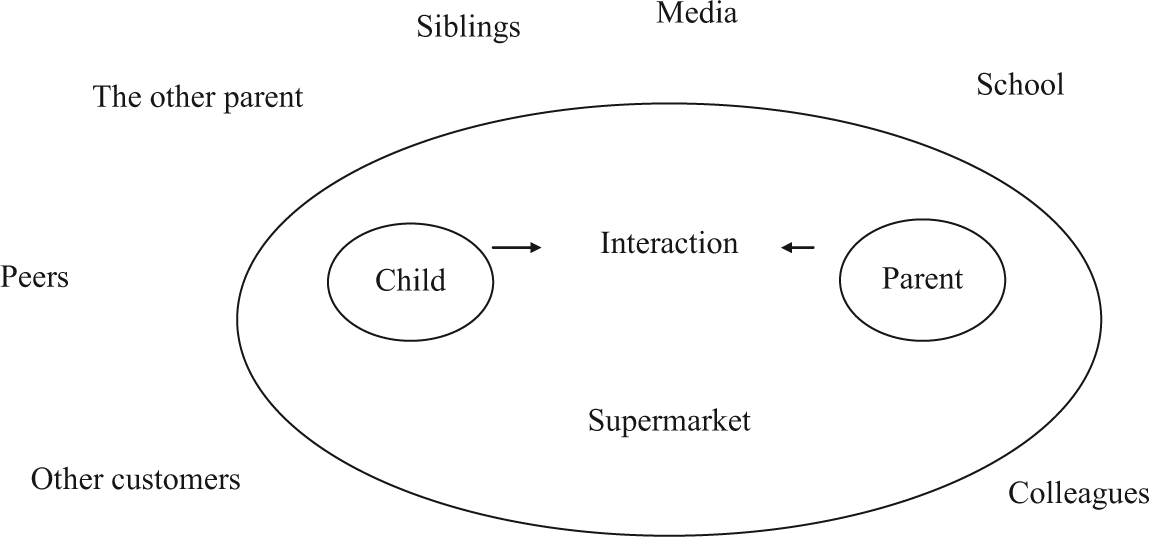
Interaction in the supermarket between child and parent.
Two Regional Contexts
To avoid a one-sided national/regional perspective, I decided to conduct the study in both Danish and American contexts. The data material shows some cross-cultural differences (a higher shopping pace in the American sample, stronger parental focus on a specific day for candy in Denmark and consequently more explicit talk about the minimization of unhealthy food such as candy, soft drinks, and crisps in the Danish context), but the similarities were more dominant than were the differences, indicating that many of the same processes are at stake when it comes to negotiation and including children in grocery shopping.
Ethical Considerations
Unobtrusive observation needs careful ethical consideration, because people are observed in their everyday lives unknowingly. In this study I observed parents and children in supermarkets while they knew other consumers were around but did not expect being observed while talking with their children. Since the observational interventions were brief, the anonymity of the participants were complete, and the observations took place in a public space, I deemed it acceptable not to ask for consent from the observed shoppers. In the following, I have omitted all locations and names.
Analysis
I carried out the literature review and observations as parallel and iterative processes, through a hermeneutic approach, drawing on theory, other studies, and empirical data to gain an understanding of the field studied (Kvale 1996). To create an overview of the observations, I categorized the observations into themes (e.g., requests for unhealthy food, use of health-related terminology, coercive behavior, parents changing their minds), and I analyzed the observations for patterns in parent/child interactions in general and related to constructions of healthy/unhealthy.
Limitations
A number of limitations are related to unobtrusive observation. The observations represent one glance at an ongoing communication, and I only saw the part that takes place directly between parents and children related to specific decisions in the supermarket. Several studies have already demonstrated that the age of children plays a role for influence and strategies during the shopping trip (Roedder-John 1999) along with, for example the frequency of parent/child shopping trips (Grossbart, Carlson, and Walsh 1991) or the socioeconomic status of the family (Pettersson, Olsson, and Fjellstrom 2004).
The following unobtrusive observational study offers insights that supplement and question the findings of studies based on self-reported behavior by seeking to nuance the understanding of the role of parents and children in the supermarket. As pointed out by Kurz (2002), few studies on actual parenting practices have been carried out, and even fewer focus on the interactional processes between parent and child. The qualitative nature of this study supplements the often quantitative approaches of observational studies in supermarkets. An alternative to unobtrusive observation would have been participant observation such as shop-along techniques (Pink 2007), which implies that the researcher shops with a family and interviews the family members during and after the shopping trip, for example. This approach would allow for important insights, and the interviews would offer more information. The advantage of the unobtrusive observation was that it was possible to get a relatively large volume of observations from different families; and since social norms in this field are strong (Flurry and Burns 2009), being less aware of the gaze of the observer in the unobtrusive observation, compared to shop-along studies, probably plays a role in the behavior of the observed. Still, just being in the supermarket will already cause the parent to feel under the scrutiny of the public eye and to look and act the part of the social identity of a parent (Collett 2005), where the purchased items will function as props because of their signifying capacity (Illouz 2009) in the staging of good parenthood (Goffman, 1959).
Findings
Contrary to “the triple threat” mentioned earlier, with very few exceptions, the observed parent/child shopping excursions seemed to be pleasant experiences, with relaxed chatting and plenty of signs of affection. Several examples were found of parents using the store visit to educate their child, for example, by letting the child touch vegetables to make him or her understand how fresh vegetables should feel. In this way, parents transferred competencies in assessing freshness, quality, price, and healthiness, among others, by including the child in parents’ shopping practices. Few examples were found of a child showing discontent loudly or of a parent scolding a child.
Choosing food happens swiftly, ranging from parents picking items by themselves with no discussion with their child or children over more elaborate discussions about preferences to situations in which the child initiates the process, leading to a purchase. In all observations, parents were gatekeepers (also found by Longman [2003] and Davis and White [2006; quoted in Marshall, O’Donohoe, and Kline 2007]), a role which is never discussed, and in my sample, parents approved all items going into the shopping cart.
Quite often, children’s requests were accepted. Children were observed to be very active when browsing through the supermarkets in ongoing interaction with their parents: “Have you seen these?” “Can we take these?” or “We really should try these.” Requests spanned from the child simply showing a product to the parent, to informing the parent about a product, to phrasing a direct request. In some cases, parents just accepted, and the item was dropped into the shopping cart. Parents said no often, sometimes with no elaboration, sometimes with an explanation, for example, “No, we have those at home” or “No, those are not healthy.” In a few observations, mothers reacted with an emotional response to a child’s request, for example, saying no in an angry voice. But mostly, the rejections were made in a friendly way. Most requests from children were polite (Ebster, Wagner, and Neumueller 2009). An example of a typical polite request, using the symbol of politeness “please” would be “Can I have this one, please?” or, in a more intensive form, “Please, please, please.” A typical example of dialogue around food purchase follows: A mother and boy of 4 are shopping. The boy is sitting in the cart, chatting away. They are at the ice cream section. “I don’t see why we should always have vanilla ice cream”, the boy says, “I want other . . . other.” His mother: “You think we should have other kinds?” Boy: “Yes.” His mother: “Then when we’ve finished the vanilla we have at home, we’ll have another kind. Deal?” They move on. (US)
This was a negotiation in which the boy questioned their habitual behavior regarding ice cream choice. He challenged his mother to give him a good reason why they should only buy vanilla ice cream, seemingly taking it for granted that he should be able to understand the family dispositions, “I don’t see why . . .,” and expected to be enlightened. This illustrates the core position children have in the families observed and the cultural shift regarding how children are perceived in contemporary society, which is in line with perspectives of childhood studies. The negotiation was concluded with a compromise: “Deal?” They did not buy the ice cream he wanted now, but she accepted his claims. Despite his young age, the boy appeared very articulate and well informed about product choice, family habits, and the use of arguments. He was listened to by his mother, who did not, however, give in to his wish on the spot, which was accepted.
The significance of age in family decision making has been discussed in several studies (e.g., Roedder-John 1999). A typical conclusion is that older children are taken more seriously and that they request fewer items, which are, then again, more often accepted, because they probably know what to ask for and when. Younger children were found not only to be more active in requesting but also to be significantly better informed than earlier studies indicate. The significance of the influence of children’s gender was not in focus in this study, and no particular differences were observed, but the gender issue would be interesting to explore in future studies.
Healthy and Unhealthy Food Items
Health seemed to be a key concept around which negotiations and decisions revolved. Being anxious to care for the child as a responsible and loving parent—and to be perceived as such (Illouz 2009)— is closely linked to concern about what the child consumes. Healthy food items function as props in the enactment of responsible parenthood (Goffman, 1959). Health appeared directly or indirectly, initiated by adults in several situations: A mother and her 5-year-old son are shopping. The boy finds a packet of biscuits: “Can we have these?” The mother: “No, you know they are not healthy.” (Denmark)
Here the mother seems to refer to earlier discussions—“you know”—and the boy knows the health argument, which was not discussed further. The mention of health equaled rejection in this example as it did in several others.
Children often requested unhealthy food items, and parents accepted many of these suggestions, but several items were also rejected. Reference to healthy/unhealthy food is often an argument in itself, for example, “No, that’s junk” (cereal, US). A mother with three girls was asked if they could have cake. She answered, “No, you guys have had enough sugar” and continued, saying, “And there is plenty of sugar at your house” (US). There seemed to be a general acceptance of the importance of eating healthy food and of limiting unhealthy food intake, which was implied between the parents and the children. After her 9-year-old son has asked for a Kinder Milchschnitte (a brand of cream-filled sponge cake, placed next to the dairy products), one mother said with a wry smile, “It is your fate to have a childhood without Kinder Milchschnitte” (Denmark), seemingly referring to a family policy on the matter, and the child accepted. Use of the word fate usually occurs in more sinister contexts, bringing unhappy childhoods of Dickens’s universe to mind, and the word was no doubt used with a twinkle in her eye in this context. This is an example of the intergenerational care processes at stake: the adult has made rules on what can be eaten and not eaten and assumes responsibility for the child by making general decisions on the child’s diet. The mother presents the policy as being “fate” connoting “evil” which is, of course, ironical when the issue is Kinder Milchschnitte. Her decision to deny the child this item was no doubt anchored in love, and the effort to make such a policy was reflecting care for the child. This seemed to be acknowledged and accepted by the boy, even if he tried to get the treat, in spite of the fact that he did not seem unfamiliar with her policy regarding this product. The mother used humor in her rejection of his request, and she expected that the boy understood this. “Health” comes to play the role of external authority, which can be seen as indirectly representing medical doctors, dieticians, and teachers, and thus, the mother is not denying the child pleasure and indulgence. They peacefully continued their shopping.
Minimizing
Several examples of explicitly balancing healthy and unhealthy food were observed (cf. Marshall, O’Donohoe, and Kline 2007), particularly in the Danish sample. Several parents were clearly keeping stock of unhealthy food intake. This appeared in the rejections of numerous requests for various items, particularly within the candy and cake/biscuits sections. Between several parents and children, an invisible account was kept of the unhealthy food that had already been consumed or purchased, which seemed to be respected. An argument used in the Danish context particularly is that “It is not candy day,” which is a special day many families have, typically Friday, during which the child is allowed (more) candy. Other arguments for refusing snacks included “It is mealtime soon” (Denmark) or that the child already got another snack and could not have both. Furthermore, consumption of healthy food couldbe rewarded by the right to consume unhealthy food (Johansson et al. 2009): “Sweetie, you have a sandwich in the car. If you eat that you will get a snack” (US). In this example, healthy food became something to be surmounted, an obstacle, before the child can get what she really wants. Children seemed to accept the rules and to have internalized these, as the following example shows: Two girls (2 and 5 years) are shopping with their father. As they approach the cashier, the oldest girl says “Look: candy” while they are queuing. The 2-year-old says: “We are not having any of that today.” The oldest girl says that she is just looking. The 2-year-old picks up a packet of Maoam candy. The big girl says: “That’s not looking, that is touching.” She laughs. The young girl puts it back. (Denmark)
In this exchange, their father was not involved, not even looking, and the two girls were demonstrating knowledge and respect of the rules on candy. “We are not having any of that today” indicates a defined space of time for candy which is not today, which even these very young girls know. “Just looking” is apparently OK, and the oldest girl reminded her sister of the definition of this. In this example, the children helped by minimizing unhealthy food purchasing on their own, which shows that just as parents seek to be “good parents,” children seem to aim at being “good children.”
Zigzagging
In some situations, parents were observed to be following a strict and explicit health strategy during some parts of their shopping trip and to be giving their children well-elaborated explanations of their rejections of unhealthy products whereas at other times during the same trip they changed behavior accepting unhealthy food items. Parents were thus observed to be zigzagging by first rejecting a product, saying that it is unhealthy/not good for the child, and by subsequently selecting it (cf. Hoy and Childers 2012): A mother and a girl of 9 are shopping. The girl leads her mother to a shelf with black biscuits. “But these are so bad for you” the mother says and looks at her child. [The daughter says something that I cannot hear]. The mother puts the biscuits into the shopping basket. (US)
“But these are so bad for you” reflects concern about health and best wishes for the child. However, the words are contrasted by the act of putting them into the basket. If the mother thinks and states that the biscuits are unhealthy for the child, why then select them? And if she wants to please her child and let her enjoy the treat, why then tell her that they are bad? Saying no to a product and then taking it anyway can be seen as the parent being torn between the two concepts of health and indulgence (Warde 1997) with several contradictory emotions and meanings at play (Illouz 2009). On one hand, the parent wants to consider the child’s health and to live up to ideals of being a responsible parent, anxious for health consequences, her fear of letting go, and her social image as a parent (Collett 2005), and on the other hand, she wishes to please and not disappoint her child, to give gifts, and perhaps has a desire for unhealthy food items herself.
Arbitrariness
Another type of situation occurs when parents reject one category of foods, using the argument that it is not healthy, and then select other products that from a nutritional perspective must be considered unhealthy, too: A mother and her 8-year-old daughter and 5-year-old son are shopping. They select sausages at the delicatessen and move on towards the bread section. On the way, the girl sees a jelly product [a premixed blend of gelatin dessert]: “Can I have this?” Her mother answers: “I think I have some at home, well, you can have one, and then you can make it yourself.” The girl picks a packet, then the boy catches up: “Then I want one, too.” The girl: “You can make it with me”. They move on. They look at bread. The mother looks for plain bagels. The children help point at them. . . . They turn towards the dairy section, and the boy points to a product and asks if he can have it. “No, no, no, you can’t,” his mother answers. The boy asks: “Why?” His mother says: “Because it is not good for you.” They do not put the item wanted by the boy into the cart. (US)
The sister stepped into the discussion to alleviate a potential conflict and to cheer her brother up by suggesting that they could make the jelly together. She took on responsibility to keep up good family relations. Their mother used the health argument “it is not good for you” to legitimize the rejection of the boy’s wish, and he accepted it without any further discussion. It might be argued that the decision justified by the health argument was somewhat arbitrary because sausages, jelly dessert, and white bread could be considered as products that are not very healthy either. The rejection can be seen as a way of minimizing the family’s purchase of unhealthy food, and that the mother wishes to signal that there is a limit to how much unhealthy food they should consume, and thus could be interpreted as a moment of consumer education with a long term perspective in mind. However, this also indicates that the health argument is used somewhat arbitrarily by the parent. Still, it is accepted by the child, who could possibly be recognizing this as caring, no doubt familiar with the reasoning behind the health argument from parents, the media, and school.
Display of Disgust
As discussed in the earlier sections on zigzagging and arbitrariness, the parent does not always stick to a straight path to healthy eating and through rational argumentation. Elaborate explanations are not always given when rejecting requests. Sometimes goods are rejected by an emotional reaction such as display of disgust. In these situations the parent or child does not respond with argumentation but with emotional rejections of products as the following adult reactions show: “Disgusting!” (cake mix; US), “Yuk!” (red sausages; Denmark), and “Ugh, you really like that?” (crab;US). In these situations, parents stepped out of the sensible caring role and reacted spontaneously and emotionally, a behavior that would perhaps be expected among children but that was actually more frequent among adults in my sample. This phenomenon also blurs boundaries between stereotypical adult and child images.
Parents Having Unhealthy Desires
In the literature on parent/child supermarket shopping, it seems to be implied that parents represent healthy eating. However, parents also have unhealthy desires and habits themselves and were sometimes found to be the ones to encourage the purchase of unhealthy foods. Danish parents especially were observed to do so, for example, “Do you want some candy for tonight?” (mother; Denmark) and “Should we buy soft drinks?” (father; Denmark). Here the health argument was out of play, momentarily put on hold, and parents and children moved into a window of indulgence and anticipated enjoyment. In some observations, parents and children spent significant amounts of time picking out, discussing, and choosing which unhealthy products to buy.
Children Bringing Up Health and Requesting Healthy Food Items
Children brought up health or requested healthy food items, too, in what seemed to be genuine interest, an attempt to be a “good child,” or possibly as part of a negotiation: A father and two sons of 3 and 5 are in the supermarket after the Christmas vacation has started. They go to the vegetable and fruit section, chatting along. The youngest boy points to green apples. “Can we have apples?” “No, we don’t need apples till the school starts again,” the father says. They look for various vegetables and the father selects some. “Can we have broccoli?” the 3-year-old asks. The father sounds a bit skeptical: “You want broccoli?” “Yes,” the boy says. “OK,” the father says. (US)
A very young child even knowing broccoli seems to indicate quite a vegetable literacy, and both a familiarity with food and food purchasing. In some families, broccoli is perhaps not a child’s first choice, which seems to be reflected in the parent’s skeptical voice in the preceding example. Still the father chose to accept the request, maybe because broccoli is an icon of healthy eating and of good parenting. The very young child experienced power, influence, and recognition of his proposal, and he influenced what was brought into the family home. This situation is obviously anchored in the historical, cultural, and geographical moment: the abundance of the offer in the supermarket of fruit and vegetables in late December; the ease with which the young child dialogues with his father, who is engaging in household chores such as food shopping; and the fact that financial resources do not seem to decide the purchase. Whether the child asked for broccoli because he knew this would bring positive attention or because of a genuine interest in and concern for health is hard to tell, but it is clear that the broccoli went into the shopping cart on his initiative.
Other children who helped select products showed health and food insights: “I take the milk with as little fat as possible, right, 0.5 percent?” a 9-year-old boy asks his mother (Denmark), displaying an insight into the use of percentages in his selection. Another example of health discourse literacy was a boy (9 years) who was surprised to see that his father had picked out nonorganic meat: “It has to be organic meat, right?” (Denmark). His father answered that the organic meat in the shop contained more fat than the conventional meat. The boy demonstrated knowledge about organic produce, on one hand, and his relaxed and antiauthoritarian relationship with his father in that he problematized his father’s choice in a natural and confident way, on the other.
Determining what is healthy and what is unhealthy is not always straightforward for neither parents nor children. This adds to the complexity of food choice, as the following example illustrates: A mother and two daughters (5 and 7 years) are in the dairy section of a supermarket. The mother is selecting milk. The youngest girl asks for a Kinder Milchschnitte. Her mother says no. The girl says: “Come on.” Her mother says: “Don’t say ‘come on.’ That is called pestering.” The girl says: “I am not pestering”. Her sister chimes in: “Yes, you are . . .”. Their mother continues to pick milk. The young girl asks for another product. Her sister says: “Don’t pester.” Their mother does not catch what the girl wants. “What did she say?” she asks and turns to the young girl, not angry but listening. The girl points to one-serving yogurts on the shelf above the Kinder Milchschnitte. “Are those unhealthy, too?” she asks. Her mother hesitates: “I don’t know really.” She looks at them and points to yogurts further to the right with fruit and crunch: “You can take one of those, not any of these which have chocolate in them.” (Denmark).
A number of issues are going on this example: there is a reference to ongoing discussions on healthy and unhealthy food, talk about appropriate behavior in a store, and a sibling’s attempt to keep a younger child from annoying their mother further. The example shows that the young child was well aware that Kinder Milchschnitte is defined by her mother as unhealthy (since she addressed the other products by saying, “Are those unhealthy, too?”) and that she needed to change her request to a product outside the unhealthy category to be successful. This demonstrates that the child was competent in assessing her mother’s categorization of the Kinder Milchschnitte. Like the boy in the earlier broccoli example, she dialogued confidently with her mother despite the rejection and was wise enough not to (continue to) pester. The example also shows that the mother did not quite know what to answer (Fischler 1988), and she did not hide this from the children but exposed her vulnerability and doubts. It was difficult for her to assess what is actually to be considered healthy or unhealthy (Hughner and Maher 2006; Elliott 2008), and objectively speaking, the question is if there is a big nutritional difference between Kinder Milchschnitte and a sugared yogurt with sugared crunch. However, the “health” concept was certainly at play, and both child and parent circled around the issue of what could be an appropriate purchase: on one hand, living up to quality, health considerations and good parenting and, on the other, wishing to please the child and fulfill an immediate craving for a treat. They both meta-communicated, the mother by addressing the child’s communication form and the child by addressing the product categories, and together, they reached a compromise and left the scene in a good mood.
Discussion and Conclusion
In spite of stereotypical images regarding parent/child grocery shopping as being unpleasant, in this study I observed these trips as most often pleasant experiences with moments of close contact between parents and children. Parents and children “do family” in the supermarket. They work on their relations and seem to respect each other’s argumentation. Buying food is not just about food but also emotional relationships and being a good parent and a good child. The way in which children are treated and act in this historical moment is special because children are included as contributing members of the family; they are well informed and well spoken (e.g., by using health terminology on fat percentages and by distinguishing what is claimed to be healthy/unhealthy), and their voices are heard. Children seem to acknowledge that throwing a tantrum or otherwise seeking conflict is not a path worth taking (Ebster, Wagner, and Neumueller 2009). They appear to appreciate keeping a good atmosphere and live up to expectations for acceptable public behavior. Du Bois-Reymond, Sunker, and Kruger’s (2001) label of “negotiation families” seems apt to explain some of these families’ supermarket practices, and their rules about what can be bought are somewhat flexible. Perhaps “emotion families” would be even more apt because the negotiations involve aspects far beyond “getting one’s way” and are imbued with care, love, and a mutual wish to maintain a good mood. Both parents and children work on adhering to social norms; also, siblings play a significant role in avoiding conflicts by suggesting solutions and taking part in admonishing siblings.
Caring for children, in this case through healthy food, seems central to the interaction processes, which also appears to be acknowledged by the children (Kurz 2002), who do not question the fact that healthy eating is important, but rather which healthy foods should be bought and how the indulgence part of the diet should be acted out, for example, by accumulating goodies for Friday or when the parent does not choose to focus on health in a particular negotiation. The observed negotiations are complex. It is not surprising that parents (or children) do not realize exactly who decides what and how much influence the child has, as has been found in several studies from the family decision-making literature. A multitude of decisions often need to be made quickly, negotiation and dialogue are permanently ongoing and must be understood as a process including parents and children, who are engaged in relationships with obligations and reciprocity (Cook 2009). In contrast to the much applied concept of “pester power” meaning that children nag parents to get products, the parent is the gatekeeper at all times, but the child enters and is invited to enter into a dialogue and participates in choosing food. Parents and children shift between various roles and their communication spans from primitive statements with no argumentation to well-developed argumentation regarding why to take or not to take a given product and demonstrate knowledge about how to handle the other.
A health discourse is clearly part of the realm of parents and children when they go food shopping. Children know the categories of healthy and unhealthy foods and mostly accept the rules set up by their parents. From infancy they frequent the supermarket and internalize their parents’ complex webs of rules that can sometimes be bent or disregarded. “Health” can be seen as playing the role of a refuge, an uncontested domain, which is accepted as important. It might be argued that when the health card is drawn by parents, more intense emotional negotiations seem unnecessary. Even very young children were found to also address and accepted health as an argument, and help both in minimizing unhealthy food purchase and in avoiding conflicts. The observed parents enforced a limit on unhealthy food products and mainly used the health concept negatively, as an obstacle, primarily to refuse items that the child desired. The children observed acknowledged the parent as gatekeeper and health guardian and did not question the importance of health as an argument.
One contribution of this study is to add to the literature on family, childhood, and food consumption by directing attention to the fact that, even from a young age, children must be considered in a more nuanced way than they have been seen in several studies on this topic. Children are also entangled in social norms about appropriate behavior and are both informed about and accepting of the need for limiting what is perceived as unhealthy food. In the great majority of cases observed, the interaction between parents and even relatively young children seem to be characterized by less conflict and more cooperation and active agency from the children than previously assumed. I would expect the inclusion of children in supermarket negotiations and dialogue to also permeate aspects of family life beyond consumption and to influence several other domains of life choices.
A second contribution is the findings of how the concept of health is constructed and unfolding in practice in family food shopping. “Health” is brought up in supermarket practice by both parents and children. However, parents are, from time to time, found to be zigzagging between sticking to and not sticking to their own health policies and between rejection and acceptance of what they themselves define as unhealthy goods, which sometimes appears to be arbitrary, and illustrates how contradictory emotions are at play (Illouz 2009). Several parents were thus observed not to practice what they preach at all times. What the implications of this are for the children offer food for thought, not least being what this means for children’s perceptions of the importance of health but also when it comes to parental “preaching” in other domains such as traffic safety, alcohol, or drug consumption.
Most children accepted the health argument and helped parents identify what they agree on werehealthy food items, often by actively playing into the health paradigm. The child brought in “health” constructively to work on the relationship with the parent, to understand decisions and possibly as a true interest in living up to the advice of the parent—no doubt well known from family discussions, school, and the media—and to be “a good child.” The parents often brought in “health” to reject the child’s request and desire. Considering health is an immanent part of responsible parenting, signifying care and love, which also seemed to be acknowledged by the children. It is thought-provoking, however, that “health” plainly risks becoming a barrier to what the child wants and becoming dissociated from having a good time and letting go together with the parent, in contrast to what seems to be a positive attitude toward health found among the children in the sample.
Some conflict and pestering take place but are by no means dominant features (Lawlor and Prothero 2011; Kerrane, Hogg, and Bettany 2012), and to understand supermarket practice, at least in relatively wealthy areas, it is the negotiation and emotional realms (Illouz, 2009) that need to be addressed if practice is to be changed. While parents recognize pestering and dissociate themselves from giving in to pestering, they are perhaps less conscious about the more subtle and friendly influence from their children and the impact of their own habitual behavior, the zigzagging and arbitrariness in their own health strategies and the negative role that health gets to play in supermarket practice.
When shopping food, health is a key feature through which food is deciphered and around which decisions are made. On one hand, health becomes an argument that signifies that no further argumentation is needed, but on the other hand, it is also clear that health is not only the playing field of parents but also of children. Just as importantly, parents must be considered as not only sensible and focused on healthy eating but also as immersed in habits and desire, and at times, they also bend their own rules and use the notion of health arbitrarily. Thus, both children and parents must be considered as competent and incompetent consumers in order to obtain the full picture when understanding family food shopping.
Implications
As found in several studies, children’s ongoing (albeit generally polite) requests for what is perceived as unhealthy as well as healthy food items were often successful. To change unhealthy food habits, it seems that it would be relevant to bring in children more actively, because children are found to be more active and responsible than often assumed and sometimes are found to encourage healthy food purchase. More focus on children’s parts in food negotiations could be promoted through the school systems, where more information on grocery shopping including role play, earlier introduction of cooking classes, and nutritional teaching might strengthen the insight and motivation of children to avoid (or ask for less) unhealthy food, which would take some pressure off parents’ shoulders.
In-store initiatives, through policy or voluntary initiatives from the retail chains and food producers, such as offering clearer and more informative labeling (Elliott 2008) or keeping unhealthy goods close to the entrance rather than the exit, would probably make a difference because several parents were observed entering the supermarket with good intentions but tiring out during the shopping trip.
The social, cultural, and historical setting which constitutes the context of observation of this study was Denmark and the United States, and this permeates my findings. In the areas observed, the ideals attached to parenthood and not least motherhood mean that great expectations and significant levels of energy are invested in “Project Child.” “You are what you eat” is changed into “My child becomes what I offer him or her to eat,” which means that the purchase of food is crucial for this endeavor, in which, of course, healthy food takes center stage, as we see reflected in parents’ repetitious evaluations of whether products are considered healthy or not in the supermarkets. Most parents know that healthy food is important, and particularly in the consumer segments observed in this study, parents seem to have both the knowledge and the resources to pay for the food they wish to buy (even though, as noted by Elliott [2008], parents’ knowledge of healthy food is sometimes flawed). The scare of overweight and obesity is also more than well known to parents. And still all parents negotiate dilemmas between what they perceive as healthy and unhealthy food. Furthermore, independence and autonomy are important ideals for upbringing in the observed contexts, which means that children are included in these negotiations, and parents and children seem to enjoy their close interaction in the supermarket, where children’s voices are listened to, if not always acted upon. Comparison with other social and cultural contexts will be of great interest, as both resources and ideals for upbringing will be expected to differ.
Footnotes
Acknowledgements
The author wishes to thank the editor and blind reviewers for their thorough and inspiring comments.
Declaration of Conflicting Interests
The author(s) declared no potential conflicts of interest with respect to the research, authorship, and/or publication of this article.
Funding
The author(s) disclosed receipt of the following financial support for the research, authorship, and/or publication of this article: The research has been undertaken as part of my research work that is part of my employment as associate professor at Aalborg University, Denmark