




Abstract
Because of the variety of ethnographic research nowadays, the need increases to locate the researcher’s own approach within this variety for the intersubjective comprehensibility of the research. The argument is that specific ethnographic research programs face different challenges when conducting fieldwork, especially in mediatized fields.
This article proposes a differentiation of ethnographic research by theoretical paradigm, methodological stance, and scientific purpose. Following these categories, we specify life-world-analytical ethnography as originating from the (subject-centered) action theory with an emphasis on observational participation, an affirmative–descriptive attitude toward the research, as well as the implementation of data gathered by personal experience and its interactive verification within the field. Furthermore, we address the challenges ethnographers are facing when conducting their research in mediatized fields and illustrate the advantages of a life-world analytical approach on our case of online-livestreams and videogaming. We thereby introduce the concept of passing to methodologically expand this approach.
Keywords
The Localization of Life-World Analytical Ethnography
The suspicion that ethnographers have established a “conspiracy of silence” on their methods, as Gerald D. Berreman wrote in 1962, does not seem to hold true with the broad methodological discussions on ethnography today. With the literature of the late 1970s and early 1980s (e.g., see Clifford and Marcus 1986; Hammersley and Atkinson, 1984; Lofland and Lofland 1984; Spradley 1980), the silence turned into a loud discussion, resulting in today’s myriad of ethnographies (see Coffey, Holbrook, and Atkinson 1996; Willis 2007). 1 The methodological consolidation of ethnography as a basic program of social research was followed by a phase of differentiation. 2 It seems that even if ethnographic fieldwork is hostile toward an appliance of strict methods, doing ethnography (in planning the research and analyzing gathered data) is certainly not. The imponderabilities of fieldwork require an elaborate methodological frame since fieldwork is vague and thus challenging, but this also means one has to choose either of the different ethnographic programs offered. Hence it would be a reintroduction of the “silence” Berreman wrote about if one speaks today of just “doing ethnography,” as this does not do justice to the differentiation in this field developed over the past decades. 3
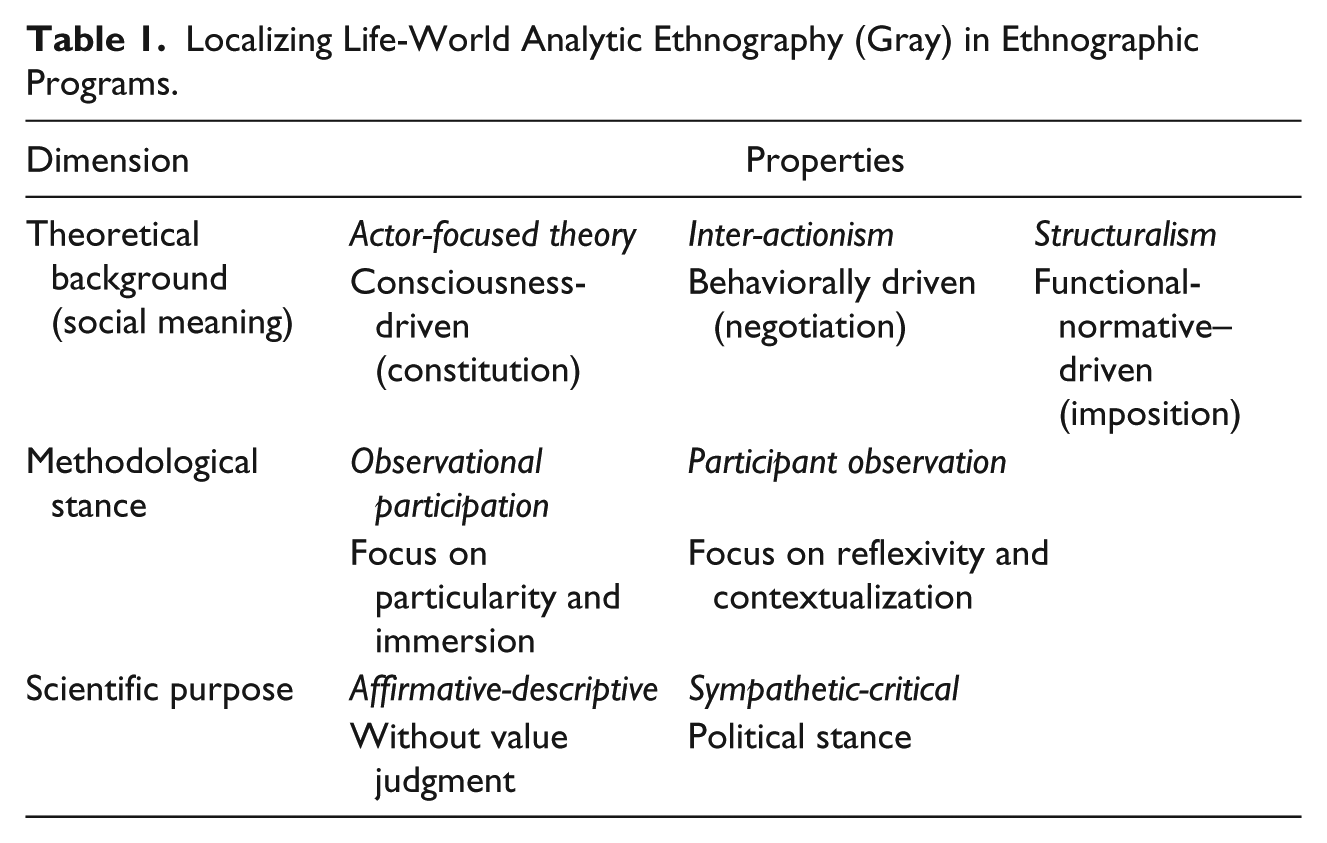
One suggestion for the classification of ethnography by Margaret LeCompte and Jean J. Schensul (1999, in a similar way Willis 2007) distinguishes between positivist, critical, interpretative, ecological, and social network paradigms for ethnographic research. Hy Mariampolski (2006, 44) differentiates between private and public settings on the one hand (e.g., an ethnography of family dinners differs from one of a protest march) and an “open-ended/existential” and “delimited/task-driven” focus on the other hand (e.g., an ethnography of a youth scene differs from one that focuses on the usage of commercial products in this youth scene). John Van Maanen (2011) sorts ethnography into “realist,” “confessional” and “impressionist tales.” In short, LaCompte and Schensul classify ethnography by the underlying theoretical paradigm, Mariampolski does it by the qualities of the field and the focus of the fieldwork, and Van Maanen does it by how results are recorded. The limitation of these classifications seem to lie within their restriction to one dimension (paradigm, field, or presentation). Thus, in order to provide a more differentiated classification, we draw on three aspects:
The underlying theoretical paradigm, which not only differs in suitable methods by theoretical perspective but often involves suitable programs fitting to that perspective (e.g., grounded theory fitting an interactionist perspective as both draw on the tradition of Pragmatism). We prefer a classification along basic positions toward the “subject” of sociology (or the question of where the meaning of the social is (re-)constructed). 4 In doing so, we provide a distinction between structuralist-, interactionist-, and actor-centered perspectives. From a structuralist view, the focus lies on the field and includes the causality, normality, and function of social phenomena. The subjective is merely a reflection of structural mechanisms (such as class, race, and social-economic background). From an interactionist perspective, the focus lies on situations as meaning is generated in the interplay of framings, actions, and their consequences (as typical situations involve typical actions and corresponding reactions). This differs from an actor-centered view insofar as the starting point of a strict action–theoretical paradigm is the constitution of meaning in the consciousness of the actor herself (see Hitzler and Eberle 2004, 68). 5 From a phenomenological view, there is a limit to interviews and observations (and a need for experiencing the field as a participant, since the interest lies in the typically experienced meaning of actions). This limitation and the need for data gained as a typical participant are not necessarily required for interactionist research. To conclude, the focus on the subjective experience for the constitution of meaningfulness (actor-centered paradigm), on the negotiation and consequence of shared definitions of situations (inter-actionism; see Strauss 1978) or the function (so to say, meaning) of social structures and the social constraints imposed on actors is guiding ethnographic fieldwork.
The methodological stance from which the researcher acts in her field. Since ethnography, by its principles, uses a variety of research methods, its promise is to bring the researcher near the answers she seeks by bringing her close to the field under study (or at least closer, as research that is mediated solely by data sets; see Becker and Geer 1957; De Munck 1998, 43). This raises the question of how the researcher wants to act and to what degree she is allowed or asked to act. Central to the researcher’s work is her role in the field (see Gold 1958; Spradley 1980, 58ff.; Adler and Adler 1987). It is undisputed that ethnographers observe and that they are not merely external observers but are, at least, participant observers (although with different statuses). As an involved observer, the subjectivity of the ethnographer is constitutive for ethnographic fieldwork, and being too close to the field is thus seen as an issue for the research (Schwartz and Schwartz 1955). But some ethnographers see participation in the field as a chance to get access to hidden populations and thereby collect additional data (Adler and Adler 1987). This stance, which relies heavily on observational participation (Hitzler and Honer 1988; Hitzler 1999), may call for an “existential” (Honer 1993, 57) or “radical engagement [ . . . as part of] a research agenda of engagement with subjects of study, a methodology that moves beyond objectivity to immersion” (Ferrell 1998, 25). 6
The projected purpose (result) of the ethnographic research. Some ethnographies (e.g., most feminist, critical, participatory, and autoethnographies) have a judgmental and political claim that aims to uncover asymmetries of power and act in sympathy toward the more powerless and in critique of powerful, and oppressive, structures. In contrast, ethnographies may aim toward an affirmative description and report what is to report without any value judgment. Thereby everything that happens in the field is accepted and (if not put under a protective silence) reported. Hence, since it does not argue against the field or participants in the field, the purpose of this research is descriptive.
This classification is useful to categorize ethnographic programs in general, while at the same time, it underlines the specifics of life-world analytic ethnography and its differences from other approaches (see Table 1). Since it is rooted in the subject-centered theory in the tradition of Alfred Schütz, with an emphasis on observational participation and an affirmative–descriptive attitude toward the research, it differs fundamentally from interactionist ethnographies that rely on participant observation, and it differs from participatory action research as well as autoethnographies because it lacks a critical perspective on the data gained by participation and self-observation.
Localizing Life-World Analytic Ethnography (Gray) in Ethnographic Programs.
To summarize life-world analytical ethnography: “The German researchers Ronald Hitzler and Anne Honer have developed a research approach which they call—in line with [Thomas] Luckmann’s distinction between phenomenology and sociology—life-world analytic ethnography. In the course of field work, data is collected on the one hand by participant observation, interviews in the field, analysis of artifacts and documents, and then gets hermeneutically interpreted, much like other ethnographic approaches do. On the other hand—and this is specific about this approach—the subjective experience of the researcher in the field is used explicitly and reflexively as an ‘instrument’ of data generation and collection. The researchers thus do not only rely on participant observation for their data collection, but also on what they call, with a different emphasis, observing participation in a field-specific role, and analyze their experiences phenomenologically” (Eberle 2013, 196, for life-world analytical ethnography see the central work by Honer 1993, introduced by Hitzler and Honer 1988, with methodological discussions in Honer 1989, Hitzler 1997, 1999, and with examples in Honer 2011, Schröer et al. 2012, Eisewicht, Emling, and Grenz 2014; for the few introductions in English, see Eberle 2013, Hitzler and Eberle 2004, Honer 2004, Pfadenhauer 2005).
After lining out the basic premises of life-world analytical ethnography, we address the challenges that arise in mediatized fields. From a phenomenological perspective, we would argue that “Netnography” (Kozinets 2010) promotes an observational stance that focuses mainly on the screen, which may not be suitable when aiming to describe the dynamics of small life-worlds (Luckmann 1970). 7 After identifying three major issues when conducting ethnographic research online, we address how life-world analytical ethnography may help researchers to overcome these challenges.
The Broken Promise of Ethnography in Digital Fields—The Problem of Delocalization
Changes in the way people live as a result of media technology (most recently, the mobile Internet) are a common understanding (see Lundby 2009). Mediatization of everyday life leading to the transformation of social practices also involves research in such fields. It is undisputed that the Internet is dissolving spatial, temporal, and social boundaries that evoke a more elusive, dynamic happening and masks the necessary information for situational context (see Schulz 2004, 90f). We see three basic challenges with our model for localizing ethnographic research when doing research in mediatized fields:
In regard to the theoretical background, the fragmentation of the social unity (respectively the unity of the field, situation, or in our case action) becomes a challenge for the researcher as a re-constructor of social phenomena. As actions (their projection and execution) can stretch over spatial, temporal, and social boundaries and over different forms of communication, researchers have to find methods to reconstruct the unity of those actions that are attributed to the actor herself.
The obviousness of evidence corresponds to the methodological stance as traces of behavior are a challenge for the researcher as an interpreter of data. As a participant-observer, this leads to questions of what is observable (where, how), and as an observational participator, this leads to questions of how to gain access to others and the typical experiences in the field.
The double-sided exposure of the researcher highlights that not only are the people we study exposed on the Internet but the researcher is as well. Unmanageable audiences are becoming more common and can challenge the sympathetically critical purpose of the research (What is private and what is public online, and how is what research beneficent to whom?), as well as affirmative–descriptive reports that were more or less hidden in the scientific community but can be easily found and followed online). This is a challenge for the researcher as a somewhat public person.
No matter with what ethnographic program at hand, to gain access to fields requires participation of some sort in social situations. Within these situations, ethnographers, aim to answer the question “What is going on here?” which implies that ethnographers have to be more or less present “where the action is” (Goffman 1969). This seemingly easy task becomes incredibly difficult when the actual “here” is constantly dissolving via media technology. Yet what still stands is that depending on the ethnographers’ degree of participation in her field, her engagement within situations may vary, and the roles that ethnographers choose or get addressed as may change during the course of the research process, depending on the specific knowledge gathered within their fields and the experience gained through participation. On the basis of this ongoing expansion of knowledge about the “small social life-world” (Honer 1993, 28) and its “backstages” (Goffman 1959), ethnographers may tackle the challenges deriving from mediatization by expanding their level of engagement in the field and with its participants.
While the Goffmanian interactionist microstudies focused mostly on observing a “situated activity system” (Goffman 1969, 49) and its specific framework, life-world analytical ethnography, as represented here, tries to provide insight into peoples’ “involvement contour” (Goffman 1969, 51) within certain social situations. This challenges the ethnographer with the task of “existential participation,” which is displayed as the ethnographer aims to fit a typical role of an engaged member in her field by experiencing what knowledge (partially deriving from firsthand experience) it takes to play this role’s part in most field-specific situated activity systems. This calls for any source of copresence, which provides the researcher with additional data that help to reconstruct the typical steps of action taken in the field (what forms of communication are used without leaving a trace, e.g., as a “lurker”).
Phenomenologically speaking, copresence is inseparably connected to the face-to-face situation. Copresence emerges when an “intermediate transcendence” (Knoblauch 1999, 5) or, respectively, an appresentation of Alter occurs within egos’ “manipulative zone” (Schütz and Luckmann 1973, 42). This means Alter is immediate, as in reach of Ego at that time with all senses ascertainable. Face-to-face presence in this sense is strictly bound to timely immediate occasions, while it is fairly open as to where one could strictly define the territorial borders of sociality within an occurring social situation. Therefore, we argue that the subject-centered manipulative zone (as well as the interactionist concept of mutual monitoring 8 ) can also be translated into certain mediatized situations as long as these provide synchronous attention-shared communication channels that allow for reciprocal action. Following the concept of Karin Knorr Cetina, such situations can be seen as “synthetic” (Knorr Cetina 2009) in the way that these social situations, when observed and experienced, constitute a “patchwork of parallel, itemized flows” (72), which are generated, maintained, and observed by everyone involved even though they are locally unbound. Following this concept, the subject-based manipulative zone may become extended by media in such a way that the resulting media setting provides participants with the possibility of “delocalized co-presence” (Kirschner 2013, 162). Participants in these situations share a continuous stretch of attention and experience (see Knorr Cetina 2003), often resulting in a “gathering” (Goffman 1963, 19) that is experienced individually via a respective screen and other manipulative interfaces. One of the main characteristics of delocalized copresence is that different monitoring and communication possibilities (such as Webcamvideo, chatrooms, videogames, skype, etc.) are being used simultaneously, while each participants’ actions and her or his points of view are continuously synthesized by feedback channels and result in a subject-centered “screen reality” (Knorr Cetina 2009, 72). The experienced delocalized copresence is, therefore, heavily dependent on continuously mediated maintenance since it stabilizes its frame and the personal focus of attention. Over the course of these synthetic situations, participants are typically heavily engaged in creating, maintaining, observing, and transforming the flow of data constituting their experiences. Synthetic situations, as well as delocalized copresence, leave the questions to be answered as to what people typically experience within these mediatized activity systems (see challenge of “obviousness of evidence” above). This is problematic, since the participants’ individual perspective is more or less depending on a personal, locally bound, situated media setting. Therefore the actions of participants to generate, maintain, and transform these synthetic situations are closely related to the given monitoring and communication capabilities. We therefore argue that firsthand experience of this interrelation between field-typical practices involving the use of specific technology has to be regarded as crucial when conducting life-world analytical research online.
While some ethnographic approaches to online data, such as Netnography or “virtual ethnography” (Hine 2000), tend to primarily focus their attention on data provided by the screen and thereby set their field as a “given” environment, a life-world-analytical approach prioritizes the researchers’ own experiences and actions resulting, at best, in a “native’s point of view” (Malinowski 1922, 25) represented by the experience of the ethnographer as a verified heavily engaged member leading to an adequate and thorough comprehension of the inherent actions that shape the small social life-world under research. With the focus on firsthand experience, ethnographers may get insight into what specific knowledge participants typically access to manage their affiliations within occurring situations. By restricting one’s field to only the data displayed on the screen without engaging in the field, ethnographers may overlook things relevant to the field and ignore their own learning process while “getting deeper involved in the field” (Honer 1993, 57). In synthetic situations, this reflection on the personal learning process has to include the specific orchestration (Schnettler 2007, 142) of media technology, which participants may use to observe and participate in their field. Thus, life-world analytical ethnography emphasizes that the ethnographer interactively validates her own experiences in the field with its participants, which can hardly be achieved by mere observation.
Passing Ethnographic Stages in the Field of Videogames
Ethnographic research may best be described as spiral in the way that the more often the ethnographer enters or reenters her field, the more knowledge she acquires, potentially revealing new options on how or if to get involved with the field and its participants. This ongoing acquisition of knowledge is an essential aspect of life-world analytical ethnography since it builds the foundation for a reflexive methodological examination between the researchers’ pre–field-experience assumptions and the following process of focusing on certain field-specific activities. When conducting ethnography via observational participation, passing certain stages of involvement is typical. These stages range from first assumptions about the field, to finding and managing gatekeepers, observing certain situations or maybe even an invitation into an “inner circle.” Depending on her knowledge and engagement, the ethnographer has the capability of becoming the most fitting research tool in the sense that her experience may become the only reliable source for progressing further during research; for example, in the ongoing process of mediatization, the stages an ethnographer has to pass typically become bound to actions connected to varying technologies. Therefore, the need to document and reflect on the personal acquisition process of these practices becomes a necessity to make sure that their research holds up to contemporary research standards and will be adequately transparent to the scientific community.
To give insight into how the concept of passing may be described empirically, we rely on data and insights from an ongoing research project in the field of videogames and livestreaming (Kirschner 2015). 9 With every return 10 to the field after examining previously taken data, we achieved a deeper understanding of the motives behind certain common practices in our field, yet with every cornerstone we passed, new questions and challenges arose. Identifying stages of passing provides the ethnographer with guidance during turbulent and excessive field-research, while helping her to retrace the otherwise exclusive and individual firsthand field experience. These stages may be identified within gathered data and give insight on how and what knowledge has been acquired and accessed or, respectively, communicated by the ethnographer on a personal level, so that it becomes possible for her to localize herself within her field at a certain stage.
When considering a life-world-analytical approach to one’s field, the research process tends to become challenging in the way that the ethnographer has to expose herself and her knowledge of the field to the field through actions (see “double-sided exposure” above). The ethnographer runs the risk of becoming repulsed or even excluded by the field and its participants if unable to pass a certain stage (i.e., acquiring a certain level of skill in video games necessary to reach certain people in-game 11 ). However, this danger becomes a necessity in this kind of ethnography, since without field-typical-situated interactive verification of the ethnographers’ experience and knowledge, identifying and locating the position and roles the ethnographer fills within her field becomes impossible, and therefore, no conclusions regarding the specifics that constitute the researched small social life-world can be drawn.
To minimize the risk of exclusion, we argue that passing as a self-reflexive methodological concept is beneficial. We want to present and thereby trace back four passing stages, which we were able to identify during our research. 12 The four stages of passing can be categorized as (1) constituting the field experience, (2) what is going on here, (3) taking part where the action is, and (4) sense of belonging.
Constituting the Field Experience
Even though it is almost as easy to watch online livestreams as it is to watch TV, the technological backbone behind the two differs immensely. Hence, we began our research by acquiring explicit knowledge through participant observation, including forum research, video tutorials, and personally setting up nonpublic online livestreams. Through this, we were able to differentiate the technological backbone that constitutes the vast range of channels and their respective content, as well as differentiate between TV-like, non-feedback-channel livestreams and user livestreams (Kirschner 2013). With this first stage of our research, we framed the future progress since we could thereafter focus on answering “what is going on here.” Before this categorization, our access to the field was simply shut off because we were neither able to comprehend nor compare different online-livestreams. We were, however, able to take part in similar synthetic situations through acquired knowledge, enabling us to compare technologically likewise user livestreams, allowing each user to participate in the streamed content via joining the streamed game while watching the same stream and communicating in the chat.
What Is Going on Here?
After passing the first stage by getting to know the technological backbone of livestreaming, we were enabled to differentiate the varying content which livestreams provided. Through video analysis of the content in combination with our knowledge regarding various types of livestreams, we identified two types of livestreamers, namely “the entertainer” and “the professional.” Since the entertainer relies heavily on interaction with viewers, it is of utmost importance for her to provide as many feedback channels as are technically possible. Viewers in these livestreams may become prosumers (Toffler 1990) in the way that they create visible content on the livestream and thereby create and co-construct the shared experience, which is perceived as entertaining. Professionals, on the other hand, would not let anyone interfere with their broadcast since they are completely focused on playing the game at the highest level of skill. Therefore, any actions by viewers involving the content would be seen as interference, and the provided feedback channels would be shut down.
Taking Part Where the Action Is
After identifying these two types of streamers, we realized that the audience of the respective livestreams and their expectations of the content also differed. To become familiar with these gatherings, by taking personal action in verifying what we had already learned, we were confronted with the question of what role we would fit in these situations. Would it be that of someone “casually” fitting in, who is highly relying on interaction with other participants, and therefore, being rather uninterested in showing off skill or a particular inside knowledge about the newest strategies of certain videogames? Or would it be a competitive profile with which we would have to display ourselves (via chat, as streamers and gamers) as skilled to a certain extent and always remain up to date with the professional scene? A clear realization when we became more involved with the field was that mixing or even switching these roles would become an unmanageable effort since we already exposed ourselves to the field in one way or another by showing our nicknames, playing the games and communicating, and/or getting to know some of the gatekeepers of this small social life-world.
Sense of Belonging
Our local persona presented as competitive rather than as casual was embedded in the process of the practices we performed in the field (e.g., trying to play on a high level, keeping up to date with tournaments and prominent players, adapting strategies regarding the “meta-game,” and finding people who shared the same interest in the game). This process of becoming professional was not a planned decision, but rather, the outcome of what knowledge we would steadily acquire and interactively verify with participants. At some point, we were addressed as “competitives,” while we also experienced the urge to differ from whom we, as competitives, perceived as casuals. The tension between casuals and competitives arose within our own perception when playing games and was interactively verified with other players as a typical heuristic in the field. This led to the analytical differentiation of field-specific attributions to different players as either someone playing games for recreational, entertaining and social purposes or as someone to whom playing meant a competitive, labor-intensive sport. This attribution was reciprocal, as we were addressed and challenged in our position as competitive, and we addressed others in such a way. With the understanding of playing the game as a competitive, our use of livestreams and other information sources differed from some players, was similar to other competitives, and became part of typical conversations in the field (who had seen which tournament and the opinions on strategies in playing the game—all required the knowledge of the field-specific language as well as certain skills of playing, spectating, and discussing). Thus, the differing motives of playing or experiences of the small social life-world lead to various actions in the field and are the basis for the social stratification within the field (e.g., who invites me to play with him, who I am able to invite and whom I actively exclude from playing with me). By reflecting on our own actions in the field and our given exposure within situations, we explored and revealed our own involvement contour regarding the role that we verified interactively with other participants. Therefore, we argue that we adequately experienced insights on shared meanings and beliefs within the small social life-world as the role of competitives.
Conclusion
Each ethnographic program faces specific challenges regarding mediatized fields. Another approach may face different problems when doing ethnography online, but in the tradition of life-world analytical ethnography, we were concerned with reconstructing our own roles as participants in the field. Reconstructing our immersion via specific stages helped us to identify key concepts for our analysis, which we only touched briefly. We see the participation in the field as a necessity for reconstructing inside views and field-specific relevancies that guide actions in small social life-worlds.
With this article, we emphasize that ethnographic research over the course of the last fifty years has developed a variety of research programs that can and should not be simplified by one term. With our classification, we point out the fruitful differences that varying theoretical backgrounds, methodological stances, as well as scientific purposes have to offer. Thus, differentiating between types of ethnographic research would help to constitute a more precise sensitivity for explorative methods (which method fits what research question). Consequently, life-world analytical ethnography is one way of ethnographic research with a specific interest in what experiences and actions constitute a certain small social life-world. The ongoing process of mediatization challenges ethnographic research in terms of fragmentation of the phenomenon, the danger of given obviousness and exposure of the scientist as a person. To face these challenges, the concept of passing provides a methodological approach that helps to localize the ethnographer in her (mediatized) field. This is especially helpful for ethnographic research that builds on observational participation rather than on participant observation. Nevertheless, we argue that personal experience and learning during the research progress has to be seen as significantly relevant when conducting ethnographic research online. In our case, passing meant differentiating certain possibilities and limitations that come with online livestreams in cases of observation and production practices (Kirschner 2012, 2013). This first step provided us with the possibility to actually take part in where the action is, as well as experience the typical field constituting relevance. Because of the constant reflection on our position in the field and the particularity of our experience during data collection and analysis, we generated and reconstructed typical coherence of meaning and action within the boundaries of this small social life-world. Thus, passing as a reflexive methodological concept led us toward identifying various practices, which come with embedding livestream production as well as reception into video-gaming.
Footnotes
Declaration of Conflicting Interests
The author(s) declared no potential conflicts of interest with respect to the research, authorship, and/or publication of this article.
Funding
The author(s) received no financial support for the research, authorship, and/or publication of this article.