



Abstract
Volunteering and working in a homeless shelter is often seen as a key way in which individuals can ameliorate class differences through intergroup contact and help those being served. However, I argue that these same environments can also serve to reinforce and reproduce class boundaries. Volunteers and employees are provided a unique space in which they can feel generous and virtuous, while also maintaining cultural stereotypes of the homeless as immoral. In this article, I show how the affluent staff at a suburban homeless shelter engage in borderwork and construct moral identities for themselves in opposition to the clients. Based on 125 hours of participant observation and fourteen semistructured interviews with staff, I argue that the identity work of the staff can reinforce the very class boundaries they purport to resist. In their attempts to provide services to the homeless, they use rhetorical and physical strategies to reinforce class boundaries and create an othered status for those they served. The staff then feel good by “helping the homeless help themselves” while maintaining a safe distance from them.
Volunteering and working in a homeless shelter is often seen as a key way in which individuals can help those in need and ameliorate class differences through intergroup contact. However, I show how these same environments can also serve to reinforce and reproduce class boundaries. Thus, homeless shelters serve as sites where staff (employees and volunteers) 1 can engage in borderwork (Thorne 1993). Staff are provided a unique space in which they can feel generous and virtuous through minimal and brief interactions with the homeless, while also creating physical distance to maintain cultural stereotypes of the homeless as immoral. In this article, I show how staff at a suburban homeless shelter construct moral identities for themselves in opposition to the clients that they serve. Through physical and moral boundaries, the affluent staff are able to feel good about themselves by helping clients who are seen as unable to help themselves without questioning the cultural schemas of the homeless as dirty, dangerous, and deviant. As a result, class boundaries are reinforced rather than dissolved.
In a society that values self-interest, meritocracy, and competition, poverty or homelessness are often seen as a consequence of failures of the individual, despite the structural conditions that cause these outcomes (Fischer et al. 1996; Kluegal and Smith 1986; McCall 2013). Additionally, individuals who spend time or resources to help the “less fortunate” are generally understood as generous, virtuous, and good people. Since Tocqueville ([1835] 1966), Americans have been seen as compassionate and civic-minded, and the literature supports that Americans believe that helping others is a positive trait to be strived for (Bellah 1991; Wuthnow 1991).
As a consequence, engaging in charity or service work allows individuals to construct a moral identity (Allahyari 2000; Blackstone 2009; Holden 1997). A moral identity is “our belief in ourselves as good people” (Kleinman 1996, 5). The moral status of an individual is often tied to their behavior and the attributions of that behavior as superior to others (Katz 1975). Katz (1975) states:
Persons understand abilities and disabilities, capacities and incapacities, talents and character defects, competencies and incompetencies, impotencies and omnipotencies of all sorts as unobservable, present and inherent states of being. By identifying another’s essence, one imputes moral status and makes a judgment about the other’s basic moral worth. (1375)
Therefore, people attribute a moral status based on their sense of their own moral worth.
Service work has cachet in our culture. The term “volunteer” carries with it an underlying sense of morality cast by society that is internalized within individuals, creating a moral identity as people correlate “doing good” with “being good.” Similarly, paid staff in non-profit organizations, social workers, and individuals in other “helping professions” (like teachers) are often seen in a similar light, particularly when they invest time and energy working with populations that are considered in need of help (Ashforth and Kreiner 1999; Cabaniss 2014; Deeb-Sossa 2007, 2013).
Research on volunteers within homeless shelters is consistent with this literature, showing how volunteers create a moral self. These accounts, however, often ignore the potential consequences of this type of work. For example, Allahyari (2000) describes the ways that volunteers create different moral selves in the different contexts of two homeless shelters in San Francisco, but she does not examine the social distance within one of the shelters. 2 The literature on the construction of moral identities in service work particularly ignores the ways in which moral selves are constructed in opposition to “immoral others.”
Holden (1997), an important exception, shows how youth volunteers were able to construct a positive moral identity, even within an organization that threatened that identity because the volunteers in her study often felt like “rule enforcers” as opposed to virtuous and charitable people. While the college-aged volunteers in Holden’s study created a moral identity by refusing to distance themselves from their clients and by creating relationships with the homeless residents, the volunteers and employees at the shelter that I observe distanced themselves through the construction of a moral identity and utilized physical and rhetorical boundaries to position themselves against the “immoral” homeless that they served.
Additionally, many scholars have studied how shelters themselves affect the lives of the homeless. These studies have shown that shelters objectify, infantilize, medicalize, and blame the homeless (DeWard and Moe 2010; Hoffman and Coffey 2008; Lyon-Callo 2008). 3 Relatedly, Gowan (2010) describes the ways that the homeless are portrayed by the bureaucratic system that works to serve them. She shows how the homeless are discussed through sin, sick, and system talk. All of these studies provide great insight into the lives of the homeless that may rely on shelter services. However, most studies on the shelter industry ignore how the staff see themselves in relationship to those that they serve. I argue that by looking at the micro-interactions within the shelter we can more fully understand how shelters are able to objectify and infantilize the homeless even with prolonged contact between groups. Middle-class volunteers and employees are able to construct identities as generous and virtuous in opposition to the homeless, who the staff see as immoral. The staff then feel good by “helping the homeless help themselves” while maintaining a safe distance from them. Understanding the perception of the staff is vital to better understanding how shelters operate. Therefore, this article makes significant contributions to the literature on the shelter industry by exploring how staff interact with and perceive the homeless clients and the consequences of these interactions.
Studies on the impact of volunteering have become increasingly prominent with the rise of service-learning requirements for high school and college students. However, the findings about the effects of contact and the consequences of service-learning are inconsistent. Some find that volunteering for youth helps them get rid of prejudicial views of the poor, engage in social justice, and focus on the structural causes of homelessness, while others find that this service work provides youth an opportunity to maintain individual explanations of poverty (Ferrari and Chapman 1999; Hollis 2004; Hondagneu-Sotelo and Raskoff 1994; Keen and Hall 2009; Rhoads 1997). Nenga (2011) finds that while some affluent youth volunteers begin to challenge their class privilege, others employ discursive strategies that reinforce their class position. She argues that prolonged cross-class contact and education about the structural causes of homelessness increases the likelihood that the affluent youth will challenge their own privilege.
Similar to Nenga (2011), a substantial body of literature explores service work and its ability to dissolve boundaries through contact. Allport (1954) argued that increasing contact between groups would reduce prejudice. Research has been conducted to look at the ways that intergroup contact has changed attitudes about individuals with disabilities (Makas 1993), gays and lesbians (Herek and Capitanio 1996), and the elderly (Capsi 1984). Lee, Farrell, and Link (2004) study the influence of contact with, and more broadly, exposure to, the homeless and argue that any and all types of exposure increased favorable public attitudes. In their one-day field experiment of volunteers with the homeless, Knecht and Martinez (2009) find mixed support for the contact hypothesis. While these volunteers were less likely to blame the homeless for their plight, their opinions on policy changed very little. Overall, this literature supports the idea that volunteering and service work with the homeless will help eradicate class boundaries. However, little is known about the micro-interactions between the homeless and those that serve them. While it is valuable to know that contact alters individual attitudes in surveys and field experiments, this project contributes to the sociological literature on intergroup contact with the homeless by examining the actual interactions, or lack thereof, between staff and residents.
I argue that staff rely on and establish symbolic boundaries, “conceptual distinctions that we make to categorize objects, people, practices, and even time and space” (Lamont 1992, 9) 4 by distancing themselves from the homeless clients. Symbolic boundaries come in a number of different forms and have been studied in numerous settings (see Lamont and Molnar 2002 for a review). According to Zerubavel (1996), this is done through a process of creating distinctions by lumping similar things and splitting apart things that we perceive as different. Therefore, all boundaries are constructed by creating in-groups and out-groups, categorizations of “like” and “different.” In Weberian terms, the process by which one social class distinguishes itself from another and creates obstacles for entrance into their social group is called “social closure” (Weber [1922] 1978). This idea led to a significant amount of literature on class boundaries. Lamont (1992) looks at how middle-class Americans and French discuss social distinctions differently, namely, through boundaries based on money, morals, and manners.
In this article, I show how the staff at this shelter maintain class boundaries, drawing on and reaffirming cultural schemas that cast the homeless as dirty, dangerous, and immoral. I conducted an in-depth ethnography of a homeless shelter in Sunnyside, 5 a suburban community in one of the wealthiest counties in the United States. I argue that the extreme class differences between staff and the homeless and the physical separation within the shelter constructs an environment in which staff create a moral self in opposition to the immoral residents. This allows them to define themselves as respectable, heroic, and generous—contrary to the dangerous homeless clients.
Interviews with the staff provide an opportunity to analyze contradictions between narratives about their moral identity and what happens in practice at the shelter in question. While the employees and volunteers spoke about their fondness for interacting and creating deep relationships with clients in interviews, I rarely observed this because physical boundaries discouraged meaningful interaction between the middle-class workers and the homeless. As Bourdieu (1989, 16) noted, “Spatial distances correspond to social distances.” I argue that the staff utilized spatial boundaries to minimize contact with the homeless clients. This had the effect of increasing that social distance, for staff cast themselves as good, charitable people and the clients as sinful. Therefore, I argue that working with the homeless provides a unique setting where people can help those in poverty yet still maintain a careful distance from them. This has significant implications for the ways that class boundaries may be maintained outside of shelters because these symbolic boundaries have the potential to make class boundaries more real and salient (Abbott 1995; Bourdieu 1989). Therefore, shelters become a site in which borderwork occurs, where contact doesn’t ameliorate class distinctions but rather reinforces them. Additionally, because the volunteers at this shelter resemble the demographics of volunteers more broadly (Bunis, Yancik, and Snow 1996; Hayghe 1992; Wilson and Musick 1997), these processes may be occurring in shelters around the U.S. Consequently, this study has social implications concerning the assumptions we make about the benefits of volunteer work, contact, and the construction of moral identities.
I start by describing the research setting, my methodological approach, background information on the shelter and community, basic demographics of clients and staff, and context of the community. Next, I describe the class differences and the physical boundaries evident in this shelter. I then show how moral boundaries operate in a dual manner as staff construct moral identities for themselves while continuing to make claims about the moral inferiority of the poor. I end by discussing the implications of the construction of a moral identity for volunteers and employees, while those they serve are cast as immoral.
Setting and Methods
The shelter served both single individuals and families and was run by an umbrella organization that also provided other services for those without housing or with potential to lose their residence (food bank, transitional housing, etc.). The shelter was open twenty-four hours a day, located in the middle of a large suburban area, surrounded by government buildings (a public library, police station, and hospital). It blended in inconspicuously and there were no signs outside the building that signified that it was a homeless shelter. Upon entering the facility, one immediately would see the front desk area, a roughly five-by-ten-foot rectangular area surrounded by a wall about three feet tall (the significance of which is discussed later). The feel of the communal area was much like a school cafeteria; it had linoleum floors, large tables, and plastic chairs. The kitchen and family living room were set straight off the dining area, as well as three long halls (one to the men’s dorm, one to the women’s dorm, and another to the staff area). Everything, with the exception of the dorms, was clearly labeled “staff only,” including the kitchen. If you continued through the dining area, there was a closed door that led you into the “family” side where there was a living room complete with a TV and some couches, as well as tables for eating dinner. Each family was given its own room off of a long hall with shared bathrooms. I never entered the family rooms or dorms. 6
I took an “active-membership-researcher” role (Adler and Adler 1987), and my capacity at the shelter was as a “volunteer.” 7 As a white middle-class woman, I resembled most volunteers in appearance and only differed in age. I completed nearly 125 hours of observation in the course of three months during the summer of 2009 and became a constant fixture at the shelter. Clients and staff routinely commented on the fact that I was “always sitting in my chair” or asked, “Do you ever leave this place?” Everyone knew me and often referred to me either by my first name or the university that I was attending, so when I would leave everyone would say “Bye Laura!” or “Bye JMU! See you tomorrow!”
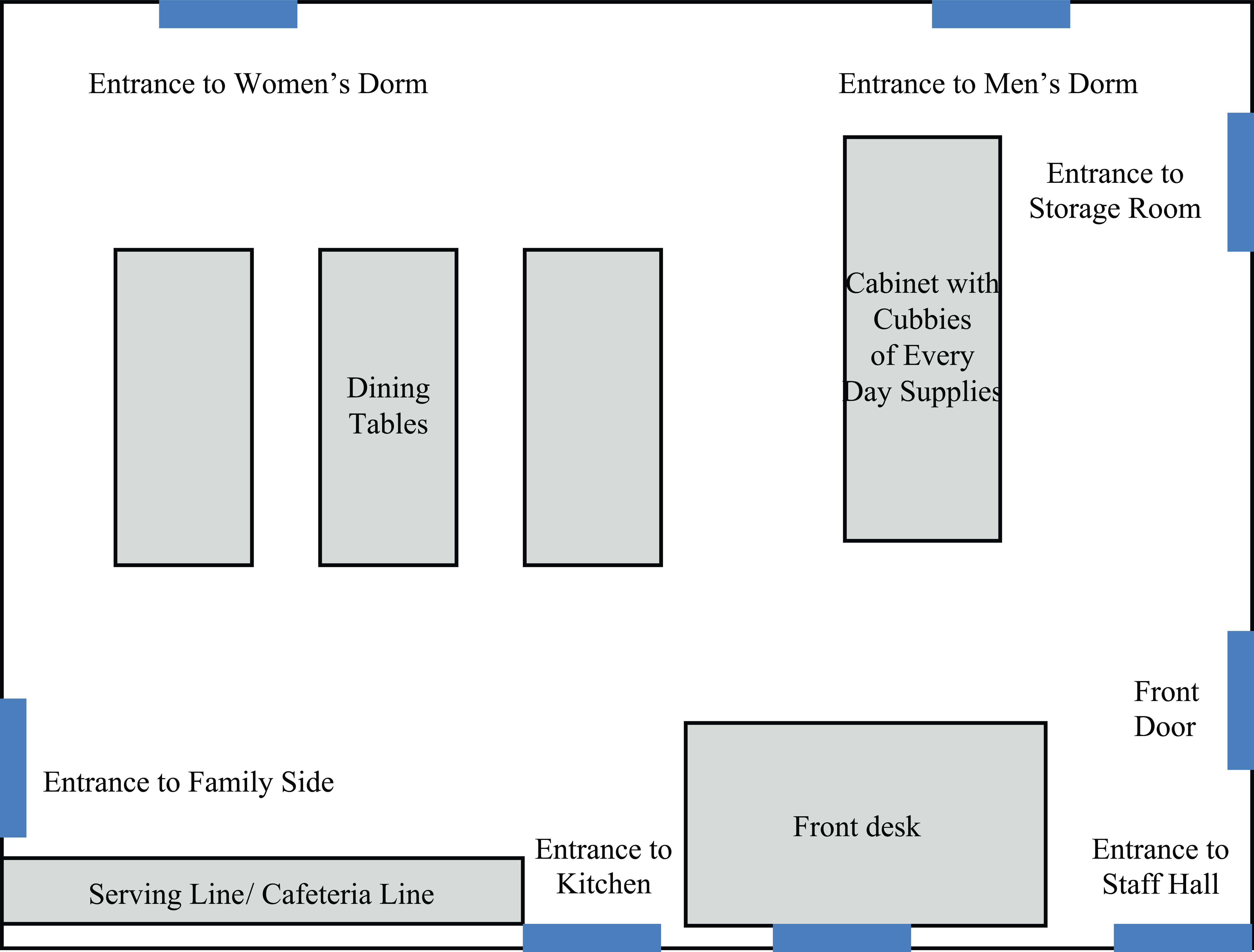
Layout of Shelter
In order to understand how staff talked about their experiences at the shelter and perceived themselves, I interviewed employees and volunteers after completing most of the observations. Conducting interviews, in addition to participant observation, allowed me to understand the differences between their narratives about their work interactions and what I saw them do in practice. I completed fourteen interviews. I interviewed seven volunteers, which was about a quarter of all regular volunteers. While most of the individuals that volunteered were women, I did interview two men volunteers. Based on my observations and staff reports, out of every four volunteers, one was a man. I also interviewed seven employees: all three case managers, two residential counselors, the community resource manager, and the housing broker. These employees worked most closely with the residents. Two interviewees invited me into their homes, two interviews were conducted at coffee shops, and one was completed at the local library. The rest were conducted inside the shelter. The open-ended semistructured interviews ranged between thirty minutes and an hour, averaging about fifty minutes in length.
At the beginning of each interview, I asked volunteers and employees introductory questions about why they volunteer, what they did at the shelter, how they came to work there, and their relationships with residents and other staff. I then asked them to describe particular experiences; for example, I asked them to “describe a tough situation that you’ve encountered and how you dealt with it.” I continued to ask questions about their perceptions of the homeless and what it was like for them working with the homeless, questions like “Is it difficult for you to leave the shelter?” “Where do you think homelessness in this area stems from?” “What do you most enjoy about working with the homeless?” Lastly, I asked them questions about their perception of the success and failure of the shelter itself: “What do you feel are the greatest strengths (and weaknesses) of the shelter?” “What would you do to improve the services?”
I used a grounded theory approach to data collection and data analysis (Corbin and Strauss 1990; Strauss and Corbin 1997). Therefore, interview questions were formulated on preliminary inductive analysis of fieldnotes. After all data were collected, fieldnotes and interview transcripts were coded using deductive codes from the interview guide and inductive codes from patterns and themes that arose. For example, I noticed patterns in how people used moral language to describe their service work, and I coded these instances as “moral identity of volunteer/employee.” Additional codes surfaced about “promiscuity,” “homeless as dirty,” “homeless as mentally ill,” etc. I then collapsed these smaller codes into the various categories of boundaries. So “homeless as dirty” and “homeless as promiscuous” were collapsed into “moral boundaries.” Codes about the “homeless as mentally ill” and “homeless as addicts” were collapsed into “individualist explanations of homelessness.”
Background Information on Community and Services
In order to fully understand the specific culture at the shelter in Sunnyside, 8 I will give more contextual information about the shelter and the community. In the following sections, I discuss the roles of the employees, the services that were available, and my role as a researcher at this shelter. The following section will also provide demographics of the clients and staff and describe the community setting. This context is important to understanding why boundaries are constructed within this shelter.
Employee Roles
During the day, the shelter was full of a variety of staff; this included case managers, outreach workers, alcohol and drug abuse counselors, and a nurse. There were nine full-time staff members that worked Monday through Friday: director, assistant director, three case managers, community resource manager, in-take director, nurse, and housing broker. One case manager, Katie, was in charge of all of the single residents, about twenty-eight different clients. Two case managers, Elaine and Ben, split the family side, about ten families total. Case managers dealt the most intimately with clients and had a wide variety of jobs, from driving residents to appointments, writing referrals for counseling, looking for housing, keeping track of medications, monitoring residents’ money, and checking dorms. During regular business hours, volunteers often ran the front desk. After 4 o’clock, “residential counselors” came in for the night shift. There were two shifts, 4
The Services Provided
The shelter provided beds for almost thirty single residents and rooms for nearly ten families. 9 After moving in, the residents were expected to stay at least thirty days; some stayed for months. Each resident was given a bed in either the men’s or women’s room (similar to a dorm). As soon as a bed opened up it was reassigned on a first-come, first-serve basis. Open beds were usually taken within an hour, and the shelter turned down fifty to seventy-five people in need of services every day. In order to remain in the shelter, the residents were required to save a certain amount of money each month, to accomplish specific goals (which were determined on an individual basis), to be in by curfew, to follow all of the stated and unstated rules, and to stay sober. 10
The shelter catered to “residents” as well as other “sheltered homeless” and “unsheltered homeless” (referred to as “clients”) 11 . The “sheltered homeless” are those staying in other people’s homes, their car, or a different form of emergency housing. 12 Additionally, the community where this shelter was located had a large number of people who lived in the woods in tents (“unsheltered homeless”). These small established “tent cities” were set back off of the main roads. Most volunteers and residents of the community called the individuals who dwelled in these settings “tent people” or the “people in the woods.” For example, Marcie, a volunteer for over 20 years casually referred to this homeless population as “street people, or tent people.” Similarly, Barbara, a front desk volunteer, called them “people from the street or people from the woods.”
“Drop-in” was held four days a week. On each of these days there was a two or three-hour window in which individuals who were not housed at the shelter were allowed to come, have a hot meal, shower, do laundry, and use the phones. The county outreach worker was available to provide clothing, toiletries, bus tokens, and any other services needed. The nurse and other counselors were on hand during these times in order to help people with minor injuries and concerns. Drop-in was always the most chaotic and crowded times of the week. As soon as the drop-in hours came to a close, the shelter usually cleared out for the day. However, these individuals were not completely ignored outside of drop-in; the county had one full-time outreach worker who spent her days driving to camp sites and making phone calls to do what she could for these unsheltered homeless. 13 There was also a part-time outreach worker who provided assistance. When someone became newly homeless and decided to live in the woods, the outreach workers often provided tents and sleeping bags for them. The county outreach workers also tried to provide pool passes during the summer that would give individuals access to community pools to shower in case they could not come to the shelter during drop-in hours.
The Role of the Researcher
As a front desk volunteer, I was in charge of tasks such as answering the phones, handing out bagged lunches, sorting donations, referring clients to staff, and handing out towels. Staff began to rely on me more than the average volunteer, and I was often asked to help around the office, file paperwork, or run errands. I was immediately given access to all keys, including ones that would open the storage facilities and offices. I was never involved in any in-take meetings or any one-on-one meetings between a client and their case manager. I worked entirely as a volunteer, and while this meant that I was often busy, I was also given access to semi-confidential information about clients and asked to do things that I would not have been if I had not been actively involved. My role as an active participant, then, played a key role in the access to the organization I achieved.
I only observed during hours where clients would be present and interacting with staff. Because the residents’ curfew began at 11
Characteristics and Demographics
The residents and clients were demographically diverse. They varied in age from eighteen to anywhere as old as seventy or eighty. Most were younger (in their twenties or thirties) or middle-aged (fifties). Some of them were Vietnam veterans. They were also ethnically and racially diverse. While the shelter served mostly whites, blacks, and Hispanics, there were also a few refugees and immigrants from other countries. Most of the unsheltered residents or “drop-in clients” were men but there were still a number of women living in the woods. Jenna, an employee, notes,
People are always really surprised, especially in this area, because we do live in such an affluent county. People kind of just assume that they [the homeless] are all of one ethnicity or one gender and they’re not at all. When you read the statistics—it’s insane who is actually homeless. The majority of the people in [Sunnyside] county that are homeless are families, they’re not African American men, they’re not, ya know, what we normally think of.
As Jenna states, it is an extremely affluent county. The median income in the county is over $100,000 a year, making it one of the wealthiest counties in the United States at that time (Income, Earnings, and Poverty Data from the 2007 American Community Survey). As a consequence, almost all of the residents worked and had some sort of income. Some of the clients worked in local grocery stores as cashiers or in delis behind the counter. Many held service jobs like in-home nursing or at Starbucks. A number of them did “odd jobs” like fix computers, service cars or lawnmowers, yard work, or paint houses. Others also received disability checks or some sort of government assistance. Despite having various forms of income, working twenty or even forty hours at the local supermarket without benefits was not enough to make ends meet in such an expensive area (see also Ehrenreich 2001; Hays 2003). With the average rent for a one-bedroom apartment at $1,300 a month, most of these individuals and families remained without shelter even while working.
The residents and clients were diverse; however, those who volunteered were not. When asked to describe the demographics of volunteers, the volunteer coordinator stated, “The majority are retired, mainly Caucasian, yeah, a majority of them, a few people of color, but not a lot.” The majority of the volunteers were middle-class, white women. This is consistent with the broader volunteer culture. Research has shown that women are more likely to volunteer than men, that individuals over the age of 60 are more likely to volunteer, and that most volunteers are white and middle-class (Bussell and Forbes 2002; Hayghe 1992; Rohs 1986; Wilson and Musick 1997).
The employees were also not ethnically diverse. Almost all employees were white; one was Asian, and one was black. The case managers and community resource manager were all in their mid- to late-twenties. The director, assistant director, and housing director were in their thirties and forties. The nurse, in-take director, and most of the residential counselors were in their fifties or sixties. Almost all of the full-time weekday employees were women, and all of the residential counselors were men. Therefore, the employees in general were younger than the volunteers and spent more time in the shelter on a daily basis as full-time staff.
Community Context: Invisibility of the Homeless
Given the affluence in this community, most of the people who live in the area and whom I met outside of the shelter did not even believe that homeless people existed in their community. However, there are hundreds of homeless and the services for them go unknown by the mostly wealthy residents. One staff member notes that there are more than seventeen hundred homeless people in the county. According to staff, many residents of the surrounding community do not know there is a homeless shelter in the area, let alone the existence of “tent cities” in the woods. Oftentimes when I ask employees and volunteers if they believe people know the shelter exists, I am immediately told, “No!” accompanied with laughter. Marcie, says, “I would say that 99% of the community in Sunnyside has no idea it exists. Every time I say something about, ya know, I can’t do that tonight because I’m volunteering at the shelter, people assume for me that I’m going to the animal shelter.” David, another seasoned volunteer says, “I think most people don’t see homeless people. Homeless people are pretty invisible. Most people in Sunnyside are surprised to know that there’s a homeless shelter in Sunnyside.”
This invisibility of the homeless and the shelter is not surprising given the affluence of the Sunnyside community and the fact that most of the homeless do not live directly in public view, instead dwelling in the inconspicuous shelter or hidden in tents in the woods. Even when people do notice tents during the winter months when the leaves have fallen off of the trees, they have a hard time recognizing the camps as sites for the homeless. Some of the volunteers and staff, in fact, had experienced this seeming willful erasure of the homeless. A relatively new employee, Mason, told me:
I think a lot of people just don’t see them, and I will be the first to say that I didn’t see them. I run, and I run just up the streets about four times a week, and I used to see tents from the path, and the first time I saw it, ya know, got kind of curious. The second time I saw them I was a little more curious, the third time, I didn’t see them, they were there, I just didn’t see them. The fourth time, I didn’t see them.
Even though there are well over a thousand homeless individuals in this area, the extreme affluence makes the homeless almost entirely invisible.
Findings
In this section, I start by describing the class differences between the staff and the residents. Outlining the class differences between the staff and the residents is vital to understanding how and why physical boundaries and moral boundaries are constructed and maintained. I then analyze how physical boundaries maintain distance between the staff and clients. Lastly, I show how moral boundaries are constructed in two interconnected ways. First, staff construct moral identities for themselves as heroic and generous people and implicitly distance themselves from the people they serve. Second, the staff maintain cultural stereotypes of the homeless as scary, dirty, and deviant.
Class Differences
The volunteers are wealthy members of a similarly affluent community and the employees are also financially and socially well-off. Both groups have significantly more class privilege than the homeless clients. The class differences between staff and residents are quickly apparent. Every volunteer whom I encountered during my research, and all of the volunteers whom I interviewed, were middle- to upper-middle class. Volunteers generally drive to and from the shelter, have nicely groomed hair and outfits, are retired or work in large corporate jobs, have iPhones or Blackberries, and carry other social status markers like expensive jewelry and cultural capital (Bourdieu 1984). Middle-class status can also be inferred by the ways in which these volunteers talk about their good fortune. For example, one volunteer said, “I just had a very good life and I am very happy and I see a lot of people around me that aren’t as fortunate and need that help.”
While the employees are not highly paid, many of them come from middle- or upper-class families and have middle-class cultural capital (e.g., many are well educated and have advanced degrees). The housing broker is financially successful from his real estate business and one of the residential counselors is a retired entrepreneur. The employees also drive to and from work, wear new, nicely fitted clothing that indicates a middle-class status, and often have expensive jewelry, purses, and electronics. Not only are the staff visibly and markedly members of a different social class from the residents that they serve, but on many occasions, I note the volunteers and employees engaging in “class-talk” that highlights their social distance from the residents of the shelter. For example, they talk amongst each other about the expensive renovations they are doing on their houses, their yoga classes, and their future vacation plans. My field notes often reference the conversations that volunteers and staff had with each other. “Chris spent about 15 minutes today talking with Amy about a massage that he got earlier.” Multiple times, I noted that Amy and Carol spent a majority of their time together talking about a yoga class that they both took. I note, “Amy and Carol were talking about their yoga class again today while the rest of us were trying to coordinate getting Mr. Thompson to the hospital.” The residents and clients rarely engaged in these conversations but could likely overhear them.
Additionally, employees often articulate that their own class position, even if they make low wages, makes it difficult for them to understand the experiences of their clients. One case manager notes that it is hard for her to relate to the experiences of her clients because her life was so different, “I have one client, she’s twenty-one with five children, when I was twenty-one I was in college, fully supported by my parents, like they paid my credit card bill, so, I really can’t, ya know, I really can’t relate to a lot of the situations they’ve been through.” Volunteers and employees notice that their class position separates them from their clients. Jenna, the community coordinator, discusses the ways that her family could help her if she hit hard times but how different that would be if she were poor,
Even if I lost my job or had thousands of dollars of medical bills, I have a family who can support me, who would be able to take care of me. So I think that’s kind of a difference, ya know. Not that I can understand [their situation] but I can empathize with it. I can never understand fully.
Jenna acknowledges that her class position is a benefit, yet, as a consequence, she states that she is unable to fully understand the experiences of the residents. Additionally, Katie notes, “I have to remember, ya know, that person literally grew up in a crack house. You don’t know what that’s like. That person literally had no one in their life for twenty-plus years to show them these are the appropriate ways to act in society, this is how you treat your peers, this is how you resolve conflict. They’re starting at scratch, ya know.”
Staff often find it hard to imagine the lives of the homeless. An employee who has lived in the area for nearly twenty-five years couldn’t picture that this many people without homes existed. Even given his previous background in real estate, he was very surprised to know that there were people living in this area making less than $45,000 a year:
Well they’re making ‘45 K’ a year, they must be working, working poor, and that’s really what I classified as working poor, that was my impression of working poor. I had no idea there were people in this county making 14, 15 thousand dollars a year, and living, I had no idea.
His inability to imagine that the working poor made less $45,000 or that there were people making only $14,000 a year exemplifies his position of privilege. While the staff are empathetic and well intentioned, the class differences between the staff and the residents create a sense of separation.
Physical Boundaries
In addition to the stark class differences between the wealthy staff and the homeless, the shelter contains numerous physical boundaries. While the staff spoke about their fondness for having deep and considerable interactions and relationships with residents in interviews, I rarely saw this during my observations. Physical boundaries discouraged significant interaction between the middle-class workers and the homeless. I explain how the spatial boundaries created within the shelter allow the staff an opportunity to serve the homeless yet maintain boundaries between them, thus avoiding meaningful contact.
Physical boundaries are maintained within the shelter that separate the staff and clients. During my time at the shelter I was surprised by the lack of interaction between residents and staff. Separation between staff and clients is evident upon entering the shelter, and partially stems from the physical boundaries between those who control the services and those that need them. Most volunteers sit behind the front desk reading books, surfing the Internet for a nice vacation spot, or talking among each other, while employees stay in the back in their offices. One day I noted that “volunteer 1 spent a majority of her two hours today looking up vacation rental cottages in the French Alps Riviera while at the front desk.” On a different date, “Carol spent her time today, in between handing out bagged lunches, looking at clothes online.” Occasionally volunteers say, “Hello,” to a resident as they come in, take a minute to talk to someone getting a bagged lunch, or direct a resident to their case manager, but otherwise, most of their time is devoted to answering the phone or trying to make the time pass quickly. Residents usually sit in the living room, outside, or in the main lobby and talk among themselves. Even at meal times, residents eat at the dining tables, and staff eat behind the desk or in the backroom. I note, “Katie, Jenna, Susan, and the Nancy all came out and were served their lunches in the kitchen and then went to eat lunch in the office together. This is very routine. Most staff eat lunch and dinner together in the backroom.” Common practice is that staff remain separate from the residents.
“The desk” is a key obstacle to staff-resident interaction. The front desk is a rectangular shape, large enough for multiple chairs and people to fit behind it. It has barriers that are about three feet high and go all the way around it with a small opening in the middle so that staff can come and go. One side of the front desk faces into the lobby, while the other faces the front door. In order for someone to enter the building they have to come through the front door and pass the front desk. If a resident or client requests to speak with an employee they must get access from someone at the front desk. It is marked “staff only” so only shelter personnel are allowed to go behind it. In that space there is a computer, security camera screens, a small cabinet, and a mini-fridge that contains bagged lunches. Through the front desk, one can also reach a room with filing cabinets that secures resident information, a safe, and the residents’ medications. This room is clearly marked “staff only.” The kitchen, storage closets, offices, and nurse’s station are also posted “staff only.” The staff also have a separate bathroom. The use of such strong physical boundaries seems to only reinforce this pattern of interaction, or the lack thereof.
The culture was one in which personnel and residents were expected to remain separate. Employee expectations of volunteers’ roles also reinforced the physical barriers between volunteers and residents. Employees told volunteers that their main duties were to answer the phones, answer any questions anyone might have, accept donations, and give out bagged lunches. As these functions, in theory, would take up most of the volunteers’ time, it would be hard to ever leave the desk. In practice, a majority of volunteers’ time was not spent doing any of those things. As mentioned above, most of my field notes on the volunteers’ actual activities show them reading a book or searching the Internet. Volunteers stay firmly planted behind the desk. During the course of my research, I never saw a volunteer leave this area when they were assigned to it, except only for a brief moment to retrieve something. Staff justify the importance of having someone behind the front desk as a security issue. However, bureaucratic distinctions allow “volunteers” full access to the front desk and everything behind it without any assumption that they might be a security risk. Because the front desk is such an imposition, the only way to interact with a resident is if they approach it or if the volunteer makes an effort to interact with them from behind the desk. Most residents only approach the front desk to ask to speak to their case manager, take their medicine, or access their money. The unsheltered homeless only come to the desk to ask for a towel to shower or to get a bagged lunch. Residents rarely come near the desk just to talk, unless the volunteer initiates it. In my observations, this does not often happen.
One day I was talking to a resident over the desk about sports and other random aspects of the social world. After talking for about fifteen minutes, he asked if I was going to get in trouble. I asked, “Why?” and he said, “Because you’re talking to me.” I was surprised that he would think I could get in trouble for talking to him. I then assured him that I would not get in trouble, and we continued our conversation. I did not get in trouble for engaging with this resident in a conversation, I never witnessed another volunteer getting in trouble for something similar, and no employee ever told me that such interactions were off limits. The fact that this resident believed that such interactions are against organizational rules or norms, however, speaks to their infrequency. These physical boundaries then actually discourage contact between staff and the homeless.
Moral Boundaries
The physical boundaries and class differences distance and separate the staff from the clients. These boundaries create an atmosphere in which staff can construct a moral identity for themselves as virtuous and generous without challenging stereotypes of the homeless as dangerous, dirty, and immoral. I argue that this specific context creates an environment where dual moral boundaries are constructed. In the following section, I outline how the moral identity of the staff is based on their ability and inclination to help others who are seen as unable or unwilling to help themselves. In addition to an implicit form of othering, I then show how the staff cast the clients as immoral: dangerous, promiscuous, and dirty.
Moral Identity of Staff
As noted earlier, the homeless population in this area is largely invisible to the community at large. The volunteers and employees at the shelter, however, recognize the prevalence of homelessness in their community and feel a sense of purpose from this work. There is a common rhetoric among the volunteers and employees that working with the homeless provides them an arena to “give back” to their community and makes them feel better about themselves. One retired volunteer states, “I was going to be showing the goodness and kindness side, and being there, and taking that place, but on many occasions I have found it being given to me, I’ve learned a lot, and even compassion from homeless people.” Engaging in “charity work” is often culturally constructed as a place to help others, but many of those interviewed also state that working with the homeless helped themselves as well. When asked why she volunteered, Samantha says, “Because I’m very lucky in my life and I want to share some of that good luck. . . . Every Monday night that I left I felt high and happy and good. Energy begets energy and I gave away a lot of energy and I get a lot of energy back.” The flow of “energy” or “goodness” in the volunteers’ accounts is multi-directional. Their words reflect the cultural belief that “you get back more than you give.” Working with the homeless provides the volunteers with an opportunity to feel like they were making a difference by giving back to those seen as less fortunate than themselves. For example, Marcie states, “I just feel like I, well, it makes a difference, I guess. . . . When we talk it’s more like a friendship, and ya know? I don’t care that they’re drunk as lords.” Samantha says, “I feel like I’ve made a difference in a person’s life, and that he or she is thankful for that, and aware of that.” Making a difference came up frequently in the accounts.
But working with the homeless provides something more than positive feelings. It offers an identity payoff to those who take it on because they can use it to build their moral selves and promote a positive sense of character. This provides them an opportunity to understand themselves; by giving back to the homeless, they are becoming better people. David states,
This is a lifelong commitment; it’s part of what I do. It’s part of how I see myself, as this is part of my giveaway. I’ve had a lot of people in my life who have been very generous and in a sense giveaway of their time or their treasure or whatever, their heart, and so, I recognize the importance of giveaway in my life. This is a way that I’ve come to feel fulfilled.
David, one of the more openly religious volunteers, uses volunteering at the shelter to help with his mission work. He discusses how giving back or “giveaway” is how he feels fulfilled. His commitment to giving back has become a part of his identity. His moral identity was on display throughout his interview:
I personally feel like I’m spending my time in a fashion that’s useful. I’m not laying in front of the TV, you know, that kind of thing. I guess that’s just part of human nature, to want to feel useful, so I do. It makes me feel useful. So, I get those feelings out of that. I interpret what I do here as being related to my mission in helping me address that, so I feel like I’m getting a lot out of it personally as well.
Volunteering not only helps David feel good about himself, but also brings value to his life. Barbara expresses a similar sentiment: “I’m proud that I work there, and I’m happy to do it.” One interviewee states,
It gives the community something to feel good about because they get to donate and feel that they’ve done their civic duties. Ya know, feel like they are some helpful soul. So that’s nice—something that people can give to, who’ve done so well with their lives. We’re in a very wealthy community, so they get to kind of give back.
The opportunity to give back to those seen as less fortunate provides the volunteers with a sense of virtuosity.
Staff often say that they feel like the work they are doing makes a difference, but they also feel greatly appreciated for their work by both employees and clients. They do not volunteer merely because they feel they are doing something good, but also because they are recognized for it. Adam says, “As I’m leaving they’re all thanking me and saying ‘goodbye,’ and ‘see ya next, every other week.’” When Barbara was asked if she felt her work was valued she said, “Yes. Yes it is. I get thanks from people all the time.” The recognition from the shelter community, then, is part of the identity payoff that shelter work provides. Both residents and employees appreciate them for their volunteer work. One of the case managers spoke at length about her and the other employees’ admiration for the volunteers:
Oh, when it comes to volunteers I basically ADORE them. Ya know, during the day, they’re the, ya know, command central, they buffer us from the clients, they triage for us, like, “Look, this is an emergency” or “The client wants to speak with you but it’s not an emergency,” and I really respect that. And they take a lot of abuse from clients. . . . So I think, I hope, they know how much we appreciate them.
Additionally, the employees themselves construct moral identities around their work and feel valued not from their paychecks but because they feel like they are really helping. Having the opportunity to help those perceived as unable to help themselves supports the construction of a moral identity for the volunteers and employees. One employee, Colin, states, “I measure the value of my work not from the paycheck so much, but, ya know, a lot of other stuff from the occupation, and knowing that you’ve done the best you can to help somebody else.” When asked what her favorite part of her job is, Katie states, “The helping aspect—helping people help themselves.” She later notes, “It [the work] is very rewarding, that’s the only reason I can work the long hours.” Julie states, “I’m here to help people, and that’s what I do.” Additionally, another employee notes,
I enjoy working with marginalized populations, and I don’t feel like, well there’s nowhere really lower to go than being homeless. Because when you’re homeless you don’t have a house, you don’t have a job, you’ve probably burnt some bridges with your family. People who just really need someone who cares, and I feel like, sometimes they really need a lot of help, that, being whatever we do. But I feel like working with this population really makes you think how difficult some of us really have it. I didn’t grow up wanting for anything, ya know, for anything, and the homeless population really has nothing.
The ability to help or give back to the homeless, individuals who are seen as having almost nothing, creates a moral identity for the volunteers and the employees. Additionally, this recognition creates distinctions between the helper and those in need of help, constructing boundaries between the giver and the receiver. This then allows the staff at the shelter to create a collective moral identity 14 because they feel that they are all doing good. Barbara spent a lot of time in her interview talking about the other people who work at the shelter, highlighting how “amazing” they are. “And the kindness of the staff, just kindness, and love for each one there, it’s just unbelievable. Yeah, it’s just, makes me feel wonderful every time.” At the end of our interview she went so far as to tell me that I deserve a “medal of honor” for the number of hours I had spent there.
In addition to providing the homeless resources, the staff feel useful in their ability to be positive role models for their clients. One volunteer notes, “I’m a supporter, and in some ways try to be a role model in some ways myself.” David states, “My mission is to know my strengths and needs and modeling to help others meet theirs.” He continues, “I don’t make a judgment about anybody’s life or how they live theirs, but I can make judgments about what’s good for them or not and help them in that respect if they want help.” David is clear that he has a sense of what is good for the homeless and feels fulfilled in his ability to help the homeless meet their needs. Additionally, Katie notes that it is important for her to maintain her composure at work because she is a role model to her clients about what working and doing a good job looks like.
I mean they’re in a crisis situation, and for us to always be uptight, or for us to always be upset, really does transfer to a client. If they see you moping around, ya know, why shouldn’t they? Who’s motivating them? But if they see you working and doing your job, I feel like it’s a good thing, I do think it is important to realize.
The perception that one is a role model or “supporter” reproduces boundaries between those who have the ability to help and those that need it. Volunteers and employees continuously and implicitly make distinctions between the helpers and the helped.
As such, the employees, who dedicate their working lives to the organization, receive special notice. As one volunteer told me during an interview, “[The employees] are kind and compassionate and when [the clients] come in, even though some of them have abused the system many times, they are always treated with respect, which is amazing, isn’t it?” The employees are seen as semi-saints for the work they do and the “hassles” they put up with: “There’s some folks here fighting heroic battles to help folks here.” The staff see the shelter as a rich source of morality to be claimed and reflected. As discussed by Schwalbe et al. (2000), the construction of a moral identity often implicitly others those that are not engaging in this moral work. For example, David notes that he does not spend his free time “laying in front of the TV.” Their moral identity is founded on their proclivity to help, inherently distancing themselves from those that do not help or those that cannot help themselves. Additionally, one residential counselor describes his role in the shelter as keeping people safe. He continued, “We can’t let people that are unable to help themselves hurt themselves.”
However, the moral identity of the staff is not only constructed in relationship with those that do not give back or are unable to. The staff’s sense of morality is also constructed in opposition to the homeless people that they serve. Perceptions of the staff as “heroic” helps to construct their moral identities but also reinforces beliefs that homeless people are individuals who are likely to “abuse the system,” be “drunk as lords,” or dangerous. In the staff’s narratives of generosity, there is an assumption that they are boundlessly generous even when the people they are trying to help are not quite deserving.
Immorality of Clients
In addition to staff narratives about their moral identity, they also frequently engage in “sin talk” and employ moral boundaries that cast the residents as dirty, dangerous, dishonest, and promiscuous (Gowan 2010). My first few days of field notes are riddled with examples of other volunteers explaining what must be done and filling me in on the residents. Given my role as a new volunteer, staff were inclined to explicitly articulate their perceptions of the homeless to prepare me for what working there would look like. 15 On my first day I wrote, “Carol explained to me that a lot of the people that come in or call aren’t very nice and can be very rude but that you just have to be a positive and upbeat person to provide a loving environment.” She also explained how some clients lived in the woods, noting that they “don’t like rules and regulations or are just too ill to come in for help.” Additionally, an employee told me “that residents love to misconstrue everything you tell them.” I was often warned that the residents would be mean to me, that clients would usually be drunk or high, and to be skeptical of the things I was told by residents.
“The ropes” at the shelter are drawn around a constructed image of the homeless as dirty, untrustworthy, and potentially dangerous. For example, Barbara, a volunteer, states, “Some of them are scary, some of them are dirty, and uh, need a bath.” Staff often caution that the homeless will smell or be particularly dirty. One volunteer warns, “Sometimes the smell of some people is unpalatable, you can ask them to go wash their hands, but that doesn’t necessarily get rid of the stench, so you just try to extract yourself from that situation.” On another occasion from my field notes, “Beth was putting hand sanitizer on today after handing out a bagged lunch and said to me, ‘Sometimes after being in here for too long you kind of want to smother yourself in it.’” The staff also use this to distance themselves from the clients. For example,
Helen was interacting with a client and getting something for them from the storage closet. She immediately came behind the desk and lathered herself up in the antibacterial liquid. While she was doing this, another resident asked her if he could be let into the room. She looked at me and signaled for me to go open the door because she had just cleaned her hands.
These examples provide evidence to the ways in which staff categorize the homeless as “dirty.” Additionally, staff often say that everyone should anticipate being treated poorly by the clients and to be skeptical of what we are told. One afternoon Janet said, “Some of them are nice but some of them are really nasty,” after referring to a resident that had been there for a while as crazy and a “cuckoo.” On a later date I was told by a volunteer, “If you didn’t see it happen, it probably didn’t,” after a client complained that his tires had been slashed. The staff at the shelter continuously see the homeless as dangerous and discuss the safety measures that must be taken. For example, Barbara states,
I also take precautions, now you know how close I live to the shelter, I never walk there. I come home in my car and I take a different route every time. They probably all know where I live but I feel I at least try to take that precaution. Because desperate people do desperate things and you just don’t want to invite those situations.
Barbara suggests that “desperate people do desperate things,” implying that their deviance is specific to their situation and not something essential about them as people that makes them dangerous. Yet despite her stated wariness and preemptive precaution, Barbara invited me into her home for our interview after a few brief interactions at the shelter. Her trepidation of the clients appears to be specifically because they are homeless. Assumptions about the homeless as dishonest and dangerous were often made about the homeless that were unfounded. For example, Nancy, a volunteer, assumed that when Austin talked about “his record” that he meant his prison record:
Austin came up to the front desk and was talking to Nancy and me about the prospects of a new job moving cars around for a car company. He was really excited about it and said that he had called to set up an appointment and everything. However, he said that he was worried that his record might jeopardize his getting the job. Nancy asked, “Oh, your prison record?” Austin looked put off and said, “No, my driving record.” He has −1 point on his insurance. It turns out that he was unable to get the job because of the one demerit point, apparently they don’t even talk to people with points that are negative, and Austin was very concerned about how to get rid of that negative one point.
These assumptions often lead to a fear of the homeless by the staff. One employee says that she is concerned about coming to work and something happening to her even when she’s never had an incident in the two years she has worked there:
People always ask me, “Are you afraid to work in a shelter?” and I’m like, “Well, it’s kind of a different shelter than a lot of other shelters.” But there have been times where either, people who are sick, I think one thing that kind of makes me uncomfortable is there’s a lot of men. It’s a homeless shelter, I mean, so the vast majority of the population are men. I’ve never had an issue, never had an incident. I’ve never had anything happen, but it still kind of reminds me when you’re working with a sensitive population, the fact that I’m female, you do think, what would happen if they are intoxicated or on alcohol or on drugs or something?
This quote suggests that not only is there class-based fear but that there is also a gendered dimension. 16 She is particularly afraid of the homeless men because they may be “intoxicated, on alcohol, or on drugs.” Additionally, one of the case managers also seems “afraid” of the single homeless residents and the outreach clients. On one occasion she was carrying a bunch of large moving boxes to her car. Another woman volunteer and I offered to help her and she quickly handed the boxes to us. One of the regular outreach clients saw us all struggling to carry the boxes and ran over to help. He carried the boxes to her car and she came back into the shelter and angrily told me and another staff member that she did not want his help because she did not want him to know which car was hers. The concern about residents identifying staff members’ cars was a pervasive one, and many staff parked in the public library lot nearby so that clients would not know which car was theirs.
On other occasions, employees talked about their anxieties about having their cars broken into. In my field notes I noted,
The director and assistant director left the shelter together talking about their car troubles and both noted that they had troubles with their locks. The director then said, “that’s suspicious . . . ” and seemed to imply that someone had been messing with the locks on both of their cars. Lauren then said that her problem was electrical though.
The fear of the homeless and what they might do or have done is ever-present among conversations and interactions with staff. The homeless clients are also described as thieves, establishing a moral boundary based in distrust. In my field notes one afternoon I noted,
Susan was leaving this afternoon and talking about her plans for moving this weekend. She wants to find a few “amigos” to help move her things for her. Colin quickly replied, “Don’t let them pack or move any of your valuables.” Susan assured him that she already knew not to do that.
Susan and Colin had a mutual understanding that while she may want to use some of the Hispanic homeless population to help her move that she needed to be wary of them stealing her valuables. On multiple occasions, staff talked among each other and referred to clients as thieves, and when things did go missing at the shelter (whether it was shelter property or that of a resident), it was often assumed that one of the clients stole it and that everyone should have known better than to trust them. One morning Austin, a resident, was complaining that he couldn’t find his sneakers. Employees and volunteers kept telling him that he should not be surprised and that he should not have left his sneakers in his dorm unattended. When he explained that there wasn’t enough room in his locker for his sneakers the staff explained that that was not their responsibility. While no one knew what happened to Austin’s sneakers, the staff assumed that they had been stolen. This lack of trust of the homeless permeates the shelter.
Yet the clients are not just considered dangerous, their personal lives are also often under scrutiny. Volunteers often critique residents’ clothes and bodies. From my field notes, “Janet kept talking about how Christina and Brittany’s clothes were too scandalous and trashy, showing too much skin. She didn’t like how their ‘fat’ was hanging out and said she often, ‘just wanted to go up and pull their shirts down.’” Volunteers and employees also frequently suspected one resident, Christina, of being pregnant. I overheard one volunteer mention that the nurse had attempted to force Christina to take a pregnancy test, but that Christina had refused. Christina wasn’t the only client accused of being pregnant, and almost all of the single women were assumed to be promiscuous. However, other than Jade, none of the other homeless women disclosed that they were pregnant to the staff. Volunteers and employees frequently pointed to Jade to show the promiscuous nature of homeless women. In one interview, Adam, noted,
The most uncomfortable feeling that I guess I had is just when you just see the one woman in here with so many little children, ya know, you see four or five kids, that are, I don’t know if this is possible, but they all look like they’re under the age of two, and I think she was even pregnant at the time, I just couldn’t imagine how she was ever going to get ahead in the world, when it’s totally stacked against her with all of those children. It made me really sad, I guess.
This one resident, then, became emblematic of the problem of homelessness. They began to use her as an example of some potential epidemic. One volunteer suggests that the shelter supply birth control to prevent the problem, “They should really give birth-control out, not just say, ‘Whoops. You wouldn’t be here if you didn’t keep popping them out.’ (Laughs) Like, it happened again?”
Volunteers even offer moral advice to clients on occasion. In one situation, a resident was walking around the lobby talking about the girl that he liked. A volunteer cut him off and told him he needed to stop talking because “gentlemen don’t kiss and tell.” Likewise, volunteers frequently tell clients exclusively to “be good” 17 when they would leave their shift. The staff maintain the idea that poor women are promiscuous and that homeless men should be feared. This supports their belief that they are the moral superiors to give advice, which reproduces the symbolic boundaries between themselves and the clients. The critique of clients’ clothes and promiscuity establishes moral boundaries between the volunteers and residents. As Katz (1975, 1376) notes, “By noting another’s lower moral status, a person implicitly takes occupancy of a higher one, and vice versa” (Katz 1975, 1376). Focusing on the moral inferiority of the homeless only serves to reinforce the moral superiority of the staff.
Conclusion
The symbolic boundaries within the shelter in question permeate most interactions involving the homeless. I argue that the class differences between the staff and the clients constructs an environment where physical boundaries and moral boundaries are used to distance and separate themselves from the homeless they work with. Therefore, the staff utilize their minimal interactions with the residents in ways that reproduce class boundaries. Rather than engaging in deep interactions, most interactions were framed by the cultural stereotypes of the homeless as deviant. Therefore, volunteers and employees were able to use this philanthropic time as a way of boosting their moral identity. Not only do they feel good about themselves for the work that they are doing, but others in the community and broader society also see them as “better people.” The perception of contact and border-crossing allows the staff engaging in this type of service a way to gain social reward.
While the employees and volunteers do not act with conscious intent to create boundaries within the shelter and are well-intentioned, I show how staff use symbolic and rhetorical boundaries to view the homeless as inherently inferior to their moral status, allowing them to maintain cultural beliefs about the homeless as dirty and dangerous. Volunteers and employees are given moral claim as virtuous because of their desires to help the homeless, a group deemed unable to help themselves or others. Therefore, the shelter becomes an environment where staff can participate in borderwork by engaging in border-crossing contact while maintaining class distinctions. The reproduction of these boundaries within the service sector also could have serious implications for the reproduction of class inequality.
Volunteers and employees see the homeless as inferior, which reproduces and maintains their elite status. The reproduction of these boundaries within the shelter could potentially reinforce the broader cultural beliefs about the poor. Therefore, the employment of symbolic boundaries within the shelter has implications for broader society as they may also reproduce social boundaries or broader class inequality. As noted by Lamont and Molnar (2002), social boundaries are stronger boundaries and less permeable than symbolic boundaries that permeate throughout the social world in the form of extreme inequality between groups. A social boundary would then be a boundary between the middle class and the poor. As the symbolic boundaries within the shelter transcend those particular interactions, social boundaries may be reproduced. This is particularly important because the identities and status of the staff may go beyond the shelter and become a part of their everyday lives. Class boundaries are found in a variety of arenas in our social world and when reproduced within small organizations and institutions only continue to reproduce them throughout society at large. I encourage future research to look at how specific organizational practices alter new staff’s perceptions over time so that we can better understand the foundation of these practices and how to eradicate them.
I argue that it is necessary to question the assumed contact within specific organizations and to look at the everyday micro-interactions within other contexts that potentially reinforce class boundaries. This research challenges the belief that intergroup contact through service work necessarily alleviates class boundaries and has significant implications given the increasing emphasis on service-learning in high schools and colleges (Astin, Sax, and Avalos 1999; Ferrari and Chapman 1999; Hollis 2004; Hondagneu-Sotelo and Raskoff 1994; Keen and Hall 2009; Rhoads 1997; Simons and Cleary 2006). In addition to expanding on contact theory and borderwork, this research contributes to the sociological literature on moral identities and volunteerism and the shelter industry.
The implications for the reproduction of class within organizations that appear to oppose such boundaries are vital to understand. Further research should focus on studying different organizations and institutions where seemingly well-intentioned elites have contact with or maintain authority over individuals with different ascriptive characteristics. Volunteers in the broader culture look similar to the volunteers in this study (Bunis, Yancik, and Snow 1996; Hayghe 1992; Wilson and Musick 1997), indicating that further research should be conducted to look at the ways that middle-class, white service workers may also maintain symbolic and social boundaries between themselves and other groups. This could be studied in other important sites, for example, low-income schools with affluent teachers (e.g., Teach for America). We can also imagine that similar processes might be happening with elite students traveling internationally to volunteer or engage in service work abroad.
Footnotes
Acknowledgements
I thank Beth Eck, Bethany Bryson, Matthew Ezzell, Isaac Martin, Amy Binder, Stephen Meyers, Alexander Davis, Dilara Yarbrough, Stacy Williams, as well as, the faculty and my colleagues at James Madison University and UCSD who provided invaluable feedback throughout my research and on numerous drafts and presentations.
Declaration of Conflicting Interests
The author(s) declared no potential conflicts of interest with respect to the research, authorship, and/or publication of this article.
Funding
The author(s) received no financial support for the research, authorship, and/or publication of this article.