




Abstract
Inspired by the classical triptych of field, capital, and habitus, Green formulates the sexual fields framework to account for the current unprecedented expansion of specialized erotic worlds. In this essay, I analyze fieldwork data to ethnographically map the contours of the sexual field of Taipei’s gay Bears. After tracing the origins of the Taiwanese Bear through Japan and ultimately back to the US, I critically examine the interactions of the sexual fields framework’s core components. I make two conclusions here. First, Bears accumulate sexual capital through their bodies and the clothes they wear and rely heavily on social media to attain and retain sexual status. Second, while the Bear originally celebrated somatic diversity, interpersonal competition increasingly homogenizes Taipei’s Bears attire to reveal the limits of Bear sociability. Through this essay, I contribute to the growing body of sexual fields research.
Xiongji
July 26, 2014
It was only 10 am, but Taipei was already roasting. The weatherman promised that the mercury would soar beyond 40°C before the sun set today. Despite the heat, some 500 very large men had gathered near the Ximending metro station. Many looked like they hardly exercise, but some sported thickly muscular arms and legs. Otherwise, they all shared a surprisingly similar look. Invariably, they had crew cuts, round faces, slit-like eyes, some form of neatly maintained facial hair, and rotund bodies bound tightly in brightly colored tank tops and shorts. As I walked into the crowd, I heard a smattering of East Asian languages and the occasional English. Suddenly, a booming voice spoke over a loudhailer in Mandarin: “Welcome to the fifth Xiongji, everyone! Are you ready?” The crowd roared a resounding “Yes!” “Please look at your ticket to find out your group number. We’ll board the bus shortly.” Xiongji (“Bear Festival” in English) started originally in 2011 as a private beach party. It became a public event in 2012, and this year, the organizers began charging admission to cover the cost of renting venue space and equipment. I nearly stayed away this year though. When I attended my first Xiongji in 2013, I was awed by the sheer beauty of the muscular men around me. That fascination, however, quickly wilted away into ennui. Beyond frolicking in the sea, the other party-goers took selfies with friends and Japanese gay porn stars in attendance. Otherwise, they gossiped about how they wanted to sleep with this muscular Bear or that cute one. It felt like an intensive high school popularity contest. Were it not for a persuasive Taipei friend, I would much rather spend today in an air-conditioned café somewhere else.
It was past noon when we arrived at Baishawan, the event’s venue in the city’s northwest outskirts, and the party was already in full swing. With dance club music booming in the background, I entered the sheltered rest area to change into my swimming trunks. With the exception of a handful of straight men and their families (easily identifiable in their distinctively out-of-place boardshorts with Hawaiian prints), everyone else was gay and dressed to kill. Our colorful tank tops came off to reveal muscular torsos. The ones with bodies reminiscent of American football quarterbacks seemed the busiest, with friends constantly orbiting around them. Even the chubbier ones made the effort to don colorful swimming trunks.
In the crowd, I spotted an unlikely figure. He had a shapeless haircut, dull tanned skin, and spindly arms that stuck out from his lump of a body. Amid the surrounding pageantry of muscles and color, this one only wore a pair of lifeless gray shorts that exposed a round tummy and an unremarkably flat chest. I took a photo of him from behind, as proof that not all Bears knew how to dress well. When I showed the photo to gay friends later, they all remarked that he must have ventured up from nanbu, Taiwan’s southern, less economically developed region, where people were thought to lead simpler but more conservative lives. Throughout the rest of the afternoon, I continued to see Nanbu Bear. Each time though, he cut a pathetic figure of unwantedness. Standing or sitting, he stared dejectedly at the beautiful men around him, men who barely registered his existence.
What was Nanbu Bear looking for, and why did he fail to find it? By drawing attention to his plight, I focus on the notion of sexual field (Green 2008, 2014) as I apply it to my study of Taipei Bears, a gay subculture nominally centered on bulky, masculine, and sociable men. Green (2008, 29) defines a sexual field as a Bourdieusian field that is “organized by desires and, in turn, resources that defy formulation.” Following Green (2014), I ask, how do the Bears’ sexual desires relate to their sexual field? What kinds of capital confer value in this field, how and why are these resources distributed among the players, and with what outcomes? How does the core group of actors horizontally differentiate and vertically stratify the Bear sexual field? Lastly, how does this field relate to Taipei’s other gay sexual fields? Through these questions, I contribute to the ongoing scholarly conversation about sexual fields. I argue that while Bear culture started in the US as an egalitarian celebration of somatic diversity, its “friendly” Taiwanese manifestation is ironically mutating into a stressful arena with homogenizing standards of physical beauty.
Sexual Fields
The sexual field framework grows out of the classic tripartite model of field, capital, and habitus (Bourdieu 1977; Bourdieu and Wacquant 1992). At first glance, Bourdieusian notions of class reproduction seem inapplicable to sexuality research. However, the pursuit of sexual pleasure brings people into the specialized sexual fields with collectively established definitions of desirability. The sensibilities and tastes, or erotic habitus, of these actors overlap, and these overlapping preferences “aggregate up” to form systems of collective valuations of attractiveness that Green (2008) calls structures of desires. They represent both the collective desires of field actors and what these actors believe is desired by others. They articulate desire and desirability in a manner that exceeds the control of any single individual. Yet, anyone who wishes to compete in the sexual arena must consider these structures (Green 2011). Hence, sexual fields are fields of force, as they enable players to express their erotic predispositions and acquire new practices (e.g., use of recreational drugs) from other actors (Rupp 2012). Sexual fields are not always sites of struggle over limited capital (although most certainly are). A radical democratization of sexual capital, for instance, exists among gay leathermen. There, anyone with proper training and technique can obtain the intense sense of presence and complete investment in one’s role in BDSM that leathermen prize most highly (Hennen 2014).
Structures of desire eroticize and assign positive value only to certain bodies, affects, and practices. In turn, these structures determine the main currency (or in some cases, currencies) of sexual capital in a given field (Green 2008; Martin and George 2006). The value of sexual capital varies between fields, and it cannot be assumed a priori. Bodybuilders, for example, enjoy high sex appeal in the gym, but less so outside (Bridges 2009). Sexual capital is irreducible to, but interchangeable with, other forms of capital. Like the other forms, sexual capital also enables individuals to locate themselves differentially in the sexual pecking order by conferring social and sexual advantages to those who possess it. Those who lack it are marginalized, invisibilized, and sometimes even stigmatized.
However, not all sexual fields are created equal. Like other forms of collective life, sexual sociality invites individuals to typologically attribute different amounts of sexual capital to others, resulting in a sexual status order of different sexual “types” stratified within and between tiers of desirability. This discrimination occurs as both horizontal differentiation and vertical stratification (Martin and George 2006). Horizontal differentiation distinguishes individuals in non-hierarchical groups organized with a range of player characteristics, including socio-economic backgrounds, sex, and erotic themes. It can occur both within sexual fields (e.g., between men and women in a heterosexual field), and across them (e.g., between a gay male sexual field and a lesbian one). A field can be bifurcated (Green 2008) when its twin, coincident structures of desire that afford value to both groups are mutually exclusive (e.g., butches and femmes in a lesbian field) (Kennedy and Davis 1993).
In contrast, vertical stratification occurs when members of each group in a given field sort themselves into tiers of desirability (Green 2008). These hierarchical positions usually reflect a distribution of sexual capital according to how well individual characteristics (e.g., breast size, skin shade, muscularity, ethno-cultural background) match cultural schemas as determined by the collective judgments of the desiring class (e.g., men evaluate women in a heterosexual field). In some cases, both the desiring and desired classes may be the same group of actors (e.g., gay leathermen in Hennen’s [2008] study). When an actor articulates whether or not he or she fits a particular type, the actor articulates the rules of the game, including who approaches whom, and how one responds to such an advance. The ones that best epitomize the type desired in a given field form its core circuit, namely, an assemblage of actors who know of each other through contact in some of the same sexual sites but lack the ties of interdependency normally associated with social networks (Adam et al. 2008). To increase their own desirability, other players may modify their own behavior, demeanor, and appearance through observation and socialization to duplicate the characteristics of this most favored class of actors (Green 2008, 2011). The degree to which vertical stratification happens may also vary with time and space. For instance, the widest distribution of sexual capital and the most clearly defined sexual hierarchies are reported in gay bathhouses during prime-time hours. In contrast, early mornings are populated by classes of men with decidedly less sexual capital than their prime-time peers (Tewksbury 2002). Spatially, the dark rooms in bathhouses may hold individuals with little sexual capital while their more endowed counterparts cruise outside. The existing literature reflects decades of scholarship about how sexual hierarchies coordinate sexual social life (e.g., Fitzgerald 1986; Levine 1998; Weinberg and Williams 1975), and how the larger sexual fields operate (e.g., Farrer 2010; Farrer and Dale 2014; Wilton 2009).
A Short History of the Bear in Taipei
It should be obvious by now that in my opening ethnographic vignette, Xiongji is a sexual field for Bears. As for Nanbu Bear, nobody knows if he really was a southerner, or why he was there. Perhaps he wanted to find others of his kind. Maybe, he thought, he might even meet someone who would reciprocate his sexual and romantic interests. Unfortunately, the sexual habitus he previously acquired misaligned with that of Xiongji. In the event’s structure of desire, the other Bears found him severely wanting in sexual capital and relegated him to the bottom of the sexual hierarchy. Whatever he was looking for, we know the outcome: he failed. However, it remains unclear as to how the other men came to judge him so. In the following sections then, I shall expound on the process by which Taipei Bears evaluate each other’s sexual capital, and establish their positions in their field’s sexual status order.
I start by first situating homosexuality and Bearness in their cultural and historical contexts. In Euro-America, the sexual identity label Bear nominally refers to a gay man with a heavyset body and prominent facial and/or body hair (Bunzl 2005). Characterized by their sociability, Bears project a working-class, supposedly more “authentic,” masculinity that gets reflected in their corporeal presentations: possessing a husky build, the archetypically bearded Bear wears clothing more for personal comfort than for fashion (Hennen 2008). Bear culture arose in leather bars in San Francisco and other American cities. In the 1960s, these bars were dominated by the “Castro Clones,” so called because their typical look consisted of gym-trained bodies, figure-hugging uniforms, leather, jeans, checked and plaid shirts, boots, and often full facial hair. Hair styles were short and required little maintenance (Levine 1998). This period also saw the invention of a complex hanky code that indicated various sexual proclivities with different colors and locations of one’s handkerchief (Goldstein 1975). In the early 1980s, some men began placing a tiny teddy bear instead of the requisite handkerchief to assert their willingness to give and receive hugs. By doing so, they rejected their objectification and reduction to a specific sexual activity under the ultimately instrumental hanky code, emphasizing instead their interests in warm, affective sexuality (Wright 1997). This ostensibly trivial tactic challenged the doxic tenets of establishing sexual desirability in the leather field, and allowed individual actors to see that they were not alone in their dissent. In the wake of the AIDS epidemic of degenerating bodies in the 1980s, this gesture further eroticized the fleshier Bear body as healthier, virile, and safe (Hennen 2014).
Age, body size, and levels of hirsuteness further subcategorize Bears. For example, the label Cub refers to younger-looking men and implies passivity in sex, as opposed to older Polar Bears with predominantly grey or white hair. Wolves refer to slimmer or less hairy Bears regardless of age, while Chasers are attracted to Bears and/or Chubs, but may not be burly themselves. Considerable slippage exists between these porous subcategories, and even Bears themselves cannot agree definitively on who is what. In the early years, even as they evaluated each other as individuals in terms of desirability, Bears devoted little effort to rank these various subtypes according to an agreed-on hierarchy. At this stage, Bears contradicted our understanding that sexual fields are always fields of struggle. However, this early egalitarianism soon gave way to overt beauty competitions over how Bearish one looked (Hennen 2014). In a roughly hierarchical order, categorization depends on facial hair, body hair, manly demeanor, and a confidence in one’s physical appearance (Bunzl 2005).
I stress here that I only gave a nominal description of Bears. Despite its conceptual links between nature and working-class authenticity, many North American Bears actually hold middle-class jobs. By idealizing masculinity, North American Bearness anathemizes femininity to reinforce heteronormativity. It also presents an implicit ethnic Whiteness (Hennan 2008). For instance, ethnic Chinese generally lack the body hair that predicates North American Bearness. While this Bearness can incorporate these men into its schema of subcategories, it does so using the uncomfortably orientalizing label of Panda. Thankfully, the self-identifying Bears whom I conduct fieldwork with in Taipei rarely use such a term; they call themselves xiong (“Bear” in Mandarin). How then do they construct their identities?
Homosexuality has a deeply embedded history within Chinese culture (Hinsch 1990), but it was not regarded as an inalienable part of one’s being as North American discourses of sexuality would have it (Foucault 1990). Historically, the Chinese practiced “compulsory heterosexuality” (Rich 1980): they married mainly to satisfy the Confucian imperative to procreate, extend the patriline, and socially legitimize their offspring. Love between the husband and wife was preferred but not a prerequisite for marriage, especially since parents often arranged their children’s unions to preserve and enhance family wealth and social status. Faced with wives whom they did not love at home, men sought affection and companionship outside their families from prostitutes, courtesans, and sometimes other men. The tolerance for homosexuality varied with time. Emperors often had male favorites (Hinsch 1990), and Louie (1999) even declares bisexuality as the norm in dynastic China. Anti-sodomy laws were enacted only in the Qing dynasty (1644–1912 CE) to punish male rape (as analogous to female violation) rather than male homosexuality itself (Sommer 2000). Liu and Ding (2005) warn against treating this tolerance as proof of a homophobia-free utopia in China’s past. Whether through discourses of self-disciplining or coercive violence against the unrepentant, reticence about homosexuality in classical Chinese thought policed sexual acts and persons. Codes of proper masculinity further demanded that a man contain his desires, lest he ruined his family (Louie 2002).
Following the fall of imperial China, China’s modernization drive saw the mass importation of Western science and its pathologizing views of homosexuality (Dikötter 1995). Attitudes toward sexuality generally relaxed in the Republican Period (Dikötter 2008). The communist victory in 1949, however, brought on decades of sex-negativity under Mao that constructed proper sex as strictly procreative and never for pleasure (Li 2006). Although the infamous one-child policy triggered a sexual revolution that greatly destigmatized non-procreating sexualities (Pan 2006), homosexuality remains a taboo subject even today (Engebretsen 2013; Zheng 2015). No less oppressive, the defeated nationalist regime across the Taiwan Straits tightly policed the media depictions and actual occurrences of sex acts to protect national existence and morality from the communists (Huang 2004). After the lifting of martial law in 1987, Taiwan made steady progress toward liberal democracy with an ever-broadening understanding of human rights, partly to make better claims against the communist mainland of representing the “real” China (Martin 2000).
In comparison, the Chinese gay Bear has a shallower history. What I make of it in the following is based on research about how capitalism enables gay cultural formation in Taipei. I started formal ethnographic fieldwork in the summer of 2013, but I visited many times before since 2005. I identify myself as a gay Bear of Chinese ethnicity and Singaporean nationality, and I do not reside in Taiwan. I choose Taipei as my site, because it hosts a vibrant male gay scene. This scene is fueled partly by regional gay tourists attracted by Taiwan’s central location in East Asia and its relatively weak currency. I studied Bears, because while they hardly constituted mainstream gay culture in Taipei, their corporeality commanded an undeniable visual presence. During my many visits, I conducted participant-observation in the dance parties, outings, social gatherings, and other gay Bear social events that I attended. Through semi-structured interviews, I talked to a total of 10 informants who self-identified as Bear. Some of them were my friends, while others were acquaintances I got to know through the snowball method. They agreed to let me refer to them in this essay with the names that they use in their everyday lives, but I refrain from mentioning their surnames to give them some confidentiality.
How did the concept of Bearness arrive in Taiwan? Shortly after the Bear emerged in the US in the 1980s, the idea first traveled to Japan where the now-defunct G-men magazine was founded in 1994 (“G” here abbreviates gatchiri, or “solidly built” in Japanese). Much of Japanese gay culture, including its magazines, is segregated according to somatic “types.” The monthly G-men magazine, for instance, favored such “hard” men as muscular Bears and blue-collared workers over the softer, willowy men popularized by the Boys’ Love manga of the 1980s. Featuring erotic and pornographic editorials, photographs, prose, and manga, it presented better defined fantasy images, and it ran serialized manga stories in each issue. Of the numerous artists whose drawings the magazine featured, Gengoroh Tagame and Jiraiya enjoyed particular popularity. Famous for his dark, sado-masochistic themes (Armour 2010), Tagame provided the cover illustrations for over sixty of the magazine’s first issues. Eschewing Tagame’s blood and gore, Jiraiya produces highly realistic drawings of massively muscular men. Also gracing the covers of over sixty issues, these drawings represented the archetypical G-man to many Bears (see Jiraiya’s personal website Hige to Boin). The gender of the artists and audience constitutes a major difference between the magazine’s drawing styles and those of the earlier Boys’ Love genre. Boys’ Love drawings are made mostly by women (sometimes lesbians) to appeal to women, despite their themes of idealized male homo-eroticism and homosexuality (Welker 2011). In sharp contrast, G-man illustrations are drawn by gay men for gay men, and feature otokokusai (sweat-stinky) blue-collared men, often engaged in so-called “3K” jobs that are dirty (kitanai), dangerous (kiken), and/or difficult (kitsui).
From Japan, the idea of the Bear was transmitted to the rest of Northeast Asia, where it germinated and flowered in Taiwan. Like their Japanese counterparts, Taiwanese gay men also segregate themselves into different somatic categories. According to Lo (2010), they initially only differentiated between slim Monkeys and fat Bears. A small number of Bear-oriented bulletin board services and websites (e.g., Xiongxiong Senlin “Bear Forest”) were available, and gay men typically did not work out at the gym. The body culture changed radically in 2000, when competition heated up between the then-newly opened California and Alexander chains of gyms (both chains are now defunct). With this new interest in the muscular body and the emphases on youthfulness, fitness, and gym attendance it indexed, Taiwanese gay culture converged with its counterparts from the capitalistic US and elsewhere (Whitesel 2014). Combined with aesthetic influences from the more in-shape Japanese G-man, this interest further subdivided the existing somatic categories into the current array (arranged according to an ascending order of body mass and muscularity) of Monkey (hou), Wolf (lang), Bear (xiong), and Pig (zhu). Wolves and Bears work out, but Monkeys and Pigs do not.
Today, the area behind Taipei’s landmark Red House Theatre, known colloquially as Xiaoxiong Cun (“Cub Village”), now hosts a cluster of gay-oriented clothing shops and café-bars. It is named after the café-bar of the same name that opened for business in 2006 (Lo 2010). Bears also now regularly form their own contingent in Taipei’s pride parade every October. But why Taipei? First, Taiwan has a cultural affinity to Japan for complex reasons that include nostalgic memories for Japanese colonial orderliness and a certain cultural “coevalness” between the two territories (Iwabuchi 2002). The kouha (“hard school”) masculinity of the Japanese G-man, itself epitomized in the figures of the samurai (Henshall 1999) and the sumo wrestler (Tierney 2013), corresponds easily with its Chinese wu “martial” cognate (Louie 2002), because Confucianism informs both ideas of manliness. Second, the ideological battle between Taiwan and mainland China over who better represents Chinese civilization led Taiwan to construct itself as China’s antithesis: it counters China’s perceived conservatism and failure to protect sexual minorities with its own liberalism and forward-thinking attitudes, at least discursively (Martin 2000). Indeed, despite the decriminalization and depathologization of homosexuality in China in 1997 and 2001 respectively, the state still adheres to a US-style “don’t ask, don’t tell” policy of “three no’s”: homosexuality receives no approval (bu zhichi), no disapproval (bu fandui), and no promotion (bu tichang). Taiwan, on the other hand, stands poised to legalize gay marriage (for an overview of the development of queer identities in Taiwan and China, see Liu 2015; Simon 2004).
Sexual Capital among Taipei’s Bears
Having dealt with the historical emergence of the Taiwanese Bear, I now move to examine the cultural specificities of his sexual field. His very corporeality highlights the body as the locus of sexual capital accumulation. People have always used their bodies to express themselves, for instance, through dance (Farnell 1999), tattoos (Schildkrout 2004), and other adornments. Under the influence of Cartesian dualism, much of canonical Western thought treats the body as lacking agency and subjectivity (Reischer and Koo 2004; for critical exceptions, see Mauss 1973; Mead 1928). Scholars now see it as a historical and socio-cultural construct (e.g., Bourdieu 1977; Farnell 1999). Two primary axes orient this broad literature, of which the “symbolic body” forms the first. Here, the body is metaphorically viewed as a symbolic text of the social world that it inhabits (Douglas 1970), so cultural and cognitive processes influence the definition of bodily beauty. The “agentic body” forms the second organizing axis. Since the self is ultimately embodied, the body necessarily participates in individual agency by mediating between the person and the world (Crawford 1984). Social actors manipulate the body’s symbolic potential, making the body both a template for ideals and a tool to achieve those ideals. As such, one’s bodily form and appearance can never be struggle-free (Comaroff and Comaroff 1992).
In Taipei, the G-man figure represents the type of bodies that Bears desire most and bestow the greatest sexual value on. Just as advertisements entice consumers with a better life if only they buy the advertised product, G-man illustrations also promise a better future of greater popularity and sexual pleasure, if gay men become G-men themselves. In a related remark about the power of the photographic portrait, Featherstone (2010, 198) writes:
Yet, this photographic image is difficult to separate from the image, in the sense of imago, the image is related to imagination, not what is “there,” but what one imagines one should be and strives to construct. This can be conveyed via a person’s body image, stance, or assemblage of facial expressions, held in “the mind’s eye”: a model of what one should or could be. Clothing, make-up and adornment are important here. They are not just the exterior signs, the constructed appearance of what one wants others to see, but also reflexively they provide an outward image which seeks confirmation in the returned glances of others, for the inner narrative of what one feels one should be. This is the made-up person, living out, or actualizing a particular temporary fiction, or moving through the life course to realize a particular larger narrative.
However, building muscles is arduous. Not only do gym memberships, nutritious food and supplements, and hiring personal trainers cost money, becoming a G-man also requires countless hours working out in the gym. Like US and European gay men (Monaghan and Atkinson 2014), some Bears resort to pharmaceutical help to hasten the bulking up process. Yet, improper use of anabolic steroids can cause death by weakening one’s heart and liver. Here then lies an irony of the G-man: he does not need to be actually vibrant and healthy to be a G-man; he just needs to look so.
By itself, however, a muscular build does not make one a Bear. By definition, a Bear should have sufficient body fat to have at least a little tummy. Like the Moors in Popenoe’s (2004) study of fat as beauty, Bears also desire fat bodies, because they have “something to hold on to.” Regarding his ex-boyfriend with a wrestler’s build, my informant Zhuang asks rhetorically, “Don’t you think he looks juicy?” Bears, in fact, are known to explicitly reject men with the trimmed waistlines and visible abdominal muscles deemed sexy in mainstream culture, complaining that such men look “unhuggable” (bu haobao), “too dry” (tai gan), and unappealing. Indeed, a muscular body is not even required. The Bear figure rejects the overly monolithic, lean muscular look of his “Castro Clone” predecessor to encompass a wider (pun intended) range of somatic types (Bunzl 2005; Hennen 2008). To the Bear, bulk has always mattered more than muscle mass or definition. In fact, I met many self-identified Bears in Taipei who hardly qualify as muscular by any stretch of that word. When the Xiaoxiong Cun first took off, it was also hardly the hot spot for Bears that it is today. As I chatted with Lo one afternoon about his research on the cluster, he revealed:
When it first started in 2006, the gay scene favored Monkeys (i.e., skinny gay men). Nobody liked Bears because they were fat, and there weren’t places where Bears could go to. So when Xiaoxiong Cun opened, Bears flocked there. It didn’t matter whether they were fat or muscular.
Here, Xiaoxiong Cun’s opening should be read not so much as a triggering event for the shift of gay Taiwanese masculinities toward greater muscularity. A more in-depth examination of this shift and the Monkey’s relative fall from grace will take this essay beyond its original parameters. Rather, it serves as clear evidence that Bears already had sufficient unmet demand for their own recreational spaces by 2006 that they propelled the cluster to prominence after that year.
That muscularity matters now—a visit to Xiaoxiong Cun during October’s pride parade weekend confirms this observation—supports Connell’s (1995) assertion that masculine ideals shift with time, compelled by competition for popularity to differentiate oneself from the rest of the pack (Etcoff 1999). The same desire for distinction, I argue, also drives fat gay men to self-identify as Bears. In the Taiwanese somatic categories of Monkey, Wolf, Bear, and Pig, Pig carries the same pejorative connotations as it does in English. Gay men use it mostly to insult others or in self-parody (except in the case of “sex pig,” a celebratory label that indexes no-holds-barred sexual indulgence). By self-identifying as still-fat Bears, a fat gay man alludes to the Bear’s masculinity rather than the Pig’s reputed laziness and moral laxity.
The wide range of body types encompassed in the Bear identity makes identifying Bears a tricky business. When I asked him how he tells Bears apart from Pigs, my Taipei informant Leo observed:
In Taiwan, we basically divide people according to the four big categories you mentioned. Actually, our perimeters are really very wide. As long as you’re not thin, you’re basically a Cub. We call even the ones with very big bodies Bears. We subdivide the category into Cubs, big Bears, hairy Bears, and muscle Bears according to one’s body shape. But when one is called a Pig because he exceeds the already-big category of Bear, that’s really too fat. He’s so fat that you can’t help but think “Oh! This is a Pig!”
One man’s desirable hot Bear may well be another man’s detestable fat Pig. Given the lack of a fixed definition, gay men sometimes invent their own categorization schemes. To my informant Tim, who self-identifies as a Cub, the key lies not in the actual size of one’s pectoral muscles and protruding belly but rather how large they look vis-à-vis each other:
When people look at you, they see your face first, then your shoulders, then your chest. If your pecs stick out more than your tummy, they’ll think you’re muscular. If they’re about the same, then you’re a Bear. But if your tummy sticks out more, then you’re just a Chub!
The Chub, however, does not constitute the bottom rung of Tim’s pecking order. To him, that dubious honor belongs to what he calls the “b-daddy”:
The worst is when you’re like one of those old uncles, those b-daddies. If you’re a Chub, at least you still have some pecs. OK, so they droop, but there’s still something there. With the b-daddy, it’s just flat chest but big tummy. Why “b-daddy”? Because you look like the small letter “b” when seen from the side!
Donnie, another informant, gives a more detailed description. A Singaporean who has lived in Taipei for more than a decade, he now operates a Bear bar in Xiaoxiong Cun where he keenly observes Taiwanese social life. He opines:
If you want to be a Bear, then you must have the look. What’s the look? First, your hair must be crew-cut. Long hair just doesn’t look good on Bears. Second, you must have facial hair. The best is a full beard [i.e., the “short boxed beard” style where one’s sideburns and moustache extend down to join one’s goatee to form a box around one’s mouth]. I know that not everyone can do that, but you must at least have a moustache. Then you must have a big body, so you must eat, and go to the gym. You must always walk, not run, and when you walk, you must shuffle your feet. This way, you look like you have weight.
Donnie also describes the sartorial choices a Bear should make, seemingly unaware of his blatant classism:
You should wear tank tops, or something tight that will show off your arms and chest. You know Abercrombie & Fitch? That brand, can. As long as it’s tight. But for heaven’s sake, don’t wear Bossini or Giordano! Those are cheap! Only married straight men and coolies [i.e., migrant manual workers who, in Taiwan’s case, usually hail from the Philippines and Indonesia] wear those. You should also wear bermudas (shorts) to show off your thick calves. They should hang low on your waist, to better show off your butt. Your shoes, they should be skater shoes. [pointing to a friend] Those are sneakers. That’s not what we wear.
Donnie’s description of Bear dress does not mean that all Bears dress this way, or that only Bears dress in this manner. As in gay language (Kulick 2000), gay dress does not strictly exist as straight men incorporate elements of gay style in the production of their masculinity (Bridges 2014). Rather, it points to the centrality of fashion in the accumulation of sexual capital among Bears. Anthropologists recognize clothing as a “social skin” (Turner [1980] 1993) that displays national (Ikeda 2008), religious (Jones 2010), ethnic (Stoller 2002), and class (Takeyama 2010) identities as potently as actual skin does. Generally, fashion innovations appear driven by anxiety (Clarke and Miller 2002) and the tensions between creativity and conformity (Simmel 1997). As part of a set of “cultural and stylistic distinctions used to delineate boundaries between gay and straight cultures and individuals” that Bridges (2014, 59) calls “sexual aesthetics,” fashion can index one’s homosexuality (for use of the term in other artistic disciplines, see Anders 1999; Gates 1988). Cole (2000), Steele (2013), and other historians of gay fashion record how men with same-sex desires used fashion to signal their erotic interests. In the late nineteenth century, English mollies solicited sex by incorporating feminine colors and clothing styles into their attire to imitate upper-class sensitivities (Miller 2006). The counterculture movement of the 1960s masculinized US gay culture to produce the “Castro Clones” (Levine 1998) and their sophisticated hanky code (Goldstein 1975). When he emerged in the early 1980s, the gay Bear figure heteronormalized gay fashion even further. By giving a precise description of what a Bear should look like, Donnie demonstrates that Bear dress and behavior have standardized sufficiently to form a commonly understood gay aesthetic that Bears use to display their identities and judge each other’s Bearness. Ultimately, whether one is a Bear or a Pig depends on his popularity. As another Taipei informant Roy puts it, “If he’s your type, then he’s a Bear. If not, then he’s a Pig! (Shi ni de cai jiu shi xiong. Bu shi ni de cai bian shi zhu!)”
Nonetheless, Donnie’s spot-on description of the typical Taipei Bear “look” remains analytically useful because of its double ironies. Firstly, both Abercrombie & Fitch and the Super Dry line of clothing that Taipei’s Bears also favor are costly brands. As conspicuous consumption, this taste for expensive threads (and ultimately, cosmopolitan identities; cf. Scheld 2007) contradicts the image of the masculine working-class Bear. Often featuring bright and contrasting colors, with bear/bear paw motifs, and/or the word bear in their designs (for example, see Figure 1), Bear fashion constitutes “conspicuous concealment” (Harvey 2007, 66). Even as they cover up one’s chest and arms, they also draw attention to one’s muscular upper torso with their loud colors and wording (loud enough, I often jest, to signal to gayliens in outer space). The clothing is, however, not cheap. Even though it is a local brand, the purple tank top cost over US$40. Consuming these tank tops (and the myriad of such Bear- and gay-themed goods in general as underwear, gym shorts, towels, jewelry, and pinned pride badges) serves two purposes. Firstly, they create and sustain one’s longing to express one’s gay Bear identity. As Chizuko Ueno writes (1992, 68), “commodities produce desire, not the reverse.” Capitalism propels the development of gay identities in Taiwan as it does in the US (D’Emilio 1983). Secondly, they help to solidify the Bear’s otherwise fuzzy categorical perimeters. These clothing crystallize the identity by stamping it onto the wearer’s body. Bears lacked these sartorial choices with which to express their identities back in 2006 when Bear culture first became popular. That a Bear style exists now points to the gradual codification of once amorphous dress codes over the past decade.
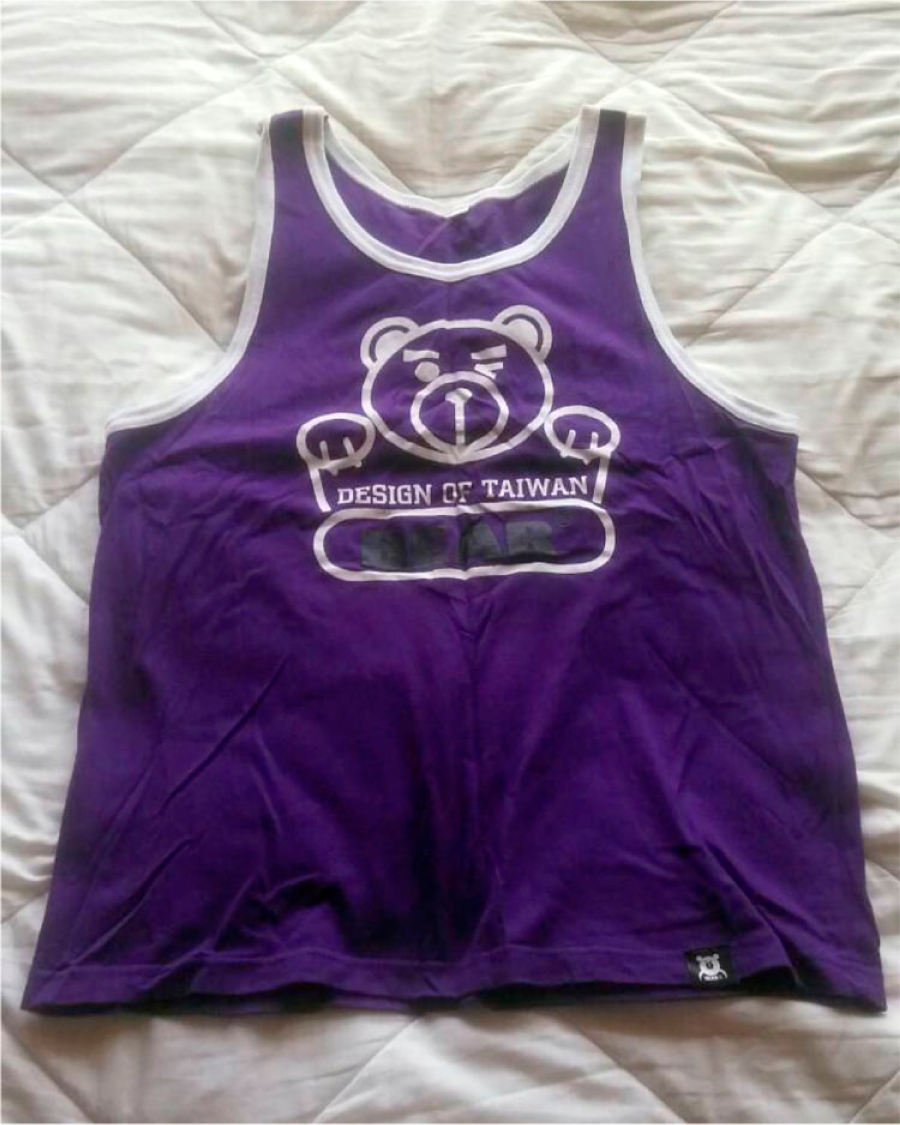
A Taiwanese Bear tank top (photo by author).
Hence, the key members of Taipei’s Bear sexual field, its core circuit, consist of those who duplicate the G-man’s archetypical physique, effect a masculine demeanor, and enhance their natural-born good looks with appropriate gay fashion. In this light, Nanbu Bear from this essay’s opening vignette is rejected, because he lacks both the muscular body and the flashy swimwear that mark one as desirable. Before a Bear joins the core circuit, however, I argue that he must be sufficiently exposed in social media. After all, one’s sexual capital is evaluated by the desiring class (Green 2008), which in this case consists of other Bears. What good can a bulky physique, flawless looks, and impeccable fashion taste do if nobody else knows a Bear has them? A Bear can achieve this exposure through a number of means: regularly attend gay circuit parties, perform as go-go boys in regional gay clubs, and/or act in Japanese gay porn. Most easily, he can also post self-taken portraits, or “selfies,” of his own naked upper torso (if not the whole body) on Facebook and other social media platforms to garner online attention. These erotic photos generally fall into two main categories, the ones that lou liang dian (“expose two spots,” i.e., one’s nipples) and the more risqué lou san dian (“expose three spots”), ones that also reveal the genitals. Xiongji and other beach gatherings provide excellent justifications for any Bear wishing to display himself so. As a narcissistic technology, the selfie’s function goes beyond self-indulgence: by enabling others to see and valuate one’s sexual capital, it plays a definitive role in the achievement and retention of status in the field’s sexual hierarchy. As long as a Bear maintains his physique and looks, each new photograph reinforces the message of desirability broadcast in previous pictures. Anyone else in these selfies gains fame by association. It should not surprise anyone then that many Bears have incorporated selfies as an integral part of their erotic habitus.
The second irony lies in how Donnie’s observations inevitably highlight the limits of “friendly” Bear culture. He can state with certainty what Bears should look like because so many of Taipei’s Bears share these features. Invariably, they have crew cuts, round faces, slit-like eyes, some form of neatly maintained facial hair, rotund bodies, and the same taste in horizontally striped rugby jerseys and the fashion brands mentioned previously. Leo explains this homogeneity:
Actually, buying clothes is itself a difficult task. Taiwan doesn’t have good designs, so if we go to some regular shop to buy pants, the widest they have is 36 [inches], and that’s already very big. If you want to buy 38, they have very, very little stock, and most shops won’t have it. . . . Your tops, they’re even more difficult to get. If you manage to buy something big enough, chances are you’ll look old-fashioned (laoqi), or it’s too loose (guodu de kuansong), and you don’t look good. So Bears would rather go online to order, or to buy from foreign brands. . . . These foreign brands look more slimming, or they accentuate your curves. However, the number of brands that you can choose from is limited, and people end up choosing more or less the same style of clothes from these brands. Gradually, foreign friends feel that Taiwanese Bears are copy cats [in English]. When you look at one person, you can guess what the next one will look like. This is embarrassing, but it’s really difficult to buy clothes that are stylish and big enough in Taipei. Naturally, the type and style of clothes that you can choose from are small.
Compelled in part by the lack of sartorial choices, Taipei’s Bears have become that which the US original rejected in the first place: they are now Clones. On the one hand, Bears are aware of their striking similarities, and this homogeneity is subtly but wryly criticized. Figure 2 features a comic strip titled “So what are you?” that gay Taiwanese comic artist Mao’er drew. In it, someone surprises two Bears by asking them: “You two look alike. Are you brothers?” She asks again: “You guys have such short haircuts. Are you soldiers?” Smiling nervously, the Bears answer “Not really.” She asks yet again: “You have such big (fat) builds, so you major in physical education?” By this time, she has annoyed the Bears sufficiently for one to roll his eyes, as both answer “No!” Dumbfounded, she finally asks: “So what are you then?” “Sisters!”

A comic strip about the homogenous look among Taiwanese Bears.
On the other hand, what does the Bears’ homogenous look say about a subculture born originally in the US from a desire to recognize and celebrate somatic diversity (Hennen 2008)? Bears, as gay men, understand implicitly that muscles attract other Bears. They understand the gay scene as a meat market: to “eat meat” (have sex with muscular men), one must first have meat (be muscular). Many Bears work out regularly to maximize this attention, making the gym a central component of Taipei’s Bear culture and sidelining those with insufficiently honed bodies. A Singaporean friend, Otto, recalls his skinny Monkey friend in Taipei lamenting about the situation: “My friend said he must either force himself to become a Bear, or change his sex to become a woman. He has no market otherwise.” While it sounds extreme, this comment reflects how non–Muscle Bears are regularly excluded. It becomes the most obvious during such peak periods as the October pride parade, when Bears from all over East and Southeast Asia descend into Taipei for a weekend of dance/sex parties and (to a lesser extent?) social activism. Competition heats up with the appearance of so many muscular and beautiful men in one’s gay social apps, as Bears vie for the attention of the best-looking and most muscular ones that they can get. Not surprisingly, many visitors leave Taipei disgruntled by their unfriendly and alienating parade experience. David, an Indonesian-Chinese friend, recalls how he became disillusioned by Taipei’s Bear scene:
You know DDH (a Muscle Bear) from Taipei? I met him when I first went to Taipei in 2009 for the pride parade with DT. I was skinny then. You also know DT, right? He’s such a social butterfly. He knows everyone, so DDH came to talk to him. I was standing next to DT, but DDH didn’t talk to me. In 2010, I went to Taipei again. By then, I’d bulked up, and I met DDH again. This time, he talked to me. He said, “Nice to meet you.” I replied, “Nice to meet you too. We met before.” And then he asked me, “We have? When?” Hello! I was standing next to DT! How could he have not seen me?
DDH could not remember when he first met David, not because David was physically absent, but because he was too skinny then for DDH to even bother noticing. That DDH had his attention on their mutual friend DT at that time did not help with the recollection. A thin body combined with effeminacy worsens the invisiblizing gaze. Another Indonesian-Chinese, Icad, observes self-deprecatingly as such a gay man: “I may as well be a ghost. I am trans-dimensional to the Bears.” In a sexual field where body mass accrues the most value, thin is sin. Being fat is better than being thin.
Closure
This paper focuses on the sexual field of Taipei’s gay Bears. Green (2011, 2014) develops the sexual fields framework and its central components of structure of desire, sexual capital, and erotic habitus to account for the current unprecedented expansion of specialized erotic worlds in the domain of intimate life. In the competitive world of the Taipei Bears, one accrues sexual capital by spending time and money buying suitably Bearish fashion, while emulating the hyper-masculine G-man figure from Japan in an arduous muscle-building regime. By itself, however, knowing how to create the Bear “look” is insufficient. For others to evaluate his capital, a Bear must also have social visibility by, for instance, posting selfies on Facebook and other social media platforms. As a consequence of this competition, a particular imagining of Bearness focused on muscular bodies and colorful clothing and accessories now dominates Taipei’s Bear scene. Indeed, contrary to the egalitarianism of its US original, the scene now celebrates somatic homogeneity rather than diversity; those who fail to look Bear enough are rejected.
The remarkable point about Taipei’s Bears lies not in their cliquishness. By definition, all social groups have limited membership, and those who best fulfill the group’s ideals stand to benefit the most. Nanbu Bear failed because he likely thought a fleshy body alone was sufficient for full inclusion in Taipei’s Bear sexual field. Rather, just as things have social lives (Appadurai 1986), ideas also develop lives of their own as they traverse the global circuit (Lee and LiPuma 2002). While never a completely empty signifier as he always carries vestiges of old meanings with him wherever he goes, the originally North American Bear figure has nonetheless become quite a different creature by the time he reaches Taiwanese shores via Japan. The sexual field that he generates has shed its original egalitarianism and now thrives on competition instead.
Footnotes
Declaration of Conflicting Interests
The author(s) declared no potential conflicts of interest with respect to the research, authorship, and/or publication of this article.
Funding
The author(s) received no financial support for the research, authorship, and/or publication of this article.