




Abstract
Taking networked social movements as a fieldsite, I chart how the Occupy Movement transformed as activists turned to building infrastructure as a mode of political participation. Critically, infrastructure is not simply a feature of networked social movements, but forms its core capacities. Integrating insights from militant ethnography with STS research on infrastructure studies, I illustrate how to use these methods to render visible the infrastructure of networked social movements. Because militant research projects and STS scholarship have a dual role of making knowledge about as well as knowledge for participants, examining the epistemological foundations of social movement research requires understanding the researcher’s purpose for participating and, then, operationalizing their knowledge. To illustrate this, I introduce cybercartography, a theory/methods package, for mapping organizational change in order, scale, and scope across networked social movements. As such, cybercartography bridges academic knowledge production with activists’ goals to organize action.
Introduction
The global uprisings of 2011 provided scholars with many opportunities to study movements in action. Following the self-immolation of Mohamed Bouazizi in December 2010, a Tunisian street vendor who was protesting police abuse, a wave of protest swelled throughout Libya, Egypt, Yemen, Syria, and Iraq. By the spring of 2011, these protests spread to Europe and the United States, where demonstrators sought to reimagine representative democracy through public assemblies. The occupation movements of 2011 expressed a core grievance against a global financial regime that left millions in precarity. The central tactic of occupation brought hundreds of thousands into public squares. In the fall of 2011, the United States joined the growing democracy movement as hundreds posted calls to #OccupyWallStreet online. On September 17, 2011, approximately three hundred people camped at Zuccotti Park in Manhattan, kicking off one of the largest protests in US history. Soon after, there were hundreds of encampments across the United States, where each location became a potential fieldsite for research.
In addition to each encampment providing an opportunity to conduct ethnographic research, the growth of the Occupy Movement also invites a moment of methodological reflection on the scale, scope, and purpose of researching contemporary movements. While social movement researchers have focused on the Internet as a tool for building and bridging movements, few have looked into the epistemological rationales for studying contemporary social movements or questioned the researcher’s relationship to their objects of analysis (Juris 2007). Feminist scholars of science and technology have expressed that who we make knowledge for should be tied to who we make knowledge about (Haraway 1988; Harding 1992). This call is most persistent in the fields of science and technology studies (STS) and the “militant research” of social movements (Mirzoeff 2013). What field methods do these research traditions have in common and how can they be applied to study contemporary movements?
As social movements adopt and experiment with information and communication technologies (ICTs), the overlap between scholarship in the fields of STS and social movements continues to expand. Scholars of communication studies describe movements like Occupy and the Arab Spring, as “networked social movements” (NSMs) because the organization of social action is undergirded by heavy reliance on ICTs, particularly social media (Donovan 2016; Castells 2012; Juris 2012). In this way, the “networked” aspect of NSMs invokes actor-network theory, where both human and nonhuman actors mutually construct social worlds (Clarke 2003, 2005). Researchers of NSMs rely on militant ethnography to study distributed groups of protesters (Juris 2012; Mirzoeff 2013). Militant ethnography refers to politically engaged participation in a social movement, where the researcher is embedded within the movement to grasp the complexity of social justice work and to learn alongside other participants (Juris 2007, 2008; Shukaitis, Graeber, and Biddle 2007; Malo de Molina 2004a, 2004b). Similarly, in the domain of STS scholarship on laboratories, ethnographers seek “participant comprehension,” to maximize interaction in the field so that the ethnographer can participate fully in the activity and knowledge production (Collins 1998, 297). Therefore, militant research and STS approaches to ethnography emphasize themes of connected engagement, desire to foreground subjugated knowledges, and meaningful participation in the groups under study. Militant research projects and STS scholarship have a dual role of making knowledge about as well as knowledge for participants, which is especially relevant for the ethnographic study of NSMs. As I show later, they also share a particular set of field methods including recursive ethnographic engagement and critical cartography, where maps and diagrams act as “boundary objects” (Star and Griesemer 1989). With the intention of improving coordination, boundary objects are employed to translate bodies of knowledge across different groups.
While doing fieldwork in 2011 with the Occupy Movement, I saw the importance of looking across the fields of STS and militant research for other ways of producing ethnographic work that was accessible to broader audiences and partners. In 2010, I completed fieldwork on the data-sharing practices of scientists at Scripps Institution of Oceanography (Donovan and Baker 2011). At Scripps, we focused on the communication infrastructures and practices used by groups of scientists, data managers, programmers, and informationists to archive ecological data. We were most concerned with how actors with different objectives, methods, and materials worked together to coordinate. We found that while the need for a digital archive was widely felt, building it required additional resources and the dedication of a small group of people. This study concluded by identifying the needed resources and infrastructural constraints on producing the shared archive. In this process, diagrams and drawing tables helped order the priorities and objectives of different stakeholders.
Later in my fieldwork on the Occupy Movement, I identified a similar puzzle and worked with activists on creating a communication platform. Like the scientists at Scripps, despite many activists advocating that a communication network was essential for the Occupy Movement, building a communication platform required a small group of activists to turn their attention, resources, and skills to its design and maintenance. This article outlines how problems of order, scale, and scope within the Occupy Movement were addressed by dedicating a small group of activists, called “InterOccupy” to do infrastructural labor as political action. As I worked with InterOccupy activists to put my fieldnotes to practical use, I saw how they responded to diagrammatic representations of order, scale, and scope among their various projects. I call these diagrams cybercartographies, which are maps produced from fieldnotes on activists’ uses of infrastructure that render visible the organizational structure of the movement.
My contribution to ethnographic methods is focused on how ethnographers of social movements must work recursively to produce knowledge about movements, but also to make knowledge for movements in a collaborative partnership. Recursive engagement is accomplished by articulating the forms and norms of different groups, holding space for discussions on values and action, clarifying questions from interlocutors, as well as offering applied knowledge and critique when the opportunities arise (Marcus 2013; Fortun 2001; Kelty 2008).
Using laboratory and feminist STS insights (Clarke 2003, 2005; Bowker and Star 1999; Collins 1984, 1998), alongside militant ethnography (Shukaitis, Graeber, and Biddle 2007; Malo de Molina 2004a, 2004b), my two-year engagement with the Occupy Movement illuminates how protesters conceptualized, designed, and augmented ICTs to meet their specific needs. I began my study of the Occupy Movement in July 2011 by following social media about the upcoming action set for September 17, 2011, in Manhattan. I then embedded myself at the encampment in Los Angeles, where I participated in daily camp life. Following this, I sought out a fieldsite situated within the communication infrastructure of the Occupy Movement, so that I could continue researching the movement after the encampments disbanded in December 2011. Throughout 2012, I worked closely with activists to build the InterOccupy.net communication platform that coordinated numerous local and national campaigns and actions. Most notably, InterOccupy hosted conference calls to coordinate movementwide direct actions and to hold discussions on topics of interest to Occupy protesters. In addition to conference calls, InterOccupy.net managed e-mail lists, a weekly newsletter, a website with a newswire, and numerous social media accounts dedicated to organizing groups across a range of issues. I learned to operate conference calling software, maintain websites, administrate social media accounts, and moderate e-mail lists. In doing so, I employed multisited ethnography by looking for the convergence points among different networks across these technologies (Marcus 1995; Burrell 2009).
I begin this article by analyzing the features of NSMs to illustrate how grounding one’s position within the communication infrastructure of activists provides a critical vantage point for conceptualizing NSMs as a fieldsite. Then, I move on to synthesizing the fields of STS laboratory studies with the practices of militant ethnography through an autoethnographic telling of my experience becoming an academic among fellow activists. From here, I explain how Malo de Molina’s field methods for militant ethnographers are similar to Clarke’s situational analysis approach to STS research (Malo de Molina 2004a, 2004b; Clarke 2003, 2005). In particular, Clarke uses cartography to locate relationships between actors, both human and nonhuman, which is essential for thinking about the infrastructure of NSMs as an object of analysis, where people, technologies, and protocols are interstitched. Following this, I describe how I generated cybercartographies of the Occupy Movement and how these maps are recursively stitched to one another and the movement’s shifting order, scale, and scope. In doing so, I illustrate how mapping different groups, technologies, and events offers protesters new ways of grasping “moral and technical order” among the messiness of social movements (Kelty 2008, 27).
Seeing Networked Social Movements through Infrastructure Studies
Scholarship in communication, anthropology, and sociology addresses the political and social uses of ICTs within social movements. This research shows how movements use ICTs to find one another, coordinate action, and create a collective identity by making their own media (Coleman 2010, 2011, 2012, 2014; Castells 2012; Juris 2008, 2012; Postill and Pink 2012; Squire and Gaydos 2013; Monterde and Postill 2014). In many of these studies, the Internet enables or facilitates collective action through mixing organizational forms and norms of previous movements. Researchers of social movements in communication and anthropology suggest that NSMs are unlike earlier movements because they are characterized by massive participant-generated networks across many online spaces, as well as an insistence on prolonged decentralized organizing that resists centralization in favor of complex leaderless rule (Juris 2004, 2008; Castells 2009, 2012; Costanza-Chock 2014; Donovan 2016). Moreover, NSMs “are reconstructing the public sphere in the space of autonomy built around the interaction between local places and Internet networks that are experimenting with assembly-based decision-making and reconstructing trust as a foundation for human interaction” (Castells 2012, 316). Here then, studying NSMs means attending to the use of the Internet, not solely as a stable and standard tool for coordination, but like the streets, the Internet forms the base on which an NSM is organized.
According to Castells and Juris, the structure of NSMs is rhizomatic and reflects the affordances of the ICTs used to spread information (Juris 2008; Castells 2012; Donovan 2016). Rhizomes are plants that mature in “an acentered, nonhierarchical, nonsignifying system without a General . . . in contrast to centered (even polycentric) systems with hierarchical modes of communication and pre-established paths” (Deleuze and Guattari 1998, 23). The Internet supports rhizomatic communication as users can publish and promote information publicly without gaining institutional clearance from a central authority. This does not mean that networked movements are without organization, but rather that the structure of communication channels provided online strengthens the participants’ capacities to act independently of one another. As a result, NSMs can spread information online quickly, but it becomes difficult to verify sources or ensure that information is distributed evenly across the movement (Donovan 2016; Gerbaudo 2017). In terms of studying groups as rhizomes, Mueller (2016) suggests moving away from thinking of groups as bounded objects, such as subcultures or virtual communities with fixed boundaries, and instead calls the researcher into a web of relations between humans and nonhumans mediated by technology, time, language, affinities, and distance. In doing so, the ethnographer does not recast a linear history, but instead posits a “chaotic history” that more closely resembles the messiness of establishing order, symmetry, and hierarchy within the rhizome (Mueller 2016, 119).
Because of this rhizomatic structure, there are many ways to begin studying NSMs. Yet, accounts of NSMs tend to focus on the analysis of searchable keywords online (Squire and Gaydos 2013; Monterde and Postill 2014; Juris 2012; Castells 2012; Gerbaudo 2017). Some of the most notable keywords from the movements of 2011 include #Jan25 for Egyptian protests, #OccupyWallStreet in the US, and #15M for Spanish mobilizations. Critically, as the use of a keyword wanes or is used so heavily that it no longer aids protesters, some movement participants turned to building infrastructure to ensure the movement continued to communicate and coordinate across nodes (Donovan 2018). New methods for researching these movements as they proliferate online and off must grapple with the complexity of doing multisited ethnography across these expansive online and offline spaces as NSMs move beyond the keyword (Marcus 1995; Burrell 2009). To conceptualize NSMs as a fieldsite, I looked to STS literature on infrastructure studies.
Importantly, because the basic structure of NSMs is rhizomatic and distributed across multiple spaces and groups through ICTs, best practices vary widely on how to choose a fieldsite, gather data, and provide analysis. Researchers have described online fieldsites as virtual ethnography (Hine 2000; Ruhleder 2000) or cyber-ethnography (Ward 1999), which leads some to conclude that the virtual is either an appendage or somehow outside the real or physical world. Boellstorff et al. (2012) and Burrell (2009) caution not to make distinctions between the virtual and the real. My research attends to this shift by identifying infrastructure built by activists as a fieldsite to show just how activists tether the wires to the weeds, that is, how activists link online spaces (wires) to organize local places (weeds) recursively.
Star and Ruhleder (1996) define infrastructure as a paradoxical product and process that arises when a project has a need for continuity and standards; it involves linking technologies, values, concepts, procedures, protocols, and people together so that a project can be accomplished by a network of actors. As Star (1999) illustrates, infrastructure seems obvious, static, and rather boring, but investigating the development and use of infrastructure reveals very dramatic stories rife with human and technological tensions. Critically important to the study of infrastructure is a description of the process and context of development and transformations in system design. Star and Ruhleder note that infrastructure is not just a question of “what technologies do people use,” but it is also a question of when does infrastructure happen? (Star and Ruhleder 1996, 113). When does information travel? When do users innovate? When does infrastructure breakdown? Questions like these point the researcher to study infrastructure in action—as a series of relationships instead of a list of components. Moreover, infrastructure is learned by doing and becomes embedded within distributed organizations as a matter of standardization and maintenance of routine action, especially when meeting a goal requires the coordination of people, technology, and protocols. For example, while many of us will not remember how we learned to use a phone, nevertheless, it is a routine aspect of everyday life. It is only when the phone does not work that we consider questions of infrastructure.
In this study, I describe how participants collaborate on network projects, that is, projects that require distributed groups of people to coordinate action using infrastructure. Especially important is how participants learn new technologies as needs arise and continue to refine this knowledge as emergent tasks require it. Using STS studies of infrastructure as a guide, I was able to demarcate how the Occupy Movement self-organized, which projects protesters took on, and how they brought about social change by following the shifting networks and locales of people, technology, and protocols. By applying Bowker and Star’s (1999) method of “infrastructural inversion,” I foregrounded the communication infrastructure of this social movement in order to illustrate how protesters both rely on technologies of everyday life to connect with one another, while also leveraging combinations of ICTs to collaborate on network projects to achieve a goal.
More than asking others how they experienced making and doing infrastructure, I was situated within it as an operator. As such, this project can be read as a contribution to the method of analytic autoethnography, where “the researcher is (1) a full member in the research group or setting, (2) visible as such a member in the researcher’s published texts, and (3) committed to an analytic research agenda focused on improving theoretical understandings of broader social phenomena” (Anderson 2006, 375). While I do not focus on an autoethnographic analysis of my involvement with the technical infrastructure development, I emphasize how I learned to work with academic and activist materials to bridge the different audiences for this research. I show how the development of cybercartographies became tools for reorganizing the communication structure of the movement, while these maps also provided academics and other outsiders with representations of an ordered division of labor within the movement. As such, I do not make much of the process of becoming an activist here as I have always been politically engaged. I did not show up to the movement with the intent of studying it, rather fellow protesters encouraged my participation as an academic with knowledge about networks. Therefore, my analytic reflexivity is oriented toward describing how I applied academic theory and practice to the activists’ puzzle of infrastructure, with a deep consideration of lessening exploitation for personal gain.
In summation, infrastructure is comprised of a relation between technologies, concepts, and people that shifts during use; therefore, it is never stable or fixed. By centering my ethnography on the network project of InterOccupy, I charted how communication infrastructure was conceptualized by protesters as well as the ways protesters remixed the intended uses of ICTs to meet their needs, especially in moments of duress. Viewing infrastructure not as a feature, but as the organizational design of NSMs, required turning to research and science and technology studies and militant ethnography for field methods.
Field Methods in Science and Technology Studies and Militant Ethnography
In my fieldwork, I explored the Occupy Movement’s communication infrastructure through action research, where participation in the community of practice was integral for analysis (Kemmis and McTaggart 2000; McIntyre 2008). Describing his ethnographic method in Asylums, Goffman stated, “any group of persons—prisoners, primitives, pilots, or patients—develop a life of their own that becomes meaningful, reasonable, and normal once you get close to it, and that a good way to learn about any of these worlds is to submit oneself in the company of the members to the daily round of petty contingencies to which they are subject” (Goffman 1961, 7). By becoming a member of the Occupy Movement and the InterOccupy group, I was able to stay close to the participants, understand why certain decisions were made, and become accustomed to the temporal and spatial dimensions of organizing networks, events, and campaigns.
The STS field of laboratory studies emphasizes rendering local knowledge production visible, where technology plays an integral role in structuring information, formatting hierarchies of access and control, and consolidates power (Collins 2010; Latour and Woolgar 1986; Knorr-Cetina and Mulkay 1983; Knorr-Cetina 1999; Mukerji 1989; Pickering 1995; Star 1999; Bowker et al. 2010). According to Hess, working in the tradition of the sociology of knowledge, laboratory studies emphasize the way in which concerns with evidence and consistency were interwoven with situationally contingent events, local decision-making processes, negotiation among a core set of actors in a controversy, the interpretive flexibility of evidence, additions and deletion of rhetorical markers (modalities) to knowledge claims, and other social or non-technical factors that shape the outcome of what is constituted as accepted knowledge and methods. (Hess 2001, 234)
In laboratory studies, knowledge production is always wedded to social, political, and historical constraints.
Additionally, laboratory studies broke down the barriers between the participant and observer. Collins (1984, 1998) pushed for a form of participant observation that required the ethnographer to seek “participant comprehension,” where “the field-worker tries to acquire as high a degree of native competence as possible and interaction is maximized without worrying about disturbing the field site; this ideal should always direct the research effort, even though the degree of native competence attained will vary from study to study” (Collins 1998, 297). In partnership, Collins consistently shared findings with his subjects and invited their input into the research project. Moreover, Pinch and Collins (1982) advocated analyzing the position of scientific claims vis-à-vis the scientific community with which they engage. As the field of laboratory studies developed, ethnographic materials under study expanded to include nonhuman actors as well as the influence of political and social contexts on scientific facts.
Methodologically, I was able to apply STS insights to my research on the Occupy Movement in very specific ways because I had previously completed ethnographic work on networked science. At Scripps, we studied how a group of distributed scientists, researchers, and graduate students coordinated their resources, while scaling and leveraging technologies and knowledge to make their data publicly available (Donovan and Baker 2011). Because I witnessed how networks of scientists struggled with collaboration, I began to conceptualize local Occupy encampments as laboratories for democracy, each with its own participatory culture and experimental approach to social change. When I looked at the literature on militant ethnography, I found Juris (2004, 355) to have already identified this tendency for NSMs to view themselves, and not the state, as “laboratories for democracy,” where protesters experiment with forms and norms of democracy to evidence alternatives and catalyze social change.
I pivoted to the research on militant ethnography to think critically about the purpose of my engagement with NSMs and for a methodological model that incorporated participants’ concerns and knowledges directly into the project’s design. While many Marxist sociologists emphasize changing the world, participating in protests remained a separate activity from my research life until this project. My outlook changed as I continued to work with activists. While it occurred to me that this movement would make an excellent research project, the camps were ephemeral. I needed an object of analysis that could endure beyond the carnival of the camps (Žižek 2012). At this point, I began traveling between camps, gathering contact information, and administrating a regional e-mail list in an effort to organize the southern California occupations. I also started to reflect heavily on what it meant to be doing this activist work with an eye toward knowledge-making that would benefit my career. I was trying to bring my work into balance with my activism by creating a project that could be useful for different audiences—academic researchers of social movements and movement participants themselves.
Militant researchers have also grappled with this same concern. I was introduced to the concept of working as an activist-academic when reading an anarchist zine written by the CrimethInc Ex-Workers Collective titled, “No Gods, No Masters Degrees.” They proudly proclaimed, “No job but the inside job!,” when describing how seizing resources from employers could aid revolutionaries (reprinted in Shukaitis, Graeber, and Biddle 2007, 305). CrimethInc write, “Revolutionary union organizing is as laudable as ever, but the revolutionary who works for the primary purpose of seizing resources should aim for the job with the most resources that requires the least amount of commitment. In this regard, the educational-industrial complex is especially ripe for looting” (reprinted in Shukaitis, Graeber, and Biddle 2007, 307). Similarly when writing about the activist-academic’s relation to the university, Harney and Moten (2013) stipulate that the academic participates in revolutionary projects insofar as they are able to channel resources toward community needs. For feminist STS scholars and militant researchers, it is critical for the academic to “link the efforts and desires of those within the system to those without its assurances and controls” (reprinted in Shukaitis, Graeber, and Biddle 2007, 311).
Of knowledge production and activist-academics, Shukaitis, Graeber, and Biddle write, “Militant research starts from the understandings, experiences, and relations generated through organizing, as both a method of political action and as a form of knowledge” ( Shukaitis, Graeber, and Biddle 2007, 9). They argue that academics and activists draw insights from one another, but generally it is activists who engage more frequently with academic texts. Whereas academics are most concerned with creating knowledge about activists and social movements, activists seek knowledge for social change. In doing so, academics create knowledge for the sake of knowledge, whereas activists produce knowledge to organize action. To this end, it is sufficient for academics to claim that writing theory is a political act, which does not require a program for action. Activists tend to disagree ( Shukaitis, Graeber, and Biddle 2007, 22–24). This tension does not resolve by declaring one form of knowledge production superior, but instead calls on the militant researcher to take the kinds of knowledge made by each group as distinct, yet mutually entwined, discourses.
In doing so, militant ethnographers often take up issues that arise out of the questions of movement participants. Malo de Molina (2004a) clarifies what projects are best suited for militant research projects, she writes: They are initiatives that explore: 1) how to break with ideological filters and inherited frameworks; 2) how to produce knowledge that emerges directly from the concrete analyses of the territories of life and co-operation, and experiences of uneasiness and rebellion; 3) how to make this knowledge work for social transformation; 4) how to make operative the knowledges that already circulate through movements’ networks; 5) how to empower those knowledges and articulate them with practices and finally, 6) how to appropriate our intellectual and mental capacities from the dynamics of labour, production of profit, and or governmentality and how to ally them with collective (subversive, transformative) action, guiding them towards creative interventions. (Malo de Molina 2004a)
Malo de Molina (2004a) offers many examples by tracing the history of militant research projects globally; beginning with Marx’s “A Worker’s Inquiry” in 1880, where Marx published a survey in La Revue Socialiste seeking responses from workers about the conditions of their labor. In the mid-1960s, Italian sociologists and activists, united under the banner of operaismo (workerism), took up the notion of worker inquiry for different reasons. Theorists of workerism conceptualized institutions based on the workers’ conditions, while activists sought to use this research to organize workers within these institutions. According to Malo de Molina (2004a), during this period the method of co-research developed, wherein the object under study by the militant researcher is the territory (the factory or neighborhood) and those that inhabit these spaces are subject-researchers who help to transform the territory. This is an especially important point for my research on NSMs, where working on network projects requires building communication infrastructure that are both structured and structuring of the groups composition and collective identity. Infrastructure is not only a set of technologies, people, and protocols, it also forms the site of interaction and, like the neighborhood and factory, can be manipulated by its inhabitants.
Malo de Molina (2004b) surmises that the experience of today’s militant researcher must acknowledge the uneven distribution of knowledge and power, both within academia and within society; I would add movements to this list. Moreover, drawing from Haraway (1988), Malo de Molina (2004b) suggests that the researcher must use his or her body as a tool and reject theories that purport to speak from a place of political neutrality. Here then, the task of the militant researcher is to devise a method that goes from practice to theory, to revised practice to revised theory, and so on, in a recursive manner. Later, I will demonstrate how creating cybercartographies can move theory to practice where a map of order can become a method for scaling and scoping NSMs.
This leads to the question: which field methods should the militant researcher choose and why? Malo de Molina utilizes a genealogical approach incorporating multiple methods including surveys, focus groups, interviews, and ethnography. As a heuristic, each application of method does different things for distinct ends. Crampton and Krygier (2006) show how the field of critical cartography developed to graph patterns of power, domination, and points of resistance. As Malo de Molina (2004a) describes, some militant researchers employ cartographies of power and position, she writes: The necessity of getting rid of fetishes and ideological backgrounds, too concerned with being and essence, and the necessity of building operative maps, cartographies in process, emerging from dynamics of self-organisation, in order to be able to intervene in the real, and maybe to transform it. They are maps to orient and move ourselves within a landscape of relationships and devices of domination undergoing accelerated mutation. But they are also maps that can help us to situate ourselves in this hyper-fragmented landscape, to identify a point of departure and a link where the production of knowledge and subjectivity converge in the construction of the common, shaking the real (Malo de Molina 2004a).
In the next section, I show how developing a map of self-organization allowed for order to emerge from hyper-fragmentation or what I call the messiness of movements.
Mapping is also an essential practice of the grounded theory approach (Star 1983, 1986; Strauss 1987) and feminist epistemology put forward by STS scholar Adele Clarke as situational analysis. In terms of creating analytic tools, Clarke employs grounded theory alongside maps of relations of power across actor networks (2003, 2005). Clarke (2005) describes the postmodern turn to complexity, localization, and situated knowledge as imperative to the method itself, where Clarke does away with the simplification of social relations in favor of a dense situational map of entangled individuals, discourses, and non-human elements. Like Foucault’s (1972, 1990) genealogical analysis, Clarke emphasizes finding gaps, silences, and constraints on discursive activity. Like the concerns of laboratory ethnographers, taking these steps allows for heterogeneous complexity to emerge as the researcher is able to illustrate how contradictions and contingencies shape outcomes.
In summation, the concerns raised by laboratory studies and feminist STS scholars coincide with the values and aims of militant ethnography, including the use of critical cartography as a field method. Concurrent themes run through these methodologies, which highlight connected engagement, desire to foreground subjugated knowledges, and meaningful participation in the community under study. Moreover, activists-academics do not take the view from nowhere to write about NSMs. Rather they participate in movements to grasp the complexity of protest and the repertoire of available action. Fundamentally, both STS and militant research projects seek to make knowledge about and knowledge for the communities they study. It is a reciprocal process of knowledge-making and movement-building that motivates my analysis, where participation is oriented toward answering a question that arises out of activist practice that can potentially “shake the real.”
Cybercartographies of Order, Scale, and Scope across the Occupy Movement
In my fieldwork, I tried to do everything I saw others doing and contribute where possible. I attended more than one hundred in-person meetings; cooked food; learned horizontal facilitation techniques for large meetings; spoke to the press, police, and politicians; operated social media; moderated organizational e-mail accounts; developed websites; engaged in civil disobedience; marched; occupied public and nonpublic space; wrote public statements; operated a conference call system; took notes online/offline; interviewed numerous participants; created digital media; participated in SMS text groups; video-streamed direct actions online; and helped coordinate several large-scale direct actions, including the West Coast port shutdown of 2011, the May Day Strike of 2012, and the Occupy Sandy Relief effort of 2012.
In this section, I describe three moments of collaboration where my ethnographic writing became a boundary object for discussion about the order, scale, and scope of the movement. First, I begin by situating my local field site, OccupyLA, and describe how creating a cybercartography of groups within the encampment opened new possibilities for organization. Second, as the movement scaled nationally, I created a cybercartography of the national organizing team, InterOccupy, by mapping the different conference calls conducted in the first three months of their existence. Because InterOccupy modeled their conference call topics on the structure of the camps, the cybercartography I created for Occupy LA became a useful boundary object for conceptualizing national organization. Third, as the movement changed, so too did the needs of groups seeking conference calls. In this final cybercartography, I identify how InterOccupy supported the proliferation of issue- and action-oriented groups as the scope of the movement transformed from supporting local encampments to networking national campaigns.
Cybercartography of Order
I started participating in Occupy protests from Los Angeles on October 1, 2011. In July 2011, I watched much of the initial organizing process unfold online through various websites and social media channels including Facebook, Twitter, and YouTube, as well as movement-specific websites, like Occupytogether.org and OccupyWallSt.org. Initially, I followed the circulation of information between independently operated websites and discussions found on social networks, including Facebook, Tumblr, and Twitter. Sharing information online eventually led to face-to-face meetings and the spread of encampments all over the world. The first encampment at Zuccotti Park in New York City on September 17, 2011, led to a rapid mimicry of the tactic across the United States. According to data gathered by Occupy.net, there were more than 1,300 occupations globally by October 15, 2011. Within a two-hour drive of Los Angeles at this time, there were twenty-one groups protesting under the name of Occupy.
On October 1, 2011, I attended the first demonstration held by OccupyLA, which led to the establishment of an encampment at Los Angeles City Hall. Camp life revolved around the production of a nightly meeting, called the General Assembly, where hundreds of participants debated the purpose of the movement and made decisions on collective actions. The General Assembly was composed of committees, that is, groups that would meet daily to discuss specific tasks, objectives, or initiatives (Figure 1). At the General Assembly, committees would present the minutes from their meetings and propose action items that the entire assembly could vote on. At first, I joined the Objectives and Demands Committee, where we discussed the relationship of the movement to local politicians. As my interest in studying the movement grew, I began attending as many daily meetings as possible; eventually I met with all committees.

Cybercartography of the OccupyLA Committee Structure.
I created this first cybercartography as part of a project with the Finance/Resources Committee at Occupy LA, who were writing an organizational charter so that the committee could apply for a bank account. The local credit union required articles of incorporation in order to provide OccupyLA with a checking account. Prior to this, members of the Occupy LA Finance Committee were using their personal bank accounts to cash checks and accept online donations. As monetary donations increased by the thousands, the committee members needed to protect themselves against allegations of embezzlement and tax fraud. To create this organizational map, I collected available information about committees by attending their meetings, assembling notes from the general assembly, watching video recordings of events, alongside gathering intel from the OccupyLosAngeles.net website and Facebook groups related to OccupyLA. This diagram of the division of labor was used as part of the official filing with the bank, which established OccupyLA as an “unincorporated association.”
In The Division of Labour in Society, Durkheim (1997) stipulates that highly technical societies rely on a specialized division of labor regulated by rules, laws, and customs, he writes, “the division of labour unites at the same time that it opposes; it makes the activities it differentiates converge; it brings together those it separates” (276). At the same time that the division of labor creates order and solidarity, anomie or normelssness occurs when individuals do not sense a moral order guiding the coordination of interrelated tasks. Moral order is produced through increasing the density of social ties, which requires steady communication between parts.
In the encampments, the general assembly was the essential infrastructure supporting order through communication. Participating in the movement by advancing the agenda of particular committees made it difficult for protesters to see how different committees worked together to produce a unified whole. In this way, committees functioned rather autonomously and often used the general assembly to ask for resources, but rarely were assemblies used to forge coordination across committees. Producing a charter for OccupyLA was an opportunity to diagram Occupy LA’s division of labor, so that insiders and outsiders could see order in the mess. However, as encampments came under duress from the police, the communication infrastructure had to scale up in order to meet the structural challenges of maintaining communication within encampments and across the movement.
Cybercartography of Scale
As camps emerged across southern California, I and others at OccupyLA saw a need for an “Occupation Communication” Committee that would connect across camps directly by traveling and welcoming those who traveled to LA to learn how to hold a general assembly. As well, because it was impossible to foresee the growth of the initial Manhattan encampment at Zuccotti Park into an international phenomenon, no system of coordination or communication was developed at the outset to organize the flow of information between or even within encampments. To start an encampment, activists outside of Zuccotti Park proclaimed that they were going to occupy a place in their city or town and coordinated locally to do it. Much of this early coordination of local encampments was through discussion boards on Reddit.com, OccupyWallSt.Org, OccupyWallStreet.Org (maintained by Adbusters Magazine), OccupyTogether.org, Twitter, Facebook, and Internet relay chat rooms. As I came to know the administrators of these online forums, I found out that there is very little overlap of participants; they too were bound by an organic solidarity as many people were performing complementary roles without requiring knowledge of the whole enterprise.
Critically, the uniqueness of the online search term “occupy” was an advantage to those who sought to find like-minded people as they could tag their content or query “occupy (insert city or town)” on numerous social networks and find one another. For example, those looking to organize an encampment in Los Angeles began using the hashtag “#OccupyLA” in conjunction with “#OccupyWallStreet” on Twitter to promote dialogue between activists who were located in Los Angeles and interested in Occupy Wall Street as a movement. In Los Angeles, this technique of bundling keywords led to a loosely coordinated group that began meeting in person at a public park on September 23, 2011. Moreover, the organizational process of the general assembly also spread through online networks and manifested in encampments. Pamphlets outlining how to facilitate large group meetings and video recordings of the general assembly at Zuccotti Park circulated widely online. These pamphlets were printed and distributed at many local encampments. Crucially, because of ubiquitous computing, moving between online and offline forums for communication became the hallmark of the Occupy Movement; however, because of the uneven flow of rhizomatic communication, it was difficult to coordinate action.
Similar to how internal pressure to share data compelled scientists at Scripps to build a digital repository, the growing desire to share anti-oppression tactics and coordinate action presaged the need for a robust communication infrastructure. In early October, I began traveling between local occupations sharing news and ideas across the burgeoning southern California network. Around the same time, a small committee, “The Movement Building Working Group,” formed at Zuccotti Park, dedicated to networking the dispersed encampments across the country. They reached out to other camps via e-mail and text messages to announce a movement-wide conference call on October 24, 2011. From OccupyLA, three of us called in on a speakerphone and instantly connected to fellow protesters from approximately eighty other locations. Quickly thereafter, I joined the small “Call Planning Team” (CPT) to help build an internal communication infrastructure that was later named “InterOccupy.” This team was composed of twelve to fifteen activists, who were also participating in local encampments.
The use of conference calls to network the movement seems curious, but as thousands of unread e-mails piled up, activists were eager to speak with one another using this many-to-many platform. InterOccupy used a conference call software that allowed for up to five hundred participants on each call. Especially as occupations were raided and evicted by police by the end of November 2011, InterOccupy were called upon to host calls on legal rights and crisis management. As well, this national crackdown on the movement was coordinated by mayors using conference calls, where they employed the policing method of strategic incapacitation to stall the growth of the movement (Donovan 2018; Gillham, Edwards, and Noakes 2013). As such, local encampments had fewer and fewer spaces in cities and towns where they could meet without the threat of arrest.
InterOccupy began to network the committees in local camps by arranging conference calls and promoting them through social media. In the CPT discussions about how to scale the movement, activists from New York were cognizant of the power inherent in centralizing communication. Therefore, InterOccupy adopted the division of labor model already present in most camps. By using the initial cybercartography of OccupyLA’s General Assembly (Figure 1), sending out a survey, and using the knowledge of the CPT, InterOccupy deduced which committees were present at many camps. Whereas places like Kalamazoo and Albany were small and focused on community outreach, civic engagement, and direct action primarily, places like Los Angeles and New York were particularly large with an abundance of specialized committees. InterOccupy scheduled a calendar of conference call topics that reflected the organizational structure already present in many encampments (Figure 2), where participants from various locations on similar committees discussed what issues they were facing and shared advice related to common problems.
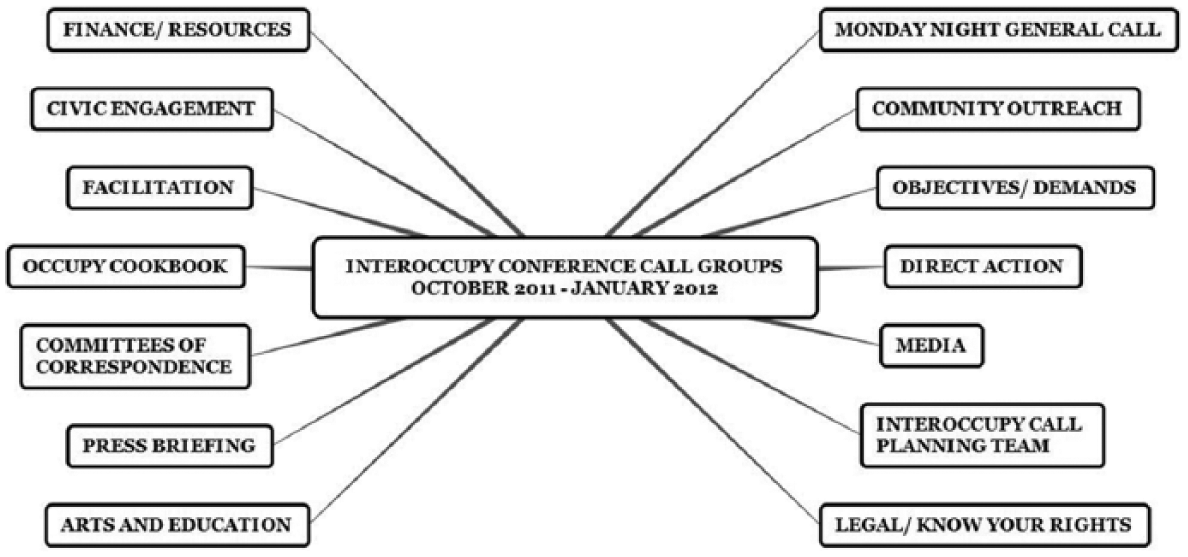
Cybercartography of InterOccupy Conference Call Topics.
For example, on the “Finance/Resources” conference call, the Occupy LA Finance Committee connected with other finance committees in other locations to discuss the benefits and problems of becoming an unincorporated association. Networking the local encampments according to the organizational schema of the general assembly model allowed the movement to scale rhizomatically, without the need to reorganize the structure of decision making or create bureaucratic hierarchies. Instead, InterOccupy focused on supporting the growth of the movement by providing the communication infrastructure necessary to scale committees. This shift in scale proved most significant for connecting direct action committees, who focused on coordinating national days of action across cities and towns.
As well, InterOccupy made one request of encampments, they asked them to form a committee dedicated to communicating within and across locations. Importantly, InterOccupy called on local encampments to form a “committee of correspondence” (COC) that would report initiatives and actions taken up at their locations. Modeled on the committees of correspondence during the American revolution, the COCs would also make announcements at their local general assembly describing what was happening in other locations. This organizational transformation, albeit a small intervention, opened up possibilities for networking across camps in ways that did not just invite nods of solidarity but coordinated participation in new ways. In the early part of 2012, more than sixty COCs convened for weekly conference calls and helped coordinate several national actions.
At this time, InterOccupy had no monetary resources, so participation in the CPT was limited to those who had steady Internet access, paid for their own travel, and could afford to spend upward of eight hours a week on long-distance phone calls. In December 2011, eleven of InterOccupy’s CPTs met in person for the first time, myself included. Over the course of this intensive three-day meeting, InterOccupy developed preliminary protocols for outreach, website administration, a statement of neutrality, and plans for network expansion aided by Clay Shirky, the communication scholar and social theorist. I note Clay’s participation in the meeting to highlight how he participated alongside activists—many of whom had not read his academic work, but were keen to apply his knowledge to this network project.
Following this face-to-face meeting, InterOccupy went from hosting between one and five conference calls a week to nearly twenty as team members learned to work together in a more cohesive manner. A crucial element of InterOccupy’s face-to-face discussions was the desire to create a trustworthy community. Given the distributed nature of the network and police suppression of encampments, rumors that some members of InterOccupy were government agents, paid union infiltrators, and/or aspiring politicians made it difficult for members to trust each other outright. While fears of co-optation may have been exaggerated at this point, it was nonetheless important to note the persistence of cautionary trust as it permeated many conversations across the movement. Moreover, voice as a communication tool was critical for building trust into the network. As one participant said, using conference calls “makes the movement human.”
InterOccupy took the quantity and quality of communication across the Occupy Movement seriously and endeavored to connect people across locations so that the movement could sustain participation after the raids. In terms of regional communication, the Occupation Communication Committee at OccupyLA used the conference call services of InterOccupy to organize four large regional gatherings from January 2012 to April 2012. These regional assemblies brought together hundreds of protesters across southern California to work on coordinated direct actions. Without recourse to distributed voice-to-voice discussion, these regional assemblies would have been difficult to plan and sustain as trust was eroding across the movement. At the same time that InterOccupy was providing infrastructure services to the movement, local participants struggled over the ownership of social media accounts, especially access to passwords. Because InterOccupy focused on internal communication through voice discussion, it coproduced networks of action and trust, which proved consequential when Hurricane Sandy hit the east coast.
Cybercartography of Scope
Over the winter of 2012, the Occupy Movement shifted from location-based organizing into coordinating across issues and actions using the communication infrastructure maintained by InterOccupy. Without consistent public meeting spaces, the influence of local general assemblies waned as did the role of the COCs. To cope with the physical transformations within the movement, InterOccupy slowly transformed their network model to accommodate groups who wanted to convene virtually to discuss issues and actions. In addition to conference calls, InterOccupy began providing a weekly newsletter, a calendar of calls and events, hubs for shared documentation, e-mail lists, and social media administration.
InterOccupy conducted more than one thousand conference calls in 2012. While some were one-time informational calls, many calls were part of an ongoing series. In Figure 3, I have mapped the changes to the organizational structure of the movement by charting the different types of conference calls offered by InterOccupy throughout 2012. Groups who used InterOccupy ten or more times in 2012 were included on this list. I obtained this information from the “Call Roster” available to InterOccupy volunteers. The Call Roster is an online shared spreadsheet listing the official schedule of calls, including date, time, topic, call requestor, name of technical assistant, duration of the call, and number of participants. Here, mapping infrastructure helps locate a second small, but critical, intervention by InterOccupy: the training of conference call operators.

Cybercartography of InterOccupy Conference Call Topics.
By dedicating some of the skills and time of the CPT toward training others to operate the conference calling software, InterOccupy was able to leverage this technology to grow new networks and prolong the movement. With each call lasting one to two hours routinely, the small CPT could not keep up with demand initially. Some calls were deferred until there was enough labor power. By the end of 2012, InterOccupy trained more than one hundred people to provide technical assistance on calls. It was this combination of network organization, structural flexibility, and technology training that readied activists to expand the scope of the movement to cover a range of new issues and to take on new network projects.
Throughout 2012, InterOccupy connected to networks internationally and maintained an e-mail list of thirty-three thousand members. Most of InterOccupy’s work was accomplished without any monetary donations to fund its services. In March 2012, InterOccupy received a grant of $5,000 from the Movement Resource Group, spearheaded by Ben Cohen of Ben and Jerry’s Ice Cream. This grant allowed InterOccupy to organize a National Gathering in Philadelphia and covered the costs of associated expenses, including wi-fi hot spots, outreach materials, server space, as well as travel for the small CPT. Despite the available monetary resources, InterOccupy did not endeavor to build new technologies, but relied almost exclusively on linking together different ready-made communication platforms to reach the broadest possible audiences.
From 2011 to 2012, activists using InterOccupy’s platform coordinated such newsworthy events as the West Coast Port Shutdown in December 2011, the anti-ALEC protests in February of 2012, the May Day General Strike of 2012, protests for Trayvon Martin, and Occupy Sandy. 1 Each of these campaigns and events required similar communication logistics provided by InterOccupy, including conference calls, posting of notes taken at local meetings, and sharing of information through e-mail lists and social networks. Across these actions, events, campaigns, and groups many activists became accustomed to organizing in the wires to make an impact in the weeds; that is, they tethered online networks to local places recursively. Moreover, InterOccupy provided a stable and consistent infrastructure for communication unlike what was readily available using any single platforms.
Because InterOccupy was able to scale the network to accomplish national coordination and had already shifted to support both regional and issue-based group communication, when New York City was hit by Hurricane Sandy on October 30, 2012, the CPT was able to provide disaster relief quickly. On the night of the storm, four New York members of InterOccupy created an informational website that showed the public where to get food, heat, medicine, and other basic necessities. The site, initially located at interoccupy.net/occupysandy, quickly expanded as information rolled in and volunteers decided to take action. At the same time, an e-mail list was devised from previous lists of Occupy Wall Street medics, organizers, and allies. Churches were contacted to allow donations to be dropped off or to let volunteers cook in their kitchens. As the online and offline infrastructure grew, more and more projects and volunteers were incorporated into the information architecture, including a donation page that raised over a million dollars. During this time, I volunteered to check e-mails sent to the main e-mail account for “Occupy Sandy,” where I answered questions, referred people to the Occupy Sandy hotline, and coordinated transit for volunteers. Here, an infrastructure built to transport trust and information transformed to distribute goods and services.
The transformation in scope was made possible by the iterative process of making and scaling moral and technical order out of the messiness of rhizomatic communication. The recursive iteration of knowledge production involved mapping the division of labor within the camps, practicing collaboration through regional assemblies and national actions, and trusting the network to accomplish a project as the scope widened. To see this process, I had to be situated within infrastructure as a protester, operator, and ethnographer.
Seeing Infrastructure as Political Action
In summation, producing an organizational map of OccupyLA aided protesters in Los Angeles who wanted to explain the movement’s structure to others. Mapping also dislodged a critique commonly advanced by the media that the movement was disorganized, while also providing newcomers with a series of choices of where to participate. For InterOccupy, using organizational maps from the camps in conjunction with their collective knowledge provided a blueprint for structuring a national movement. After the evictions, InterOccupy diversified the content of conference calls focusing on maintaining the infrastructure for events, actions, campaigns, and groups, which prepared and trained a national network of activists who provided disaster relief in the wake of Hurricane Sandy.
Because I made infrastructure a fieldsite, I was able to continuously participate in the Occupy Movement after the camps were raided. The decisions InterOccupy made about how to build the communication infrastructure required a set of skills that had to be learned as the platform evolved, so focusing on organization and transformation also provided a vantage point to see what networking models were not taken up too. InterOccupy did not set out to build a platform for disaster relief, but that objective found the movement as political, social, and historical conditions developed—a point that STS ethnographers also highlight as critical to understanding how local knowledge is constrained.
Militant research projects are concurrently committed to producing scholarly knowledge and benefiting those being researched. Speaking to this two-fold effect of STS scholarship and militant ethnography, using cybercartography, I mapped the recursive strategies of the Occupy Movement as we experimented with organizational structure and social change. As boundary objects, the cybercartographies aided discussion and reflection on the network projects facing OccupyLA and InterOccupy. Figure 1 was developed to aid OccupyLA in writing a charter, but it also helps other audiences grasp the division of labor within the movement. Figure 2 arose out of discussions with InterOccupy on the need to scale the movement without centralizing power or creating hierarchies. As such, it was a plan for national organization, but because of the raids on local encampments and local police repression, the movement had to reorganize and rely heavily on wired communication. While scaling, the movement shifted scope to meet the needs of groups who sought to organize regionally and nationally based on issues and actions. Figure 3, developed from the internal records of InterOccupy, marks an academic contribution to the study of NSMs. Here, supporting the internal life of the movement requires distributing the communication technology as widely as possible, which also involves training others to do the work. More than training though, the process of enculturating people to the Occupy Movement began in general assemblies and continued on the conference calls, where activists designed and implemented plans for social action. Like activists, when militant ethnographers diversify their field of vision and purpose for scholarship, they have a world to win.
Footnotes
Declaration of Conflicting Interests
The author(s) declared no potential conflicts of interest with respect to the research, authorship, and/or publication of this article.
Funding
The author(s) disclosed receipt of the following financial support for the research, authorship, and/or publication of this article: National Science Foundation (NSF) Grant No. 1322299 for “VOSS: The Comparative Analysis and Theory of Participation in Socio-Technical Systems” 2013-2016.