




Abstract
Drawing on a comparative study of evangelical premarital counseling programs, I analyze how the leadership construct sexual discourses that reimagine and reify existing views about sex and how to feel about it. Situated within evangelicalism’s emotional regime that conceptualizes unmarried believers in a sexual battleground and married couples in a playground, engaged couples occupy a liminal position where they must engage in emotion work to relearn how to think and feel about sex. Comparing the sexual discourses at each program—sexuality as a behavior and sexuality as embodied—that inform leaderships’ advice to couples beginning to make this transition, I find that how they talk about sex has consequences for how they imagine people should manage their emotions.
Evangelical author Dannah Gresh (1999, 15) opens her book on sexual purity with a vignette of her own wedding day noting, “At the front of the sanctuary, we faced our guests so they could see the joy on our faces as we exchanged vows. The kiss was sweet and simple, ending with a knowing glance.” After detailing her anxiety in the hotel, she spiritually reframes this “knowing,” But when my eyes met my husband’s deep blue ones . . . full of compassion and true love . . . the nervousness was replaced with a knowing. We had waited. We had made it through the maze of temptation, and now a warm and comforting Presence was with us, assuring us that this covenant into which we were about to enter would be blessed. (16, ellipses original)
Writings such as this have formed evangelicals’ well-known position on abstinence that secular culture and academics have evaluated in terms of when, how, and with whom people should engage in sexual activities (Carpenter 2005; Gardner 2011; Hendershot 2004). Less attention, however, has considered how these disparate discourses coalesce into an “emotional regime” that “transcends individuals, shaping what they can feel, how they can feel it, the ways they can express their feelings, and hence the forms of social relationships and courses of action that are open to them” (Riis and Woodhead 2010, 10).
Rather than conceptualize the loud and prolific calls for abstinence as an example of sexual repression, Foucault (1978) reminds us how steady and multiple discourses on sex, even negative ones, can operate as an exercise of institutional power that cultivates in individuals an orientation to their bodies and pleasure. A growing body of work has already highlighted that evangelicals are not anti-sex but, instead, have developed a “Sex is Great” rhetoric that involves “using sex to ‘sell’ abstinence, shifting from a negative focus on ‘just say no’ to sex before marriage to a positive focus on ‘just say yes’ to great sex within marriage” (Gardner 2011, 13). Drawing on a study of evangelical premarital counseling, I build upon this point by examining how variations in this sex-positive discourse establishes different modes for understanding and managing one’s emotions.
Compared to the “no sex” expectation for unmarried evangelicals and the “great sex” they are supposed to have after their vows, engaged evangelical couples find themselves situated within a liminal space where discourses and “feeling rules” (Hochschild 1983) are in flux. This stage offers an ideal case to study evangelical discourses on sexuality and emotions because the need to individually and interpersonally adjust simultaneously calls into question and stabilizes assumptions about what sex is, its purpose, and how to feel about it. As an intentional community-level discourse, premarital counseling provides insight into the ways that evangelical “culture shapes sex into sexuality” (Ghaziani 2017, 15). As Ghaziani (2017) notes, a multitude of sex cultures permeate people’s everyday lives as they move across different contexts, including communities, that can shape experiences, regulatory institutions, and traditions that denote how to celebrate sex. Religion consists of all three characteristics, making it an instructive site to analyze how the discourses that construct sex as relationally and spiritually meaningful are varied, contextual, and even contradictory. Building upon this perspective, I analyze how divergent discourses found within evangelical sex cultures cultivate emotional expectations, consequences, and a need to manage one’s sexual desires. Reviewing previous scholarship, I first establish how American evangelical discourses on sex and singleness frame sexuality as a “battleground” that is made worthwhile because, in marriage, sex will be a “playground.” By comparing two evangelical premarital counseling programs, I explore the advice given to engaged couples about how to manage and adjust their emotions while they are liminally positioned between fighting and enjoying their sexuality. I find two sexual discourses—sexuality as behavior and sexuality as embodied—that differentially instruct couples about God’s vision for sex(uality) and teach divergent emotional management strategies (Hochschild 1983).
Emotionalism of Religious Sexuality
In everyday life, people may discuss sex as a source of pleasure but much of the scholarship examining it within religious communities has tended to focus on its tendency to produce negative emotions, such as guilt and shame. Some scholars, such as Yip (2010, 667), have begun to question this approach and ask, “Why is religion so pervasively perceived—by many religious believers and non-believers alike—as intrinsically sexnegative, or at least sex-restricting and constraining?” In answering this challenge, an emerging group of researchers have begun to critique this tendency to treat “religion” as inherently oppositional to “sexuality” (Avishai 2012; Avishai and Burke 2016; Burke 2016; Fuist 2017; Moon 2004; Page and Shipley 2016; Wilcox 2006; Yip 2010). This body of work ranges in their criticisms from reminders that neither institution is monolithic (Ellingson 2002; Fuist 2017; Page and Shipley 2016) to showcasing how official mandates do not fully capture individuals’ religious lives (Avishai 2012; Burke 2014; Fuist 2017). A consistent thread within these studies has been an attempt to offer a more nuanced understanding of the myriad ways that religious culture shapes how people feel about sex and sexuality in their lives (as well as within public discourses).
For example, Fuist’s (2017) recent work on LGBT religious identities challenges deterministic assumptions that faith communities will make queer people feel guilt or shame about their sexuality. While not explicitly an analysis of emotions, his work to expand beyond a model of “identity reconciliation” draws attention to how people’s social networks shape how they interpret their religiosity and sexuality, as well as how they feel about the intersection of the two identities. Those he calls “selectives” and “integrators” often had different cultural resources that helped them to recount more positive narratives that allows these identities to support the other. Moving beyond individuals’ emotion work (Hochschild 1983), Moon (2004, 227) analyzed how two congregations’ debates about homosexuality were discursively constrained by a language of emotion that called upon gay members to “continually experience and demonstrate their pain” as a means of belonging within the community. These newer studies of religious sexualities highlight feelings in part because they tend to start from a place that privileges “lived religion” over formal doctrine (Ammerman 2007; McGuire 2008).
As part of a broader move within the sociology of religion, McGuire (2008) argues this approach can replace overly cognitive approaches that reduce faith to a frame of mind. Instead, she notes “the individual is able to experience, rather than simply think or believe in, the reality of his or her religious world” (13). The shift away from belief-centric conceptualizations of religion importantly shapes studies of religious sexualities because it enables both the body and feelings to be brought further into discussions. Additionally, it aligns this field with sexualities scholars that seek to explore “the sorts of things people like to do with their bodies and with whom, the fantasies of physical intimacy they create, the micropolitics of sexual encounters and taboos, the macropolitics of sexual regulation and controversy . . . and most of all, and always, the suffering and joy in the name of sexuality” (Gamson and Moon 2004, 60). Each subfield has been influenced by the recent cultural turn in sociology that has challenged scholars to explore meaning-making processes (Edgell 2012; Moon 2008) which importantly must include a consideration of how emotions serve as a way for people to express their understanding of a situation and themselves (Riis and Woodhead 2010).
Building upon this work, I center emotions in my analysis of evangelical lessons on sexuality. I begin by treating American evangelicalism as an “emotional subculture” (Kolb 2014) that not only holds a distinctive set of beliefs (Smith 1998) but also includes “feeling rules” (Hochschild 1983). An integral part of being an (evangelical) Christian includes the “ability to feel and display the ‘right’ emotions at the right times” (Kolb 2014, 30; see also Wilkins 2008a; Wolkomir 2001). For example, Wilkins (2008a) found in her study of an evangelical campus group that they conceptualized Christian as being “happy” and saw it as evidence of Jesus’ presence in their lives. Within a religious context, “right” implicates more than social competency and includes a moralized connotation. By elevating the stakes to sin and salvation, faith communities produce “religious emotional regimes” (Riis and Woodhead 2010) that order emotional lives by connecting people to a sense of transcendence that purports to be truer, more satisfying, and, at times, more natural. In conceptualizing emotions as a regime, Riis and Woodhead (2010) draw attention to how emotions transcend individuals’ interior worlds, which contributes to their power to shape social relations and (re)produce inequalities. After all, as Foucault (1978) explains, power is not merely coercive but overlaps and reinforces emotions, such as pleasure. While Foucault (1978) and Riis and Woodhead (2010) highlight how power operates discursively to construct interior lives, Hochschild’s (1983) “emotion management” helps to illuminate how this process works in practice. She defines it as “an effort by any means, conscious or not, to change one’s feelings or emotions” (1998, 9), as well as attempts to induce feelings that may not initially occur or suppress those that do. Through her ethnographic and interview data primarily with flight attendants, she links the discursive construction of feelings within capitalist systems to the cultivation of individuals who must make sense of their own emotions on the job. Taken altogether, this highlights how individuals’ emotions are not their own to make sense of, but how the available discourses amount to a regime that sensitizes people to their emotional state and orients them in how to interpret others they interact with. Before presenting my ethnographic fieldwork of two premarital counseling programs’ efforts to teach emotional management in their lessons on sexual intimacy, I first review research on evangelical (heterosexual) relationships to showcase how engaged couples exist in an emotionally and physically liminal space where the norms, expectations, and anticipated feelings around sexuality are in transition.
From a Battlefield to a Playground: (Hetero)sexuality and Evangelical Relationships
Evident in public debates over same-sex marriage and abstinence, evangelicals revere marriage as a special and sacred institution (Gardner 2011; Hendershot 2004). Unlike the broader American culture that has increasingly begun to view marriage as optional (Cherlin 2009), evangelicalism conceptualizes it as the context for people to fulfill their religious calling and become adults in their faith (Aune 2002; Brasher 1998; Irby 2014a; Jorstad 1993). As Jorstad (1993, 96) notes, “Marriage as evangelicals understand it is for most persons simply programmed into the biological, spiritual, and mental makeup of humankind. God intends that it be a blessing, a way of carrying out the divine mandates of the Bible, and a means of self-understanding.” Despite critiques, often from single women, about how churches idealize marriage and fail to recognize the value and contribution of single people to the faith (Aune 2002; Irby 2014b), marriage operates as a dominant framework organizing the lives of evangelicals in their homes, churches, and beyond (Irby 2014a). Even before evangelicals say their vows, the imagined future as a married individual shape and constrain how they “do” their religion, gender, and sexuality (Avishai 2008; Burke 2016; West and Zimmerman 1987) and represents a narrative of how people should aspire to feel (Hochschild 1983).
The expectation that everyone should marry along with the belief that marriage is the only context for sexual activity ties sexuality and marriage together. For unmarried evangelicals, this produces the expectation that they bodily and spiritually enact chastity (Diefendorf 2015; Freitas 2008; Hendershot 2004; Irby 2014b; Malone 2018; Sharma 2011; Wilkins 2008b). Because of reigning ideology of gender complementarianism, men and women are expected to face different sexual struggles and, thus, are held accountable in separate ways by their communities. According to popular Christian self-help books, men are biologically weak because “men are by nature sexual predators, their pursuit of purity revolves around doing battle with their very nature” (Freitas 2008, 79). Diefendorf (2015, 654) found this translated to a conception of “sex before marriage is a ‘beast’ that must be controlled” and young men heavily relied on accountability partners to ensure they did not succumb to the temptations of pornography or masturbation. Women, in contrast, are often discursively presented as relationally weak in Christian self-help books and “must fight the urge to use sexuality as a way of trying to ‘capture’ a lustful man” (Freitas 2008, 79). In practice, Sharma (2011) found this passively constructed sexuality for evangelical women, who often found themselves constrained by a good sex–bad sex binary, making it difficult to cultivate an active sexual subjectivity. As Wilkins (2008b) notes, the construction of sex as a temptation means successfully battling it proves the authenticity of young Christians’ religious identities and demonstrates their self-discipline and moral fiber as they supersede their embodied desires to their faith. For unmarried evangelicals, sexuality is best captured with the metaphor of a battlefield that represents how they should feel about sex, the way these feelings are expected to structure their sense of self, and directs actions with others (Hochschild 1983). Whether the struggle is against themselves or against becoming sexually objectified by others, single and dating evangelicals are expected to avoid sexual intercourse and comport themselves in a chaste manner (Aune 2002; Diefendorf 2015; Freitas 2008; Hendershot 2004; Irby 2014b; Sharma 2011; Wilkins 2008b).
The struggle is made worthwhile because “sex—along with marriage—is presented as the reward for abstinence” (Gardner 2011, 13). Once the chastity battle has been fought and won, evangelicals are told that their sexual lives will be better for it (DeRogatis 2015; Diefendorf 2015; Gardner 2011; Lewis and Brissett 1986). Despite their general reputation as being prudish and against sex, within the context of marriage evangelicals hold high expectations that sex will be enjoyable and provide an important bond for couples (Burke 2014, 2016; DeRogatis 2015). Reviews of evangelical published sex/marriage manuals consistently find sex is treated as a pleasurable and necessary component of a healthy relationship (DeRogatis 2015; Lewis and Brissett 1986). Lewis and Brissett (1986, 69) describe one book as arguing that “Not only does God reveal himself in sexual love but . . . the only way mortals can find Christ is in the marital act.” The culmination of this type of discourse has led DeRogatis (2015, 1–2) to conclude that “American evangelicals have come to believe that good marital sex is not just ordained by God, but is healthy and leads to strong self-esteem, financial prosperity, and heightened spiritual awareness.” In practice, Burke (2014) found that the increased emphasis on the spiritual importance of sexual satisfaction has created space for evangelicals to sanctify and practice non-normative sexual acts such as erotic crossdressing (men wearing women’s clothing during sex) and pegging (anal penetration of a man by a woman). Thus, for married evangelicals, sex is best captured by the metaphor of a playground where couples are encouraged to have fun, explore, and play.
As Hochschild (1983, 74) notes, a transition in social roles—such as singleness to marriage—also involves a shift in the “rules for how to feel and interpret events.” For engaged evangelical couples, they find themselves positioned on a precipice between the battlefield and playground where not only their sexual behavior is supposed to change but so are their feelings towards sex. During the engagement period, these soon-to-be-married evangelicals must begin a process of identity work that necessitates that they emotionally, mentally, and bodily shift from battling their sexuality to enjoying it. Changing themselves in this way is not easy, however, as some studies have found that those who remained chaste and fulfilled the subcultural expectation of abstinence prior to marriage struggled after their vows to forget and unlearn years of associating their sexuality with shame and as an object of control (Diefendorf 2015; Malone 2018; Sharma 2011; see also Avishai 2012). Whereas the young men that Diefendorf (2015, 655) spoke with “lamented the church dictate that sex is bad without telling them why,” the evangelical premarital counselors I spoke with sought to offer an explanation and provide resources during this transition. Focusing on this intervention, I analyze how religious authorities’ divergent lessons about healthy and moral sexuality transmit a way to discipline one’s sexual feelings. While everyone argued that God created sex as a gift, variation in personal experience and professional expertise shaped leaders’ discourses on how to emotionally manage sexual impulses to acquire this reward in marriage.
Data and Methods
Ethnographic research as “the study of groups and people as they go about their everyday lives” (Emerson, Fretz, and Shaw 1995, 1) has generally been distinguished by sustained and lengthy time spent in the field to allow researchers to obtain a deep understanding of locals’ own meaning (Paulsen 2009). Yet, this approach to ethnography often presupposes a longevity of the intended object of sociological observation. The problem as Paulsen (2009, 510) notes in her call for a “ethnography of the ephemeral” is that “many socially important institutions, scenes and events are of limited duration.” Premarital counseling represents both a sustained practice within certain communities and a brief experience for the couples that participate in it. Rather than treat the religious organizations as the unit of my analysis, I approached my research as an ethnography of a practice. I followed standard ethnographic procedures: immersing myself in a research site, learning from actively participating in activities, and establishing informative relationships with people (Emerson, Fretz, and Shaw 1995; Lofland et al. 2006). The key difference is that I was not focused on learning the routines of congregations but instead the nuances of a shared practice that transcends individual religious communities. Studying practices, especially those that exist outside of the otherwise regular exercises of a community, has the potential to also reveal important dimensions of social life. As a brief, formal intervention by religious communities into individuals’ lives, premarital counseling involves explicit discussions on what makes a marriage good, healthy, and, even, Christian. As with Hochschild’s (1983) study of the commercialization of emotions that heavily relied on training sessions for flight attendants to observe the public articulation of emotions expected to be private, premarital counseling represents a similar institutional training ground for engaged couples preparing for marriage work.
To explore how religious communities seek to intervene and prepare couples for marriage, I employed an open recruitment strategy that involved contacting congregations and paraministry organizations in Western Washington to see if they offered premarital counseling and whether someone would be willing to speak with me and/or allow me to observe group sessions. This approach introduced me to a variety of organizational forms of premarital counseling and provided me with insights into the resources and community concerns that impacted programming and frequency. While I conducted interviews with pastors, therapists, and lay couples that conducted personalized sessions, small group mentorship teams, or facilitated couples’ use of workbooks, I focus in this article on the ethnographic observations at “Cosmopolitan Church” and the “Exploring Your Relationship Retreat.” 1 Between 2012 and 2015, I conducted several phases of fieldwork at each location, including observing two full sessions of each. I initially gained entrée to both by emailing the “Contact Us” information from their websites and speaking with the lead person about my project. Each granted me permission to observe the group programming that are open to the public but not any private counseling sessions. After gaining organizational consent and registering, I arrived early on the first day to introduce myself to the full leadership team. As with many small group activities, the programs started with introductions, which allowed me an opportunity to learn about the leadership teams and couples attending, as well as introduce myself as a researcher and describe my project. Given the organizational consent and my interest in cultural transmission, I focused my jottings on the discourses and practices of the leadership. While attending couples spoke infrequently during the programs, I still took extra precautions to ensure their confidentiality by recording more general notes about the audience and their stories. To learn more about the couples’ point of view, I casually chatted with them during breaks and made a formal call for interviews towards the end of the program. I conducted a total of thirty interviews, with fifty-five participants, from the two programs: ten with leadership and twenty with premarital couples. 2
Exploring Your Relationship Retreat
Each year, a denominational evangelical retreat center in a rural area offers three sessions of Exploring Your Relationship Retreat for engaged and dating couples to learn more about each other, as well as what they describe as Biblical principles for marital success (See Table 1). The program is not associated with any single church but instead draws widely from congregations within the denomination. In recent years, they have sought to move towards a more broadly evangelical identity, which has included efforts to market to other denominations and nondenominational congregations. From Friday evening to midday on Sunday, a leadership team of three married couples rigidly follows a structured curriculum that includes twelve brief presentations on a variety of topics, including “sexuality.” Following each presentation, their audience of generally six to eight couples individually journal on the topic by writing “letters” to each other. Afterwards they retreat to one of their rooms and with an open door (and noisemaker in the hallway), trade their letters and use them as prompts to learn more about each other and discuss their future. During my first observational visit, I used the individual journaling time to take more thorough jottings and visited with the leadership teams during the couple’s time to learn about the program’s vision, history, and organizational structure. I also participated in all the team’s prayer sessions that occurred prior to each presentation and included discussions about upcoming content and comments about any concerns. Apart from presenting, I fully participated in all elements with the leadership team for the weekend, including arriving early to set-up, sharing meals, and staying late to review the participants anonymous feedback (which was followed by their commentary). All of this “backstage” time allowed me to “get close” and accomplish a deep immersion (Emerson, Fretz, and Shaw 1995); however, my early interviews with couples led me to realize that I had missed out on their point of view. Therefore, I conducted observations a second time with my partner to participate in the process and learn about premarital couples’ experience. Since the scripted talks had not changed, I focused less on jotting down the discourse but tried to absorb the lessons and use them to think about my own relationship. After the talks, my partner and I would separate to write “letters” inspired from the provided questions and content discussed. During the discussion time, we exclusively focused on reflecting on our relationship, communicating our feelings on issues, and attempted to really listen to one another. We also spent more of the meal and break time chatting with other couples and sharing our thoughts on the weekend. After the weekend, I used our “letters” and the briefer jottings to expand into full fieldnotes. Whereas the fieldnotes from my visit sometimes recorded my own emotional reactions of frustration or (dis)agreement with the advice, those from the second visit focused more on exhaustion and a sense of accomplishment that comes from spending so many hours looking inward and trying to understand someone else. Altogether, these two visits, along with the in-depth interviews, and additional shorter visits for recruitment allowed me to reach a point of saturation into Exploring Your Relationship Retreat’s programming.
Overview of Research Sites.

Cosmopolitan Church
As an urban mega-church with a positive reputation among those in their twenties and thirties, Cosmopolitan Church regularly offers two premarital education classes for twelve to twenty couples interested in preparing for the next stage of their relationship. One class is offered to dating couples to help them discern if their relationship should move toward marriage and another is designed to provide engaged couples with a healthy foundation for marriage. Instead of concentrating on “biblical principles,” the lay couples that led these programs privileged therapeutic insights and focused on providing more clinically informed relationship skills. This approach coupled with the weekly format produced a different atmosphere that more closely resembled a classroom. Unlike the scripted back-and-forth of the retreat, the husbands who had training as marriage therapists tended to take the lead and lecture on psychological topics, such as introvert versus extrovert or the development of personality. In contrast, the wives mostly participated when the talks shifted to personal anecdotes from their relationships. While most of the evening was spent with couples listening, they always included a variety of short activities and discussions that allowed couples to discuss the ideas with one another or in small groups. Compared to the retreat, however, the couples had fewer in-class opportunities to have private and vulnerable conversations. The leaders provided homework and the occasional readings in the hopes that they would do this relational work during the week between classes. Following the recommended progression, I first observed a full 8-week session of the dating class and then a session of the engaged class. Since Cosmopolitan Church did not have distinct times and spaces for leadership and couples (like the retreat), I employed different strategies for understanding these separate experiences. To ensure time to talk with the leadership more privately, I always arrived early and stayed late, which allowed us to discuss topics such as how this class compared to previous ones, changes they’ve made over the years, etc. During the ninety-minute session itself, I sat with the premarital couples and would participate in the group discussions but not couple activities (although I did some of the homework with my partner). Conducting in-depth interviews with the leaders and participating couples (many of whom attended both classes) confirmed that observing the sessions by myself still provided me with a full sense of each point of view. Additionally, to help ensure saturation I also interviewed the family life pastor that oversaw and established guidelines for these programs, interns earning credit for their masters in marriage counseling that observed the engaged class, and two couples that participated in a newlywed panel in the engaged class.
Since both programs encouraged couples to take notes during their talks, I easily recorded leadership teams’ discourses, as well as their interactions and responses to couples’ questions. At a later point, I expanded upon these jottings to create extensive field notes (Emerson, Fretz, and Shaw 1995) that captured how the married couples that led these programs wove together their personal experience, Christian viewpoint, and social-scientific insights to craft a narrative of relationship success (and failure). In total, across these two sites I conducted approximately 85 hours of observations and produced 150 pages of single-spaced typed fieldnotes. As I frequently alternated between field sites, as well as returned to each one over the period of fieldwork to recruit, I noticed early the differences in organizational styles and discourses and recorded them in my jottings, fieldnotes, and memos. At this initial stage, I identified how sexuality was discussed as a gift in each program but that details about how this gift worked or when it was given varied. As I returned to the fieldnotes, the memos, and interviews at a later stage to conduct open coding, I targeted the sections that explicitly discussed sex and intimacy (Emerson, Fretz, and Shaw 1995). Through this process, I identified what I call “sexuality as embodied” and “sexuality as behavior” to capture the distinctive discourses about sex and connect them to differences in expertise, backgrounds, and structures of the programs. In returning to the data with these broad frameworks, I focused subsequent coding and analysis on explaining the similarities and differences between the approaches (Emerson, Fretz, and Shaw 1995). At this stage, the significance of emotions emerged, which led me to return again to the data and literature to write a series of “integrative memos” (Emerson, Fretz, and Shaw 1995) in an effort to understand how one should feel and recommended strategies for how people move from an undesired emotional state (often shame) to a more desirable one (often pleasure).
Teaching about “God’s Gift”: Divergent Discourses of Evangelical Sexuality
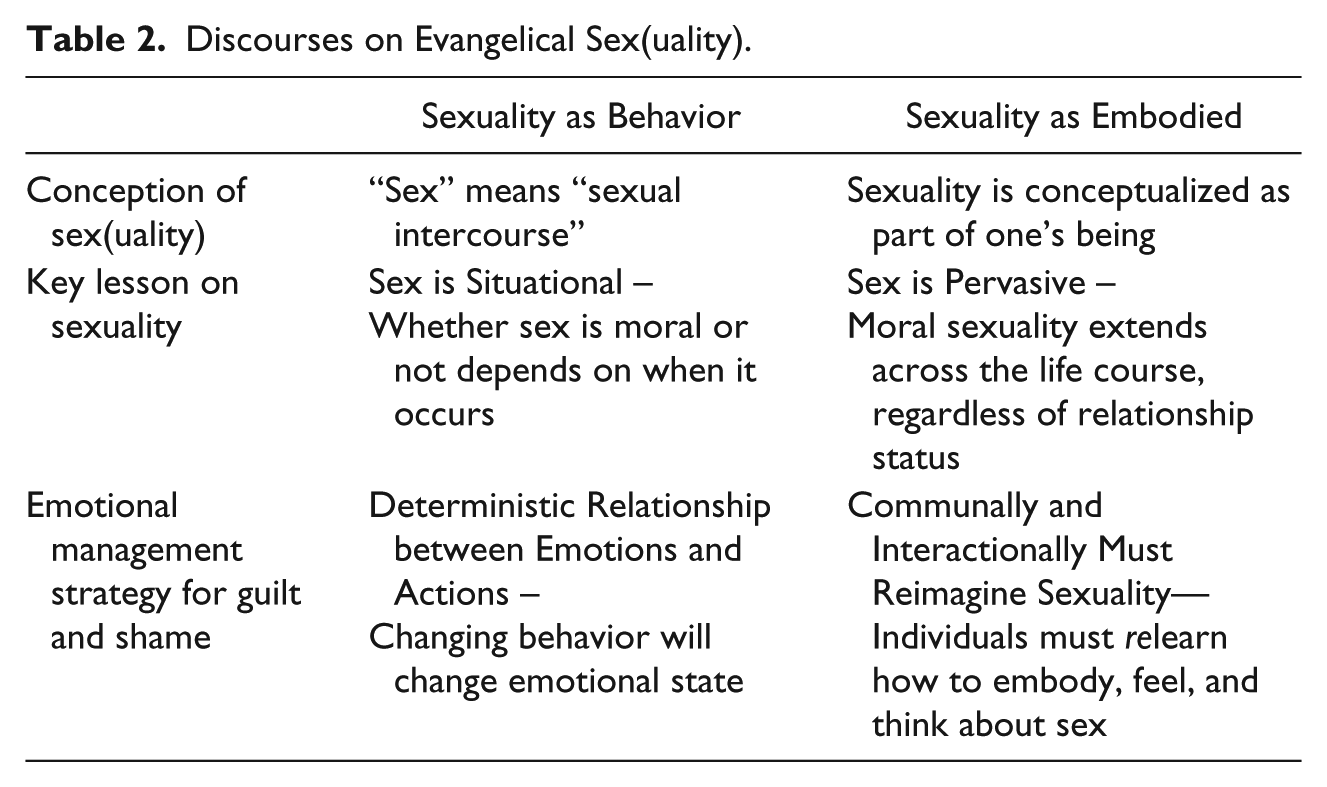
As with the rest of American society, evangelicals have spent the decades following the sexual revolutions of the 1960s contemplating, reflecting on, and renegotiating the meaning of sex within relationships (Burke 2016; DeRogatis 2015; Lewis and Brissett 1986). Despite public efforts to legislate with whom and when people have sex, increasingly a sex-positive rhetoric has emerged within evangelicalism (Gardner 2011; Lewis and Brissett 1986). At the two evangelical marriage preparation programs where I conducted observations, this translated into a shared discourse of sex as a gift from God. At both Exploring Your Relationship Retreat and Cosmopolitan Church, leaders contend God desires sex to be a source of pleasure, enjoyment, and emotional connection for married (heterosexual) couples. Neither site presented what Avishai (2012, 149) has called “the problem of the flesh”—“an ambivalence towards embodiment, the erotic, and desire, and a purported incongruence of carnality/desire and piety/religiosity.” Married volunteers’ advice to premarital couples instead critiqued churches’ tendency to operate from this perspective and saw their own approach as countercultural to not only secular culture but also among Christians. Despite these similarities, the leadership teams offered divergent construction about the meaning of this gift in believers’ lives which led to different “feeling rules” (Hochschild 1983) about sex and advice for how to manage emotions, especially shame. Exploring Your Relationship Retreat sought to present a redemptive view of sexuality as behavior that linked “correct” actions with morally and emotionally more satisfying outcomes. In contrast, Cosmopolitan Church challenged this behavioral approach with their presentation of sexuality as embodied that sought to disassociate God’s vision of healthy sexuality from relationship status or specific actions (See Table 2).
Discourses on Evangelical Sex(uality).
Exploring Your Relationship Retreat Taught Sexuality as Behavior
Intentionally combatting what many premarital counselors viewed as problematic negative messaging within the Church about sex and what they saw as a mistakenly relaxed presentation in secular culture, Exploring Your Relationship Retreat operated from what I call a sexuality as behavior approach that focused on how the act of intercourse emotionally unifies married (heterosexual) couples by providing pleasure and intimacy. Their discussions of sexuality narrowly focused on assessing “sex” as an action that under the right circumstances fulfills this promise from God or at the wrong time obstructs it. As with Gardner’s (2011) “sex is great rhetoric,” the leadership offered a sex-positive account of sex as a pleasurable reward for the faithful. For those that have strayed, the behavioral emphasis provides clear instructions on how to change actions that produce negative emotions of sexual shame and guilt. These lessons were transmitted by the three volunteer, lay, married couples that read from scripted talks. The talks had been written in advance and edited by the rest of the leadership team to ensure that they centered on personal stories from their marriages while only occasionally weaving in lessons from evangelical self-help books and scriptural stories.
Setting the tone for the talk on what Christian sex is and should be, the sexuality session began with a discussion of virginity loss during the honeymoon. Sharing their story, Paul and Kelly explained “The honeymoon is not about great sex. Great sex is a product of time and communication.” Instead, they encouraged couples to “enjoy the honeymoon” but warned “be aware it may not live up to all the romantic fantasies you have imagined.” Illustrating their own experience, they alternated reading their parts to tell a unified story.
Knowing that we may be tired after the wedding and that it would be difficult our first time, we decided that we would like to try and have intercourse but it wouldn’t be a priority. As virgins, we knew we needed to adjust our expectations for the wedding night. In order to ease into the evening, maximize our time learning about each other, and enjoy ourselves, we planned out the event down to the little details. Paul visited the cabin early to stock it with food to ensure there was no reason to leave to eat. He even decorated the cabin.
Once they arrived at their room after the reception, they began to take things slowly, as planned. However, it turned out they had proceeded “too slowly” because Kelly became tired, leading Paul to self-deprecatingly joke, “It felt like I spent the whole night waiting for her to wake up. Just watching her sleep.” Kelly thoughtfully interjected to explain, “His patience was a symbol of love.” Leaning into the awkwardness of sharing the story of their first sexual experience to a group of strangers, Paul joked that he remembered thinking to himself during their own marriage preparation “I won’t be that guy up there telling the embarrassing story about his wedding night, but little did I know.” Against a secular and evangelical backdrop that constructs sexual pleasure as a critical bond in a relationship (DeRogatis 2015) and the reality that first sexual experiences are not the best sex, Kelly and Paul recast the meaning of a honeymoon for premarital couples, “Our honeymoon was the first time in our relationship that we spent a full 24 hours together without interruption. This time was important because we spent it together. And, the sex helped establish trust in our relationship.” While in many ways engaging in sexual intercourse is conspicuously absent in much of this story, it still offers a clear narrative of when people should have sex, how it should make them feel, and its appropriate place within Christian relationships.
Starting from the view that virginity represents a gift (Carpenter 2005), they construct a narrative that situates sex as about becoming a couple and not about individual desire or needs. In sharing their story together and carefully pointing out the ways their partner was attentive to their needs, the scripted talk allowed them to paint an idealized scene of how sex should be a unifying and mutual act. By emphasizing the couple, the talk discursively removes personhood and identity from the construction of sexuality. Unlike broader secular, and even academic, discussions of sexuality that tend to conceptualize sexuality as an identity held by an individual (Ghaziani 2017), Paul and Kelly’s narrative sets the stage for the remaining session which discursively limited sexuality to a behavior. The emphasis on behavior allows them to accentuate couples’ interactions and the emotion work of marriage that calls individuals to supplement their own emotional states to their partner’s.
In comparison to this “successful” narrative of waiting until marriage, the youngest couple on the team, Monique and Danny, offered a less perfect account of their sexual pasts. Yet, their story presents premarital couples with a consistent emotional framework in how it details that failure to act according to God’s vision will not result in the correct feelings. Each took turns explaining how despite their Christian upbringings they eventually had premarital sex, not just with each other but with previous partners. Starting off with his more relatable story, Danny explained that he had “learned the importance of abstinence” growing up in the church but that it mostly consisted of “because the Bible says so.” Eventually he became dissatisfied with this message and by age thirty he “fell off the path.” Without providing too many details, he noted, “My first sexual encounter was not something great or special.” Articulating a similar frustration as the evangelical men that Diefendorf (2015) interviewed, Danny believed the Church had failed to explain why he should avoid premarital sex. As Monique began to share her sexual past, her normally ebullient personality shifted and tears slowly started to stream down her face as she briefly shared her pain of being sexually abused by her father. She eventually realized that “as a result of this early sexual trauma, I used sex as a way to feel cared for in relationships.” To begin a process of healing, she spent a year not dating (and not having sex). By telling their stories separately, Danny and Monique’s isolated narratives about their sexual history emphasize the dangers of individualized approaches to sexuality that removes it from the framework of the couple and God’s vision of the gift. Neither includes details of their past partners or relationship status, instead they framed their sexual experiences as personally motivated and not as an act to bond intimately with someone.
Shifting from telling her personal background to their collective story, Monique explained that as the year of singleness ended, and during a time when she felt stronger in her faith, she met Danny and they began to date. Within a couple weeks they were emotionally committed and, following their previous patterns, had initiated a sexual relationship. “Since we were confident in the fact that we would marry,” she recounted “we began to have sex because we were convinced it was part of our love.” Within less than a year, they were engaged and as a present Danny’s parents paid for them to attend Exploring Your Relationship Retreat. Monique recalled that as she read over the schedule “the section on sexuality felt like a shining beacon calling me out.” Unlike previous Christian discussions about sex, they believed the weekend helped them to recognize the reason for abstinence.
Sex had come to dominate our relationship. We had explored our bodies but not each other. The consequences of premarital sex had always been easy to see but the blessings of obedience had been obscured. We began to see this was not only about protecting ourselves [against pregnancy or STIs] but also about what it provided.
Their own attendance at the weekend shifted their views on sexuality away from individualistic concerns, such as “exploring our bodies” or “protecting ourselves,” to instead understand how their behavior distanced them from God’s gift. Along with the other leaders at that time, Paul and Kelly presented the idea of “second virginity”—making the decision to recommit to premarital abstinence and seek forgiveness from God. Feeling compelled to change their behavior and a desire to feel differently about their sex life, Monique and Danny made the decision to stop having sex until their wedding. While they explained this was not easy and that they accomplished it with the help of accountability networks, they passionately argued that by changing their actions they were able to fully experience God’s grace, the gift of sex, and recapture the honeymoon experience. Comparing their earlier experiences of sex as a “forbidden fruit,” Monique noted “Even though everyone, and I mean everyone, knew what we would be doing that night, for once I felt no shame. Instead, sex on our wedding night involved the receiving of blessings.” Danny followed with, “Our wedding night felt like the first time all over again. It was awkward and exciting. But, the experience of being able to engage in these acts without shame and with the knowledge that we had received the full blessing was wonderful.”
Exploring Your Relationship Retreat’s leadership team sought to provide couples with a motivation for remaining abstinent until marriage. Seeking to address what they considered to be an existing limitation in “the Church’s” approach to sexuality, they rhetorically replaced telling people what they cannot do or what they need to avoid with a call for what they could emotionally and spiritually obtain. While this approach follows a broader discursive shift to a sex-positive rhetoric (DeRogatis 2015; Gardner 2011), it remains predicated on the belief that by conforming one’s actions to community-sanctioned expectations, a person can achieve the idealized emotional state. The morality of sexuality is determined by considering whether, when, and what types of sexual behaviors are acceptable. To determine the answers to these questions, the overarching sexuality as a behavior framework links sexual intercourse to marital intimacy. Sex, therefore, is a project of the couple and becomes removed from the legitimacy of an individual’s claims to desire. Implicitly, this helps ensure that the construction of sexuality—its purpose and emotional consequences—remains heteronormative. A behavioral approach that centers “the couple” works against claims that sexuality is about personal identity or orientation that have dominated queer discourses. While the heteronormativity was subtle and never brought fully into the lessons for the couples, “there is no binary division to be made between what one says and what one does not say” (Foucault 1978, 27). Despite a discussion during a prayer session about whether they should draw attention to an upcoming ballot for marriage equality in Washington state, the leadership only used their time with the couples to emphasize the importance of sex as a project for couples. Additionally, this collective emphasis also posed limitations on individual sexual exploration. Most notably, pornography and masturbation were discussed as problematic because of how they made sex a selfish act oriented toward individual pleasure and not about establishing intimacy between the couple. During the question-and-answer section later that evening, Paul shared an unscripted story about how a long trip overseas during their marriage had him worried about sexual temptation. Through prayer and intentional work, he recounted how he was able to make it through the whole trip resisting these selfish urges.
Cosmopolitan Church Taught Sexuality as Embodied
Whereas the sexuality as behavior framework addresses a tension among evangelicals transitioning into a sanctioned sexual life by focusing on what actions are appropriate, Cosmopolitan Church operated from what I call a sexuality as embodied approach that calls for greater reform within the Church to recognize sexuality as part of one’s life regardless of marital status. Unlike the previous approach, here sexuality is more than sexual intercourse and, instead, conceptualized as a core part of one’s humanity. Cosmopolitan Church’s dating and engaged programs contested emotional management strategies that asserted changing actions or getting married provides people with a happier and guilt-free sex life. The lay volunteers that led these classes instead targeted evangelicals’ “emotional regime” (Riis and Woodhead 2010) for how it cultivates, disciplines, and teaches people to express their sexuality. While they employed a similar confessional strategy of personal stories, this was accompanied by therapeutic insights from the husbands’ professional training and experience as marriage counselors. This approach was typified in the dating classes at Cosmopolitan Church.
To open the evening’s discussion, Michael asked “How has the Church talked about sexuality?” Raising their hands to share memories, people recalled how premarital sex appeared to be a “greater” sin and express their frustration that “the Church says premarital sex is bad but doesn’t say why.” Immediately, and repetitively, their answers emphasized shame, which led Michael to comment, “Shame is something that keeps coming up with this topic. We hope tonight will be shame free. All are welcome here in whatever way you are here.” Elaborating and beginning to articulate the critique that would dominate the evening, he explained, Whenever you have something so powerful and important that it becomes clouded in shame it sends it underground. I hope that the Church will make sexuality less taboo in the future and celebrate it more. God is clearly good with sexuality because He gave it to us as a gift which can be seen in both the Old Testament and the New Testament.
After another person agreed that they had never experienced celebratory discussions of sex in Church, Michael rhetorically asked the class of dating couples: “How do we talk about this in a better way given that the focus on behavioral processes makes it difficult?” Before anyone could respond, he proceeded to explain, “One of the issues is in how we define sexuality because it is more than arousal. Sexuality is a part of our self and we can’t turn it off. However, we don’t have a lot of sex-positive messages in the Church to help understand this.” Rather than open with the leadership’s personal stories or lessons about what to think, Michael instead guided the class in a discussion to consider how evangelicals talk about sex. Unlike Exploring Your Relationship Retreat’s scripted talks, this provided premarital couples an opportunity for reflexivity that turned immediately to emotional consequences of sexual discourses. Building upon the couples’ own criticisms, he connected them to the rhetorical practice of conceptualizing sexuality exclusively as behavior. Only after this critique had been established did the leadership turn to briefly present biblical insights and share their own personal stories about struggling to enjoy sex in marriage.
To begin, Lauren-May, Caleb’s wife, rhetorically asked, “How do you make the jump from little to now it’s all on the table?” To illustrate the difficulty of this transition she explained, We had a lot of guilt and shame prior to marriage because of boundaries we had not successfully maintained. Somehow we thought that being married would solve those feelings. It took time, however, to negotiate these previous feelings and to realize the impact of the expectations that I had brought into marriage.
She believed her expectations had been partially skewed by living in a sorority house in college that left her with a sense that couples have sex four to five times a day. Stressing that “communication is key,” she concluded her perspective of their story by noting, “Sexuality eventually became a source of joy and delight, but it took time and communication to accomplish this.”
In contrast, Rebecca experienced little guilt because her long-distance relationship with Michael meant they had crossed fewer personal boundaries. Confessing that they “hadn’t really talked about their expectations in advance,” she provided a different vantage point about struggling with the sudden freedom to explore sex. She observed “It was just hard to go from ‘No, no, no’ to ‘Okay,’ because I said ‘I do.’ Sex took a long time for me to adjust to.” Pausing, she continued, “ . . . especially because of the pain. Initially it was so painful. I thought it would be instantaneously pleasurable. In fact, I even went to a doctor because the pain was so significant, and I didn’t know what to do.” In a frustrated voice, however, she noted “But the doctor just told me, ‘It will get better after you have a couple kids.’ That wasn’t very useful since we weren’t planning on having kids right away.” Offering a similar conclusion as Lauren-May, she said “As a result of the pain, we really had to work on our communication about sexuality because Michael didn’t want to cause me pain.” Speaking to dating couples more likely situated in the “battleground” stage of sexuality, the two women’s stories offer cautionary tales about the impact of the behavioral approach and undermines claims that marital sex will be instantaneously easy and enjoyable. They reveal how their emotional (and embodied) management strategies entailed a continual process of shaping and reshaping emotions (Hochschild 1998) to align them with personal, couple, and cultural expectations for how to feel about sex in marriage.
After having turned a slightly brighter shade of red than he had been earlier, Michael returned the class to a broader critique of sexual discourses but targeted secular culture this time. “Sex in marriage has to do with the level of trust between the partners,” he explained before condemning media’s efforts to sell people on the “hottest sexual act” which he argued has meant that “Western culture turned sex into a product.” Or, as Caleb later explained, “When we focus on the physical, it’s all about what the self gets out of sex. But, when the focus is on the couple it’s more about being together and what together the couple gets out of it.” After commenting that “the transition is part of learning to embody and honor one’s sexuality,” Michael changed the pace of the class by leading everyone in a “soul-gazing” exercise. For three minutes, couples sat facing each other with their knees touching and were instructed to communicate to their partner why they are drawn to them without talking. Some stared deeply into each other’s eyes, others slowly caressed a non-erotic part of their partner’s body without making eye contact, and one woman even silently shed tears. After couples shared feeling connected and drawn in by their partner during this exercise, Michael challenged them to reconsider how they express sexuality.
In Western culture, we tend to focus on how quickly and erotically we can express our sexuality. But, it’s these small moments, which can be even in public places, can establish intimacy and are closer to what God wants us to experience. God gave us our sexuality not just for our own pleasure but to experience a difference in marriage, compared to our other relationships. It is the intentionality that is the key difference.
While echoing broader evangelical criticisms that Christians must avoid individualistic and hedonistic attitudes towards sex (Lewis and Brissett 1986), the leadership moved the conversation beyond the behavioral focus of intercourse. Calling people to “embody” their sexuality, the soul-gazing exercise encourages couples to not limit sexual intimacy to the bedroom but instead learn to feel their sexuality connecting them to their partner in any setting.
Returning to the lecture format Michael inquired of his fellow leaders, “How do we honor God with our sexuality with each other?” Caleb answered by sharing his own perspective about transitioning and learning to embrace sexuality in their marriage.
This is an evolving process. I really struggled with boundaries prior to getting married which impacted my sexual experiences in marriage. Eventually, I sought to understand: “What does God look like in our sexual relationship?” I realized we had kept our sexuality and sexual relationship from God—or, at least we had tried to because of shame—of course, it’s not actually possible to keep anything from God because He knows.
Echoing Lauren-May’s earlier account, he admitted, “The first few years were really rough because marriage felt like a title and I struggled with what I had brought into it.” Breaking her silence, she briefly interceded to note this had been harder on him than on her. Agreeing he explained, “I had to really learn to accept, and know, that God had created me to be a sexual person. Sexuality is about creating children but it’s also meant to be something more fulfilling. It feeds one spiritually, emotionally, and physically, by connecting you to your spouse.” Breaking the awkward tension of his emotional revelation, he joked “it’s not like we now pray before we have sex or anything,” but his somberness quickly returned as he admitted that sexual healing only began after realizing that “my shame ran so deep that I didn’t even feel comfortable praying for healing in this area because it made me feel sick.” Connecting Caleb’s story and providing some personal details of his own, Michael again pointed to the Church’s failure to recognize that sexuality is central to personhood and noted as a single person “sexuality was part of myself” but had “problematically been self-driven.” Therefore, he entered marriage “sexually focused on myself and my own pleasure.” Crediting his relationship with Rebecca, he described needing to learn “those ideas were largely about me and not about a ‘we’ or an ‘us.’” Today, he tries to pass on this wisdom in his private practice by teaching couples to “focus on making sexuality and sex a ‘we’ and consider how they want to make intimacy together.” While sexual pleasure eventually enters these narratives, the leadership appeared to presume couples know of that possibility and instead focused their efforts on the work required to make it possible.
Despite Cosmopolitan Church’s commitment to abstinence (which included pastoral staff sometimes refusing to marry couples they knew were living together and/or having sex), the volunteer married couples that led the premarital education programs did not center this message. Instead, they avoided telling people what they cannot sexually engage in and sought to craft a redemptive message on sexuality that destigmatized conversations and feelings for all Christians, regardless of marital status. The discussion alternated between targeting the level of couples with advice on the necessary emotion work (Hochschild 1983) required for sexual pleasure and the level of evangelicalism’s emotional regime (Riis and Woodhead 2010) that has made this difficult to obtain. The sexuality as an embodied approach offers an incisive critique of the behavioral approach, as well as challenges the dichotomy between spirit and body and the belief that sex is only spiritual within the context of marriage (Moon 2004). Their critiques, however, were distinctly evangelical in their condemnation of individualistic and hedonistic attitudes fostered in secular society (Lewis and Brissett 1986). The discourses also shared Exploring Your Relationship Retreat’s view that sex is a gift from God to be worked out collectively as a couple in marriage. Abstinence may have been absent from their actual discussions but comments, such as Michael’s claim that God designed sexuality to make marriage distinctive and the repeated call for sexual communication that produces a “we,” reveal that sex is meant to be part of the project of being a married couple. Yet, in the sexuality as embodied framework, this became one, but not the only, dimension of sexuality. The call to broadly recognize individuals as sexual beings and the expansion of sexual intimacy beyond intercourse also allows for the potential queering of evangelical sexuality. At the time of data collection, this potential was left unrealized since discussions in class never challenged heteronormativity and nonheterosexual couples had not participated in the courses.
Shame and Pleasure: Emotional Management of Evangelical Sexuality
American evangelicals discursively have maintained a view that reveres sexual purity and views it as a gateway to the great sex that God promises to (heterosexual) married Christians (Gardner 2011; Hendershot 2004; Irby 2013; Malone 2018; Wilkins 2008b). Yet, this rhetoric is in tension with the lived experiences of evangelicals emotionally, spiritually, and physically struggling to make the transition from battling their sexuality to enjoying sex (see also Malone 2018; Sharma 2011). Even the leadership of these premarital counseling programs, who are charged with guiding and preparing couples, all told stories of having to reflect on, reevaluate, and eventually augment their understanding and feelings about their sex lives. These confessional stories, along with the exercises and discussions, create a space for “emotional training” (Schweingruber and Berns 2005) where the leadership attempts to change the way that couples think and feel as part of a pursuit for marital success. For the training to be successful, however, they must provide couples with emotion management strategies that offer couples a sense of what emotions need to be changed and how to induce feelings that may not initially occur (Hochschild 1983; see also Hochschild 1998; Lois and Gregson 2018; Wolkomir 2001).
Each program crafted a narrative of the emotional journey for sexual lives that loosely mapped onto the broader evangelical battleground-to-playground template. Targeting supposedly hedonistic secular discourses and problematic abstinence messaging within the Church, the leadership presented premarital sexuality and early sexual encounters in marriage as characterized by negative feelings that must be managed and replaced. In their place, they offer a jointly pleasurable sex life. On a general level, the two groups share this assumption that all couples will need to move from shame to pleasure through a process of self-reflection that identifies one’s own needs and marriage work that make these known and ensures an outward orientation to one’s partner. The personal stories told as part of the divergent discourses, however, reveal different processes for emotional management.
The sexuality as behavior approach at Exploring Your Relationship Retreat presupposed a deterministic relationship—specific actions produce certain emotions. To remedy sexual frustration, shame, and guilt, the leadership counseled couples to evaluate and modify their behavior. The session focused on two narratives that illuminate how following the “right” actions will ensure a rewarding honeymoon (and by extension pleasurable sex life in marriage). The first honeymoon account did not mention shame because it involved people conducting the right actions and achieving the “correct” (or desired) emotions, but the younger couple had to change their behavior to reduce their negative feelings and receive a similar experience. From this vantage point, shame is a small-scale problem for individuals whose actions are inconsistent with (the leaders’ interpretation of) God’s gift.
In addition to the causal model offered in the sexuality as a behavior approach, the leadership’s scripted talks also allowed them to more intentionally control the discourse allowing for a simplified and clean explanation for how to reach a desired emotional state. Over the years, however, there has been consistent negative feedback about reading their talks. To address this problem, Kelly explained in our interview, “We started bringing props into some of it, trying to make our presentation a little more lively, and trying to encourage new team members to read with enthusiasm and make it as real as possible.” By crafting their messaging beforehand and practicing how to present their stories, their talks blend what Hochschild (1983) calls “surface acting” and “deep acting.” While, in writing out their talks, the leaders sought to tap into their own real emotions, sharing the stories also had to focus on impacting and convincing the audience. Showcasing and revealing their emotional states lends authenticity and credibility to their messages about how to feel and the ease by which behavioral change can produce positive sexual feelings.
In contrast, the sexuality as embodied approach at Cosmopolitan Church relocates the source of shame to both the evangelical subculture and secular culture which shifted the strategies of emotional management in a variety of directions. For the evangelical community, Michael made recommendations for how discourses could be changed at the organizational level to ideally reduce individuals’ misconceptions about sexuality and shift what people hear about sexuality within the emotional subculture (Kolb 2014). At the individual level of the couples attending, the leaders drew on their therapeutic backgrounds to stress the importance of communication skills to help people recognize how they presently feel about sex, their hopes for sex in their marriage, and how to achieve a desired emotional state about their own sexuality. The embodied conception of sexuality complicated the emotion management narratives that the leaders shared, as well as how they presented individual believer’s emotion work (Hochschild 1983). Unlike Danny and Monique who found relief in changing their behavior, Caleb experienced shame as a virgin. Although he never had sexual intercourse, past feelings of sexual shame continued to cause problems even when they engaged in sexual activity within the approved context of marriage. Previously having made the “right” choices was insufficient immunity against the need to engage in this emotion work. While teaching an emotional management strategy that broadly calls Christians to relearn how to embody, feel, and think about their sexuality prior to marriage, the specifics of how to do this emotion work were less clear.
Cosmopolitan Church’s classroom structure that utilized lectures and exercises to cultivate individual learning also contributed to the multivocal messaging in the sexuality as embodied approach. The extemporaneous presentation that sought to cover numerous points and encourage class participation meant that people were able to walk away with different insights and feelings. In contrast to the interviews with participating couples at Exploring Your Relationship Retreat where people frequently commented on the emotional vulnerability of the leadership, those attending Cosmopolitan Church more often struggled to understand what they were supposed to do with the sexual lessons. As one man explained, “We left nowhere [near] having more information. We were frustrated a little about that at the end.” While, in our discussion, he, along with his girlfriend, eventually were able to recall talking points, they remained disappointed that the classes had not clarified matters on this issue that they struggled with.
Ultimately, the programs’ sexuality sessions predominately offered emotional instruction rather than technical guidance. Specific concerns, such as contraception, emerged infrequently and generally because of a participant’s question. Compared to many evangelical dating and marriage self-help books that often present how-to instructions for Christian sex (Burke 2016; DeRogatis 2015; Irby 2013), the leaders of these programs focused the little time they had to talk about sexuality on how to feel. In other words, they did not instruct couples in the logistics of having sex but rather sought to structure how couples experience sex by impacting the emotional states surrounding sex and sexuality. The lessons were less about instructing sexual bodies and more about disciplining sexual feelings. Sex represents part of the project to become Christian and an opportunity to sublimate selfish desires to fulfill God’s calling. In turn, it ties feeling the “right emotions” with spiritual authenticity (Wilkins 2008a; Wolkomir 2001).
Conclusion
By examining distinct ways that evangelicals conceptualize sexuality, the present article builds on recent work that empirically highlights how evangelicalism is not anti-sex but has, in fact, embraced a sex-positive rhetoric (Avishai and Burke 2016; Burke 2016; DeRogatis 2015; Gardner 2011; Lewis and Brissett 1986). Yet, the present work also points to the boundaries and tensions within this rhetorical shift. Despite the leadership’s best attempts to present sex as “God’s gift”—a unique blessing within (heterosexual) marriage—they could not escape the themes of shame, embarrassment, guilt, and pain. Lessons on sexuality became aimed at cultivating Christians who could successfully navigate moving from battling their sexuality to enjoying it which required presenting emotion management strategies (Hochschild 1983). Similar to Foucault’s (1978, 35) critique of Victorian repression, evangelicals have “not consigned sex to a shadow existence, but [have] dedicated themselves to speaking of it ad infinitum, while exploiting it as the secret.” Likely, other evangelical sexual discourses have proliferated as well but, in this article, I analyzed the emotional language within what I call sexuality as behavior and sexuality as embodied approaches. In each case, the spoken and unspoken claims about what sex is and its purpose were packaged with views about how one should feel about their sexuality and the necessary steps to ensure the correct emotions.
By showing how talk about sex has consequences for how to feel about sex, the article points to the potential power of local faith communities to reify, reimagine, and contest evangelicals’ emotional regime (Riis and Woodhead 2010). Each program viewed themselves as countercultural and as offering premarital couples with a new way to think and feel about God’s gift of sexuality. Resistance and power, however, never occur entirely discretely, but operate in relation to one another (Foucault 1978). Even the attempts to construct new discourses on sexuality reveal how religious authorities continue to use the power of talk to establish parameters around what sex should be, how it should make someone feel, and when it is moral. Religious communities’ requirement of, and particular curriculum within, premarital counseling legitimizes their right and moral prerogative to emotionally structure believers’ lives. Additionally, by infusing sexual lessons with emotional management strategies the programs model the moral importance of self-discipling and reinforce evangelicalism’ emotional regime. In fact, as lay leadership, and not official religious authorities, the premarital counselors instructing couples lend an authenticity to the ability for everyday believers to do this work. Their personal narratives of adjustment and sacrifice within marriage provide emotional motivation, instruction, and the possibility of what couples can have if they work on themselves and with each other.
Footnotes
Acknowledgements
I appreciate the helpful feedback I received from earlier presentations of this paper at the Religious Research Association’s 2014 annual meeting, the Sociology of Religion’s Working Group at Loyola University Chicago, and at Illinois Wesleyan University’s Religion Department’s 2018 spring Colloquium. In addition to the editor Charles Edgley and three helpful anonymous reviewers, I also thank Lucas Sharma and Todd Nicholas Fuist for their suggestions.
Declaration of Conflicting Interests
The author declared no potential conflicts of interest with respect to the research, authorship, and/or publication of this article.
Funding
The author disclosed receipt of the following financial support for the research, authorship, and/or publication of this article: Research for this project was funded by the Sociology of Religion’s Joseph H. Fichter Grant, Arthur J. Schmitt Foundation, and Loyola University Chicago’s Graduate School.