




Abstract
This article analyzes the production of memory on a neighborhood scale, comparing the different logics that shape narratives about the past in the historic center and a peripheral area of the city of Valencia (Spain). We analyze the uses of the past developed by three kinds of actors: local institutions, social movements, and residents. This line of research shows that administrators boost aestheticized memories oriented towards commodification and tourist promotion in the historic center and towards an unconflicted representation of interculturality in the periphery. These hegemonic narratives are being reproduced, appropriated, and negotiated by social movements and local residents, who replicate some elements of the official narratives while, at the same time, resignifying other parts and claiming neglected and erased memories. Urban memories function, therefore, as a political arena for the imposition and negotiation of different dynamics and transformations experienced at the local level.
Introduction
Since Halbwachs (1968) we know that past can sediment in spaces as collective memory. On the basis of this idea, we can find a large literature in the fields of urban sociology and anthropology focusing on the essential role that past and memory play in urban dynamics. A wide range of empirical and theoretical studies that analyze how “memory politics” (Hunter, Loughran, and Fine 2018) or the “political economy of memory” (Bélanger 2002) develop in different territories, regarding collective memory as a crucial domain for the negotiation of multiple urban transformations. This work follows mainly a neo-Marxist critical approach inspired by authors such as Harvey (1973) and Lefebvre (1974), introducing complementarily some elements of the culturalist urban perspective proposed by Borer (2006, 2010).
This analytical corpus is especially prolific with regard to historical areas where heritage activations, renewal operations, and commodification processes are being developed, focusing on the impact that these dynamics have on local actors and territories. Less attention, however, has been given to urban environments outside historical areas, where past and memory have a subtler presence and exert a more ambivalent role in urban transformations. This article intends to address this gap in the literature, comparing the different logics and dynamics that shape the political economy of memory in a historical neighborhood and a peripheral area.
We base this comparative analysis on the ethnographic fieldwork carried out in two neighborhoods of the city of Valencia (Spain), one case located in its historical district and the other case in the northern periphery. The comparison between these two neighborhoods is of interest because it allows us to examine the multiple ways of using the past that arise in urban spaces with substantially different geographical locations, spatial attributes, and historical developments.
In order to analyze the political economy of memory of each of these neighborhoods, we pay attention to the uses of the past developed by three different actors: administrators, social movements, and residents. The dialectic relationship between these three local social actors shapes different memories and narratives, following particular logic depending on their location within the city. In this regard, administrators try to establish hegemonic memories related to heritagization practices and commodification dynamics, developing hegemonic narratives that are negotiated by social movements and residents. Local organizations reproduce part of these official memories, while reappropriating, resignifying, and contesting other aspects of the established narratives from a subaltern position. Finally, out of vindicatory contexts, but also from subalternity, residents share individual memories that can become collective and nourish alternative narratives about the place.
This article starts, first, with a contextualization of the two studied neighborhoods and a presentation of the applied methodology. Second, we develop a theoretical framework based on the analytical axes of hegemony/subalternity and individual/collective memory. After that, we approach the construction of memory developed by administrators, focusing on dynamics such as heritagization, urban renewal, and institutional relegation. Then, we address the uses of the past deployed by urban social movements, paying attention to the negotiations of the hegemonic narrative. Finally, we focus on biographical memories and nostalgic anecdotes shared by residents, reflecting upon their relationship with other existing narratives. The article finishes with some concluding thoughts.
Methodology
This article is based on the comparative ethnographic study of two neighborhoods located in the Spanish city of Valencia: the area of Velluters, part of the historic district, and the neighborhood of Els Orriols, located on the northern edge of the city. The selection of the two study cases responds to the main aim of this research: contrasting the different ways in which the political economy of memory deploys in both the city center and a peripheral area.
Valencia is a medium-sized city located on the Mediterranean coast of Spain. With around 800,000 inhabitants sits as the third biggest city in the country. Its size and location, together with a long period of right-wing hegemony in the local governance (from 1991 to 2015), have fostered an intense application of neoliberal urban policies aiming to place it in the global market of cities. Spectacular architecture projects, international sports events, and city-branding operations have represented a major part of the local urban policy during the last decades, shaping a city of substantial contrasts. A neoliberal urban strategy that, despite the formation of a left-winged coalition in 2015, is still ongoing, as it proves the strengthening of Valencia as a major international tourist destination.
Within this city, we are going to focus our analysis in two different areas. Velluters, with around 4,000 inhabitants, is one of the neighborhoods of the historic district of the city and its origins date back to the 14th century when silk manufacturers started to settle in the area. This part of the city center, characterized by prostitution, drug dealing, stigma, and intense urban decay at the end of the 20th century, went through a series of urban regeneration operations that led to still ongoing gentrification dynamic. In the last few years, despite the persistence of urban decline and stigma in certain parts, Velluters is revitalizing with the arrival of new residents and its promotion as an area of touristic interest. The presence of the past is, therefore, very significant in this neighborhood with more than six centuries of existence and different heritage assets related to its historical connection with silk manufacturing.
The second neighborhood, Els Orriols, with nearly 17,000 inhabitants, is a peripheral working-class area that developed in the second half of the 20th century propelled by Franco regime urban policies. It was an old agrarian village that was absorbed by the large expansion of the city during the 60s and 70s, when plenty of working-class migrants coming from other parts of Spain settled in the area. The poverty of these populations nurtured the bad image of some parts of this neighborhood associated during the 80s with drugs and criminality. More recently, it has become one of the main reception areas of the city for international migrants, concentrating significant situations of urban precarity and leading to its institutional categorization as a vulnerable area. In the case of Els Orriols, as we will see, its brief history, as well as its peripheral location, make the social significance of the past more ambiguous.
Within the framework of different research projects (Multicultural coexistence in times of crisis. Comparative analysis of two neighbourhoods in Valencia (2012-2013), Living-together and multicultural neighborhoods: conflict and social cohesion in Spanish crisis, 2015–2017 and Diversitours: Valencia intercultural tours, 2021), fieldwork has been conducted between 2016 and 2019 in Velluters and between 2012 and 2021 in Els Orriols. First, systematic participant observation has been carried out during these periods, through permanent residence and activism in local organizations in the case of Velluters and through recurrent visits and participation in local associations in Els Orriols. Second, we have done semi-structured and in-depth interviews with different neighborhood profiles and local associations activists (31 residents of Velluters and 15 of Els Orriols), NGOs and social organizations (5 in Velluters and 4 in Els Orriols), and local administration workers (4 in Velluters and 1 in Els Orriols). In addition, five focus-groups have been conducted with actors from different local organizations of Els Orriols. The selection of the actors interviewed responded to purposive sampling, according to the objectives of the different research projects mentioned and based on the knowledge of the context provided by ethnographic fieldwork. Finally, we have carried out a content analysis of multiple documentary sources produced by administrators, local and national media, and social movements, including an analysis of web and Facebook pages.
Urban Memories: From Hegemony to Subalternity, from Individual to Collective
Urban space is produced through contradictory narratives that are connected to different disputes over uses of memory and related to multiple political and economic processes. The concepts of “politics of memory” (Hunter et al. 2018) or “political economy of memory” (Bélanger 2002) propose, precisely, a critical analysis of the political, economic, cultural, and symbolic disputes among different actors, such as institutions, social movements, and inhabitants, in order to shape collective memories and social representations of the past. Institutional actions play a decisive role in the cultural and historical production of urban space, moving between the logic of heritagization and commodification (Brumann 2012; Herzfeld 2015). Heritage logics are applied, from hegemonic positions, shaping urban policies that seek to attract capital and a well-off population (Berliner 2010; Mirabal 2009; Mitchell 1998; Santamarina, Mármol, and Beltran 2014). At the same time, memory and past are invoked and mobilized from subaltern positions, engaging with practices of resistance developed by urban social movements (Aricó, Mansilla, and Stanchieri 2016; Fioravanti, 2020; Herzfeld 2015; Mompó 2019; Portelli 2020; Zhang 2006). The tension between hegemony and subalternity results, in this sense, essential to comprehending the role of collective memory in the cultural production of urban spaces and senses of place.
These uses of the past, both institutional and counter-hegemonic, show different levels of nostalgia, a way of relating to the past that is useful for constructing a sense of belonging (Ocejo 2011). Nostalgia is produced within power relationships (Bissell 2005), in a multivocal and ambivalent way (Berliner 2010, 2012). It can be the basis for institutional operations (Contreras 2017), a source of legitimacy for political claims (Mitchell 1998), and a platform for negotiating structural conditions and transformations (Herzfeld 1997). According to Berliner (2010), we can distinguish between two main different ways of evoking the past. On one hand, some local actors develop “endonostalgia,” seeing the present as the loss of something lived in the past. On the other hand, we can find “exonostalgia,” when actors and groups yearn for a past that has not been personally experienced. We can find this last form of nostalgia in the actions of experts who promote and defend heritagization and elites who develop gentrifying narratives about the place. There is a gray area between these two forms of nostalgia, shaped by different notions of history and multiple expectations about the future.
When we think about this in terms of hegemony and subalternity, we adapt the Gramscian proposition considering social domination or subordination supported by dynamics of consent or coercion (Gramsci 1979). Both dynamics come from policies that support market operations that constrain the life of people in places and build limits for actions and expectations. But, at the same time, subjects in a subaltern position do not remain passive. We observe that exonostalgia tends to be produced from positions of social domination, while endonostalgia has the potential to function as a platform for resisting and negotiating power and authority. In this sense, in order to build memories that are useful for the commodification of urban spaces, institutional and market forces erase from official narratives those elements of the past that project a negative image of place (Aptekar 2017; Bissell 2005; Salamandra 2013).
This relegation of certain pasts is coherent with the dynamics of dispossession and displacement of the local population (Berliner 2010; Herzfeld 2015; Mitchell 1998; Zhang 2006) and the creative destruction logic characteristic of “neoliberal urbanism” (Peck, Theodore, and Brenner 2009). This concept refers to the global shift of urban policies towards the commodification of cities, the attraction of capitals and business opportunities, and the consequent extraction of surplus value from certain urban spaces (Cox 1993; Harvey 1989). On one hand, we find urban redevelopment projects, intensive and highly localized urban operations promoted by public administrations in collaboration with the private sector with the aim of reverting processes of urban decay and generating attractive spaces (Roberts and Sykes 2000; Swyngedouw, Moulaert, and Rodríguez 2002). On the other hand, we find operations of urban marketing oriented at the reshaping of urban images and the production of city brands capable of competing in the global market of cities (Boyle and Rogerson 2009; Paddison 1993). Neoliberal urban policies, therefore, have an important effect on local memories, since redevelopment plans and marketing operations act on previously existing narratives and memories of place.
Some dimensions of the past may be relegated to oblivion when it comes to projecting a positive and desirable image of urban space, but they remain in spatial markers and in the memory of some residents (Small 2004). Commodified environments and spectacular territories that are attractive often contrast with stigmatized areas that constitute spaces of fear that provoke rejection (Kingman Garcés 2011). Something that is possible to recognize in the changes and continuities of particular toponymies that may differ from official denominations (Fernández 2014). In this sense, populations that have been dispossessed or displaced from certain urban areas preserve their individual memories about the place and can take part in the production of shared narratives, reproducing the hegemonic imaginaries or resisting them with alternative memories (Berliner 2010; Mitchell 1998; Salamandra 2013; Small 2004).
Thus, narratives about the place are shaped in the crossroads between individual and collective memory. Local actors experience urban transformations and incorporate them into their biographies as individual memory but, at the same time, these accounts of life can take part in the production of shared narratives about the place (Giglia 2012). Moreover, these individual memories can give authority to certain subjects, when recalling particular episodes of the past reinforces their own position, following patterns of hegemonic memory construction (DeGloma 2015). The possibility of individual memory gaining a collective dimension is enhanced when those who evoke the past are active in the collective production of place (Borer 2006, 2010). This is why activists of social movements tend to have a relevant role in the production of shared memories and narratives. In other cases, individual memory connects with conflictive pasts and neglected denominations, shaping uncomfortable representations about places that can hardly be incorporated into the narratives fostered by administrators and social movements (Mitchell 1998). Mainly at an institutional level, occasions for narrative remembering support the manifestation of collective memories in occasional or regular occurrences and through particular places (museums, sites, events, monuments, etc.) or artifacts (pictures, plaques, etc.) (Linde 2005).
The political economy of neighborhood memory is shaped, as represented in Figure 1, in the tension between the actions of administrators, social movements, and residents in nonactivist contexts. Different ways of using the past differ according to the position of these actors along the axes of hegemony/subalternity and individual/collective memory.
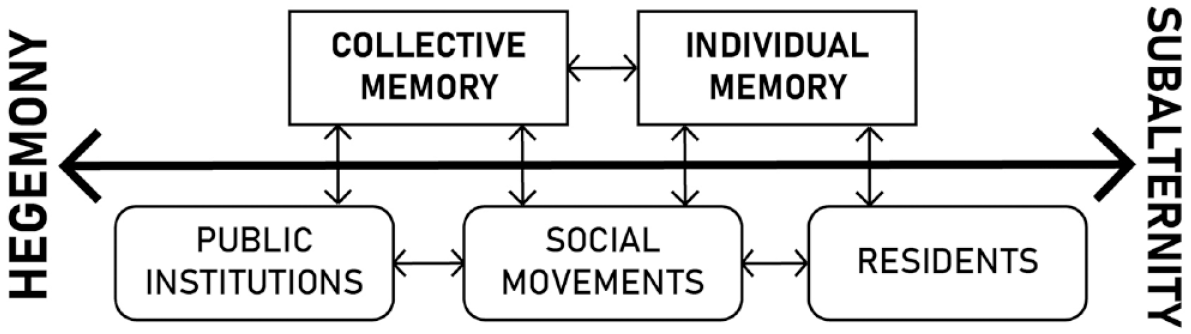
Axes and Actors in the Production of Collective Memories.
We observe that social movements are in a relationship with both administrators and individual residents who are not necessarily activists, shaping an interaction that is crucial in the production of collective memories. In this regard, residents produce individual memories that may end up being collective especially through the action of social movements. At the same time, administrators focus on the production of collective memories and narratives that tend to be disconnected from the individual lived experiences of neighbors.
As we show in the following analysis, these multiple ways of using the past follow different logic depending on the location and characteristics of each urban environment. This article compares two different neighborhoods of the same city precisely with the aim of contrasting how these tensions between hegemony/subalternity and individual/collective memory develop in different territories. On one hand, we show how central and peripheral areas differ in terms of the relevance of market-oriented imaginaries and heritage operations, contributing to urban dynamics of gentrification and relegation. On the other hand, in both areas, we can see how actors situated in subaltern positions negotiate ongoing urban and social transformations. Social movements and residents reproduce, appropriate, and re-signify hegemonic representations and narratives, evoking in some cases alternative memories that can boost the emergence of neglected pasts and denominations.
The Institutional Production of Narratives about the Past
One of the main actors that establish narratives about the past in these two neighborhoods are administrators. Regarding Velluters, we can see how local administrations are activating and promoting a memory that places its historical connection with silk manufacturing in the center of the narrative. The very name of Velluters, which could be translated as silk craftsmen, reveals its past relationship with the silk industry. Its toponymy unveils that in the past it was the area of the city that housed the silk and velvet manufacturing trade. This activity, one of the main economic drivers of Valencia between the 15th and 19th centuries, was concentrated in this area of the city, exerting a crucial influence on the development of this neighborhood (Baydal, Aparisi, and Esquilache 2020; Reig Armero and Taberner 2000; Teixidor de Otto 1982). However, this historical connection with silk manufacturing has not always been part of the official narrative of this territory. It is a past that administrators began to recover in the 80s, as we can infer from the following words of Antonio, a neighbor born in Velluters: In the 80s or so they started to say Velluters, Velluters, Velluters. But I’ve never heard the name of Velluters before in my life. I found out about the history of the silk and the silk district and all that. . .. Having lived here all my life I had no idea. Yes, I knew about the Colegio del Arte Mayor de la Seda [the silk art guild building] (. . .) but I had never noticed the houses and all that, and suddenly it became trendy to talk about the silk district. (Antonio, 55 years old, born in the neighborhood)
Antonio explains that he only learned about the neighborhood’s historical links with the silk industry in the 80s, when the name of Velluters and the role of silk manufacturing in this area and in the whole city began to be socially and institutionally claimed (replacing the former name of El Pilar, hardly used nowadays). He was aware of the presence of heritage elements such as the building of the silk art guild (Colegio del Arte Mayor de la Seda), declared National Historic-Artistic Monument in 1981, but he underlines that it was the restitution and fostering of the silk district memory that happened in the context of a political movement of defense of local language, culture, and heritage during the period of the democratic transition what allowed him to give meaning to these symbolic references.
Later, during the 2000s, administrators dedicated, once again, important efforts to promote this past connection of Velluters with silk manufacturing. They did it in the context of urban regeneration plans and interventions carried out by the URBAN Initiative funded by the European Union
1
aiming to reverse the situation of abandonment, decay, and stigma that characterized Velluters at that time (Gaja Díaz 2009; Sorribes 2015). These operations implied a series of material transformations, mainly the restructuring of the urban layout and the construction of cultural amenities such as a School of Design (EASD) and the Valencian Museum of Illustration and Modernity (MuVIM). At the same time, local and regional administrations deployed a symbolic operation with the purpose of generating a renewed imagery of Velluters capable of attracting private investments and new residents (Fioravanti, 2020). Following neoliberal urban logic, administrators sought to shape a new narrative of the neighborhood very different from the stigma of marginality, associating Velluters with cultural dynamism, historic charm, and heritage interest. The following words of Emilio, born in Velluters and active in the neighborhood association at that time, point in this direction: A project for a neighborhood that has already begun to regenerate, that has already recovered its historical name, a neighborhood project in which the boards of the Colegio de la Seda, Institut Français, MuVIM, NGOs, etc., are participating, right? What kind of neighborhood we want, right? And the idea that we all defended at the time was the idea of a cultural neighborhood that could become part of the cultural tourism of the city, which until then had stopped at the gates of this neighborhood. (Emilio, 57 years old, born in the neighborhood)
Emilio argues that regeneration plans allowed Velluters to begin to regenerate and recover its historical name. In this context of transformation of the neighborhood and its image, administrators collaborated with different institutions to shape a “cultural neighborhood.” A new narrative that would restore the historical relevance of this territory and contribute to include it in the cultural tourism circuits from which Emilio considers that it had been unfairly excluded. His words reveal how different institutional actors contributed to the production of a new narrative of Velluters that is closely connected to the recovery of the silk memory that began in the 80s and played a pivotal role in the process of regeneration and revitalization of the area BE.
A dynamic of commodification that has become especially intense since 2015, in close connection with the significant increase in tourism in the historic center of Valencia. In recent years, administrators are cooperating with different organizations and private actors to promote tourism in Velluters, using the silk manufacturing memory as the cornerstone of the image they seek to project. These initiatives include the restoration of the silk art guild building, after decades of abandonment and continuous citizen claims of restoration, and its opening in 2016 as a private museum (promoted by the Hortensia Herrero foundation) where visitors can learn about this historic art, and the creation of a tourist brand under the idea of the “Silk Road” that same year. These actions are shaping a context in which this neighborhood has started to be regarded as an area of the historic center that treasures the legacy left by the artisans and masters of the art of silk manufacturing, fostering the promotion of the area and some of its buildings as potential tourist destinations.
In the case of Els Orriols, administrators are nurturing a narrative about the neighborhood that weaves its past as an agrarian village with its current multicultural character. Despite the existence of two heritage monuments in the area, they have little projection in terms of collective memory and tourist appeal.
On one hand, the medieval Monastery of San Miguel de los Reyes, a prison between 1844 and 1966, a public school between 1971 and 1985, and the current headquarters of the Valencian Library and the Valencian Academy of Language, fails to become a significant touristic spot. The report resulting from the participatory strategy for the design of a comprehensive intervention plan for the neighborhood, 2 carried out in 2017, pointed to the monastery’s potential as a tourist attraction, but at the same time, it also underscored the disconnection caused by of one of the main ring roads of the city (Ronda Norte). On the other hand, another less renowned monument, but one that also stands out in that strategy as an architectural element of interest, is the Church of Nuestra Señora del Sagrado Corazón. This church was part of the monastery of Santa Catalina de Siena, originally located in the center of Valencia until 1970, when it was dismantled stone by stone to build a shopping mall and rebuilt in Els Orriols. In this case, the building fails to take part in the representation of the neighborhood not only because it is located on its outer edge but also because of the obvious artificiality of its construction in this area.
Rather than its monumental assets, as we can see, is the past of Els Orriols as an old little agrarian village that nurtures the institutional narrative. In this regard, it is significant that the historical core of the neighborhood has been declared as Heritage of Local Relevance and that the rehabilitation of two farmhouses has been undertaken to host a youth center (under construction for years) and a cultural center (awaiting the end of an ongoing restoration). The most visible urban operation developed in Orriols during the last years has been the construction of a square in front of the hermitage of San Jerónimo, the main symbolic milestone of this idea of an old agrarian village. The square was inaugurated in 2018 and was the result, as we will explain later on, of a neighborhood claim that included a participatory process on how it should look. The selection of vegetation typical of old agrarian hermitages, the image of the old houses located in the historical core of the neighborhood, and the intervention on the ceramic cobblestone paving this square convey a sense that recalls the previously existing agrarian houses that were demolished more than 20 years ago. In addition, the original location of the hermitage has been highlighted in the paving. At the public inauguration ceremony, the mayor of the city said that the new park had been created: In accordance with a broad discussion between those responsible for the project and the neighborhood associations, considering the history of Orriols. . .. That is why the garden reflects the footprint of the old houses that were there and also the place where the old hermitage was. . .. In some way this garden aims to be the town square, the square of Orriols. (Valencia Plaza, 6 February 2018, originally published in Spanish)
When the square was inaugurated rumors pointed to the opening of a very well-known Valencian restaurant in one of the old town houses locate on one side of the square. Moreover, one of the organizations in the neighborhood suggested that the pedestrianization of the area may catalyze a gentrification process.
Finally, more recently, administrators have developed a project aiming to design and organize intercultural tours to this neighborhood, represented as the area of Valencia that best shows its cultural richness and diversity. The places visited in these tours are very diverse, ranging from the two monuments previously mentioned, the historical core of the neighborhood and the hermitage of San Jerónimo all the way to local shops, ethnic restaurants, an Islamic Centre, a Sikh Temple, and local associations. Here, administrations collaborate with different local organizations in the production of a narrative of Els Orriols that interweave its history as a little agrarian village, its past as an area of working-class migrants from other parts of Spain, and the recent arrival of international populations characterized by its ethnic diversity.
Overall, we can see that administrators play a central role in the production of hegemonic memories and narratives about the place, drawing on certain historical facts, heritage assets, and neighborhood sites while leaving aside other elements. Our two study cases evidence that this institutional construction of memory follows different logic in the historic center and the city’s periphery.
In the case of Velluters, the production of official memory connects with urban regeneration plans, processes of heritagization, and touristic branding. Precisely, its historical connection with silk manufacturing is instrumentalized by local administrations, who have fostered the renewal of the area and the promotion of heritage assets connected to this past in order to establish an aestheticized imagery useful for the commodification of the neighborhood. An official narrative that encapsulates the denomination of Velluters, promoted by local administrations because it is easily recognizable and capable of effectively evoking appealing values such as historicity and authenticity.
In Els Orriols, in contrast, its peripheral location and the disconnection of the few existing heritage monuments lead to a significantly different logic in the production of institutional memory. Here, the references to the origins of the neighborhood in a little agrarian village condensed in the name of Els Orriols are woven with imagery that presents it as an unconflicted symbol of ethnic diversity and interculturalism. Administrators, in this case, rather than pursuing urban renewal, heritage activation, and tourist promotion, aim to create and idealized narrative of the neighborhood capable of disputing its frequent associations with relegation and precariousness.
Uses of the Past by Social Movements
The social movements of these two neighborhoods are also placing the past at the center of their actions, claims, and narratives. In relation to Velluters, we find two examples that demonstrate the crucial role played by memory in the revindications made by neighborhood social movements. The first one is a local festivity called the Foguera del Motí dels Velluters (Bonfire of the Silk Workers Riot), a celebration held every year in this neighborhood to commemorate an uprising led by silk workers that took place in Valencia in 1856. It is a festivity that started in 2008 as an initiative promoted by the neighborhood association as part of the campaign “Velluters, un barri viu” (Velluters, a lively neighborhood) aimed at improving the image of the area and promoting a shared identity among inhabitants. Over time, other social movements have joined the organization, leading to the transformation of this celebration with new logic and claims. 3
This festivity includes different activities such as historical tours where the neighborhood past is explained and performed, parades with music to attract the attention of the citizens, and demonstrations that allow these local social movements to express different political demands. The celebration ends in one of Velluter’s main squares, where residents share dinner and celebrate around a large bonfire. These kinds of rituals developed by social movements are used to update historical memory with events that have been excluded from the hegemonic narrative (Del Valle 1997). It also allows these actors to trace a continuity between the workers’ struggles of the past and the current urban movements, giving legitimacy and historical depth to their claims and frameworks of meaning.
But most interestingly, this festivity involves an appropriation and negotiation of the established narrative of Velluters, the one that, as we have previously shown, instrumentalizes the past connection of the territory with the silk manufacture to foster the commodification of the area and the attraction of tourists. These social movements mobilize this very same past, but they do so in a very particular way, commemorating a working-class riot. They are not reproducing the official narrative of the silk industry, the history instituted by and from “places of memory” (Nora 1984). On the contrary, they are retrieving the memory of a little-known historical event that reflects the resistance of the working classes. They are, in short, appropriating the memory of the silk district with the purpose of resignifying it in very different terms, emphasizing the conflictive dimension of history and the relevance of class antagonism, highlighting the working-class character that they assign to the neighborhood and its inhabitants. Despite this contentious and counterhegemonic character, it is interesting to see that the celebration of this festivity has been included by administrators as one of the tourist attractions that are promoted on the official website of the Silk Route in Valencia.
A second example of how social movements are using the local urban past can be found in the collective claim of an abandoned plot located in Velluters. This place, neglected for several decades, was occupied in 2011, in the context of Spain’s so-called Indignados movement, with the aim of refurbishing it into a collectively managed space. Since then, Ciutat Vella Batega (Old District Beats), a local organization created at that time, has long struggled to turn this abandoned plot into a space for gardening, practicing sports, and social gathering, proposing a project managed collectively by the local community.
In addition to occupying this site, this association has investigated and publicized the past uses of this place, such as popular games, agriculture, silk production, and charcoal trading. A past that they link with the use they intend to give to this place in the present, proposing to build a playground where there used to be one before and to set up allotment gardens in an area that used to be agricultural centuries ago. A range of past uses have also been represented in a large mural created by different graffiti artists, converting one of the walls of the plot into a platform for neighborhood collective memory. These actions reveal a strategic utilization of the past, an appropriation of memory that allows this local organization to emphasize that this place has historically been a space inhabited by neighbors and, therefore, to express their legitimacy to occupy it and fill it with life in the present. An appropriation of space and memory that we can understand, according to De Certeau (1980), as a manipulation of the logic of power carried out to dispute the imposed order.
Regarding Els Orriols, as we have previously seen, the hegemonic narrative of the neighborhood evokes its origins as an old agrarian village and links it with unconflicted imagery of ethnic diversity and interculturalism. We find echoes of these elements in some of the activities and mobilizations developed by local associations. Precisely, we find a very illustrative case in the actions carried out, since 2014, in the abandoned plot where the hermitage of San Jerónimo was located until 2018. These activities were boosted by a group of neighborhood organizations that collaborated in the initiative Orriols Convive (Orriols Living Together). This project, which brings together cultural, social, and religious organizations as well as individual residents, is located very close to that plot. It is an initiative that emerged from a project financed by European funds and launched by the NGO Valencia Acoge (Valencia Embraces), which began with a participatory diagnosis that clearly evidenced the relegation felt by those who live in Els Orriols. Dirt, insecurity, and the lack of facilities became a unifying element for the different people who participated in Orriols Convive meetings (Moncusí-Ferré, 2017). The hermitage location used to be a muddy plot full of rubbish that was functioning as an improvised car park, but it ended up becoming a symbol of neighborhood struggle. Orriols Convive organized music concerts, film screenings, and several working and festive events with the purpose of claiming the construction of a square in that abandoned plot. Among other things, they organized traditional games, a contest on the memory of the neighborhood, and several workshops where the interest of both the hermitage and the old town center was vindicated.
In addition, these actions claimed the multiethnic character assigned to the neighborhood, leading to the celebration of an intercultural week every year. The event includes photography exhibitions and talks on the cultural diversity that represents the foreign origin and the Roma ethnicity of part of the neighborhood. They also celebrate a parade with traditional dances and music from different parts of the world, concluding with a fair with stands from various organizations. The plot where the hermitage was located now is a square and it is the place chosen to start and finish the parade and to celebrate this neighborhood associations fair. In front of the hermitage and at the core of the old village, traditional Valencian parades are combined with batucada rhythms, capoeira, and typical dances from Colombia.
The uses of the past developed by social movements show similarities and divergences in the city center and the periphery. In both neighborhoods, we can see that local social movements are negotiating the hegemonic memories promoted by administrators, adopting and reproducing some elements of these narratives about the past, but also resignifying or contesting other dimensions. Past functions, in both cases, as a powerful resource that social movements activate and mobilize in order to give legitimacy to their actions and claims over urban space.
In Velluters, we have seen that history plays a central role in the actions and narratives developed by social movements, mainly as a consequence of its location in the historic district. Here, we observe a stronger opposition to the hegemonic narrative, associated with the administrators’ efforts to renew, commodify and promote the area. Local social movements are reproducing the memory of the silk manufacture and claiming the denomination of Velluters, but, at the same time, they are reappropriating it from a counter-hegemonic position, emphasizing the role of subaltern actors in history and resignifying the narrative of the silk neighborhood in terms of class struggle.
By contrast, in Els Orriols, the past of the neighborhood is not as intensively used by social movements. They tend to reproduce, in this case, a narrative significantly similar to the administrators one, emphasizing its origins as an agrarian village and its current multicultural atmosphere. However, the referents arise here in the context of vindication and collective claim over a space that symbolizes the relegation and precariousness experienced by the residents of this peripheral neighborhood, transforming this narrative, in this way, into a useful platform to convey and legitimate their demands in front of local institutions.
Lived Memories: Accounts of Life in the Neighborhood
This political economy of memory is complemented with a third domain that moves on a more individual level and emerges when residents share their biographical experiences about life in these neighborhoods. In the case of Velluters, we observe that accounts and anecdotes about how life in the neighborhood used to be in the past shape a memory that has similarities and differences with the idea of the district of silk artisans that, as we have previously shown, is being promoted by administrators and re-signified by certain social movements. We can see this, for instance, in the following words of Amparo, a resident who has lived her entire life in Velluters and is currently active in the neighborhood association: And this was like a village. And the doors were left open. And people would come down to the streets to play, the children, I mean. And it was another world. Now it’s nothing like that. Nothing to do. The neighborhood, the essence of the neighborhood is being lost. (. . .) Besides, all the drug problems and. . .. Prostitution has always existed, but the prostitution used to be very respectful with the neighbors, everyone occupied their own space and respected each other’s space. (Amparo, 57 years old, born in the neighborhood)
We find a similar narrative in the words of Emilio, who was born in Velluters and used to be a leader of the neighborhood association: The neighborhood had a very bad reputation, El Chino, considered a dangerous, ugly neighborhood, but inside there was a very intense social life. The children played in the streets. The ground floors of buildings were also used as dwellings where people lived. In the summer they brought their tables out in the street to eat. There was a lot of interaction between all the people who lived here, right? Including the prostitutes too. They would pass by and say: hello, good morning, etc. All that has disappeared too. (Emilio, 57 years old, born in the neighborhood)
Also, Luis, a resident who has known Velluters for more than four decades, shares similar memories about how the neighborhood used to be: But it has changed a lot, from the past, (. . .) to now, well. . .it has changed out of all recognition. Because back then, people trusted each other. . .especially among residents. (. . .) The prostitutes themselves were friends with the neighbors, with the. . .. Neighbors used to take care of their children. There was a relationship like. . . neighbors, friends, family. (Luis, 75 years old, related to Velluters for more than 40 years)
Accounts of life such as those of Amparo, Emilio, and Luis were common during the ethnographic fieldwork. We found them in interviews but also in informal comments during celebrations or everyday interactions. These anecdotes shape a nostalgic memory of life in Velluters in the 60s and 70s, a period they associate with intimate neighborhood sociabilities that they yearn for in the present. They tend to follow a very similar narrative plot, referring to a nearly mythical time when the neighborhood is recalled as a “family” in which everyone knew each other and was part of trust, protection, and reciprocity networks. Here, local urban space is presented as a place where sociabilities, including those between neighbors and sex workers, were close, friendly, and supportive. They also tend to point out that the neighborhood changed dramatically with the arrival of issues such as drugs, migration, and trafficking, which, according to them, are responsible for the loss of these idealized local sociabilities.
These accounts refer to the so-called “barrio Chino” (the Spanish term for red-light districts), an area of Velluters that was since the 40s one of the main sex work spots in the city. The historical presence of prostitution, together with the arrival of drugs and urban decay from the 80s onwards, led to an intense process of stigmatization of Velluters, which came to be regarded as a marginal, decadent and dangerous area. The need to eradicate the activities that characterize the “barrio Chino” acted as a legitimizing narrative that served to justify the intense urban regeneration operations which, as we have seen, were developed within the framework of the URBAN Initiative at the end of the 90s. The idea of eradicating the “barrio Chino” has also driven different campaigns carried out by the neighborhood association aiming to displace sex workers and drugs from the streets of Velluters.
As previously analyzed, a series of urbanistic operations transformed this territory materially, demolishing a large part of the buildings and replacing them with new constructions and facilities. These operations served also to displace drug dealing and sex work from the streets of Velluters, now less present and concentrated only in a small stretch of a road. The transformation was also symbolic, associating the area with cultural dynamism and promoting it on tourist circuits as the area of the historic district that treasures the legacy left by the art of silk manufacturing. This collective imagery has been constructed in direct opposition to the idea of the “barrio Chino.” A past that is denied and erased in the official narrative, but that, nevertheless, as we have just seen, emerges in the biographical accounts of some residents.
As pointed by Ocejo (2011) and Contreras (2017), nostalgia cannot be reduced to a simple sentimental yearning, but it needs to be regarded as a platform for collective empowerment, a political strategy useful for transgressing the imposed social order. Sharing memories in the social interactions of everyday life is a way to go from individual to collective memory. We can observe this in the case of Velluters, where nostalgic memories of how life used to be in the “barrio Chino” serve to express the collective feeling of loss of identity references caused by urban regeneration. They express, as well, the discontent with current neighborhood sociabilities, perceived in the present as impersonal, distant, and distrustful. Anecdotes referring to the good relationships that there used to be between residents and sex workers allow the emergence of a past that is being denied in the established narrative. In this sense, idealized memories of how everyday life used to act as a channel to recognize that the “barrio Chino” is also part of the past of Velluters, offering in some cases reconstructed materials to reverse its oblivion in the collective narrative.
Regarding Els Orriols, we can observe how a hidden narrative and a neglected name are also emerging through biographical memories. The name “Barona” refers to an area of working-class houses built during the 1960s in the context of Franco regime housing policies, where migrants from other parts of Spain settled. An alternative name for the neighborhood of Els Orriols that is associated with drugs, crime, and insecurity. In a similar way to what we have shown in relation to the “barrio Chino,” the narrative of Barona as a sordid area is not omnipresent and categoric. On the contrary, it also allows the emergence of nostalgic memories that turn this part of the neighborhood into a privileged place for collective identity. In this sense, we find in Els Orriols a shared perception of the relegation of the neighborhood in the hegemonic urban order. This is expressed, for example, by neighbors like Fernando, an activist who has lived in Orriols his entire life: This neighborhood has a bad reputation. Also, Russafa [another neighborhood of the city] has a lot of immigration, but I don’t know why. . .. I guess because it is closer to the center, it is a more historical neighborhood. . .. There are many people who live next door, and you tell them about a shop here that is very good. . .and they say: Where?! In there?! (Fernando, 57 years old, born in the neighborhood)
We can see it as well in the following words of Maria, a leader of the neighborhood association: Barona is actually Orriols. . .. People don’t like to call it Barona because it was. . .the worst thing in Valencia. They always used to say: “don’t go to Barona.” My mother wouldn’t let me cross Primado Reig [an avenue that separates both areas] because Barona was the worst part of the city. . .. The neighborhood was very affected in the period in which heroine spread. . .. There was also a time of a big crisis here, during the 70s. At that time people were. . .immigrants as well, from Albacete, Cuenca, Teruel [other cities of Spain]. (Marisa, 59 years old, resident in Orriols for more than 30 years)
Another resident expressed herself in a similar way in an informal conversation recorded in a shop: Thirty or forty years ago nobody knew Orriols. Now people know it, since the bus arrives there and it says Orriols on it, and since they built the beautiful part. Because every time I’ve been out of here, I’ve always introduced myself as a girl from Barona and it has always caused rejection. (shop customer, 45 years old, born in the neighborhood)
The “beautiful part” that she refers to is the residential area known as Nuevo Orriols (New Orriols), where some people who used to live in Barona moved. Others like Santiago, on the contrary, decided to stay. In spite of all this, we observe that his memories of Barona are not negative: This neighborhood was one of the quietest and safest in all of Valencia. My wife and I used to go out around Valencia, we used to go to the cinema, and we didn’t feel very safe in the center of Valencia and when we were back in the neighborhood we said: “well, now we’re calm, now we’re home.” This neighborhood used to have a lot of shops, a lot of retailers. It had the economic life of a neighborhood. If they did something, they didn’t do it here, they did it somewhere else. . .. People said: “you, having the possibility of buying a flat or renting a flat in another place that isn’t there, how come do you live there?” I’m fine. I’ve never had any trouble with security. . .. I live in a flat that I like a lot. (Santiago, 76 years old, resident in Orriols for more than 50 years)
Life in the streets and shops is an anchor point for a memory that presents the neighborhood as a safe space. The relevance of these local sociabilities also arises, presented with nostalgia, in a Facebook page called “No eres de Barona si no. . .” (You are not from Barona unless. . .),
4
created in 2015 with the purpose of sharing old pictures and informal conversations about how people and places of the neighborhood used to be in the past. The elements that constitute the hegemonic narrative, such as the monastery of San Miguel de los Reyes, the hermitage, the streets of the historical core, and the agrarian origins are resituated and redefined within the framework of interwoven biographical accounts, allowing the emergence of memories of how life used to be in Barona. Expressions such as “the neighborhood has changed a lot, I miss it so much” appear as comments on the pictures posted by people recalling their childhood or adolescence. For instance, a member of this Facebook page posted the following comment: And the location of Alfonso garage used to be a cabbage field and the ditches and the leather house alley and the sawmill and the alley leading to the road with the fountain. I came here when I was 4 years old and here I am, such beautiful memories! Playing in the streets and having dinner there, too. (February 8, 2018)
It is frequent to see people that join this group pointing out that they no longer live in “la barriada” (the slum area), although they remember it. In this context, these biographical accounts reveal that Barona was inhabited provisionally for people whose parents emigrated from other parts of Spain.
A few months after its launching, the page turned into a platform to claim improvements in the neighborhood, criticize urban planning, and complaint about the antisocial behavior of some residents. In recent years, old pictures alternate with advertisements and announcements of activities promoted by neighborhood organizations. Significantly, a new Facebook page called “Yo soy de Orriols” (I am from Orriols) 5 was created this year. The description of this page indicates that it has been launched as a continuation of the page “No eres de Barona si no,” although this one is still active. One person greeted on the page by stating: “I’m happy to see the real name of our neighborhood ORRIOLS.” Here, we observe an incipient symbolic replacement of the name of Barona by Orriols, important for some of the residents even if the old nostalgic pictures are to remain in the original page. Over this same period, a third Facebook page called “Barrio Orriols (Barona)” 6 has been launched, where the name of Barona is preserved, although it appears in between brackets.
This third domain of memory works quite similarly in the city center and the periphery. In both neighborhoods, residents’ lived memories function as a platform for the emergence and restitution of a past that has been neglected both in the hegemonic narratives and in those mobilized by social movements. In this sense, we observe how the denominations of “barrio Chino” and “Barona” are used to recall a dark and stigmatized past that both administrators and social movements have left aside in their particular ways of using the past. These biographical memories function as anchor points in the present that enable these hidden narratives of the “barrio Chino” and “Barona” to come out of oblivion. Nostalgic stories about the past serve, thereby, to reveal the omissions and distortions that shape the main narratives of place, evidencing the intrinsically selective processes through which administrators, economic actors, and social movements mobilize history.
Nostalgic accounts of life play also an important role in the negotiation of wider urban and social transformations experienced by residents of both neighborhoods. In Velluters, memories of life in the “barrio Chino” serve to deal with the transformations caused by urban regeneration plans and to express the loss of close sociabilities and shared identities, while in Orriols the nostalgic memories about “Barona” allow residents to negotiate a sense of belonging and exclusion to a neighborhood characterized by precariousness, insecurity, and stigma, expressing in this way a shared experience of relegation and contesting the official neglect of the area.
Conclusions
We have shown that administrators, social movements, and residents in nonactivist contexts operate differently in the production of collective memories of a neighborhood, following significantly diverse logic depending on their locations in the historic center or in the urban peripheries, as well as on their positions in relation to the axes of hegemony/subalternity and individual/collective memory.
On one hand, we have seen that administrators, in a hegemonic position in a central neighborhood, activate heritage assets useful to boost an aestheticized version of memory oriented towards commodification and tourist promotion. Also reinforces the denomination of the neighborhood with a name that contributes to this commodifying imagery. This is what we have observed in the Valencian neighborhood of Velluters, where the hegemonic production of memory is negotiated by local social movements, who reproduce some elements of the official narrative while, at the same time, resignifying and contesting other parts of it. For their part, we have shown how residents reproduce the hegemonic narratives and, at the same time, activate individual memories tinged with nostalgia, in order to negotiate symbolically the transformations experienced in their neighborhood, allowing in this way the reemergence of a narrative and a denomination (“barrio Chino”) neglected in the representations mobilized both by administrators and social movements.
Also in Valencia, the case of Els Orriols illustrates how the production of collective memories is developed, in contrast, in a peripheral neighborhood. There, factors such as more recent incorporation into the city and the significance of migration in its sociodemographic conformation as well as in its associative, religious, and cultural network give a different role to memory. In this case, administrators draw on the past in order to produce, from a hegemonic position, an idealized and unconflicted representation of the neighborhood. A narrative of the place related to its history as a little agrarian village and to the idea of a community open to interculturality, erected with the onward arrival of foreign residents. Once again, the official memory and a certain name of the neighborhood are used by administrators and reaffirmed by social movements that try to counteract the relegation of the area and claim dignity for the neighborhood reproducing, in this way, elements of the hegemonic narrative. Also, in this case, residents reproduce some of the previous memories, but they also draw on their individual memories in order to foster the reemergence of an erased past and a neglected name (“Barona”), shaping an uncomfortable narrative that is absent in the hegemonic production of collective memory.
In short, the comparison between center and periphery, analyzed under the light of the axes hegemony/subalternity and individual/collective memory, shows how the production of collective memories develops in different ways in the very same city. Precisely, it highlights the different logics that are behind the mnemonic practices of administrators, social movements, and residents, fashioned by dynamics of heritagization, commodification, relegation, and contestation; by the particular urban trajectories and configurations of each territory; and, finally, by the power that different actors have when it comes to shaping narratives about the place. In this sense, additional research is needed to further explore the interconnections between individual and collective memories and the possibilities of generating changes, from subalternity, in the mnemonic production carried out by institutions situated in a hegemonic position.
Footnotes
Acknowledgements
This study has partly been carried out within the research project “Living-together and multicultural neighborhoods: conflict and social cohesion in Spanish crisis” (CSO2014-54487-R) financed by the Spanish Government.
Declaration of Conflicting Interests
The authors declared no potential conflicts of interest with respect to the research, authorship, and/or publication of this article.
Funding
The authors received no financial support for the research, authorship, and/or publication of this article.
