



Abstract
The present article examines women’s narratives concerning the COVID-19 pandemic experience in Athens, Greece. The spacetime contexts that women construct to situate this experience involve the city and the house, the former involving historical and cosmological temporalities, and the second a ritualized domestic tempo that gradually becomes disorganized. In these spatiotemporal formations women develop performative acts of individuality and singularity that end up as explorations of mainly ungendered, bodily selves that exist in the emptiness of a short-term, suspended pandemic present.
Introduction
The COVID-19 pandemic was characterized by immobility in a world that was previously governed by mobility. This immobility, or “spatial continuity in an individual’s centre of gravity over a period of time” (Schewel 2019, 329) concerned relations with space and time, the body and the self. It is interesting that the condition of the COVID-19 pandemic was described by social scientists both in terms of time, the “coronacene” (Higgins, Martin and Vesperi 2020, 2), and space, the “coronascape” (Irons and Gibbon 2022, 223). Globally enforced lockdowns were exemplary moments of a lapsed supermodernity, as Auge (1995) describes it: an “acceleration of history” (26) which led to an overabundance of events, and an “excess of space [which was] correlative with the shrinking of the planet” (31) and led to a spatial overabundance. This abundance of events took place in a temporal stasis, in countless, infinitesimal spatial units. The planet turned into a huge “negative space”, “a space of deletions or of delimitations constraining one’s presence at particular locales” (Munn 2003, 93). Inside this negative space people developed “the clamour of particularisms” (Auge 1995, 34–35), performative acts of individuality and singularity. As immobility entered every moment of people’s lives, a self-reflecting magnifying glass registered and made meaningful even the tiniest trajectories of movements, glimpses of images, and senses of selves. Immobility gradually became perceived as mobility confirming the continuum uniting symbolic and physical movement and challenging existing binaries that divide movement from stability (Cresswell and Merriman 2011; Glick Schiller and Salazar 2013). Already from the 1990s identities were studied in terms of home and movement, linking the two and perceiving the world as a “world of movement” (Rapport and Dawson 1998, 4), both physical and imaginary. During the pandemic the distance between mobility and immobility shrunk and brought along changes in projects of self-making and in people’s internal (im)balances.
In the present article, I explore Greek women’s identities, discursively constituted through narratives of the self, as they developed in the pandemic bio-social condition. I follow Munn’s (2003) idea of spacetime as “a symbolic nexus of relations produced out of interactions between bodily actors and terrestrial spaces” (93) in specific temporalities. I argue that the blurred boundaries of the newly formed immobility/mobility spatio-temporal spectrum of the pandemic led to formulations of new technologies and imaginations of new women’s selves. My fieldwork took place in Athens, Greece in the period 2020–2021 during both of Greece’s major lockdowns: The first was implemented by the government from March 23, 2020 to May 4, 2020. People had to send a message through their cell phones to 13033 to confirm their type of movement (to the pharmacy/doctor, to the super market, to the bank, to help people in need, to attend funerals, to work out outdoors). The second lockdown was in effect from November 7, 2020 to January 11, 2021 when schools re-opened. Fieldwork was also conducted during periods of free movement.
In Greece, the pandemic crisis was the third in a succession of crises (after the financial crisis and the refugee crisis) taking place in the country since 2010. The accumulation of crises lessened hope, “the capacity for imagination on a sense of time and temporal progress” (Pine 2014, 95). The present became a continuous process of waiting for something that could no longer be imagined and time lost its potential to be thought of as filled with possibility: It became a vertigo (Knight 2016), folded, and nonlinear, intensified and uncanny because people could no longer anticipate the future on the basis of it (Bryant 2016). In their introduction to Lilies of the Field, Day, Papataxiarchis and Stewart (1999) define the groups they study (sex workers in London, Aegean Greek peasants and Rom Gypsies) as groups of marginal people who claim personal autonomy and “live in the present [. . .] live in the short-term and, in privileged moments, [and] transform this short-term into a transcendent escape from time itself” (Day, Papataxiarchis, Stewart 1999, 2). What were the spatiotemporal characteristics of the pandemic as a condition of generalized marginality for Greek women? How did time (especially the present) and space in respect to the mobility/immobility spectrum become related to agency? What constructions of the self-appeared and how were they related to the body and gender? In his Principle of Hope, Ernest Bloch insightfully points out that waiting does not equal going to sleep: “Even disappointed hope wanders around agonizing, a ghost that has lost its way back to the cemetery and clings to refuted images. It does not perish through itself, but only through a new form of itself” (Bloch 1986, 195). Or, in Odyssean terms, going to sleep entails mobility and results in a passage to knowledge. The time of the pandemic slipped into a present of suspension, where everyone, confined in space, had to build from scratch their own distinct circular or linear, in any case moving, temporalities and in doing so, re-invent themselves.
Until the lockdowns, Athens was described as a city composed of different, provisional non-places of hyper-mobility, for example, Gazi and Kerameikos/Metaxourgio (Yannakopoulos 2010). A city of “discouraging” (Kanellopoulou 2017, 184), unfriendly, badly constructed and badly maintained sidewalks, often occupied by street vendors, cafés, cars and motorcycles, all limiting neighbourhood walkability for city commuters.
[A city where] people walked in a hurry, going to their jobs and returning to their homes, as if through tunnels made of walls of opaque air. None was looking next to him, or above his height, only looked straight ahead, towards what they were trying to reach. This was the traffic code. (Karapostolis 1995, 12)
For Athens’ commuters to get in touch with themselves they needed the soundproofed environment of a Walkman, iPod, or cell phone (Panopoulos 2010). The Athenian walkability was difficult and non-relational, constantly disrupting relations even with the self. How did walking in the city change during the pandemic? How did the non-relational Athenian walkability become relational during the lockdowns? How was the distant relationship of the city to nature (Avdelidi 2009, 153–154) changed?
Greek ethnography describes the Greek house (spiti) as “a sanctuary from the hostility of both nature and society” (Du Boulay 1974, 38), a “vessel that ensure[d] a subject’s secure place in the world. . . A piece of the world in order” (Papataxiarchis 2005, 10). Moreover, in Greek society, in villages and to a great extent in towns and cities, the house was physically and morally associated with women (Du Boulay 1974; Dubisch 1986; Hirschon 1978). Non-relatives coming inside the Greek domestic space, were treated with suspicion and were considered a potential threat stressing the sharp distinction between the inside of the house and the outside (Pavlides and Hesser 1986; Hirschon 1989). How was the house experienced by Greek women during the two major lockdowns and what were the transformations that took place in perceptions of them as gendered places of security and order?
For the present research, I interviewed 12 Greek women, two of whom I interviewed twice (duration of interviews from one to two hours and a half), permanent residents of Athens living there during the lockdowns. The majority (10 of them) were middle aged, while two were in their late thirties and all of them had gained tertiary education. Half of them were married with children and half of them were single. Through my personal networks, I searched for women of a specific educational level and differentiated marital status. Two of those in the single women’s group were living with their companions and five alone, and two of my informants were lesbians and 10 heterosexuals. More than half of the women I interviewed were living in central Athens (municipality of Athens, Zografou), four in north Athens (Chalandri, Philothei, Papagou, New Heraklion) and two in south Athens (Nea Smyrni, Glyfada). All of my informants were employed (civil servants or self-employed). Thirteen of the interviews were conducted in Greek over Skype and one over Zoom in the winter and spring of 2021. At the time of the interviews, I was at home, as were 10 of my informants. The other two were at work. In the clearly private sphere of Skype (and Zoom) I asked my informants’ permission to use data recorded on my mobile phone. My research method followed the main road of achieving sociality during the pandemic, organized through various digital technologies. For a while, from “the door of my screen”, to paraphrase Rosaldo, I became a “digital native” studying other digital natives in their “digital homes” (Goralska 2020, 49). All my informants described internet sociality as failed, lesser, false, a phantasmatic substitute of something real that had been suspended. Interaction through the internet failed to be recorded as social praxis, and thus it failed to create temporality. My interviews and the relationships I built through them were perceived in equal terms: provisional, casual, a distortion of social relationships and lost time. E., a widow, in her fifties working as a civil servant said: The fact that we do not meet in person but only through the phone or even the internet distorts things, is a kind of seclusion. When you do not directly see the other, your relationship with him is distorted. [. . .] When you see him, things get easier, you can understand the other person. You can enter his reality.
My inability to enter my informants’ reality, as implied by E., perhaps explained the comfort they felt during the interviews. In contrast to the in-person interviews I conducted for many years as a professional anthropologist with people feeling (at least for a while) embarrassed, glancing suspiciously at my recording device, my online interlocutors were “there”, right from the start, relaxed and ready to respond as they participated in a more symmetrical relationship than traditional fieldwork usually entailed (like the “intimate and egalitarian” relationships between online participants and Howlett in her research in Ukraine during the COVID-19 pandemic) (Howlett 2022, 394). Thus, from their homes or the neighbourhoods around them, which traditionally offer ontological security (Bauman 1995), Greek women shared stories of movement and seclusion, and of female selves being continuously discovered.
Walking Nearby: Turning to the City, History and Nature to Make Time
Walking in the city
Tilley (1997, 15) constructs a typology of particular kinds of space that correspond to identities of place. Among them is the “perceptual space”, the “egocentric space perceived and encountered by individuals in their daily practices [. . .], a space of personality, of encounter and emotional attachment” (16) and the “existential space” which is space as it is constructed in the “concrete experiences of individuals socialized within a group [. . .], a space that transcends the individual and form a grounding for perceptual space rather than being some kind of summation of individualized perception” (16). During the pandemic existential space was reduced and perceptual space was augmented. New urban landscapes were created, less bustling, composed of huge empty spaces where only a few people walked, keeping their distance from each other (at least 1.5 meters). Inside these spaces, walking gradually became less blind and unconscious of the bodily poems it created, and through a purposeful, creative practice of moving, created “walkscapes” (Wunderlich 2008, 125) or “embodied spaces”, that is locations where human experience and consciousness took on material and spatial forms (Low and Lawrence-Zuniga 2003, 2). L., a 60-year-old self-employed resident of Philothei says: Yes, I remember my walks, I keep them in my mind like charts. Yesterday, I went to Palia Agora [Filotheis] passing through Drosopoulou square. It was a detour, but I felt the need to see people. And it’s nice. I observed the park, trees, . . . of course the municipality do not do good work. Pines trees always need pruning. . .
The majority of my informants described their walking in Athens turning from an “automatic”, “habitual”, “‘pre-reflective” (Seamon 1979, 41), “purposive walking” (Wunderlich 2008, 131) to a “discursive walking”: A mode of walking where we consciously exercise the global touch, being in complete awareness of the external environment and participating in it. Discursive walking is a participatory mode of walking, during which we half consciously explore the landscape while sensorially experiencing it passing by. (Wunderlich 2008, 132)
Athens was already a fragmented metropolis, whose inhabitants tended, before the pandemic, “to perform the preponderance of their activities, productive and consumptive, in the arena closest to their doorsteps” (Faubion 1993, 41). Now, it was obligatory (through governmental decisions) for them to move solely near their doorsteps. There, women’s little walks literally created “spaces of enunciation” (Certeau 1988, 98), uttered urban trajectories by systematic creative voyeurs as well as narrators of value-laden walking events of the day. E. says that sometimes “I write about my walks, it’s a kind of diary. Going to the super-market becomes the big event of my day, I have to write about it!”. Recording, memorizing and mapping with their feet and, finally, narrating their walks, became a means to “materialize time” (Bender 2002, 103) and turn subjective time into a potentially shared, social time. L. says: I like these walks, they structure my day, otherwise it is like a mush, do you understand? The other day I was talking to Liz, a friend of mine, and she told me where she went for a walk, and I told her too [laughing]. Ridiculous, eh?
By using “rhetoric of walking”, speaking their singular “spatial language” (Certeau 1988, 99) through their steps and paths, creating “spatial stories”, Greek women “existed in the world” (Tilley 1997, 29), understood the new city they had in front of them and constructed a specific spatiotemporal ontology. D., a civil servant in her 50s, mother of two children, living in Zografou and working in central Athens, says: I am in the centre of the city I love. I walk. For me this a way of living. I walk, ok? I miss people around, all this . . . But the space is around me and I live it with my body. I walk the space; I get connected to the space.
The agential character of walking brought about its transformation into an exploration (see also Casey 1996; Kanellopoulou 2017) and the neighbourhood’s transformation into a forest-like place, like the constant changing of paths of the Mbuti within the space of the forest (Turnbull 1961). G., a 60-year-old single woman, self-employed, living in Papagou, described in detail the different roads she used to visit her doctor in Agia Paraskevi, and added, “I need variety. . . I need to change routes all the time”. In her everyday walks around her home V., a 55-year-old civil servant of Philothei, explained “I feel so bored, the only thing I do is to write [for her job] and explore the neighbourhood. Every day, a different part of it”. Every tiny, unimportant piece of public space was turned into a picture, a narrative, a spatial experience creating connectedness, belonging and ontological security in a time of danger. Women turned into contemporary flâneuses, uncovering the secrets of the Athenian landscape (Elkin 2017; Wilson 2001) and often replaced the feminized loitering and looking of window shopping.
Athenian neighbourhoods were, according to Greek ethnography, spaces defined according to social relationships (Du Boulay 1974) or according to geographical proximity to the house and social relationships (Hirschon 1989). The outside of the house was often described as competitive, insecure, dangerous and disorderly, depending on the distance someone went from his/her domestic space. My informants retained this conceptualization of the neighbourhood describing their walks near their houses as relatively safe in contrast to walking, for example, in the city centre were people behaved dangerously. Even though she works in the centre, E. says: “I prefer to stay in the neighbourhood. The other day I went downtown, and I regretted it: people did not keep their distance and some of them did not even wear a mask. I was feeling attacked the whole time”.
Echoing Greek ethnographies of the 1970s and 1980s (see Hirschon 1978, 1989) neighbours organized their walks from their verandas which extended outwards into neighbourhood space and once again turned neighbourhoods into spaces of sociality. E. started to systematically discuss with her neighbour through her balcony and turned it into the new public space of the pandemic (Pournara 2020). There, she made all arrangements to walk with her new friend, on a weekly basis, to the neighbourhood of New Heraklion. Together they enjoyed window shopping or visits to the local super-market “invest[ing] in ‘low-involvement’ yet symbolic daily expenditures” (Chatzidakis 2018, 155) like people did during the financial crisis.
Other women turned their space into an existential one by taking photos of their urban discoveries: of a monument, a wall, a flower, stray cats, photos of Athens from afar. Most subjects created cityscapes of solitude (rather than of solidarity as in the financial crisis, see Chatzidakis 2018) in the social media. From 2020 until today, I have followed a Facebook group called “justification for movement no. 6”. It was a period during which people all over Greece were required to send messages to a government number (13033) indicating the justification for moving outside their private residence. No 6 was the code that referred to movements for exercising outdoors or for walking dogs. Created during the lockdowns, this group (similar to the one Morag [2021] describes in the United Kingdom) was for people to upload their photos taken during their walks in Athens (and in other places) without instructions from any user. In November 2021, Z., a woman active in the group, uploaded a photo (Figure 1) and explained to me: I take photos a lot, I understand people who do this on FB. They upload photos [. . .] this insignificant, everyday thing you can share it with others. And you find out that other people do the same: they walk into the city and share this very simple thing that is outside their doors.
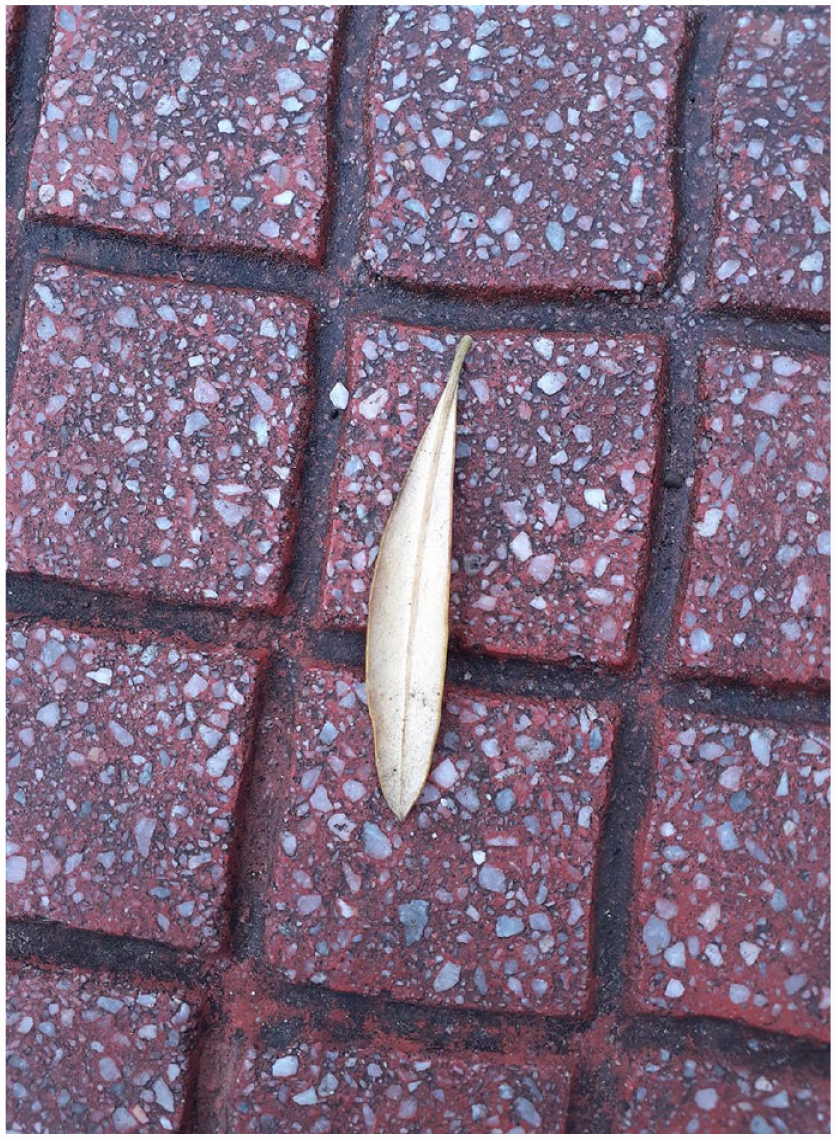
Image courtesy of Z.
Photos of loneliness and a-sociality in the city and its outskirts became a dominant motif of COVID-19 iconography, and later, a means of virtual socializing and of landscape creation, [this] anonymous sculptural form always already fashioned by human agency, never completed, and constantly being added to, and the relationship between people and it is a constant dialectic and process of structuration: the landscape is both medium for and outcome of action and previous histories of action. Landscapes are experienced in practice, in life activities. (Tilley 1997, 23)
To walk in the city was, apart from a narrative experience, a mainly visual one. Discursively and/or visually constructed walking in the city became for Athenian women a consciously performed practice constitutive of female selves rather than an un-hesitating common women’s practice (Faubion 1993, 174).
Moreover, it transformed lost time spent in-between other activities to meaningful time and an act by itself. F. says: This everyday walk, even though it was short, just half an hour, is very important to me. Without it, I feel like I’m sinking. . . I don’t know, it gives me a sense of time, a feeling that I am alive. Without it, time is undifferentiated, it is always the same.
However, this meaningful time remained relatively atemporal as informants failed to specifically describe the time of their walks, something that they did before the lockdowns, according to Avdelidi (2009, 166). During the lockdowns time got disconnected from the western calendar and became long, deep, and historical.
The Past in the Present
Faubion describes Athens as a city in which “the local past dominates the local present”, “classicism prevails” and a unified landscape is formed where the Acropolis and Mount Lycabettus dominate (Faubion 1993, 15) in an otherwise fragmented Mediterranean urban landscape. For a third of my informants, walking outdoors involved looking or visiting (if it was allowed) historical sites situated in the city centre or in its outskirts. For N., a mother of two children in her 30s, everyday walking (with her family) was about experiencing a present of things past, in St. Augustin’s words, where she found “peace”. Her walking around in Athens’ centre, where her house was, often involved seeing “ancient places” as she called them: To walk past the Acropolis, for example, this “relentlessly temporal regime” (37), and just look at it, signified an inner change in the present, her mind’s passage into a place of peace and serenity. She says: I love the ancient places here, so now that I cannot visit them, just to look at them changes me. That means if I am tired, they completely change my mood [. . .]. Yes, to look at the Acropolis, the rock of the Pnyx, the Kerameikos, just to pass by them or pass by the Ancient Agora, this completely changes how I feel. It relaxes me, I don't know why. I admire them, I enjoy them, I like them! I look at the Acropolis and I get crazy! I forget everything!
For N., the monuments were not passively accepting her gaze but actively created emotions in her. Being agential, the Acropolis and other monuments produced experiences and built biographies (see also Yalouri 2001). In the FB group “justification for movement no. 6” people often took photos of monuments like B., a woman member of the group, who uploaded a photo she took of the archaeological site of Brauron (Figure 2). In these pictures, archaeological sites were usually presented empty of people, standing alone in eternity.

Image courtesy of B. Title: 2021, Vravrona [in Greek].
For D., during the pandemic Athenians discovered the historical landscapes of Attica for the first time in their lives and “at last, got to know their past”. V., living in Athens for 20 years now, visited many Athenian historical monuments for the first time in-between the lockdowns. She described how she, finally, found the time to do that, because of her restriction inside the city, and made discoveries of beauty and serenity, a sense of Athens, a city she previously despised: Walking to the Ancient Agora, to the Acropolis, seeing the Temple of Hephaestus, changed my relationship with Athens. Even though I’ve lived here for 20 years now, I despised this city. Now I daydream of it, I have this sense that this rootless city has roots.
Visiting ancestors’ places became an individual means of aboriginal-like “dreaming” (Gill 1998): walking and stopping at particular sites, physically connecting to the past, defined the new territory that was called Athens.
D. defined herself as an “old Athenian walker” who, during the pandemic, became even more observant of her urban environment and of other, new walkers of the pandemic. “I was always tuned to my environment but now I am observing everything”. D. compares the city of Athens during the pandemic to the city during the financial crisis of 2010 and constructs an analogic memory through metaphors of urban “deaths”: On Wednesday I walked from Omonoia square to Kolonaki to see S. Which means that I crossed the whole city. It was December the 2nd [2021] and it was really sad. It was grey, empty, ehh just nothing was there. It did not remind me of Christmas, shops were shut down, and you feel that, you feel . . . you know what. For me it was like the crisis of 2010, 2012, 2015, let’s say plus 10. I remember myself then, again watching the centre of Athens dying. Every day I would see that death. Stadiou street was . . . to watch it die, become paralysed little by little. The shops shutting down, one after another. Space around was turning into a ghost of itself. [. . .] I was saying to myself: this shop that I like so much, will it survive? Will I see it next week? Now it is even worse.
Shuttered stores and the lack of consumption and the relationships this created was a recent traumatic past, remembered and re-lived. The only difference was that Athens was not any longer “the world’s failed consumer city” (Chatzidakis 2018, 148), as it was during the financial crisis. During the COVID-19 pandemic crisis, the whole world became a consumer failure. Research shows that in 2019 and 2020 households in European countries reduced consumption by 6.5%. Greece was slightly below the average (5.9%) despite the fact that it recorded the third deepest recession in Europe (Katsikas and Fasianos, 2021). The world of consumption that, in Baudrillard’s words, previously “grasped the whole of life” (Baudrillard 1988, 33) had now retreated, returning work, leisure, culture and nature to their original state: dispersed, separate, irreducible entities.
Nature in the City
The quest for “nature” was already a leading factor in the movement of Athenian walkers in the centre of the city before the lockdowns, as Kanellopoulou had showed in her research in Athens (2017, 186). In 2020–2021, discoveries of natural habitats, of natural spots inside the city, or even near or inside houses were strongly stressed. D. described her frequent presence on mount Hymettus, both before and during the pandemic, constructing an imaginary “bridge” as she called it, between her house and the mountain. This daily presence forged, according to her, a personal relationship of belonging between her and these places: In Zografou municipality, we are only 40 minutes away from the foot of mount Hymettus. You can reach that point and walk by yourself, be all alone. This relationship with nature shows you that the place belongs to you, and you belong to the place. I don’t know how to say this . . . but it is important to me, I always loved it and it kept me alive during the lockdowns.
She and other interlocutors also described changes in the soundscape, consisting “of events heard not objects seen” (Schafer 1993, 8) of the city: silence and sounds of “nature”, of birds in particular, inside the historical parts of the city, and everywhere else. Birdsong was part of the Greek apartment building and domestic temporality, noticed by women (Raftopoulou 2021, 227) even before COVID-19. During the lockdowns, though, it became part of the city’s soundscape, again observed by women. Journalists wrote articles about the birds of Athens (see Kokkini 2020; Protagon 2020) and people shared sense experiences, like listening to birds’ vocalizations. Birdsong was described as being heard inside ancient monuments, penetrating the city’s past. In a meeting of women artists and scientists (part of a program titled “The House of Time or Time capsule Santorini” and funded by the Greek Ministry of Culture and Sports) through zoom one of them mentioned the sound of water, and birds, even wild ones, singing under the rock of the Acropolis. Archaeological spaces combined with “natural”, archetypical sounds, turned the city’s ancient past into a primordial, cosmological past. Birds were described by informants as always having lived under the Acropolis or, if they were wild ones, as returning after a long time of exile to the place where they used to live. Other women described news of wild birds seen in the city, “the return of nature to the city” as they called it or witnessed them themselves. The return of wild birds and silence set the city in the old dualistic spatio-temporal spectrum: (a) a past with its pristine, unsullied natural environment that became, through people’s intervention (b) a modern, noxious urban environment. Now, an idealized female quality, as Greek ethnography presents it (See Dubisch 1986, 207) that of silence (and nature), was covering the space of the masculine city. COVID-19 was itself seen as another return of a pristine but also vengeful “nature”. N.’s narrative echoes Schauberger’s ideas of nature-as-a-teacher and The-Slow-City-Movement as she blames humanity’s congregation in huge cities, far away from “the circles of nature”, for being responsible for all problems: We turn away from the circles of nature, from the wonder of nature, we believed so much in our own power that metaphysical worries and quests were set aside. How can I say it? We drew a line, a line that is technical [and not natural]. For me, all this is the great power of nature that cannot stand our presence. It tells us: adapt or vanish [. . .] These huge cities, this scale of things augments problems.
Big cities and wild nature were considered personified opposites, the second constantly trying to educate the first, this time using a virus. If the city as space and history was a visual experience, the city as nature was mainly an acoustic one. Athens was, at least for a while, a “natural” environment reached by crossing the threshold of the house or taking a leap of faith to the natural world.
Staying Inside: Irregular Domestic Tempos and Disorganized Selves
During the first lockdown, the idea of home as a localized, self-sufficient, safe place was revitalized. The security offered by the house became even more significant as images appeared through scientists, TV, and news websites showing the health of the outside world, extending far beyond Greece’s borders, to be under threat. Greece’s media, the main source of information for Greek people during the pandemic (Scarpa and Garoufallou 2021), did not suffer from an “infodemic” but faced the crisis “with a view to the world”: They emphasized international coverage, and gave priority to the authorities and scientists, keeping (at least in their majority) hoaxes and conspiracy theories out of the agenda (Kostarella and Kotsakis 2002).
Women, as “controllers of pollution” and “guardians of order” (Dubisch 1986, 195, 203) of the house, but lately also of the whole planet (green behaviour was strongly connected to femininity, see Brough et. al. 2016) had to ensure control and order. More than half of my informants distinguished the first and second lockdown by measuring the degree of control of the outside, of the things and people entering the house. In January 2021, K., living alone in Halandri, explained the importance of disinfection and porches, “areas where certain types of dirt [could] be controlled so that they need not enter the house” (Dubisch 1986, 201) in the first lockdown: I disinfected everything! Every single object had to be cleaned, sprayed, wiped off with disinfectant tissues while still on the porch, before it entered the house. I sprayed everything! Ps, ps, psssss everywhere! The house smelled like a hospital, my clothes smelled of Dettol. I could not breathe! [. . .] Now I don’t do it so much. It was too much.
Greek women’s olfactory performative acts involving disinfection were a means of transforming natural things to cultural things, another form of hygiene “cooking” (following Dubisch’s application of the Levi-Straussian idea of cooking as an act of mediation between nature/outside and culture/inside in the Greek context) in order to preserve the house’s therapeutic attributes and ensure its members’ physical health. Informants who did not disinfect objects entering the house made ironic comments about this “hysteria”, as they called it, using a highly gendered, historically, diagnosis of mental disorders. Perceiving cleaning and wearing a mask as emasculating, pacifying practices, as men did (see also Glick 2020), they conceived the negation to disinfect and wear a mask as “resistance” to the hegemonic model of hygiene COVID-19 rules as described by scientists and the government. By doing this, they confirmed “resistance” as a dominant, gendered, motif of organizing action in Greek society especially in periods of “crisis” (for a discussion of different forms of resistance during the Greek financial and refugees’ crises see Kalantzis 2016; Theodossopoulos 2014; Topali, 2020). However, most women ritually controlled the incorporation of “strangers” (objects, bodies) into the house making them stop, disinfect/get masked and then become acceptable. Living in the house at this point was mainly described as an olfactory experience, revolving around disinfection.
Besides objects, danger was also perceived as emanating from people living in the house as, more or less, unwelcomed “guests”. “Home” was seen as a field of gender dispute and violence as a result of males, formerly perceived as outsiders or “guests”. According to Loizos and Papataxiarchis (1991) in virilocal contexts in Greece men identified more with the household and women were represented as mobile in a world of male stability while in uxorilocal contexts women identified with households and men experienced a detachment from domestic life (15). Herzfeld (1986) pointed out that on Crete men were perceived as “guests in their own houses” (229). Now, in the urban context of Athens, men permanently residing inside the house, disturbed gendered symbolic order and confused the lines of gender demarcation. Greece had the highest percentage, among European Union countries, of women believing that the COVID-19 pandemic led to an increase in physical and emotional violence against women. Nine in ten Greek women believed this (European Parliament 2022, 5), my informants included. However, none of the women I talked to mentioned violence inside their own houses. Reference to domestic violence, along with the burden of motherhood, were among the very few occasions that the pandemic experience was described in gendered terms.
All of my informants that had children referred to the enhanced burden they were taking over as mothers, with domestic and children’s care as well as attendance to elderly relatives being put solely on their shoulders. Children were a second category of rather unwelcomed “guests” in the female realm that was the Greek house, far more welcomed than men, but still occasionally described in terms of violence. S., divorced, living with one teenaged girl in the house, described her house as being “violated” by the continuous presence of her teenage daughter: I would expect to have more time, but I feel like I have less time. Its ehh . . . as if there is a black hole and time is sucked into it. I have the impression that because we had a routine which no longer exists, you wake up every morning, the kid goes to school, you get on the bus, you go to work, you get your breakfast at the office, you return home by bus . . . You have zones, time zones in your day, and you know what to do.. . . Now, especially in the second lockdown, I do remarkably fewer things at home than before. I miss my routine, and the sense of clear time zones in my day, in my week. Now my home is no longer mine. It is violated. She [her daughter] is always there. I hear that for mothers with small children it is horrible, a total disaster.
If the constant presence of children and men in the house was perceived as a “disaster” that “violated” the Greek house, animals and plants were seen as ontological categories organizing and calming homes. F., a 55-year-old woman without children, living with her husband says: Staying inside the house makes me feel numb, as if I am not really there. I am like a zombie. I do all the work the house requires but I don't feel a thing. I used to enjoy ironing, baking cakes, decorating the sitting room. The other day I bought a vase online. It was beautiful. When it came, I felt happy for a while and then I forgot it. Only flowers give me happiness, wake me up. I buy flowers every 2 or 3 days.
Following a similar logic, G. describes that what defines domestic temporality and builds home routine is her dog and its caring. She, too, has stopped enjoying decorating her newly acquired apartment (bought a few months before the pandemic).
Ok, I enjoy my house, but it’s not like before. I feel too bored to do housework, to decorate and you know how much I enjoyed taking care of my house. Thank God I have Lucy and we go for walks. I cannot imagine my house without her, she saved me during the lockdowns.
For both F. and G. living things (animals, plants), crossing the boundaries between the inside and the outside of the house, brought their houses to life and order, and they themselves followed.
In contrast to members of the household who were not seen in positive terms because of their disturbing endless presence at home, members of the extended family and friends were strongly missed. Homes were linked to pristine families and friendships forged inside them, these beautiful “communit[ies] in microcosm” (Rapport and Dawson 1998, 7) which were under extinction during the lockdowns. Greek women were within the top five of European Union countries “worried about and missing friends and family” during the pandemic (62%) (European Parliament 2022, 6). Some informants tried to reactivate the “work of kinship” (Di Leonardo 1984) by reducing the size and frequency of family dinners and celebrations. More often they focused on the work of friendship, organizing dinners for friends, always in person and never via zoom/skype, to connect at a larger scale. K., a self-employed, single woman in her 30s, said: I had forgotten how wonderful it is to have dinners at home. The table! To gather around a table! I had forgotten how important that was. Now [in lockdown] I have friends for dinner every week. I wish I could also organize family dinners, but I am afraid of the elders’ health, you know my grandma is in the hospital with COVID.
J., a lesbian woman living alone, also remembered her (dead) grandmother and dragged memories of an idealized past of domestic family gatherings into our conversation: “My grandma used to tell me that people would finish their work and gather in houses, singing, and having fun. Wouldn’t that be great nowadays too? Maybe the pandemic crisis offers us an opportunity here”. Another lesbian informant W., also living alone, focused specifically on the absence of lesbian friends’ gatherings during the lockdown, among whom she could freely perform what she perceived as homosexual behaviour (ways of looking at each other, flirting with women, etc.). She thus, confirmed older findings that in the absence of public space (for lesbian women in the past, for all during the pandemic) domestic space acquired characteristics of public space (Kantsa 2005; Vaiou, 2009).
Instead of idealizing, other women contested previous social relationships and past sociality, especially with friends. G., single and in her 60s, thought of past social gatherings as pointless, even forced, and exalted this new condition of withdrawal and introspection: “I have this great need to withdraw. I may have been more extroverted than I wanted in the past so now this situation is to my benefit”. For G., restriction to the house during both lockdowns was seen in positive, rather than negative terms, permitting soul searching and self-reflection. Both G. and five of my other informants described the second lockdown as a period of disorientation as well as soul searching. Domestic space gradually turned into a field of disarrangement and disorder and failed to create duration as Howe (1981, 231) defines it. During the second lockdown the routinization of time and space that work and housework involved was disturbed, and domestic life became uncontrollable and stopped offering specific “directions of existence” (Douglas 1991, 290). Domestic time became vast or too little, unorganized and chaotic. Ε. Says, I start doing something, and this may lead me to something else. The fact that I will be home all day, and all this time is mine, disorganizes me, maybe it is also an opportunity to do things inside the house. There are so many things you want to do inside the house, I am not bored, nor do I want to watch TV, but I cannot organize what I will do. My day inside the house is unpredictable. I will do things; I will not be completely inert but this time that I have on my hands puts pressure on me. To do stuff, but. . .
Domestic chores changed during the second lockdown from repetitive, organized actions which are “done ritualistically” (Rostas 1998, 102), to uncoordinated or irregular ones because their doing no longer carried a rhythm. Years ago, an old Greek women told me: “To know when something needs cleaning is to have a house”. When I asked informants if and how often they cleaned their houses during the second lockdown, four of them said that they did it but in a haphazard way. Most women agreed though, that in this disorganized and stressful domestic environment that was losing its agential power, that is the power “to structure and constrain the lives of [. . .] individual agents” (Birdwell-Pheasant and Lawrence-Zuniga 1999, 8), they found something new about themselves: They were now more and more involved in (self) reflections and projects of the body and the self. These projects first involved the city and the house as “complex configurations of identity” (Pink 2004, 58) and later the territory of the body building a naturalized sense of the self.
Reflections on the Self: Observing the Natural Body
In the globalized environment of the COVID-19 pandemic, women’s positioning in the world was through bodies that were considered “natural”, even cosmic. Narratives of body images that denoted a distance between an over reflective self and (its) body became common. F. says: I used to find house cleaning therapeutic, it helped me think and calm down. Not anymore. Now I focus on my yoga lessons that I do online, and I observe my body more. . . . The other day I was observing my body moving around the house. When I went for a walk, I observed what I was observing. It’s strange, I don’t think of how I look these days. It’s like I am distanced from my body.
As spatial and social isolation turned time into space and resulted in a rupture in the unity of self and body, there followed an excessive observation of the latter as a reflection of cosmic ordering. G. says: Time felt like space, the inner space we experience. It is not, you know, Monday, Tuesday, Wednesday, morning, afternoon, night. I don't look at my watch anymore [laughing] . . . Only if I have work to do, work! Overall, nowadays, I am defined by light [laughing a lot]. I am defined by light. Now, for example, I see that it is dark outside, we enter a specific condition. . . . It is as if the time we pass in confinement has a quality that makes you forget the past. It is very absorbing. It absorbs everything . . . Time is smoother now and there are . . . Ok, it is morning, there is daylight and there are the standard activities like food. The time to eat. So, it gets defined more physically, by what the body needs. Bodily needs. Let’s, say, it’s the direct needs of the body.
A self in limbo emerged as part of human “physis”, in Heideggerian terms, of temporal unfolding of a Being that was now bodily and plural. For G.
The past is not exactly a thought, it is as if this lack of action has left a lot of space for selves to appear in the present. The self is more complete than before. The childhood self, the adolescent self . . . I am sure it has to do with the lockdown and the phase I am in in my psychoanalysis. But I have space, empty space for such a gathering of selves. Yes, a gathering!
In the “off-balance” condition of the COVID-19 pandemic, as Whiteford (2020, 7) describes it, the self was situated in changeable, multiple Beings retaining the “unclosed capability of becoming, this Not-Yet-Closedness both in its ground and in its horizon” (Bloch 1986, 196). These multiple Beings were experiencing space mainly with reference to the city, historical sites and natural elements, only in a fragmentary way, to the house and finally to a naturalized body.
Moreover, they experienced time as three distinct temporalities: (a) a social, extroverted, city time that was conceived as related to mobility realized through walking in public spaces, (b) a domestic, family time connected to domestic mobility (performance of domestic chores and routines), which at other times organized the subject and at other times completely disoriented it, and (c) a Bergsonian, that is, a subjectively constructed, unsegmented temporality, an inner durée (see Bergson 1889/1927), centring around a newly discovered non-gendered, a-personal, a-social, synchronic selfhood. The latter carried characteristics of a condensed, almost phenomenological temporal formation of synchronic appearances of all three temporal modes of past, present and future existences (the “primal presentation”, directed toward the now-phase of the object, accompanied by “retention”, consciousness of the just-elapsed phase of the object, and “protention”, the phase of the object about to occur): A black hole of creative present-ness sucking inside it both the past and remembrance and the future and planning.
Inside the empty spaces and temporalities of the pandemic “a world of solitary individualitie[s]” (Auge 1995, 78), exemplary of a special version of super modernity in which “the figure of the ego, the individual” dominates (36), emerged. Greek women’s narratives of the self-defied the categories of “male” and “female”, these manipulable symbols of exterior and interior identities (Herzfeld 1986, 217) and became, only occasionally, gendered in the context of domestic space and in regard to male violence and motherhood. Greek ethnography had already showed women’s association with family and the home (Loizos and Papataxiarchis 1991; Hirschon 1978; Dubisch 1986; Du Boulay, 1974) and the domestic interior as a place of women’s self-knowledge (Herzfeld 1986, 217) that was seen as fluid and defied ideas of women’s subordination or of a fixed and stable gender dichotomy. Now, the pandemic’s feminist geopolitics rearranged the relationship between domestic and global space (see Sharp 2021) and downgraded gender in women’s narratives of their self. As the house gradually became queered, challenging, resisting, or complicating social conventions (Bryant 2015, 263), female selves also became (in a non-discursive way) queered, temporarily transgressing gender norms in unexpected ways, and confirming the idea that some heterosexualities are queerer than others and pose a challenge to established heteronormative relations (Hubbard 2012). Through their carefully crafted “reflexive projects” (Beck, Giddens, and Lash 1994) women actively connected to history, nature, and became agential by turning all of their reflective devices towards their inside, just to discover a pandemic reality of unclosed possibilities and new, esoteric spaces of a-social, deconstructed, and only for a while, ungendered “gatherings”.
Footnotes
Acknowledgements
I would like to thank Stelios Zacharias, my editor, for his valuable comments.
Declaration of Conflicting Interests
The author declared no potential conflicts of interest with respect to the research, authorship, and/or publication of this article.
Funding
The author received no financial support for the research, authorship, and/or publication of this article.
