




Abstract
State initiatives that build innovation capacity by supporting local academic research, attracting eminent scholars, and building research excellence have become prominent among the 50 states over the past 30 years. This article focuses on three programs: University Research Grants, Eminent Scholars, and Centers of Excellence. We include examples for each of the state programs and trace the historical evolution of program attributes. Our objectives are to differentiate program attributes to improve understanding of state science initiatives and to begin to assess how programs contribute to the ultimate goal of creating economic growth. Our empirical analysis demonstrates evidence of the long-term impact of these three programs in building state innovative capacity. The article concludes by outlining how these data may be used in future analyses.
Keywords
Introduction
Governments worldwide view investments in scientific capacity as a critical precursor to creating economic growth in the knowledge economy. Global competitiveness is predicated on the capacity to innovate. In contrast to a resource economy, where location is predetermined, scientific capability is constructed over time through both public and private investment. The logic is that public sector investment provides programs and incentives for subsequent private sector investment that will yield economic growth (Block & Keller, 2009; Schrank & Whitford, 2009). Although the role of universities in generating economic growth is well examined (see Andersson, Quigley, & Wilhelmsson, 2009), the ways in which public policy, in general, and state policy, specifically, incentivizes university research excellence and engagement with industry are largely unexplored.
Following the logic of Brandeis’s Laboratories of Democracy, states in the United States have taken the lead in experimenting with technology-based economic development programs (Berglund & Coburn, 1995; Eisinger, 1988, 1995; Osborne, 1988; Plosila, 2004). Starting aggressively in the 1980s, motivated by the perceived loss of U.S. competitiveness in the last major economic recession, the number of state technology-based economic development programs and initiatives has proliferated. The full range of programs include the following: (a) educational programming directed toward ensuring a stronger workforce, especially using targeted training programs at local community colleges; (b) the delivery of economically-oriented outreach services aimed at encouraging modernization at existing firms and the formation and viability of new firms; and (c) capacity building programs at state-funded and state-located universities to encourage technology-led economic development. Of these three approaches, state policies that engage state-funded and state-located universities toward economic development objectives are the least understood despite their strategic importance and the significant resources devoted to them. One problem is that at first glance these programs appear unique and highly differentiated. This is perhaps attributable to the fact that politicians have every incentive for their programs to appear new and groundbreaking. This category of programs, however, attempts to build state science capacity with the logic of increasing the amount of research and development conducted within their borders for the ultimate impact of creating jobs and economic growth.
Berglund and Coburn’s (1995) compendium of state and federal cooperative technology programs provide an early attempt to describe and classify state programs. Building on that seminal effort, the State Science and Technology Institute (SSTI) provides a wealth of information accessible through a central digital repository, classified by state. To begin to understand, however, what program attributes and mechanisms work well and under what circumstances, requires taxonomy of salient program attributes and grouping of similar programs. Without common taxonomy, policy makers are left to evaluate each program on an individual basis, with limited systematic learning between programs. Scholars will be limited to case studies of specific programs or limited empirical analysis within a specific state. To generalize between states and increase understanding of how programs contribute to the ultimate goal of creating economic growth, and also to determine when and if certain policies and programs may be desirable in certain industries and at specific times requires examining state programs in detail and assessing common mechanisms and evolution in form over time.
The next section of this article examines the history of state efforts to building strong economies with university science and research at their core and explores the logic behind the emergence of formal state science and innovation policy. The third section discusses data and research methods. The fourth section describes the major types of state science capacity policies: University Research Grant, Eminent Scholars, and Centers of Excellence programs. Examples for each of these programs are provided along with a discussion of the evolution of program attributes over time. The fifth section provides descriptive analysis of the diffusion of these programs across the states and further considers the impact of the adoption of programs on economic outcomes, measured in terms of state-level, federal, and industry investment in university research and development (R&D). The article concludes by outlining how the data may be used in future empirical work.
State Science Capacity Building
States have a long history of engaging in building capacity in higher education with the intended objective of creating economic development. Some argue that the current wave of programs that we study are a new phenomenon and represents a break from historical smokestack chasing (Haider & Law, 1989). Bingham and Mier (1993) argue that the era of state policies aimed at reducing the production costs of relocating manufacturers began in 1937 in Mississippi with the issuance of the first industrial development bond. This served as the starting point of an era characterized by tax abatements and incentives, and is argued to be a zero-sum game that resulted in bidding wars among states and simply shifted activity from one state to another. Indeed, there seems to be an ongoing tension between the economic development strategies of investing in building capacity versus providing industrial subsidies to lower costs. In practice and with a longer view of history these two strategies may be alternative tools in the pursuit of economic development goals. Certainly states have a long history of investing in building capacity through investments in building and sustaining state universities. While others have reviewed the literature on the role of universities in economic development (Goldstein, 2010), this section will briefly consider the role of state policy in building these institutions.
Nash (1964) argues that states historically took an active role in investing in public goods and creating conditions conducive for the development of private enterprise—what in contemporary language we would call economic development. Nash notes that colonial Americans “agreed that (state) government should assume certain responsibilities to further economic growth” (Nash, 1964, p. 11). Early policies include providing direct aid to encourage the formation and growth of private enterprise, providing information about trade opportunities, and creating conditions conducive for specific industries.
Combes and Todd (1994) argue that the establishment of public universities was motivated by a desire to improve the economy by state legislatures. As an example, the University of North Carolina system originated in the North Carolina Constitution (1777), which stated, “. . . all useful Learning shall be duly encouraged and promoted in one or more Universities.” 1 State support was authorized so that instruction might be available to all residents of the state. Key (1996) notes that these early efforts provided the model used in the Federal Morrill Land Grant Act (1862), which created a mandate to establish universities in every state. State leadership in building innovative capacity is further witnessed by the establishment of a system of community colleges with a decidedly economic development orientation (Brint & Karabel, 1989).
State engagement in capacity building is a long-held tradition consistent with the contemporary orientation. Even as industrial incentives were gaining popularity capacity building existed alongside. For example, the Alabama Research Institute was established in 1941 to serve a “regular function as a research organization” and to coordinate research projects between institutions of higher education, such as the University of Alabama, Alabama Polytechnic Institute, and other universities and private firms (Science, 1944). This institute’s mission extended to coordinating the state’s economic development initiatives. State capacity building programs became more prominent in the late 1970s with the witness of a marked decline in federal funding for economic development. Up until this time, the federal government was at the forefront of supporting university R&D with the federal mission agencies—including the National Science Foundation, National Institutes of Health, National Aeronautics and Space Administration, and Department of Energy—overseeing the vast majority of R&D activity within the United States (Teich, 1982, 2009). The decentralization of authority from the federal government to states placed them in a favorable position to customize and initiate R&D programs (Feller, 1997).
Following the passage of the Bayh Dole Act of 1980, which granted university researchers the rights to intellectual property from publicly-funded research, state governments became more interested in playing a greater role in university R&D activity (Clarke & Gaile, 1992). This action, among others, promoted state rivalry. To level the playing field, the federal government created the Office of Experimental Program to Stimulate Competitive Research (EPSCoR) to support and encourage R&D for disadvantaged states (Hauger, 2004). EPSCoR goals are “(a) to provide strategic programs and opportunities for EPSCoR participants that stimulate sustainable improvements in their R&D capacity and competitiveness; (b) to advance science and engineering capabilities in EPSCoR jurisdictions for discovery, innovation and overall knowledge-based prosperity.” Still in operation as a federal program, EPSCoR augments state efforts to build science capacities.
State policy makers have come to justify and sustain support for building science capacity under the premise that they can stimulate innovation by leveraging state universities and state-located universities. Scholars have found that states have great discretion to design customized science policies that better align to the economic and research climate (Bozeman, 1999). One noted problem is that, at first glance, these programs appear highly differentiated and unique and thus have difficulty being compared or classified. Of course, politicians have every incentive to want their initiatives to appear unique and groundbreaking; however, in practice scholars observe that good ideas diffuse in rather systematical ways across the 50 states (Berry & Berry, 1990; Gray, 1994; Karch, 1996; Volden, 2006). Although scholars trace the diffusion of state lotteries and tax credits, economic development initiatives have received less attention, perhaps because of the large portfolio of programs and policies that fall under the umbrella of technology-based economic development. In an effort to better understand economic development policy, we now turn to a closer examination of the efforts taken by states to promote state capacity building by leveraging universities.
Data and Method
The data for this study came from a variety of sources. We began by consulting with Partnerships: A Compendium of State and Federal Cooperative Programs—a 640-page description of R&D programs, economic development enterprise strategies, and specific institutes in each state (Berglund & Coburn, 1995). This study was a product of the 1993 State–Federal Technology Partnership and was recommended by the Carnegie Commission on Science, Technology, and Government in the Commission’s report, Science, Technology, and the States in America’s Third Century. Furthermore, this report resulted in the establishment of a spinoff organization, the SSTI—a national membership organization and think tank on state technology policies. SSTI holds annual conferences, maintains an extensive archive of historical materials and state reports, and provides a weekly digest that is broadly disseminated to practitioners and policy makers. This organization is the focal point for state technology-based economic development initiatives and was a gracious partner in our undertaking.
Next, to better understand the context, we interviewed 35 economic development practitioners to gather information on their experiences at the onset of this project. These organizations included SSTI, Battelle, the Association of Public and Land-grant Universities, the Association of University and Technology Mangers, the Kauffman Foundation, the State Higher Education Officers, and the National Governors Association. As another resource, we referred to individual states’ websites, which provided supplemental information on a given set of programs and initiatives. In addition, we used the enabling regulations as a reliable source of information, augmented with newspaper articles and other program materials.
To limit the scope of our data collection, we use four general criteria. First, the program must be initiated and funded at the state level and the authorization must come from state government, either as direct appropriation or a pass-through from an agency or organization. We include programs with a regional administrative mechanism such as Pennsylvania’s Ben Franklin program, but do not include regional programs that are autonomous. Second, the program must be codified in a policy document, state statute, or legislative act and not be a special initiative from the governor’s office or state agency. This criterion excludes special discretionary funds provided by governors or other state officials, state earmarks, and other types of special initiatives. Third, to make this exercise tractable, the program description needed to mention academic research, universities, or higher education institutions as the designated target, implementing agency, partner, or advisory body to the program. We exclude programs that are targeted at specific institutions unless there was a provision that the program is beneficial for the entire state economy. Fourth, the program should be administrated by a state agency (either by the regents, the state [higher] education agency, or the department of economic development), quasi-public entities, or public–private partnerships. Programs that transfer funds directly to universities are excluded. We limit the focus of state science and innovation programs to those established from 1980 onward due to the difficulties of collecting reliable information before that time. We did, however, include data for older programs when complete information was available. We recorded only the earliest adoption of each program and disregarded a later program change, closing, or adoption of a similar program managed by another agency or established at a later point in time. We should also note that the lifetime of a program varies significantly and was not a variable in our research.
In our attempt to classify state activity, we recognize long-standing concerns over the comparability, consistency, and comprehensiveness of data on state policies. In a related exercise, McGeary (2001) finds that data on health research funding suffers from definitional inconsistencies between states. Specifically for economic development programs this task is complicated because initiatives may be administered by any number of agencies and this information is difficult to track. In addition, there are differences between the announcement of a new initiative and the legislative appropriation of funding. The actual programmatic expenditures may be different from the budgetary request. Thus, it is problematic to create a reliable time series. For this reason, we do not provide funding information but rather simply start by identifying and categorizing programs.
In many cases, the verification of facts involved short phone interviews or e-mails with staff from the organizations that administered the programs. After the programs were vetted, we synthesized the information and categorized the programs by discerning common characteristics that broadly described the same phenomena. This is discussed in detail for each set of policies in the next section. The common characteristics within the groups of the programs allowed us to create a taxonomy of state science and innovation programs and to identify trends within types of programs. Ultimately such a taxonomy would be needed if we are toadvance our understanding of how different programs and program attributes contribute to innovation and economic growth. With any undertaking like this we are sure that there will be omissions and inaccuracies. Nevertheless, our intention with this analysis is to begin providing a framework that others may build on, correct, and fill in additional details.
Categories of State Science Capacity Building Programs
Science capacity building programs attempt to create research expertise and attract talented researchers and students. Having the capacity to conduct research and cutting-edge science is a precursor to technology-based industrial activity. Building capacity is an attempt to establish university resources that bolster a stock of university research. Rather than placing a precedent on industrial collaboration, these programs are granted greater flexibility regarding the scope of research and instead attempt to promote the basic research enterprise. Although industrial partnership and commercialization may serve as more distant goals for these initiatives, these programs are premised on elevating the stature and quality of university research where the indirect potential for positive spillovers is increased.
We identified three major categories of capacity building programs—University Research Grants, Eminent Scholars, and University Research Centers programs. Related information on the Experimental Program to Stimulate Competitive Research (EPSCoR), a federal and state cooperative matching program, is provided in Appendix B. Each of the three major programs is described in turn.
University Research Grant Programs
Our defining criteria for the University Research Grant (URG) programs are the following: (a) grants oriented toward basic scientific research, (b) grants available to all researchers at universities or research institutions within the state, (c) grants that do not fund physical infrastructure, and (d) grants that do not require supplemental funding by an industrial partner. 2 By March, 2011, 29 states had adopted research grant programs that satisfied these common criteria.Table 1 in Appendix A lists all URG programs, the date of their first adoption, and the initial objective and main characteristics of the programs.
The first state to adopt an URG program was Arkansas in 1983. Named the Basic Research Grant Program, it was administrated under the Arkansas Science and Technology Authority (ASTA). The primary aim of the program was to build “the state’s scientific infrastructure and improve the ability of Arkansas research scientists to compete for awards at the national level by awarding grants to researchers at the state’s colleges and universities.”
3
This program targeted individual researchers who had not previously received federal funding and required a 40% cash or in-kind contribution match by the individual’s home institution. The primary intention of this program, as stated in the research objectives, was to use state funds as an incentive to get scientists interested in new areas of research and to provide them with a track record that will help them to compete for federal monies, thereby bringing more research funds to the state. (Berglund & Coburn, 1995, p. 84)
The ASTA program and others including the Louisiana Education Quality Support Fund, the Ohio Technology Action Fund, or the Michigan Smart Ideas program place precedence on improving the ability of scientists to compete for federal funds.
Other state programs are more concerned with expanding their state R&D sector, including the Delaware Research Partnership, Georgia Research Alliance, New York State Foundation for Science, Technology and Innovation (NYSTAR), and the New Jersey Stem Cell Research Grants. Despite this difference, the objective of these various programs encompasses the generic goals of improving greater university-based statewide research competiveness. Regardless of whether the state program is interested in leveraging federal funds, industry funds, or stimulating state-level R&D activity, it operates with the logic of increasing the amount of research activity within the state.
The language used to describe the objectives of the programs has evolved over time as well. In more recent years, we found that state programs are increasingly aimed to provide strategic leadership and create competitively focused areas of research. As an example of this shift, the Kansas STAR Fund (2000) promoted national competitiveness in strategic technology niches; NYSTAR (2000) aimed to make New York a national leader in high-technology academic research and economic growth; West Virginia’s Research Challenge Grants (2004) targeted a broad spectrum of science, technology, engineering, and mathematics; and Arizona’s 21st Century Fund (2006) focused on scientific, medical, and engineering research with an emphasis on biosciences. In an effort to improve a state’s competitiveness, these states have narrowed their intended aims with the goal of cornering different niches of the R&D market.
In addition to the variation in program objectives, we found that states adopted these policies over three distinct phases. The first cohort of the URG programs was adopted during the 1980s. These early research grant programs envisioned limited involvement from industry and did not require a match from an industrial partner. Some of the programs (such as the ASTA program) required a match from the universities as a cash or in-kind contribution. These programs were awarded on a competitive basis that engaged in peer review followed by an approval from the administering body such as a governing board.
To distinguish this first cohort of research grant initiatives from the latter two, these early adopters did not mention technology transfer and commercialization. Rather, they had modest initial funding and were not oriented toward specific industries or technologies. Their intention was clearly oriented toward strengthening the research capacity of universities and, even more noticeably, toward targeting federal R&D funding rather than industrial funds.
On another note, during this initial adoption phase states began building their universities’ research capacity in response to competition over federal research funding. As examples, Alabama (1984), Delaware (1984), and Nebraska (1988) established their research funding programs shortly before they qualified as EPSCoR states. 4 In 1987, four states established their basic research programs in conjunction with EPSCoR state matching funds. Namely, the Louisiana Education Quality Support Fund, the Kansas Strategic Technology and Research (KSTAR) Fund, the Oklahoma Health Research Program, and the South Dakota Expand Research Capacity at the Universities program provided matching funds for university scientists to enter a pool of federal funding supported by the EPSCoR federal matching program. Six other states (Montana, Arkansas, Kentucky, Maine, South Carolina, and Wyoming) established their research support programs after they were granted the status of EPSCoR states. Twelve more states 5 that entered the EPSCoR program, however, never established research grant programs in their portfolios of state science and innovation policies.
Although the majority of early research grant programs were not oriented toward developing specific industries or technologies, North Carolina (1984) and Oklahoma (1985) became the first states to align their research capacity-building efforts with specific sectors. North Carolina promoted microelectronics and biotechnology whereas Oklahoma established the Health Research Program, which concentrated on health care discoveries related to the diagnosis, prevention, and treatment of human diseases and disabilities. According to Battelle’s report on bioscience initiatives, by 2006, 26 states and the territory of Puerto Rico established research programs supporting bioscience. The majority of these states’ bioscience research efforts were supported by research science grants that matched our four criteria for an URG state program. Moreover, by 2008, among 30 states targeting the bioscience industry, 20 states provided matching research grants for federal R&D funding. This trend demonstrates a change in how these policies transformed from supporting broader research programs into programs more targeted at specific industries. To gain political credence, researchers started to orient their efforts toward specific industries that were promising in generating higher returns for investment.
On a final note for this first cohort, due to the focus of strengthening university research capabilities, several programs were administered through the state higher education governing body. For example, Texas’ Advanced Research Program was administered by the Texas Higher Education Coordinating Board, which oversees all higher education institutions in the state; the Louisiana Board of Regents sponsored the Louisiana Education Quality Support Fund; and the Kentucky Council on Postsecondary Education administered the Kentucky Research Challenge Program under the “Bucks for Brains” initiative.
The second wave of the diffusion of URGs occurred in the late 1990s and was characterized by adopting research support programs within broader state initiatives. These initiatives were supported by greater funding dedicated not only to building research capacity but also dedicated to including technology transfer from universities to industries. Entities eligible to apply for funding were broadened as part of this commercialization effort to include research institutes and start-up companies if their projects satisfied the criteria of conducting scientific research and building a state’s research capacity. At this point in time, states began large initiatives that focused on specific sectors and URGs fit strategically in these plans.
The last wave of research grant programs, which occurred after 2004, resembles the design of the programs initiated in the late 1990s; however, these encompassed an even broader, unrestricted focus. Three of the seven most recent programs—West Virginia’s Research Challenge Grants (2004), Arizona’s 21st Century Fund (2006), and Utah’s Science and Technology Research Initiative (2006)—are available to fund any research project within the state. Two other programs in California and New Jersey were focused on stem cell research. While California and New Jersey’s stem cell research grant support were the first programs supporting university research capacity within the parameters of this type of state program, by 2008 nine states had established dedicated stem cell research support grant programs. These trends suggest that there is sufficient heterogeneity between targeted programs and open-ended research grant programs.
What falls outside the scope of this analysis but remains to be determined are the implications associated with this heterogeneity. Do URG programs that are more narrowly construed benefit from greater political support or do the more broadly defined programs gain greater traction? How do these differences affect the nature of the state-level activity? In this section, we attempt to classify a common group of policies; however, this discussion serves as the first step in understanding the effect these policies have on state capacity building.
Eminent Scholars Programs
The second broadly diffused state initiative aimed at building research capacity comprises a set of programs targeted at recruiting highly productive researchers. Although known by different names, we term this type of initiative an Eminent Scholars (ES) program. Rather than investing in research projects directly as discussed with the research grants programs, the ES program seeks to attract world-class researchers to public and private universities located within the state boundaries. This program demands substantial up-front costs, often ranging between $3 and $6 million per scholar, to support the scholar’s salary, lab materials, graduate students, administrative support, and overhead. Despite these notable costs, this program is centrally premised on the idea that these scholars will recover the state’s investment by the following: (a) building research capacity within the university, (b) leveraging additional federal and private funds, (c) serving as research magnets for industrial recruitment, and (d) ultimately generating revenue from commercialized research (Bozeman, 2000; Feller, 1997). By providing funds for endowed chairs at research university campuses, states seek to increase innovative activity by cultivating a rich knowledge economy rooted by these individuals.
Recent studies on academic scientists have identified a valuable subset of university scholars who exhibit high levels of technology transfer productivity in terms of publications, patents, licenses, and even spin out companies (Zucker & Darby, 1996; Zucker, Darby, & Armstrong, 2002). These highly accomplished researchers contribute importantly to a region’s economic infrastructure through their path-breaking science and strong ties with industry. By investing in these prolific researchers, states hope that they will increase the partnerships between universities and the state’s private sector that in turn will stimulate economic activity and development.
As of March 2011, 21 states adopted an ES program. Table 2 in Appendix A lists the states that have adopted the program and includes information on the state programs and the year the policies were first implemented. Virginia was the first to adopt this program in the 1960s; however, the rest of the adopters did not introduce the program until the 1980s. With Ohio serving as the second adopter in 1983, only five additional states implemented the program within the following decade—Tennessee, North Carolina, Louisiana, Georgia, and Arizona. During the latter part of the 1990s, only a handful of states selected to adopt the program. This program gained the greatest traction after 2001, however, with nine states introducing it within a 6-year period between 2002 and 2007. Arguably, this recent surge may have resulted from state reports published in the late 1990s highlighting the notable benefits of the state programs. Two reports in particular are discussed below.
Although 21 states currently have adopted an ES program, the Georgia Research Alliance (GRA) and Kentucky’s “Bucks for Brains” stand out as exemplary programs (Bozeman, 2000; SSTI, 2006; Youtie, Bozeman, & Shapira, 1999). To elaborate on the former of the two, with a primary mission of fostering economic development within the state, the GRA seeks to develop and leverage research capabilities within the state to assist and develop scientific- and technology-based industry, commerce, and business. In Combes and Todd’s (1994) case-study examination of the GRA program, they found the program to be notably successful given the beneficial knowledge and technology spillover effects that resulted from a dense cluster of Eminent Scholars within the state. With the GRA organized as a 501(c)3 corporation, led by an alliance of industry, government, and university executives with the supplemental support of state funds, Combes and Todd argue that this model has been so successful given that it is premised to “assure a coalition of private, public and academic interests that conceive, direct, and implement science-based development throughout the state” (p. 75). In building a robust cluster of Eminent Scholars, Georgia has reaped considerable benefits in terms of leveraged funds and innovative output. One illustrative example of such benefits lies with a distinguished IBM researcher who was recruited to the GRA program for $1.055 million and in return secured a National Science Foundation (NSF) grant to establish an Engineering Research Center in Electronic Packaging worth a total value of $40 million over a 3-year period (Combes & Todd, 1994). By complementing the state’s growing infrastructure with world-class personnel, the state of Georgia has cultivated a robust knowledge economy that is favorably positioned to stimulate additional R&D.
As for Kentucky’s ”Bucks for Brains” initiative, a 2011 review of the program conducted by a national economic development nonprofit lauded the program for increasing the number of endowed chairs and professorships in the state by more than fivefold from 1997 to 2010. Alongside this notable increase in endowed chair and professorship positions, the extramural research expenditures from two of Kentucky’s research universities—the University of Kentucky and the University of Louisville—increased by roughly 250% over the same time period. 6 State and local officials interviewed as part of this report were very enthusiastic of the program’s results, specifically the financial resources leveraged for university research in the state.
Although programs like GRA and “Bucks for Brains” definitively model the intended benefits of the ES program, skeptics would argue that this program is not the optimal mechanism for investing in human capital to stimulate economic development (SSTI, 2006). To reiterate, this program is premised on states supporting individuals who have a high probability of stimulating economic development for the university and more broadly within the state. Although accomplished scholars are selected as potential candidates based on their track record of previous work, providing a professorship does not directly ensure that the scholars will be successful in leveraging and delivering the intended benefits. It is the hope that by providing these scholars with an attractive set of amenities in terms of salary, lab, graduate students, and administrative support, this will result in external grants and successfully commercialized discoveries. Providing the resources for a chair, nonetheless, does not ensure that the scholar will recover the cost of the initial investment.
Another criticism with the ES programs revolves around the tension between investing in young promising scholars versus attracting established senior faculty. Hypothetically, an up and coming young faculty member could produce benefits over the course of his/her career in terms of grants received and technology transfer measures comparable to those of a senior star research scientist. Although it may take the young researcher a longer time to achieve such aims, the cost of investing in a young scholar is a fraction of the ES professorship. Some studies have found that the cost of one ES professorship is equivalent to 10 tenure-track positions (Teitelbaum, 2004). This is troubling for some policy makers given that universities are training more PhD scientists than there are academic jobs (Sarewitz, 1996). This is an important policy concern: State resources set aside for this program could be viewed either positively as an essential investment to stimulate the economy or negatively as a loss in 10 or more junior academic jobs for each eminent scholar position. Moreover, state recruitment may result in bidding wars for top talent.
Despite the interest in eminent scholar programs, there has been little systematic evaluation that considers the productivity of individuals who have been attracted to states.
Center of Excellence Programs
The Center of Excellence (CE) programs build capacity by way of investing in physical infrastructure and strengthening research partnerships with industry. These programs include state initiatives alternatively called University Research Centers, Advanced Technology Centers, and Centers of Advanced Technology. The important differentiating criterion of this program, compared with the other two, lies with the more central and active role of the university’s industrial partners. Given the breadth of organizational forms and research foci across CE programs, both in terms of research scale and scope, scholars have struggled to reach a consensus on the definitive features that characterize these unique research organizations (Aboelela, Merrill, Carley, & Larson, 2007; Friedman & Friedman, 1982; Mallon & Bunton, 2005; Youtie, Libaers, & Bozeman, 2006). In our review of these CE programs, we identified four common features: (a) a directed research mission focused on basic and applied research, (b) emphasis on graduate training, (c) collaboration between universities and industry, and (d) a strong research orientation directed toward a specific industry sector or technology. Despite these common features, some states place greater emphasis on the partnership with industry, while others are more concerned with the research program. The Massachusetts’ Centers of Excellence (2004) serves as an exemplar of the latter, placing a concerted aim on improving emerging technologies such as biotech and nanotech. The Florida Technology Development Initiative, however, exemplifies the former. This CE program promotes both functions of research excellence and collaboration with industry for conduit building.
The Connecticut Institute of Material Science (IMS) at the University of Connecticut was the first state program that met the defining criteria for the CE program. Even though it was called an “institute” and not a university center, this entity was established in 1965 by the Connecticut General Assembly with a goal to maintain an outstanding advanced material research center, provide superior graduate research education in the interdisciplinary fields of material science and engineering within the state, and provide materials-related technical outreach to Connecticut’s industries. 7 This initiative predated the NSF Industry-University Cooperative Research Centers (I/UCRC) program. Only 10 years later after the establishment of IMS, Alabama adopted a similar program, the Aging Infrastructure Systems Centers of Excellence (AISCE). This statewide program targeted the life science industry of aging with a mission “to mitigate and reverse the effects of age on the Nation’s public and private sector infrastructure through the development, dissemination, and application of intellectual property.” 8 This program intended to accomplish its vision and mission via the creation of partnerships among government, commercial organizations, and universities.
After the remarkable success of the NSF-funded Industry–University Cooperative Research Centers program (1984), the NSF Engineering Research Centers program (1985), and the NSF Science and Technology Centers program (1987), NASA’s Centers for Commercial Development of Space program followed. 9 This trend illustrates that many states started to counterpart the federal initiatives by starting their own programs modeled on federal programs.
As of March 2011, 37 states implemented a CE program. Table 3 in Appendix A provides an overview of the key characteristics for each program, as stated in their mission statements and objectives, and lists the diffusion of CE state adoption by year. In addition to a concerted research focus, 20 programs prioritized technology transfer or commercialization of their products as an objective. Moreover, out of all 37 states that adopted this program, 17 incorporated economic development into the center’s goals. Sometimes the overall goal of economic development was not explicit and was limited to assistance in developing new companies or the expansion of existing ones, whereas others were more limited in their level of assistance and outreach capacity. All these characteristics differ not only in each state, but have exhibited a dynamic and evolving form over time. Serving as one of the most definitive features of capacity building, we found that these programs often established a separate operational unit at a university with both a business development function and a research focus on advancing science and innovation.
Connecticut and Alabama were the first two states to build the research capacity of universities by promoting university and industry collaboration to stimulate basic research and economic advancement. In analyzing the subsequent adoption of CEs following these first two, it is noteworthy that there was no clear diffusion of cohorts. Out of all 37 states, roughly two thirds were established during the 1980s and early 19902; this trend continued after the turn of the century. Many states supported these programs with the anticipated hope that centers would search for complementary funding activities. Furthermore, some centers were formed with the expressed intention to increase the amount of federal funding received using initial state support as an added incentive and to provide federally mandated matches (New York, New Jersey, Tennessee).
In our effort to account for the emergence of CEs, we found the organizational nature and form of CEs to be dynamic; they exhibited notable fluctuation over time. To highlight some of these shifts, many of the early adopters concentrated on a single type of technology or research area (e.g., the Michigan Biotechnology Institute and the Florida Institute for Simulation and Training). However, over the 1980s the CEs shifted and broadened their strategic and programmatic scope. They expanded their research portfolio to include multiple technologies that exhibited development or commercial potential, such as advanced combustion engineering, biopolymers and interfaces, controlled chemical delivery, engineering design, and space engineering.
In addition to fundamental shifts in research foci, CEs began to prioritize economic development as a key initiative. Up until the mid-1980s, CEs were not concerned with broader economic development objectives; however, in 1983 Kansas’ Center of Excellence pledged “to assist in the expansion of existing companies and the formation of new ones,” 10 the Colorado Advanced Materials Institute promised to “coordinate and foster research in materials science and engineering leading to economic development,” 11 and the New York Centers for Advanced Technology Program aimed “to spur technology-based applied research and economic development in New York [ . . . and] provide more resources to successful centers to expand their work with New York Businesses.” 12 To facilitate these efforts, technology transfer activity and commercialization became more prevalent among CEs. Although economic development was not a central consideration during the early diffusion of CEs, it became and has remained a critical feature of these programs.
To elaborate on a third evolving trend among CEs, we found that educational capacity became less explicitly emphasized compared with some early adopting programs. The earliest program, IMS, not only outlined the primary disciplines related to the research center but also housed the Associate Program to enable state businesses to provide specialized training and short courses. Florida’s Institute for Simulation and Training made a pledge in “supporting education in modeling and simulation and related fields,” 13 and Indiana’s Institute for Molecular and Cell Biology purported to “foster excellence in molecular biology disciplines.” 14 Only a few of the late adopters declared education as one of the central goals of the centers.
As with our discussion of the other two programs, what extends beyond this article but remains to be determined are the implications associated with this heterogeneity. Although we attempt to classify a common group of state programs, this discussion serves as only the first step in understanding the effect these policies have on state capacity building.
Descriptive Analysis
While the three sets of state-supported university-based programs share the common objective of building scientific capability, each differs in its focus and expected intermediate outcomes. The URG programs aim to increase the amount of university scientific research projects by offering a state matching program; the ES programs attract world-class researchers to institutions within the state to leverage additional research funds; and the CE programs build capacity by investing in physical infrastructure and strengthening research partnerships with industry, thereby increasing industrial research conducted in the state.
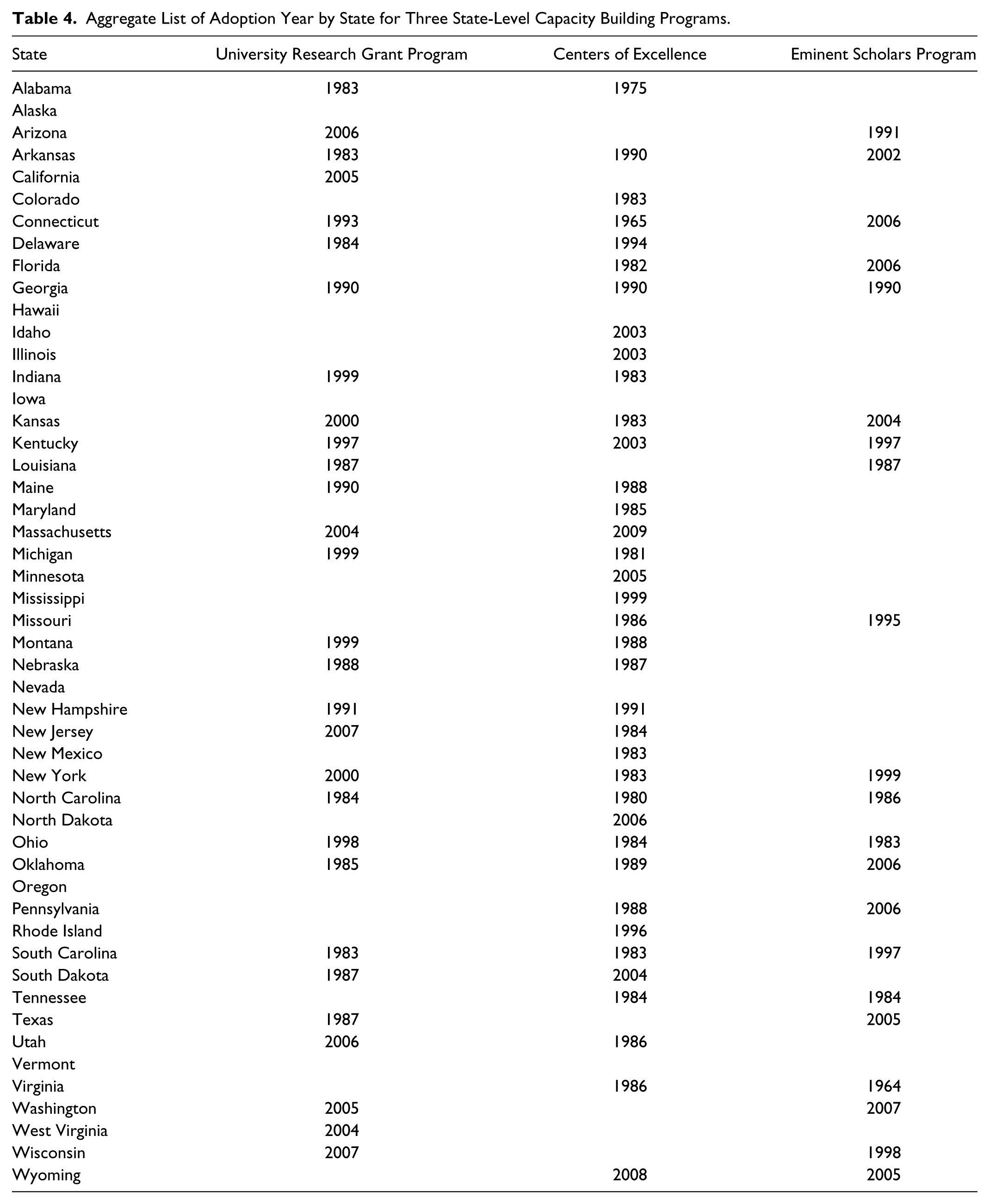
In this effort to assess the diffusion and impact of the adoption of these programs on economic outcomes, we gathered data from the NSF WebCASPAR database, which provides annual data on federal and industry expenditures in university R&D from 1972 to 2009. As a preliminary assessment of each of these categories of programs, we plot of the level of federal and/or industry investment in university R&D in 1980 (adjusted to constant 2009 dollars) against the annualized percent change in federal and/or industry investment in university R&D over a 30-year period from 1980 to 2009. 15 The summation of federal and industry investment in university R&D is used to measure the expected outcome for the URG programs, federal R&D investment is used to measure the expected outcome for the ES programs, and industry investment is used for the CE program. Ideally, we would like the dollar amount invested by states in the programs. State programmatic expenditure data are not readily available and represent a topic where additional effort and research is needed. To account for difference in the duration of the program, we weight the size of each data point based on the length of time that the state had adopted the program. Table 4 in Appendix A lists the year of adoption for each of the three policies by state. In addition, we include horizontal and vertical lines, which indicate the U.S. average level for each variable.
Figure 1 presents data on federal and industry investment in university R&D for the URG program. In general, we find evidence that states with smaller federal and industry investment in university R&D in 1980 adopted the program at earlier stages. This would suggest that, among the myriad reasons for adopting the program, states chose to implement the URG program in an effort to address and improve the lagging university research activity, measured in terms of external investment to the university. We found that early adopters of URG also qualified for the federal EPSCoR program. Moreover, the data suggest a positive association between the length of time a state has had the URG program (as indicated by the size of the point on the scatterplot) and the change in federal and industry investment over the 30-year period (as indicated on the x-axis). This provides preliminary evidence of long-term positive outcomes for those states with the program. More specifically, the trends suggest that this program has been beneficial—in terms of increasing the change in federal and industry investment beyond the rate of the U.S. average—for those states who adopted earlier compared with both later adopters and those who never adopted.
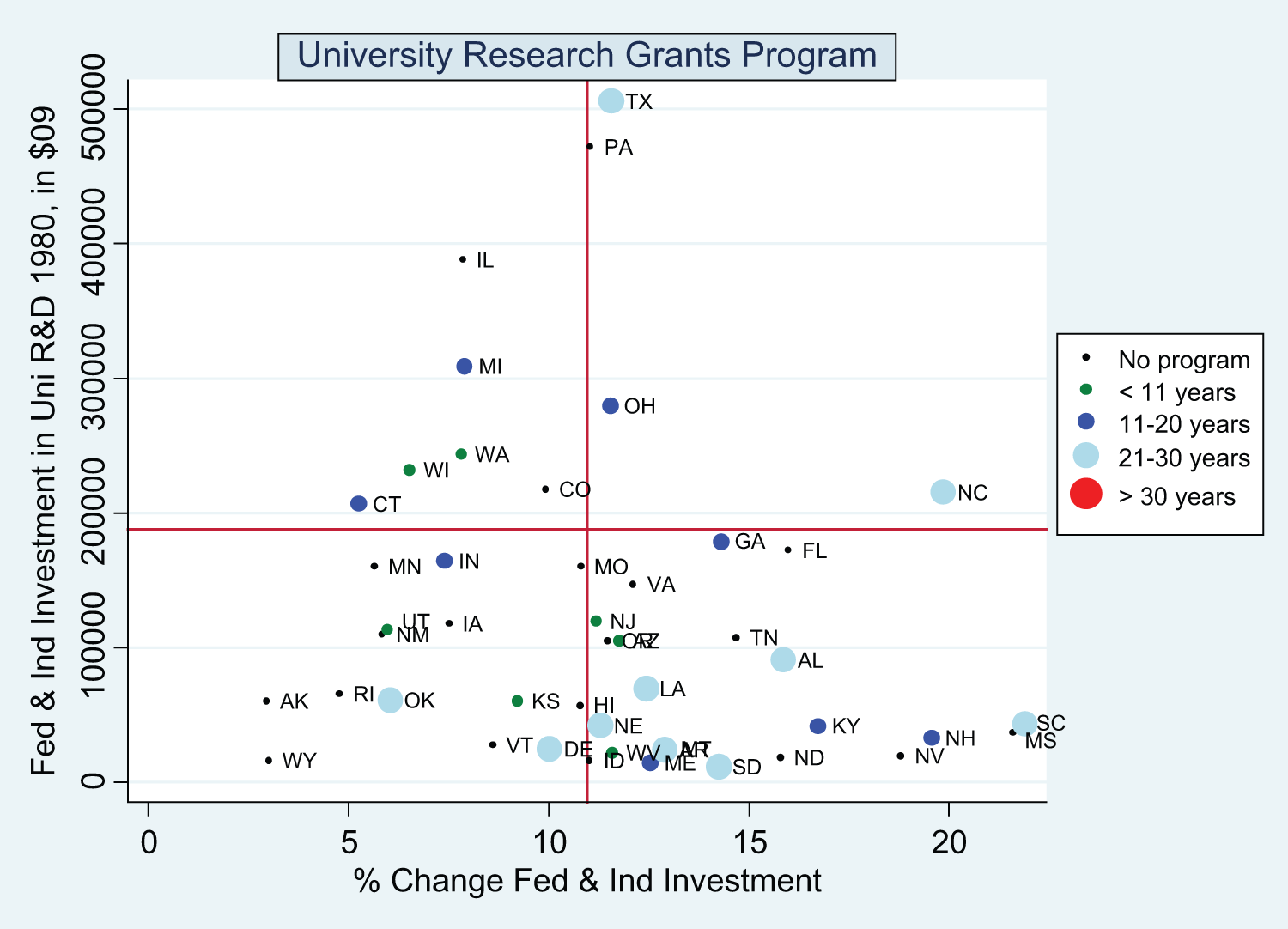
Scatterplot of university research grants program.
Figure 2 presents data on federal investment in university R&D for the ES program. Results in Figure 2 are relatively similar to Figure 1: (a) early adopters of the program generally lagged in terms of federal investments in state-level university R&D in 1980 and (b) earlier adopters are associated with disproportional increases, in relation to the U.S. average, in the percent change of federal investment over the 30-year period. This suggests that one of the reasons states chose to adopt the ES program was to improve the lagging level of federal investment in university R&D. Moreover, this preliminary evidence points to positive long-term effects of the program in terms of disproportionally increasing the change of federal investment over the past 30 years for those states who adopted earlier.
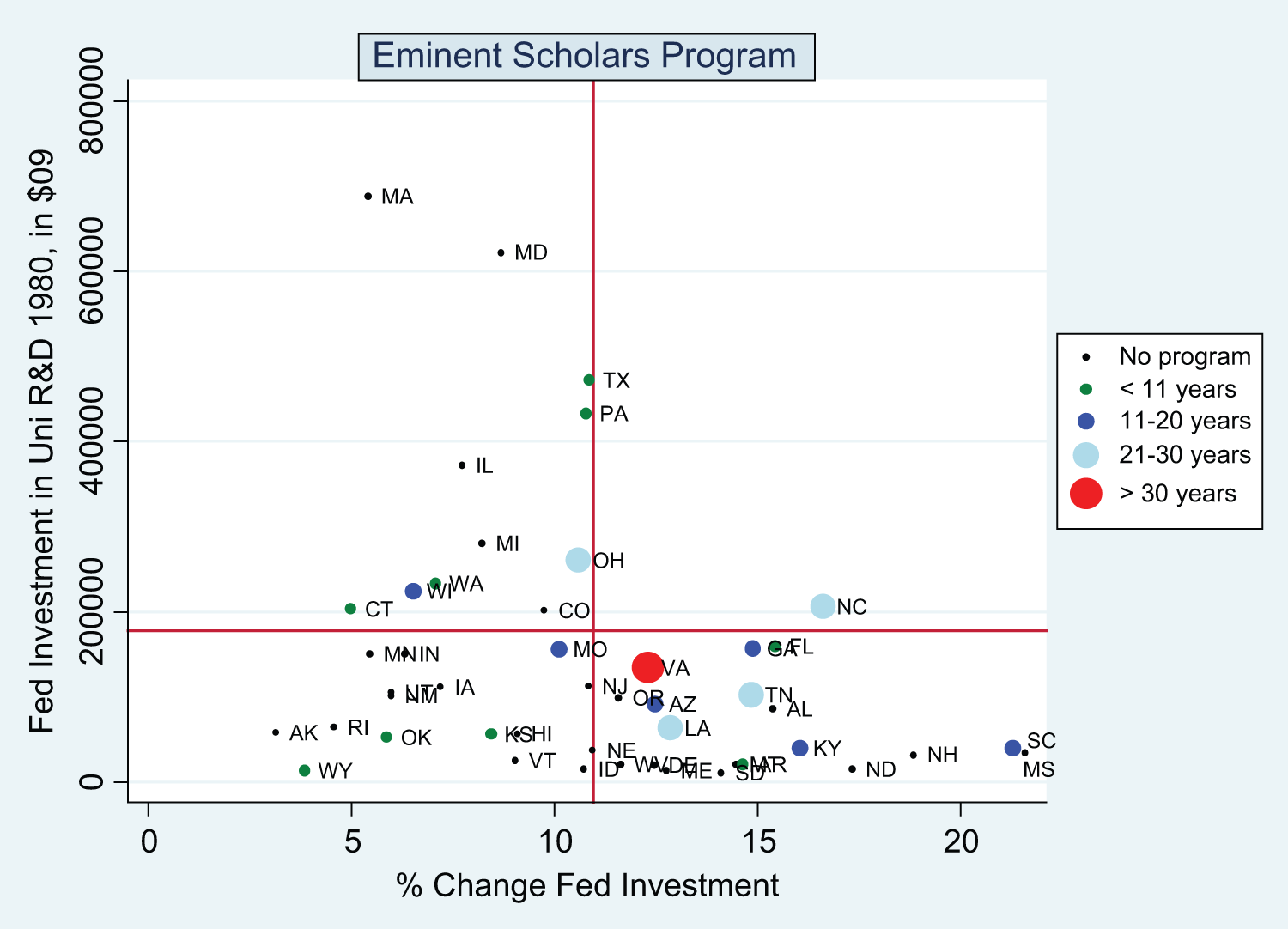
Scatterplot of eminent scholars program.
Figure 3 presents data on industry investment in university R&D for the CE program. With 37 states having adopted this program, this is the most diffuse program among the three. The patterns in this scatterplot are less pronounced than the previous two. The level of industrial investment in university R&D in 1980 does not appear to affect when the state adopted the CE policy. Moreover, in contrast to the trends highlighted above, the length of time a state has had the CE program does not appear to be strongly associated with disproportional increases in the change of industry investment in university R&D over the 30-year period. What the data do suggest, however, is that among the 13 states that have not adopted the CE program, only Washington has experienced increases in industrial investment in university R&D that exceeds the national average. Although many states that do have the program lagged behind the national average in terms of industrial investment changes, those states without the program appear to be even more behind.

Scatterplot of centers of excellence program.
These figures offer preliminary evidence regarding both reasons why states might have adopted a policy in the first place and the impact these programs have had in increasing the level of R&D federal and/or industrial investment to universities within the state. These results are preliminary and we must be cautious in interpreting these results. This analysis only captures the trends of one outcome variable for each policy, without any intervening variables or underlying casual model. A robust analysis of these three sets of programs, which lies outside the scope of this article, would need to control for possible confounding variables and certain endogeneity that are endemic with regional economic analysis.
Reflective Conclusions
This article has classified and reviewed three sets of state-level policies targeted at leveraging university-based R&D policies with the objective of generating economic development over the past 30 years across the United States. Our intention in this analysis is to lay a foundation to advance an understanding of state science initiatives, the reasons behind their adoption, and their ultimate impact on achieving the intended objective of creating innovation, jobs, and wealth. There is simply too much at stake for our economic future as policy makers strive to find effective and transformative policies that best use scarce public resources. Understanding the experimentation among American states requires codifying and classifying programs and initiatives. Just as Charles Darwin was motivated to try to organize species into a coherent schema, it is our belief that a systematic classification benefits understanding and increasesour ability to compare and evaluate programs and understand why types of policies and mechanisms are most appropriate in specific circumstances. With this information, scholars can begin to systematically understand program design and assess impacts. Rather than evaluating individual state programs, scholars and policy makers can engage in systematic comparative evaluation. In this way, the results of states’ rich experimentation with programs can be analyzed and more effective policies created. It appears that states have often experimented with program design and implementation uncritically, even copying other states’ efforts without considering the state’s economic circumstances, university characteristics, and research capacity (Fagerberg, 2003).
Our purpose was to examine state programs that focus on building science capacity for economic growth. Our criterion was programs that build capacity at state or state-located universities. Despite the variation in the portfolios of these initiatives across the United States over the past 30-year period, we find compelling similarities among state programs in terms of their objectives, incentives offered, and instruments used. Our major categories include University Research Grants, Eminent Scholars, and Centers of Excellence programs. Each of these programs focuses on a different aspect of research capacity. University Research Grants provide funding for academics within the state. The intention is that increased capacity would translate into tangible measures such as increased publications and notoriety and additional research funding from industry and federal government sources. These awards provide funding for current faculty at universities largely concentrating on developing young local talent. In contrast, Eminent Scholars programs attempt to induce highly qualified faculty to relocate to universities within the state to serve as a foundation for stimulating economic development. As such, these programs augment state resources. Prominent scholars with established research portfolios and high levels of technology transfer productivity are given priority. The final category, Centers of Excellence, connects universities to local industry and moves academic research toward practical applications and the building of technology capability within the state. By creating Centers of Excellence programs, states aim to build a research capacity that is beneficial for broader economic development goals and to cultivate a culture of collaboration between academic and industry environments. This program serves as a surrogate research capacity for private companies that are incapable of bearing the costs of individual research units. This type of program benefits universities by giving them industrial targets for academic research, which moves the university research products closer to commercialization. All three major types of capacity building programs are still popular among the states in the high-intensity research areas where basic research is critical and where industry demands guidance to increase a probability of success.
This review of state-based science policy initiatives not only provides an overview of state initiatives since 1980 but also lays the groundwork for future analysis to systematically examine state science efforts on a broader scale. The data presented provides a strong baseline and foundation for both the diffusion and policy evaluation literature. There have been few attempts to systematically study the origins of state policy and their diffusion across states, and the policy initiatives’ relationships to the specific contexts of their home states and universities. In practice, scholars are able to trace the diffusion of specific programs such as state lotteries and tax credits in systematical ways across the 50 states (Berry & Berry, 1990; Gray, 1994; Karch, 1996; Volden, 2006). Economic development initiatives have received less attention, perhaps because of the large portfolio of programs and policies that fall under the umbrella of technology-based economic development.
The evaluation of state economic development policies has also been limited, because it is difficult to construct a series of state expenditures and attributes on these programs. Berglund and Skinner (1998) already attempted this endeavor by providing a review of all state expenditures on research, conducted by surveying all state agencies that conduct research. In total, they found that states had funded more than $3 billion of research in 1991. This is certainly a notable finding; however, the results are now dated and an update and extension would be valuable. State economic development budgetary and expenditure data are not centralized and an opportunity exists to collect this information in a concise and meaningful way. In addition, every state retains rich program data about the awards that have been made over time, and programs have now been in existence for long enough that statewide evaluation of similar programs is now within reach. We hope our efforts will motivate additional research on this topic.
Moreover, although this research holds unique appeal for both diffusion and evaluation, future analysis building off of this research could benefit from synergy. In the policy diffusion literature, scholars aim to identify macro- and micro-level antecedent factors that account for the adoption of a policy; the policy evaluation literature, on the other hand, aims to examine the unbiased treatment effect of a policy. Much of policy evaluation research designs, however, rely on ex post analysis by examining natural experiments, which hinges on the critical assumption of an exogenous policy switch (Shadish, Cook, & Campbell, 2002). This would assume that the policy is randomly adopted. Evidence from the policy diffusion literature, however, provides ample evidence that the adoption of these policies is not random, but in fact systematic. Given that diffusion scholars explicitly aim to identify the antecedent factors leading to the adoption of a policy, evaluation scholars could leverage this research and include those significant antecedent factors to essentially control for the policy switch. This article thus serves as the beginning of what could surmount to be a long line of research that systematically examines the factors that not only lead a state to initiate state-based university R&D policies, but also that assesses the efficacy of the program or policy once implemented.
Footnotes
Appendix A
Aggregate List of Adoption Year by State for Three State-Level Capacity Building Programs.
| State | University Research Grant Program | Centers of Excellence | Eminent Scholars Program |
|---|---|---|---|
| Alabama | 1983 | 1975 | |
| Alaska | |||
| Arizona | 2006 | 1991 | |
| Arkansas | 1983 | 1990 | 2002 |
| California | 2005 | ||
| Colorado | 1983 | ||
| Connecticut | 1993 | 1965 | 2006 |
| Delaware | 1984 | 1994 | |
| Florida | 1982 | 2006 | |
| Georgia | 1990 | 1990 | 1990 |
| Hawaii | |||
| Idaho | 2003 | ||
| Illinois | 2003 | ||
| Indiana | 1999 | 1983 | |
| Iowa | |||
| Kansas | 2000 | 1983 | 2004 |
| Kentucky | 1997 | 2003 | 1997 |
| Louisiana | 1987 | 1987 | |
| Maine | 1990 | 1988 | |
| Maryland | 1985 | ||
| Massachusetts | 2004 | 2009 | |
| Michigan | 1999 | 1981 | |
| Minnesota | 2005 | ||
| Mississippi | 1999 | ||
| Missouri | 1986 | 1995 | |
| Montana | 1999 | 1988 | |
| Nebraska | 1988 | 1987 | |
| Nevada | |||
| New Hampshire | 1991 | 1991 | |
| New Jersey | 2007 | 1984 | |
| New Mexico | 1983 | ||
| New York | 2000 | 1983 | 1999 |
| North Carolina | 1984 | 1980 | 1986 |
| North Dakota | 2006 | ||
| Ohio | 1998 | 1984 | 1983 |
| Oklahoma | 1985 | 1989 | 2006 |
| Oregon | |||
| Pennsylvania | 1988 | 2006 | |
| Rhode Island | 1996 | ||
| South Carolina | 1983 | 1983 | 1997 |
| South Dakota | 1987 | 2004 | |
| Tennessee | 1984 | 1984 | |
| Texas | 1987 | 2005 | |
| Utah | 2006 | 1986 | |
| Vermont | |||
| Virginia | 1986 | 1964 | |
| Washington | 2005 | 2007 | |
| West Virginia | 2004 | ||
| Wisconsin | 2007 | 1998 | |
| Wyoming | 2008 | 2005 | |
Appendix B
Acknowledgements
We acknowledge the contributions of James Hearn and Michael McClendon as part of the larger research project. We acknowledge the assistance of Dan Berglund and Mark Skinner for sharing their expertise and the archives of the State Science and Technology Institute, Walter Plosila and Marianne Clark from the Battelle Memorial Institute, Howard Gobstein and Robert Samors from the Association of Public and Land-grant Universities, Randall Kempner from the Council on Competitiveness, and Chris Hayter, Ray Scheppach, and John Thomasian from the National Governors Association.
Declaration of Conflicting Interests
The authors declared no potential conflicts of interest with respect to the research, authorship, and/or publication of this article.
Funding
The authors disclosed receipt of the following financial support for the research, authorship, and/or publication of this article: The National Science Foundation supported this study during Project SciSIP 0947814: State Science Policies: Modeling Their Origins, Nature, Fit, and Effects on Local Universities (Original Award Number was SBE:0738130).