



Abstract
This study explores the economic factors that are associated with the success of university spin-offs. Drawing on a unique sample of academic entrepreneurs from research institutions in New York State, the article finds that spin-off success is dependent on both the type and size of the academic entrepreneur’s social network. Specifically, extraregional networks of nonacademic contacts—including investors, researchers from other companies, and advisors—allow academic entrepreneurs access to a broader base of knowledge and other resources important to spin-off success, which leads to regional economic development.
Keywords
Introduction
While the global economy slowly emerges from the financial crisis, regions worldwide continue to look to research universities for their myriad contributions to social and economic development. Of particular interest is the role of universities in establishing and supporting new spin-off companies, defined here as new firms established by faculty entrepreneurs based on intellectual property generated from their research (Shane, 2004).
The potential impact of university spin-offs is not lost on policy makers, who believe that these new ventures will create jobs and therefore generate regional economic growth. As Janet Napolitano (2006), former Arizona governor and chair of the National Governors Association, noted, University spin-off companies are not only critical to the translation of university research into new technologies and innovative new products, they create high-paying jobs and drive regional and state economic development.
Universities, too, have embraced university spin-offs as part of their strategy to respond to incentives established through the Bayh–Dole Act of 1980.
1
The Bayh–Dole Act aligned the policies of federal research and development (R&D) funding agencies, assigning (in most cases) intellectual property derived from federally funded research to the institution where it was performed. The effective result of Bayh–Dole over the past 30 years has been substantial, as has long-term growth in the number of companies that have spun off from universities and their associated economic impacts (see, e.g., Roberts & Eesley, 2009). Therefore, the more universities encourage and support successful academic entrepreneurship, the more they can contribute to regional economies: Governments and business and industry expect universities to contribute to economic growth, innovation and research and development . . . universities are supposed to contribute to knowledge transfer, to strengthen its links with the region, and to be of service to society in general. (Bataller & Montesinos, 2010)
Surprisingly, little is known about the economic factors that influence the success of university spin-offs, especially the role of social networks among faculty entrepreneurs. A social network is a conceptual construct composed of a set of actors—and ties representing some relationship or absence of relationship among the actors (Scott, 2000). A focus on networks is motivated by the growing body of empirical research in the sociology and management disciplines that have shown such networks are a critical ingredient in the overall entrepreneurial process ranging from enterprise founding and growth to turnover (Hoang & Antoncic, 2003; Jack, 2010). Networks have also been shown to be conceptually important to the success of university spin-offs (e.g., Hayter, 2013a; Nicolaou & Birley, 2003; Shane & Cable, 2002). However, within the literature, empirical investigations of the structure and composition of social networks and how they relate to spin-off success are conspicuously absent.
Understanding the relationship between the social networks of faculty entrepreneurs, among other factors, might provide insight to university leaders, including their offices of commercialization and offices of technology transfer, and possibly to regional partnerships focused on enhancing regional economic growth. This study expands the limited body of research by examining empirical networks and other factors that correlate with the success of university spin-offs and, accordingly, suggesting an agenda to enrich their contribution to regional growth.
The remainder of the study is as follows: I discuss the academic literature related to the success of university spin-offs, as well as the emerging empirical literature relating to the role of social networks in entrepreneurial success; I then posit an empirical model of university spin-off success and motivate my measurement of the variables in the model, and also discuss the data collection process. The empirical results follow, and the study concludes with an interpretation of our findings for a strategy for enhancing regional economic growth.
Literature Review
Quantifying the Success of University Spin-offs
As mentioned, a university spin-off is a new venture founded by faculty entrepreneurs based on intellectual property generated through their research (Shane, 2004). There is literature on selected dimensions of the antecedents of university spin-offs but less so on the consequences of such endeavors. For example, in their reviews of so-called academic entrepreneurship literature, Phan and Siegel (2006) and Rothaermel, Agung, and Jiang (2007) find that most quantitative studies rely on data collected annually by the Association of University Technology Managers. These studies necessarily focus on institutional or environmental factors that predict numbers of university spin-offs but not their success or economic impact (Rothaermel et al., 2007; Shane, 2004).
Among the handful of studies that empirically examine the consequences of university spin-offs, success is framed in several distinct ways. The first and most basic approach is to consider whether or not a university spin-off continues to exist over time (Dahlstrand, 1997; Leitch & Harrison, 2005; Mustar, 1997; Rothaermel & Thursby, 2005; Shane, 2004; Shane & Stuart, 2002). Roberts (1991) and Reitan (1997) demonstrate, however, that spin-off survival data may have limited utility. Their research shows that spin-offs are often subject to the so-called living dead phenomenon, where firms have very high survival rates but show no indication of growth or profitability. Hayter (2011) also finds that academic entrepreneurs are motivated to establish spin-off companies for a number of nonpecuniary reasons that do not necessarily relate to short-term business growth or economic development.
Second, success is framed in terms of a spin-off’s capability to achieve various performance milestones. Most common among these milestones is a spin-off’s ability to attract early-stage financing, especially venture capital (Lockett & Wright, 2005; Lockett, Wright, & Franklin, 2002; Shane & Stuart, 2002; Wright, Clarysse, Lockett, & Binks, 2006; Zucker, Darby, & Armstrong, 2002). Goldfarb and Henrekson (2003) and Shane (2004) view success in terms of whether or not a firm had an initial public offering. Vohora, Wright, and Lockett (2004) view success as iterative and nonlinear, where spin-offs acquire and reconfigure necessary resources, capabilities, and network ties necessary to pass through a series of critical junctures. Although such an approach may yield insight about spin-off success, its contribution is dependent on robust longitudinal data that, unfortunately, rarely exist.
Third, researchers have used a number of output measures to proxy spin-off success. Zucker et al. (2002) examine the number of patents and scientific articles produced by spin-offs. More traditional business output measures have also been used, including sales growth (Roberts, 1991), sales per employee (Blair & Hitchens, 1998), and profitability (Samson & Gurdon, 1993). More recent studies frame spin-off success in terms of technology commercialization (Hayter, 2013a; Link & Ruhm, 2009; Link, Siegel, & Bozeman, 2007). Despite the use of various sales metrics to illustrate spin-off success, scholars have identified several challenges to doing so, such as the inability of sales per se to gauge technical progress among companies developing early-stage technologies (Shane, 2004) and their inability to account for development differences among various technology areas, especially in the life sciences (Golub, 2003; Lowe, 2002; Pisano, 2006).
Fourth, researchers often frame the economic contributions of university spin-offs in terms of employment. Cohen (2000) estimates, for example, that between 1980 and 1999, university spin-offs in the United States produced some 280,000 jobs. Despite the use of employment to explain the importance of spin-offs and the existence of a rich literature linking entrepreneurship to job creation and economic growth (Acs & Audretsch, 1990; Audretsch, 1995; Birch, 1981), employment has not been widely used to proxy the success of university spin-offs.
Finally, researchers have used multiple indicators to proxy spin-off success. For example, Siegel and Wessner (2010) use seven different indicators of success, including actual sales, expected sales, new employees, patent applications, copyright applications, trademark applications, and licenses to proxy success among ventures that have received Small Business Innovation Research (SBIR) awards. Similarly, Shane and Stuart (2002) define spin-off success in terms of venture capital financing, initial public offering, and survival.
Given the relationship between job creation and regional growth, limitations with the present data 2 and the need for clear understanding of effective strategies for university and regional economic development leaders to promote and support university spin-offs, this study defines university spin-off success in terms of employment. The next section explores the empirical literature relating to the role of networks in entrepreneurial success.
Social Networks and Entrepreneurial Success
Although the study of networks initially emerged from the mathematical and physical sciences, the application of networks to the study of entrepreneurship began primarily in sociology where networks are often seen as a de facto benefit to entrepreneurs (Knoke & Yang, 2008; Scott, 2000). Researchers within the discipline of management later applied social network concepts to entrepreneurship, positing that firms are embedded in networks of social, professional, and exchange relationships with other actors (Granovetter, 1985; Gulati & Gargiulo, 1999). It is through these networks that entrepreneurs acquire information, knowledge, capital, and services important to their enterprise (Lechner & Dowling, 2003; Renzulli & Aldrich, 2005).
Therefore, conceptual perspectives such as Brüderl and Preisendorfer’s (1998) so-called “network approach to entrepreneurship” typically assume the larger the network the better (Witt, 2004). Lechner and Dowling’s (2003) concept of relational capability, however, finds that an entrepreneurial firm’s ability to manage networks grows over time but eventually reaches a maximum level, therefore limiting the efficacy of networks beyond a certain size.
Beyond network size, network composition is also important to entrepreneurial performance. Researchers often conceptualize networks dichotomously: Ties exist or do not exist—or are weak or strong (Hoang & Antoncic, 2003; Jack, 2010). To whom entrepreneurs are connected also matters; among all network types, business contacts are especially important for firm success (Renzulli & Aldrich, 2005). Once entrepreneurial firms are “connected” to robust business networks, they have access to, for example, human, technological, and financial resources important to performance (Aldrich & Zimmer, 1986; Lechner & Dowling, 2003; Shane & Cable, 2002; Wright, Clarysse, Mustar, & Lockett, 2007).
Governing the “flow” of network resources is social capital, trust levels within a social network, and the resulting willingness of individuals within that network to provide mutual assistance when needed (Coleman, 1988). High levels of social capital within a network provide entrepreneurs with a foundation for exchange through reputational credibility, certification of mutually known contacts, fairness and equity, and the prospect of future exchange (Coleman, 1988; Nohria & Eccles, 1992; Shane & Cable, 2002) typically leading to improved entrepreneurial performance (Aarstad, Haugland, & Greve, 2010; Pennings, Lee, & vanWitteloosstuijn, 1998). High social capital levels also result in homophily—the emergence of shared values, functional language, culture, and practices—among, for example, entrepreneurial teams (Ruef, Aldrich, & Carter, 2003).
High levels of social capital within networks, however, can have a detrimental impact on entrepreneurial performance. For example, firms can be locked into relationships with firms that have few new ideas, diminishing a firm’s capacity for innovation (Gulati, Nohria, & Zaheer, 2000; Johannisson & Monsted, 1997). Related to university spin-offs, Mosey and Wright (2007) find that faculty entrepreneurs are often constrained by their own networks and are therefore unable to access individuals from industry important for the success of their spin-off. In the literature, university researchers typically lack connections with industry, but those that do enjoy a higher likelihood of commercialization and entrepreneurial success (Audretsch, Lehmann, & Warning, 2005; Dietz & Bozeman, 2005; Gulbrandsen & Smeby, 2005; Hayter, 2013a; O’Gorman, Byrne, & Pandya, 2008).
Knowledge-based perspectives on entrepreneurial performance not only view networks as conduits for knowledge and resources, they also emphasize the importance of geographic proximity or clustering. Knowledge, once created, spills over within geographically-bounded regions vis-à-vis localized networks (Audretsch & Feldman, 1996; Feldman, 1994; Jaffe, 1989; Jaffe, Trajtenberg, & Henderson, 1993). Spillovers, in turn, provide the seed corn for entrepreneurs and innovators who often have few formalized R&D resources of their own. This localized “knowledge production function” has long been used to explain the sustained entrepreneurial cultures of California’s Silicon Valley and Boston’s Route 128 (Saxenian, 1994). Kenney and Patton (2005), however, also highlight the importance of extraregional entrepreneurship networks, especially in the biotech industry, just as Davenport (2005) and Gertler and Levitte (2005) find that firms are increasingly sourcing ideas internationally.
In summary, an examination of the literature among several disciplines points to three important elements relating to the role of social networks in entrepreneurial performance—network size, composition, and geography. To my knowledge, scholars have yet to empirically examine the relationship between these network elements and spin-off success within a theoretically relevant sample of faculty entrepreneurs, a gap this article seeks to address.
Method
Data Collection
As mentioned, federal and state policy makers are placing ever-increasing emphasis on the relationship between government expenditure, including R&D spending, and job growth. This study examines the relationship between social networks among faculty entrepreneurs and the success of (their) university spin-offs established within New York State. New York State enjoys one of the highest levels of federal R&D spending in the United States (second among all states), but ranks relatively low in terms of innovation and high-tech job creation (see, e.g., Information Technology and Innovation Foundation, 2012; Milken Institute, 2013). 3 Although New York’s “innovation gap” is often mentioned by policy makers, no systematic studies exist relating to the role of social networks in the success of university spin-offs within the state.
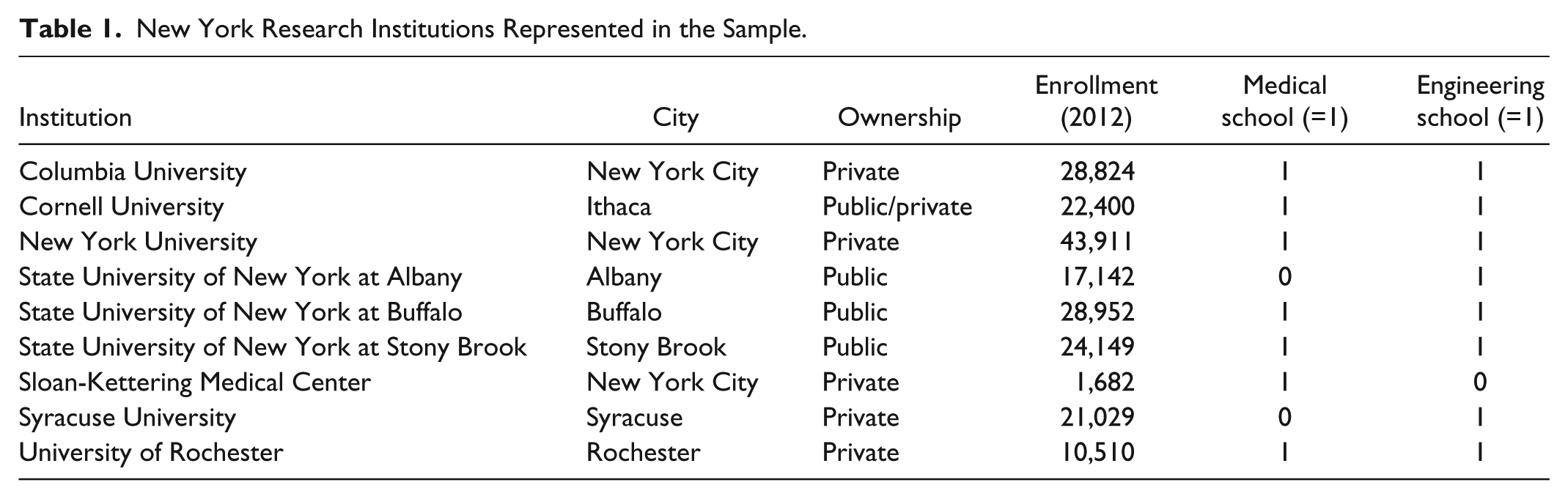
To create a theoretically relevant sample, university officials generously provided names and contact information for academic entrepreneurs, supplemented by public sources. Academic entrepreneurs in the sample come from diverse institutions within New York State, public and private, emphasizing a substantial degree of variance, including different stages of spin-off development, technological focus, and location and environmental factors (Table 1). A total of 104 academic entrepreneurs who founded a spin-off between the years 1965 and 2011 were randomly selected, contacted by e-mail, and invited to participate in this study. A total of 81 faculty agreed to be interviewed in person or by telephone, and all but 2 actually participated in the study. 4 Thus, the effective response rate is 76%.
New York Research Institutions Represented in the Sample.
Potential self-selection bias is an important consideration when using a small, random sample like the one collected for this study. Davidsson (2004), for example, discusses selection bias among individual entrepreneurs, hypothesizing that nascent entrepreneurs are less likely to respond to survey requests compared with more established entrepreneurs. Year of spin-off establishment is available for the sample population of academic entrepreneurs, including nonrespondents. Accordingly, tests for self-selection found that sample means for venture age did not differ between respondents and nonrespondents.
Interviews were conducted in person or over the phone between December 2011 and August 2012 using an open-ended interview template based on the literature review above. Network data, representing the primary factor of interest, are collected using a so-called name generator technique (Renzulli & Aldrich, 2005), whereby survey respondents are asked to list contacts most important to their business. Whereas early network studies limited the number of names so-generated to five (Aldrich, Rosen, & Woodward, 1987; Nicolaou & Birley, 2003; Ostgaard & Birley, 1994), more recent studies place emphasis on the total number of contacts reported as a possible factor of success (Lechner & Dowling, 2006); most studies emphasize the importance of capturing the professional affiliation of listed contacts.
Studies have shown that academic entrepreneurs may have relatively unique definitions of success, so a broad name-generator question was used to capture as many names as possible. Specifically, entrepreneurs were asked in the interview guide to list their most important contacts with whom “you have collaborated for the purpose of establishing your company and/or commercializing your company’s technology.” For each contact, respondents were also asked to include the full name, position, organization, location, and frequency of collaboration with each respective contact.
The Empirical Model
The empirical model examined herein is

where spin-off success is a measure of the economic success of the university spin-off,
Description of Variables.
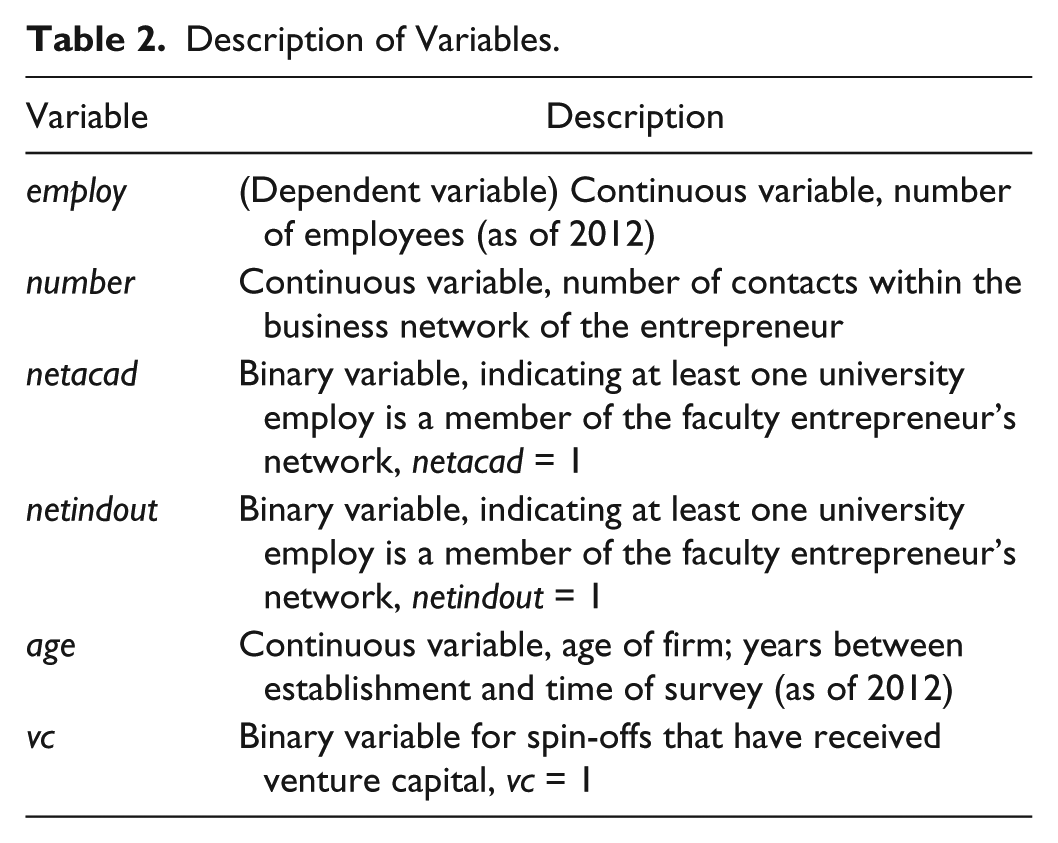
As discussed in the previous section, there have been few empirical efforts in the academic literature to measure the economic success of university spin-offs. Here, we follow the efforts of Link and Scott (2012a, 2012b, 2013) who quantified the success of small entrepreneurial ventures in terms of their employment, employ. Arguably, this measure characterizes only one dimension of success, but it is an operational measure and, perhaps more important, one that aligns with our interest in explaining New York’s innovation gap at a micro level. 5
The academic entrepreneur’s social network is measured in several dimensions based on the literature review above. The variable number represents the total number of distinct business contacts of the academic entrepreneur. Following the broader network literature that shows diminishing returns to network size, a quadratic version, number2, is included for this count variable. The variable netacad quantifies dichotomously if at least one member of the academic entrepreneur’s social network is affiliated with an academic research institution, including their own (netacad = 1). Finally, the variable netindout quantifies dichotomously if at least one member of the entrepreneur’s nonacademic network is located outside the local region, defined as being more than 50 miles from the faculty member’s university (netindout = 1). 6
Relevant controls in vector
Also, the availability of alternative investments, vc in particular, is important for entrepreneurial ventures in general to cross the so-called Valley of Death. In fact, there is precedence in the literature (e.g., Heirman & Clarysse, 2004; Hellman & Puri, 2001; Link & Scott, 2010; Shane & Stuart, 2002) that the availability of financial resources is one of the more important factors for success, allowing spin-offs to hire staff, conduct research, and pursue commercialization.
Other variables collected inductively during the study, such as prior experience establishing a spin-off, faculty consulting, receipt of angel funding, and receipt of Small Business Innovation Research awards were also considered, but in no case significant at conventional levels. 7 Furthermore, the number of variables used in the empirical model were limited because of degrees of freedom and multicollinearity concerns.
Results
Descriptive Statistics
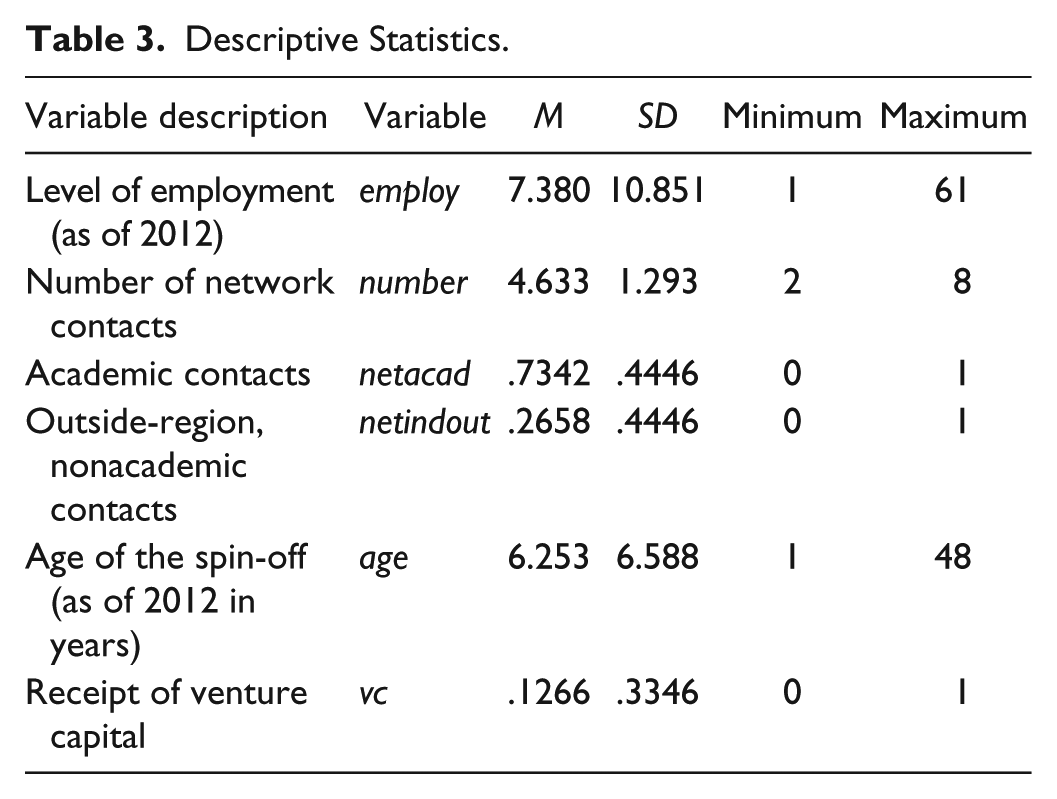
Descriptive statistics on the relevant data used to estimate a version of Equation (1) are presented in Table 3 and a correlation matrix of all variables is presented in Table 4. Based on Table 4, the strongest significant positive relationship with the dependent variable (employ) is the outside-region nonacademic contact variable netindout (.688); followed by vc (.509); a significant negative correlation with the academic contact network variable netacad (−.505), which might reflect that such spin-offs have less of an eye toward business than toward academics; and a significant positive relationship with spin-off age (age; .243), although that effect is shown below to be nonlinear.
Descriptive Statistics.
Correlation Matrix of the Variables.
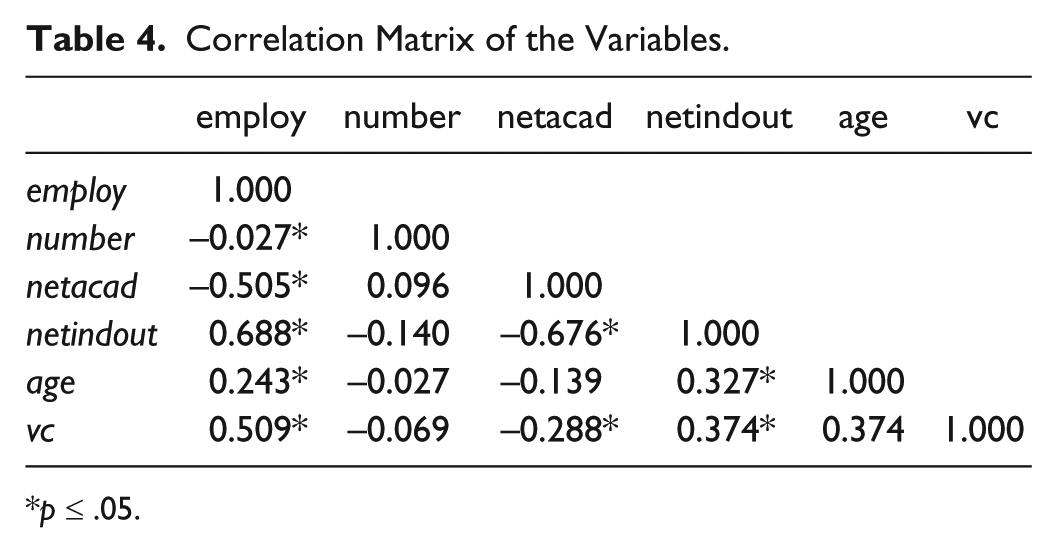
p ≤ .05.
The strongest correlation among the independent variables exists between netacad and netindout (−.676). This negative correlation may represent the trade-off among academic entrepreneurs; emphases on academic networks may come at the expense of other nonacademic contacts.
The variable netindout is positively and significantly correlated with the variable vc (.374), just as the academic network variable (netacad) is significantly and negatively correlated with vc (−.288). Although directionality is not inferred, there appears to be a relationship between the receipt of vc funding and network type. And the outside-region nonacademic network variable netindout exhibits a positive correlation with the variable age (.327).
Empirical Findings
The least-squares empirical results from the estimation of Equation (1) are reported in Table 5. The size of the spin-off (number) and the age of the spin-off (age) 8 enter nonlinearly. I also run logarithmic versions of the model to account for possible nonlinearity with the dependent variable.
Least-Squares Regression Results. a
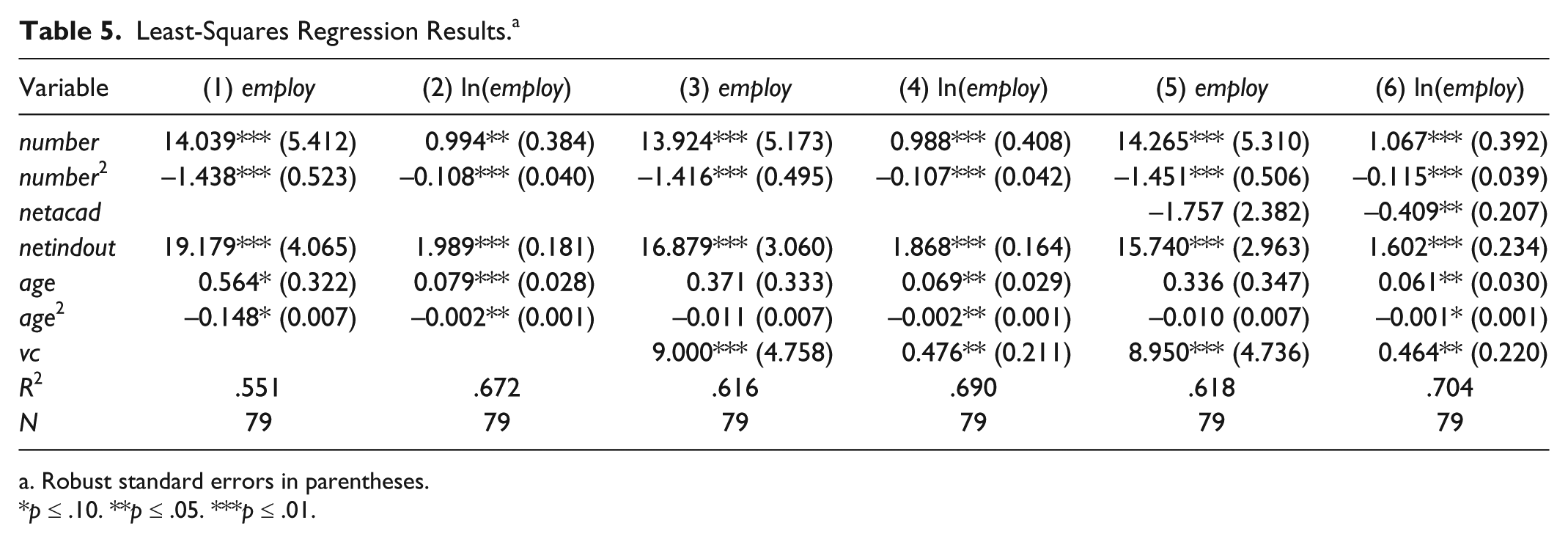
Robust standard errors in parentheses.
p ≤ .10. **p ≤ .05. ***p ≤ .01.
The results in Table 5 suggest that the relationship between spin-off success and the size of the academic entrepreneur’s social network follows an inverted U. The estimated coefficient on number is positive and statistically significant in each of the specifications in Table 5, and the estimated coefficient on number2 is negative and also statistically significant.
Although corresponding empirical studies of networks among faculty entrepreneurs do not exist, this finding complements the finding of Spanos and Vonortas (2012), who find diminishing returns on the number of partners participating in research joint ventures in Europe. 9 Our findings also illustrate Lechner and Dowling’s (2003) concept of relational capability, whereby an entrepreneurial firm’s ability to manage networks grows over time but eventually reaches a maximum level. Based on the results in column (5) in Table 5, the optimal size of an entrepreneur’s network is five.
With regard to network type, the linear version of the model in column (5) is negative but insignificant, whereas the coefficient in the logarithmic version in column (6) is significant. Although statistically weak, these results support Mosey and Wright’s (2007) assertion that academic researchers are constrained by their own networks and are therefore unable to access individuals from industry important for the success of their spin-off.
The results in Table 5 both show that spin-offs with founding academic entrepreneurs embedded in networks that include nonacademic individuals outside their home region (netindout) have higher employment levels, holding constant the age of the spin-off, compared with those that do not. The coefficient on netindout is positive and statistically significant in each of the specifications: Academic entrepreneurs whose network includes nonacademic individuals outside their home region have approximately 16 to 19 more employees compared with those whose networks do not, a more than 100% increase compared with the sample mean level of employment of 7.3. Whereas the importance of nonacademic networks that include investors, service providers, and industry contacts is well understood (Aldrich & Zimmer, 1986; Mosey & Wright, 2007; Ostgaard & Birley, 1994; Shane & Cable, 2002), few studies have examined the geographic footprint of academic entrepreneurship networks. Although scholars of economic geography have long supported agglomeration theory, my finding supports emerging research that finds that extraregional networks are also important to entrepreneurial success (Audretsch & Stephan, 1996; Davenport, 2005; Gertler & Levitte, 2005; Kenney & Patton, 2005).
The results also show that spin-off success improves, up to a point, with age: The variable age demonstrates an inverted U relationship with spin-off success. This not only demonstrates that a spin-off must pass specific early milestones, as discussed by Vohora et al. (2004), but after this threshold may be subject to the aforementioned living dead phenomenon. For example, based on the results in column (5) of Table 5, the impact of age remains positive for nearly 17 years.
The receipt of venture capital, vc, is positively and significantly correlated with the success of the spin-off, ceteris paribus. Academic entrepreneurs whose spin-offs receive venture capital have approximately nine more employees, compared with those in the sample who did not. This is a well-documented success factor in the literature (Heirman & Clarysse, 2004; Hellman & Puri, 2001; Shane, 2004).
Discussion and Implications of the Findings
This study focuses on the role of networks in spin-off success, defined here as employment due to its importance in regional economic development. Based on a random sample of university entrepreneurs from academic research institutions within New York State, the findings suggest that an individual entrepreneur’s network type and, at least up to a point, network size are important determinants of so-measured spin-off success. Although the receipt of venture capital and, to a lesser extent, spin-off age correlate with spin-off success, the principal contribution of this study is to link the social and geographic proximity of social networks among academic entrepreneurs to employment and, therefore, regional economic growth.
These findings have important implications for leaders from universities, industry, and chambers of commerce or regional partnerships interested in promoting university spin-offs for their economic development potential. Billions of dollars have been invested globally in incubators, science parks, proof-of-concept centers, venture funds, and other mechanisms to encourage and support university spin-offs. However, if these efforts do not incorporate relevant, robust network-building elements, they not only risk being ineffectual, they may—following Hayter (2013a)—actually have a negative impact on spin-off success.
In the present case, spin-off success may be attenuated by the strength and relatively closed nature of traditional academic research networks, a phenomenon known by sociologists as homophily. This follows Gulati et al. (2000), who find that networks can lock firms into unproductive routines and practices, diminishing success. Thus, the success of university spin-offs is dependent on, among other things, an academic entrepreneur’s ability to break out of their traditional professional networks and access networks of nonacademic contacts—investors, industry researchers, and advisors—who, depending on the technology and product focus of the spin-off, are often located outside an entrepreneur’s home region.
These findings also have relevance to scholars interested in the role of networks within the context of knowledge spillover perspectives of economic growth, such as the knowledge spillover theory of entrepreneurship (Acs, Audretsch, Braunerhjelm, & Carlsson, 2004; Audretsch, Keilbach, & Lehmann, 2006). Recent research (Audretsch & Lehman, 2005; Audretsch, Lehmann, & Warning, 2004; Hayter, 2013b) finds that entrepreneurship networks are critical channels for the acquisition and dissemination of new knowledge, a critical ingredient—according to Romer (1986)—for innovation and economic growth. Knowledge spillover theory of entrepreneurship embraces the importance of new knowledge in economic development but takes exception to the assumption that knowledge spills over automatically to other organizations: Knowledge spillovers are subject to various constraints known collectively as the “knowledge filter” (Acs et al., 2004; Audretsch et al., 2006). Based on the results of this study, closed, homophilous social networks may represent one such filter, therefore diminishing regional economic development—and perhaps helping to explain New York’s aforementioned innovation gap.
These findings also provide substantial nuance to long-accepted economic development strategies based on the concept of industry clusters (Porter, 1990). Cluster strategies have been supported from a knowledge spillover perspective based on research that shows networks are localized and that knowledge spills over within geographically-bound regions (Audretsch & Feldman, 1996; Feldman, 1994; Jaffe, 1989; Jaffe et al., 1993). Although this study does not examine the dynamics of regional clusters per se, it does find that extraregional networks provide knowledge and resources important to the success of university spin-offs in New York State.
The literature offers at least three possible explanations for the importance of outside-of-region networks to academic entrepreneurs within the sample. First, recent research finds that the localization of knowledge networks may differ by scientific discipline and technology areas, especially within the life sciences and biotech industries (Audretsch & Stephan, 1996; Gertler & Levitte, 2005; Kenney & Patton, 2005). Spin-offs in the sample are from disparate technology areas and were established by university scientists representing a number of scientific disciplines. Second, the majority of spin-offs in the study are located within regions of New York State that may lack what Davenport (2005) calls “knowledge-acquisition interfaces,” resources important to innovation and growth. Yet similar to Davenport’s (2005) findings, some spin-offs in the present study use extraregional networks to access knowledge and other resources needed for success. Finally, entrepreneurship networks evolve over time and may differ by stage of development (Greve & Salaff, 2003; Hite & Hesterly, 2001; Huggins & Johnston, 2010; Vohora et al., 2004), with most spin-offs in the sample at a relatively early stage of development.
If the findings within this study are generalizable to broader populations of academic entrepreneurs, then state, regional, and university policy makers should seek to first understand the disciplinary, industry, and geographic contexts in which spin-offs are established. In regions lacking relevant knowledge interfaces and resources, these data can then be used to establish and strengthen pertinent extraregional support networks. These networks will not only need to extend beyond the “four walls” of the university and region, but also outside the social networks (and traditional culture) of academia, differing among various industries and disciplines. Regional chambers of commerce, government, and university leaders could do this by creating long-term partnerships with relevant international regions and by building networking models through which academic entrepreneurs could be introduced to funders, professional managers, support services, potential customers, and a variety of innovation sources important to the success of their spin-off.
Future investigations will hopefully overcome some of the data limitations that accompanied the data set on which this empirical investigation is based. In particular, the present sample is small, limited to a single state within the United States, and a point-in-time snapshot. Future empirical work might examine the individual network contacts of entrepreneurs, their specific role, and their contributions to spin-off success. Another opportunity for scholars would be to investigate how networks evolve, depending on a spin-off’s specific stage of development, an area where longitudinal studies and case studies may both prove insightful.
Footnotes
Declaration of Conflicting Interests
The author(s) declared no potential conflicts of interest with respect to the research, authorship, and/or publication of this article.
Funding
The author(s) disclosed receipt of the following financial support for the research, authorship, and/or publication of this article: This research was graciously funded through a grant from the Ewing Marion Kauffman Foundation.