




Abstract
The extensive adoption of the industry cluster-based approach to economic development as popularized by Michael Porter calls for the examination of the expected benefits for inner cities. Clusters encourage practitioners to view regional economies in terms of groupings of related firms and supporting infrastructure, and to link economic development with workforce development and business support strategies. On September 15-16, 2015 researchers and practitioners gathered in Detroit for the Inner City Economic Summit, to share knowledge and experiences regarding strategies that can help drive economic growth in inner cities. In this conference summary, we analyze the findings and discussions of that meeting for the special edition of the Economic Development Quarterly May 2016 publication. The research findings presented at the summit suggest that agglomeration economies can foster employment growth in inner cities. Evidence also suggests that human capital development and a supportive business ecosystem, including better access to financing for minority entrepreneurs in inner cities, are important ingredients for a cluster-centered policy framework. The discussions at the summit underscore that industry cluster-based development strategies can be an effective intervention for change for distressed communities when they link to effective workforce training and business development programs.
Industrial cluster–based economic development strategies have attracted the attention of a growing number of practitioners. Ever since Michael Porter (1998) popularized research on clusters, industrial cluster–based development strategies have become part of the basic policy toolkit used by local economic development authorities and community development and workforce development practitioners in the United States and throughout the world. New sets of institutions are being developed to support an industry cluster-based business environment, especially in disruptive technology and high-growth innovation sectors (e.g., Wessner, 2001). Public/private relationships are being formed to enhance small business ecosystems in cities throughout the country. By encouraging related businesses to locate centrally in cluster hubs, policy makers in states and city governments are fostering knowledge spillover effects and other benefits of proximity to simultaneously grow their regions and to attempt to revitalize their urban cores. 1 Drawing on data that have become available from the U.S. Cluster Mapping Project, practitioners now have a framework to build on the competitiveness of their areas. 2 They are linking workforce training for residents to potential opportunities to be had in existing identifiable industrial clusters and emerging sectors with high demand in their regions. 3
Despite the popularity of cluster-based initiatives and strategies across the nation, however, the extent to which industrial clusters affect various economic outcomes in inner cities—places that have remained stubbornly and increasingly poor over time—continue to be an open question. 4 Clusters tend to develop in cities where strong assets and human capital are already concentrated (e.g., Glaeser & Mare, 2001), and it is unclear whether clusters are equitable tools for economic development in inner cities. Do they provide benefits for communities at a broad level or do they only favor a certain social strata? More fundamentally, recognizing that outcomes in inner cities are the results of complex interrelated factors, 5 where does cluster development fit within the full spectrum of policy tools for the inner city? These questions are important for practitioners working on sustainable economic development initiatives in inner cities and for policy makers who want to understand the research that probes the implications and the nuances of clusters. 6
The 2015 summit, titled “Revisiting the Promise and Problems of Inner City Economic Development,” brought together researchers and practitioners to share data, present findings, and discuss experiences, as a way to synthesize current lessons learned with regard to cluster strategies. The summit featured Harvard Business School Professor Michael Porter, who shared his observations based on 25 years of accumulated research and evidence on what works and does not work with inner-city revitalization interventions, and discussed the relationship between cluster-centered strategies and economic development in inner cities.
The summit also featured other researchers who presented new evidence on the importance of industrial clusters and agglomeration economies to the competitiveness of inner cities within regional economies, the role of human capital and workforce development, as well as the importance of ensuring credit flows to households and entrepreneurs, especially to minorities in inner cities who have traditionally been denied credit, and who face other barriers to financial access. Those presentations were based on selected articles that are published in this issue of Economic Development Quarterly (EDQ): Porter (2016), Delgado-Garcia and Zeuli (2016), Hartley, Kaza, and Lester (2016), and Bates and Robb (2016).
In addition, the conference included experts and practitioners from various industry cluster “spheres,” who discussed efforts to improve human capital and workforce development, as well as access to financing and resources for entrepreneurs in inner cities to facilitate their integration into their broader regional economies. The practitioner organizations that were represented at the summit included The Water Council, a hub for water-related companies in Milwaukee; Tech Town, a business incubator and accelerator in Detroit; JumpStart, an entrepreneurial support program in Cleveland, Ohio; and Focus: HOPE, a workforce development and training organization in Detroit. Also, Eastern Market Corporation, a food hub in Detroit, and Midtown Detroit, an organization that has been heavily involved in revitalizing areas of Detroit, provided an overview of their sectors during neighborhood tours.
An important goal for the conference organizers was to ensure that the studies were accessible and relevant to practitioners, and to account for the practitioners’ views, responses, and reactions to the research that was presented at the conference. This article evolved from that pursuit. It summarizes the research and discussions, and highlights the insights from industry experts who presented at the conference. To more effectively capture the practitioners’ perspectives, the authors invited audience members (composed mostly of practitioners) to complete open-ended questionnaires. The purpose of the questionnaires was to gauge whether the presentations delivered by the panelists resonated with the practitioners’ experiences. We report these results in this article. This article thus uses a mixed methods strategy that integrates the cross-section of research presented at the summit (and the broader literature on industry clusters in inner cities), with practitioners’ presentations and insights from the semistructured questionnaires, to draw a series of lessons and recommendations that we hope will further inform the practical application of research on industry clusters. Box 1 summarizes the findings and recommendations.
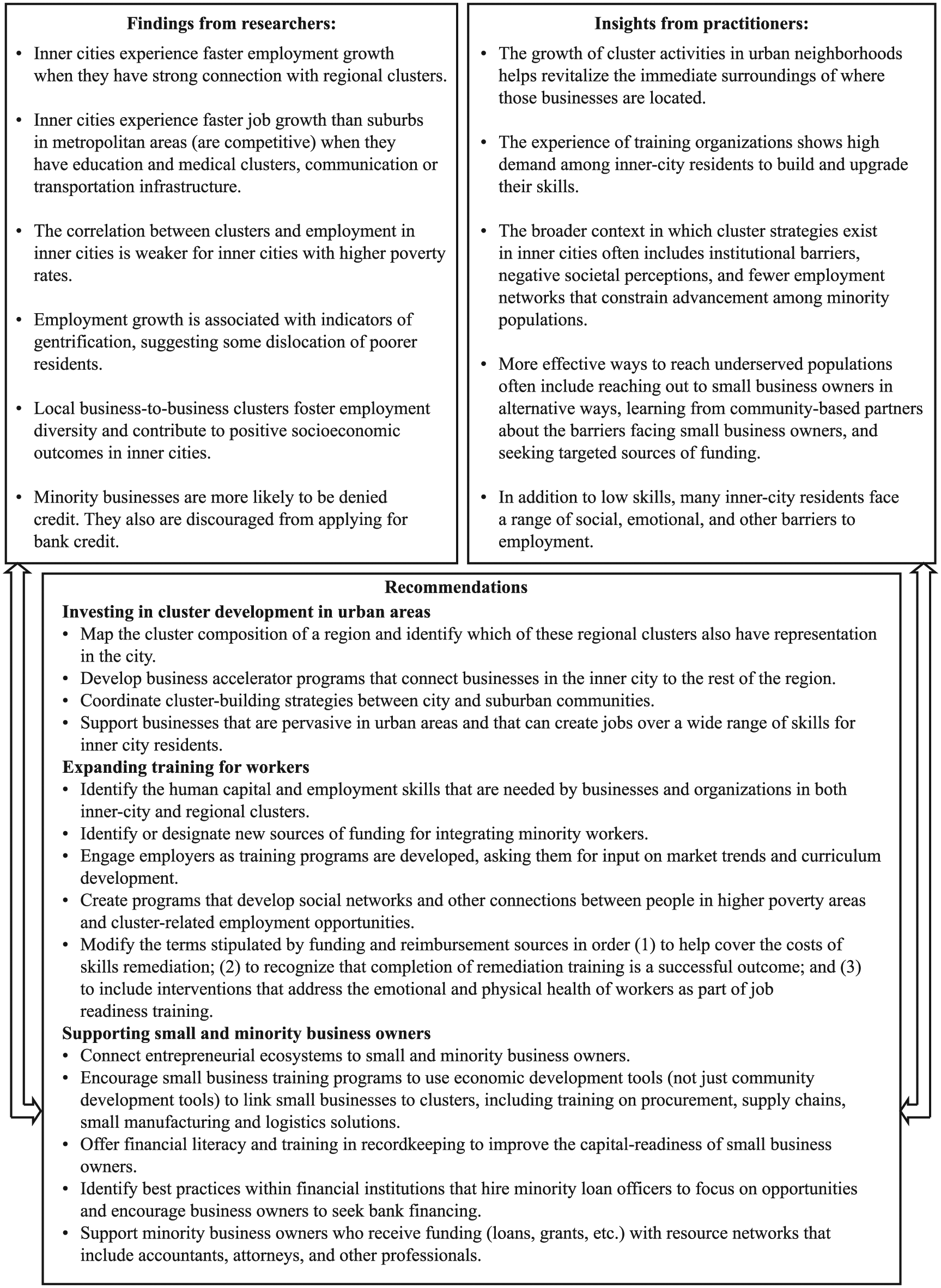
Summary of Findings and Recommendations, Using Mixed Methods.
The remainder of this conference summary is organized as follows: In the ensuing section, we provide a brief description of selected data and trends in inner cities to illustrate the socioeconomic context of inner cities as the backdrop for the discussions at the summit. The “Research Review” section summarizes the research presented at the summit that examines the relationship between clusters, employment growth, and poverty. We also provide limited reference to the broader literature that links clusters with other socioeconomic outcomes, such as racial economic inequality in inner cities. In addition, we note research findings on the types of clusters (i.e., local vs. traded) 7 that are more apt to promote inclusive economic development in terms of workforce diversity within inner cities; this is important, especially given the concerns among practitioners that certain inner-city populations may be less likely to benefit from cluster-based strategies.
The “Insights from Practitioners” section of this article provides an overview of the various ways in which practitioners implement cluster-based initiatives with respect to place making, business ecosystems, and workforce development. We share the experiences and opinions that are expressed by practitioners as well as insights gleaned through the surveys in which audience members offered their views and reactions to the panel presentations. The lessons learned highlight opportunities and challenges that practitioners face as they reach out to businesses and as they develop programs for workforce training for inner-city residents to connect them to local industries that have a high demand for labor. We conclude with a summary of key findings and recommendations from the summit.
Synopsis of Conditions in Inner Cities
According to Michael Porter (2015), structural changes in the U.S. economy over the past 20 years have led to a growing divide between the haves and the haves not, which have added to the challenges of strengthening inner cities. Although some inner cities are stable and a few are growing rapidly, the reality that emerges for the majority of inner cities is bleak. Poverty among minority residents in inner cities has remained stubbornly persistent. Ten percent of the U.S. population lives in the inner city, yet inner cities accounted for 23% of U.S. poverty and 34% of U.S. minority poverty in 2013 (Porter, 2015). In 2000, poverty in these places accounted for 19% of U.S. poverty and 31% percent of U.S. minority poverty (Porter, 2011).
According to Porter’s calculations, inner cities have experienced a net loss of jobs over time and regional employment growth is increasingly not translating into job expansion in the inner city. Between 1998 and 2009, inner cities had a 3.3% decline in employment, compared with the rest of the central cities, which had an average 4.2% increase in employment (Porter, 2011). From 2003 to 2013, net jobs in the inner city declined by 0.4%, compared with a 0.7% increase in the rest of the central city. Reflecting this bifurcation, the correlation between regional and inner-city employment, which stood at 20% between 1998 and 2009, dropped to 12% between 2003 and 2013 (Porter, 2015). Lower levels of educational attainment have impeded inner-city residents from competing in emerging high-skill and high-wage sectors in the regional economy. As of 2013, 15% of inner-city residents 25 years and older had a bachelor’s degree or higher, versus 29% in the United States overall (Porter, 2015).
The panels in Figure 1 use a measurable definition of inner cities constructed by Hartley et al. (2016), and present additional indicators of socioeconomic disparity between inner cities and the rest of the region (which we compute using various other data sources). The results in Figure 1A show that single female heads of households with children, a demographic highly correlated with poverty, make up more than a third of households in inner cities with a majority Black population, more than three times the rate of the rest of the metropolitan statistical area (MSA), which includes the central business district (CBD) and suburban areas. The homeownership rate in inner cities, a measure of wealth and neighborhood stability, is half that of the rest of the MSAs. Unemployment figures present an even more compelling picture of disparity. Between 2002 and 2013, predominantly Black inner cities had, on average, a 20% unemployment rate, compared with an 8% rate for the rest of the MSAs.
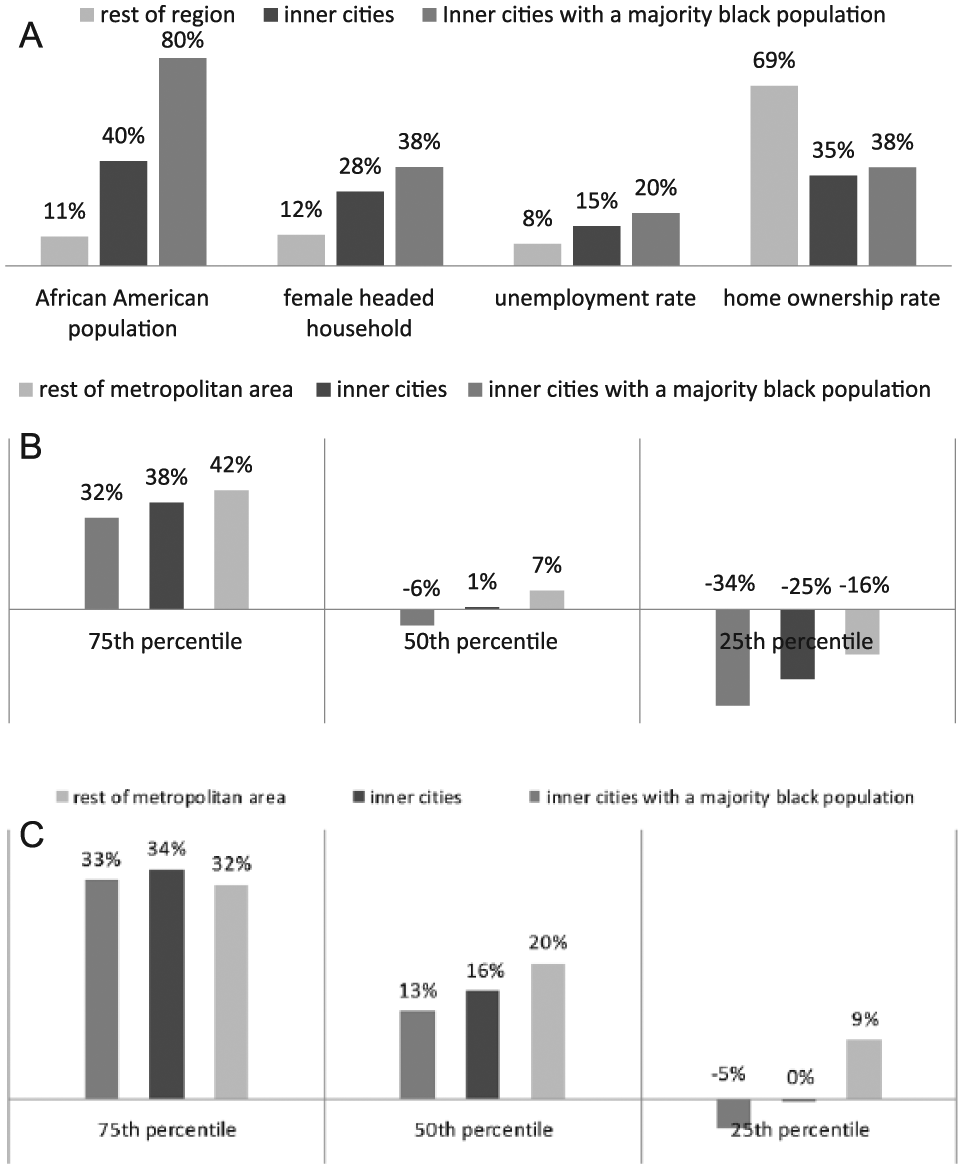
Synopsis of conditions in U.S. inner cities. (A) Demographic and socioeconomic characteristics, 2013. (B) Quartile distribution of job growth, 2002-2011. (C) Quartile distribution of household income growth, 2002-2011.
Panels B and C of Figure 1 provide an additional illustration of Porter’s argument regarding the bifurcation of economic opportunities. These figures (again using a definition of inner cities constructed by Hartley et al., 2016) depict the quartile distribution of job growth and household income growth, comparing inner cities generally (those with 20% or more poverty rate) with inner cities with a majority Black population (50% or more), with the rest of the MSA. Predominantly Black inner cities at the bottom of job growth distribution (those in the bottom 25th percentile) saw as much as a 35% drop in jobs over the 2002-2011 period, compared with a 16% decline in counterparts in the rest of the MSAs (panel B). Similar divergences are noted for household income. Inner cities at the bottom of the percentile distribution experienced up to a 5% decrease on average in household income, compared with a 9% increase for counterparts in the rest of the MSA (panel C).
A recurring theme of the conference emphasized the disparities that exist with regard to access to financial resources and credit, especially for minority entrepreneurs. 8 Figure 2 computes the number of small business loans (per every100 businesses) that flow to inner cities compared with the rest of the MSA, by the percentile distribution of the number of small business loans in each place type, respectively. We compare conditions in 2005 (prior to the 2008 financial crisis) in Figure 2 Panel A with those in 2011, in Figure 2 Panel B. The results for 2005 show less than 55 loans going to every 100 businesses for the average inner city (in the 50th percentile). This number decreases to less than 45 loans for inner cities that have a predominantly Black population. By comparison close to 70 loans were going to every 100 businesses in the MSA’s central cities and suburban areas, in the 50th percentile. After the financial crisis, credit was highly restrained everywhere, and some inner cities (in the 25th percentile) saw less than 10 loans per 100 businesses. For those inner cities with a majority Black population in the lowest 1 percentile (not shown in Figure 2), credit dried up completely. Overall, the data make clear that barriers in many inner cities limit prospects for employment, business formation, and economic mobility for residents.
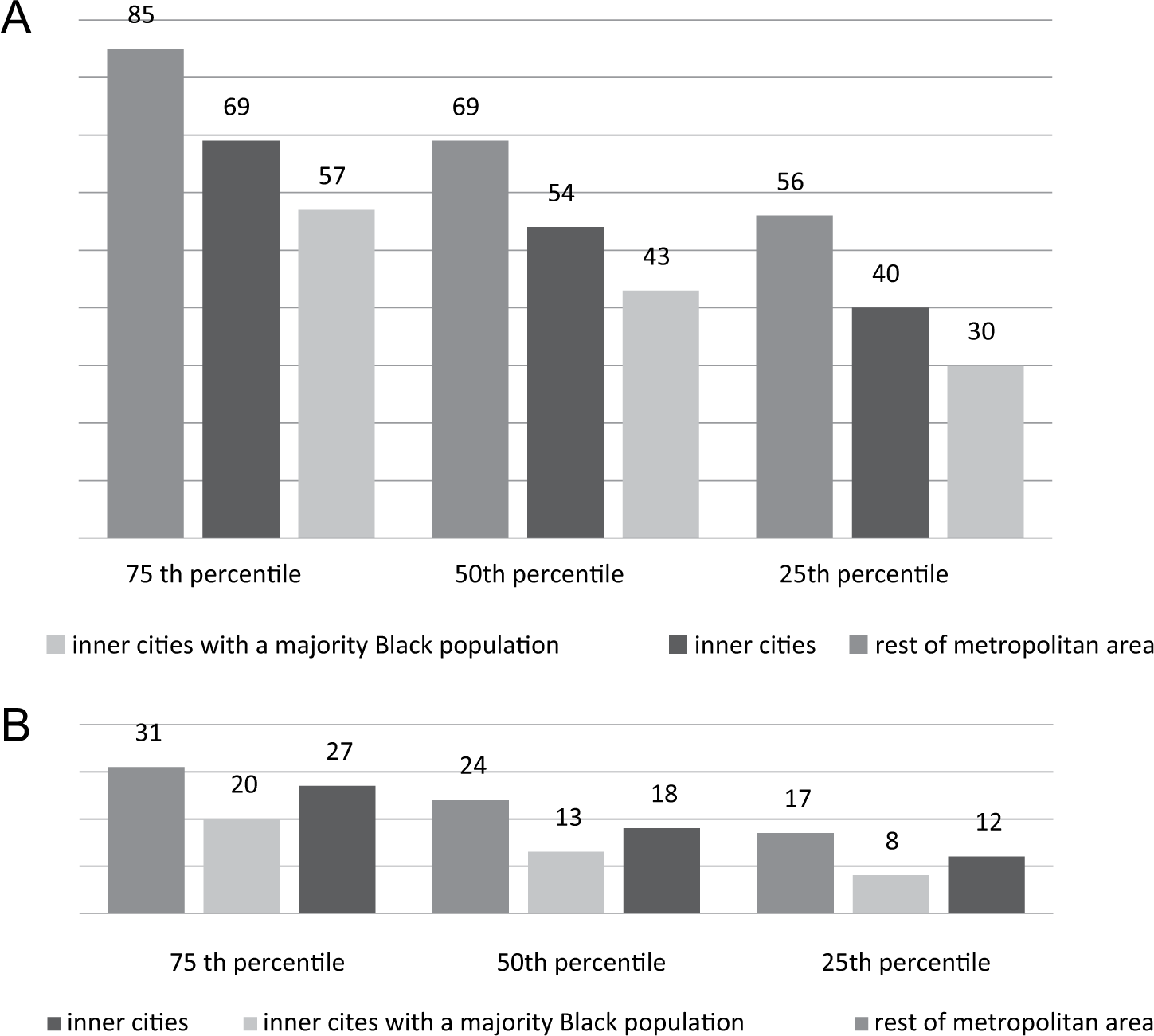
Differences in access to small business lending in inner cities versus rest of metropolitan areas. (A) Total number of small business loans for every 100 businesses, 2005. (B) Total number of small business loans for every 100 businesses, 2011.
Research Review
The research on industry clusters overall underscores opportunities that do exist in inner cities. To be clear, industry clusters are groups of related firms understood to leverage agglomeration economies (economies of scale) based on their proximity within a region. By working in proximity, firms are able to benefit from things such as the local pool of expertise and workers, as well as access to information networks. 9 Porter (1990) and some other contemporary researchers (e.g., Feser, 1998; Rosenfeld, 1997) are credited with expanding this type of cluster/colocation-based industrial organization, by emphasizing the importance of specialized institutions, the infrastructure and supply chain linkages that are needed to support and maintain firms in clusters, and the underlying mechanisms, policies, and structures that make them successful. To be more precise, Porter (1998) identifies clusters as (a) linked industries and other entities, such as suppliers of specialized inputs, machinery services, and specialized infrastructure; (b) distribution channels and customers, manufacturers of complementary products, and companies related by skills, technologies, or common inputs; and (c) related institutions such as research organizations, universities, standard-setting organizations, training entities, and others.
Clusters as a distinct form of industrial organization, which feature linkages and social networks, may be particularly useful in low-income settings such as inner cities (Nadvi & Barrientos, 2004). By engaging in clustering, firms in inner cities and more distressed places can overcome constraints associated with their (generally small) sizes, placing them in a better position to benefit from collective action in the face of common problems. The process of clusters itself can promote formation and survival of firms in poorer places such as inner cities, where they can be part of a readily identifiable supply or value chain.
At the summit, Porter reiterated that inner cities have to build on their comparative advantages. 10 The objective, in Porter’s view, is to build a critical mass in fields where (inner) cities have existing advantages; for instance, the automotive sector in Detroit. This allows cities to focus investments on filling gaps in infrastructure and services that help make all businesses in a given cluster more efficient and effective, as opposed to contemplating the particular needs of individual companies. When firms locate in proximity to each other in a given area, with the right surrounding environment in terms of government and regulation, that’s where, in the words of Porter, you have “ignition and lift off” in terms of job generation and wage improvement. Those are the critical mass, colocation, or cluster effects.
From a public policy perspective, a cluster-centered strategic framework is thus one construct for addressing inner-city problems, according to Porter. Clusters provide an opportunity to systematize economic activities and provide a way for organizing and prioritizing many public policies and investments, which are needed in inner cities. Central to a cluster development strategic approach, attention and investments need to be made to improve the efficiency of doing business in an inner city. As Porter’s model in Figure 3 illustrates, this indicates that businesses need to have access to high-quality inputs, including physical infrastructure, qualified human resources, and capital. Local rules and incentives need to be put in place to encourage investment, competition, and productivity. Also, the firms have to develop good management and operating practices, as well as improve their use of technology. 11

A cluster-centered policy framework for business attraction and economic development.
At the 2015 summit, researchers presented new and additional evidence to examine the theory that agglomeration economies can foster employment growth in inner cities. Mercedes Delgado-Garcia’s presentation tested the premise from Porter (1997), which asserted that inner-city jobs can be integrated into regional clusters. She finds that the presence of a strong cluster in inner cities, 12 that is linked or connected with other regional clusters (defined as when the cluster of the inner city is of the same type as the cluster in the rest of the region, a proxy for traded relationship), leads to an increase in employment growth in the inner city (see Delgado-Garcia & Zeuli, 2016). For the policy maker, this means that the idea is not to choose to develop or create a “generic cluster” from scratch or to “attract any type of firm,” but rather that place-based business attraction strategies ought to be intentional in attracting firms that can form an industry cluster or enhance an existing one. These findings also confirm the value of deploying resources for infrastructure that connect places and facilitate knowledge dispersion within the region.
In T. William Lester’s presentation at the summit, he also finds that many inner cities can be viewed as being competitive in terms of having faster job growth than suburbs in their metropolitan area. He and his coauthors find that growth is most evident in the education and medical clusters. In addition, inner cities with communication or transportation infrastructure are also likely to see greater job growth than others, and government actions such as empowerment zones also contribute to employment growth in inner cities (see Hartley et al., 2016).
Kevin Stolarick, another speaker at the summit, also finds that clusters of economic activities work through an agglomeration of knowledge, ideas, skills, and information. Exploring the relationship between human capital skills in cities compared with the suburbs, Stolarick and his co-researchers find that a critical mass of human capital in cities, measured in terms of population share and geographic density, is correlated with stronger regional economic performance in larger population centers. That is, places where educated people are concentrated, as opposed to being evenly spread out across suburbs and the inner city, do better than other areas (Stolarick, Mellander, & Florida, 2015).
The research presented at the conference underscored the distinctions that exist in terms of the efficacy of different types of clusters, as well as the scope of what cluster strategies can accomplish. Delgado-Garcia acknowledged that, while their research looks at traded clusters, local clusters—the work of local entrepreneurs (in terms of offering retail, amenities, business-to-business services, etc.) is also important. Indeed some previous research that has analyzed both traded and local clusters has shown that local entrepreneurs in local retail services and business-to-business activities in local clusters tend to form the core contributors of economic activities in poorer places (e.g., Butler, 1996; Rocha, 2004). Local clusters have a preponderance of small firms in labor-intensive sectors, they tend to hire harder to employ less-educated workers, and they can potentially have a direct impact on poverty alleviation (e.g., Beyers & Alvine, 1985; Feser & Isserman, 2009; Harrington & Lombard, 1991; Simms & Allen, 1996). An analysis to that effect of the local business-to-business sector in Detroit finds that it is well represented (in terms of its proportion to overall industry in the area); it has high levels of minority ownership, and employs a mixed composition of workers with different skills and education (Holifield, Kamis, & Lynch, 2012). It is therefore an example of a sector that can promote inclusive employment in the inner city.
Lester’s research echoed findings from other studies that suggest that, although some particular clusters are associated with a reduction in the poverty rate and inequality, most clusters do not have this effect (e.g., Fowler & Kleit, 2013; Morgan, 2007). Although clusters are positively correlated with employment in inner cities, this relationship is weaker for inner cities with higher poverty rates (2016; this EDQ issue). Indeed, Lester’s study finds that employment growth is associated with indicators of gentrification, suggesting some potential dislocation of poorer residents. 13
If employment and earnings disparities among different population subgroups were only a matter of human capital differences, poverty in inner cities could be alleviated by improving the skills of the labor supply to meet labor demand in industry clusters. However, if discrimination interferes in the search for employment or access to capital and resources, leading to exclusion, constraining the optimal adjustment and performance of markets, then the link between industry cluster, business growth, and economic outcomes in inner cities are less clear. To that effect in his presentation, Timothy Bates, distinguished professor emeritus at Wayne State University emphasized that strong disparities in access to financial resources and credit exist for minority entrepreneurs (Blacks and Hispanics), and explained why Black and Latino entrepreneurs are still less likely than White entrepreneurs to receive bank financing. In addition to confirming findings that minority entrepreneurs are more likely to be denied credit and citing an audit study that shows that bankers tend to exhibit differential treatments vis-a-vis minority applicants (e.g., Bone, Christensen, & Williams, 2014), Bates’s analysis reveals that these entrepreneurs often do not apply for financing, even when they qualify, because they do not expect to be successful in securing a loan (Bates & Robb, 2016). These findings suggest that efforts aimed at measuring place-based economic development may fail to identify the structural, institutional, or historical obstacles that affect the people who actually live in those places. Bates recommends demand-side strategies that encourage minority business owners to seek loans, as well as improved training for bank loan officers.
Insights From Practitioners
At several points during the summit, practitioners had the opportunity to share their perspectives on cluster-based strategies, including as panelists, keynote speakers, and audience members providing feedback on the sessions. Some of these practitioners came with the message that clear benefits exist for firms locating in certain inner cities. Some practitioners also described how they have implemented their programs with an appreciation of the cluster framework, looking beyond the internal workings of particular neighborhoods to link businesses and workers with higher growth sectors. Discussions from practitioners also provided nuanced and mixed perspectives on the limits of cluster-based development approaches to revitalize inner cities, and acknowledged that a fuller set of interventions related to business owner preparedness, human capital development, credit access, and other issues may be needed for inner cities to realize the benefits of regional growth and cluster strategies.
Cluster-Based Place-Making Strategies
Some practitioners at the summit focused on the positive experiences of situating their offices within an inner city. That was the story behind the keynote presentation from Rock Ventures, a multisector corporation that saw changes in Detroit’s leadership, fiscal management, and demographics as offering new opportunities for moving its headquarters and subsidiary businesses to the city, and bringing along 3,800 employees in the process. As Matthew Cullen, president and chief executive officer of Rock Ventures explained, the city offered (and continues to offer) competitively priced real estate; thus, the company continues to purchase commercial buildings outside the downtown area. The result has been more than 100 financial services, media, and technology businesses (associated with Rock Ventures) establishing themselves in Detroit, operating in scores of locations, and transferring or generating some 8,000 jobs to the city. The investments they have made in creating “cool urban spaces” have held a particular appeal to prospective job seekers.
Scott Mosely, director of investment strategies at The Water Council, conveyed a similar message in terms of the place-making benefits of the water cluster in Milwaukee. Mosely credited the development of the water district for creating thousands of new jobs in the city and revitalizing the Walker’s Point neighborhood, a formerly economically dormant section of city. Although Milwaukee was a major manufacturing center for much of the 20th century, the city had lost at least a third of its manufacturing jobs between 1980 and the early 2000s. 14 Innovative water technologies became a viable area for economic development in Milwaukee, given the strong global water market, 15 the city’s proximity to the Great Lakes, and its long history with water-related industries (e.g., immigrants who had arrived in Milwaukee in the mid-1800s brought with them experience in making beer). The Water Council’s home is the Global Water Center, a research and business accelerator situated within a 98,000 square foot facility that also houses academic institutions and water-related businesses. According to Mosely, the companies and organizations that make up the water cluster employ more than 35,000 people and attracted more than $210 million in investment between 2010 and 2014. Today more than 200 companies in southern Wisconsin focus on the water cycle, one of the densest water industry clusters in the United States.
During his tour of Eastern Market, a 125-year-old food district and economic development organization, President Dan Carmody also acknowledged the importance of place to Detroit’s food cluster. Food clusters have been gaining traction in some former Rust Belt cities like Detroit, where vacant or idle properties have been repurposed for food production, distribution, or commercialization purposes. In Detroit, the real estate market has been a key ingredient allowing for the growth of Eastern Market, which consists of fresh food sellers, distribution centers, and more than 100 food processing, manufacturing, and incubation businesses across 43 acres. Whereas many cities used to claim food districts like Eastern Market, these clusters disappeared when working food businesses were priced out of the real estate market. Even as some parts of Detroit have seen increases in land prices, places to the east and north of the market have remained affordable for Eastern Market to plan for expansions and updates. This is allowing Eastern Market to migrate its wholesale distribution facility and build new buildings to host scalable food enterprises in conformance with food-safety modernization standards. Eastern Market is able to convert older buildings to a wider variety of uses, including for the arts, housing, and other retail, while keeping these amenities close to the existing food district.
Business Ecosystem Support
The finding that “clusters matter” also resonated with practitioners involved with the creation of incubators, accelerators, and other business development tools, which are working to strengthen and connect inner-city businesses with the rest of their regions. As JumpStart’s Chief Executive Officer Ray Leach explained, JumpStart achieved considerable success as an entity that focused initially on providing venture capital to early-stage technology businesses in northeast Ohio. Identifying a void in financial resources for entrepreneurs in the region, Jumpstart strategically targeted industries with potential for high growth in regional and national markets. As Leach noted, Jumpstart invested $30 million of public and philanthropic money in 80 technology companies, secured more than $2 billion in private investment, received a return of $70 million, and transformed the capital landscape in northeast Ohio. More recently it has turned to supporting nontechnology inner-city businesses, and has begun to partner with a different set of actors including community development financial institutions, the Urban League, and others to match companies with funding experts across the United States. Among the lessons Leach emphasized during this presentation was the importance of identifying the existing “ecosystem” of service deliverers and capital providers so as not to duplicate efforts and to bring additive resources to the region.
Paul Riser, managing director of technology-based entrepreneurship at Tech Town in Detroit, explained how Detroit has also created a fertile environment for entrepreneurs through a significant increase in funding and support services for a small business ecosystem. 16 Tech Town is one component of that ecosystem, connecting start-ups and established businesses to trainers, experts in nearby universities, and funders. In his presentation, Riser further echoed some of the themes raised by the researchers regarding the broader set of interventions, in addition to cluster-related investments, that may be needed for business development organizations to operate entrepreneurship and consulting services in more blighted areas of a city. For example, when implementing its SWOT City program for underserved neighborhoods in 2012, Tech Town determined that the best strategy would be to build relationships with local community development corporations to learn from them about the distinctive needs of a community in terms of housing, education, and safety in addition to business development. Tech Town came to learn that capital availability is not always the main obstacle to growth, but that capital readiness is also an issue for many businesses, particularly for those that have followed inconsistent recordkeeping practices. Tech Town also encountered issues of trust, where many business owners did not believe that they would receive the assistance that would be necessary and relevant for their businesses. Riser noted that the onus is on incubators and technical assistance providers to develop appropriate training for neighborhood small businesses at various stages of the business life cycle.
Workforce Development
Practitioners at the summit attested to the influence of cluster thinking in the sphere of workforce development as well. Rashida Thomas, director of education and workforce development, explained how Focus: HOPE in Detroit operates with an explicit goal of understanding regional cluster strengths. Although the organization began decades ago with a mission to combat neighborhood poverty, its goals currently include helping people to participate in the economic mainstream, focusing on regional market dynamics as a way to understand the drivers of neighborhood conditions. They rely heavily on labor market data, analyses of cluster employment prepared by local community colleges and economic development organizations, and feedback from employers and universities to make sure its instruction is purposeful and industry-driven. Focus: HOPE trains in fields with the highest demand for new workers, including health care, retail, and hospitality, as well as for higher paying jobs in machinery, computer science, and engineering.
In her presentation, Thomas also corroborated the idea that creating a competitive business environment requires investing in human capital—investments that may be even more substantial than funding sources contemplate. Focus: HOPE offers an array of training programs depending on where students are in their skill development, from remedial classes to certificate programs for information technology and machinists, to associate and college degrees. This structure, as Thomas described it, offers various on-ramps to get people of all levels into the system. A substantial proportion of people who come in to test for placement, for example, turn out to require additional academic remediation. And along with academic enrichment, many of these students need an extensive amount of case management to address the range of social and life challenges they face. However, it is not always possible for Focus: HOPE to work with these students since the terms of its funding often do not cover the comprehensive set of services needed to build these basic skills. According to Thomas, Focus: HOPE would train more people if funding sources would help pay for more of these remediation costs, and if the system were to recognize that successful outcomes include the completion of remedial training or returning to school for higher education in addition to immediate job placement.
Results of Convenience Sample Survey of Audience Members
To engage an even wider number of practitioner perspectives, the authors developed an open-ended questionnaire that was distributed to a sample of audience members who attended the 2015 Inner City Economic Summit. A set of questions asked audience members to share their responses to the presentations on the competitiveness of inner cities, and offer their own views on opportunities for business growth, financing, and human capital development in the inner city. The audience members were also asked to elaborate on opportunities and challenges, as well as on tools and strategies that are being used by practitioners.
On one hand, the responses revealed a clear receptivity to the concept of clusters and agglomeration economies. Based on feedback provided on the first panel of the summit, the respondents agreed that industry and regional clusters, along with anchor institutions, are effective factors for growth and development. That is, in response to the question about which research findings resonated with them with respect to the drivers of employment and competitiveness in inner cities, respondents listed clusters and anchor institutions as factors (a not altogether surprising answer because the focus of the conference was on clusters). But survey responses also revealed that many practitioners believe that cluster strategies alone cannot drive employment in inner cities. In response to the question regarding which other drivers of employment creation and competitiveness in inner cities that they believe are crucial, the most common response had to do with institutional perceptions and structural barriers against Blacks, Latinos, and immigrants who make up these ethnic/racial groups, which were seen as constraining economic development and growth in inner cities (see Figure 4). To that effect, audience members indicated that poverty, racism, income inequality, and lack of access to resources play an important part in whether economic development takes place and benefits inner-city residents.
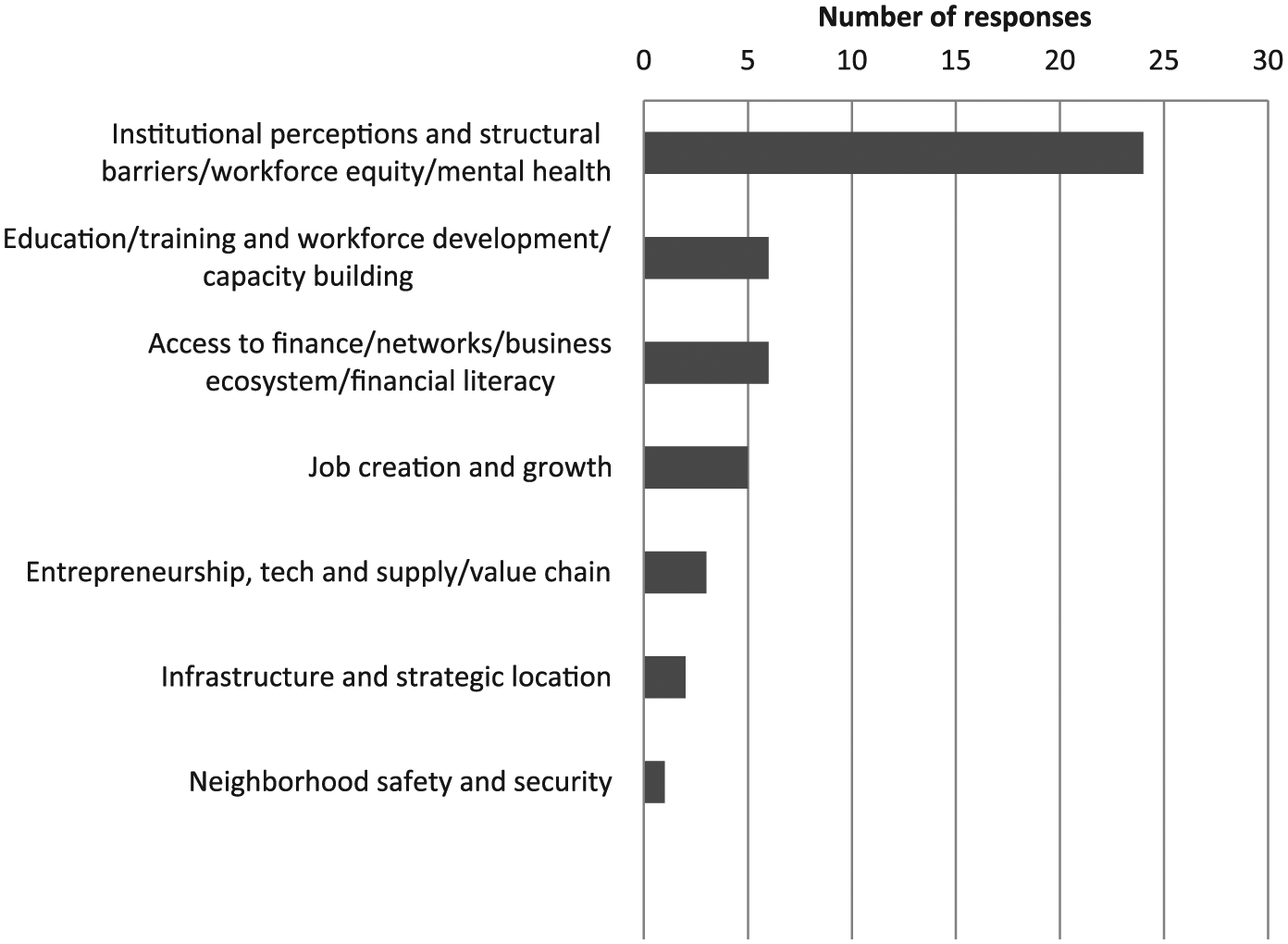
Issues related to employment and competitiveness, human capital, and funding in inner cities that are important to practitioners.
Audience members picked up on concerns raised during the panel discussions that workforce equity is not a “given” in inner-city cluster development. Audience members also returned to the idea that emotional and physical health cannot be ignored when it comes to job readiness and preparedness, and looped in the notion that financial literacy (in addition to access to financing) are other challenges in the way of business opportunities in the inner city (Figure 4). The perspectives that emerged from the answers to the summit sample survey revealed a strong interconnectedness of the highlighted themes in terms of the barriers that prevent residents of inner cities from capitalizing on employment and entrepreneurial opportunities. Blacks and Latinos often lack access to resources and networks, leading to discouragement from seeking to borrow money from banks, and the decision not to participate in the financial system.
When asked about areas of intervention in which different strategies can be used by practitioners to ameliorate conditions in inner cities, the most common remarks related to the notion that practitioners could use tools to redress entrepreneurship, especially in technology-related and supply/value chains, to combat constraints and counteract lack of employment opportunities in inner cities. This was followed by the importance of ensuring access to financing and financial literacy and resource networks for businesses (Figure 4).
Finally, respondents had specific recommendations (not shown in figure). Those expressing support for promoting entrepreneurial ecosystems and business networks emphasized the need for regulation and enforcement for relevant and appropriate resources to reach the traditionally disadvantaged groups (Blacks and Latinos). Another suggestion from the respondents was that those minorities who receive funding (loans, grants, etc.) should be supported with networks that include accountants, attorneys, and other professionals who can support them both as entrepreneurs and as employees within the workplace.
Summary and Recommendations
In this conference summary, we use a mixed methods approach to review the implications of industry clusters for economic mobility of residents and entrepreneurs in lower income communities in inner cities, drawing from research, industry cluster programs, and insights from discussions, which took place at the 2015 Inner City Economic Summit (see Textbox 1). Using data available with the U.S. cluster mapping project, researchers have begun to evaluate the hypothesis that the formation and strengthening of clusters drive development and economic growth in inner cities. This new evidence demonstrating a positive relationship of clusters and employment growth and inner-city competitiveness, is, in the words of Michael Porter (2015), “a tremendous opportunity to move the needle and accelerate progress for inner cities.”
Many of the practitioners who spoke at the summit also report positive experiences with cluster-based activities or programs within the inner-city neighborhoods and communities where they operate. Their work has contributed to new narratives that counter existing negative stereotypes. As they have made investments and improvements in their buildings and surrounding communities, they have changed perceptions about the benefits of working and living in the inner city.
However, as many practitioners and others noted at the summit, realizing the benefits of cluster strategies in urban areas may require some unique refinements. Part of tailoring clustering strategies to inner cities involves rethinking how to apply existing economic development tools like empowerment zones to maximize the potential benefits of an agglomeration economy for the businesses that locate in those zones. Tailoring clustering strategies to inner cities may also require businesses and organizations to identify or designate new sources of funding for particular programs, as in the case of The Water Council in Milwaukee that received a grant from the Small Business Administration to promote the growth and development of small businesses operating in the water technology sector.
Perhaps most important from the practitioner perspective, the benefits of clusters are not necessarily perceived to be automatic for all. Minority entrepreneurs in inner cities continue to encounter barriers to financial resources. In addition, there is a tendency for clusters to favor more skilled workers, as evidenced by gentrification in cluster areas. Thus, as many practitioners emphasized in their presentations and feedback, a purposeful set of interventions may be necessary to avoid possible unintended consequences such as displacement of low-skilled workers. This includes supporting the types of businesses that are pervasive in urban areas and that can create jobs over a wide range of skills for inner-city residents. This means directing efforts at upgrading the skills of workers and connecting workforce training to businesses in the clusters both in the inner cities or/and regionally. This also includes focusing on a wider range of issues and barriers facing residents so that cluster-based strategies help address problems of inner cities in a more holistic way. For example, in addition to worker readiness, cluster-supporting policies could address neighborhood housing blight, high crime, and related perceptions that impair the business environment in distressed and segregated places.
Increasing awareness of the economic and social inequality in America’s inner cities has brought new levels of attention to the topic of clusters as a strategy to attract businesses and grow employment in urban areas. This article reaffirms long-held perspectives on the promise and limits of clusters. Poverty and related adverse socioeconomic outcomes in inner cities are the results of complex interrelated factors, and no single policy can fix all problems. If industry cluster-based development policies are to represent a promising venue for revitalization of the inner city and lead to the betterment of residents, they should be informed by research demonstrating that industry clusters are linked to encompassing socioeconomic outcomes in inner cities. By the same token, a broader set of policies and investments may be needed to complement cluster strategies, including those that create employment opportunities and offer skills training, as well as those that connect entrepreneurial ecosystems to small and minority business owners. This more comprehensive approach may be needed to give inner-city residents a better opportunity to share in the potential benefits of agglomeration economies and provide the enabling environment for inner cities to achieve economic development and growth.
Footnotes
Authors’ Note
The views expressed are the authors and do not necessarily reflect those of the Federal Reserve Bank of Chicago, or the Board of Governors of the Federal Reserve System.
Declaration of Conflicting Interests
The author(s) declared no potential conflicts of interest with respect to the research, authorship, and/or publication of this article.
Funding
The author(s) received no financial support for the research, authorship, and/or publication of this article.