



Abstract
In 2005, the Supreme Court’s Kelo v. New London ruling reaffirmed governments’ right to use eminent domain for economic development purposes. Widespread public backlash over the ruling resulted in numerous states quickly passing laws restricting the use of eminent domain for such purposes. This study uses the swift and uneven response of state legislatures to the public outcry that followed Kelo to test the empirical question of whether restrictions on eminent domain affect states’ ability to fulfill their economic development goals. Results indicate that states that restricted the use of eminent domain following the Kelo ruling experienced no adverse effects in terms of state employment and gross state product or county employment and county income in the states’ most dense counties.
By and large, the general public views the fostering of economic development as an important responsibility for state and local governments. Seventy percent of respondents to an American Planning Association (2012) poll identified job creation as a high priority for policy makers, and 63% identified a preference for economic development funding receiving a high priority for scarce local government resources. However, the use of eminent domain as a tool for achieving governments’ economic development goals is a more contentious issue. The power of eminent domain, given to state and local governments by the Fifth Amendment to the Constitution, authorizes the government to take private property for public use. A long-standing debate exists over whether public use should be narrowly defined to projects in which the general public has access, such as roads, parks, and public infrastructure, or if it should be broadly defined to include projects that further a well-established public purpose. In 2005, the United States Supreme Court’s Kelo v. City of New London (2005) ruling upheld the broad definition of public use by reaffirming governments’ right to use eminent domain to transfer property from one private owner to another to further its economic development goals, declaring, “Promoting economic development is a traditional and long accepted function of government” (Kelo v. City of New London, p. 2). The use of eminent domain for economic development purposes has long been opposed by free-market advocates who object to its infringement on private property rights, 1 as well as by many anticorporate progressive advocates who object to local governments using eminent domain to transfer property from small businesses and homeowners to big businesses and developers. 2 Although the ruling reaffirmed a common practice undertaken by many local jurisdictions, the publicity that followed the Kelo ruling elicited a broad public backlash that went beyond the long-standing opponents of eminent domain and resulted in an outburst of state laws pertaining to its use. In the 2 years following Kelo, 41 states passed such legislation, but there was great variation in the extent to which the new laws placed effective limits on local governments’ use of eminent domain.
The rationale for eminent domain’s role in economic development comes from the potential market failure resulting from the need to assemble contiguous land parcels from multiple owners, which is often required for large redevelopment projects. As stated in their amicus briefs supporting the city of New London, 3 the fear of local governments and economic development agencies is that developers would be less likely to initiate development projects that require assembly of properties without the possibility of petitioning for the government’s use of eminent domain to overcome a holdout problem that cannot be solved with private negotiations (Kelo v. City of New London, 2005). If eminent domain does have such a broad impact on negotiations between developers and landowners, then its impact extends well beyond the individual cases where local governments initiate condemnation. Instead, eminent domain laws affect all developments where the possibility of holdouts and costly assembly exists. This study’s important contribution to the literature on eminent domain is the examination of whether binding restrictions imposed by state legislatures following the Kelo decision influenced economic development agencies’ ability to fulfill their public purpose of fostering economic growth by focusing on the impact on state employment and gross state product (GSP).
Market Failure, Eminent Domain, and Economic Development
The power of eminent domain represents a limitation of private property rights and is given to governments through the takings clause of the Fifth Amendment to the Constitution. Courts have interpreted this clause to impose two restrictions on the government’s use of eminent domain: The taking must be for public use and the owner of the condemned property must receive just compensation. The courts’ interpretations of both restrictions have changed over time. The Supreme Court’s ruling in Berman v. Parker (1954) expanded the interpretation of public use to include the broader view of serving public welfare, leaving it to local governments to define public purpose. As fostering economic development through various means is a ubiquitous role for local governments, the courts had ruled that utilizing eminent domain for such ends falls under the definition of public use. In Poletown Neighborhood Council v. Detroit (1981), the Michigan Supreme Court ruled that the City of Detroit could use eminent domain to transfer property from 4,000 residents to General Motors, who intended to build a factory that would employ 6,000 workers.
Eminent domain’s theoretical ability to foster economic development is shown by Munch’s (1976) and Saginor and McDonald’s (2009) models of land assembly, where developers assemble contiguous parcels with homogenous characteristics. Although parcels are homogenous, sellers’ reservation prices vary and as a result, the average price of assembled parcels increases with the number of parcels assembled. The market failure in the Munch and Saginor and McDonald models occurs when the developer cannot determine the reservation price of individual sellers and must therefore offer a single price to each parcel owner. Consequently, the developer’s marginal cost of assembling parcels is above the reservation price of the marginal seller resulting in an inefficient underassembly of parcels. 4
Strange’s (1995) model of the holdout problem in the presence of asymmetric information emphasizes the potentially broad impact eminent domain powers may have on economic development. Whereas the Munch and Saginor and McDonald models emphasize the inefficiency resulting from the developer’s inability to engage in perfect price discrimination, Strange’s model incorporates the uncertainty present in the negotiation process and contains a number of results significant to the current study. First, the landowner’s uncertainty creates inefficiency as it results in the possibility that mutually beneficial transactions do not occur. Second, as ownership becomes more disperse, the likelihood of reaching an agreement to assemble the properties falls and, when the developer does reach an agreement with landowners, the aggregate price is higher. 5
These theoretical models summarize the fears of municipalities and economic development agencies—that the lack of eminent domain powers would cause developers to focus developments in fringe areas with less disperse ownership or in states that allow for eminent domain condemnations in support of economic development. The National League of Cities, National Conference of State Legislators, U.S. Conference of Mayors, Council of State Governments, and National Association of Counties all joined in an amicus brief supporting of the city of New London in the Kelo case, raising concerns that restricting the use of eminent domain would result in private developers avoiding areas that required assembly of properties (Kelo v. City of New London, 2005).
Whereas these models suggest that both the holdout and land assembly problem can lead to inefficient assembly, they are ambiguous as to whether the more efficient outcome occurs by allowing government agencies to break impasses with eminent domain, or by allowing the market to reward developers that are most effective at solving the problem. The first view holds that government intervention through eminent domain can improve efficiency so long as the judicial and political systems accurately and efficiently take into account the full cost of unwilling sellers subjected to eminent domain proceedings by recognizing that their reservation price is greater than the market price. The second view, in the spirit of Coase (1960), holds that preserving well-defined property rights along with competition between developers will result in the most efficient outcome, as developers that are most efficient at solving the information problem associated with land assembly through private negotiations will come to dominate the redevelopment market. 6 Assemblage of land using secret purchases utilizing buying agents to obfuscate a developer’s intentions and limit holdouts is a common practice (Ayotte & Smith, 2011). Nordquist’s amicus brief in support of the petitioners (Kelo v. City of New London, 2005) also cites cases where landowners organized the assembly process, agreeing ex ante how the economic gains would be distributed among property owners. As both government intervention and market solutions to the assembly problem require additional labor and time costs, the relative effectiveness of the competing solutions is ambiguous.
Since Kelo represented a reaffirmation of an existing practice, the ruling alone placed no added restrictions on the use of eminent domain for economic development. Nonetheless, the controversy following the ruling quickly raised the issue into the public consciousness, leading to widespread legislative changes. Somin (2009) reported the results from a 2005 Saint Survey, which asked a random sample of people the following question: “The U.S. Supreme Court recently ruled that local governments can take homes, business, and private property to make way for private economic development if officials believe it would benefit the public. How do you feel about this ruling?” (p. 2111). Somin (2009) reported that 81% of respondents disagreed with the ruling. Opposition to the ruling cut across political parties with 79% of Democrats, 85% of Republicans, and 83% of Independents opposing the ruling. This broad political opposition to Kelo is also found in the amicus briefs filed on behalf of the petitioners. Libertarian groups, such as the Cato Institute, Reason Foundation, and the Goldwater Foundation, were joined by progressive groups, such as the NAACP, AARP, Southern Christian Leadership Conference, Hispanic Alliance, Jane Jacobs, and the Congress for New Urbanism, in their support for the petitioners (Kelo v. City of New London, 2005). Interest groups such as the National Association of Homebuilders, National Association of Realtors, and American Farm Bureau Federation also opposed economic development as a justification for eminent domain as entrepreneurial governments would be less inclined to protect their interests over those of commercial developers (Kelo v. City of New London, 2005). Prior to Kelo, the general public’s ignorance left these disparate special interests without the political strength to match that of economic development interests. It is important to note that economic development interests not only include private developers but also local governments and their delegating agencies that are under significant political and public pressure to foster local economic development.
Lanza, Miceli, Sirmans, and Diop (2013), Lopez, Jewell, and Campbell (2009), and Sharp and Haider-Markel (2008) summarize the public choice model of states’ decision to restrict local governments’ use of eminent domain, with state legislatures finding the optimal restrictions on eminent domain by weighing the political benefits and costs of such action. Although the public outrage following Kelo shocked the political equilibrium, adding a significant cost to the status quo, local government officials still viewed the status quo as providing adequate protection for abuses of eminent domain. As such, for some states the post-Kelo political equilibrium entailed the passage of a symbolic law that satisfied an uninformed public’s ephemeral demand for reform, while containing loopholes that resulted in no effective restrictions on local governments’ use of eminent domain. While 41 states passed laws purporting to restrict the use of eminent domain in the 2 years following Kelo, only 20 states effectively restricted the use of eminent domain for economic development purposes. Carpenter and Ross (2010) is the only other study to examine the impact of eminent domain restrictions on economic development measures. They examined the impact restrictions had on construction jobs, building permits, and property taxes and did not find any evidence of an impact. Carpenter and Ross limited their analysis to these three measures because of their close connection to new developments. This study examines broader measures of economic development, state employment, and GSP, because doing so better reflects the stated public purpose of economic development agencies. The city of New London’s aim was not to attract the construction jobs tied to the building of Pfizer’s research facility, but to attract the high-paying jobs and agglomeration economies that the facility would bring to the city’s waterfront. Property taxes and residential building permits are also a poor measure, as local governments often use eminent domain to convert properties from residential use to commercial use. As shown in McDonald (2001), the cost-benefit analysis of economic development programs incorporates not only additional tax revenue but also labor market effects and costs of providing government services. For these reasons, economic development agencies often have a preference for nonresidential property, as it represents a tax base with lower ongoing government spending requirements, in particular for public safety and education. Following this line of reasoning, both the National Association of Homebuilders and the National Association of Realtors viewed the use of eminent domain for economic development purposes as a detriment to the industry, and filed an amicus brief in opposition to New London’s use of eminent domain (Kelo v. City of New London, 2005).
Data
The Supreme Court issued its Kelo ruling on June 23, 2005. Until that time, Utah was the only state that restricted the use of eminent domain, effectively banning takings for economic development purposes several months before Kelo was decided. By the end of 2005, two states, Alabama and Texas, passed laws restricting the use of eminent domain. Twenty-three additional states enacted laws in 2006 and 16 more states enacted laws in 2007. Only Arkansas, Hawaii, Massachusetts, Mississippi, New Jersey, New York, Oklahoma, and Washington failed to pass eminent domain reform in the wake of the Supreme Court’s Kelo decision. 7 Although 41 states enacted statutes in the 2 years following Kelo, there was great variation in the extent to which the laws effectively restricted the use of eminent domain for economic development purposes. Some states enacted legislation prohibiting the use of eminent domain to transfer property from one private party to another, but explicitly exempted economic development takings from the restrictions. Other states enacted legislation prohibiting the use of eminent domain for economic development purposes with an exemption for takings with a finding of blight. The blight exemption also represents a loophole for economic development, as courts have generally allowed governments to declare any developable property blighted.
For the purpose of this study, I have defined a state as having enacted effective legislation restricting the use of eminent domain for economic development purposes if the following two conditions held: (a) the law prohibited economic development as a justification for eminent domain and (b) the law did not include broad exemptions to the restriction for blight reduction.
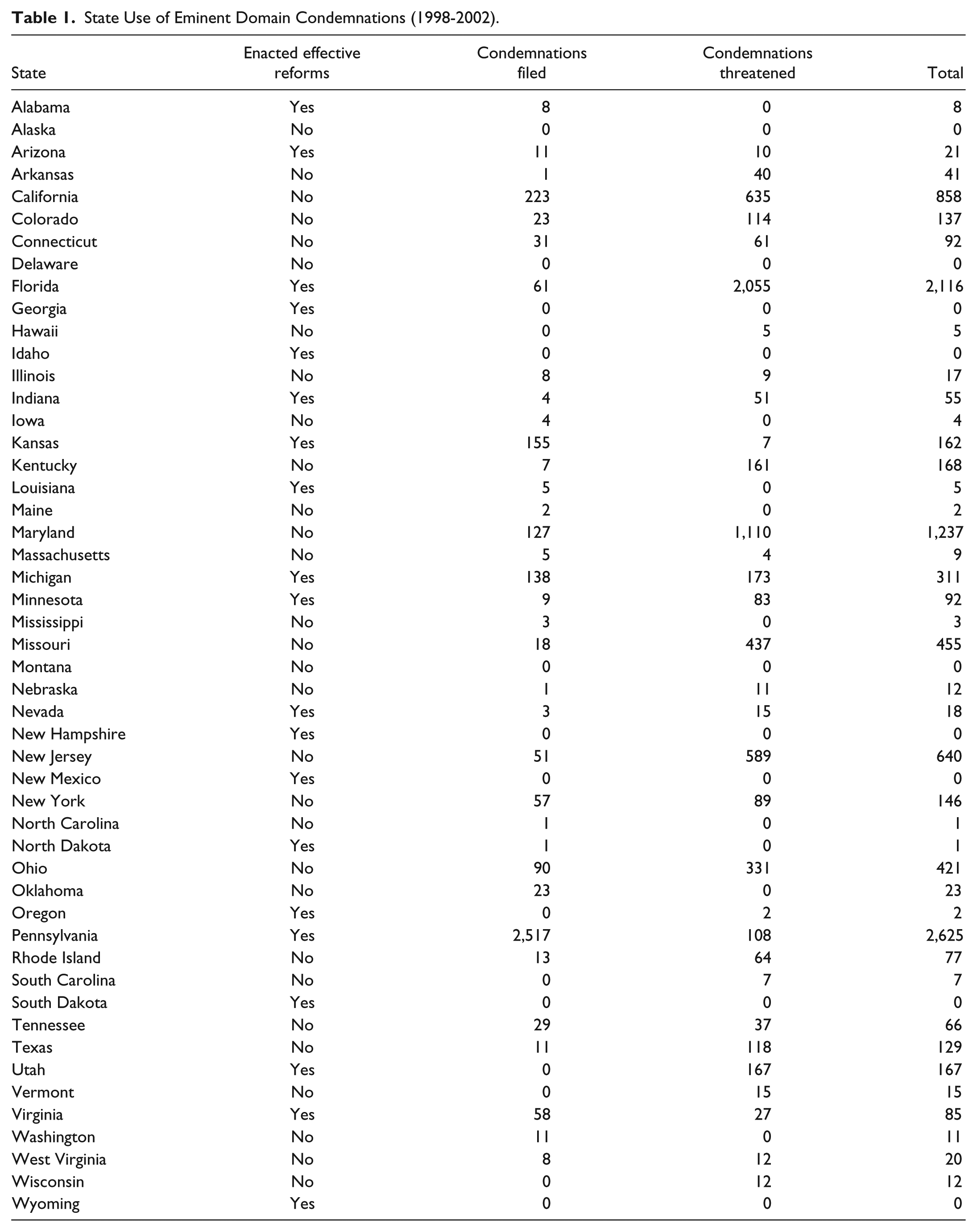
I defined states as having met the second condition if the legislation included specific measures for a finding of blight. Based on the criteria, 20 states effectively restricted the use of eminent domain and 30 did not. 8 Table 1 presents the number of eminent domain condemnations threatened or filed in the years prior to the Kelo ruling (1998-2002), as reported by Berliner (2003). 9 Tables 1 and 2 confirm the view that broad-based outcry over the Kelo ruling resulted in significant and uniform political pressure to restrict the use of eminent domain, as states that restricted the use of eminent domain did not differ significantly from those that did not. 10 In fact, states that restricted the use of eminent domain had more condemnations on average, and the two most prolific users of eminent domain, Florida and Pennsylvania, are in the restricted group.
State Use of Eminent Domain Condemnations (1998-2002).
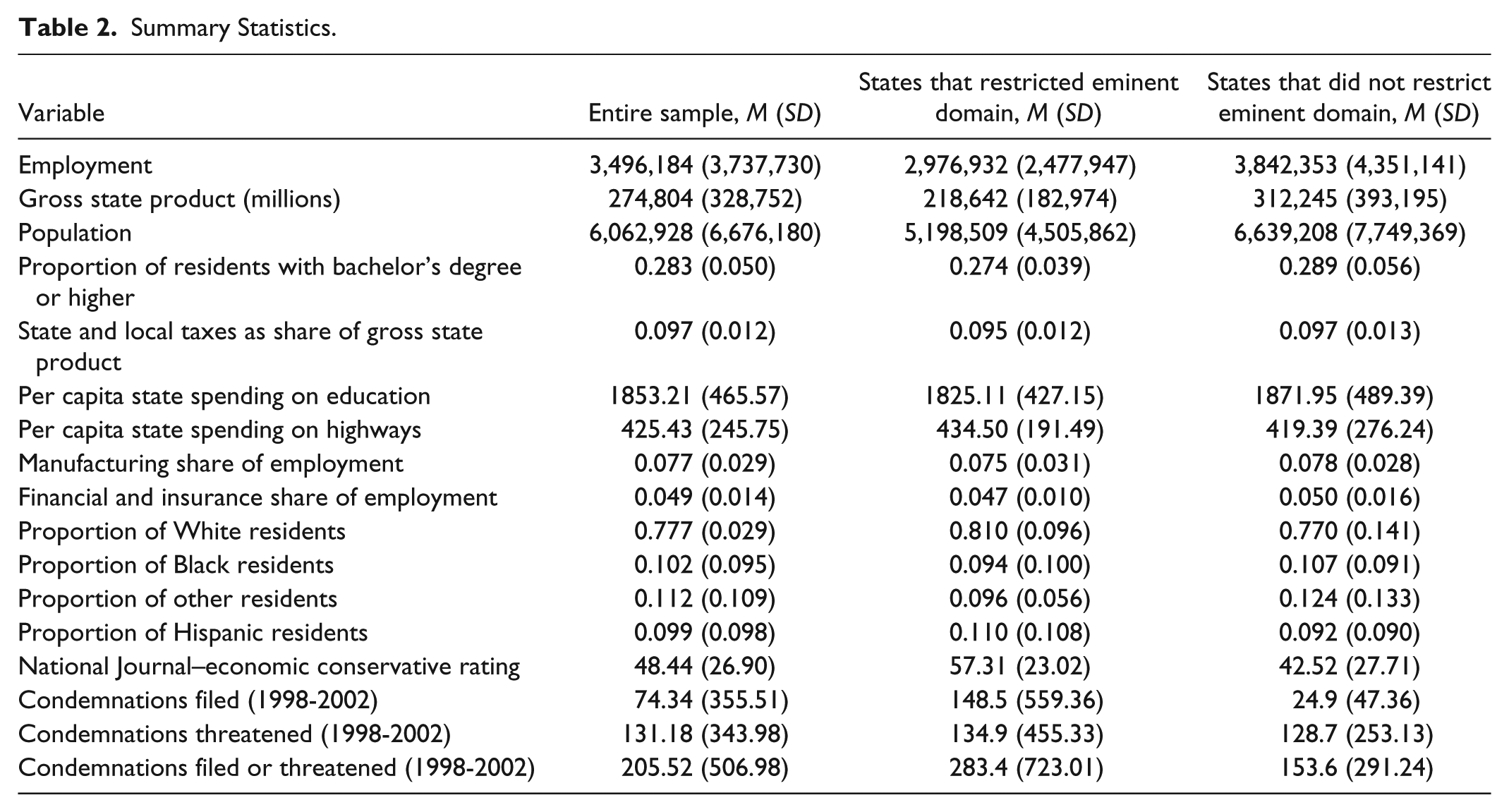
Summary Statistics.
GSP and employment are used as measures of economic activity that state economic development programs are meant to support. For regressions at the county level, county employment and income are used. These measures come from the Bureau of Economic Analysis’ Regional Economic Accounts. Additional data from the Regional Economic Accounts include population, manufacturing share of employment, financial and insurance industry share of employment, and state and local taxes as a share of GSP. We would expect that industry mix of a state or county may affect economic growth (Funderburg, Bartik, Peters, & Fisher, 2013; Garrett, Wagner, & Wheelock, 2007), and the relative decline in manufacturing employment over the past few decades could result in states that are more reliant on the manufacturing sector to experience less employment growth. Manufacturing’s share of impact on GSP and county income is ambiguous as the decline in manufacturing jobs is a result of increases in manufacturing productivity (Schiller & Trebing, 2003). This growth in productivity makes it possible for output in manufacturing to increase, while employment in manufacturing decreases. As for the expected impact of state tax burden, Wasylenko (1997) summarizes the literature on taxes and economic development, and reports tax elasticity estimates in the range of −0.1 to −0.6, implying that a 10% increase in taxes would result in a 1% to 6% decrease in economic activity. Buss (2001), Fisher (1997), and Helms (1985) highlighted the importance of including public service in models of state economic development. For this reason, state per capita spending on education and highways from the U.S. Census Bureau’s Annual Survey of State Government is included to control for any effect that state governments’ investment in human capital and infrastructure has on economic development.
I included data from the U.S. Census Bureau’s American Community Survey to control for additional demographic characteristics that may affect economic activity. These variables, at both the state and county levels, included the proportion of the population with a bachelor’s degree or higher along with the race and ethnic makeup of the population. I expect states and counties with higher stocks of human capital to have higher levels of economic activity, and the demographic characteristics are included to control for differences in labor force participation and unemployment rates between groups (Edmiston, 2006; Partridge & Rickman, 1997). To control for differences in political climates that might affect state economic activity, I included each state’s average senators rating as an economic conservative by the National Journal (Barone & Cohen, 2006, 2008, 2010; Barone & McCutcheon, 2012, 2014). Garrett and Rhine (2011) found that state measures of economic freedom have a positive and significant effect on state employment. I also tested specifications using alternative ratings as a proxy for a state’s political climate. 11 Dummy variables are also included for the four census regions to control for regional differences in economic growth.
As discussed below, the study uses two difference-in-differences (DD) methods for testing its hypothesis. In the first approach, each state has two observations: pre-Kelo (2004) and post-Kelo (2012). The second approach utilizes panel data of states from 2004 through 2012. Table 2 presents the panel data’s summary statistics for the entire sample and for the two groups of states categorized by whether they effectively restricted local governments’ use of eminent domain. The mean employment level and population in the sample was 3.5 million and 6 million residents, respectively. The mean GSP was $274.8 billion and state and local taxes accounted for 9.7% of GSP. On average, 28.3% of residents had a bachelor’s degree or higher, the manufacturing sector accounted for 7.7% of employment, and the financial and insurance sector accounted for 4.9% of employment. Per capita spending on education and highways was $1,853 and $425, respectively. The characteristics of states that restricted the use of eminent domain and states in the control group are quite similar, giving additional confidence in the appropriateness of the DD approach, which treats states that did not enact effective legislation as a control group. t tests on the difference in means between the two groups’ variables indicate that states that restricted the use of eminent domain were not significantly different than states that did not restrict the use of eminent domain.
Difference-in-Differences Methodology
This study estimates the impact of eminent domain restrictions on economic growth using two DD regression methods. Following Meyer (1995), the standard DD approach treats the enactment of eminent domain restrictions as a quasi-experiment with states that did not restrict local governments’ use of eminent domain serving as the control group. The sample is separated into two time periods: pretreatment and posttreatment. The pretreatment variables are from 2004, the year prior to the Kelo ruling, and the posttreatment variables are from 2012. 12 An alternative approach is to use a first-differencing (FD) fixed-effect estimation following Wooldridge (2002). Each approach has its benefits and drawbacks.
Bertrand, Duflo, and Mullainathan (2004) indicate that serial correlation can lead to underestimation of standard deviations of treatment effects and therefore overestimation of t-statistics and significance levels when using panel data. Collapsing the data into pre- and postperiods corrects this problem. The DD estimates would also better capture the effect of the restrictions on eminent domain if the impact on state economies take time to materialize. The timing of legislative responses to Kelo makes DD estimation particularly appropriate for assessing the impact of the restrictions. Prior to Kelo, there was little pressure on policy makers to address the issue, as such, with the exception of Utah, there were no significance legislative restrictions placed on eminent domain. The Kelo ruling instantaneously created an enormous amount of political pressure on legislatures who responded by quickly passing laws that either superficially or substantially restricted eminent domain. The public soon returned to its ambivalent state, resulting in no additional pressure on legislatures to find a new political equilibrium. In this sense, the response to Kelo more closely resembles a quasi-experiment compared with other public policy changes that slowly work their way across states before reaching a crescendo. The response to Kelo also resembled an exogenous event in that the public backlash was somewhat unexpected, as the Supreme Court merely signed off on what was standard practice for states. The estimated DD model has the following form:

where
The FD approach estimates the impact of eminent domain restrictions using the entire time period from 2004 to 2014. This fixed-effect approach transforms the variables as a year-to-year change, thus estimating the model:

The variable ΔRESTRICT takes a value of 1 in the years where a state implements new restrictions on the use of eminent domain and takes a value of 0 in all other years. Although estimates of time-invariant coefficients are lost through the FD transformation, the transformation also eliminates any unobserved, time-invariant heterogeneity between states. With more observations, the FD approach could better control the time-invariant omitted variables than the simple DD approach. Interpretation of the coefficients of the other covariates differ slightly between the two approaches. While the two-period DD model relies primarily on variation between the 50 states, the FD estimate is a fixed-effect, within estimate, relying on variation within states over time.
Regression Results
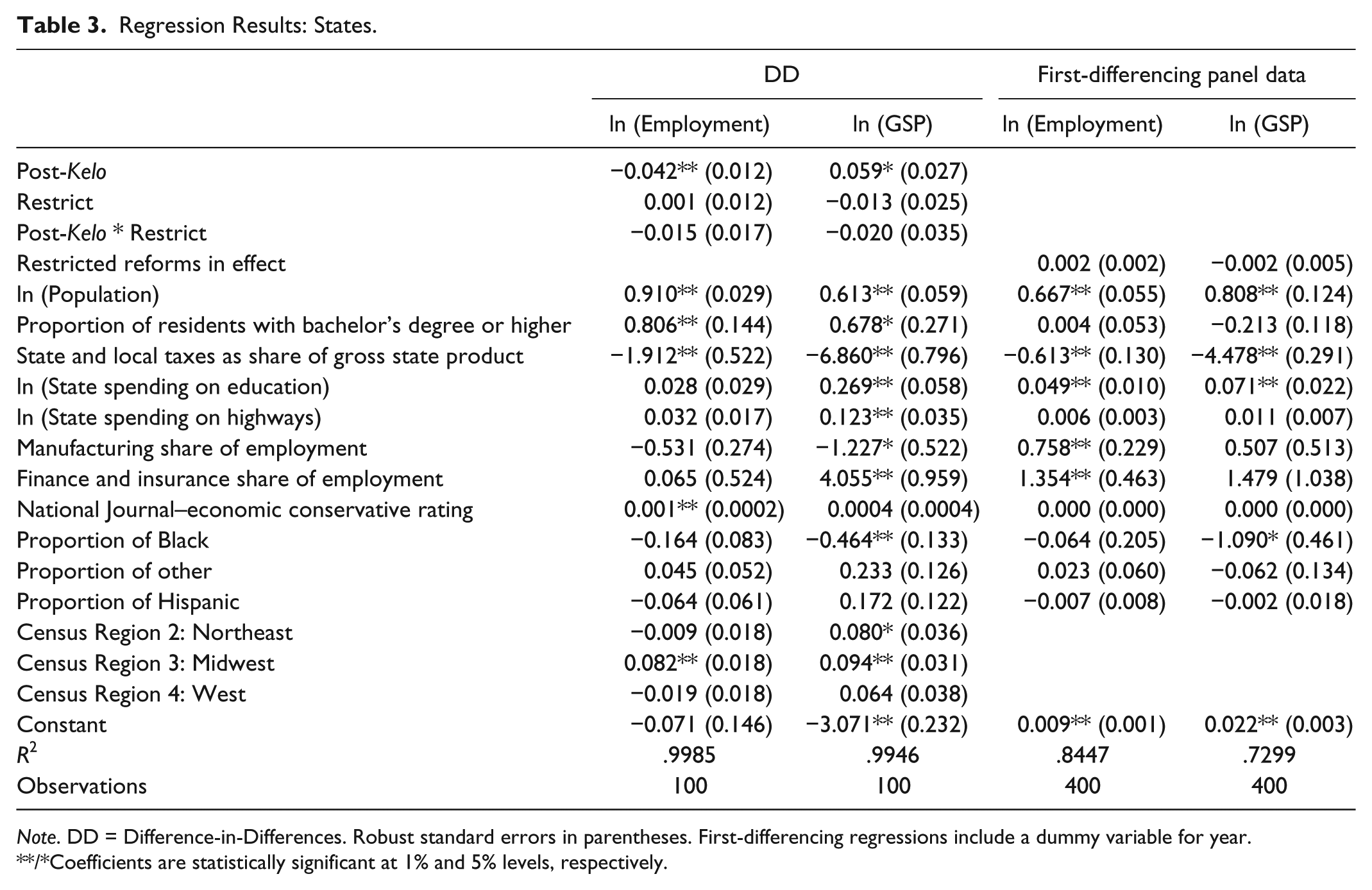
Table 3 shows the regression results with ln (state employment) and ln (GSP) as the dependent variable. 13 The first two specifications present the DD estimates and the last two specifications present the FD estimates. The DD regressions includes dummy variables for census region; however, as time-invariant variables, these drop out of the FD regressions. Following Wooldridge (2002), the FD regressions also include dummy variables for year.
Regression Results: States.
Note. DD = Difference-in-Differences. Robust standard errors in parentheses. First-differencing regressions include a dummy variable for year.
/*Coefficients are statistically significant at 1% and 5% levels, respectively.
The primary results of interest in the DD regression are the coefficients for the dummy variables
These results indicate that the fears of eminent domain proponents, that restricting its use would hinder the ability of economic development agencies to foster economic growth within states, did not come to fruition and are consistent with Carpenter and Ross (2010), who also found no evidence of an adverse effect from eminent domain restrictions on the construction industry. The fact that states restricting the use of eminent domain did not experience a relative decline in employment levels or GSP could suggest that having developers rely solely on private negotiations to solve the holdout and land assembly problem, as opposed to having the potential last resort of petitioning local governments to resolve impasses in private negotiations through eminent domain takings, did not have an adverse effect on a state’s economic development. Conversely, it could indicate that the eminent domain, under the guise of furthering local governments’ economic development objectives, served no purpose other than increasing economic rents for developers. The lack of significance in the coefficient for
As for the impact of other variables on economic development, results indicate that a 1% increase in state population results in a 0.91% increase in state employment and a 0.61% increase in GSP for the DD regressions, and a 0.67% increase in state employment and a 0.81% increase in GSP for the FD regression. The proportion of the population with college degrees has a positive and statistically significant impact on employment and GSP in the DD model, with a standard deviation (0.05) increase in the proportion of residents with a college degree increasing employment by 4% and GSP by 3.4%. However, neither coefficient is significant in the FD model. State and local taxes as a share of GSP have a negative effect on employment and GSP in both models. A standard deviation (0.012) increase in the share of taxes results in a statistically significant 2.3% decrease in employment in the DD model and a 0.6% decrease in employment in the FD model. This estimate implies a tax elasticity of −0.06 to −0.22 at the mean state tax burden, which is at the lower range found in Wasylenko’s (1997) review of the empirical literature on the impact of state taxes on economic development. Taxes also have a statistically significant and negative effect on GSP with estimated tax elasticity of −0.8 in the DD model and −0.4 in the FD model, which is in the high and middle range or Wasylenko’s estimates. State spending on education has a positive and significant effect on GSP in both the DD and FD models and a positive and significant effect on employment in the FD model, with a 1% increase in per capita education spending increasing GSP between 0.07% and 0.27% and increasing employment by 0.05%.
In the DD model, the share of the population employed in the manufacturing sector also has a negative effect on employment and GSP, although the coefficient in the employment regression has a p value of .051. A standard deviation (0.029) increase in the manufacturing sector’s share of employment decreases state employment and GSP by 1.5% and 3.6%, respectively. In the FD model, the manufacturing sector’s share of employment has no impact on GSP, but a significant, positive effect on employment. While the change in sign is a little unusual, it is not too concerning as most of the variation in the two-period DD model comes from variation between the 50 states, whereas the FD estimation gives the within estimator. It is plausible that states with high shares of employment in manufacturing experience lower employment than states with low shares of employment in manufacturing, while simultaneously, states experiencing greater increases in their share of employment in manufacturing experience higher increases in employment. For the FD model, a 0.01 increase in the manufacturing sector’s share of employment increases state employment by 0.8%. The impact of the financial and insurance sector’s share of employment on economic growth is mixed as the variable has an insignificant effect on employment in the DD model but a positive and statistically significant effect in the FD model. Conversely, a state’s share of employment in the financial and insurance sector has a positive and significant effect on GSP in the DD model but an insignificant effect on GSP in the FD model.
The average rating of a state’s senators also has statistically significant impact on employment in the DD model with a standard deviation (26.9) change in the rating causing a 2.3% change in state employment. The Midwest census region’s employment and GSP is significantly different than the omitted South category. Since dummy variables represent a semilogarithmic transformation their coefficients are interpreted as causing an (
Dense Counties and Categorization of States
Although results from Table 3 are consistent with state economies not being harmed by restrictions on the use of eminent domain, it could be the case that eminent domain does have a negative effect on the more dense areas of a state. The assembly problem eminent domain is purported to solve is a greater issue in the more dense areas of a state, where ownership is likely to be dispersed. As a result, eminent domain restrictions may shift economic development from the more dense areas of a state to the less dense areas of a state. To test this hypothesis, the models are estimated using the Bureau of Economic Analysis’s county employment and county income estimates for the county in each state with the highest population density. County-level variables were also used for population, proportion of residents with bachelor’s degrees, industry employment shares, and racial and ethnic makeup of the county. The variables for state tax burden, state spending on education and highways, and political preferences were still measured at the state level. Table 4 shows the results of this approach using both the DD and FD methods. Once again, the findings do not support the view that eminent domain is a necessary tool for fulfilling local governments’ economic development role, as restrictions on the use of eminent domain had no impact on the states’ most dense counties’ employment or income.
Regression Results: Most Dense County in State.

Note. DD = Difference-in-Differences. Robust standard errors in parentheses. First-differencing regressions include a dummy variable for year.
/*Coefficients are statistically significant at 1% and 5% level, respectively.
To check the robustness of the results to how the study categorizes states as having effectively restricted the use of eminent domain, the models from Tables 3 and 4 were estimated using Castle Coalition (2010) and Lopez et al.’s (2009) categorizations. Castle Coalition graded states from A to F based on the extent to which they restricted the use of eminent domain. There is a great deal of consistency between this study’s classification of states and the Castle Coalition grades. Of the 20 states that this study categorized as having effectively restricted the use of eminent domain, all but one of them (Idaho [D+]) received a grade of B− or higher by the Castle Coalition. Of the 30 nonrestricting states, all but two of them (South Carolina [B+] and Iowa [B−]) received a grade of C or below by the Castle Coalition. There was far less consistency between this study’s categorization of states and Lopez et al.’s, which used an index of 18 criteria to categorize the effectiveness of state restrictions. Of the 20 states categorized as having effectively restricted the use of eminent domain in this study, six were categorized as nonreformers by Lopez et al. 14 Of the 30 states categorized as nonreformers in this study, nine were categorized as restricting by Lopez et al. 15 Regressions categorizing states as having restricted eminent domain if they were given a grade of B− or higher by the Castle Coalition and using the Lopez et al. categorization also resulted in no significant effect of restrictions on economic development at either the state or county level for both the DD and FD approaches.
Concluding Comments
The Kelo ruling upheld local governments’ right to transfer private property from one party to another to foster economic development goals. The negative response to the ruling brings to light the fundamental disagreements over its necessity to achieve these goals. Although the court’s ruling, concurring opinion, dissents, and amicus briefs contain numerous arguments, whose foundations are based on presuppositions of economic theories regarding eminent domain, economic theory offers no clear-cut answers on the necessity of eminent domain to achieve efficient economic outcomes. Eminent domain can just as easily be used as a rent-seeking tool as it can be used as a solution to market failure in land assembly. This study uses the swift and uneven response of state legislatures to the public outcry that followed Kelo to test the empirical question of whether restrictions on eminent domain is indeed necessary for states to fulfill their economic development goals. Proponents of giving local governments the ability to use eminent domain for economic development purposes argue that even if the tool is seldom used, its presence is crucial for encouraging investments in local economies as eminent domain helps ensure developers that their high-value projects will not be held up by a single, obstinate holdout. It is also argued that developers would be more willing to initiate projects in states allowing them to petition local governments to use eminent domain in the cases where private negotiations fail. Similar to Carpenter and Ross (2010), the empirical results here do not support this view, as states that significantly restricted the use of eminent domain following the Kelo ruling experienced no adverse effects in terms of employment or GSP at the state level or in terms of employment or income in the densest counties. In addition to possibly dispelling the fears of supporters of the Supreme Court’s ruling, the results may also give credence to critics of eminent domain who contend that local governments can achieve their economic development goals without relying on eminent domain to compel property transfers to developers.
Footnotes
Declaration of Conflicting Interests
The author(s) declared no potential conflicts of interest with respect to the research, authorship, and/or publication of this article.
Funding
The author(s) received no financial support for the research, authorship, and/or publication of this article.