




Abstract
Immigrant entrepreneurship is important to local and regional economies, cultural identity, placemaking, and tourism. Meanwhile, regional conditions, such as the development of suburban immigrant gateway communities and increases in the cost of business ownership, complicate local economic development efforts in urban ethnic districts. This research is presented as a mixed–methods case study of Devon Avenue in Chicago, IL, home to a significant concentration of South Asian–owned immigrant businesses. Challenges and pressures facing businesses are examined through merchant surveys and interviews. Observations reinforce the notion that cultural competency and strong grassroots leadership is vital for economic development planning so that “capitalizing” on an ethnic heritage does not become a tool for commodification or commercial gentrification. Agencies must also be mindful of the impacts associated with suburbanization of immigrant communities and take a long-term, regional approach to planning in ethnic commercial corridors.
Local governments and tourism agencies seek to enhance and showcase local neighborhoods and retail corridors for economic development purposes (Ashutosh, 2008; Loukaitou-Sideris, 2012). They encourage tourism by promoting districts that are home to ethnic and immigrant businesses and residents, acknowledging how these populations contribute to the cultural, economic, and social diversity of the city. There has been a surge of interest in “authentic” urban small business development and planning for arts and culture, as well as in promoting the benefits of buying “small” and spending locally (Mitchell, 2001; Zukin, 2008). 1 Small-scale, independent retail is increasingly recognized as a source of economic vitality (Linovski, 2012; Sung, Lee, & Cheon, 2015) and can help instill a sense of cultural pride in older urban neighborhoods (Loukaitou-Sideris, 2002; Mitchell, 2001; Schuch & Wang, 2015; Sutton, 2010). Small-scale businesses are recognized for their local revenue generation, job creation, neighborhood character, tourism, and placemaking benefits (Powe, Mabry, Talen, & Mahmoudi, 2016; Schuch & Wang, 2015). However, competition in retail is mounting with the rise of e-commerce and ever-changing consumer preferences (Balazs & Zinkhan, 2003). In addition, inner-city business districts face commercial gentrification with the introduction of national-chain retailers and through the upscaling of existing independent businesses to attract new clientele (Rankin, 2008; Zukin, Kasinitz, & Chen, 2016). Regional shifts in demographic and socioeconomic conditions, such as the development of new suburban immigrant gateway communities (Singer, Hardwick, & Brettell, 2008) and increases in the cost of business ownership in urban areas, also complicate local economic development efforts in neighborhoods traditionally home to multiethnic and minority businesses (Lane & McAvey, 2014). These shifts raise questions about how an ethnically diverse commercial corridor can remain a cultural and economic hub that supports the entrepreneurial endeavors of a growing immigrant population.
This study examines the challenges of local economic development planning in an urban ethnic, predominantly South Asian retail district made up of Asian Indian, Bangladeshi, Bhutanese, Nepalese, Pakistani, and Sri Lankan merchants as well as other non–South Asian businesses. Using West Devon Avenue (Devon Avenue) in Chicago, IL, as a case study, we ask the following: What are the challenges and pressures for both established merchants as well as new businesses in an urban ethnic district? How are South Asian merchants responding to increasing competition both internal to the district and with an increasing proportion of South Asian businesses and residents at the suburban periphery? How should local governments respond to the changing demographics of global cities and support and protect retail corridors that provide substantial benefits as places that incubate immigrant entrepreneurialism as well as sustain a vibrant sense of place?
We first review the literature of immigrants and economic development, as well as trace the history of South Asian diaspora in the Chicagoland region. Next, we introduce Devon Avenue in Chicago as a case study, providing a brief history and discussion of current conditions. We then present a discussion of our research questions, incorporating other case study information with the survey and in-depth interviews with merchants. We observe that, while a turn toward cultural tourism may present an opportunity to support the vitality and long-term viability of ethnic business districts, it may also herald additional gentrification pressures as everyday businesses are converted to “boutiques”—shops, restaurants, and bars that appeal to upscale customers and substantially change the character of the street (Zukin et al., 2016). We conclude that local and regional government and community-based organizations must aim at increasing cultural competency to address barriers that limit the ability for South Asian business owners to access city services or gain representation within the local chamber of commerce. Local government and civic organizations need to create new grassroots economic development strategies and stronger partnerships with immigrant entrepreneurs to address the potential for the displacement of small businesses. Economic development efforts along a maturing urban ethnic commercial corridor must be culturally appropriate, focused, inclusive, and community led. These efforts must operate with a very intimate knowledge of community microdynamics, coupled with a broader understanding of regional to global demographic and economic trends.
Literature Review: Immigrants and Small Business Development
Immigrants contribute substantially to the U.S. economy, particularly in the growth of small businesses. 2 Foreign-born residents make up half of all small business employees nationwide and 18% of small business owners, despite comprising lower percentages of the population and labor force (Fiscal Policy Institute, 2012). The share of foreign-born business owners is greater than the share of foreign-born persons in almost all the largest urban metropolitan areas (metros) in the United States, including Chicago (McDaniel, 2014). Moreover, the retail sector is the second most prevalent employment sector for immigrant business owners after professional and business services (Fiscal Policy Institute, 2012). Immigrant business owners also play an important role on main streets and retail corridors, which consist of concentrations of small-scale, neighborhood-based businesses along a central corridor (Fiscal Policy Institute & American Society/Council of the Americas, 2015).
Despite having high ownership rates in retail trade and other small business operations, immigrants and ethnic minorities are a large and diverse population, and not all groups have the same experiences. Success in retail can vary by economic conditions, business practices, ethnic group, gender, and geography within a metropolitan area (Raijman & Tienda, 2003).
The historical tendency of immigrants to cluster together has created distinct immigrant business districts in large cities worldwide, sometimes labeled as ethnic enclaves. 3 The reasons people settle in ethnic enclaves are complex. A scan of the literature shows that distinct settlement patterns may form according to social and cultural lines (Ashutosh, 2008; Hall, 2015; Rankin, 2008), availability and quality of housing, and social services, or to spur entrepreneurship and small business development (Sutton, 2010). Much has been written from a sociological perspective about the way residential ethnic enclaves came to be, the benefits of residential clustering, and the complex social ties that bind residents together (Portes & Manning, 2008; Waldinger, 1993), but less has been studied about the formation of commercial enclaves. A traditional view of small business enterprise in ethnic enclaves stresses the importance of clustering similar or complementary businesses together. Often business development and neighborhood development are closely related; the success of ethnic minority-owned businesses is dependent on the residential concentration of ethnic population, as well as colocation with other similar businesses (Raijman & Tienda, 2013; Rankin, 2008; Wang, 2012). Other studies, however, have stressed the importance of larger immigrant networks rather than the local neighborhood, stating that space and place do not matter as much as regional or national social connections, especially as the immigrant population began to leave the inner city (Maude Toussaint-Comeau, 2008; Waldinger, 1993).
Ethnic retail corridors can preserve cultural heritage, provide community support for immigrants (Wang, 2012), serve as a temporary “gateway” to the country for new residents (Boyd, 2007), and are important to making the city “accessible to vulnerable and marginalized groups” (Rankin & McLean, 2015, p. 216). These corridors also diversify local consumption patterns (Bubinas, 2003; Sutton, 2010), create job opportunities for low-skilled workers (Raijman & Tienda, 2003), revitalize inner-city commercial strips (Loukaitou-Sideris, 1997; Sutton, 2010), create ethnic subeconomies (Bubinas, 2003), enliven abandoned spaces through placemaking (Schuch & Wang, 2015), and promote cultural tourism (Borrelli & Kalayil, 2011; Loukaitou-Sideris, 2012).
North American cities have several successful multicultural small business clusters, especially in larger “gateway” cities with diverse ethnic compositions. For example, in San Francisco, the city has been proactive in neighborhood, corridor, and economic development planning in immigrant communities, such as in the Mission and Japantown neighborhoods. 4 In Queens, NY, the neighborhood of Jackson Heights moved toward a “super-diversification” strategy with a new “Diversity Plaza” that pairs transportation and public space improvements with business development (New York City Department of Transportation, 2016). This strategy responds to the phenomenon of growing ethnic diversity, where “shopkeepers and customers come from a wide variety of different, though still predominantly immigrant, backgrounds” (Zukin et al., 2016, p. 9). In other cities, private or nonprofit groups manage public markets that sell goods from many different ethnic groups. The Minneapolis Global Market and Toronto’s historic Kensington Market are examples of multicultural retail hubs that give visitors a shopping experience mirroring bazaars found around the world. While some cities have attempted to showcase their cultural neighborhoods in an authentic manner, Loukaitou-Sideris (2012) observes that U.S. cities “mostly tended to invest in cultural development strategies that rely on blockbuster events and centrally located facilities rather than on cultural production and programs in diverse city neighborhoods” (Loukaitou-Sideris, 2012, p. 51).
Some local governments, such as the cities of Chicago and Philadelphia, have recognized the need to support immigrant entrepreneurs and have set up offices for new Americans. In Chicago, the city government created the Office of New Americans in 2011 (City of Chicago, 2012). The new agency was created, in part, to help immigrants establish small businesses through place-based strategies. These strategies include increasing exports from immigrant-owned businesses; creating a small business incubator; creating bilingual pop-up city services in neighborhoods with information about city resources, programs, and services; partnering with Choose Chicago (the local tourism bureau) to promote tourism in immigrant neighborhoods; and creating a “chamber university” to train chamber of commerce leaders.
In many cities, economic development efforts to support small businesses rely on business improvement districts 5 (BIDs), chambers of commerce, and other organizational structures (Mitchell, 2001) that support business development through a mandatory or voluntary membership model. Support services typically focus on sanitation, maintenance, and security (Mitchell, 2011), as well as short-term strategies like “technical assistance, access to small business capital, corridor beautification and area marketing” (Sutton 2010, p. 354). However, there are concerns with these quasi-public organizational structures because they tend to benefit property owners more than commercial tenants (Sutton, 2010), can be difficult to hold accountable (Mitchell, 2001), may result in the privatization of public space (Lee, 2015b), or may cause spillover effects to adjacent neighborhoods (Lee, 2015b).
The suburbanization of the immigrant population is also challenging economic development efforts. Suburban municipalities in the Chicagoland region with growing minority and immigrant populations 6 often see the need for targeted services and community outreach to their newer immigrant population. However, they face barriers due to staff and budget constraints; lack of cultural competency; low immigrant participation in community, government, and political life; a historical mistrust of government within immigrant populations; or clashes within different communities for government attention and resources (Chicago Metropolitan Agency for Planning, 2014). It is unclear how inner-city immigrant business networks fare with a growing number of their customers living in suburban areas, despite the fact that this has long been a phenomenon (Kosta, 2014). Challenges in these localized efforts can occur when predominantly minority neighborhoods and immigrant business districts do not have the organizational capacity, resources, or the desire to affiliate with the official structural entities or business organizations. Language barriers, culture shock, limited credit history, lack of marketing skills, and low financial literacy can instill fear, apathy, or discomfort in seeking government services such as small business loans and entrepreneurship education (Lane & McAvey, 2014). New businesses, in particular, face higher barriers to entry and rely on word-of-mouth advertising, personal relationships, and social networks to survive in high-turnover commercial strips (Rankin, 2008). These factors combined contribute to “unequal participation in local governance . . . and participatory planning” (Lee, 2015b, p. 23). A lack of historic cohesion or leadership can inhibit future community organizing around local economic development and planning issues (Lee, 2015a; Lee, 2015b).
Drawing from the aforementioned literature, we examine Devon Avenue in Chicago as a case study of an ethnic retail district that has long served as an area for incubation of immigrant-owned businesses. In this case study, we can gain a valuable vantage point on economic development challenges related to a maturing urban retail district, and conditions related to new immigrant gateways emerging in the suburbs, super diversification within an ethnic corridor, and the potential for commercial gentrification.
Case Study Methodology
This research is based on an in-depth case study of a 1-mile segment of Devon Avenue, a prominent cultural and commercial corridor on Chicago’s far north side. Our mixed-methods research initially included interviews with stakeholders, document review (including scholarly literature, news articles, and professional reports focusing on the case study corridor and the Chicago metro area), economic and demographic data analysis, direct observation, and photo documentation. We also surveyed merchants and conducted follow-up interviews with businesses along the corridor.
Stakeholder interviews were conducted with the West Ridge Chamber of Commerce and a local artist who assisted with a concurrent Chicago Department of Transportation streetscape project along Devon Avenue. Another interview was conducted with the director of the South Asian American Policy Research Institute (SAAPRI), an organization that authored the 2007 “Developing Devon” Strategic Plan, to provide a contextual framework and expert knowledge that would help in interpreting surveys and interviews and in understanding the state of the neighborhood.
Data on local businesses were obtained from the online database ReferenceUSA. The National Historical Geographic Information System (Minnesota Population Center, 2016) and American FactFinder (U.S. Census Bureau, 2016) were used as sources for demographic information, which was then mapped using ArcGIS.
A survey and subsequent in-depth interviews were conducted with business owners, managers, and employees (referred to inclusively as merchants) from a convenience sample of South Asian–owned and South Asian–oriented businesses along a case study area on Devon Avenue. Twenty-six responses were collected in person (N = 26), through a door-to-door paper survey instrument over two rounds of visits in August 2014 and January 2015. While the survey instrument was written in English, with most participants self-responding in English, some merchants preferred to respond verbally in Hindi due to limited English proficiency or because they were interested but did not have time to complete the survey in writing. In such cases, the surveyor transcribed what they said verbally into the survey. As a bilingual South Asian American from the Chicagoland region, the first author of this study has a similar cultural identity to most of the merchants, which allowed her to build trust and more seamlessly interact with merchants in the language of their choice.
Only one respondent from each business was surveyed, which represents a limitation in the study. Initially, refusal rates were high. Often, merchants would tell the surveyor to come back later at a less busy time, but then were either not available or continued to postpone the interaction. Some would wait a few hours or days and talk to other merchants before agreeing to take the survey. Hence, such “gentle refusals” and unclear reactions made counting the actual number of refusals difficult. In addition, some merchants owned multiple businesses along the corridor. In such cases, respondents were asked to answer the survey based on the establishment they were currently standing in at the time of completing the survey. Table 1 summarizes information about respondents.
Characteristics of Businesses Represented in Survey.

As a part of the survey process, participants were asked to respond to a set of optional follow-up questions regarding their perceptions of the corridor, the challenges facing the district, personal memories of the corridor’s development, the history of their own business, and ideas for improvement through semistructured interviews with the surveyor. Nineteen of the 26 initial survey respondents agreed to these additional, more in-depth semistructured interviews. 7
Although the number of merchants participating in the survey is somewhat low, those who did participate offered valuable insight regarding perspectives among South Asian merchants along the corridor. Unfortunately, there is no definitive source of detailed information about the ethnicity of business owners; ReferenceUSA and other comparable business databases did not have this information nor did previous research conducted in the area. 8 In addition, it was difficult to categorize businesses solely on ethnicity because the nationality of the owner is not always reflective of the type of goods sold, employees hired, or the primary customer base. For example, a halal grocery store may be owned by an Indian merchant but may be frequented by Pakistani, Sri Lankan, Bangladeshi, and Middle Eastern customers. This makes assessing representativeness in terms of ethnic composition difficult and highlights the need for detailed data about ethnicity in economic and business data. Despite these limitations, the voice of each individual participant provided valuable insights into understanding the experiences and perspectives along an inner-city ethnic retail district.
In the next section, we discuss the history and current conditions of South Asians within Chicagoland and Devon Avenue. We return to discuss what we learned from the merchant survey and interviews in a subsequent section.
South Asians in Chicagoland and Along Devon Avenue: A History
Within the context of American immigration, the South Asian diaspora is a relatively recent phenomenon. Although some were early pioneers in a wider range of professions, including manual labor, most early immigrants from the Indian subcontinent came as skilled professionals in the 1960s from urban, upper-class backgrounds. Many arrived after the Immigration and Naturalization Act of 1965 seeking “employment and economic success” in specific professional occupations such as medicine, engineering, science, technology, and academia (Ashutosh, 2008; Bubinas, 2005). Because of their high educational attainment, access to family capital back home, fluency in English, attraction to stable real estate markets, and general eagerness to assimilate into American culture, most did not feel the need to segregate themselves into inner-city ethnic enclaves, and instead dispersed throughout the surrounding region into majority White neighborhoods and suburbs (Rangaswamy, 2000). Despite geographic dispersal, immigrants still “maintained strong ties to their ethnic group through membership in religious organizations, participation in cultural programs, involvement in [South Asian] civic organizations, and shopping in the ethnic economy” (Bubinas, 2005, p. 163). It was in a second wave of migration that established South Asian immigrants brought family members over from abroad to establish an independent business sector and took advantage of opportunities in the travel, real estate, hospitality, and retail industries. In Chicago, many established their businesses along Devon Avenue in the city proper and through informal business networks.
Over time, the South Asian American population grew significantly in the greater Chicago metro region, including increases in people of Indian, Pakistani, Bangladeshi, Sri Lankan, Nepali, and Bhutanese descent (SAAPRI, 2013). By the mid-1990s, the economic gap between suburban South Asians and city dwellers became readily apparent, with those living in the city having generally lower incomes, education levels, English language skills, home-ownership rates, and poverty rates than their suburban counterparts. Narratives of South Asian success in the region were often associated with a move to the suburbs and better school districts. Those who stayed in existing central city neighborhoods initially did so because they could not leave, either because they could not afford to or because they could not leave the amenities, social network, and business connections of the neighborhood (Ashutosh, 2008). As a result, fewer immigrants in the central city were employed in professional occupations and more turned to sales and retail trade as their primary occupation, leading to the growth of the Devon Avenue corridor (Rangaswamy, 2000). Currently, South Asian growth in Illinois has been concentrated in the suburbs of Chicago rather than within the city limits, as shown by the declining proportion of South Asians living in the city as compared with the region. 9 Figure 1 shows Asian Indians as a proportion of the total population in 1980 compared with 2014, close to and within the Chicago metro area. 10 Figure 2 illustrates the percentage of foreign-born residents who identify as South Asian in proximity to Devon Avenue and at the regional scale. The maps in Figure 2 depict 2000 and 2014, as detailed racial or ethnic data for foreign-born populations were not available prior to 2000.

Map of the Distribution of Asian Indians as a Proportion of the Total Population in Census Tracts, 1980 and 2014.

Map of Percentage of Foreign Born Who Identify as South Asian, 2000 and 2014.
Popularly known today as Chicago’s Little India, the South Asian portion of Devon Avenue is a dense independent retail cluster, which is a small part of the larger east-west thoroughfare. Devon Avenue consists primarily of diverse one-story commercial storefronts surrounded by residential bungalow-style homes and apartments that line the side streets. Even along areas beyond the predominantly South Asian study area, the corridor is marketed as Chicago’s “International Market.” Besides South Asian businesses, the neighborhood is also home to Jewish, Russian, and Middle Eastern businesses, groups who have played an integral part in the historical development of the corridor (Ashutosh, 2008). The city’s Plan for New Americans recognizes Devon Avenue as one of Chicago’s 15 main business corridors in neighborhoods with large immigrant populations. West Ridge, the neighborhood where the case study area is located, continues to have the highest concentration of South Asians (just over 9,000) across the city today, making it the second largest immigrant business district after Little Village (City of Chicago, 2012).
The entirety of Devon Avenue runs through multiple neighborhoods and the outlying suburbs of Niles, Lincolnwood, Des Plaines, and Itasca. However, this research focuses specifically on a 1-mile strip of businesses along West Devon Avenue in West Ridge from California Avenue to Western Avenue in an area dominated by hundreds of desi (South Asian) retail stores from the Indian, Pakistani, Bangladeshi, and Sri Lankan immigrant communities (Bubinas, 2005). The exact number of businesses in this corridor is unclear. While some online databases like ReferenceUSA list more than 500 businesses and the city’s official database lists approximately 340 business licenses, the West Ridge Chamber of Commerce estimates approximately 400 operating businesses in the study area. Examining businesses by North American Industry Classification (NAICS) code reveals 401 businesses in diverse categories, sales volumes, and employment sizes as of ReferenceUSA data from 2016. Data from Table 2 below indicate that 65% of the businesses have 1 to 4 employees; 47% have a sales volume of less than $500,000; 81% are 0 to 2,499 in square feet in size, and over 50% of the businesses can be described as either Retail Trade or in the Accommodations and Food Services sectors.
Attributes of Devon Businesses From California to Western Avenue.

Most common business types (five or more businesses of the same Detailed Standard Industrial Classification Code).
Source. ReferenceUSA (2016).
As aforementioned, Devon Avenue has a long history of multicultural development patterns. In the 1970s and 1980s, the corridor was primarily occupied by Jewish, Polish, and Russian storefronts. After initially selling Indian merchandise out of hotel rooms (Bubinas, 2005), the first Indian-owned business identified a market for South Asian merchandise and established India Sari Palace in the heart of the Jewish cultural district in 1973 (Bubinas, 2005; Lyons, 2015). Sari shops and grocery stores soon gave way to appliance and video stores, restaurants and banquet halls, and later, jewelry stores (Rangaswamy, 2000).
The reasons Devon Avenue became an established business corridor are numerous and varied. Logistically, the neighborhood was commercially affordable, along a bus line (Lyons, 2015), safe, clean, and already established as a bustling “ethnic” retail area (Bubinas, 2005). Devon Avenue is also located near Rogers Park, where many Indians established “port-of-entry” communities. West Ridge was an attractive neighborhood for immigrants to live in because of its ethnic diversity, affordable housing, plethora of small businesses, proximity to Loyola University Chicago, and overall perception of neighborhood stability.
In the mid-1980s, there was a significant increase in immigration from India in correlation to a decline of existing Jewish-owned commerce. Devon quickly became a local economic engine due to the availability of commercial property for rent, the formation of transnational social networks within the business community, the attractiveness of the residential character of the neighborhood, ease of business transactions between stores, geographic proximity of family-owned businesses, spin-off effects of new business start-ups, and a strong sense of cultural belonging (Bubinas, 2005). In addition to economic growth, the neighborhood also grew to be an important cultural hub for regional tourism across the Midwest, drawing both South Asians and non–South Asians alike from nearby states like Indiana, Iowa, Wisconsin, and Michigan.
After the new millennium, the corridor began to see change. As South Asian businesses expanded to the east, there were concerns about competition, maintenance, and long-term viability. Community development concerns were voiced within the neighborhood, leading to the writing of a strategic plan by a local research and advocacy group (SAAPRI, 2007). The plan, compiled by SAAPRI, outlines several “critical issues” facing the corridor, including a lack of unity and leadership; traffic congestion and lack of parking; the high cost of business operations; security and crime; cleanliness and sanitation; lack of affordable health care; unemployment, underemployment, and low wages; lack of awareness of government programs; and lack of participation in the West Ridge Chamber of Commerce. It also cited declining businesses and growing vacancies; lack of aesthetic appeal and signage; lack of cooperation from the city; frequent shutting down of restaurants; and loitering, begging, and panhandling. Shortly after completion of the plan, Preservation Chicago, a local advocacy organization dedicated to historic preservation, named the structures in the Devon Avenue corridor as one of the city’s “Seven Most Threatened Neighborhoods of 2008,” citing “neglect, indifference and the City’s lack of enforcement of zoning and building codes” as a risk to preserving its rich history as represented in its building stock (Preservation Chicago, 2008, p. 1).
At the same time, distinct retail patterns emerged on the corridor. In a study of the neighborhood undertaken by the University of Illinois Extension office, community members strongly felt that commercial corridor and business development were topics of utmost priority (Stiehl, 2007), given West Ridge’s declining number of businesses and total retail sales despite continuing to uphold a strong local presence. In West Ridge, Devon Avenue was maintaining its place as the “breadwinner” corridor for the neighborhood. According to the report, about 50% of all retail businesses in West Ridge were on Devon Avenue or within one block of the corridor. These businesses provided “nearly a quarter of West Ridge’s $1.8 billion economy and also almost a quarter of the neighborhood’s employment” (Stiehl, 2007, p. 5) as compared with other major commercial corridors in the area. Even though sales in West Ridge greatly outnumbered sales in the nearby neighborhoods, members of the business community still found the declining sales and job losses a threat to the long-term financial sustainability of the business district. Although the corridor had a stronghold in West Ridge, it was facing vacancy and business turnover. Multiple businesses experienced lower sales and fewer customers than before, according to the study. Business owners cited economic recession, hostility toward South Asians post-9/11, competition from the suburbs, perception of uncleanliness, lack of parking, and traffic and safety concerns (Ashutosh, 2008; Stiehl, 2007). Retail is also a very volatile industry in West Ridge; retail jobs were being lost at twice the rate of all jobs in the neighborhood, which raised a significant equity concern for new immigrants and unskilled, entry-level, and younger workers who worked in retail (Stiehl, 2007).
Today, there are many Indian, Pakistani, Sri Lankan, Bangladeshi, and Middle Eastern businesses in the form of ethnic restaurants, cafes, and grocery stores, beauty salons, appliance and electronics stores, convenience stores, travel agencies, and specialty stores for clothing and jewelry catering to South Asian consumer tastes. Figure 3 depicts the locations of businesses along Devon Avenue identified using ReferenceUSA. ReferenceUSA indicates the primary NAICS code for businesses. The highest proportion of businesses within the study area fall within the retail trade category (N = 155). The second highest proportion of businesses is within the Food sector (N = 69; Figure 3).
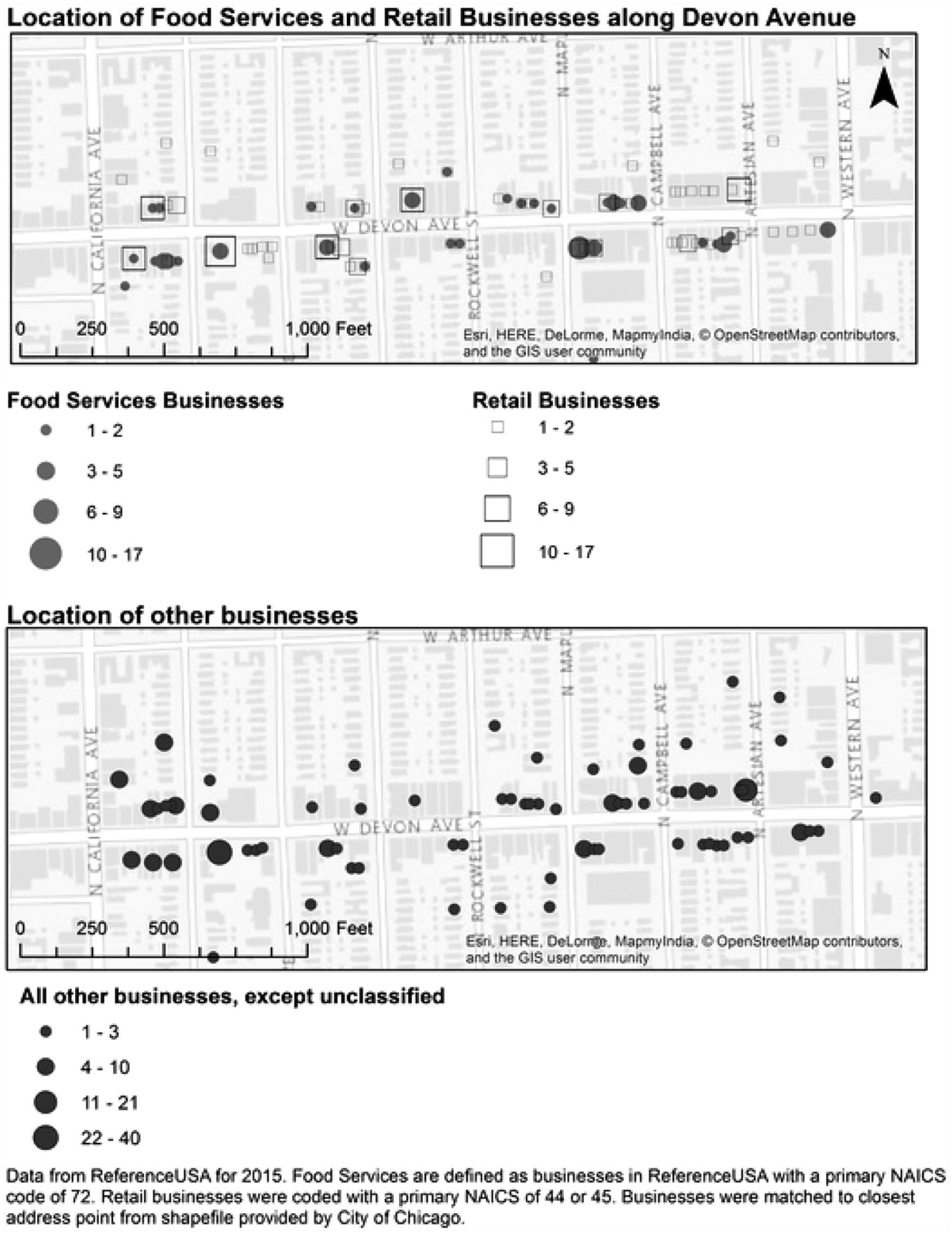
Map of Location of Food Services and Retail Businesses along Devon Avenue. Source: Reference USA (2015).
In 2014, West Ridge’s population was just over 73,000, with an average median income of $48,067—a number less than the city overall but much lower than the average median income of the region (Chicago Metropolitan Agency for Planning, 2016). Over 10% of its working population is employed in retail trade and slightly more than half of occupied housing units are rentals (Chicago Metropolitan Agency for Planning, 2016). Although typically regarded as a working-class neighborhood, a recently completed community outreach effort in West Ridge and Rogers Park related to a citywide climate plan found a discrepancy emerging in West Ridge between two competing customer groups who shopped on the Devon Avenue corridor. Those who visited were perceived to be well-established suburban immigrants with higher incomes who came less frequently (usually by car) for higher-end goods such as bridal clothing and jewelry. In contrast, those that lived in or near the neighborhood and relied on its day-to-day neighborhood services were perceived to be newer immigrants with lower incomes, living in apartments on the margins of the neighborhood, and commuting to the corridor on foot or by bus (City of Chicago, 2011). The differences in spending habits between immigrant groups reflect the complexity of the social and economic dynamics of the corridor and its relationship to the suburbs.
Analysis
In this section, we address our initial research questions, incorporating history and context with results from the surveys and interviews of South Asian business owners and employees discussed in the Case Study Methodology section.
Challenges and Pressures
In our first research question, we sought to understand what challenges and pressures merchants face within this urban ethnic business district. Responses to the survey of owners and employees of South Asian businesses provided insights. The most commonly cited issues included parking and mobility, increased competition, attracting customers, and the attractiveness of the corridor. These confirmed ongoing challenges noted in an earlier strategic plan.
Some merchants observed that many consumers visit Devon Avenue in groups from the suburbs—as a family, with extended relatives, or with friends on a visit to Chicago from out of state. Given the isolated location of the corridor on Chicago’s far north side and the tendency to shop in groups for bulky items such as groceries or special occasion clothing, many visitors find car travel the easiest and most economically feasible option as to be taken to reach Devon Avenue, especially compared with the costly and inconvenient transit options currently available from suburban Chicagoland. 11 This challenge was reflected in merchants’ concerns about parking, circulation, and mobility: 26% of the survey respondents cited it as the most pressing barrier to operating a successful business along Devon Avenue. Recent confusion about changing parking regulations and increased costs of on-street parking fares, as well as a perceived increase in enforcement and ticketing in the residential cross-streets adjacent to Devon Avenue, have led to concerns over lack of parking availability. These concerns were expressed despite the development of a colorful new structured parking garage at the intersection of Devon Avenue and Rockwell Street within the commercial district. Although other issues relating to transportation were raised as well, such as pedestrian and vehicular safety and traffic congestion, 12 many respondents were concerned about the lack of adequate and affordable parking in the district.
Increased competition from similar ethnic businesses was the second most pressing concern for survey respondents; 24% of survey respondents cited competition from either other urban or similar suburban businesses as major concerns. One respondent from an Indian restaurant commented on the difficulty of sustaining a new restaurant in a heightened market:
Many restaurants open, and in two months they are gone. Vacancy and turnover happens here. There might be 35-40 restaurants along Devon just from California to Western—there is stiff competition not only [from] here, but especially from the suburbs.
Another merchant mentioned the rise of traveling bridal expos and home-based special occasion/costume clothing rental businesses in the suburbs, which allow suppliers and designers to keep overhead costs low and sell more up-to-date fashions at heavily discounted prices as opposed to maintaining a permanent store with fixed costs. A few merchants also described the increased popularity of e-commerce and Internet shopping, which allowed both the customer and vendor to sidestep the traditional brick-and-mortar shop, decreasing costs and increasing the variety of goods available. Increased competition and the upscaling of some stores made it difficult for one newcomer to establish himself as a retailer. Another comment described higher barriers to entry for smaller businesses: “If a new business wants to come, then they need to require additional features like unique items you can’t find elsewhere.”
Attracting new customers was the third most common priority issue. Many merchants reported that both business and foot traffic had slowed in recent years, while a few indicated either continuing or proposed pathways for increasing customer traffic. One Indian retail merchant explained the challenges to marketing his jewelry business to newer clientele: “Indo-Pak buyers are our main customers. Americans come sometimes, but they usually come to look; they don’t buy. It is usually older people [who buy]. Young people are not interested in gold anymore.” Another merchant reported that their longevity and customer loyalty among middle-aged established immigrants remained a key to their success: “This store is famous because it is old. We have been able to develop relationships with customers [over the years].”
Five respondents indicated that “attractiveness of the corridor” was a challenge in operating a successful business on Devon Avenue. Some merchants expressed concerns over aesthetics, stating that the corridor looked dirty and unkempt. One merchant suggested ideas for programs such as “a façade improvement program, better visual merchandising, cleanliness and parking solutions” as well as placemaking features found in other immigrant business corridors. Unlike other prominent immigrant business districts in Chicago and elsewhere, Devon Avenue lacks formal gathering spaces, culturally relevant wayfinding, or culturally relevant public art in the form of murals or sculptures. Two merchants cited other ethnic neighborhoods in Chicago as inspirations for what Devon Avenue could strive for aesthetically, such as Chinatown’s large entrance gate and riverfront park as iconic and well-kept markers of neighborhood identity. One solution that multiple merchants suggested was to add liveliness to the corridor by increasing special events programming and decorations during South Asian festivals and holidays. Finally, some merchants have begun to notice changes in the corridor as well as in consumer preferences, and are starting to respond. One restaurant owner commented on a positive, but wary note:
Devon has undergone some changes. It is more developing now, a little cleaner and more attractive. Initially when I started, it was not so clean. Now it has more visitors, and there are new standards for marketing, business and customer service education. We get online reviews now, and have to pay attention to those. Some parts of the street have become a little more upscale.
Merchants expressed other concerns informally and through the follow-up interviews. “Boutiques” and newer upscale businesses were met with mixed feelings; some thought they enlivened the corridor and attracted new visitors, but others felt threatened by their existence. 13 In addition, some respondents spoke to distinctly specific cultural issues, such as conflict over the degree of price haggling and bargaining that South Asian customers generally expect, and racial and territorial tensions between competing ethnic groups along the corridor. One merchant blamed the corridor’s high immigrant business ownership rates as the cause of unsightliness, hinting at anti-immigrant sentiments: “Immigrants living on Devon keep it extremely dirty. If they keep this place clean, that would be great.” Four respondents indicated that neighborhood relations were making it difficult to operate a business on Devon Avenue, whether through clashes over residential permit parking with the often higher income, non–South Asian residents of the adjacent streets or because of intercultural clashes with the growing population of newer, lower-income South Asian immigrants, especially from countries other than India or Pakistan. Two respondents cited language barriers or intercultural issues communicating with merchants outside of their nation of origin or with non–South Asians. Some comments alluded to generational differences and change, such as uncertainty over the future takeover and management of existing family-owned businesses or the ability to attract young people to shop on Devon Avenue.
In-depth interviews also yielded additional insights into tensions between new and established businesses along Devon Avenue. Comments focused on increased competition as well as relations among merchants. Interviewees indicated that newer and smaller merchants face greater threats than pioneer businesses that have been on Devon Avenue for generations and have a stronghold on the local market. This may be due to difficulties in quickly adapting to changing consumer tastes and to market themselves. Established business owners and their families seem more likely to have moved to the suburbs, and may have a higher income and/or quality of life than newer merchants who tend to live closer to the corridor. Thus, established businesses may also be more likely to cater to higher end suburban customers, while smaller businesses may be frequented by local customers for day-to-day needs.
Despite challenges, clustering South Asian businesses together in the same business corridor had largely positive effects for the merchants interviewed. Many respondents said that being on Devon Avenue with other immigrant businesses helped them establish a “home away from home,” find ethnic food, and make friends. However, some merchants also complained that as businesses expand within the commercial district, there has been increased competition and polarity among merchants and the development of ill relations due to ethnic differences. One participant mentioned that, while the corridor seems like an international market on the outside, most merchants and customers tend to stick to stores of their own ethnicity, resulting in invisible and intricate spatial divisions along ethnic lines. Some of the symbols of this microsegregation are physical and contentious because they are tied to issues of identity, power, and the inclusion or exclusion of certain groups (Rankin, 2008). Portions of Devon Avenue, for example, are marked by Indian or Pakistani honorary street names, depending on where larger clusters of Indian-owned versus Pakistani-owned businesses are located along the corridor (Ashutosh, 2008).
Although many merchants on Devon Avenue share common characteristics, noted by merchants was the need to recognize the intercultural differences within various South Asian ethnic groups. Though we use the term “South Asian” in this research to collectively refer to most of the merchants in the study area, in reality Devon Avenue is not so much an isolated enclave as it is a place where “transnational” transactions happen on an everyday basis. Such
transnational transactions [form] . . . an intricate network that includes symbolic, economic, and familial connections that span the diaspora . . . which means that likening Devon Avenue to an “Indiatown,” potentially marginalizes the active role of other groups in making Devon Avenue a transnational site. (Ashutosh 2008, pp. 233-237)
Responses to Competition
Our second research question was, “How are South Asian merchants responding to increasing competition both internal to the district and with an increasing proportion of South Asian businesses and residents at the suburban periphery?” Despite merchants’ concerns outlined above, out-of-town visitors still find Devon Avenue to be a regional draw; it is known as a one-stop shop for all types of South Asian goods. Merchants and stakeholders agreed that there was nowhere comparable in the Midwestern United States with as large a variety of goods and services concentrated in one neighborhood. In addition, the corridor continues to be a strong community anchor for merchants and employees. A retail merchant described stiff competition, but also pride in the quality of products offered on Devon:
There is heavy competition from online retailers and suburban ones, but you will still find the best stuff here, short of making a trip to Pakistan yourself. In other [smaller] places, you won’t find the nicer clothes with heavy designs.
A willingness among newer merchants to cater to a non–South Asian and upscale customer base was also represented among responses. One respondent from an Indian restaurant reported: “We want non-Asian customers. We want to spread our taste culture to others; we can even customize based on taste requirements.” A second restaurant merchant recently underwent a complete renovation of her café to attract a younger customer base who may not have ever experienced authentic Indian street food:
My restaurant is more of a young people concept and is more tourist friendly. We took India’s street food concept and added in a contemporary interior design to have a modern look but authentic feel with a chaat counter, paan station, and juice bar.
Rebranding efforts also spilled over to merchants working in retail. One merchant who affiliated with both a restaurant and retail store commented: “We want to attract non-Indian vegetarians in our café. At [our other] clothing store, we have more fusion items . . . to attract the second and third generation of South Asians.” A Pakistani merchant also reported:
Some of the newer upscale shops have adopted a boutique style of business, with nicer interiors and couches, with mixed American and South Asian magazines lying around, and Bollywood music playing. We have hired a few young people to work on the floor because young people are active and they know more about style. They speak English well. In order to adapt to the new market, we have branched into costume rentals, custom dresses, and bridesmaids’ dresses.
Such rebranding efforts to attract a new customer base, however, are resource intensive and not always visible. For smaller businesses, renovations are costly and time consuming in addition to the day-to-day work of running a shop with customers that have specific cultural tastes and spending habits. Despite strains on resources, some merchants recognized the need for a greater variety of marketing strategies beyond word of mouth, including both print and social media sites like Yelp:
It’s hard—you need a proper supply source, constantly update your styles with new inventory, and of course, South Asian people tend to comparison shop a lot, haggle, and bargain, etc., so that’s also something to cater to. Branding and marketing is also very important—you need to be in both the Indian newspapers as well as on social media.
In addition to strengthening regional tourism, several merchants expressed the desire to expand their customer base to either non–South Asians or second-generation South Asian Americans. Some have already done so by accommodating interracial and interethnic wedding shopping, or standardizing restaurant menus for returning non–South Asian clientele (Bubinas, 2003). Other businesses have undergone interior and façade renovations to appeal to younger markets, or added a digital presence on social media and review websites. Some have not yet, but expressed desire to venture into regional marketing strategies, such as a merchant who commented: “Right now there is a long-term sustainability problem for Devon’s identity. I’d like to see more involvement with Chicago [area] fashion shows and traveling wedding expos.” Appealing to these consumer markets, however, is not an easy task for many immigrant business owners that are “inwardly focused” and are not able to actively adapt to environmental and market changes (Balazs & Zinkhan, 2003).
Local Government Response
In our third research question, we posed the challenge, “How should local governments respond to the changing demographics of global cities while supporting and protecting retail corridors that provide substantial benefits as places that incubate immigrant entrepreneurialism as well as sustain a vibrant sense of place?” As noted above, place-based economic development has increased visibility among many local government efforts across the country, which is reflected in the City of Chicago’s capital investment along Devon Avenue. In response to business, community, and police concerns about traffic and pedestrian safety, 14 the Chicago Department of Transportation recently undertook a sidewalk widening and streetscape enhancement project along portions of the business district. The Devon Avenue Streetscape Project is an example of a short-term safety project that doubles as a streetscape beautification solution. During our interviews, many merchants welcomed the improvements, such as wider sidewalks, culturally sensitive street art, new benches, and banners. However, some also raised concerns over the loss of already competitive on-street parking spaces, justification and high cost of the project, and a lack of transparency and adequate community engagement in the decision-making process.
In our findings, there appeared to be a gap between South Asian businesses and local institutions. Among merchants interviewed, there was a general lack of awareness, or even desire, to participate in formal grant programs or educational workshops offered through the city and the chamber of commerce. This was despite observations that many newer business owners had less experience with business development, marketing, visual merchandising, inventory management, and community development, and therefore could theoretically benefit from the assistance. Several smaller and newer independently operated, family-owned, small storefronts on Devon Avenue struggle with day-to-day operations; these merchants may not have the resources or marketing skills to survive long term. Although some efforts at local cultural tourism promotion and small business education were started in the form of neighborhood tours and financial workshops in the mid-2000s (Ashutosh, 2008; Borrelli & Kalayil, 2011), community support for sustaining such efforts long term proved to be difficult.
One of the barriers may be rooted in cultural norms. Some merchants see small business operation as an occupation that is largely self-regulated and self-reliant, as is the cultural norm in South Asia. Hence, even if they do not actively mistrust government, merchants did not appear accustomed to asking for help outside of their family and social networks, which may be required to receive specialized city incentives, educational programs, or other services. One merchant doubted the effectiveness of traditional, government-led economic development programs: “How you attract customers is dependent on your own personal ability [to do business] . . . what will the City do?”
In addition, there appeared to be barriers to full participation with existing nongovernmental organizations equipped to assist small businesses. Existing small business development falls under the efforts of the West Ridge Chamber of Commerce, a membership-based neighborhood organization that also acts as the sole service provider for SSA #43, Chicago’s equivalent of a BID system, for the district as of 2006. The chamber and SSA somewhat resemble a BID but lack in the authority, funding, and community support that a more targeted, corridor-based organization can provide. From merchant and stakeholder interviews, as well as from examining the chamber’s membership directory, we understood that the organization struggles to attract more than a couple of the businesses within the Devon Avenue corridor, likely due to its large geographic coverage area for the entire West Ridge neighborhood, understaffing/staff turnover, and issues of cultural competency. While most of the 400 or so businesses in the Devon Avenue corridor receive the services provided by SSA #43, a review of the West Ridge Chamber of Commerce’s online membership directory revealed that very few members were South Asian businesses along Devon Avenue.
The barriers between the South Asian merchants’ ability to access city programs and receive full representation within the local chamber of commerce illustrate the importance of the City of Chicago’s Office of New Americans initiative. The Devon Avenue case study shows that there is a dire need for local government officials and members of the chamber of commerce to gain additional cultural competency to overcome the cultural barriers that may inhibit both place-based and people-based economic development. Some of the answers may also come from within the community. For instance, in our interviews two young professional business owners expressed interest in creating a new South Asian business association that would better cater to the needs of South Asian–specific merchants along Devon Avenue. 15 One-on-one mentorship tailored to the specific needs of immigrant business owners could help smaller businesses form stronger relationships with other businesses, retain them on the corridor, and maintain a strong, diverse mix of shops and services in West Ridge.
Conclusions
Devon Avenue provides a window into the challenges facing South Asian merchants in Chicago. Many maturing, inner-city ethnic retail districts and corridors around the country are facing similar trends in the suburbanization of the foreign-born population, which is affecting their viability (Tavernise & Gebeloff, 2010). Moreover, independent businesses and business districts have limited resources to adapt to the rapidly changing retail landscape and may face threats of commercial gentrification in the future. Despite these challenges, the value of ethnic retail districts is evident. Immigrant entrepreneurship is important to local and regional ethnic economies, placemaking, and tourism. These districts are also important sources of cultural heritage and social capital. Transnational ties between immigrant communities and retail corridors can help strengthen local ethnic economies.
Although the growth of Devon Avenue is a cultural amenity to Chicago, this newfound growth presents challenges of its own. Growth has meant stiff competition and a high barrier to entry for new businesses that may lack ingrained social connections to the existing merchant community. South Asian food and drink, particularly, has become more mainstream in recent years, making it no longer necessary to visit the corridor for ethnic cuisine. In addition, small clusters of Indian and Pakistani shops have emerged throughout the Chicagoland suburbs, following the trend of South Asian residents leaving West Ridge for suburban communities. As the proportion of the South Asian population increases in the suburbs and smaller communities outside of Chicago, the South Asian business community has started to follow them (Ashutosh, 2008; Rangaswamy, 2000). Online shopping, rental and contract-based companies, and the emergence of traveling expos and trade shows also compete with traditional family-owned brick-and-mortar stores.
To address challenges, current best practices in economic development planning focus on fostering an inclusive, deliberate, and targeted outlook toward community engagement when working with both merchants and residents of immigrant, minority, and/or low-income communities (American Planning Association, 2015). Many merchants and community members interviewed expressed having little time or interest in attending or having little knowledge of community meetings. Some were prone to “engagement fatigue” from repeatedly talking to academic researchers, media/reporters, nonprofit organizations, and government officials about the corridor without seeing immediate results. Some saw business development as a self-reliant activity and did not see a role for city government due to the independent nature of operating a small business in their home countries. Even interested merchants faced other obstacles such as limited English proficiency, historical distrust of government, or lack of understanding about the (American) planning process. We conclude that, while long-range planning may be the tool of choice for local government planners, economic development professionals, and community and business leaders, such plans should be presented in a manner that is relatable and visible to merchants rather than focused solely on policy. One way to do this is to present short-term improvements that tie directly into long-term visions. More strategic community assistance and engagement must go beyond public meetings and workshops. This can take the form of organizing pop-up neighborhood services, putting on street fairs, holding social media tutorials, increasing multilingual outreach, creating additional financial incentives, and introducing one-on-one business mentoring. Over time, these targeted services can help merchants feel more comfortable receiving assistance and engaging with local officials. Merchants on Devon Avenue continue to rely on social connections and word of mouth as a primary means of doing business, a tactic that local economic development practitioners may also need to invest in despite the higher cost in time of doing so.
There is also an emerging need for more contextualized economic development planning than what is currently available to immigrant merchants through the chamber of commerce. Community empowerment is more likely to occur if representation of immigrant merchants increases within the West Ridge Chamber of Commerce and/or a Devon-specific BID is formed. Cultural competency and strong local grassroots organizational leadership is vital for economic development planning to ensure that “capitalizing” on heritage is not simply a tool for the commodification and homogenization of diverse cultures, particularly when multiple ethnic groups occupy the same space (Loukaitou-Sideris, 2012). Different groups along the corridor can have different needs, and recognizing the diversity within an immigrant district is crucial to addressing those needs within a panethnic retail district.
Although there is debate in scholarly literature as to how much the physical location and spatial ties of ethnic enclaves actually contribute to increasing levels of self-employment and the economic success of small business establishments (Maude Toussaint-Comeau, 2008; Waldinger, 1993; Wang, 2012), economic development professionals need to think about ethnic and immigrant retail from the standpoint of a regional system or network rather than solely through the lens of a specific corridor or neighborhood due to the changing nature of economic transactions in immigrant communities. While most merchants we interviewed saw suburbanization and increased competition as a threat, this trend may also present an opportunity for regional partnerships, business expansions, comarketing, additional branding/placemaking efforts to differentiate the corridor from suburban districts, and participation of Devon merchants in regional events. Furthermore, economic development efforts could be enhanced by better recognizing the full spectrum of services the corridor provides, including neighborhood services, regional South Asian tourism, general (non–South Asian) tourism, and special occasion and niche shopping (e.g., wedding products and services).
While increased marketing efforts may benefit the visibility of the corridor, city governments and economic development agencies must be careful that their actions aid immigrant businesses, and do not push them out or encourage gentrification to the degree that immigrant start-ups are no longer possible. In the case of Devon Avenue, the function of the corridor as an immigrant incubator could be lost if economic development efforts do not explicitly address the needs of immigrant entrepreneurs or value them.
In conclusion, when working in immigrant neighborhoods, local economic development efforts need be relatable and visible, including innovative approaches to engagement and programming that meets merchants where they are. Efforts must empower the local community to take on leadership within the corridor. Economic development efforts must be cultural appropriate and address growing super diversity along the corridor. To be successful, local economic development must address regional trends. Finally, economic development must address the potential for commercial gentrification. New resources and ethnically sensitive forms of cultural tourism, event programming, marketing efforts, and placemaking strategies should nurture immigrant entrepreneurialism in the city. This will take additional efforts to understand both transnational and regional immigrant networks, as well as economic development efforts attuned to the microclimate of social and economic relations among merchants and customers at the scale of the urban corridor.
Footnotes
Declaration of Conflicting Interests
The author(s) declared no potential conflicts of interest with respect to the research, authorship, and/or publication of this article.
Funding
The author(s) received no financial support for the research, authorship, and/or publication of this article.