




Abstract
An increasing proportion of low-income single mothers are experiencing periods of economic disconnection, defined as receiving no cash income from welfare or work. Most research on disconnection has focused on personal attributes as risk factors for experiencing disconnection at a static point in time. This study adopts a dynamic perspective and broadens the existing set of determinants by adding regional socioeconomic characteristics to explain changes in status. Results from multivariate survival analyses demonstrate that residence in a disadvantaged county is associated with an increased risk of becoming disconnected. State-level policies, as opposed to county socioeconomic characteristics, have stronger influences on movements out of disconnection. The findings from the analyses provide a base for policy discussions about helping this vulnerable population.
Keywords
A growing body of research examines the prevalence, demographics, and barriers of low-income families “economically disconnected” from public cash assistance, commonly known as welfare, and employment. Economic disconnection is typically defined as having no public cash assistance or employment income. Although disconnected mothers often receive other types of noncash aid and utilize other in-kind support from family and friends to survive, they lack access to formal cash income. As such, some disconnected families may be able to meet their basic needs of food and shelter; others may not. All likely struggle to cover other basic expenses, including personal hygiene and household cleaning products, save for future emergencies, and buy shoes and school supplies for their children. Disconnected families likely qualify for welfare based on their financial situation, and receipt of welfare would improve their financial situation and lessen associated hardships. Mothers connected to either welfare or formal employment, in contrast, have cash resources to utilize and budget according to their needs.
Disconnection from employment and public cash assistance for any period of time may create challenges for families, but short periods of transition between jobs or from employment to welfare may sometimes be unavoidable. Prompt reconnection to either employment or welfare is preferred over long-term disconnection. Those who easily return to a state of disconnection and those who are chronically disconnected are arguably less able to maintain minimal living standards. Thus, it is crucial to consider not only the static status of families at any specific point in time but also the dynamics of changes in connection status.
Additionally, approaches to assisting disconnected mothers must consider the barriers and opportunities facing them at several levels. Although current research has added much to our knowledge of individual-level risk factors, little is known about the ecological circumstances of disconnected families and how macro-level factors, especially local socioeconomic characteristics and state policies, influence economic disconnection. An understanding of how such factors may hinder or facilitate moves into and out of disconnection is critical in designing programs to assist these families.
This study uniquely adds to our understanding of disconnected families by focusing on how county socioeconomic and state policy characteristics relate to the likelihood of entering or leaving disconnection. Our research complements previous research that focuses more extensively on the correlates or risk factors, particularly on the individual level, of being in a particular state. For example, how quickly an individual returns to connection after disconnection, how long it takes to recover from disconnection, and what factors extend or shorten the recovery period are the primary concerns of this study. Using restricted-use, confidential, microlevel census data merged with county and state data from a variety of public sources, this study investigates influences of regional attributes on the change in disconnected status of low-income single mothers. The analysis includes variables at the county level, a level of identification unavailable in the public use files. Findings indicate that the county unemployment rate, the proportion of vacant housing, and residence in a disadvantaged county are associated with an increased risk of becoming disconnected, but no county-level variables are statistically significant in changes to connection. Generous state welfare policies, such as higher benefit levels and time limits greater than the federal 60-month limit, are associated with both types of changes.
Background and Previous Research
Economic Disconnection Among Low-Income Women
The consensus among researchers examining economically disconnected mothers is that they comprise a large and growing portion of families in poverty (Blank & Kovak, 2008; Loprest & Nichols, 2011; Loprest & Zedlewski, 2006; Wood & Rangarajan, 2003). Despite different definitions regarding income amounts, time periods, and households, most estimates range from 20% to 25% of all low-income women. Much of this research has focused on former welfare recipients, known as welfare leavers, who are without work and do not reapply for welfare (Acs & Loprest, 2004; Brock et al., 2002; Q. Moore, Wood, & Rangarajan, 2012; Ovwigho, Kolupanowich, Hetling, & Born, 2011; Wood & Rangarajan, 2003). Not all disconnected women, however, are former welfare recipients. Stricter requirements as a result of the 1996 Personal Responsibility and Work Opportunities Reconciliation Act (PRWORA) have reduced the number of welfare-eligible families. Data confirm that the take-up rate for cash assistance or Temporary Assistance for Needy Families (TANF) among eligible families has also declined (Zedlewski, 2002). Using the National Survey of American Families, Loprest and Zedlewski (2006) found that in 2002, 20% of former welfare recipients and 12% of those who never received welfare were economically disconnected.
Based on their lack of cash income, disconnected families are arguably some of the most disadvantaged. Research on survival strategies supports this assumption, with the majority of disconnected women reporting material hardships including food insecurity (Loprest & Zedlewski, 2006). Although disconnected families utilize public noncash assistance at rates similar to other low-income mothers, more are likely eligible to receive help based on their financial circumstances (Hetling, Kwon, & Mahn, 2014). Research also shows that they may have access to sporadic sources of cash, either through help from family or friends or informal work (Edin & Lein, 1997; Zedlewski et al., 2003). Such work may include “under the table” jobs such as babysitting or doing hair, or potentially illegal means such as sex work or drug trafficking (Pyles, 2007). The consensus, however, is that this additional income is very low, unreliable, and insufficient to meet daily needs (Ovwigho et al., 2011).
Disconnected mothers often live without other adults in the household, but some reside with relatives or cohabitate with romantic partners. Research on disconnection and household structure indicates that a majority of these other adults, whether related or unrelated, are also disconnected, disabled, or not sharing resources (Blank, 2007). Hetling, Kwon, and Saunders (2015) investigated the role of state welfare rules on the probability of disconnection separately for all disconnected mothers and then for those that live without other adults, and they found similar results. Research on the differences in resource sharing among married versus cohabitating households support the assumption that some cohabitating women have limited access to their partners’ financial resources (Cross-Barnet, Cherlin, & Burton, 2008; Nock, 1995). Safety net and tax policy in the United States are also based on the assumption that only married couples fully share resources. Thus, cohabitating mothers who have no cash income of their own may be forgoing safety net assistance that would improve their financial situation and that of their children, and their economic independence.
Disconnected single mothers face several individual-level barriers, such as low education and poor health, that hinder their ability to find stable, formal employment (Acs & Loprest, 2004; Blank, 2007; Loprest, 2003; Miller, 2002; Turner, Danziger, & Seefeldt, 2006; Wood & Rangarajan, 2003). Although initial decreases in the welfare rolls during the mid- and late 1990s have been attributed to a large number of work-ready women entering the labor force, recent leavers have reported an increasing number of barriers to work (Loprest & Zedlewski, 2006). Disconnected mothers are also more likely to report multiple barriers in comparison with working poor women or TANF recipients. The same circumstances that pose difficulties to findings and maintaining employment may also hinder the application process for public benefits. Although some disconnected women have reached TANF time limits or have been sanctioned, others choose not to apply despite eligibility. Women report their decision not to apply for welfare is due to a “hassle” factor (Seefeldt & Levy, 2008). Both formal and informal diversion policies and practices at many welfare offices are related to the decreased number of welfare applicants (Mead, 2000). Other research theorizes that women with the least amount of human capital are the least capable of negotiating the bureaucratic application process (Brodkin, 2006).
Movements Into and Out of Economic Disconnection and the Role of Ecological Factors
Although most studies on disconnected women have focused on point-in-time data, newer research examines risk factors related to entering and leaving disconnection (Loprest & Nichols, 2011; Q. Moore et al., 2012; Mykyta, 2013). Loprest and Nichols (2011) found that individual characteristics including health problems and low education levels increased the risk of entering disconnection, whereas living with other adults not in the workforce decreased that risk. Mykyta (2013) expanded on this research by including men in the analysis to assess whether the factors associated with entering a spell of disconnection differ by gender. Although Loprest and Nichols (2011) included measures of macro-level conditions, such as unemployment rates, these are limited to the state level. Q. Moore et al. (2012) included county-level measures in their study, but have data for New Jersey only. Considering environmental factors, they found that increases in the unemployment rates are associated with entering a spell of disconnection.
An investigation into the role of ecological factors in individual- or family-level outcomes is not unique to studies on economic disconnection. Recent research in family studies also used a systems theory perspective and provides insights into possible ecological factors that may have affected the ability to become connected after a period of disconnection. Family systems theory highlights the linkage between family resilience and the larger sociocultural context and explains the role of community services (Walsh, 2013). The larger society in which a family resides is critical in determining the family’s ability to be resilient (Becvar, 2013). The connection to community-level supports, includes but is not limited to, those from neighbors, health care providers, and employers, helps families under crisis to handle stressors (Landau, 2013).
We framed this study with a systems theory perspective with the research goal of identifying ecological factors that may influence changes in disconnection status or a low-income mother’s resilience, defined as an individual’s ability to bounce back from a disruption (Holling, 1973). We considered a low-income, single mother to be resilient if she returned to connection from disconnection within a relatively short period and maintained her connection status. A woman that often becomes disconnected is also considered vulnerable. The longer the time needed to recover from disconnection, the more vulnerable the woman is, where vulnerability indicates the inability to recover to the preshock status connection.
In considering disconnection from welfare and work, two sets of ecological factors seem particularly relevant to one’s resilience and vulnerability. First, policy variables, particularly those related to applications and receipt of public cash assistance or low-wage work, may affect one’s ability or motivation to pursue either employment or welfare receipt. In 1996, PRWORA shifted the details of many antipoverty programs, including aspects of TANF, into the hands of the states. Thus, states have different rules, which vary in leniency and strictness regarding program requirements and participation.
We hypothesize that state welfare rules have effects on disconnection through two mechanisms—discouraging applications and encouraging exits without employment. First, disconnected women may be discouraged to apply for welfare because of low benefit levels or in the presence of diversion and upfront job search programs. The intention of the latter two programs is to prevent work-ready applicants from becoming welfare recipients by facilitating employment. Diversion grants allow case workers to grant a lump-sum cash amount to help an applicant address an emergency need related to work, such as car repairs. The grant is typically larger than a monthly TANF benefit and thus the recipient forgoes eligibility for welfare for the equivalent number of months. Upfront job searches are designed to place applicants in jobs immediately, thus avoiding their need for assistance. Fender, McKernan, and Bernstein (2002) categorize these two rules, cash diversion programs and mandatory upfront job search, as part of a summary variable to measure “obstacles faced to get onto TANF” (p. II-41). Although research is mixed, some speculate that diversionary messages at welfare offices have played a significant role in decreasing the welfare rolls (Mead, 2000). We anticipated that the existence of a formal cash diversion program and an upfront job search program would increase the risk of a transition to disconnection and decrease the likelihood of a transition to connection.
Second, a state’s rules regarding time limits and sanctions, as well as those related to extensions or exemptions from certain requirements, may influence a recipient to leave the program without employment. The original intent of such rules was to motivate recipients to find work before reaching the time limit (Bloom & Butler, 1995). Macro-level studies on caseload dynamics examine the influence of rules on welfare exits but consensus on the relationship has not been reached, and results differ depending on the choice of methods and modeling (Danielson & Klerman, 2008). Research on the outcomes of recipients who have been sanctioned (Lee, Slack, & Lewis, 2004) and have reached the time limit (Farrell, Rich, Turner, Seith, & Bloom, 2008), however, indicate that many are without employment and are worse off than while on welfare. Other research indicates that non-TANF policies, such as the minimum wage and the Earned Income Tax Credit (EITC), may also affect individual outcomes (e.g., Grogger, 2004), thus supporting the importance of examining broader social policy variables. This study hypothesizes that a longer time limit and more generous employment support programs reduce the likelihood of becoming disconnected.
The second set of ecological factors that may affect one’s ability to connect to welfare or, in particular employment, is composed of more local-level socioeconomic circumstances. Economic conditions of a region and the strength of sociodemographic community measures are increasingly seen as critical factors supporting successful individual outcomes and well-being (e.g., Byrne, Munley, Fargo, Montgomery, & Culhane, 2013; Jargowsky, 1997; Pickett & Pearl, 2001). An ongoing question in TANF research focuses on the relative impacts of welfare rules versus influences of the economy (e.g., Ziliak, Figio, Davis, & Connolly, 2000). Herbst (2008) concluded that local economic characteristics may support policy outcomes as strong economic conditions reinforce policy incentives. County characteristics in our models represent disadvantaged socioeconomic conditions, except for the residence in metro areas. 1 We hypothesize that several of these variables will show a positive correlation to the likelihood of disconnection and a negative relationship to the likelihood of connection.
Sample, Data Sources, and Variables
Our sample comes from the Survey of Income and Program Participation (SIPP), a nationally representative survey collected by the U.S. Census Bureau and based on stratified sampling with an oversampling of low-income households (U.S. Census Bureau, 2001). Variables in the SIPP include income and program participation information from all members of the selected households who are older than 15 years. Respondents provide their economic and demographic information, including income sources and amounts, employment status, public assistance participation, and family composition, and are interviewed for a panel, which forms a unique set of the SIPP data.
Panels are formed once every 4 years, beginning in 1983. Household members, interviewed at the start of a panel, are split into four subsamples, or rotation groups, of approximately equal size. The Census Bureau interviews one rotation group every month, beginning with the first one and continuing with the other three groups in the subsequent months. This 4-month period constitutes a “wave.” During each wave interview, respondents are asked about information for the past 4 months including the month of being interviewed, resulting in a complete understanding of monthly circumstances.
This study uses restricted-use, confidential, microlevel SIPP data available at the secured New York Census Research Data Center at Baruch College, operated in partnership with the U.S. Census Bureau’s Center for Economic Studies. Unlike the public use data available through the Census Bureau website, the confidential data contain respondents’ state and county of residence, which allows for analyses of the impact of regional attributes on disconnection. This study specifically uses the SIPP data from the 1996, 2001, and 2004 panels, which contain 12, 9, and 12 waves, respectively. These three panels are chosen among the 14 panels as their combination, spanning 1996 to 2007, best captures the impacts of the 1997 reform on low-income families.
The sample is limited to low-income single mothers: female respondents between the ages of 18 and 54 at the start of the 1996, 2001, and 2004 SIPP panels, whose household incomes are not more than 300% of the poverty line in any wave and are less than 200% of the poverty line in at least one wave, who have at least one child younger than 18 years in every wave of the panel, who live in the same county for the duration of the panel, and who are not married or living with their spouse at any point during the panel. The decision to include single mothers who reside with other adults, including cohabitating partners, was based on previous research on disconnected mothers and differences in resource sharing in households as discussed in the literature review, as well as our focus on families who are financially eligible for TANF. The sample is weighted by households to correct for the oversampling in high-poverty areas, based on the SIPP household-based weight. The modified data set has 5,263 respondents for the three panels.
This study first splits the entire sample into five nonoverlapping subsamples, based on respondents’ disconnected status. An individual is defined as being disconnected for the study wave if her family had no aggregated total income from public assistance payments such as Aid to Families with Dependent Children (AFDC) or TANF, no aggregated total family Supplemental Security Income (SSI), and no total earned income for the interview month. If her family earned income from at least one of these three sources, she is defined as being connected for that wave. Data collection from the SIPP sample members occurs every 4 months. Although sample members were asked about information for the past 4 months, including the month of being interviewed, only data from the interview month are used based on the seam bias identified by other researchers (e.g., J. C. Moore, 2008). The seam bias refers to the occurrence of spike in estimate changes at the seam between waves compared with estimate changes within waves. This unintended occurrence generates more frequent or larger transitions at the interview months than the noninterview months, misleading test results in a longitudinal study. A common solution to the seam bias in SIPP is to limit data to those observed in the interview month (Grogger, 2004).
The first subsample, “always disconnected group” (N = 198), contains individuals who reported no family income from AFDC/TANF and SSI and no family earned income in all waves of the panel. The second subsample, “always connected group” (N = 3,349), contains individuals who reported family income from at least one of the three sources (earned income, AFDC/TANF, or SSI) in all waves of the panel. The third subsample, “single change from connection to disconnection” (N = 339), contains individuals who were connected in at least one wave, but experienced disconnection in the following wave that persisted until the end of the panel. The fourth subsample, “change from disconnection to connection” (N = 300), contains individuals who were disconnected in at least one wave and became connected in the following wave and remained connected until the end of the panel. The last subsample, “more than one change from disconnection to connection or from connection to disconnection” (N = 1,080), contains individuals who changed disconnection status more than once.
Variables examined range from demographics of individuals to socioeconomic characteristics of the county in which an individual resides and to state-level variables including state welfare rules, and come from a variety of sources. Demographic variables, which come exclusively from the SIPP data, include age, race, marital status, education level, work-limiting disability, household-level living arrangements, student status, receipt of any public noncash assistance, food stamp grant amount, and residence of a metro area. Socioeconomic characteristics are examined at the county level and include a base set of measures similar to those established by the seminal work of Sampson, Raudenbush, and Earls (1997). The county unemployment rate was taken from the Bureau of Labor Statistics. Median household income, percentage of single female-headed families, percentage of residents of a minority race, percentage of households receiving public cash assistance, and percentage of housing units vacant come from both the 2000 Decennial Census and 2009 American Community Survey 5-year estimates. Based on these county indicators, an additional dichotomous variable was created to indicate whether an individual resided in a disadvantaged county. A disadvantaged county was defined as one that had a score higher than the mean for each of the county socioeconomic indicators, except for median household income.
State-level characteristics capture and describe state welfare rules and other state policies. Variables measuring state TANF rules were coded from the Urban Institute’s Welfare Rules Database, and include typical TANF benefit amounts; existence of diversion programs; existence of upfront job search programs; whether the state had a time limit below, at, or above the federally recommended 60-month limit; and the state’s flexibility index. Because there are a great number of rules related to exemptions and exceptions to rules, this study employs the commonly used flexibility index, which is composed of 12 related variables measuring state rules regarding work activity and sanction leniency (Fellowes & Rowe, 2004). Other state-level characteristics are total SSI benefits, typical food stamp benefits for families of three, 2 state EITC rates, state minimum wage, and gross state product. These variables were compiled by the University of Kentucky Center for Poverty Research from several sources, including the U.S. Department of Labor, U.S. Department of Agriculture, U.S. Department of Commerce, and the State Online Resource Center.
Method
This study focuses on understanding resilience among individuals by analyzing changes in their disconnected status over time and investigating possible reasons for the change. The first analysis is designed to examine the probability of being reconnected after disconnection. An individual is defined as being resilient if she has a high probability of being reconnected. First, it measures how likely a disconnected individual is to return to a connected status, how much time is necessary (i.e., how many waves should pass) for her to return to that status, and what factors determine her level of resiliency. The status of individuals in our sample was recorded by wave and thus well examined by discrete survival analysis. More specifically, this study adopts the Cox proportional hazards model to estimate the likelihood of reconnection and explanatory factors of the likelihood. This semiparametric regression model does not specify a distribution form for the hazard function over time. Rather, it determines the hazard function by covariates, whose hazard 3 is assumed to be:

where h0(t) is the baseline hazard, x is the covariate, and β is the coefficient.
To make the data appropriate for survival analysis, time points of start, event, and censorship were identified for each individual. The point of start indicated the wave in which an individual became disconnected for the first time, which is either the wave when a status changes from connection to disconnection, the first wave of a panel for those disconnected in the beginning of the panel, the last wave of a panel for those who experienced a status change to disconnection at the end of the panel, or the wave for those who respond in only one wave of the entire panel and are disconnected in that wave. The point of event represents the wave in which the disconnected individual becomes reconnected. The censored point indicates whether a disconnected individual remains disconnected through the end of the panel (i.e., an individual is disconnected at the last wave of a panel and that wave is not her start point). Individuals who experience no start, event, or censored point (i.e., who never experience disconnection and are always connected) during the observation period are dropped from our sample. This procedure limited our sample to 1,739 individuals (or subjects) and these individuals experienced a start of disconnection 2,230 times (or observations). If an individual experienced a spell of disconnection, connection, and disconnection in a row, this individual is counted once as a subject, but twice under the number of observations. The analysis was run on the multiple failure-per-subject basis and thus observations, not subjects, were the unit of analysis.
This study treats multiple failures per subject as identical and independent. Exiting the state of disconnection and becoming connected imply having at least a minimal cash flow, and reaching at this state is considered equally. As this study defines connection either through employment or welfare, it is hasty to assume that the order of the reconnection is correlated with whether an individual went through a spell of connection in the past. For instance, having earnings in the past are assumed not to relate to receiving welfare or having earnings in the present. The survival model under this methodological construction produced conventional standard errors. If future research distinguishes connection through employment from connection through welfare, it may be useful to assume that recurrent events of an individual may be correlated and adjust the standard errors of the estimated hazard ratios to account for the possible correlation. The counting order of each event of an individual or adopting a shared frailty model produces robust standard errors.
In this survival model, the disconnected status that might have occurred prior to the start of a panel is not captured. This limitation of being unable to distinguish individuals during a spell of disconnection prior to the start of a panel from those who start a new spell of disconnection may underestimate necessary time to return to connection. The semiparametric survival model used, however, estimated hazards in a relative sense without assuming a particular functional form of distribution. Therefore, the regression results were not distorted by the stated limitation. Furthermore, if the sample were to be reduced to include only new spells of disconnection within the study period, the sample size would reduce by approximately 40%, adversely affecting the analysis. Thus, the left censoring is ignored in our analysis.
After determining the probability of reconnection and the number of waves spent in the disconnected status, a further component of this analysis explored factors associated with the level of resilience through a regression model. The hazard or likelihood of becoming reconnected is regressed on individual demographic characteristics, county-level socioeconomic characteristics, and state-level variables. Demographic variables include age, race, educational attainment, number of children, whether she lives with families, whether she is a student, and individuals’ welfare status such as receipt of any noncash public assistance; county-level variables include percentage of non-White residents, percentage of vacant housing units, percentage of single female-headed households, percentage of households receiving public cash assistance, median household income, and unemployment rates; and state-level variables are typical TANF benefit amounts, existence of diversion programs, existence of upfront job search programs, the average flexibility index, total SSI benefits, state EITC rates, state minimum wage, typical food stamp benefits for families of three, and gross state product. This model also included controls for state and county size.
The second discrete survival analysis measured how likely it is for a currently connected individual to become disconnected, how long it takes for her to change to the disconnected status, and what factors contribute to this type of change in status. An individual is considered vulnerable if she has a high probability of being disconnected after experiencing a spell of connection. The procedure of sample modification is like the one described for the first analysis; however, the definitions of start, event, and censored points are reversed. When applied to the original data set of 5,263 respondents, the process limited our sample to 4,990 individuals (or subjects) who experienced the start of connection 5,908 times (or observations).
After determining the probability of becoming disconnected and the number of waves an individual is connected before returning to disconnection, the second analysis also attempts to find factors associated with the resilience level through a regression analysis. The dependent variable is the hazard or likelihood of becoming disconnected. The independent variables are identical to those in the first analysis and variables for state and county sizes are controlled.
Results
Descriptive Statistics
As represented in Table 1, the comparison of the five subsamples identified variables that are positively, negatively, or neutrally associated with disconnected status. The first (always disconnected) and the second (always connected) subsamples distinctly show opposite signs in several variables compared with the total sample. Latinas, individuals with a college education or higher, individuals without disability, individuals living with related family, and current students are found to be connected at a higher rate or disconnected at a lower rate. Individuals residing in metro areas, counties with a higher percentage of non-White residents, or counties with a higher median household income are more likely to always be connected or less likely to always be disconnected. Individuals residing in states with no time limit for receiving TANF also fall into this category.
Characteristics of Low-Income Single Mothers by Disconnected Status.
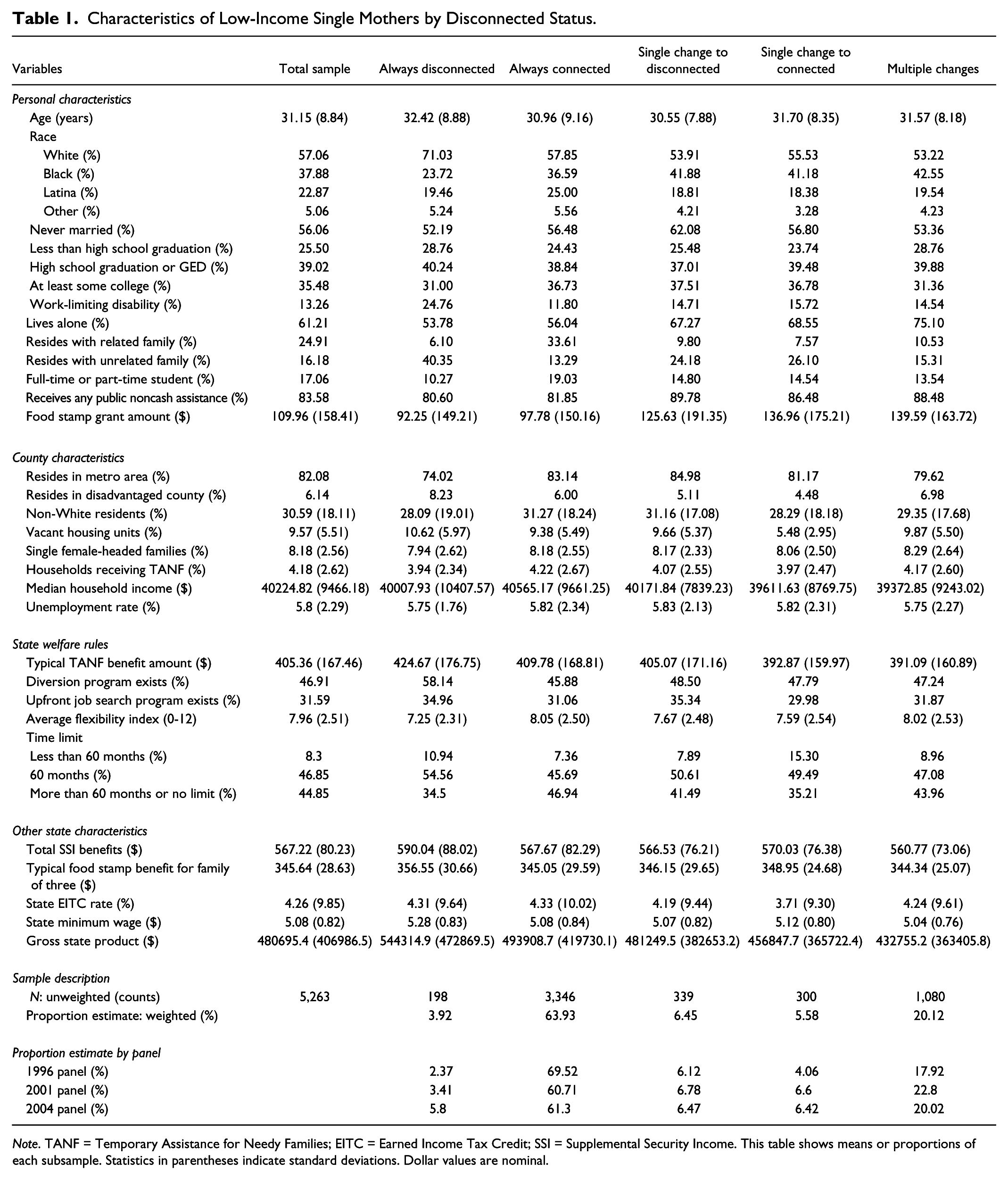
Note. TANF = Temporary Assistance for Needy Families; EITC = Earned Income Tax Credit; SSI = Supplemental Security Income. This table shows means or proportions of each subsample. Statistics in parentheses indicate standard deviations. Dollar values are nominal.
One may assume that the third (single change from connection to disconnection) subsample shared similar patterns with the always disconnected subsample, and that the fourth (single change from disconnection to connection) subsample shared similar characteristics with the always connected subsample. Our descriptive statistics, however, represented a different pattern. The third and fourth groups tended to have similar individual demographic characteristics, whose patterns are different either from the always-connected or always-disconnected group. Compared with the total sample, individuals who are Black, have a college education or higher, are without disability, live alone, reside with unrelated family, receive public noncash assistance, or receive a higher food stamp grant amount are likely to experience a single change in status. White, Latina, and individuals residing with related family, on the other hand, are less likely to experience a change in status. While several demographic variables are shared by these two subsamples, only few show the same signs for the always-connected and single-change-to-connection subsamples, or for the always-disconnected and single-change-to-disconnection subsamples. The fact that single mothers who experienced a change in status are distinguishable from those who never experience such a change confirms the need for examining the dynamics in disconnected status of this vulnerable group.
Differences in county characteristics among the subgroups are also evident. Those residing in disadvantaged counties, counties with a lower percentage of non-White state variables, including a lower EITC rate, a higher food stamp benefit, and a higher SSI benefit, also tend to be linked to reconnection. The statistical significance of these regional variables is examined through the following regression results.
Factors Associated With Becoming Connected
Results from the first analysis examine the hazard rate of individuals over time and statistically significant explanatory factors of movements out of disconnection to connection. The hazard rate in this analysis is defined as the probability that an individual who is currently disconnected will experience the status change to connection at time t. Figure 1 shows the hazard function of the change in status from disconnection to connection, derived from a life table. During the earlier waves (Waves 1-9), individuals have a low chance of becoming connected, despite a gradual increase in the hazard rate over time. However, during the later waves (Waves 10-12) individuals experienced a high chance of returning to connection. A possible reason for the sharp increase in the hazard rate in the later waves is the decrease in sample size. The 2001 panel has nine waves, whereas the 1996 and 2004 panels have 12 waves. Thus, the data in Waves 10, 11, and 12 come from only two panels, resulting in a reduced sample size. In addition to this structural issue, the number of observations in each wave itself declines over time, as those who become reconnected and stay connected are censored and not included in the analysis anymore.

Hazard function of reconnection.
The cumulative hazard function, derived from a nonparametric Nelson–Aalen model, presents the sum of the number of failures per subject at risk at each observed time. Our cumulative hazard function depicts a straight line from beginning to end, meaning that no particular wave largely affects the overall hazard rate. All three panels are generally similar in shape, but the two older panels (1996 and 2001 panels) yielded steeper slopes, as shown in Figure 2. The difference in slope indicates that individuals who fall into disconnection in more recent years have a lower chance of being reconnected. Mean survival times of the three panels, which exclude the largest observed analysis time in each observation for conservative estimates, are 2.4, 2.6, and 3.2 waves in the 1996, 2001, and 2004 panels, respectively. The comparison of means further confirms that during the latest panel it takes more time for an individual to return to connection.

Nelson–Aalen cumulative hazard function of reconnection by panel.
Table 2 presents the regression model examining explanatory factors and their impact on the likelihood of becoming reconnected. Age, race, residence with family, and the receipt of noncash public assistance show significance among individual-level characteristics. The likelihood of becoming reconnected decreases by 1.3%, as age increases by 1 year, holding all other variables constant. Black and Latina individuals had a 26.7% and 23.7% higher likelihood, respectively, than White individuals. An individual who lives with her related family has a 35.1% higher chance of being reconnected than a person who lives alone, but the chance decreased by 38.4% for an individual who resided with unrelated household members. If an individual received any noncash public assistance, the likelihood of becoming reconnected increased by 29.0%.
Factors Associated With a Change From Disconnection to Connection.
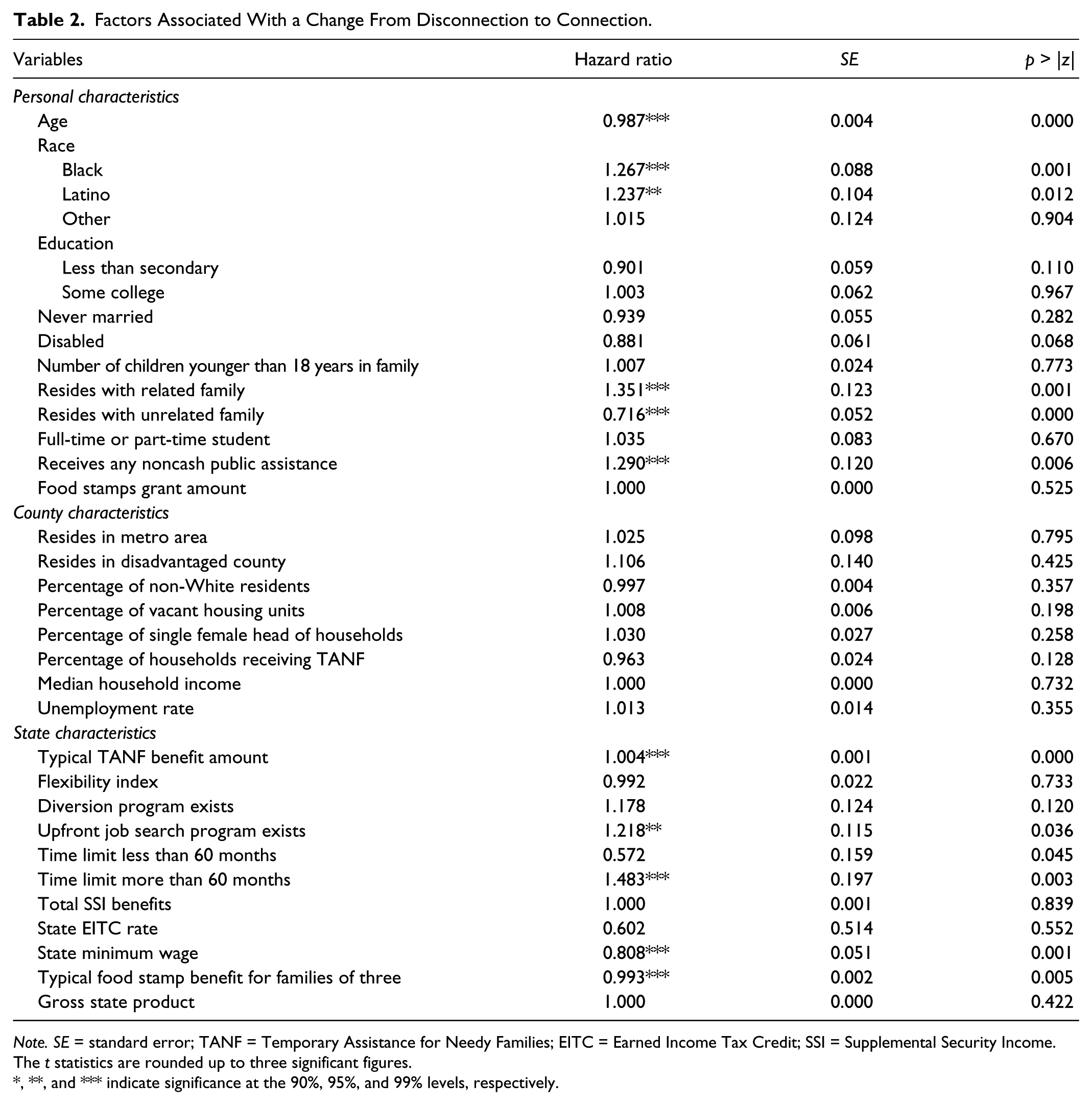
Note. SE = standard error; TANF = Temporary Assistance for Needy Families; EITC = Earned Income Tax Credit; SSI = Supplemental Security Income. The t statistics are rounded up to three significant figures.
, **, and *** indicate significance at the 90%, 95%, and 99% levels, respectively.
Some state welfare policies affect the likelihood of becoming economically connected. A dollar increase in typical TANF benefit amount or a job search program in a state increases their residents’ probability of reconnection by 0.4% or 21.8%, respectively. Compared with individuals who live in a state with the federal recommended TANF receipt limit of 60 months, those who live in a state with a longer limit have a 48.3% higher chance of reconnection, and those who live in a state with a shorter limit encounter a 42.8% lower chance. As the state minimum wage or the typical state food stamp benefits for families of three increased by a dollar, the likelihood decreased by 19.2% or 0.7%, respectively.
Unlike the individual- and state-level characteristics, county characteristics do not hold significance in the model of reconnection. These variables do not relate to the likelihood in general nor are they a primary explanatory factor for the likelihood.
Factors Associated With Becoming Disconnected
The second survival analysis focused on the change from connection to disconnection. The hazard or likelihood that an individual who is currently connected will experience a status change to disconnection at time t is the dependent variable. Figure 3 shows the hazard function of the change in status from connection to disconnection, derived from a life table. The hazard of returning to disconnection increased over time and most rapidly in the later waves partially due to the reduced sample size. The degree of hazard in this analysis is much smaller than that of the previous analysis, which indicated that the likelihood of becoming disconnected after a state of connection is generally lower than that of being reconnected after a state of disconnection.
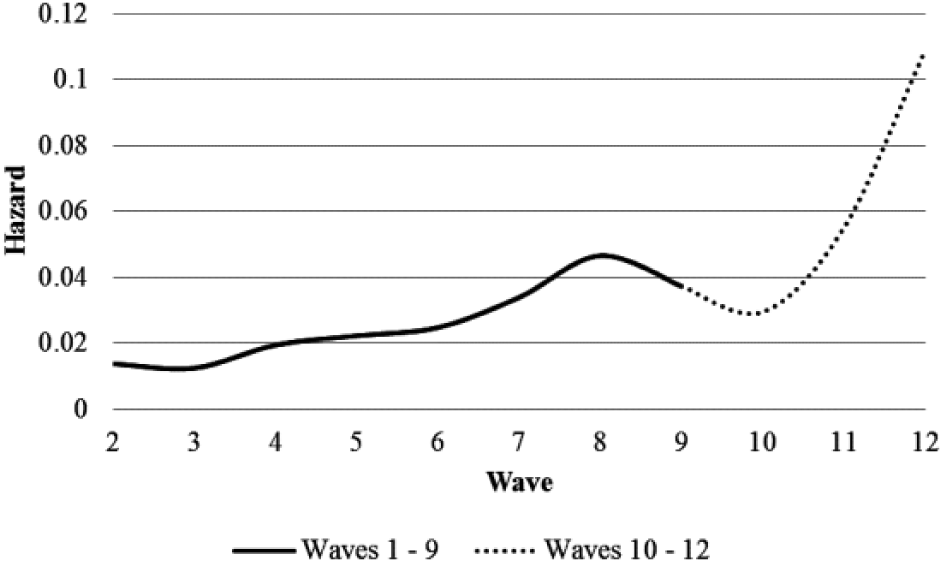
Hazard function of disconnection.
The cumulative hazard function for all three panels, derived from a nonparametric Nelson–Aalen model, shows similar straight trends. The function of the earliest panel from 1996, however, has a more moderate slope than the others, as represented in Figure 4. The difference in slope indicates that individuals who were connected in the earlier years have a lower chance of being disconnected. Mean survival times of the three panels, excluding the largest observed analysis time in each observation for conservative estimates, are 8.6, 6.1, and 7.9 waves in the 1996, 2001, and 2004 panels, respectively. This indicates that an individual in the earlier panel experiences a longer period of connection.
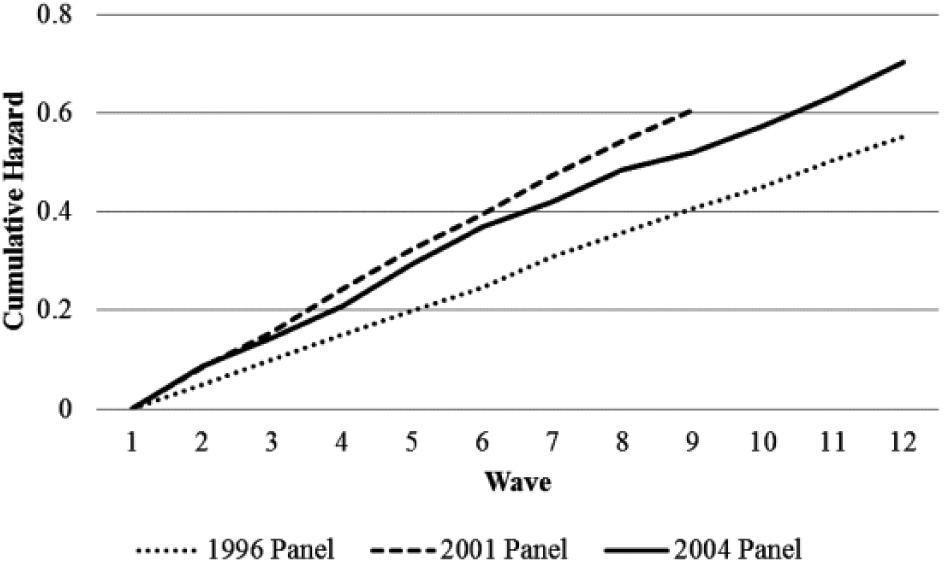
Nelson–Aalen cumulative hazard function of disconnection by panel.
To better understand the influence of regional socioeconomic characteristics on the likelihood of becoming disconnected, a regression model, shown in Table 3, was analyzed. Unlike the first survival analysis model, many county characteristics influence the likelihood. Residing in a metro area or a county with a higher percentage of households receiving TANF reduces the risk of disconnection by 27.6% or 22%, respectively. The risk, on the other hand, increases by 39.0% if one resides in a disadvantaged county, 1.2% if the percentage of vacant housing units in the county of residence increases by 1%, or 9.7% if the unemployment rate of the county of residence increases by 1%.
Factors Associated With a Change From Connection to Disconnection.

Note. SE = standard error; TANF = Temporary Assistance for Needy Families; EITC = Earned Income Tax Credit; SSI = Supplemental Security Income. The t statistics are rounded up to three significant figures.
, **, and *** indicate significance at the 90%, 95%, and 99% levels, respectively.
In addition to these county variables, the model found several personal attributes and state policies related to the likelihood of becoming disconnected. As age increased by one unit, the likelihood of becoming disconnected decreases by 3.0%. If the individual has an additional child younger than 18 years old in her family, the likelihood also decreased by 8.4%. If one lived with related family, the risk decreased by 66.1%, whereas the risk increased by 32.5% for an individual who resided with unrelated household members. A disabled individual or one with any noncash public assistance faces a 42.9% or 19.5%, respectively, higher likelihood of becoming disconnected. A one-dollar increase in the average food stamps benefit slightly raised the risk by 0.2%.
Considering other macro-level influences, a one-dollar increase in typical TANF benefit amount in a state also increased the likelihood by 0.6%. The existence of the state upfront job search program increased the risk of becoming disconnected by 24.1%, and a time limit on welfare receipt longer than 60 months increased the risk by 178.9%. According to this model, as the state EITC rate increased by 1%, the likelihood of becoming disconnected increases by 630%, a much larger influence than that of other variables; thus, one that merited further examination. Unlike the coefficients on other variables, which remained similar in significance, magnitude, and direction regardless of model specification, the coefficient on the EITC variable fluctuated drastically, sometimes losing significance and changing sign. Therefore, the variable was interpreted as a control in the model and not an influence on the outcome. We suspected that the variable picks up the effect of time with later years, increasing the risk of disconnection as shown in the figures, as most states do not adopt a state EITC until the 2000s. Finally, as the state minimum wage increased by one dollar, on the other hand, the likelihood decreased by 27.4%.
Comparison of the Regression Models
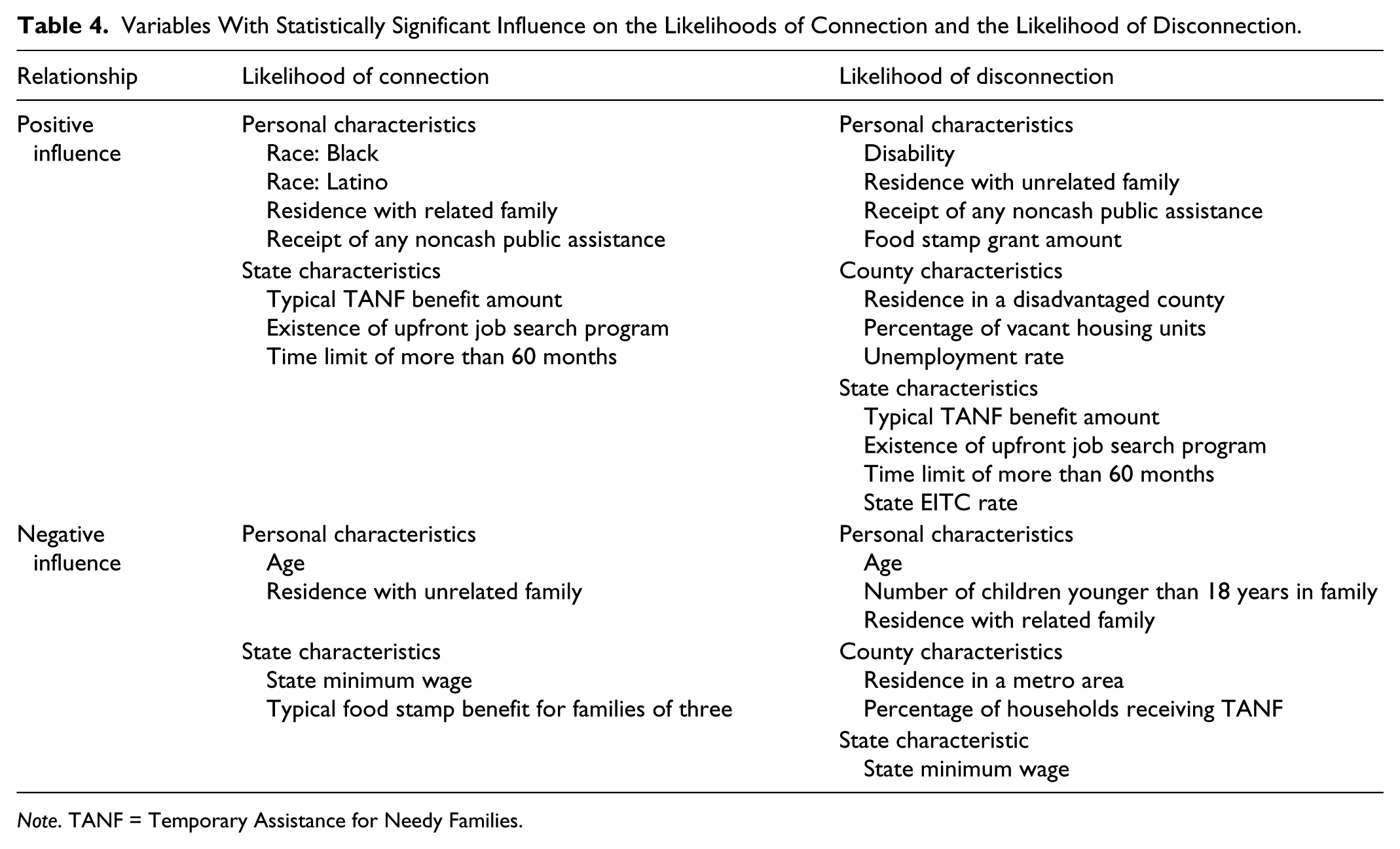
A comparison of the influence of each of the variables on the likelihood of disconnection versus its influence on the likelihood of connection provides a fuller understanding of the dynamic changes between states. The coefficients of variables with statistically significant impacts can be placed into four categories: having opposite signs in each model, holding significance only in one model, showing positive signs in both, or showing negative signs in both. Table 4 summarizes the distinct influence of these variables in each model. Recalling that the two models are designed to find variables associated with the change in status, moving into and out of disconnection, not the correlates of the static state of connection or disconnection, these four categories have distinct meanings.
Variables With Statistically Significant Influence on the Likelihoods of Connection and the Likelihood of Disconnection.
Note. TANF = Temporary Assistance for Needy Families.
The first two categories of variables, ones with opposite signs or with significance in only one model, are easily interpreted as straightforward explanatory factors of specific changes between connection and disconnection. The two household structure variables are statistically significant influences in both models and in opposite directions. Residing with related adult family members decreases the risk of a change to disconnection and increases the probability of becoming connected. Residing with unrelated adults has the opposite effect, increasing the likelihood of a change to disconnection and decreasing that of a change to connection. This finding supports the possibility that women in cohabitating relationships are less likely to apply for assistance or work. The possible reasons for this finding are varied and merit future research; perhaps some are unaware of their eligibility for assistance, perhaps some are in abusive relationships, or perhaps some do not need assistance.
A number of variables show statistically significant impacts in only one model. We interpret those that either increase the likelihood of a change to connection or decrease the risk of becoming disconnected as factors promoting resilience. Along with women who reside with related adult family members, Black and Latino mothers had a higher probability of moving to a connected status; moreover, having more children, living in a metro area, and living in a county with a higher proportion of TANF recipients all decrease the likelihood of becoming disconnected. These characteristics supported resiliency among low-income single mothers in terms of their ability to maintain formal cash income. A comparison of the models also facilitated the identification of variables that related to the vulnerability of families, or increased risk of a change to disconnection or a decreased likelihood of a change to connection. On the individual level, being disabled and receiving higher food stamp grant amounts, along with residing with unrelated adult household members, are related to an increased risk of becoming disconnected. Higher average food stamp benefits at the state level reduce the likelihood of becoming connected. Although we considered economic disconnection as a vulnerable condition, we do not interpret the Supplemental Nutrition Assistance Program (SNAP) findings here negatively. It is possible that the generosity of SNAP assistance and its receipt assists families in avoiding hardships while experiencing disconnection. County-level findings are of more concern and demonstrate the negative influence of poor regional socioeconomic conditions on the individual level. Residing in a disadvantaged county, a county with a higher percentage of vacant housing units, or a county with a higher unemployment rate increases their risk of becoming disconnected.
Variables in the third category, those showing positive signs in both models, support changes between states. Because our models explained influences related to changes in status and not the correlates of being in one state or the other, these results are not contradictory. Three state policy variables and one individual-level variable fall into this category. The one individual-level characteristic is the receipt of noncash public assistance. Low-income single mothers who received some type of noncash public assistance, such as Medicaid or SNAP, are more likely to experience both types of changes. State welfare rules, in our models, similarly contribute not only to resilience but also to vulnerability, demonstrating that these policies are associated with the movements between states in either direction. The state-level TANF benefit amount, an upfront job search program, and a TANF time limit of greater than 60 months are associated with changes to connection as well as changes to disconnection. While the first two state variables are linked to both likelihoods by a comparable degree, a time limit of longer than 60 months shows a greater influence on the likelihood of becoming disconnected (178.9%) than that of being reconnected (48.3%). The interpretation of these influences can be both positive and negative. On one hand, multiple status changes may indicate inconsistency in income and a more vulnerable state. On the other hand, the ability to move between states may be indicative of residing in a more supportive environment, one that enables families to take risks, living without for short periods of time, to make progress toward increased economic well-being, and with the reassurance that a change to subsequent connection is also possible.
Finally, two variables show negative signs in both models, indicating that they are associated with more stable states or fewer changes. Age, which is negatively linked to both likelihoods by similar degrees, increases one’s stability, resulting in a more static status regardless of a sample member’s disconnected status. State minimum wage represents a state perspective on low-wage workers and is also associated with a lower likelihood of either change. A higher state minimum wage provides a positive impact on employees who are at the minimum-wage boundary, but may create an even higher barrier to those who are unable to reach that boundary (Neumark, Salas, & Wascher, 2014). This finding supports the possibility of a mixed influence of minimum wage on labor market, especially on the vulnerable group of single mothers.
Policy Implications
Regarding state welfare rules, study results could be seen as a comment on the effectiveness of the 1996 U.S. welfare reforms. By investigating low-income single mothers’ welfare status between April 1996 and January 2007, the study examines trends in disconnection over the history of welfare reform and its implementation. Under TANF, eligibility requirements became more restrictive and programs diversified among states. The comparison of reconnection by panel reveals that respondents in more recent panels experience a lower probability of reconnection and a longer time to return to reconnection. Simultaneously, these respondents face a higher probability of disconnection and experience shorter connection times. These results do not necessarily demonstrate that welfare reform is unsuccessful, but do indicate that the reform has not improved the well-being of certain subgroups.
At the same time, increased underreporting of TANF in the SIPP may complicate this finding by overestimating the occurrence of disconnection. Several studies found that underreporting of TANF increased after the adoption of the 1996 PRWORA. Wheaton (2008) revealed that reporting rates of TANF in SIPP decreased from 83% in 1997 to 59% in 2002, likely related to increased stigma and confusion about changes in program names. Meyer, Mok, and Sullivan (2009) also showed a decline in TANF reporting rates, dropping from above 70 prior to 1996 to around 60 in 2001 and 2004. The increase in underreporting within our study period likely affects our findings. The underreported TANF amounts may lead to an incorrect higher likelihood of disconnection and a lower likelihood of connection in 2001 and 2004 than in 1998. Thus, the difference between the 1996 panel and the 2001 and 2004 panels in Figures 2 and 4 may partially reflect the decline in reporting rates of TANF after 1996 and should be interpreted cautiously. Despite this limitation, the SIPP has a higher reporting rate than other survey data such as CPS, due to shorter interview duration, more detailed questions about receipt of support, and a higher imputation rate (Meyer et al., 2009).
Over the entire study period, our findings indicate that over 30% of low-income single mothers experienced a change in status at least once, demonstrating that staying connected is a struggle for this vulnerable population. Therefore, welfare policies should be designed both to lead a disconnected individual to a connected status, and to help a connected individual stay connected, either through continuing benefits or facilitating a direct transition to employment. The results of the survival models, which examine the impact of state welfare rule variables on individual resiliency, indicate that the variables either have no significant influence or have an impact on both types of changes. The existence of a diversion program had no significant impact on resiliency, and the existence of an upfront job search program increases both the probability of disconnection and that of connection, indicating that the program facilitates movements in both directions. Higher flexibility index values, signifying fewer restrictions, and more lenient regulations, are found to have no significant impact on changes between statuses. Regarding TANF time limits, another measure of leniency, residence in states with a time limit longer than 5 years increases both the probability of reconnection and of disconnection. The federal government recommends that states set lifetime limits at 5 years and the majority of states accept this guideline: 24 states in 1997, 33 states in 2000, and 37 states in 2005. Perhaps longer time limits encourage individuals to take some risks in working toward self-sufficiency because exiters know they can return to the TANF program if those efforts fail. Additional support programs targeted for connected single mothers might help prevent disconnection. Recently, some states have been developing more intensive case management approaches for those recipients who are approaching the time limit. Breaking welfare receipt into stages and offering more concentrated supports, perhaps even with a gradual decrease in the benefit amounts, toward the end of the TANF time limit may help recipients who are struggling to find employment, prepare for independence, thus eliminating a spell of disconnection after leaving welfare.
Our findings also indicate that county-level factors are critical components of understanding moves into economic disconnection. Survival analysis results revealed that reconnection is rarely affected by characteristics of one’s county but regional characteristics play a critical role in determining its residents’ ability to avoid disconnection. Residents in a disadvantaged county, a county with a high percentage of vacant housing units, or a county with a high unemployment rate face a higher probability of disconnection. This finding demonstrates that the poor economic conditions of a region adversely affect its residents’ ability to stay connected. This conclusion is further confirmed by the fact that those who live in metro areas or a county with a higher proportion of households receiving public assistance tend to experience a lower probability of becoming disconnected.
If states hope to design policies and programs that prevent economic disconnection, perhaps policy makers should also consider regional differences as well as state ones. Despite the recent policy devolution to the states, this trend, for the most part, has ignored the differences among counties within the same state. Although some states have devolved a certain level of authority to the county level, county residence is usually not considered when TANF applications are reviewed or the amount of benefits is determined. Regional characteristics may need to be included as part of the eligibility screening and, more important, during the redetermination process. Doing so will allow residents in regions with poor economic conditions to more readily benefit from TANF programs. The influence of residing in a disadvantaged county also implies that policies aimed at community development initiatives should be viewed as a strategy to address economic disconnection of low-income single mothers. The state Community Development Block Grant program, for example, is designed to create jobs and provide services to residents. Such programs may improve the economic condition of places where low-income single mothers reside, helping them stay connected. If a state takes the prevalence of low-income single mothers into consideration in the process of selecting which community receives grants, the efforts may induce a more stable environment for this vulnerable group.
Future Research
The study’s findings are tempered by some limitations that could be addressed by other projects. The economic downturn in recent years is a critical issue for the well-being of low-income families. The 2008 SIPP panel was released recently and the inclusion of these data may lead to more comprehensive and updated research. Our analysis also focused on counties as the lowest level of a region. Some may argue persuasively that neighborhood characteristics are more influential. Further developments in the ACS may provide data for such future investigations.
The study’s findings offer new avenues of research. Statistically significant variables from the series of survival analyses may be examined further, one by one. For individual variables, age may be specified by incorporating the mother’s age at first birth and the age of the youngest child into models, and race may be expanded by including nativity additionally. As discussed above, findings related to household structure offer another avenue for future projects. Given that most significant variables, particularly in explaining moves into economic disconnection, are regional variables, the inclusion of additional county-specific socioeconomic variables, and again city- or neighborhood-level variables, may further broaden and deepen the field of antipoverty and welfare research.
With respect to the structure of data, analysis with varying definitions of economic disconnection and connection is another topic for future research. First, our use of the SIPP interview month focused our examination of changes in status to spells lasting at least 4 months. The weakness of this data structure is that a quick status change within a wave is not captured, which may underestimate or overestimate the duration of connection or disconnection. Future research may investigate shorter spells and transitions. Second, in addition to earned income, TANF or AFDC, and SSI examined in our models, other public assistance payments such as the SNAP and disability insurance benefits may offer a more practical definition of connection. Third, the data in this study are left-censored, where the previous disconnected status is ignored. Assuming a new survey or administrative data set with a sufficiently large sample, a more conservative analytical data set with only new spells of connection and disconnection may unveil the bias behind the left censoring and provide a supplementary story to research on disconnection. The Cox proportional survival model selected for this study has advantages, such as the possibility of estimating the influence of covariates without knowing the distribution of the overall hazard function, but the survival analysis has several variations when it comes to specific modeling. Comparing and contrasting outputs from various survival models, including but not limited to the shared frailty Cox proportional model and the Kaplan–Meier method, may contribute to a clearer understanding of the change in disconnected status.
Finally, a consideration of the types of connection would advance knowledge. This study is aimed to provide an assessment of the dynamics of economic disconnection regardless of whether an individual is connected through employment or welfare. The time point when an individual moves from welfare to work is a critical point for the individual and the nation, but this time point is not revealed under our research structure. The types of connection must be an interest to present policy makers in obvious preference to work. Variables that induce connection through employment would be of great use for setting the right policy direction. Investigating whether statistically significant variables differ by type and if so, how, may greatly contribute to the research of economic disconnection.
Footnotes
Authors’ Note
This research utilized restricted-use microdata from the U.S. Census Bureau analyzed at the New York Census Research Data Center at Baruch College, a secure laboratory, operated in partnership with the U.S. Census Bureau’s Center for Economic Studies. Any opinions and conclusions expressed herein are those of the authors and do not necessarily represent the views of the U.S. Census Bureau. All results have been reviewed to ensure that no confidential information is disclosed.
Declaration of Conflicting Interests
The authors declared no potential conflicts of interest with respect to the research, authorship, and/or publication of this article.
Funding
The authors disclosed receipt of the following financial support for the research, authorship, and/or publication of this article: The project was supported in part by grants from the Fahs-Beck Fund for Research and Experimentation in the New York Community Trust and Rutgers University Faculty Council.