




Abstract
The authors investigate the training choices made by workers entering the Trade Adjustment Assistance program and their postexit outcomes. This is important as more workers enter these types of programs due to technological change and globalization. Their study shows that workers that choose a training occupation beyond their skill level (skill overshooting) achieve higher earnings ($615 annually) and wage replacement rates (2.0 percentage points) at the cost of lower reemployment rates (−1.9 percentage points) immediately following program exit. An investigation of subsamples shows that skill overshooting is especially beneficial to females and those living in rural areas with earnings gains of $1,443 and $1,080, respectively, without hurting their chances of reemployment.
Recent labor market experiences during the Great Recession and thereafter have brought worker dislocation and reemployment into the center stage of policy discussions. However, worker dislocation is an ongoing, centuries-old societal issue. As technology advances, the skills in demand at any point in time constantly change, and this adds to the adjustment costs of dislocation as acquiring new skills is sometimes necessary for reemployment. Rapid globalization further accelerates changes in skill demands across industries. To lower the adjustment costs of dislocated workers in this environment, governments around the world offer various active labor market programs (ALMPs) to dislocated workers to help with reemployment (Barnow & Smith, 2016). 1
This article evaluates one such program by focusing on the job training provision of the Trade Adjustment Assistance (TAA) program. We investigate whether the training, when participants take it as a chance to upgrade their skills, can provide an extra boost to their postparticipation earnings. The TAA program is a dislocated worker program administered by the U.S. Department of Labor that is designed to help those whose employment is adversely affected by foreign competition. 2 We use the TAA participants’ data because of the information that it provides on the services each participant received, as well as detailed information on the individual participants. There is a particular emphasis on job training in the TAA, based on the idea that import-competing tasks are being replaced by foreign competition at an increasing rate (Acemoglu et al., 2016; Autor et al., 2016), rendering the skill sets possessed by the TAA-eligible workers practically obsolete in the United States. Marcal (2001) showed that TAA participants are older, have a longer tenure at their previous employment, and have a much lower chance of being recalled by their previous employer compared with unemployment insurance (UI) recipients in the manufacturing sector. To secure a sustainable career path, workers must obtain new sets of skills that are marketable in the United States.
Many studies have investigated the impacts of participating in the TAA and receiving job training on labor market outcomes, and the findings are inconclusive. Using a survey data of TAA participants around 1988, when the emphasis of the program shifted toward training provisions, Decker and Corson (1995) showed that TAA participants suffered a greater wage loss (wage replacement rate of 0.76) compared with displaced manufacturing workers in general and they did not find any significant impact of TAA training on postparticipation earnings. Marcal (2001) confirmed their findings on the impact of TAA training on earnings but found that it had positive impacts on employment. In more recent studies, Reynolds and Palatucci (2012) used the same TAA participant data used in our study and found similar patterns as those in Marcal (2001). In their large survey study, Schochet et al. (2012) showed that TAA participants suffered negative impacts on both employment and earnings compared with non-TAA displaced workers, but that TAA training reduced such negative impacts compared with nontrainees. From a different perspective, Barnette and Park (2017) found that TAA training enrollment was beneficial in reducing the negative impacts of a large increase in local unemployment.
Our article goes one step further into examining participants’ choices of training occupations and how those choices can be used as a chance to improve their skill levels. 3 Specifically, we examine the outcomes of participants that choose a training occupation that is above their skill level when compared with the outcomes of those who choose an occupation that is at or below their skill level. We use educational attainment as a proxy for skill level to define skill overshooting as a participant choosing to train for an occupation where the average job holder of that occupation has at least one more year 4 of education than the participant. 5 We construct the comparison group—TAA trainees that did not overshoot—using nearest-neighbor matching with replacement on a propensity score to minimize the selection bias inherent in any voluntary program participation. Andersson et al. (2013) documented that the selection of a specific training program within a TAA was less of an issue compared with participation in the program itself. We expect that the selection issue is even smaller in our analysis, since we only compare skill overshooters with nonovershooters among TAA trainees. Carefully selecting a comparison group through propensity score matching further reduces the selection issue.
We find that skill overshooting improves trainees’ earnings potential, but it hurts their chance of finding a job. Specifically, during the three quarters immediately following the program exit, overshooting increases their wage replacement rates by 2.0 percentage points and $615 in annual earnings compared with trainees who did not overshoot. But, the chance of reemployment falls by 1.9 percentage points.
We also investigate the impacts of skill overshooting for subsamples based on gender, age, urban and/or rural characteristics of their local labor market, and education level to find how skill overshooting affects different groups of trainees. We find the most drastic differences in gender subsamples. Overshooting is highly beneficial for female trainees who experience a 4.1 percentage point increase in wage replacement rate, a $1,443 increase in annual earnings, and no discernable impact on their chance of reemployment. In contrast, male trainees suffer from a decline in their reemployment rate (−3.1 percentage points) without much benefit to their earnings ($173). Trainees in rural areas also benefit more from skill overshooting with earning increases of $1,080 and without the negative reemployment effect. Additionally, the findings on our subsamples suggest that overshooting is especially effective in improving the labor market outcomes of particularly disadvantaged groups of workers based on preparticipation characteristics. Trainees with more than a high school education also enjoy a large gain in earnings ($1,186), but not without the cost of lower reemployment rate (−1.7 percentage points). We find very small and statistically insignificant differences between older (ages 43 to 65 years) and younger (ages 18 to 42 years) workers.
The main contribution of this study is that we look deeply at the choices made by workers toward their next career after a layoff, especially the trade-displaced workers to whom acquisition of new skills is deemed necessary for reemployment. Liu and Trefler (2019) is the closest to our study in the sense that they focused on the behavioral aspect of occupation switching among the workers whose displacement was connected to rising import competition. They examined the impact of trade in services with China and India on U.S. labor market outcomes by studying how this affected unemployment and earnings for the period of 1996 to 2007. They distinguished workers who switched to an occupation that paid more on average than their current occupation (upward switching) and those who switched to an occupation that paid less on average than the current occupation (downward switching). They found that rising service imports from China and India over the past decade had increased the incidence of downward switching by 17%, while upward switching had only increased by 4% over the past decade. They found that workers leaving import-competing occupations faced higher chances of downward switching.
Kosteas and Park (2015) is another study that explored the occupation switching behavior of trade-displaced workers. They traced workers transitioning away from import-competing occupations and found that the cross-occupation movement of trade-displaced workers had a significant negative impact on the wages of the incumbent workers in the receiving occupations as well as the trade-displaced workers entering these occupations.
With the help of rich information on TAA services rendered to each participant, this study goes one step further than simply observing occupations before and after a layoff. We regard the job training choices, which lie between the two employments observed in other data sets, as workers’ intentions or strategies for their future employment prospects.
This article also complements previous research on the positive transitions from industry-switching behavior of the trade-displaced. Autor et al. (2014) showed a positive impact of industry-switching among the trade-displaced workers in response to rising exposure to Chinese imports between 1990 and 2007. They found a large and negative impact on the cumulative earnings in general, but showed that those workers who switched industries, but remained within the manufacturing sector, experienced a positive impact on their earnings. Hyman (2018) also found positive impacts of industry switching on earnings. 6
Our study has policy relevance. The large emphasis of the TAA program on training provisions and the mixed results on impacts of training shown in the empirical studies discussed above, suggested that enrolling in training alone does not guarantee well-paying jobs for the participants. Many studies showed that the quality of the match between a worker and a job was important for the determination of wages and the retention rate (Abowd et al., 1999; Andrews et al., 2012; Shimer & Smith, 2000). A good match between a TAA trainee and a training program could lead to similar effects. Mack (2009) found that the training occupation choice was made with substantial interactions with TAA staff through worker assessment and career counseling. This implies that the program administration has influence over the process that can lead to improvements in the program outcomes.
Trade Adjustment Assistance and Job Training Provisions
The TAA Program is a dislocated worker program administered by the U.S. Department of Labor (DOL) that is designed to help those whose employment is adversely affected by foreign competition. TAA provides a variety of services to eligible workers, such as job search assistance, financial support for physical relocation, job training, remedial education, extended UI benefits, and Health Insurance Tax Credits. 7 These services are provided at American Job Centers (AJC) located throughout the country. The AJC serve all federal employment and training services that are administered under the umbrella of the Workforce Innovation and Opportunity Act (WIOA), 8 which includes TAA.
When three or more workers at an establishment are laid off due to import competition, they (or a representative—union, AJC staff, or the company itself) may file a petition with the DOL. Petitions are filed at the establishment level, representing one physical location of an employer. 9 Once the petition is certified by DOL, workers whose employment is reduced or terminated between the day layoffs began and 2 years from the date of petition certification are eligible for TAA benefits.
TAA emphasizes job training provisions as trade-displaced workers tend to possess skill sets that are increasingly less marketable in the United States. To determine participants’ training needs, TAA offers worker assessment, counseling, and career planning services with staff members at AJC. Job training can be delivered by classroom training, on-the-job training (OJT), and customized training. Classroom training is offered through job training programs at vocational schools and community colleges. OJT is provided directly by an employer actually hiring the trainee. In this case, the TAA subsidizes 50% of the trainee’s wages for up to 6 months. Customized training is like OJT in that the skill sets taught through these programs are designed to meet specific needs of a certain employer, but posttraining employment is not guaranteed. The training, regardless of the modes of training, can last up to 2 years. TAA participants are also eligible to enroll in up to 6 months of remedial training courses such as English as a Second Language (ESL), GED preparation, and basic math skills in addition to their job training. TAA job trainees receive income support for the duration of job training as extended UI benefits for up to 2 years. Remedial trainees can receive an additional 26 weeks of UI benefits.
Data
Trade Act Participant Report (TAPR) and TAA Petition Data
The DOL manages two separate data sets regarding the TAA program: one for the petitions (TAA Petition Data) and the other for the participants (TAPR). The TAPR consists of three sections: (1) participant characteristics, (2) services and benefits delivered during participation, and (3) labor market outcomes after exit. The data were acquired through a Freedom of Information Act request. Our sample covers 320,603 workers who participated in the TAA program from 1998 to 2007.
The first section of TAPR covers information on the individual characteristics of participants such as gender, age, race/ethnicity, education, English language proficiency, and tenure with the previous employer. It also reports the date of participation, the TAA petition number under which the participant is certified, and his earnings during the three quarters prior to participation. 10 The second part of the data on services and benefits contains information on training provisions such as the modes (classroom, customized, on-the-job, or remedial), occupation, and the duration of training. It also shows various forms of financial support participants received during participation. The outcome portion of the TAPR covers employment status and earnings during the three quarters following the program exit. The date of program exit and reemployment occupations are also reported here.
In this study, we make heavy use of training and reemployment occupations data. Both are reported using the Standard Occupational Classification (SOC) system and we use the six-digit version in this study. Among participants who received any job training, 56.70% of them have a valid six-digit SOC. The reporting rate for the reemployment occupation is even lower, at 26.71%. 11 The issue of occupation code reporting quality should not bias the estimation results unless the poor reporting is systematically biased in one direction. States are subject to performance evaluations based on (1) reemployment rates, (2) retention rates, and (3) postexit earnings. Occupations of training and reemployment do not factor into performance evaluation. Therefore, we have no reason to believe that there is a systemic bias in the quality of occupation code reporting.
We utilize information on the participant’s geographic location to control for the labor market characteristics of their local areas. We link the TAA petition data to TAPR using the petition numbers and zip code of the previous employer as a proxy for the participant’s location. We then use the zip code and the city/state pair to identify the commuting zone (CZ) of each participant.
Panel A of Table 1 shows the summary statistics for TAA participant characteristics. They are, on average, 43.88 years old, received 12.26 years of schooling, and made about $34,957 annually in 2000 US$ values. 12 We also compare the characteristics of selected subgroups—gender, age (43 to 65 vs. 18 to 42), geography (urban vs. rural), and education (11 years or less vs. 13 years or more). 13 The starkest difference we notice between subgroups is in preparticipation earnings. Not surprisingly, the difference is the largest for the education subgroup. The high-education sample earned, on average, 65% more than their low-education counterparts. The gender subsamples show a similar disparity. Male participants earned 51% more than female participants. We also see that location matters—participants living in an urban area make 29% more than their rural counterparts.
Summary Statistics: Trade Adjustment Assistance Participant Characteristics and Training Enrollment.

The Low Education subsample includes participants with 11 years of education or less. The High Education subsample includes participants with 13 years of education or more. bThe share of workers in each mode of training does not add up to 100% due to small overlaps in data.
Panel B shows the enrollment statistics for various modes of training programs. 14 Just over 65% of all participants received a form of job training (classroom, customized, or OJT). The vast majority (97.72%) opted for classroom training. Age is a definitive factor in deciding whether to receive job training. Of younger participants, 76.54% received training compared with 63.09% of older participants. The low-education sample (less than high school) has a relatively high rate of remedial training enrollment (35.60%), as it offers GED and ESL classes. Even though participants are eligible for job training in addition to remedial training, only 46.18% of the low-education sample receives job training, a remarkably low rate compared with the other subsamples. The training enrollment pattern is quite distinctive between male and female participants as well. Female participants show a higher rate of both job training and remedial training than male participants.
Panel C summarizes the labor market outcomes of the participants. Approximately 77.20% of them found employment within three quarters of exiting the program. At the new job, they make annual earnings of $26,798 (on average) or 86.53% of their previous earnings. Participants who received job training show a slightly higher rate of reemployment, but slightly lower earnings compared with all participants. This pattern holds for most subsamples.
Without accounting for selection into job training, we are cautious with comparing the outcomes of all participants and job trainees. One pattern that arises from all subsamples is that job training seems to narrow the gap between advantaged and disadvantaged groups in both reemployment rates and earnings. The largest gap, again not surprisingly, occurs in the education subsample in terms of both reemployment rates and earnings; however, training narrows the gap in the reemployment rate substantially. The disadvantage that female and rural participants display in preparticipation earnings remains after exiting the program. However, the magnitude of the disadvantage decreases with participation and the magnitude decreases further with job training.
Current Population Survey (CPS)
Public-use Current Population Survey (IPUMS-CPS) data, together with TAPR data, are used to construct our main variable, skill overshooting. We construct skill overshooting by comparing a participant’s skill level at the time of TAA participation to the skill level of the training occupation. We use educational attainment as a proxy for skill level. The participant’s years of schooling are taken directly from TAPR. Occupation-level educational attainment is constructed using the average years of schooling for job holders of each occupation each year from IPUMS-CPS data. CPS reports occupations using three-digit Census Occupation Codes (COCs). We crosswalk this to six-digit SOC codes and merge with TAPR for the year of participation. 15
Local Labor Market Characteristics
We incorporate two aspects of participants’ local labor markets: unemployment rate at the time of program exit and an urban–rural designation. Following recent literature, such as Autor et al. (2013), we use CZs as our unit of geographic disaggregation because they represent separate labor markets identified by commuting patterns. We use the 2003 version of the Urban–Rural Continuum Code published by the U.S. Department of Agriculture to construct the urban–rural designation of CZs. In this data set, each county is identified on a 9-point scale, with 1 being the most urban and 9 being the most rural. Ratings are based on whether a county is in or adjacent to a metro area and the size of urban population in the county. We aggregate this county-level designation to the CZ level to identify a CZ as urban, rural, or in-between. A CZ is classified as urban if all counties in the CZ are in or adjacent to a metro area. A CZ is classified as rural if no county in the CZ is a metro area. Out of 708 CZs in the United States, 298 are identified as urban and 297 as rural.
For the unemployment rates, we use Local Area Unemployment Statistics, which provides labor market statistics at various levels of geographic disaggregation from state level to city level. These data are managed by U.S. Bureau of Labor Statistics and are constructed by merging various sources of labor market data. We use county-level statistics aggregated to the CZ level.
Definitions and Summary Statistics
Our main variable, skill overshooting, captures a trainee’s intention to improve her skill level by choosing a training occupation that has a higher skill level than her own. In this study, we use educational attainment measured in years of schooling as a proxy for skill levels. Accordingly, skill overshooting (Skill_OSi) is defined as the following:

The information on participants’ schooling is obtained from TAPR. The average schooling of a trainee’s training occupation is measured as the average years of schooling for job holders of the occupation as recorded in the CPS. 16
Using skill overshooting defined above, we also construct an indicator variable for overshooting, I_OSi. We consider a 2-year band (±1 year) around the participant’s own education to represent her skill level. If a participant chooses a training occupation that has average schooling more than 1 year above the band, we say she is overshooting and assign the value of 1 to I_OSi.

Admittedly, educational attainment alone does not capture the full extent of the skill level of a person; however, we believe it is the most suitable measure for our analysis of TAA participants because it is a good measure of one’s general skills that are transferrable across employment. The literature discusses an individual worker’s skill level to be composed of general skills and specific skills. General skills are specific to an individual worker and are accumulated through education and overall labor market experiences. Specific skills are tied to one’s employment. There are firm-specific factors, such as firm-level productivity and efficiency wages, and factors specific to firm-worker matching, such as within-firm seniority (Kletzer, 1989; Topel, 1991). These firm-specific factors are not transferrable across employers. More recent studies focused on task-specific skills that could be transferrable across employers if a worker found a job in a similar occupation (Gathmann & Schönberg, 2010; Gibbons et al., 2005; Kambourov & Manovskii, 2009). TAA participants are likely to lose both firm-specific and task-specific skills as most of them move away from their previous employers, occupations, and industries. Our data show that only 1.81% of TAA participants report expecting to be recalled by their previous employer. According to Marcal (2001), 86.9% of TAA trainees switched industries (two-digit SIC) and 80.2% switched occupations (two-digit SOC 17 ). 18
While several of the studies cited in this article used wage rates to convey information on various aspects of one’s skill sets, wage rates are not the proper measure of the level of one’s general skills that is relevant for our study. A large portion of wage rates is based on specific skills. Davidson et al. (2014) showed that a substantial portion of one’s wage rate was specific to firm-worker matching in their analysis of the impacts of rising competition from imports on the quality of assortative matching. Gathmann and Schönberg (2010) also found that the wage rate was largely associated with task-specific skills. 19 In this study, we compare a participant’s skill level with the level of general skills associated with a certain occupation. Although the level of general skills depends on both education and overall labor market experiences of a participant, we use years of schooling as a proxy for general skills and leave out general labor market experience, as it is difficult to construct a meaningful measure of overall labor market experience required for an occupation.
Panel A of Table 2 summarizes the skill levels of training and reemployment occupations compared to the participants’ education level. The first column shows that 49.09% of the sample choose a training occupation that is comparable with their own skill level (±1 year; 38.99% overshoot; and 11.92% of participants choose a training occupation that is below their skill level). On average, participants train for occupations that are associated with 0.74 more years of education than they had upon entering the program. The second column shows a similar variable for reemployment occupation, comparing a participant’s own education level with the average education for job holders in the reemployment occupation. While 38.99% of participants overshoot to find a higher skilled job, only 25.60% succeed in finding one 20 and 17.27% of participants actually end up with a job that is lower skilled relative to their education. Overall, while reemployment occupations are associated with higher educational attainment, they do not equal the skill level to which the overshooting trainees aspire.
Summary Statistics: Skill Levels of Training and Reemployment Occupations.

Training Occupation sample (Train) includes participants who enrolled in training programs with a valid occupation code for the training occupation reported in Trade Act Participant Report (TAPR) regardless of their reemployment status. The sample shares refer to the overshooting status.
Reemployment Occupation sample (Reemp) includes participants who are reemployed with a valid occupation code for the reemployment occupation reported in TAPR regardless of their training status. The sample shares refer to the status for the reemployment occupation.
Panel B of Table 2 gives details on participants’ different educational backgrounds. As noted above, the percentage of participants who overshoot is greater than that of those who find a higher-skilled job (middle row for all columns), implying that choosing a higher-skilled occupation during job training does not always lead to employment in one. Another obvious trend we find here is that participants with lower educational attainment tend to overshoot more often. It is intuitive that people with a lower skill level benefit more from upgrading their skills and therefore show a higher rate of overshooting. However, a portion of what we observe is due to the way the variables are defined. The skill level of a training occupation is measured by the average years of schooling for job holders in that occupation, as reported in the CPS. A participant’s skill level is measured by his or her own educational attainment. The participants’ skill levels convey a much larger variation. The amount of variation in years of schooling is similar for TAPR and CPS samples ranging from 7 to 17 years. 21 We take the mean years of schooling of all job holders for the skill level of training occupations; these mean values range from 10.5 to 17.0 years. 22 This makes any TAA trainee with less than 9.5 years of schooling an overshooter. For the same reason, a highly educated TAA trainee is less likely to be identified as an overshooter. 23
Methodology
The main question of this study is whether skill overshooting through a federal job training program improves the labor market outcomes of the trainees. As in any other ALMP, there is a selection issue around who chooses to overshoot. Do the high-ability trainees who are predisposed to positive outcomes overshoot? To separate the impact of selection from the impact of overshooting itself, we use a propensity score estimation to construct a comparison group for the treated (skill overshooters) using nearest-neighbor matching with replacement. This methodology reduces the selection issues around overshooting by choosing the comparison group that is most like the treatment group in its preparticipation characteristics. 24
Table 3 presents the propensity score estimation results for our baseline matching criteria. English proficiency and gender show a large influence on whether a trainee overshoots. Trainees who are not fluent in English are 9.5 percentage points more likely to overshoot. This is consistent with the intuition that low-skilled workers have more to gain from acquiring higher level skill sets and thus are compelled to overshoot. Male participants show a substantially lower rate of overshooting (13.9 percentage points lower). Tenure at previous employment does not affect the overshooting decision, offering support to the argument made earlier that job-specific human capital is rather irrelevant in TAA training decisions compared to general skills that are largely captured by educational attainment. The negative impact of age on the overshooting decision is as expected, but the magnitude is surprisingly small. An age difference of 10 years only makes 1 percentage point difference in the likelihood of overshooting. Preparticipation earnings pose a highly significant influence, although the overall effect is small. A 1 standard deviation increase in earnings ($22,395) lowers the likelihood of overshooting by 2.22 percentage points. Ethnicity also seems to be an important factor, suggesting that there might be cultural influences in the decision to overshoot.
Skill Overshooting: Propensity Score Estimation (Dependent Variable: I_OS).

Note. This estimation is the first part of matching. Each match is also paired with another of the same education and from the same state. Earnings are annualized from quarterly earnings reported in Trade Act Participant Report converted to 2,000 US$. I_OS = indicator variable for overshooting.
p < .15 **p < .05 ***p < .01
While we have used several individual characteristics available to us in the TAPR, we may still suffer from selection bias due to unobservable qualities of the TAA trainees. Ambition is an obvious one. An ambitious individual is more likely to overshoot in her training choice and find a job. The ambitious individual is more likely to obtain higher earnings as well. Even without overshooting, her labor market outcomes would likely be better than those of less ambitious trainees. This factor, if substantial, would yield an upward bias in our outcome estimates.
Higher levels of general labor market experience, the portion of a trainee’s human capital that is not captured by education, are also likely to be associated with overshooters and more favorable outcomes. While this creates another upward bias in our outcome estimates, we expect it is captured, at least partially, in the propensity score estimation of the trainee’s age.
Next, we construct a comparison group by matching one overshooter to two nonovershooting trainees using matching with replacement. 25 We force this matching to have the same years of schooling within the same state of residency. 26 Identical schooling is forced on our matches because overshooting, as defined by Equation (2), is negatively linked to one’s own schooling. Therefore, a trainee with less (more) schooling is more (less) likely to be identified as an overshooter. 27 Left untreated (when we move to analyzing the impacts of overshooting on labor market outcomes), the coefficients on the overshooting indicator could pick up the impacts of low educational attainment and the impacts of skill overshooting.
Additionally, the same state of residency is used to minimize the impacts of cross-state differences on both the overshooting decision and labor market outcomes. States differ greatly in terms of industry composition and skill demands, labor force composition, and the administration of workforce development programs like the TAA. There are also differences in UI benefits across states. TAA trainees are eligible for income support during their training as an extended UI benefit. More generous UI benefits may encourage TAA participants to choose longer training programs that are more likely to be associated with higher skill-level occupations. This stronger incentive could create a downward bias in our estimates. A shorter duration of UI benefits may encourage TAA participants to enroll in any training to extend the benefit payments. This then could hurt the overall outcomes of the TAA training provision. If there is a tendency toward or away from overshooting, it could create a bias in the relevant direction noted. Forcing the match of the same number years of schooling and the same state of residency can eliminate these various unobservable factors that could bias our outcome estimations.
Figure 1 and Table 4 demonstrate the quality of our matching and its balance. Figure 1 displays the histogram with predicted probabilities of skill overshooting for the matched sample on top (Treated: On support) 28 and the comparison group at the bottom (Untreated). The figure displays what are near mirror images on the top and bottom suggesting considerable overlap between the two groups. Table 4 shows summary statistics for the treated and the comparison groups after matching. The variables display similar values for these two sample groups with no mean values statistically different from each other. This table, together with Figure 1, convinces us that the following analyses using the propensity score matched sample is valid. 29

Predicted probability of skill overshooting for baseline matched sample.
Summary Statistics: Treated Versus Comparison Group.
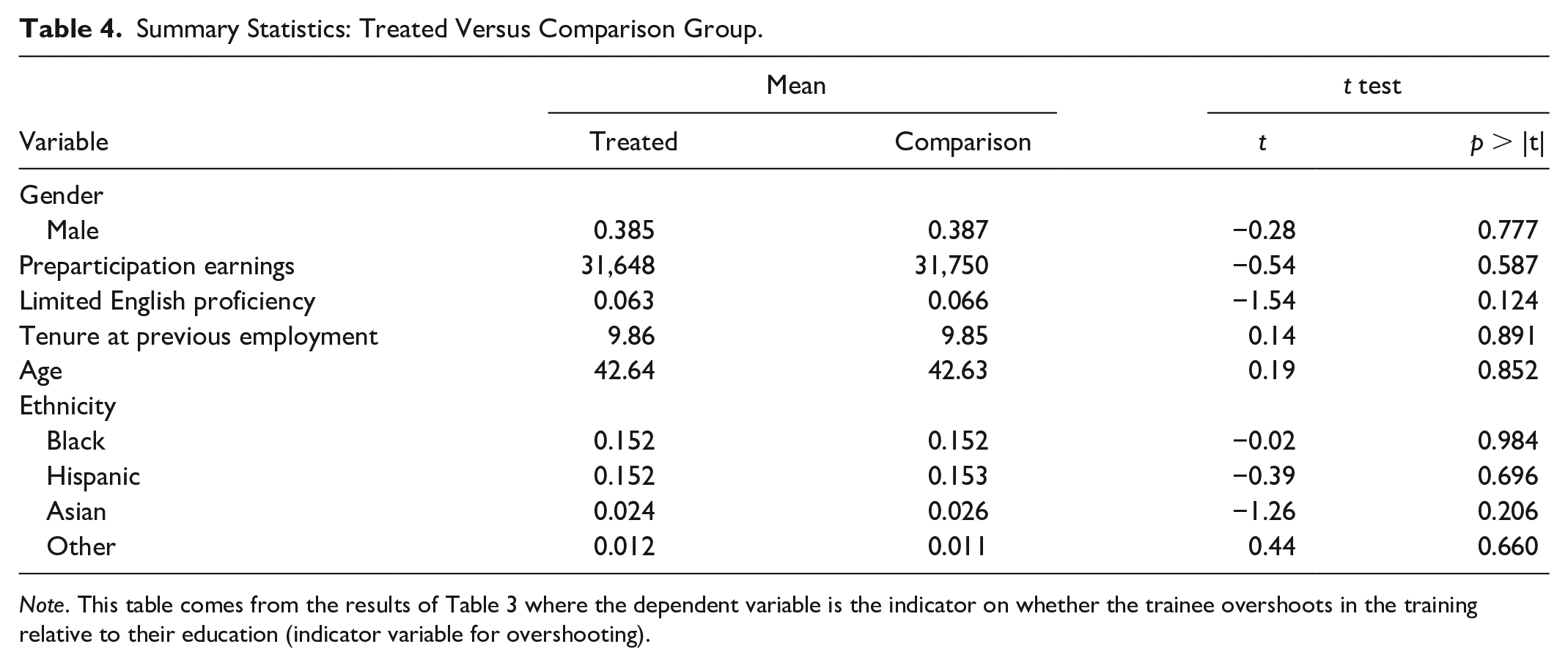
Note. This table comes from the results of Table 3 where the dependent variable is the indicator on whether the trainee overshoots in the training relative to their education (indicator variable for overshooting).
Results
Before a more detailed analysis using the treated and comparison groups constructed based on the propensity score matching as described above, we first perform simple ordinary least square (OLS) estimations using all valid observations available as the following:

Outcomei represents various labor market outcomes such as whether the worker is reemployed, the wage replacement rate, and earnings after exiting the program. It also represents whether the overshooters find a job that is of a higher skill level than their own. This outcome measure takes the value 1 if the average education of job holders of the reemployment occupation is 1 year or more above the trainee’s education level. Skill overshooting is indicated by I_OSi. We use Xi as a vector of control variables including education, limited English proficiency, tenure at previous employment, age, gender, and ethnicity. Additionally, we control for the CZ-level unemployment rate in the year of program exit, using the two-digit SIC industry of the previous employer and exit-year fixed effects.
Table 5 presents the results. Skill overshooting lowers the chance of finding a job by 2.7 percentage points. This suggests that aiming for a higher skilled job through training is a risky strategy, as the trainees would have to compete with more skilled workers. However, if the overshooter is successful, she is 43.0 percentage points more likely to be in a higher skilled job with a higher wage replacement rate (1.7 percentage points) and postexit earnings ($885). That is, skill overshooting is a strategy that comes with a trade-off: higher earnings but a lower chance of reemployment.
Labor Market Outcomes—OLS estimation.
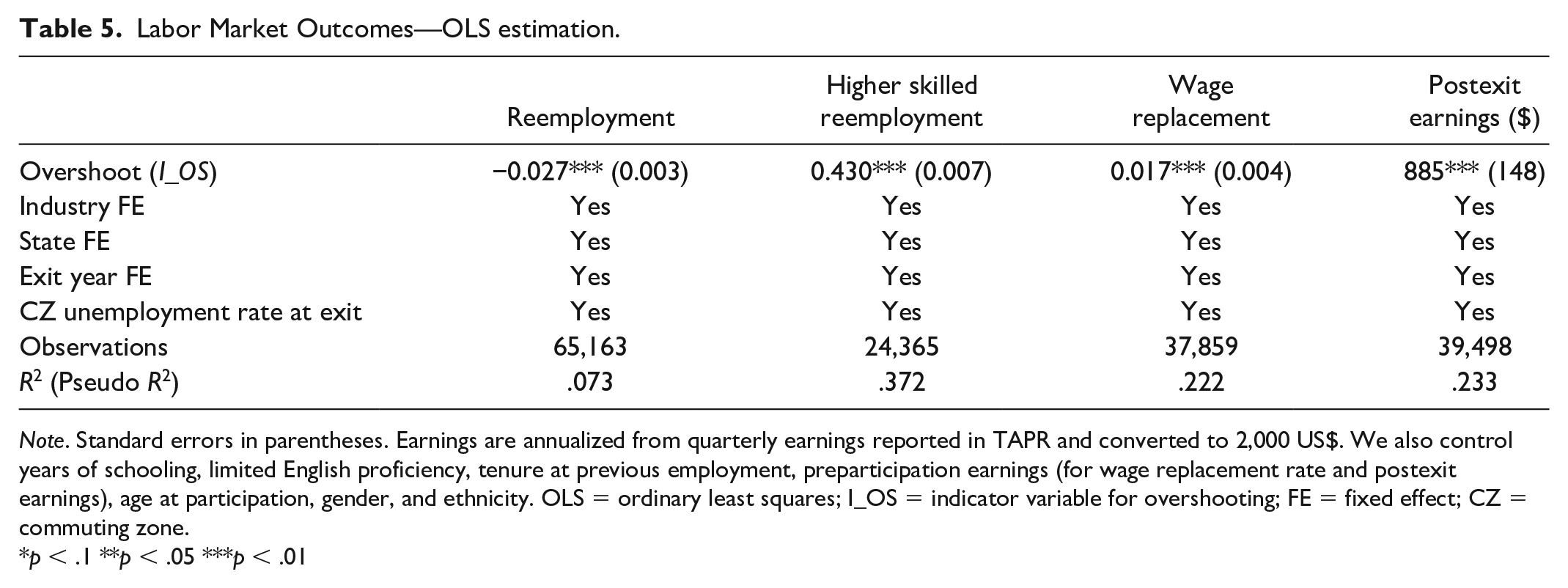
Note. Standard errors in parentheses. Earnings are annualized from quarterly earnings reported in TAPR and converted to 2,000 US$. We also control years of schooling, limited English proficiency, tenure at previous employment, preparticipation earnings (for wage replacement rate and postexit earnings), age at participation, gender, and ethnicity. OLS = ordinary least squares; I_OS = indicator variable for overshooting; FE = fixed effect; CZ = commuting zone.
p < .1 **p < .05 ***p < .01
Baseline Estimation: Skill Overshooting on Labor Market Outcomes
Now we carry out the estimation for three labor market outcome measures using the treated and control groups we constructed based on propensity score matching. We use exit-year fixed effects to control for factors associated with the overall business cycle at the time participants begin job searches. We also control for the unemployment rates of trainees’ CZs in the exit year to capture the local labor market more accurately. We use dummy variables—a dummy for rates below 4%; dummies for 1 percentage point intervals between 4% and 10%; and a dummy for rates above 10%—to allow the influence of unemployment rates to be nonlinear.
Geography is an important factor in determining people’s labor market experiences. Barnette and Park (2017) showed that geography influenced the labor market outcomes of a TAA participant in two ways. First, the local labor market could affect the quality of service delivery at the local AJC as their workload changes. Second, the local labor market could affect the participants’ training decisions. Both influence the participant’s choice of a training program that we explore in this study. More broadly, many studies have shown that the adverse impacts of trade-induced displacements affected all workers in the local area, not just those who were directly affected (Autor et al., 2013; Kondo, 2018; Park et al., 2014). This means that TAA displacements could be linked to a worsening local labor market overall. This could create a systematic downward bias in the outcome measures.
Table 6 shows the results of our baseline analysis with all matched observations in Panel A. We find that the pattern we observed in the OLS estimation of Table 5 remains strong. Overshooting has positive impacts on earnings, but the strategy has risks because it reduces the chance of finding a job after training. The first column shows that overshooting lowers the reemployment rate by 1.9 percentage points, with the mean rate for all observations in this estimation at 85.6%. The positive earnings impacts can be seen in both the wage replacement rate and the level of postexit earnings. When preparticipation earnings are controlled, overshooting is shown to improve the wage replacement rate by 2.0 percentage points and annual earnings by $615.
Outcome Estimation: Baseline and Healthier Economy Samples.

Note. All samples use a matching restriction of the same state of residency and the same education level. The matching is performed within each sample. All estimations include a control for the CZ-level unemployment rate in the exit year and an exit-year fixed effect. Both the wage replacement rate and the postparticipation earnings estimations also include a control on the preparticipation earnings. Earnings are annualized from quarterly earnings reported in TAPR and converted to 2,000 US$. Robust standard errors clustered at the industry level are in parentheses. OLS = ordinary least squares; I_OS = indicator variable for overshooting; FE = fixed effect; CZ = commuting zone.
p < .1 **p < .05 ***p < .01
Comparing the coefficient estimates in Tables 5 and 6 shows the direction of influence that the training selection has on the outcomes. When compared with all trainees, those who overshoot have a lower reemployment rate (−0.027 compared with −0.019), a lower wage replacement rate (0.017 compared with 0.020), and higher postexit earnings ($885 compared with $615). This means that factors such as education (low), gender (female), age (younger), preparticipation earnings (low), and English proficiency (limited) that we found in Table 3 cannot explain the selection bias. These factors are all associated with low levels of earnings, which should lead to a higher wage replacement rate and lower postexit earnings. Perhaps the less obvious factors such as industries of previous employers and states of residency have a larger influence on the decision to overshoot.
Based on the coefficient estimates in Table 6, we calculate the expected value of skill overshooting based on the mean values and the coefficient estimates of the reemployment rate and postexit earnings as a crude way to summarize the trade-off. A trainee who does not overshoot has an 85.6% chance of finding a job with the mean earnings of $25,668. Therefore, the expected value of their post-TAA training is $21,972. The overshooter has an 83.7% chance of reemployment at average earnings of $26,283; the expected value of their TAA training is $21,999. Thus, the value of choosing to overshoot is only $27, a 0.12% advantage. This small advantage in terms of the expected value does not imply that the impacts of overshooting are negligible. Rather, it tells us that its positive impacts on earnings is nearly offset by its negative impacts on the reemployment rate. For this reason, we cannot claim with certainty that overshooting is a winning strategy for all TAA trainees. The trade-off should be considered individually for each participant based on their specific circumstances.
In Panel B, we look at the subsample of TAA trainees who exited the program during the years of a healthier economy (2003 to 2007). 30 This is a useful robustness check to see whether our findings hold across different stages of the business cycle, since a weak labor market has strong consequences on the labor outcomes of those changing jobs (see Kahn, 2010; Oreopoulos et al., 2012). The estimation results show that the trade-off between the earnings gain and the loss in reemployment rates is again well preserved, but the impacts are bigger in magnitude. The positive impact on earnings increases from $615 for our baseline sample to $953 for those in the healthier economy. The expected values of postexit outcomes for overshooters and nonovershooters in a healthy economy increase to $22,655 and $22,422, respectively. Somewhat surprisingly, the negative impact on the reemployment rate also increases—from a 1.9 percentage point decline for the baseline sample, to a 2.2 percentage point decline for the healthier economy sample. So, the value of overshooting is $233, which is a 1.04% advantage over nonovershooting. This implies that overshooting is a more attractive strategy when the economy is in better shape.
Analysis of Subsamples
In this section, we analyze various subsamples based on natural divides suggested in the literature along with previous findings within this article. Specifically, we investigate how gender, age, local labor market characteristics, urban versus rural areas, and education levels play a role in determining the impacts of overshooting. Table 1 shows various statistics of these subsamples and the disparity between different types of participants in terms of preparticipation background, TAA program benefit utilization, and labor market outcomes after exiting the program. Table 1 suggests that these subsamples have fundamentally different labor market experiences and these disparities are worth exploring. For each of these subsamples, we create new matches by employing an additional matching restriction for trainees to be matched within each subsample. Table 7 presents the results for all subsamples.
Outcome Estimation: Subsamples.
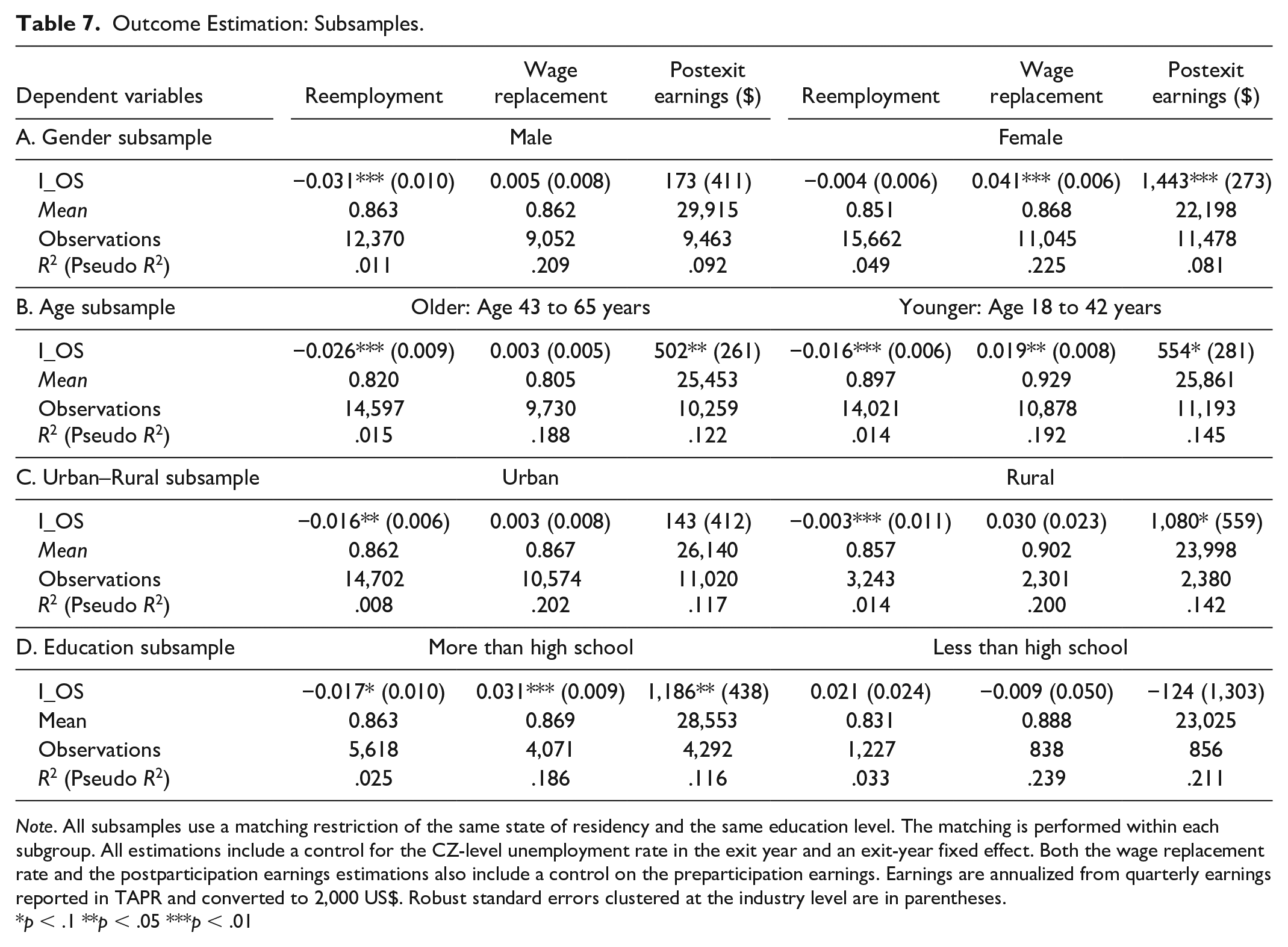
Note. All subsamples use a matching restriction of the same state of residency and the same education level. The matching is performed within each subgroup. All estimations include a control for the CZ-level unemployment rate in the exit year and an exit-year fixed effect. Both the wage replacement rate and the postparticipation earnings estimations also include a control on the preparticipation earnings. Earnings are annualized from quarterly earnings reported in TAPR and converted to 2,000 US$. Robust standard errors clustered at the industry level are in parentheses.
p < .1 **p < .05 ***p < .01
Gender Subsamples: Male Versus Female
Panel A shows the outcome estimation for male and female trainees. Gender subsamples display the most drastic differences among the subsamples we investigate. We see in Table 1 that male trainees receive drastically higher earnings both before and after participation despite their education level being similar to their female counterparts, on average. Table 1 also demonstrates that female trainees take both job and remedial training at much higher rates. Based on the mean values of the reemployment rate and postexit earnings, we still observe that male trainees enjoy more favorable labor market experiences. However, skill overshooting greatly improves the outcomes of female trainees. It increases their postexit earnings by $1,143, which is 5.3% of their mean earnings ($22,198), without any significant impact on their chance of reemployment. The opposite is the case for male trainees. Overshooting hurts male trainees by lowering their reemployment rate by 3.1 percentage points without any significant gain in postexit earnings. This translates to a 5.99% gain in the expected value of postexit outcomes for female overshooters and a 3.03% loss for male overshooters. 31
Age Subsamples: Age Group 43 to 65 Years Versus Age Group 18 to 42 Years
We split the sample into two age groups: 43 to 65 and 18 to 42 years of age. We look at the difference in experience across age to account for two factors. First, older and younger participants make very different choices during TAA program participation, especially regarding training. Table 1 shows that while 76.54% of younger participants received job training, only 63.09% of older participants did. Second, job loss has larger negative consequences for older workers. Table 1 shows that younger participants had a much easier time finding a job after exiting the program and a substantially higher wage replacement rate. These statistics corroborate the general findings in the involuntary displacement literature that, compared with younger workers, older workers experience a larger decrease in their earnings relative to their peers after displacement. 32
Panel B of Table 7 shows the results for our two age groups. Overshooting results in bigger gains and smaller costs for younger trainees. The impacts on annual earnings are nearly identical for younger ($554) and older trainees ($502), but, on average, younger trainees enjoy a higher wage replacement rate because their preparticipation earnings are lower (Table 1). On average, younger trainees that overshoot have a higher rate of reemployment (89.7% compared with 82.0% for older trainees) with less of a negative impact on their reemployment rate (1.6 percentage points compared with 2.6 percentage points), reflecting the fact that finding a job is generally harder for older workers. We conclude that, while overshooting creates a small gain (0.32%) in the expected value of postexit outcomes for younger trainees and a small loss (1.26%) for older trainees, the magnitude of these impacts is smaller than that of other subsamples. 33
Geographic Subsamples: Urban Versus Rural
We also look at the differences across geography because displaced workers in rural areas are more likely to have fewer job opportunities than urban workers. Evidence continues to mount that rural areas experience mass job losses more frequently than urban areas (Diamond, 2016). This could lead to worse labor market outcomes for TAA participants in the rural areas. It is also possible that different training choices have different impacts on these workers.
Panel C of Table 7 presents the results. We find that the labor market works in favor of urban dwellers in terms of both the chance of reemployment and earnings, on average, but that overshooting reverses this trend a bit. Overshooting increases the earnings of rural trainees by $1,080, making up half of the earnings differential between urban and rural trainees, on average ($26,140 and $23,998, respectively). This large positive impact on earnings comes without a noticeable decline in the reemployment rate. On the other hand, the impacts of overshooting are generally negative for trainees in the urban areas. It lowers their chance of reemployment by 1.6 percentage points without any significant gain in earnings. In terms of postexit outcomes, overshooting creates a 4.13% gain in expected value for trainees in rural areas and a 1.32% loss for those in urban areas. 34 The findings on this subsample, along with the gender subsample, suggest that overshooting is especially effective in improving the labor market outcomes of particularly disadvantaged groups of workers.
Education Subsamples: Less Than High School Versus More Than High School
Next, we analyze how the impacts of skill overshooting differ across education levels by splitting the sample into trainees with less than a high school education (less than 12 years of schooling) and more than a high school education (more than 12 years). We exclude trainees with exactly 12 years of schooling for this analysis.
How skill overshooting would influence the labor market outcomes of these two groups is not intuitively obvious. One could predict that it would be more beneficial to less-educated trainees because they may lack general skills and other marketable skills, so improving their skill level would be especially valuable for reemployment. On the other hand, one may predict that overshooting could be more beneficial to highly educated trainees as they may have the general ability to apply the newly acquired skills more efficiently.
Panel D of Table 7 presents the results. We find that skill overshooting is highly beneficial for the earnings potential of trainees with higher education. It raises their postexit earnings by $1,186. Unlike the female and rural subsamples, however, overshooting poses a negative impact on their reemployment rate (−1.7 percentage points). We do not find any noticeable impacts on trainees with less education, but this could be due to the small sample size of this group. Both groups show gains in the expected values of postexit earnings. Overshooters with more than a high school education gain 2.10% and those with less than a high school education gain 1.97%. 35
Conclusion
In this article, we use data from the TAA program to study how participants strategically choose to improve their earnings potential by aiming at occupations of higher skill levels (skill overshooting) compared with their own. We investigate how skill overshooting affects their reemployment rate, wage replacement rate, and earnings after they exit the program.
Among the workers entering the TAA program between 1998 and 2007, only 77% of all participants find a job during the three quarters immediately following their exit from the program. On average, the reemployed participants recover only 87% of their previous earnings. Participants who opted to take job training through the TAA show a slightly higher rate of reemployment (80%), but their earnings are nearly identical to those who do not. The trainees who overshoot in their training choices, however, do experience higher earnings after exiting the program. But the gain comes at the cost of reduced chances for reemployment. We find that skill overshooting increases the wage replacement rate by 2.0 percentage points and the annual earnings by $615, but it lowers the reemployment rate by 1.9 percentage points. The pattern of earnings gain with a decline in the chance of reemployment is amplified when we look at the participants who exited the program during a healthier economy (2003 to 2007).
Our analyses of four subsamples of trainees—female/male, older/younger, urban/rural, and those with more/less than a high school education—show that skill overshooting works differently for different groups of trainees and such trade-offs disappear for certain groups of workers. We find that skill overshooting is especially beneficial for female trainees and trainees in rural areas. Female participants show much lower average earnings prior to participation compared with their male counterparts, but skill overshooting offers them a large improvement in their earnings ($1,443) with no discernible impact on their reemployment rate. In contrast, men who overshoot find that the strategy leads to a negative impact on their reemployment rate (3.1 percentage points) without much gain in earnings ($173).
When we compare trainees in rural and urban areas, we find that participants in a rural area show drastically lower earnings prior to participation, but that overshooting raises both their wage replacement rate (3.0 percentage points) and earnings ($1,080) without hurting their chance of reemployment. The opposite is true for trainees in urban areas. Overshooting hurts their chance of reemployment without any gain in earnings. The large gains that skill overshooting brings to female and rural trainees suggest that it is especially beneficial to workers who are traditionally disadvantaged.
Most other sample groups display the same pattern: skill overshooting improves earnings measures while hurting reemployment rates. The pattern holds for trainees with more than a high school education, but the earnings gain is much larger at $1,186. Age subsamples are very similar to the baseline results except that older overshooters suffer from a larger decline in their reemployment rates.
Our findings provide an avenue to improve the outcomes of the TAA program. With a higher emphasis on the training provision compared with the other federal ALMPs, improving the performance of the TAA program likely lies within these training services. By exploring the strategy of skill overshooting in training occupation choices and its impacts on labor market outcomes of those who partake in it, we provide a better understanding of the benefits and consequences of training program choices. Our findings on subsamples suggest that applying different strategies to participants with different backgrounds could lead to better program outcomes.
Supplemental Material
sj-pdf-1-edq-10.1177_0891242420984843 – Supplemental material for Skill Overshooting in Job Training With the Trade Adjustment Assistance Program
Supplemental material, sj-pdf-1-edq-10.1177_0891242420984843 for Skill Overshooting in Job Training With the Trade Adjustment Assistance Program by Justin Barnette and Jooyoun Park in Economic Development Quarterly
Footnotes
Declaration of Conflicting Interests
The author(s) declared no potential conflicts of interest with respect to the research, authorship, and/or publication of this article.
Funding
The author(s) received no financial support for the research, authorship, and/or publication of this article.

Supplemental Material
Supplemental material for this article is available online.
Notes
Author Biographies
References
Supplementary Material
Please find the following supplemental material available below.
For Open Access articles published under a Creative Commons License, all supplemental material carries the same license as the article it is associated with.
For non-Open Access articles published, all supplemental material carries a non-exclusive license, and permission requests for re-use of supplemental material or any part of supplemental material shall be sent directly to the copyright owner as specified in the copyright notice associated with the article.
