



Abstract
The authors discuss economic development policy facing the burgeoning entrepreneurial ecosystem research. They aim to answer four questions. First, how are entrepreneurial ecosystems different from regional innovation systems and clusters, two related frameworks that had been vastly popular among economic development policy makers prior to the rise of entrepreneurial ecosystems? Second, what are the key findings in the entrepreneurial ecosystem research that can guide economic development policy making? Third, how should economic development policy be adjusted under the entrepreneurial ecosystem approach? Finally, what does the ongoing debate on the geographical boundaries of entrepreneurial ecosystems mean for economic development policy?
Keywords
Entrepreneurial ecosystems (EEs) have gained tremendous scholarly attention in the past decade. EEs address the actors and regional environmental factors that interactively facilitate innovative or productive entrepreneurship, ultimately contributing to regional economic development (Acs et al., 2018; Qian, 2018; Stam, 2015). There are many comprehensive reviews of the rapidly growing EE research, including some published in leading entrepreneurship or economic development journals (Alvedalen & Boschma, 2017; Brown & Mason, 2017; Cao & Shi, 2021; Cavallo et al., 2019; Malecki, 2018; Qian, 2018; Spigel et al., 2020; Wurth et al., 2022). Meanwhile, policy makers all over the world have embraced the EE concept in their policy documents (Brown & Mawson, 2019).
This commentary focuses on the relationship between EEs and economic development policy. More specifically, we aim to answer four EE questions that should interest the readers of Economic Development Quarterly. First, how are EEs different from regional innovation systems (RISs) and clusters, two related frameworks that had been vastly popular among economic development policy makers and practitioners prior to the rise of EEs? Second, what are the key findings in the entrepreneurial ecosystem research that can guide economic development policy making? Third, how should economic development policy be adjusted for the EE approach? Finally, what does the ongoing debate on EEs’ geographical boundaries mean for economic development policy making?
From RISs and Clusters to EEs
EE is not a brand-new idea. In the context of regional economic development, it has its origins in RISs and clusters (Acs et al., 2014, 2017; Feld, 2012; Qian et al., 2013). In this section, we clarify the relationships between RISs, clusters, and EEs. In Table 1, we compare RISs, clusters, and EEs using multiple criteria.
Regional Innovation Systems Versus Clusters Versus Entrepreneurial Ecosystems.
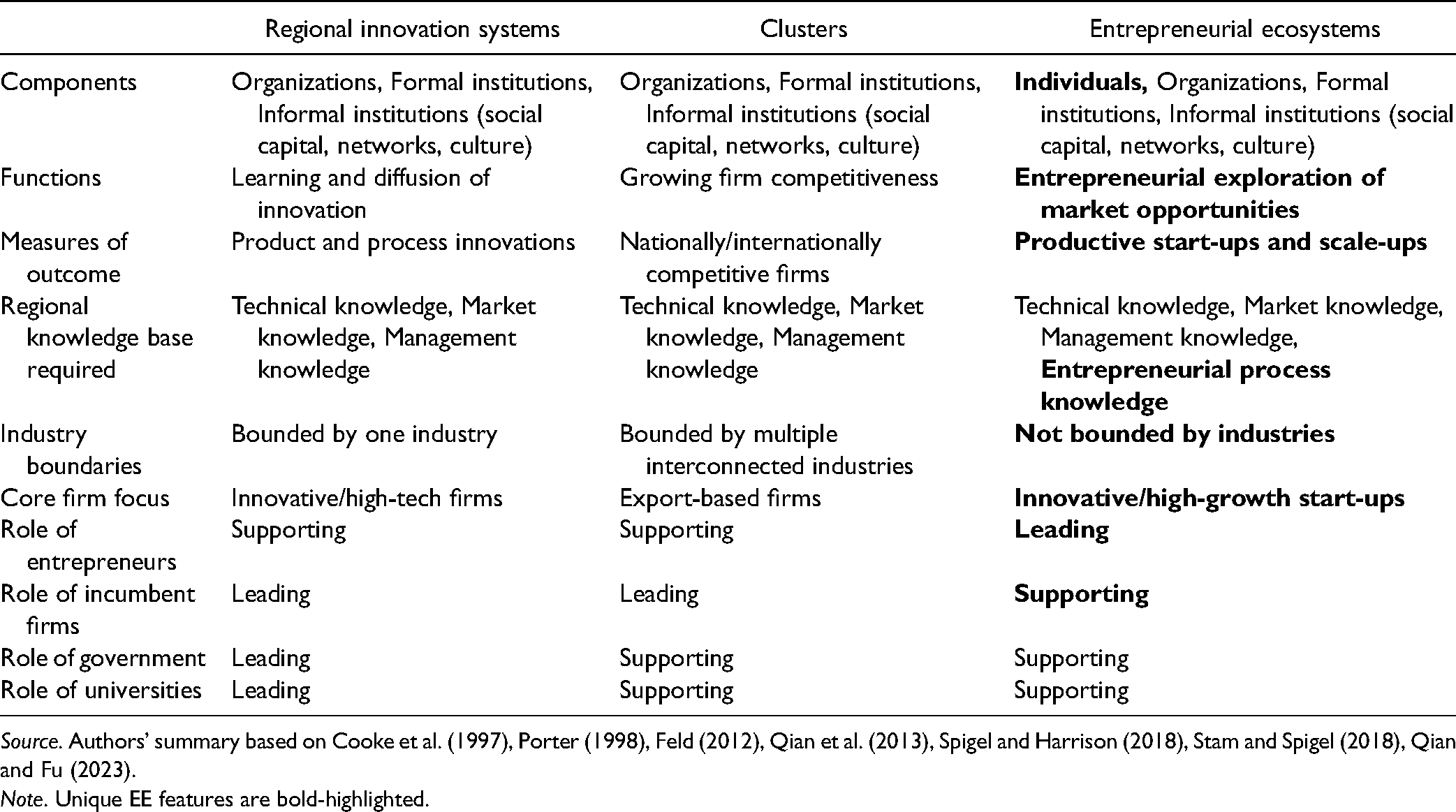
Source. Authors’ summary based on Cooke et al. (1997), Porter (1998), Feld (2012), Qian et al. (2013), Spigel and Harrison (2018), Stam and Spigel (2018), Qian and Fu (2023).
Note. Unique EE features are bold-highlighted.
The RIS approach focuses on regionally bounded resources and formal and informal institutions that underpin firm innovation. It highlights the nonlinear, interactive, and systemic nature of the learning and firm innovation processes (Asheim et al., 2011; Cooke et al., 1997). Based on the so-called triple-helix model, firms, governments, and universities are often considered core players in an innovation system where firms commercialize (typically) government-funded university research (Leydesdorff & Meyer, 2006). An RIS typically has an industry boundary and is often discussed in a particular sectoral context (e.g., biotechnology; Cooke, 2002). Depending on the knowledge base of a region, the organization of RISs (i.e., the key players and their interactions) can be very different (Asheim & Coenen, 2005). Regardless, public research and development (R&D) investment, support for universities, and fostering a culture of collaboration are common policy recommendations under the RIS framework.
Clusters are “geographic concentrations of interconnected companies and institutions in a particular field” (Porter, 1998, p.78). To a large extent, the clusters approach covers the same actors as the RIS approach, which includes firms, universities, and governments, but universities and governments only play supporting roles in clusters. Productive, export-based firms in a particular field are the core actors in a competitive cluster, which are also supported by other firms or industries through for instance, buy-sell relationships, shared specialized labor, and knowledge spillovers. A cluster involves multiple industries that are economically interconnected. The popularity of clusters among economic development practitioners arises in part from some clear measures of clusters that make it possible to identify the scale of clusters at different geographic levels (Delgado et al., 2016). Regional economic development policy toward clusters, according to Porter (2007), includes building connections among cluster participants and investing in infrastructure like universities and community colleges. Interestingly, even though clusters are identified through industries, Porter argues for an industry-neutral approach to cluster policy. Also interestingly, these cluster-based policy efforts are not much different from those suggested by RIS scholars. The lack of new policy implications is considered a major weakness from the cluster theory (Motoyama, 2008).
How are EEs different from RISs and clusters? The most important difference for the EE approach lies in the shift from a focus on firms to a focus on people, including entrepreneurs, investors, connectors, dealmakers, and other entrepreneurial supporters (Acs et al., 2014; Motoyama, 2019; Qian et al., 2013; Stam & Spigel, 2018), even though the outcome of the EE is typically measured by productive start-up or scale-up businesses (Brown & Mawson, 2019; Stam & Spigel, 2018). Among all these actors, entrepreneurs should play a leading role in EEs, either through their own entrepreneurial process or through engagement with the local start-up community (Feld, 2012). “Blockbuster” entrepreneurs help sustain a strong EE when they invest their capital gains in local start-ups, mentor new entrepreneurs, and build a collaborative and giving culture (Feld, 2012; Mason & Brown, 2014). Interpersonal networks developed through entrepreneurial events, entrepreneurial support organizations, or even serendipitous meetings are of particular importance to the vibrancy of EEs. Another notable distinction of EEs is that they are not subject to industry boundaries, as knowledge on how to create and grow a company (i.e., entrepreneurial process knowledge) circulated in one sector benefits local entrepreneurs from all sectors (Spigel & Harrison, 2018).
As shown in Table 1, even with some notable differences, EEs share some features with clusters and RISs, such as the importance of organizations, institutions, networks, a culture of change/risk taking, and the needs for technical, managerial, and market knowledge. However, these similarities do not make EEs substitutes for RISs and clusters. The EE approach should not be considered as a replacement of its two precedents, because their outcome measures are different (see Table 1). The outcome of RISs is measured by product and process innovations; the outcome of clusters is measured by competitive firms and industries; and the outcome of EEs is measured by productive start-up and scale-up businesses. EEs should be considered complementary to RISs and clusters (Audretsch et al., 2021). Ideally, a region has a strong innovation system, a competitive cluster, and a vibrant EE at the same time (such as Silicon Valley), but most regions do not.
EE Research Findings with Policy Implications
EEs are complex systems involving large numbers of actors, factors, and relationships. The EE research accordingly has been broad in scope. In this section, we discuss three EE research streams with findings that directly inform economic development policy makers: EE elements, the evolution of EEs, and the equity aspects of EEs.
EE Elements
The first and most important stream of EE research is on identifying EE elements—the regional factors that signify the strengths or weaknesses of an EE. Some of these factors are directly tied to the role of government, while others may be impacted by economic development policy. There are many efforts in this stream, which have proposed a large variety of elements needed for vibrant EEs. Isenberg (2011) discussed the importance of these six EE pillars: finance, culture, support, human capital, markets, and government policy. For government policy, he covered initiatives such as R&D investment, public venture funding, tax incentives, support for universities, and business friendly legislation. Feld (2012) emphasized nine interconnected actors and factors behind successful EEs like Boulder, Colorado's: entrepreneurial leaders, intermediaries, networks, government, talent, professional services, engagement events, large firms, and capital. Instead of recommending specific government initiatives toward EEs, Feld encouraged economic development policy makers to ask entrepreneurs directly what they need and then meet these needs with available public resources. More recently, Stam and van de Ven (2021) conceptualized EEs through two sets of elements: resource endowments (including physical infrastructure, demand, intermediaries, talent, knowledge, leadership, and finance) and institutional arrangements (including formal institutions, culture, and networks). Under this framework, governments may play active roles in setting formal institutions and building physical infrastructure, and contribute to other elements by attracting talent, investing in knowledge-generating organizations such as universities, providing early-stage start-up funding, and funding entrepreneurial support organizations and events. In the case of technology-based EEs, Qian (2018) highlighted six factors: technological knowledge bases, absorption capacity, competition, networks, diversity, and culture. More specifically on economic development practice, he highlighted that local government leaders can “serve as conveners among technology communities, sponsors of local entrepreneurial events (such as small meet-up events and mega entrepreneurial celebration events), or ad hoc connectors of various stakeholders” (p.173). He also emphasized public efforts to help grow and retain talent.
The diversity and broad scope of EE factors/elements covered in the literature make it very difficult for economic development practitioners to decide what to follow. Adding one more layer of complexity, recent research has demonstrated that different combinations of EE elements may achieve the same desirable outcomes: high levels of growth-oriented start-up or scale-up businesses (Muñoz et al., 2020; Vedula & Fitza, 2019). One clear takeaway for economic development policy makers is that a region does not have to be strong in all elements. Indeed, Brown and Mawson (2019) argued that there are no one-size-fits-all EE policies and that policy makers must consider their local conditions and customize practices prevalent in star EEs (e.g., Silicon Valley and New York) to the local context. Overall, public efforts can target resources that growth-oriented entrepreneurs need and/or networks that facilitate the flow or combination of these resources for start-up business success (Spigel & Harrison, 2018).
Evolution of EEs
The second stream of EE research with important policy implications on economic development is the differentiation of EEs based on their evolution/development stages (Brown & Mason, 2017; Brown & Mawson, 2019; Cho et al., 2022; Spigel & Harrison, 2018). Because EEs are not subject to industry boundaries (Spigel & Harrison), their evolution path may not follow the industry life cycle as RISs and clusters do. Most importantly, unlike some industries, an EE may not decline after it reaches a mature stage if the recycling of entrepreneurial resources occurs organically in the community thanks to strong networks and trust (Spigel & Harrison).
The typology of Brown and Mason (2017) separates embryonic ecosystems, where there are limited numbers of growth-oriented start-ups and economic development is driven by incumbent firms, from scale-up ecosystems, where there are high densities of productive start-ups and high-growth firms. In a (mature) scale-up ecosystem, the role of public policy is very limited. It is in the embryonic stage of the ecosystem development that economic development policy makers are likely to make a major difference by injecting resources, such as funding for entrepreneurs and entrepreneurial support organizations (Colombelli et al., 2019). Brown and Mawson (2019) introduced more categories by differentiating emergent ecosystems, developing ecosystems, and advanced ecosystems, which are similar to nascent ecosystems, strengthening ecosystems, and resilient ecosystems discussed in Spigel and Harrison (2018). In the developing or strengthening stage, public efforts may start to shift from providing resources to start-ups to supporting scale-up or high-growth companies. In the advanced or resilient stage, EEs are self-sustaining and economic development policy is barely needed.
Equity in EEs
People (instead of firms) are the central focus of EEs. As a result, the equity dimension has been an important topic in EE research. This represents a significant new direction compared to the firm centered RIS or cluster research that pays limited attention to individuals. Disparities in accessing entrepreneurial resources or networks have been well documented along the gender line (Brush et al., 2019; Motoyama et al., 2021) and by race/ethnicity (Neumeyer et al., 2019a, 2019b). Diversity of actors and equal access to resources reflect the strength of EEs (Feld, 2012). In reality, however, women entrepreneurs secure less capital from EEs (Brush et al., 2019) and are more isolated from the ecosystem network (Motoyama et al., 2021). Based on the case study of EEs in Chicago and Orlando, Neumeyer et al. (2019b) found that high-growth entrepreneurs are predominantly White males, who are closely connected to local entrepreneurial support programs in technology commercialization and business acceleration.
While ecosystem leaders may be in the best position to address the inclusiveness of EEs, economic development policy makers can direct some resources aimed for entrepreneurial support to underserved population groups. They can also support entrepreneurial events that celebrate entrepreneurship among under-represented groups or provide funding to entrepreneurial support organizations with an equity mission. To sustain adequate access to resources for minority entrepreneurs, government incentives should be aimed to turn marginalized groups into equal and active participants in the local EE.
Steering Economic Development Policy Toward EEs?
The Resilience of “Third-Wave” Economic Development Strategies
So, what do all these mean for economic development policy makers? A short answer is that support for EEs will not require major shifts from the “third-wave” economic development strategies (Bradshaw & Blakely, 1999) or, more broadly, the capacity-building approach to economic development (Feldman et al., 2016) that has been around economic development practice for three decades. The third-wave economic development policy focuses on place-based capacity building that involves strategic planning and management, creating partnerships and networks, cluster development, and physical and soft infrastructure building (Bradshaw & Blakely, 1999; Elisinger, 1995). This is consistent with RIS policy and cluster policy, as it emphasizes R&D investment, human capital, infrastructure, collaborations, and networks.
There are several reasons why RIS or cluster-based economic development policy is almost sufficient for EEs. First, there are large overlaps between EE elements and RIS/cluster elements. Factors such as institutions, human capital, knowledge, infrastructure, and most importantly, collaborations and networks, are highlighted in all three approaches. Improving any of these factors will most likely strengthen the RIS, cluster, and EE at the same time. Second, EEs are complements but not substitutes for RISs or clusters. It does not necessarily benefit the regional economy when resources are redistributed (e.g., from cluster initiatives to EE initiatives). Third, there are no one-size-fits-all EE policies. As Brown and Mawson (2019) reported, even though the EE concept is widely used in government policy documents, there is no consensus over what EE really means and, not surprisingly, policy actions vary by country and geographic contexts. If it is not clear what to do, “do no harm” should be the policy. Last, but not least, EEs should be led by entrepreneurs—not policy makers (Feld, 2012).
New Economic Development Policy Arising from EE Research: Sum of Small Things
Assuming a region has already adopted the capacity-building/third-wave approach to economic development, the new economic development policy implications from the burgeoning EE research can be summarized as the sum of small things, to borrow the book title from Elizabeth Currid-Halkett (2017). We list some of these policy efforts below.
Promote and celebrate entrepreneurship. Economic development policy traditionally aims to attract large incumbent firms because of their immediate job creation and tax base effects. Different from the RIS or cluster approach, EE research has put entrepreneurs and entrepreneurship at the center of economic development. It is therefore important for policy makers to celebrate entrepreneurship and promote entrepreneurial ecosystems. While Brown and Mawson (2019) were critical of the “messy” use of the EE concept in government policy documents, we view this rather positively as government efforts to promote entrepreneurship. Telling the stories of minority entrepreneurs is particularly useful, as the demonstration effect may encourage more under-represented population groups to become entrepreneurs and active participants in the local ecosystem. Participate in ecosystem events and listen to entrepreneurs. It is important for policy makers to participate in ecosystem events and listen to entrepreneurs to grasp the real needs in start-up communities, which vary by ecosystem. For instance, the lack of affordable space for start-up businesses may be a greater concern for entrepreneurs in a tight real estate market. Or some local regulations may not be friendly to start-up businesses. Or there is a lack of start-up funding. It is particularly important to listen to minority entrepreneurs who may face greater barriers to access of ecosystem networks and resources. Policy makers can only contribute in a meaningful way when they truly understand the needs of entrepreneurs or the ecosystem in general. Support ecosystem events and entrepreneurial support organizations. When the local ecosystem is in the embryonic or emergent phase, without strong entrepreneur leaders there may not be enough self-organized entrepreneurial events and adequately funded support organizations (e.g., incubators and accelerators). Government support can help develop these activities and organizations that are critical to the growth of EEs. It may be in the form of providing financial support, offering space with low rental costs, and building connections with other stronger ecosystems. Convene and connect EE participants. Dense networks and connections represent a core feature of strong EEs, which are missing in embryonic or emergent EEs. In a void of entrepreneurial leaders, public service leaders are reasonably positioned to serve as conveners or connectors and jumpstart the community building process. Such roles are expected to diminish once other community leaders (most importantly, entrepreneur leaders) emerge.
These efforts are small things because they do not require large-scale investments or major policy shifts when regional policy makers have already practiced RIS or cluster-based strategies. They are incremental changes and require policy makers’ patience. After all, ecosystem building is a long-term process (Feld, 2012). The sum of small things that helps create a strong EE will greatly benefit long-term regional economic development.
EE Boundaries and Economic Development Policy Making
The ongoing debate on the geographic boundaries of EEs has important implications on what level(s) of government should act in the process of growing EEs or at what geographic scope EE policy initiatives should be directed. There is no consensus on the EE boundaries in the current literature (Wurth et al., 2022). While most scholars accept a regional approach, the notion of national entrepreneurial ecosystems (Acs et al., 2014, 2018) has gained lots of attention as well. Moreover, the geographically boundless digital entrepreneurial ecosystem (Song, 2019; Sussan & Acs, 2017) has also become a popular perspective. Meanwhile, there has not been much attention to the state level, though it is not negligible due to the tremendous power of states under the U.S. federalist system. In fact, the most influential discussions on the third-wave economic development strategies often focus on state policies (e.g., Bradshaw & Blakely, 1999; Elisinger, 1995). State-level regulations, such as enforcing non-compete agreements, may also have significant impacts on entrepreneurship (Qian, 2018).
The social network among EE participants is perhaps the most important defining feature of EEs and EE boundaries should mirror these network boundaries. Unfortunately, there is not much solid empirical analysis on the social network boundaries of EEs. Nevertheless, one can reasonably expect that entrepreneurial networks, often facilitated by face-to-face interaction, are regionally bounded. For instance, most entrepreneurial support organizations serve their entire economic region. Entrepreneurial meetups or other events also have a regional scope of participants. Accordingly, we argue that EE policy making, especially during the embryonic stage of EE development, is primarily at the regional level, as are RIS policy and cluster policy. Regions in this commentary refer to economically functional regions, such as metropolitan/micropolitan areas or commuting zones in the United States. A major challenge in regional-level policy making arises from the “spatial mismatch” between the economic region (e.g., the metro area) and the administrative/policy regions (e.g., the cities and counties within the metro area), which encourages interjurisdictional competition (Qian, 2020). Effective economic development policy in favor of EEs will require coordination and collaboration.
Economic development policy makers at the local/regional level need to consider the national and digital dimension of entrepreneurship (Acs et al., 2014; Sussan & Acs, 2017), especially when their EE starts to evolve into the scale-up or strengthening stage (Brown & Mason, 2017; Spigel & Harrison, 2018). Digitalization diminishes the importance of territorially bounded entrepreneurial resources (Song, 2019), such as funding and mentorship, thus expanding the geographic scope and EE boundaries of entrepreneurial networks. Also, when an EE becomes more developed, their growth or scale-up often requires highly specialized support from other more advanced ecosystems, such as large-scale venture capital investments and IPO support services. Evidence exists that these advanced entrepreneurial services are increasingly more concentrated in a few star EEs (e.g., Silicon Valley and New York), at least in the case of the IT sector (Li et al., 2022). Therefore, as the EE grows, it should strive to make connections with more advanced ecosystems. While entrepreneur leaders in the region may be more effective in building these extraregional relationships, policy makers may also contribute by expanding the geographical reach of small thing policy initiatives.
Footnotes
Declaration of Conflicting Interests
The author(s) declared no potential conflicts of interest with respect to the research, authorship, and/or publication of this article.
Funding
The author(s) received no financial support for the research, authorship, and/or publication of this article.
