



Abstract
The COVID-19 pandemic brought about an unimagined level of federal investment in regional economic development and much greater political attention to its priorities. Economic development researchers have an opportunity to contribute to an array of federally funded and pandemic-inspired regional experiments, many of which reflect shifting concerns about economic development and what constitutes success. Among these include the importance of addressing historical racial, ethnic, and gender inequalities; the value of research and development as a solution to major human problems; the severity of impending workforce shortages in key sectors; the fragility of many highly efficient global supply chains; and the inadequacy of our underinvested economic data infrastructure to help understand these issues. Researchers have a unique opportunity to examine the regional impacts of national issues by improving public investment logic models, advocating for an improved data infrastructure, and providing evidence to address the long-standing tension between growth and equity as competing economic development priorities.
Keywords
Critical economic development issues are now highly visible in the popular media and central to public policy making. The COVID-19 pandemic helped the public media and politicians gain a fuller appreciation for many of the more complex issues occupying economic development leaders: for example, the health of our domestic supply chains, the productivity of the workforce, and the inclusion of more regions, firms, learners, and job seekers as beneficiaries of overall economic prosperity. These issues are central in the federal pandemic response (e.g., the CARES Act of 2020, the American Rescue Plan Act of 2021, the Infrastructure Investment and Jobs Act of 2022, the CHIPS and Science Act of 2022, and the Inflation Reduction Act of 2022).
These issues are not new to economic development researchers and practitioners, but neither do we have a robust framework for guiding investments, evaluating progress, and recognizing what works best for different geographies and constituencies, especially at the multicounty regional level. Programmatic and administrative siloes as well as disparate ideologies lead to divergent definitions of basic terms and keep us from sharing knowledge, findings, and lessons learned. Divisions across state, urban, and rural policy making, as well as a lack of knowledge about fundamental economic elements (such as the skills required to perform emerging new jobs, the demographic makeup of the workforce in critical economic sectors, the prevalence of new business models, or the nature of supplier–purchaser relationships), keep us from quickly translating evidence and insights into more impactful projects and evaluation. This leaves policy makers and program administrators struggling to gain the consensus and focus needed to advance their goals.
In an environment that has become more complex, more global, and more exposed to technological change, economic development scholars have an opportunity to distinguish themselves as authorities on issues that policy makers and the popular press now recognize as urgent (e.g., the impact of technology on business operations and work, the gaps in the industrial and supply chain infrastructure, and shortage of talent). These economic challenges have an outsized impact, not only on America's role as an economic leader, but also on the increased equity and participation required to ensure broader political satisfaction with our economic priorities.
Economic developers understand that the decision of a business regarding where to locate and where to invest or grow is multifaceted and that the community response to the business decision-making process can be equally if not more intricate (Lowe, 2014; Lowe & Freyer, 2015). In adaptive and resilient regions, these are community concerns as well. Understanding and anticipating company decisions and community responses will also keep economic developers at the forefront of efforts to combine resources to address business concerns about research and innovation, connecting smaller local companies to networks offering new business opportunities, and launching talent recruitment and diversity initiatives that effectively address gender, racial, and spatial inequities. The decisions and responses influence what is possible for growth as well as the prevalence (or lack) of equity and broad participation in the economy.
With debates regarding equity and participation central to policy making at this moment, concerns focus on the distribution of both economic power and prosperity as well as on the potential impact resulting from either an impending recession or structural economic change. This is a critical time for scholars to engage with practitioners on fundamental questions about how we invest limited time and resources to support economic development and growth. This is especially important work during the once-in-a-generation federal and state investment underway in industrial and regional development priorities because of our national pandemic response.
Background: Global Competitiveness in a Regional Context
To understand where the economic development practice is and where it might go, it is important to appreciate how the current policies came about. The deindustrialization of America during the past four decades triggered a significant focus for state and regional policy makers on restoring the comparative advantages of their respective traded sectors in their respective geographies. This is the legacy for many of today's economic development policies in which fast-growing regions attracted jobs and wealth from other regions. The focus was on regional growth—often to the detriment of growth elsewhere. This was the basis for arguments about America's “race to the bottom,” first the movement of activities from one part of the country to another part and later the movement to developing countries (Mast, 2018).
The states and regions that were losing the race tended to seek out new growth opportunities, focusing primarily on technology as one strategy and the development of emerging new traded clusters (such as education and medicine) as another to stem losses occurring in other parts of the economy. For many of those gaining from the 1980s to the early 2000s, economic development strategies focused most visibly on luring large anchor investments by keeping costs low—especially taxes, utilities, and wages—while offering larger incentives to offset relocation expenses. These regional policies were driven in large part by a national laissez-faire attitude toward economic globalization and corporate cost-cutting as a national economic growth strategy. Furthermore, these regional responses have long prevailed, despite many economic disruptions and evidence that otherwise suggested their ineffectiveness (Hines et al., 2001).
Personal computers and the Internet further transformed the national economic landscape at the turn of the millennium, as did the “China shock,” as companies in all U.S. regions (not just the traditional Rust Belt) faced new competition from the developing countries of Asia (Autor et al., 2016). Rather than fight these trends, most larger U.S. companies embraced them, developing global supply chains fully dependent on Asia's low-cost labor, leveraging instantaneous digital communications technologies linked to distant factories, and tapping cheap fossil fuels to support a far-flung production network. In this context, economic development policy continued to focus on achieving strong measures of job creation and sustained moderate economic growth, while income inequality and the number of people in poverty continued to rise in the United States (U.S. Census Bureau, 2021). This became not only a moral problem, but also an economic one because, as researchers began pointing out, poverty leads to disinvestment in innovation, which ultimately leads to stifling the very growth that created the problem (Hall & Howell-Moroney, 2012).
If economic development is defined as improving standards of living and well-being by raising per capita income, and economic growth emphasizes increased net gross national income or gross national product (Barigozzi & Luciani, 2018), then it should not be surprising that most policy makers view economic development (often measured simplistically in terms of job creation) as a by-product of positive economic growth (MIT, n.d.). If, as most policy makers continue to believe, government's efforts to redistribute growth have implied costs, then it should also come as no surprise that national and state policies opt to focus on growth for its own sake, despite evidence that inequality may be impeding it (Berg et al., 2018; Forbes, 2000).
The compounding challenges of high employment rates (translating into tightened labor markets), continued income inequality, and continuous economic disruptions (from factors such as manmade and natural disasters, the COVID-19 pandemic, and geopolitical instability) have led policy makers to turn their attention to who benefits from economic development (Bartik, 1991; Katz et al., 2022). In this new environment of global insecurity and inflation-inducing product shortages, policy makers on both sides of the political aisle are increasingly arguing that our economic security depends on creating opportunity for all to participate in this country's wealth creation. More recent evidence from the United States suggests that efforts to sustain its growth will require engaging an increasingly diverse population in all aspects of the economy. Recent efforts to redistribute income have emphasized diversity, equity, inclusion, and accessibility (DEIA) to foster economic growth that results in broader benefits from economic development (Benner & Pastor, 2016; Dixon-Fyle et al., 2020; McKim, 2021). DEIA initiatives are now an integral part of America's progressive agenda and are fully integrated into the implementation of the federal pandemic response.
It is important to acknowledge the historical political tension between growth and equity as a foundation for understanding current (and past) state and regional economic development approaches. These tensions may be contributing to the persistence of practices that are failing those who most need to prepare for a disruptive and rapidly transforming economy. Many of today's state and regional economic development strategies were designed to focus on job creation because that is how the public measures economic success. At present, economic development frequently places innovation, low-cost capital, entrepreneurship, and market competitiveness at the forefront of the policy agenda driving federal, state, and local priorities. These priorities are at the heart of most current regional economic growth strategies, and they are often reflected in new state and local tax incentives and spending proposals designed to jumpstart the economy (DiTommaso & Greenbaum, 2021). These approaches may not necessarily be tied directly to the quality of job creation and are certainly not typically tied to the equitable distribution of income, wealth, or economic opportunity.
Yet, legacy rules, regulations, and norms are persistent. Consider our taxation systems and our reliance on exceptions to business tax policies to promote growth. Taxation tools are critical to strategic action, creating a locus for coordination between business and government and setting the stage for negotiations regarding investments that businesses and residents are seeking. However, they are slow to adapt and often highly resistant to change because lawmakers remain committed to past logic frameworks or are ill-informed about how these incentives have done in affecting desired private sector investment behaviors (Lyon-Hill et al., 2019).
Researchers should continue to investigate how well these policies are adapting to our better understanding of how economic development occurs and whether program design improvements are resulting in a better return on investment for taxpayers. In examining these existing logic frameworks, researchers can consider still marginal but increasingly integrated practices, such as those focused on racial and gender equity in access to employment, training, low-cost capital, and social infrastructure (e.g., health and dependent care).
A Hollow Case for Economic Development Practice? The Current State of U.S. Supply Chains
The pandemic and increasingly frequent natural disasters highlight how ill-prepared the United States and its regions are for disruption and how little was invested in the information and industrial infrastructure that would help the country during economic disruption. With the COVID-19 pandemic, industry resiliency was tested as never before: supply chain and material shortage challenges were immediately a concern to state and local policy makers seeking personal protective equipment (PPE), microelectronic parts, rare-earth minerals, building supplies, and myriad other raw materials, parts, and imported products. The long-predicted hollowing out of America's supply chains were on full display in regions across the country.
Well before the pandemic's onset, policy makers expressed concern about the transparency of America's supply chain regarding the origin of parts that make up sensitive electronic equipment, such as defense parts, voting technology, and critical infrastructure. However, the 2020 pandemic highlighted a broader issue. Material shortages caused by idled port terminals, as well as shipping containers and factories abiding by lockdown procedures, significantly impacted many industries. For instance, KN95 masks were touted as the premier early tool to protect against the global pandemic, but almost all the most effective gear was made in China. Our frontline health-care professionals adapted with unsafe mask reuse practices while the American public resorted to relatively ineffective protective gear such as bandanas.
Despite warnings (Levinson, 2013), this occurred because of decades of deliberate inattention from U.S. policy makers. Corporate and government leaders made supply chain decisions based on the lowest-priced inputs. Those decisions had concomitant impacts on available talent. Short-term return on investment trumped other public priorities such as national security, public health concerns, or even economic resiliency. As the pandemic subsided, the construction, manufacturing, and trading sectors continued to experience supply chain delays that have contributed to inflation through rising raw material costs, goods transport delays, increasing inventory costs, energy supply disruptions, and unpredictable production schedules abroad.
These known challenges are triggering a reimagining of the U.S.' comparative advantage, but it is unclear whether the pandemic-era attention to these issues is permanent and what the most appropriate long-term state and regional responses should be. This is one example of how the failure to address known national problems can limit our regional economic potential by limiting necessary investments to prepare for crises or opportunities. Moving forward, researchers can help support the economic development practice by providing greater awareness and offering insights about established knowledge and knowledge gaps that affect policy making.
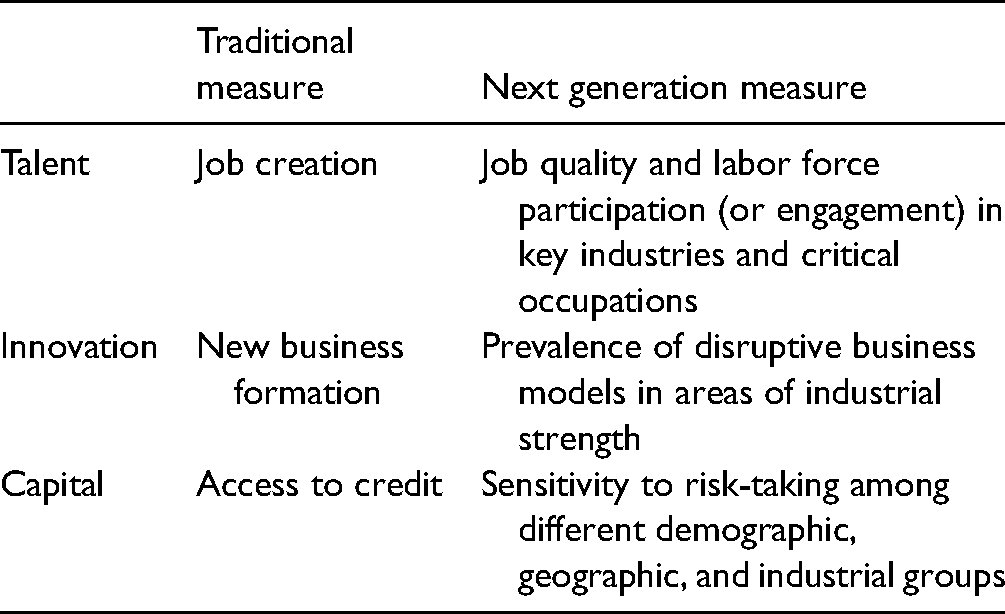
Traditional and Next Generation Measures for Economic Development: A Sample Set.
Measuring Prosperity Better: The Rise of Evidence-Based Policy Making and Data as an Asset
At close range, today's economic development challenges are what they have always been—managing the impact of a globalized marketplace while strategically building the regional workforce, preparing the runway for technology/innovation, making capital more widely available, and actively ensuring business attraction. Now it is time for researchers to help practitioners tailor and scope effective solutions that adequately address sustainable and long-term change (Brinkley & Visser, 2022). A key first step is to ensure that data to support evidence building are available to help shape sustainable economic development strategies. But what do we need to measure to guide research about those new strategies?
A key underlying theme from the practice is an inexorable shift toward economic development efforts that create more equitable opportunities, not just economic growth for its own sake. However, practitioner frameworks for understanding and measuring progress have not evolved to reflect new economic realities and emerging new policy priorities. In this shift, insights are needed about how regional economic assets are distributed, who benefits from economic development efforts, and why these results matter for both growth and equity. Policy makers need to establish new and clearer sets of goals that help practitioners better monitor how well they are doing.
Gaps in the availability of useful data to measure relevant impacts are many, often because so little attention and resources are dedicated to economic development goal setting and performance monitoring. Also, many legacy programs were established without clear objectives or with objectives that no longer seem relevant. Furthermore, few economic developers have the teams or resources needed to develop metrics, activate their data, or use the data to make informed decisions. Available information is sourced from underfunded national and state data systems.
Obtaining and analyzing good metrics of economic prosperity is a first-order challenge for researchers and policy makers. In the shifting landscape of regional economic development, policy makers seek to measure prosperity in new ways, but performance monitoring continues to focus on two standby measures: job creation and capital investment. The data systems also rely on poorly curated and rarely validated client-reported information. Evidence-based insights about the importance of job quality or the prevalence of opportunities available to underrepresented populations or economic asset owners are rare. New research on these and other opportunities and challenges must examine systems, organizations, and processes at work across regions, which requires higher quality data and increased data system capacity to ensure access to reliable, verifiable performance information and insights.
Contextual information is critical to understand multicounty regional conditions in the context of global and national trends. Economic developers are experts at generating related insights and in wielding the location quotient or shift-share analysis, but they don't have shared frameworks for comparative analysis of interventions and outcomes to the same extent. They are often looking ahead, as is necessary, but rarely looking back to assess performance except to tout their success to eager or skeptical political leaders. Metrics and data infrastructure are only helpful if they capture key local conditions in context.
Sound evaluation requires prior agreement on key goals or measures of success, but too few policy makers seem interested in looking back. And looking forward? That's another problem entirely since very little has been invested in predictive methods (which may be inaccurate anyway in this highly volatile global economic climate). Even so, improving projection methodologies could help guide practitioners to better assess where to hasten growth or to prepare for expected declines.
Metrics are a topic of focus for regional economic development practitioners because a key question is whether funded efforts are having desired impacts. This provides an opening for thoughtfully crafted metrics and the planning of data collection, which will empower leaders with the tools to measure outcomes, help monitor for ongoing improvement, enable strategic decision making, and support inquiry into the processes that shape the outcomes. Researchers could help policy makers establish a new logic framework that recognizes today's very different policy landscape. For example, regional economic developers are reimagining the effect of how the employment multiplier aligns with workforce development initiatives and the needs of industry in a globalized marketplace. For example, what are meaningful metrics of job quality or equitable economic opportunity?
Data infrastructure represents the capacity and systems in place to collect, validate, access, and share data across organizations. A vital foundation for economic development research, this infrastructure includes the collection systems, data standards, identifiers, and reference data that together serve as building blocks for ensuring that high-quality information about actors and events is maintained in a highly structured and confidential environment. Typically overlooked as a policy priority, these data are continuously collected through interactions between businesses and government for purposes other than economic development. Administrative records from these interactions are excellent sources of third-party validated data that complement publicly available statistics in monitoring current conditions, tracking activity, and assessing program performance. These systems typically lack investment or are underappreciated as a resource. Researchers can help economic developers to recognize and advocate for good systems for collecting validated data or accessing/sharing third-party data and new ways to measure regional economic performance.
The discussion around data sharing and integrated systems is often partnered with concerns for privacy and data transparency. The National Institute of Standards and Technology's (NIST) cybersecurity compliance guidelines suggest that nonfederal data systems should ensure a level of protection for their data on par with federal agencies when controlled unclassified information is processed, stored, or transmitted (Ross et al., 2021). Researchers and regional leaders alike should commit to building their knowledge about the use of restricted access data (e.g., unemployment insurance, business tax, and other so-called administrative records) in secure environments. For example, digital rights management licenses can streamline access and define the terms of data usage; pseudonymization can be implemented to replace data with simulated identifiers; and tokenization can be used to validate data without ever transferring the actual data. This is important for building credible business and worker data systems that would allow researchers to access new forms of data to improve our understanding of the need for and impacts of economic development interventions.
Data standardization is one tool to strengthen the data infrastructure of economic development organizations. Data may be collected for one purpose but shared with others for a different use. As a result, multiple entities collect similar data for related purposes without fully understanding how the data will ultimately be used or interpreted (U.S. Chamber of Commerce Foundation, 2021). This fragmented approach to data collection creates cost burdens for data-collecting entities as well as the companies and workers being asked to supply information. Furthermore, databases across domains often use similar, but different, concepts that add confusion to researching regional economic trends or evaluating program impacts. Improving metrics require consideration of how data are collected, organized, stored, and shared. In this context, standardizing data definitions and data management protocols can help reduce the barriers associated with evidence-based policy making. The inconsistent use of data labels, definitions, terminology, standards, and format among agencies collecting data creates major challenges for program managers and evaluators seeking to interpret, validate, or rely on past performance metrics to make decisions about how to adjust programs.
Researchers should intervene to help inform these standards within the context of program monitoring and measurement. For instance, curated databases or integrated data systems that link or align common concepts can simplify efforts to prepare data for evidence building, leaving more resources to value-added data interpretation and analysis. Several states have started along the path of creating these integrated systems, but regional practitioners and researchers are rarely at the decision-making table to ensure the relevance of data for their cause (Jenkins & Culhane, 2019). An important role for researchers is advocating for these integrated data systems and serving as subject matter experts and key stakeholders in their design and deployment.
A Research Agenda to Advance the Regional Economic Development Practice: What Works and What Should We Measure?
The economic development research agenda is quite complex, but there are some topical areas that are particularly important to today's practitioners focused on promoting regional economic development. We present comments in three broad buckets—talent, innovation, and capital—that roughly equate to the traditional factors of production (i.e., labor, technology, and capital; Durlauf et al., 2001), but with an emphasis on the spatial characteristics of each that can be manipulated to address regional economic development policy concerns. Researchers can contribute significantly to the practice by helping practitioners better understand how these factors impact the regional economy, what policy levers associated with these factors are most adept at influencing market behaviors, and whether policy experiments have the intended consequences. Helping to rationalize, design, and disseminate a new generation of policy-relevant metrics may be one of the most important contributions that researchers can make to the practice (Table 1).
Talent
Businesses have been clamoring for talent for the past 3 decades. Manufacturing associations put out a particularly loud cry for help in the mid-2000s. Manufacturing firms felt the effects of reduced investment in education for the technical trades and experienced an overwhelming shift in popular support away from manufacturing due to offshoring and downsizing after trade opened with China. The economic consequences of these shifts affected U.S. regions quite differently, and U.S. federal or state attempts to address the negative impacts of these industrial shifts on regional manufacturing were inadequate to the challenge.
By early 2020, national unemployment had been stable at or below 4% (full employment) for nearly 2 years, and many states had unemployment levels below 3%. When the pandemic hit, and the economic landscape shifted overnight, firms scrambled to adjust and keep their businesses running. Workers adjusted, too, but some were less able to do so than others. Lack of dependent care, concerns about the use of public transit, the high prevalence of health concerns, and poor health outcomes reduced the ability or willingness for a large share of workers to return to work during the pandemic. Both firms and workers were dependent upon whether their regions and their prominent industries had developed the resources and the will to invest sufficiently in robust talent development systems over the previous decades. Many of the regions and industries were not making the investments needed.
Public attention shifted and more research emerged on the need for racial inclusion and equity and the role these issues have played in creating barriers to work and economic prosperity. Several authorities have translated disparities by race into lost opportunity for the U.S. economy. Estimates suggest that addressing the earnings gap between Whites and racial minorities would help to increase U.S. gross domestic product (GDP) by 12% to 33%, creating many more opportunities for all (Buckman et al., 2021; Turner, 2016). These studies suggested that the country's economic growth could be much faster but are met with skepticism about whether these types of gains are truly possible and if so how.
Before the pandemic, economic developers were already recognizing that their role was shifting from attracting jobs to helping existing and relocating companies to find people to fill jobs. Traditional measures of success continued to focus on job creation, but state and regional economic development agencies were instituting new programs to help increase labor force participation and bridge the workforce development system gaps to strengthen the current and future talent pipeline. The workforce participation challenges have allowed economic development practitioners the leeway to explore innovative solutions for firms seeking talent and to emphasize their states' competitive talent advantages as well as to seek out partnerships that could address long-standing issues of economic inequity and inclusion (Center for Regional Economic Competitiveness, 2019).
Though the economic development field has been activated on issues of talent and workforce development related to equity and inclusion, the work remains on the margins with many factors outside of its control. Moving forward, workforce-related equity and inclusion efforts may need to be integrated into broader efforts to ensure that investment leads to prosperity for all. This may require tying labor force participation to an understanding of what is possible in productivity and innovation efforts. To what extent can technology and artificial intelligence tools help ease the chronic talent shortages that firms are experiencing? To what extent do they create new demands for talent? To what extent do talent shortages limit the ability to invest in new technologies?
To date, research shows that new technology generates more demands for skills than it replaces, thus more jobs are created than lost in the long run (Stewart, 2022). But research also shows that we are not doing a very good job of creating or deploying new technology in the United States. Overall productivity has stagnated despite the recent pandemic productivity “blip” (Krishnan et al., 2018; Sparque, 2021). Scholars suggest this has something to do with people, their work environments, and their work processes. For example, how well are young people able to integrate into the workplace? Are retiring baby boomers able to pass on critical knowledge and expertise? How can more people from rural areas and low-income areas contribute to this work? How do we finance the interventions needed to fill gaps in performance?
The focus is often on the number of new labor market entrants and retirees leaving the workforce entirely, but there is a lot of other movement that is critical to the effective functioning of the labor market, including the movement of workers between jobs and across occupations (Nelson & Wolf-Powers, 2010; Persky et al., 2004). One person's move from a location, firm, or even job within their firm creates opportunities and a demand for others to enter the location, the firm, or the job. Greater knowledge about job chains (ladders and lattices), as well as advancement and succession planning beyond the level of the firm, could help smooth or at least inform the transitions. Has the pandemic changed these patterns permanently? As workers reshuffle according to new or revealed priorities, how does that affect talent supply for work at different wage and skill levels, in different industries, and among firms of different sizes? How do these trends affect participation in the workforce by women and people of color?
Innovation
At the national level, we assume innovation is the result of research and development (R&D) conducted by large universities and large firms in major metropolitan areas while the contributions of other actors and smaller firms, especially those in rural areas, are often overlooked (Mann et al., 2021). Regional economic developers are concerned with both the R&D functions and the commercialization and deployment of technology by regional actors, with an important role for entrepreneurs. Large and small firms alike struggle to integrate and deploy new technology, and large and small universities struggle to transfer their insights and innovations to commercial ventures. Entrepreneurs play a key role in all areas, helping to create systems that are nimbler and that generate more activity.
For decades, scholars have touted the value of technology to economic growth (Bristow & Healy, 2018; Dedrick et al., 2003; Malecki, 1997). Investments in technology are often correlated with economic growth, creating virtual cycles for fast-growing areas, and leaving regions with limited technology assets behind. Marketplace vitality, the availability of federal investment, and corporate self-awareness about the importance of R&D to long-term survival influence how rapidly industrial R&D has grown during the past half century (Geisler, 2001). Furthermore, the increased emphasis on technological advantage as a market differentiator has the potential to benefit some populations more than others, exacerbating inequalities in the urban–rural divide, demographic inequalities associated with socioeconomic status, and large business advantages over small businesses that have a lower tolerance for risk and fewer resources to experiment with innovations in products or business models. Key research is needed in whether technology can be induced into areas without an existing strong asset base and what it may take to develop enough assets to help companies and people in “have-not” regions to fully leverage the opportunities associated with economic transformation.
While equity and broader participation are possible in all stages of the innovation process, entrepreneurship is more universally embraced as a foundation for economic growth and development across the political spectrum (Hathaway & Morris, 2021). As industrial recruitment has become a lower political priority for a full employment economy, the focus for many regions has shifted to “economic gardening” that fosters both growth and development (Desplaces et al., 2009). The academic literature often links entrepreneurial activity and economic performance (Acs et al., 2018; Luke et al., 2007), but the focus tends to be on new business formation as a source for growth and alternative employment with little regard for the types of businesses forming, the industries in which they are operating, or the demographic makeup of owners (Carree & Thurik, 2005). Only limited research has been conducted about how efforts to foster entrepreneurship have impacted the distribution of economic benefits among underserved communities or how surges in entrepreneurial activity impacted the ability of a new generation of private sector leaders to influence their region's economic destiny as well as their own. With so many disruptive events now occurring (from natural disasters to public health crises), research is needed on how younger businesses are demonstrating resilience and whether churn in business ownership because of these crises is offering new opportunities to improve equity and inclusion among a new generation of business owners.
In many cases, innovation may be tied to an industry or to a region's ability to attract large capital infusions to pay for new technologies or changing business processes. Consequently, small businesses with limited access to risk capital can miss their opportunity. Likewise, entrepreneurs unfamiliar with how these capital markets work (or who do not have access to knowledgeable and trusted financial advisors) also miss these opportunities. Thus, small businesses often encounter significant barriers to introducing disruptive technologies or adopting new business models that help workplaces to function more effectively.
While it may be common to think new business formation results from identifying market gaps or deploying new technologies, many companies succeed because they introduce disruptive business models that create or capture economic value in new ways. Business model transformations that link technological innovation to emerging markets tend to be the key to success (Kavadias et al., 2016). To illustrate the importance of this issue, one significant driver of business model shifts is increased integration of data as a connecting component across all aspects of the production process—digitalization. Digitalization transforms business operations because increasingly powerful computing technologies can help companies anticipate issues before they happen. From monitoring and anticipating machine breakdowns (including consumer products) to integrating artificial intelligence into the customer service experience, digitalization can improve productivity and product quality through data that enhances automation. From solving problems before they occur thereby reducing the need for customer service representatives and repair technicians to increasing the skill requirements for process maintenance and software programming, digitalization is transforming how work is performed and how products interact with customers. Understanding this transformation is important, but many regions with poor broadband or enterprises with poor cyber security will not be prepared for this revolution. Researchers can provide a better understanding of how these trends are impacting industries, who is poorly prepared or underserved, and what regions might do to facilitate the adoption of solutions.
Research suggests that technical assistance focused on business model innovations can be a key to success for most firms (Bartik, 2009). But it is unclear whether business services and technical assistance would be sufficiently targeted or funded to make a significant difference in improving economic opportunity for people of color, women, or other underrepresented populations. The pandemic pushed many businesses to adapt or die (Zamani et al., 2022). Understanding the impact on business survival and economic growth rates would be helpful to better understand how small businesses are impacted by policy efforts to develop a new generation of talent, create more economic opportunities for underserved populations, and increase new business model adoption.
Capital
The risks and costs to businesses associated with developing new products and services continue to rise, increasing the demand for capital, especially among growing or emerging companies. Capital is concentrated in a limited number of metropolitan locations (like the San Francisco Bay Area and Southern California, as well as greater New York and Boston) and a few tech hubs (Florida & King, 2018). Interviews with innovative new firms over the years have confirmed the pull of these money centers. Many companies that received early rounds of seed or venture capital were ultimately required to relocate closer to the capital source where business and money managers could keep a close eye on their investments. Increasingly, equity capital continues to shift toward lower risk and more mature investment opportunities.
Lenders are even slower to offer capital to small businesses without a long track record, significant cash reserves or highly valuable collateral assets, and a steady stream of revenue that clearly demonstrates that they can fully repay the debt. Small- to medium-sized companies typically struggle to obtain capital because they often have a limited track record or few assets. The challenges are even more significant for businesses that do not have established social networks, such as those located in rural areas, owned by women or people of color, or operating in sectors perceived as declining. Requests for capital are usually based on promises for future growth as companies seek out new market opportunities, acquire new technologies, and develop new products. Decisions are often made based on risk assessments, not only on the business and financial plan but also on subjective factors including the perceived creditworthiness of a borrower.
The risk profile for many small businesses is too high for traditional debt sources and the return-on-investment prospects (in terms of total volume or rate of return) are too low for private equity markets. So, many companies instead rely on personal capital (i.e., home equity or personal savings) or expensive alternatives (e.g., credit card debt). When success for small companies depends disproportionately on access to personal resources or near-predatory lending, business owners encounter a much higher probability of failure. But more broadly, it means that many entrepreneurs simply do not have access to capital. The problem is particularly acute for capital-intensive manufacturers that may need to make large investments in productive capacity and technological development to stay competitive. Without public sector intervention, this lack of capital affects certain regions more than others (Rupasingha & Wang, 2017).
As part of the Small Business Jobs Act of 2010, Congress created the State Small Business Credit Initiative (SSBCI), allowing states to create their own model using $1.5 billion in federal funds. Due to the differences in how SSBCI is implemented across states, the program offered a veritable laboratory for testing different lending and equity financing models. Relaunched as part of the American Recovery Plan Act of 2021 with $10 billion, this new version of SSBCI seeks to address systemic inequities in capital markets including improving access to capital for underrepresented populations and underserved markets. This new emphasis offers an opportunity for researchers to explore the impact that capital access can have on those markets, including success rates of marginal risk borrowers.
Changing market dynamics are impacting not only private capital access to small businesses, but also the goals of public investments that influence business location decisions or investment behaviors. Anecdotally, businesses often note the importance of cost factors to these decisions, but more recently competitive labor, quality of life, infrastructure access, and advanced technology have risen in importance. Research has long explored key principles for designing incentives that focus less on providing cash (or credit) and more on information sharing, technical training, R&D investment, and high-risk financing that helps to diversify the existing base or foster risk-taking (Rodrik, 2008). From a research standpoint, it is important to continue testing these assumptions by obtaining more nuanced insights from companies and greater clarity about the shifting importance of key factors that influence private investment decisions. If this evidence shows variation in the incentives influencing investment decisions, then researchers might also assess whether various types of incentives can be effectively implemented in different contexts. Likewise, given the current concerns about the impact of certain incentives on economic opportunity, it is important to begin exploring how incentives influence development patterns and benefit (or harm) underrepresented individuals or underserved communities.
Conclusion
Policy makers and economic developers seeking to increase regional economic activity depend primarily on their professional networks to learn. Yet, today's economic development practitioner increasingly values knowledge engendered from a more judicious use of data to monitor progress, measure performance, and predict future trends. They are also increasingly concerned about all aspects of evidence building. However, scholars are not well integrated in the policy diffusion process because scholars' insights often do not or cannot consider the political realities of policy making, nor are their findings incorporated as part of practitioner best practices sharing.
Scholars must pay attention to political actors and private sector leaders as well. For regions, public/private partnerships led by businesses play an outsized role in policy adoption because multicounty economic regions are not well recognized in the politics of our federal system and the private sector has a different time horizon than political leaders. Private sector leaders may be more influenced by evidence-driven research and less committed to legacy policies so they can be strong allies for researchers offering evidence about the impact of various policy approaches. The challenge is that regional private sector leaders may represent larger companies that may have competing interests and priorities because they are more likely to benefit from current economic development policies. Can the evidence that scholars provide help engender greater participation of underresourced small business entrepreneurs or underrepresented voices in state and regional agenda setting?
In short, scholars are important economic development stakeholders because their work has the potential to inform the dynamic processes of policy making and investment decision making by providing public and private decision makers with insights from a body of established knowledge and an understanding of the gaps in evidence. Partnerships between scholars and practitioners enrich the shared body of knowledge, including when scholars serve as state or regional economic or programmatic advisors or when practitioners teach a course or advise on academic research. Where can these research partnerships benefit the public most? Trends toward deglobalization and increased concerns about the availability of local economic opportunity suggest a new industrial policy and research agenda that embraces unlearning what always was and rewarding the implementation of evidence-based strategies that address a whole new set of performance goals (Harpel & Poole, 2017).
What is needed to jumpstart the regional economic development learning agenda in ways that encourage scholars, practitioners, and stakeholders (especially from the population who stand to benefit) to work together? Researchers have a unique opportunity to examine the regional impacts of national issues and shape emerging philosophies about how to solve major human problems and how to enact equitable and inclusive practices. By engaging community members, researchers and practitioners can develop and implement solutions that bolster equity and inclusion. Here are 12 ways that economic development practitioners and applied researchers can collaborate to foster new or improve existing research by informing what research is funded and how it is conducted:
Ensure research about economic development engages stakeholder institutions and organizations and reflects the racial, ethnic, and economic diversity of the regions they serve. Connect talent, innovation, and capital through interdisciplinary work on big issues such as how technology is deployed during different phases of the innovation cycle (e.g., R&D, commercialization, entrepreneurship, business model design). Facilitate collaborative dialogue among practitioners, industry leaders, and technologists to better understand how complex regional economic systems can more effectively create growth and equity. Advocate for data infrastructure and systems that offer validated administrative data for high-quality evidence-building efforts. Guide state, regional, and local level teams in increasing use of and access to restricted data and improve the usefulness of publicly available data. Support evidence-building efforts and logic model designs that acknowledge different political ideologies to ensure economic development retains its stature as a bipartisan policy priority. Demonstrate how today's emphasis on equity and inclusion can contribute to growth and development goals while allowing for recognition of failure or revision of policies in the face of new evidence. Develop new methods designed to help better understand emerging technology areas and their impact on existing or new industries, as well as on existing or new talent needs. Design more responsive performance monitoring methods that reflect the need for ongoing program assessments sought by practitioners. Develop and deploy new metrics (and data collection systems to capture data associated with those metrics) to monitor economic development progress—focusing on job quality, innovation capacity, and equitable economic participation. Provide training and incentives to encourage scholars and practitioners (moving beyond single-paper, single-intervention studies focused on controlling related factors) to consider regional systems and dynamics in developing effective growth and development strategies. Assess how national shifts that impact business planning (such as labor force participation, business models, emerging skill requirements, and end-market consumption patterns) are altering both the landscape for regional growth and development and whether these shifts are structural or cyclical.
Regional economic development efforts become even more critical as supply chains decouple from global networks to become more resilient to black swan events stemming from natural or manmade disasters, geopolitical rivalries, and uncertain energy markets. In this context, research is needed to understand how these trends might create new regional economic growth challenges or opportunities. By taking on a more collaborative role, scholars can increase the value of their body of work, have a more direct impact on economic development practice, help identify priorities, and offer evidence-based ideas to address continually evolving economic challenges.
Footnotes
Declaration of Conflicting Interests
The author(s) declared no potential conflicts of interest with respect to the research, authorship, and/or publication of this article.
Funding
The author(s) received no financial support for the research, authorship, and/or publication of this article.