




Abstract
Hooking up is a term commonly used in contemporary American society to refer to sexual activity between two people who are not in a committed romantic relationship. Data show that although many college students are engaging in hookups, there is no consensus on how to define a hookup. The author uses the concept of “strategic ambiguity” to explore the intentionality and usefulness of the vagueness of this term. Specific to hookups, strategic ambiguity is when individuals use the term “hookup” to describe their sexual activities rather than give details about their sexual activities as an impression management strategy to protect their sexual and social identities. Analyzing data gathered through interviews with heterosexual students at a mid-sized public university in the South, this article addresses the normative character and the myriad definitions of hookups; addresses the underlying heterosexist bias in the definitions of hookups; and analyzes how the ambiguity of the term “hookup” serves women and men in different ways and both reinforces and challenges the current gender order, allowing men to conform to and preserve components of hegemonic masculinity and women to conform to and preserve components of emphasized femininity.
“Hooking up” is a term commonly used in contemporary American society to refer to sexual activity between two people who are not in a committed romantic relationship (historically known as “casual sex”). Despite the apparent ubiquity of hookups, there is an underlying ambiguity to the term. When someone says a hookup has occurred, there is no clarity about precisely what happened unless details are offered.
In this article, I use interview data to analyze how and why heterosexual college students use ambiguous language to describe their and others’ casual sexual activities. I use the concept of “strategic ambiguity” to explore the intentionality and usefulness of the vagueness of this term. Historically, the term “strategic ambiguity” was used by policy analysts to refer to a country’s policy of intentionally misleading or hiding information from other countries about its foreign policy intentions or strategies. 1 In a sociological context, I use this term to refer to the impression management strategy used to protect one’s social identity and/or self-image by using ambiguous language to describe one’s activities in a given situation. Specific to hookups, strategic ambiguity is employed when individuals use the term “hookup” to describe their sexual activities rather than give details about their sexual activities. This behavior helps maintain the existing (and seemingly appropriate) gender order. I argue that it allows women to protect their social identities as feminine and men to protect their social identities as masculine.
My analysis focuses on the following questions: How do gender norms and heterosexism affect how college students describe and interpret hookups, and how do social prescriptions of emphasized femininity and hegemonic masculinity influence the gendered meaning-making regarding this topic? The components of emphasized femininity and hegemonic masculinity on which I focus are the ones most frequently found in the interview data: how women walk a fine line between hooking up “enough” but not “too much” and exhibit a level of sexual compliance to men by downplaying their own sexual desires, and how men have a hyper-focus on heterosexual sexual activity and bonding with other men. Some of the included topics have been addressed elsewhere in the hookup literature, specifically the ways women focus on the sexual desires of men rather than their own (Armstrong, England, and Fogarty 2012; Armstrong, Hamilton, and England 2010; Backstrom and Puentes 2012; Eshbaugh and Gute 2008; Hamilton and Armstrong 2009), the normative nature of hookups (Bogle 2004, 2007, 2008; Bruce and Stewart 2010; Daniel and Fogarty 2007; England, Fitzgibbons Shafer, and Fogarty 2007; England and Thomas 2006; Kimmel 2008; Ramage 2007; Reid, Elliott, and Webber; Sessions Stepp 2008), and the vagueness of the term “hookup” (Bogle 2004, 2008; Bruce and Stewart 2010; Glenn and Marquardt 2001; Kimmel 2008; Paul, McManis, and Hayes 2000; Sessions Stepp 2008). However, this analysis combines previously disparate topics, adds the lens of strategic ambiguity, and proposes that maintaining the current gender order is motivation for this intentional vagueness.
Literature Review
Hegemonic Masculinity and Emphasized Femininity
The most often cited theorizing on hegemonic masculinity and emphasized femininity comes from R.W. Connell (1987, 1990, 1995, 2001), who introduced a complex analysis of these concepts. Hegemonic masculinity is the form of masculinity that is most highly valued in a society and is rooted in the social dominance of men over women and nonhegemonic men (particularly homosexual men). Emphasized femininity is “the pattern of femininity which is given most cultural and ideological support . . . patterns such as sociability . . . compliance . . . [and] sexual receptivity [to men]” (Connell 1987, 24). Both are multilayered processes of acting out gender publicly in culturally and socially accepted, defined, and appropriate ways (see West and Zimmerman 1987). Although there are variations of hegemonic masculinity and emphasized femininity, there are commonly accepted and expected displays of both, grounded in time- and culturally specific contexts.
There are three patterns in the extensive research on these concepts that relate to this study: Emphasized femininity is often theorized as a reaction to hegemonic masculinity; masculinity writ large is still more highly valued than femininity in most cultures; and a specific iteration of hegemonic masculinity usually takes hold in “core” social institutions that both reflect and affect the gender norms of the culture at large (Connell 1987, 1990, 1995, 2001; Connell and Messerschmidt 2005; Gilmartin 2007; Kimmel 2003, 2008; Messner 2002; Yancey Martin 1998).
Casual Sex and Hookup Literature
Extramarital and casual sex (sex between people not in a committed or monogamous relationship) have been studied extensively since the 1970s. After the sexual and feminist revolutions of the 1960s-1970s, many researchers assumed that premarital sex in the context of a committed and/or monogamous relationship was socially acceptable but that sexual activity in casual or uncommitted contexts was less straightforward from both an interactional and a research perspective. The research highlighted micro aspects and focused on two topics—long-term, uncommitted partnerships and single events (often termed “one-night stands”). Some research focused on general attitudes about, personal experiences with, and interpretations of casual sex, other researchers examined individual, parental, or family characteristics affecting sexual decision-making, and still others looked at the frequency of casual sex, numbers of sexual partners, or choices surrounding birth control (Cates 1991; Gerrard and Gibbons 1982; Maticka-Tyndale 1991; Regan and Dreyer 1999; Sherwin and Corbett 1985). Research results varied depending on research questions, methodologies, and participant pools, but most researchers concluded that as of the early 1990s, casual sex was limited in scope among young people and there were usually negative reasons for or repercussions to this type of activity.
It is only in recent years that research has shown that casual sex is, in fact, common, and is not always socially constructed as negative (Bogle 2007, 2008; Daniel and Fogarty 2007; England, Fitzgibbons Shafer, and Fogarty 2007; England and Thomas 2006; Manning, Longmore, and Giordano 2005; Martinez, Copen, and Abma 2011; McGinn 2004; Paul, McManis, and Hayes 2000). The term “hooking up” has emerged in academic and popular discourse to refer to a wide range of sexual interactions outside committed romantic relationships. There are two clear perspectives in the examination of hookups—one negative and one more neutral. Much popular writing/reporting and some academic literature are disapproving and moralistic, focusing on the negative aspects of hooking up, particularly for women. This literature frames the disconnect of sex from committed romantic relationships as negative, equates hookups with a breakdown of sexual morality among young people, and ties it to a decrease in condom use and increased rates of sexually transmitted infections (Daniel and Fogarty 2007; Glenn and Marquardt 2001). In addition, a few researchers have begun to examine a potential link between hookups and dating violence (Armstrong, Hamilton, and England 2010; Kahn et al. 2000), although this relationship is unclear and needs more investigation. In contrast, there is a growing body of academic research that is more neutral and focuses on the social meanings and gendered implications of hookups. This literature offers a nuanced and complex picture of social-sexual interactions and shows how hookups are simultaneously affecting and being affected by traditional/historic patterns of intimate partnering.
Without exception, these researchers have found that hookups are ubiquitous and normative among college students. Various studies have reported that high proportions of their participants have engaged in at least one hookup: 72 percent (Armstrong, England, and Fogarty 2012), 87 percent (Kahn et al. 2000), 78 percent (Paul, McManis, and Hayes 2000), 85 percent (Paul, McManis, and Hayes 2000), and 78 percent of female and 84 percent of male (Lambert, Kahn, and Apple 2003).
Researchers have also found that women and men report engaging in hookups at approximately similar rates, although men do report slightly higher numbers than do women (Bogle 2008; England and Thomas 2006; Fielder and Carey 2009; Kahn et al. 2000; Kimmel 2008; Lambert, Kahn, and Apple 2003; Glenn and Marquardt 2001; Paul, McManis, and Hayes 2000). Differences in reported numbers can be attributed, at least in part, to the fact that heterosexual men tend to overreport and heterosexual women tend to underreport their sexual activities and that men may be hooking up with more different partners than do women (Brown and Sinclair 1999; Jonason and Fisher 2009; Kimmel 2008).
Research has also consistently shown that hookups are “normal” among contemporary college students, whether or not they engage in or approve of such activities, that hookups have become the dominant sexual and intimacy script on many college campuses, and that young people are not engaging in traditional “dating and mating” patterns as much as in the past. Researchers conclude that this shift is related to the increased prevalence and social acceptance of premarital sex, increased dating and sexual initiating behavior among women, increased rates of unmarried cohabitation, and older ages of first marriage and childbearing (Armstrong, England, and Fogarty 2012; Bogle 2004, 2007, 2008; M.E. Eisenberg et al. 2009; England and Thomas 2006; England, Fitzgibbons Shafer, and Fogarty 2007; Eshbaugh and Gute 2008; Garcia and Reiber 2008; Glenn and Marquardt 2001; Jonason and Fisher 2009; Kimmel 2008; Paul and Hayes 2002; Paul, McManis, and Hayes 2000; Reid, Elliott, and Webber 2011; Risman and Schwartz 2008).
These findings do not, however, indicate a wholesale rejection of traditional moral sexual standards. Recent research shows that many young people still have their primary sexual relations within romantic relationships, many will engage in hookups for a certain period of time during high school and/or college before settling into more traditional dating routines later in college or postcollege, and many still seek emotional connectedness in their sexual relationships, even when participating in casual hookups (Armstrong, England, and Fogarty 2012; Bogle 2004, 2007, 2008; Daniel and Fogarty 2007; M.E. Eisenberg et al. 2009; England and Thomas 2006; Epstein et al. 2009; Eshbaugh and Gute 2008; Garcia and Reiber 2008; Hamilton and Armstrong 2009; Kimmel 2008; Manning, Giordano, and Longmore 2006; Martinez, Copen, and Abma 2011; Reid, Elliott, and Webber 2011). In addition, recent national research has shown that the percentage of teenagers reporting having intercourse has declined in recent years. In 1998, 51 percent of females and 60 percent of males ages 15-19 reported having engaged in sexual intercourse. In the period 2006-2010, those rates dropped to 43 percent of females and 42 percent of males (Martinez, Copen, and Abma 2011). These findings could indicate less sexual activity in general among teenagers in recent years, or more oral sex or “non-intercourse” activities as a substitute for intercourse, but additional research and analysis must be done to ascertain the causes and consequences.
For the most part, researchers find that hookups are perpetuating a sexual double standard in which men receive more sexual and social benefits from hooking up than do women (Bogle 2004, 2007, 2008; Eshbaugh and Gute 2008; Fielder and Carey 2009; Glenn and Marquardt 2001; Kimmel 2008; McGinn 2004; Ramage 2007; Sessions Stepp 2008). Some researchers claim a dynamic in the mold of the historic gendered double standard, in which women are at a serious disadvantage and are often emotionally damaged by extramarital sexual behavior (Glenn and Marquardt 2001; Sessions Stepp 2008). Others conclude that the double standard is more nuanced and complex than the assumption that “hookups are bad for women and good for men.” Some identify increasing levels of sexual agency among women participating in hookups, concluding that there can be social and sexual advantages for women as well as men (Armstrong, England, and Fogarty 2012; Armstrong, Hamilton, and England 2010; Bogle 2008; Bruce and Stewart 2010; Garcia and Reiber 2008; Paul, McManis, and Hayes 2000; Risman and Schwartz 2008).
I add the concept of strategic ambiguity to the existing hookup literature and offer a gendered analysis without focusing on the negative repercussions for women. I analyze how ambiguously defining both “hookup” and “sex” is an interactional strategy (within a larger cultural social-sexual context) that reinforces a gender order still based in a sexual double standard. Specifically, I examine the gendered interactional dynamics in hookups through the lens of emphasized femininity and hegemonic masculinity, highlighting how men and women protect their sexual and social identities by relying on some historic/traditional definitions of gender while simultaneously challenging the concept that women should not be sexual beings.
Methods
The data used for this analysis come from in-depth interviews with 78 full-time, heterosexual students at a co-ed, public university in the South (SU) between March 2006 and December 2007. These data are part of a larger research study that included information from non-heterosexual students, which will be analyzed in a future article. At the time of the study, there were approximately 8,300 undergraduates. The student body comprised 60 percent women and 40 percent men; 90 percent white, 5 percent black, and 5 percent “other”; about 10 percent of the students belonged to fraternities and sororities; and 5 percent were intercollegiate athletes. Demographics of interview participants can be found in Table 1.
Demographics of interview participants
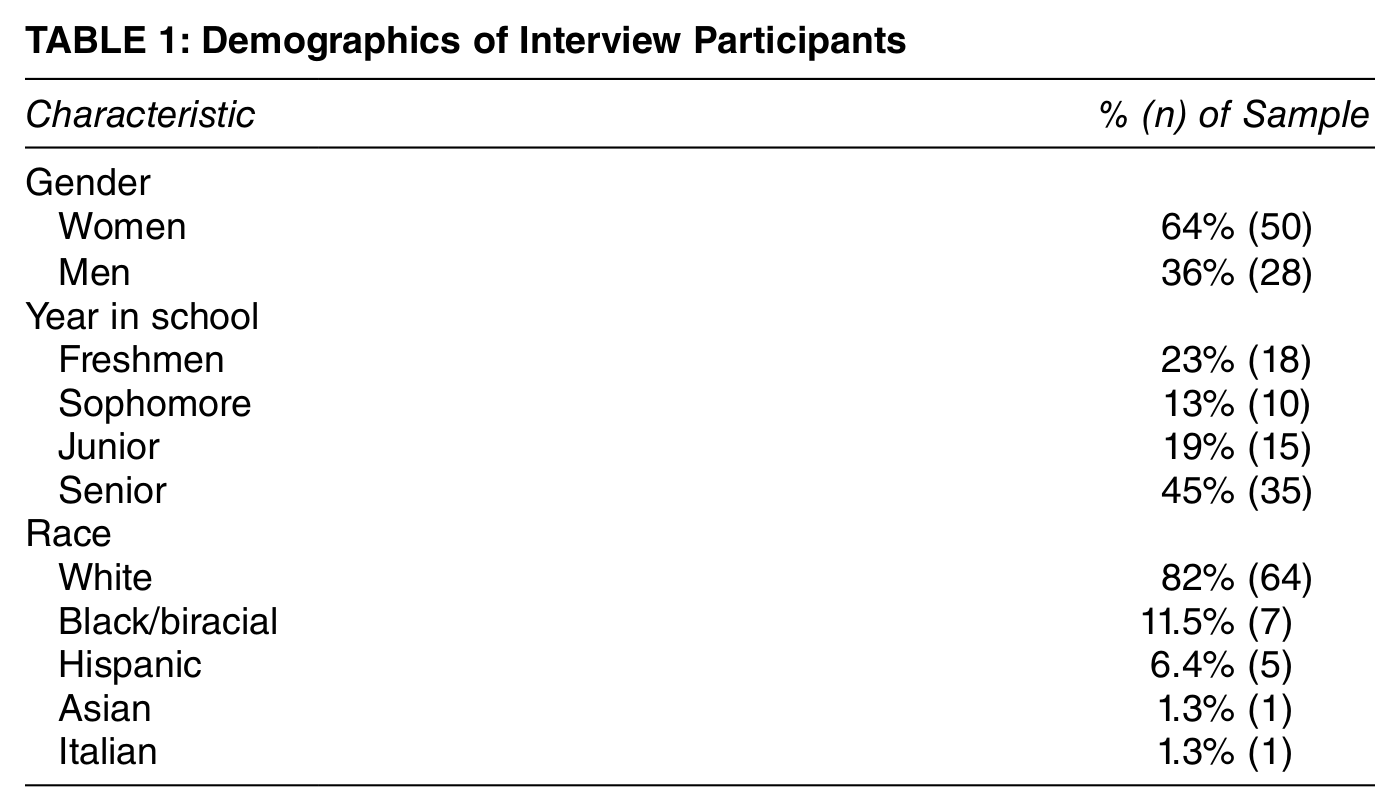
The participants’ demographics were more diverse than the student body, resulting in some analytic strengths. The relatively high proportion of juniors and seniors offered a breadth of experience, and many of these participants engaged in mature self-examination of current and previous sexual decisions and reported changes in behavior and attitudes through their college years. The relatively high proportion of both Greek members and intercollegiate athletes was helpful analytically because both social groups were referenced repeatedly as central to SU’s social life in general and social-sexual culture specifically.
The one-on-one interviews were conducted in private, ranged from 30 minutes to four hours, were taped, and transcribed by me or a professional transcriptionist who signed a confidentiality agreement. All participants chose a unique pseudonym (used in all paperwork and reporting of the data) to ensure confidentiality. A combination of convenience, purposive, and snowball sampling was used to gain participants. No class credit or monetary incentive was offered for participation. I used a semistructured interview guide based on relevant topics in the literature and information gained in a survey administered in the fall of 2005. 2 During the 21-month interviewing process, I engaged in recursive back-and-forth interaction with data gathered in the interviews, relying on tenets of grounded theory (Charmaz 2001; Corbin and Strauss 1990; Glaser and Strauss 1967) and incorporating new topics and analytic categories to reflect promising theoretical ideas. Each interview included the open-ended questions “How do you define a hookup?” “Have you hooked up?” “If so, how much?” “If not, why not?” and “What is your opinion of hookups?” All participants were asked about their sexual histories, social and sexual identities, birth control use, violence in dating relationships, and attitudes and beliefs about gender, sex, hookups, and the “hookup culture.” 3
Interview data were coded by me and three trained undergraduate research assistants, using extensive cross-verification to create intercoder reliability. For this particular analysis, I coded for terms and concepts that related to definitions of hookup and sex, ambiguity or vagueness, normativity of hookups, and conceptions of femininity and masculinity. All members of the research team searched the interview transcripts independently; those terms and concepts found by at least three of the team were included for this analysis.
Findings
The following examination is grounded in two findings that mirror previous research: hooking up as common among college students, and the sexual double standard in hookups. While these topics have been considered elsewhere, my analysis is unique because I analyze them through the lens of strategic ambiguity and incorporate a discussion of emphasized femininity or hegemonic masculinity and the underlying gender order.
I discuss two components each of emphasized femininity and hegemonic masculinity that were the most often repeated by participants. Emphasized femininity was evident in how the women walked a fine line between “enough” and “too much” hooking up, and displayed a level of sexual compliance by downplaying their own sexual pleasure and desires in hookups. Hegemonic masculinity was evident in the active hyper-heteronormativity expected of men and in how men’s descriptions and interpretations of hookups often revolved around their relationships with other men rather than their relationships with women.
“Everyone Is Out There to Hook Up”
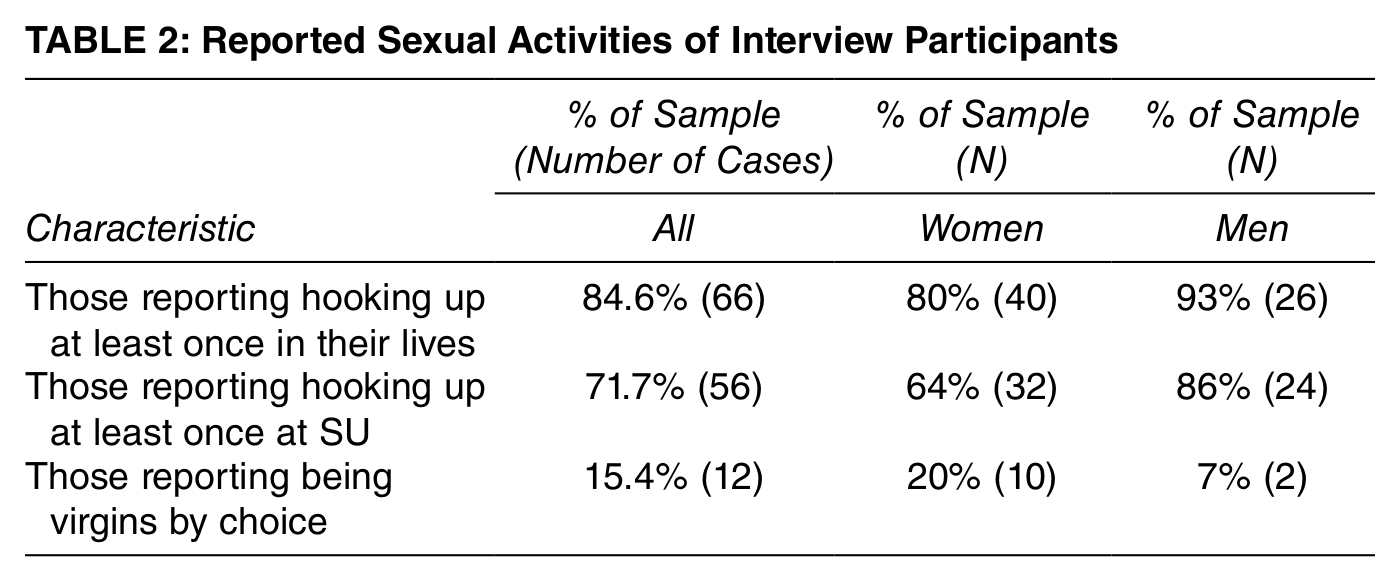
All of my participants reported that hookups are perceived as both ever-present and normative in college and are a central component of social life at SU, whether or not they participated in hookups. The large majority of my participants (84.6 percent) reported having hooked up at least once in their lives. (See Table 2 for specifics of reported activities.)
Reported sexual activities of interview participants
If you’re out on the weekends, if you’re not with a girlfriend or boyfriend, you’re looking for it. Maybe the person you’re trying to hook up with isn’t going to hook up with you, but it’s likely she’s trying to hook up with someone else. Everyone is out there to hook up. And sometimes it happens, sometimes it doesn’t. But, I would say it’s on just about everyone’s mind, the desire. (Bruce, white man, 22)
As Bruce indicates, the social-sexual scene is based on both actual hookups (“sometimes it happens”) and the perceived potential and desire (“everyone is out there to hook up”), and this potential is a constant undercurrent in the social interactions on college campuses.
“Anything from Kissing to Having Sex . . .”
The first question in every interview was “How do you define a hookup?” Despite the consensus that “everyone is doing it,” there was no consensus on what exactly “it” is. I found two interesting patterns in the definitions—first, there were no significant differences in how women and men defined (or failed to define) “hookup.” Second, both sexes struggled equally and most participants used similar language. I heard a plethora of definitions, from both women and men, and all were aware of the relative nature of how they were addressing the topic:
It depends—I guess it is in the eye of the beholder. . . . If I met a girl at the bar and even if we didn’t have sex, we just went to her place and made out for an hour and then left, then I would consider that . . . yeah, we hooked up . . . and then it can go the other way, like, if I said we had intercourse, because that’s their definition. So I guess that’s kind of the double-edged sword, the defining it. (Bodie, white man, 22)
Clearly, a hookup is “anything from kissing to having sex” (Casper, white woman, 22) and is “in the eye of the beholder” revealing the subjectivity and underlying ambiguity of the definition. Many descriptive differences were framed in the context of levels of alcohol consumption (usually much), how well they knew the people with whom they had hooked up (often little), and the context in which hookups occurred (often a party).
Because of this spectrum of potential activities and the various caveats offered, I asked participants to expand or offer more details. This defining process was often characterized by confusion and frustration. Many participants began with confidence but, as they continued, would stumble or question themselves:
I’m gonna say . . . a hookup is something . . . it doesn’t specifically have to include intercourse but, like . . . it’s so difficult now to actually say what it is. (Angela, white woman, 21) I guess it is kind of a vague term. I think . . . I mean I think that . . . I mean . . . hmmm . . . I don’t know! I don’t know how to define it, I guess. (Carl, white man, 20)
Angela and Carl are but two examples of participants who paused or struggled when trying to describe a hookup. These students were so familiar with the ambiguity of hookups that they couldn’t find words to explain them—they just “know it when they see it.” When struggling for a concrete definition of hookup, many asked what other people had said. I interpret this as evidence of the importance of social and cultural contexts in how individuals define and interpret even the most intimate of interactions. They did not, however, ask about others’ definitions of “sex,” although there was an ambiguity to defining that as well.
Ambiguity and “Sex”
I found two components to the relationship between the definition of “hookup” and the definition of “sex”: whether or not a hookup included sex, and what sex actually is. When asked to define a hookup, all participants referred to either the presence or absence of sex. However, a few were adamant that a hookup always included sex:
That’s the goal . . . to have sex. Like, have sex first and then . . . maybe you’ll talk again. (Angela, white woman, 21) Basically just randomly meeting somebody and going back to their room and having sex. (Kayleigh, white woman, 19)
Most participants, however, said that hookups and sex are not synonymous:
Hooking up and having sex can be two different things. Because I don’t really consider having sex hooking up . . . that’s a different thing. Like, having sex is separate from hooking up. (Brianna, white woman, 22) I would not define it as having sex necessarily. I think it is sexual contact that goes beyond kissing. (Carl, white man, 20)
These comments reveal the ambiguous relationship between hookups and sex. They also relate to the underlying ambiguity about what constitutes “sex,” an ambiguity rooted in heteronormative conceptions of sexual activity. When asked to define “sex” both women and men participants usually gave heterosexist definitions, primarily vaginal/penile penetration:
Sex? Penetration. That is sex. Intercourse is sex. (Styx, white man, 20) In my definition it’s intercourse. (Angela, white woman, 21) Having sex . . . intercourse. I don’t consider foreplay sex . . . anything that doesn’t include the actual penis going in the vagina is foreplay. (Trinity, white woman, 20)
This unambiguously heterosexist definition was in stark contrast to the fuzziness of the plethora of definitions provided for “hookup.” This heterosexist bias revealed the complex relationship between “sex” and “hookup.” Most respondents contended that oral sex is normative behavior in many hookups, and for most of them was not “sex”:
Oral sex is, like, third base . . . you’re not having sex . . . you’re just hooking up. (Casper, white woman, 19) Oral sex is oral sex. It’s foreplay, that’s not sex. (Styx, white man, 20) Sex is vaginal. Oral sex is just with the hookups. (Lee, white woman, 20)
When I asked for details about why oral sex was not “sex,” most could only respond “because it isn’t” or “it just isn’t,” if they could come up with a response at all. In a deeper analysis of the data, I found intimacy a central component in how oral sex was constructed and understood as being different from sex:
So which is more intimate—oral sex or vaginal sex? Vaginal. (white woman, 20) Well, the oral part . . . is different because it’s not like vaginal intercourse . . . it’s not as personal, I don’t think. Because it could just be one person doing the act or one person receiving it . . . it doesn’t take both people. (Patrice, white female, 20)
Lee and Patrice’s answers were mirrored among both women and men. There was a common characterization of oral sex as less intimate than vaginal sex, sometimes simply because many of them perceived oral sex to be a frequent activity in hookups:
[Oral sex is] very common. I hear people just doing it left and right at parties, to people they don’t even know. (Casper, white woman, 22) I think oral sex is easier to get . . . I think oral sex is kind of commonplace nowadays and I think intercourse is more of a sacred thing for women, like they don’t want to give that up but oral sex is just commonplace. (Henry, black man, 23)
Because many report engaging in this activity, they do not always see it as special or as intimate as vaginal sex. This does not mean, however, that there is no intimacy at all, and other research on this topic shows that, although many consider oral sex both normative and nonintimate, it can also be another sexual activity that is fraught with emotional ambiguity (Backstrom, Armstrong, and Puentes 2012; Chambers 2007; Hamil Halpem-Felsher et al. 2005; Hunt and Curtis 2006).
A clearly gendered aspect of oral sex was the giver–receiver dynamic. Although overtly stated in only a few interviews, the implication was that women performed it on men, and rarely the other way around. A couple of women indicated that if they were going to perform oral sex on a man, he had to be willing to reciprocate, but most of the women did not expect it:
I think it’s really common for girls to do it to guys, but I don’t think it’s common at all for guys to do it to girls. (Hannah, white woman, 22) I think it’s more expected for girls to do it to guys. Because it still—I don’t know, it still has that demeaning look towards it—guys doing it, you know. (Donald, Hispanic man, 19)
Both Hannah and Donald were clear about how oral sex was often a one-way proposition. And Donald’s comments indicate that part of that proposition related to conceptions of masculinity and what was appropriate behavior for men.
Additionally, the use of the word “commonplace” (Henry, above) reveals a generational difference that was identified by two participants:
My mom—I remember in high school when she found out that I was having oral sex . . . she was just astonished because she’s, like, “Well, we would have intercourse before we’d have oral sex. Like that’s so much more strong and so much more intimate” . . . That’s what she told me . . . and I just didn’t understand that ’cause my big thing was like, oh, you know . . . oral sex I just don’t consider sex . . . not having intercourse was the thing that I thought I should hold on to much longer, you know? I guess with that older generation that’s sex, but that’s just not how I understand it. And my peer group, we just view it differently. (Paige, white woman, 21) I talked to my parents about this once. At least my mom. She defined sex as oral, fingering, all that into sex. Sex for me, if you lose your virginity, it’s just vaginal sex. Nothing else. Everything else is just messing around. Just kind of . . . very big definition difference there. So you could tell your parents you hadn’t had sex, and would not be lying. (Bruce, white man, 22)
By invoking their conversations with their mothers, Paige and Bruce show mature insight about how sexual norms change over time. Research shows that we are unclear about when extramarital sex became at least somewhat normative, nor are we clear about when the term “hookup” became a ubiquitous term in popular discourse (Bogle 2004, 2007, 2008). Paige and Bruce, however, offer a glimpse into the ways normative sexual behaviors can change quickly (one generation) and contribute to the confusion apparent not only in micro-level interactions but in macro-level cultural understandings and definitions.
Finally, Paige’s and Henry’s comments reveal the highly gendered nature of the social meanings of sex and oral sex – Henry indicates that “real sex” is something for women to “give up.” And Paige reports it was something she “should hold on to.” Here we see the ways in which historic patterns of women being “gatekeepers” is perpetuated in today’s sexual negotiations and interactions, despite women’s increased sexual agency in general.
I have concluded that defining oral sex as “not sex” helps maintain the gender order privileging men and perpetuates the dominant constructions of masculinity and femininity whereby men are sexually dominant and women are (at least to some degree) sexually submissive. The fact that women perform oral sex on men more than vice versa helps illuminate the patterns of emphasized femininity evident in the interviews. Women expect to satisfy men’s sexual needs and desires by helping them achieve orgasm, but do not expect the same in return, thus privileging the men’s desires over their own.
Protecting and Reinforcing Emphasized Femininity
I have identified three ways in which women participants conformed to prescriptions of emphasized femininity: disregarding their own sexual desires by performing oral sex on men without reciprocation, ignoring their right to sexual pleasure in hookups, and being intentionally ambiguous about their sexual activities during a hookup by not talking about or downplaying their sexual activity.
When I asked women directly about why they did not expect to receive oral sex, all but two indicated it was because they did not expect (or ask for) sexual pleasure in a hookup:
I think [girls don’t do it because they] don’t think they have to get pleasure themselves. (Hannah, white woman, 22)
This led to discussions about pleasure in general, unrelated to oral sex. Both women and men expressed the belief that pleasure in hookups was primarily focused on men:
So is there a lot of pleasure involved in it?
In a hookup? Not as much. Because sex is defined as over when the guy climaxes. So . . . guys get off more during hookups than women. (white woman, 21)
How much do you think sexual pleasure is involved on both sides?
Oh, God, way more for guys. Based on what I’ve heard and what I’ve seen and experienced firsthand, I think for girls it takes more of an emotional attachment to orgasm, whereas for guys it’s a lot easier. The guys are guaranteed every time, and if the girl gets hers, [it’s a] “lucky her” kind of thing. (white man, 22)
An interesting dynamic seen in Angela’s and Bodie’s comments is that pleasure can be interpreted as synonymous with orgasm, rather than as a spectrum of physical and emotional experiences to be enjoyed by both parties. This highlights a central aspect of the gender asymmetry I found in both subtle and overt ways throughout the interviews—hookups were expected to be more sexually satisfying for men than for women, and pleasure was often seen as a unidimensional achievement of orgasm for the man.
However, my discussions of pleasure with a few participants were more complex and multilayered than the norm. While many indicated that pleasure or satisfaction meant orgasm, some suggested that there were aspects of pleasure that were nonphysical and resulted from attention, affection, and intimacy. This confirms recent research showing that sexual pleasure is a complicated gendered dynamic that is just beginning to be negotiated openly in uncommitted heterosexual relationships (Armstrong, England, and Fogarty 2012).
Ultimately, the sex asymmetry evident in oral sex participation and physical pleasure continues the historic pattern of women being submissive to men’s sexual desires, and segues into discussion of the second pattern I identified among women participants—intentional and strategic ambiguity, ultimately as a way of avoiding the label “slut.” The word “slut” was used repeatedly in interviews with both women and men when referring to women who had “too much” sexual activity, and being labeled as such was a deep fear for most of my women participants:
Obviously, because girls get labeled if you hook up with too many people or you just hook up with a random person like the first night you meet ’em. They get labeled a slut. . . . And obviously you don’t want that reputation of guys thinking they can just get in your pants whenever. (Lee, white woman, 20)
Lee’s use of the word “obviously” reveals underlying cultural assumptions that are made about what is defined as appropriate femininity, and acting in ways that result in being labeled “slut” is clearly not appropriate. However, a challenge for women is the lack of consensus on how much sexual activity is necessary for a woman to be labeled as a slut. Clearly, hooking up with “too many people” is bad, but when pressed to define “too many,” few were able to give a definitive number. The answers ranged from one to “never too much.”
To navigate this catch-22, the women engaged in two patterns of strategic ambiguity: not talking about or being vague about the details of their hookups:
I don’t think girls admit to things as much as guys do. Or at least they don’t go around telling everyone. I know my old roommate, she was the hookup queen! I mean, she would hook up with a different guy literally every night. But she would never admit to it. She just didn’t want to say it because she didn’t want to be a slut or whatever. (Brianna, white woman, 22) I definitely think girls hook up a lot more than they let on. Guys are constantly talking about hooking up. “I hooked up with this girl, I hooked up with this girl. . . . ” Well, where are all the girls? Where are all the girls that all these guys are hooking up with? (Trinity, white woman, 20)
Both Brianna and Trinity reveal how many women internalize the idea that there are boundaries around how much and what kind of “sex” they can/should be having. If women admit to transgressing the unspoken, often unclear, boundaries (“hook up a lot”), they will be negatively sanctioned, so they sidestep this potential by actively steering clear of concrete discussions of what they are doing. Note that the label “slut” was applied only to women—evidence of the underlying double standard vis-à-vis labeling people regarding their amount of sexual activity. This pattern of differential gendered labeling has been recently noted by Amy Schalet (2010).
Other women used strategic ambiguity by remaining vague about their sexual activity:
If you don’t want to say you had sex, just say you hooked up, but then people can think oh, they just fooled around a little bit. (Angela, white woman, 21) When people say, “We hooked up,” you don’t really know what they mean by that. They could be having sex every night. And you’re assuming that they probably just made out or something like that. (Brianna, white woman, 22)
Angela and Brianna are examples of the many women who strategically and intentionally used the ambiguity of the term “hookup” while they were simultaneously frustrated with what they perceived to be social restrictions on their activities. Ironically (from an analytic standpoint), one of the common complaints I heard from women was their perception that having sex may not be a positive thing for them (“don’t want to say you had sex”), or at least not too much sex (“having sex every night” needs to be hidden by women), despite the perceived prevalence of sexual activity among their peers. And although they were able to protect their individual social identities and status by downplaying sexual activity, they were perpetuating the very cultural double standard against which they were chaffing, the dynamic that makes hooking up so complex a negotiation for women.
These patterns of impression management among many women reveal an underlying dynamic of the sexual double standard—that women don’t and men do talk about their sexual activities. In general, while many women used strategic ambiguity to imply that they are not having sex, many men used the ambiguity to imply that they are having sex, and always with women, not men.
Protecting and Reinforcing Hegemonic Masculinity
The clearest patterns I found in the data were those apparent in the relationships among hooking up, certain conceptions of masculinity, and strategic ambiguity. I identified two patterns of perceived pressure on men to achieve appropriate “masculinity,” both of which were supported by the ambiguity of “hookup” and “sex”: a hyper-focus on heterosexuality and sexual activity, and the importance of bonding with or impressing other men, much more than bonding with or impressing women. In trying to achieve accountability and social status with other men, men used strategic ambiguity in two ways: overt exaggerations or more subtle avoidance or duplicity (note that the latter is similar to the strategy employed by women, but with different aims).
In many interviews with the men, there was a subtle and indirect yet constant reference to the connection between masculinity and an active pursuit and expression of heterosexual sexual activity. This relates to a core aspect of Connell’s conceptualization of hegemonic masculinity: “The most important feature of contemporary masculinity is that it is heterosexual” (1987, 24). Many men wanted to avoid the label “gay” and maintain a heterosexual social image:
For guys, I guess sexuality is kind of questioned if you’re not seen talking to a girl or making out with a girl. (Henry, black man, 23) If you’re not having sex—with my definition of sex—people might think there’s something wrong . . . You might be thought to be gay. (Lance, white man, 22)
An interesting aspect of the men’s concern with their public image with “people” was that it centered on what other men thought of them, not what women thought of them:
People talk to impress their guy friends, to make conversation . . . not only to impress but to maybe make a name for themselves, a reputation that they would want or one that would make them more popular. . . . It’s definitely [with other] guys. Because I think the standard for acceptance among men on a college campus is . . . a great deal higher than men to women. (Lance, white man, 22)
No men in my study expressed worry that women would think they were gay, and they were not trying to impress women by hooking up a lot. The men were doing masculinity in ways that made them “accountable” to other men (West and Zimmerman 1987). Not only did they want to emphasize their heterosexuality and impress other men, but they also assumed that hooking up with or having sex with various women would “make a name” for themselves. This is a stark contrast to the women’s active strategies to avoid getting a “name” (usually “slut”).
Most interviewees recognized the cultural assumption that college men are, or should be, sexually active. In fact, many men reported both subtle and overt social pressure to hook up and/or have sex:
My old roommate . . . his whole life has only had sex with one person, and he’s 23. And my friends—including myself—joking around, just continuously gave him crap: “Why don’t you go hook up with her, you had a chance, do this, do that.” I think there’s a lot of pressure while in college to hook up. (Lance, white man, 22)
Lance’s comments are interesting because he complained about the unwanted sexual pressure from his fraternity brothers, but he then turned around and pressured other men. Here we see the deep internalization to hold others accountable to appropriate norms of behavior, even if we ourselves do not want to experience that same pressure. Lance and five other male respondents negotiated this pressure by using the ambiguity of “hookup” and “sex” to exaggerate what they had done sexually with a woman when talking with their men friends:
The guy goes around telling all his friends, “Oh, I hooked up with the cute girl downtown the other day.” But she might see it as just maybe “that wasn’t a hookup, we just kissed real fast. I didn’t hook up with him.” I think what often would happen is the guy would say they hooked up, in order for his friends to kind of run with it and assume he did more than he actually did. (Bruce, white man, 22)
By being strategically and intentionally ambiguous, men like Bruce and Lance were able to maintain or advantage their social status as active heterosexuals vis-à-vis other men while simultaneously preserving their own sense of self. This again relates to the pressure on men to prove that they are “real men” in the eyes of other men by hooking up with women and conforming to proscriptions of hegemonic masculinity. The ambiguity of defining hookups and sex is part of this dynamic and allows men to appear to be performing “appropriate” masculinity, even if in reality they are not.
Unfortunately, this desire to be “a man” in the eyes of other men clearly comes at the expense of both the women they are treating as sexual objects and of their potential to have emotionally satisfying relationships with women (both are addressed at length in Kimmel 2008). It also reveals how the continuing sexual double standard informs the gender order and how an actively heterosexual definition of masculinity affects the social-sexual interactions of men, with both women and men.
Conclusion
In this analysis, I have applied the concept of “strategic ambiguity” to the sexual experiences and interpretations of hookups among heterosexual college women and men. In this context, strategic ambiguity is an interactional strategy to maintain social status by using vague language or rhetoric. By keeping the definition of “hookup” ambiguous, women are able to protect their status as “good girls” (sexual but not promiscuous) and men are able to protect their social status as “real men” (heterosexual, highly sexually active).
This study demonstrates how the current sexual double standard is deeply nuanced and complex. It is not the historic model, which unambiguously restricts women’s and encourages men’s sexual activity. The young women in my study reported walking a fine line between hooking up “enough” but not “too much,” always trying to avoid the label “slut.” In this sexual context, they have the “out” of oral sex, which allows them to be sexually active but not engage in “sex” because it is not socially constructed as “real sex.” In addition, most men in my study reported experiencing both subtle and overt pressure from other men to achieve and maintain a socially acceptable level of “masculine” behavior and displays. This pressure comes with the expectation of “real sex,” which can be problematic for men who do not want to engage in that activity. Interestingly, the differential peer pressure combined with heterosexism begs the question of with whom the men are expected to hook up if women are not “allowed” to do so as much.
However, my participants reported that, in their experiences, hookups revolve more around men and their desires than around women and their desires, and doing femininity still often means reacting to men and cultural definitions of masculinity. Ultimately, the patterns discussed in this article are tangible evidence of how emphasized femininity is often a reaction to or an offshoot of hegemonic masculinity, and in the context of hookups, doing femininity still often means reacting to men and cultural definitions of masculinity.
Several limitations of this study can be addressed in future research. First, the participant pool was primarily white, so substantive race- and ethnicity-based comparisons were not possible. From the limited number of nonwhite participants in my study (7 women, 6 men), it can be surmised that there are potentially significant differences between white and black women and their perceptions of and participation in hookups. Several of my black women participants indicated that they felt they worried more than their White counterparts about creating a negative impression by hooking up a lot, given they were already a member of a stigmatized group. Substantive conclusions cannot be drawn from such a small sample, but I hypothesize that differences revealed in future research could illuminate how privilege and power dynamics affect individuals and groups within this unique social world.
Another area of future research should include analysis of the different impression management strategies used by heterosexual and queer women in their attempts to avoid stigmatization or labeling. Finally, more research should be done on developing strategies to make hookups more honest and communicative. An opening of dialogue about this topic (and sexuality in general) at both the individual and the societal levels will help uncover some of the pitfalls and myths navigated by both women and men participating in hookups. Understanding what a hookup “is” is not the ultimate goal. Rather, we need to understand why people hook up, what those hookups mean on an individual and cultural level, and how they relate to the wider gender order and gendered interactions within that order. An opening of dialogue between various groups about these prevalent sexual activities could help eliminate the gendered double standard and gender asymmetry still evident in heterosexual sexual encounters.
Footnotes
Notes
Danielle M. Currier is an assistant professor of sociology and gender studies at Randolph College. Her areas of research and teaching specialization are gender and identity, sports, and violence; qualitative methods; and social theory. She has published on rape myths, violence against women’s studies programs, and abortion rights.