




Abstract
Until recently, raising a young child as transgender was culturally unintelligible. Most scholarship on transgender identity refers to adults’ experiences and perspectives. Now, the increasing visibility of gender-variant children, as they are identified by the parents who raise them, presents new opportunities to examine how individuals confront the gender binary and imagine more gender-inclusive possibilities. Drawing on Foucault’s notion of “truth regime” to conceptualize the regulatory forces of the gender binary in everyday life, this work examines the strategies of 24 such parents, who represent 16 cases of childhood gender variance. Specifically, I analyze three practices—“gender hedging,” “gender literacy,” and “playing along”—through which these parents develop a critical consciousness about gender binary ideology and work to accommodate their children’s nonconformity in diverse discursive interactions. Taken together, their newfound strategies and perspectives subvert traditional conceptions of “gender-neutral” or “feminist” parenting, and reveal new modes of resistance to the normative transmission and regulation of gender practices.
Tristan’s just everything, he’s not limited, and I think part of it is that gender thing, there’s no boxes for him . . . I just want to keep it that way, I don’t want the world to crush him.
Transgender identity has long been significant in sociocultural analyses of gender (Bornstein 1995; Halberstam 2005). Gender variance exposes the limits of the gender binary and the overly deterministic role it ascribes to assigned sex, in turn signaling possibilities for social change against dominant ideologies and practices. Pursuant to West and Zimmerman’s (1987) canonical distinctions between sex, sex category, and gender, several empirical studies have addressed trans persons’ experiences to illuminate the logics of the gender binary, both when it prevails and when it is troubled (Connell 2010; Gagné and Tewksbury 1998; Jenness and Fenstermaker 2014; Schilt and Westbrook 2009). As crucial as these studies are to a sociology of gender, their principal substrate for analysis has been adult experiences and perspectives. Save Tey Meadow’s research (2011, 2013), childhood gender variance is largely absent from the empirical repertoire. Only recently has the prospect of raising children as categorically “gender-variant” or “transgender” 2 surfaced on the cultural landscape.
Over the last decade, preadolescent gender-variant children have garnered widespread visibility, beyond the walls of the “medicopsychological” clinic, where much of the research on, and management of, childhood gender variance traditionally has occurred (Bryant 2006). These children’s behaviors consistently and significantly stray from the expectations of their assigned sex—from the clothes, toys, and play groups they prefer to their repeated articulations about their sense of self (e.g., “I’m your son, not your daughter!”). This visibility is due in no small part to the parents who raise these children and reject traditional reparative interventions (e.g., Green 1987; Zucker 2008). An increasing number of mental health practitioners reject reparative approaches as well (Ehrensaft 2011; Lev 2004).
This article draws on interview data with 24 parents of gender-variant children, who represent 16 childhood cases altogether and are part of a larger longitudinal project on parents of gender-variant and transgender children. I examine three practices—“gender hedging,” “gender literacy,” and “playing along”—to illuminate the ways in which these parents come to an awareness of the gender binary as a limited cultural ideology, or a “truth regime” (Foucault 2000), and in turn devise various practical and discursive strategies to navigate that regime and accommodate their children’s nonconformity. These parents widen the options their children have, not only regarding interests and activities, as conventional “gender-neutral” parenting would advocate, but also with regard to a potentially transgender sense of self. They also adhere to essentialist understandings of gender identity and expression, in ways that expand, rather than limit, the range of gendered possibilities. Altogether, these families are inventing a new mode of social response to a problem that would, in previous decades, be the province of psychotherapeutic intervention, and expose new challenges to the gender binary during early childhood development.
Parenting and Gender: the Gender “Truth Regime”
Following her work on “transgender families,” Pfeffer (2012) called for more concerted research into “the increasingly diverse family forms of the twenty-first century,” whose members expose new strategies for negotiating and resisting gender norms (Pfeffer 2012, 596). Meadow’s (2011, 2013) ethnography offered some of the first insights into a new generation of parents who are raising transgender children. Meadow found that parents drew on traditional explanatory tropes—including biomedical, psychiatric, and spiritual—to explain their child’s gender-variant “self” to others, thereby “assimilat[ing] their children’s atypical identities into familiar knowledge and belief systems” (Meadow 2011, 728). Meadow argues that these traditional frameworks bear as much potential for embracing non-normative genders as they do for constricting them. I build on this budding sociological terrain, turning my focus to specific methods and strategies parents develop in everyday interactions to navigate the gender binary, starting with their initial reckonings with the gender binary as faulty cultural ideology.
Of course, parents’ potential to challenge the gender binary is not new. Attendant with ideological aspects of second-wave feminism, many scholars have been interested in parenting practices that resist stereotyping male and female children, often referred to as “gender-neutral” or “feminist” parenting (Bem 1983; Pogrebin 1980; Risman and Meyers 1997; Statham 1986). Both Kane (2006) and Martin (2005), however, have noted the limited legacy of such parenting ideals, which they attribute to negative cultural associations between childhood gender nonconformity and adult homosexuality, fostering parents’ maintenance of compulsory heterosexuality and hegemonic masculinity. More recently, Kane (2012) revealed a range of tendencies among contemporary parents, from those who presume stereotypical gender behaviors in their children to those who consciously seek to widen their children’s social options. Nonetheless, Kane observed that almost all parents succumb to the “gender trap,” or social expectations that limit parents’ best intentions against the binary (Kane 2012, 3). Even the most progressively minded parents in Kane’s sample still felt accountable to a modicum of gender normativity in public, especially with their sons. And few, if any of them, seemed cognizant of the prospect of a transgender child. Indeed, one of the parents in Kane’s sample—who chased down a store clerk when the clerk assumed her boys would not use glitter in a crafts project—easily dismissed the notion that her three-year-old son would grow up to be a “girl”: “So I said, ‘Eli, you’ll never be a girl, but if you want that Barbie pool you can have it’” (Kane 2012, 150). As traditionally conceived, gender-progressive parenting encouraged boys and girls to be whatever they wanted to be, regardless of stereotypes—but they were ever and always (cisgender 3 ) boys and girls, respectively. 4
In this article, the “gender binary” refers to a dominant cultural presumption about sex and gender: namely, that there is an expected “congruent” relationship between one’s sexed body and their gender identity and expression—that is, babies assigned “male” grow up to be “boys” and babies assigned “female” grow up to be “girls,” and without many options in between. I use “male” and “female” to refer the sexual anatomy that is coded at birth, and “boy” and “girl” to refer to the gender identities that are presumed of bodies assigned as such. Many parents no longer expect stereotypically “masculine” and “feminine” behaviors from their children—and often laud a child for stepping outside these in certain respects (e.g., boys who exhibit sensitivity, girls who prefer sports to Barbies). However, the presumption that a child’s assigned sex will predict and circumscribe their gendered sensibilities and identities (“boy” or “girl”) still holds force in our culture. The first question that is asked after a child is born is the first of many iterations of this belief system, around which myriad institutions and practices are arranged.
In these ways, the gender binary functions as a “truth regime” in society, which Foucault described as a “‘general politics’ of truth . . . that is, the types of discourse [a society] accepts and makes function as true” (Foucault 2000, 131). Several scholars have used the concept of “truth regime” to explain actors’ management of other cultural meaning systems that negate their identities. Sullivan (2001) examined the strategies of nonbiological lesbian mothers who navigate the heterosexual nuclear family truth regime—including discerning when to out themselves to strangers or go along with their presumptions that they are birth mothers. Bernstein and De la Cruz (2009) described the ways in which Hapa activists challenge the U.S. monoracial truth regime, which renders biracial and mixed-race identities unintelligible. Targeting both state-level policies about racial categorization and questions about their race during everyday conversations, these activists deploy new discourses that “deconstruct hegemonic cultural codes while also securing recognition for new identities” (Bernstein and De la Cruz 2009, 740).
Like these scholars, I employ the concept of “truth regime” to analyze the practical, discursive, and intellectual strategies these parents engage in to navigate the gender binary and legitimize childhood gender-variant subjectivities. The power of the gender truth regime lies in its erasure of childhood transgender possibilities; children assigned male who present as “girls” and children assigned female who present as “boys” 5 are culturally unintelligible. And the parents who permit such possibilities are implicated negatively by others, including neighbors, doctors, teachers, and extended family, who might question the apparent “mismatch” (especially if they were aware of the assigned sex). I draw on the concept of “truth regime” to examine these parents’ newfound negotiations with, and increasing resistance to, the gender binary in the face of its regulatory effects, particularly during everyday discursive interactions.
The “truth regime” framework intersects with the “doing gender” approach. The dictates of the gender truth regime powerfully inform interactional practices, to which parents at first feel accountable. However, parents’ growing awareness of the falsehoods of the gender binary enables “redoing gender” (West and Zimmerman 2009), or “doing gender differently” (Dalton and Fenstermaker 2002), through which alternative gender practices become possible. Rather than “undoing gender” altogether, parents still attribute gendered meaning to their children’s preferences—they are atypically masculine or feminine, but masculine and feminine nonetheless. I use the term “truth regime” to emphasize the discursive and ideological foundations of the gender binary that parents work to resist, through which changes to the system of normative gender accountability might transpire.
As I demonstrate, parents’ strategies emerge in response to children’s demands and preferences, and not necessarily due to a “gender-neutral” agenda of their own. This child-directed dynamic speaks to more general “bidirectional” or “reciprocal influence” theories of childhood socialization (Coltrane and Adams 1997; Peterson and Rollins 1987), in which both parents and children are seen as active agents in the process. Below, I analyze a range of parents’ practices, including “gender hedging,” “gender literacy,” and “playing along.” In some ways, there is a developmental aspect to parents’ responses, with some actions being particular to earlier stages of their careers, such as “gender hedging,” before parents embrace a critical consciousness about transgender possibilities. Later on, however, other strategies surface more contemporaneously, as a means of accommodating and protecting their children in multiple ways with different audiences, as with “gender literacy” and “playing along.” Not all of these practices pose an explicit challenge to the gender truth regime, but they all reveal strategic efforts to support their children’s nonconformity in the most appropriate ways they can construct, in diverse social situations. Altogether, I show that these parents’ approaches are forging new responses to, and outlooks on, childhood gender variance, and expose new forms of (trans)gender change in the family and in society at large.
Methods
The data presented here are part of my larger longitudinal project on parents of gender-variant and transgender children. The parents discussed in this article, 24 in all, come from my first interviews with this group in 2009-2010. As such, this analysis captures several early practices and perspectives that are part of a broader, unfolding parental journey, during which many of these parents identified their children as significantly gender-nonconforming (especially for the children assigned male), but not necessarily as “truly transgender” (as it was often put to me). Since these initial interviews, 5 of the 10 children who were identified as gender-variant are now living as transgender girls; in turn, a total of 10 of the 16 cases are now identified as transgender.
The criteria for participation in this project was being a parent who identified their child as significantly gender-nonconforming, including as “transgender,” and who did not want to “correct” or repress their child’s gender-atypical expressions. I recruited participants in two major forums: first, in 2009, at an annual support conference for parents of gender-variant children, which is held by a leading advocacy organization on the West coast; and second, via an Internet blog authored by one of the parents in my sample (the parent posted a blurb on my behalf). I secured 24 parents, who represent 16 cases of childhood gender variance altogether, for the first phase of the project. While this is a small sample size overall, my informants and the children they speak for represent a hard-to-reach category of families, and thus fit the kind of in-depth, qualitative analysis I seek to perform on a relatively new and understudied population. Of the 16 children represented, 11 were assigned male at birth, of which 10 were identified as gender-variant males and 1 as a transgender girl, and 5 were assigned female at birth, of which 4 were identified as transgender boys and 1 as a gender-variant female. The discrepancy between male and female children is notable (almost all children assigned female were embraced as “transgender” by the time of these initial interviews, versus only one child assigned male), and could point to the particular cultural policing of male femininity (Kane 2006; Pascoe 2007). The mean age of the children at the time of the interviews was 8 years old, with 2 adolescents, 15 and 19 years old (see Table 1).
Participant Reference Chart
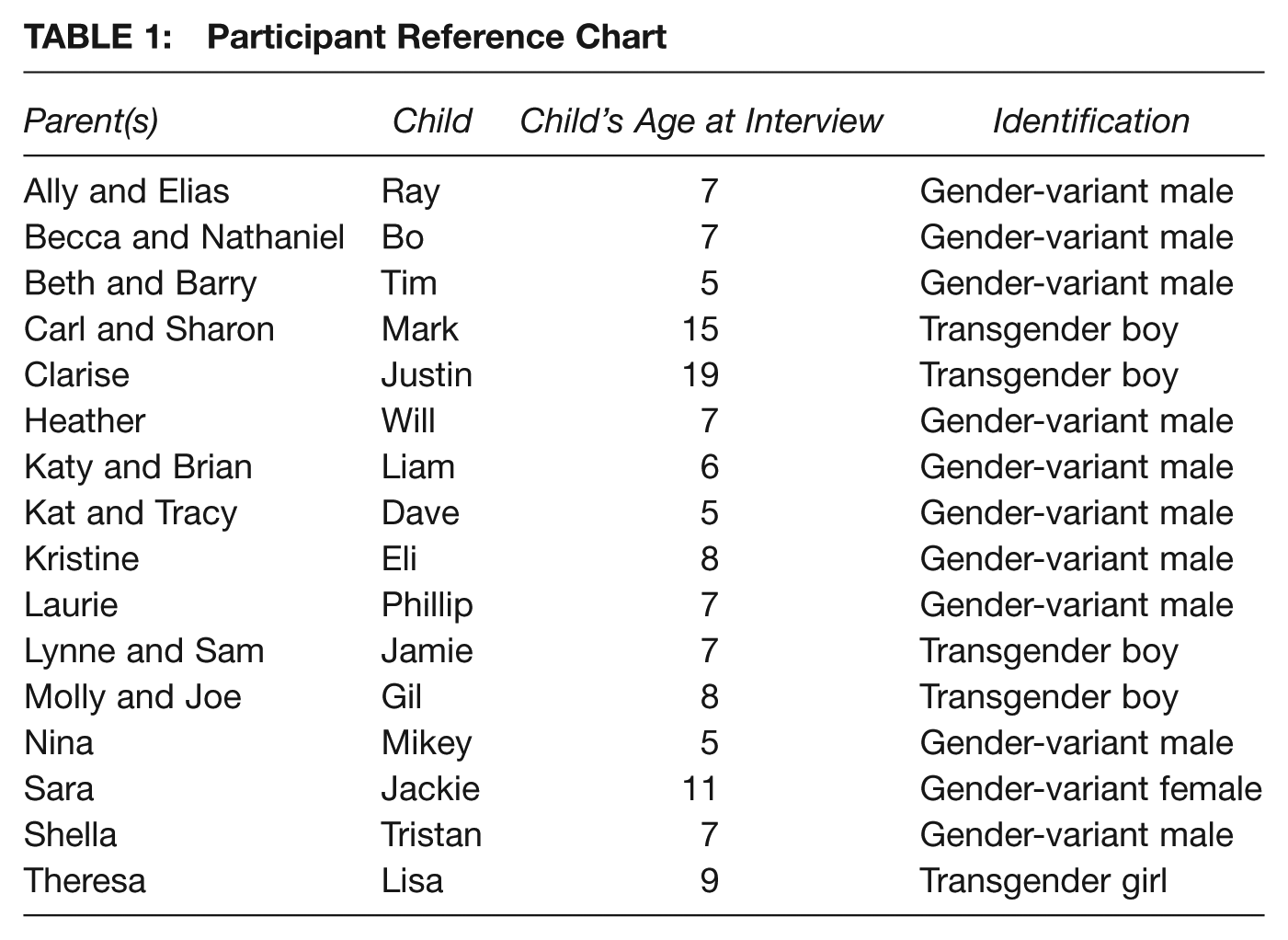
Demographically speaking, the participants are largely white, middle-class, and well-educated: those comprising half the households earn more than $100,000 per year (none of whom have more than 2 children), and 18 of the 24 parents are college-educated (6 of whom have graduate degrees). Nearly all of my interviewees are white (23 of the 24 parents), although 3 of the children/partnerships involve interracial unions, white and Latino. The parents represent 10 heterosexual partnerships, 4 same-sex female partnerships, 6 and 2 heterosexual single mothers. None of the parents are transgender (although one mother identifies as “butch” and gender-nonconforming). While there are a substantial number of lesbian couples in the sample, I did not work to recruit lesbian couples. While many might assume that LGBT parents are more likely to embrace a child as LGBT, there is no statistical evidence for this (Stacey and Biblarz 2001), and several women in the sample advised that being LGB-identified made them feel no more prepared to raise a transgender child. One lesbian parent advised that prior to these experiences, she was “borderline transphobic,” and feels pressured, in her parents’ eyes, to have “normal” children. However, her partner, as well as 2 other women, mentioned having transgender friends in their social networks who stand as key personal resources. The majority of the cases are located in California (12 families), while 2 are on the East coast, 1 is in the Midwest, and 1 is in Canada.
This demographic profile is representative of the kinds of parents that would be best equipped, and have ample resources, to support their nonnormative child in the ways observed in this article. From navigating the online advocacy community, to attending support groups and national conferences, to consulting various gender “experts” and mental health specialists, to negotiating with school administrations, to blogging about their experiences—all on top of the “regular” demands of parenthood—these parents’ raced and classed privileges no doubt enabled them to advocate in the ways that they did for their children’s gender variance. Another salient feature of the sample is the preponderance of mothers over fathers. Indeed, the majority of comments presented here come from mothers; fathers never contacted me for the study. These aspects might reflect wider cultural trends in childrearing that are inflected by race, class, and gender, including “intensive mothering” (Hays 1996) and “concerted cultivation” (Lareau 2003), which entail similar kinds of parental capital—often from mothers—to attend to a child’s individual growth so intently.
Between June 2009 and September 2010, I conducted 17 interviews with these 24 parents, lasting from 1 to 3 and a half hours. Six of the interviews were held at the parents’ homes, but most were conducted over the telephone, as many of the participants lived a significant distance away. While a study on parents’ practices would be well suited to direct observation, that kind of ethnography, in the privacy of families’ homes, was not an option; except for a few cases, most parents did not want their child studied by a researcher. It seemed that, for many parents, keeping their child ignorant of my project was part of their efforts to normalize their child’s nonconformity. 7 As such, interviewing parents about their experiences with their children, versus directly observing them, proved the most viable method for this project.
In the semi-structured interviews, I asked parents about a range of themes, including: how they first came to observe and identify their child as gender-variant or transgender; which terminology they preferred and/or used with their child; the means of support and resources they sought; their child’s school life and parents’ negotiations with administration; siblings’ reactions; dialogues they had with their children about gender, sexuality, and/or the body; and new understandings about gender that parents had developed. I recorded all interviews with a digital recorder and manually transcribed them, and wrote preliminary memos for each interview, highlighting salient themes. I then coded all transcripts using Atlas.ti, a qualitative data analysis software program. Informed by grounded theory methods, I used open coding techniques to allow for patterns to emerge from across the narrative data (Charmaz 2006; Glaser and Strauss 1967). I also flagged contradictory data relative to these patterns. From these, I ultimately clarified and organized the major stages, processes, practices, and beliefs that parents articulated about identifying and managing their children’s gender variance.
As an outsider on multiple fronts in such sensitive terrain—I am not a parent, not transgender, and not the kind of medical or mental health professional parents normally consult—I was concerned about the major sources of difference between my research subjects and me. In truth, interviewing the cisgender parents, and not the gender-variant children, offered me a modicum of reassurance that I was resisting the legacy of cisgender academics objectifying transgender research subjects (Serano 2007). Given my outsider status at the conference, the organizers asked me not to approach parents directly, which I strictly obliged. Instead, parents approached me and/or left their contact information at my table in a designated vendor section if they were interested in participating. Despite my concerns and the wariness I sensed from conference organizers, parents seemed to have great faith in my status as a researcher and cited an eagerness to participate due to what they feel is a dearth of information about these children. Several parents also expressed feeling that the interview was “therapeutic” for them, as they were able to confide in someone anonymously. Moreover, I found that my cisgender status offered a source of rapport with the other cisgender parents I was interviewing; we connected as gender-normative persons who are invested in supporting (trans)gender diversity.
Challenging the Gender Truth Regime
By the time they enter parenthood, many adults have internalized a dominant cultural ideology that presumes a deterministic relationship between sex and gender; “males” are boys and “females” are girls. But the parents in this study confront the limits of these “certainties” in the face of their children’s persistent gender-variant preferences and expressions. In this section, I describe three major practices that surfaced in parents’ narratives: “gender hedging,” “gender literacy,” and “playing along.” Through these practices, parents come to an awareness of the gender binary as a restrictive truth regime, and work to carve out more inclusive understandings of, and practices around, gender nonconformity, despite a world that is largely ignorant of childhood transgender possibilities.
Gender Hedging: “Walking the Fine Line” of the Gender Binary
When referring to the early stages of their parenting careers, before they grew cognizant of the prospect of a “gender-variant” or “transgender” child, almost all parents described engaging in a kind of boundary work with their children’s “atypical” behaviors, especially as the child approached school age. I refer to this work as “gender hedging,” or parents’ creative efforts to curb their child’s nonconformity and stay within gender-normative constraints. A parent purchases pink socks for their “son,” for example, but not a skirt. I introduce gender hedging as parents’ first strategic negotiations with the gender truth regime, as it marks a crucial phase in their developing consciousness about this dominant belief system: gender proves as much a set of cultural dictates to which parents feel beholden as it does a given “truth” about their child’s sex, which offers little reference for their child’s persistent preferences and behaviors. While gender hedging largely upholds the gender truth regime, as parents work to fashion an overall front of normativity (e.g., no dresses at the store), it also permits small concessions to a child’s gender-variant interests (e.g., a pink shirt is okay), and stirs parents’ questioning about how much of these they should regulate and restrain, if at all.
When I asked parents to orient me to their child’s gender nonconformity, they listed a variety of activities their child engaged in, often starting around the age of two, that were the stereotypical stock of the “other sex’s” interests and preferences, including toys, clothing, types of play, and friend groups. 8 Tim, for example, adored playing dress-up in an Ariel mermaid costume (which Beth purchased for him after he repeatedly begged for it at the store), which came complete with jewelry and high heels. However, the outfit proved “too much” for Beth and Barry to accept, and lines were drawn regarding the extent to which Tim could wear it: the dress was allowed, but not the accessories, and only indoors. Tim also wanted to carry a purse in public. Beth offered him a “substitute”; she gave him a small boutique shopping bag with handles instead of a woman’s handbag, so as to be less conspicuous. Beth described such efforts as a “daily tightrope walk” and “a fine line that [they] walk.”
Katy also remembered trying to accommodate her child’s preferences for girly clothes in public: “He started wearing some feminine stuff, [at the store] I’d pick out, okay, it’s not pink but it’s got Hello Kitty on it, that’ll be okay, you know.” Theresa recalled her efforts to “soft pedal” around Lisa’s girliness in one emblematic move: when Lisa started kindergarten, Theresa made an interactive chart with popsicle sticks designating the kinds of daily attire Lisa could wear to school. On some days, Lisa could wear more feminine clothes (skorts—half shorts, half skirt); on others, she had to wear boy clothes (pants). Now, Theresa cringes at the thought of it, but at the time, she felt she had to “enforce a balance . . . not to go all the way into girly-girly land.” Ally commented on the conscious border work that gender hedging entails: The compromise was, “Okay, not dress-ups to the park but how about this pink T-shirt?” . . . We’d find ourselves negotiating when a new thing was introduced that was just going to make him stand out a little more. I think what we were wondering about was, where was that line where it would, quote, “bother” people?
Parents, in both male and female cases, also expressed fear about their child’s risk of bullying and exclusion, which largely compelled their early efforts to keep the nonconformity at bay and indoors.
Notably, Kane (2006, 2012) described similar kinds of “boundary maintenance” among the parents she studied, who allowed gender-atypical play indoors but ensured gender-normative presentations in public, especially with male children. However, the parents in this study eventually allowed children assigned male access to proverbial “icons of femininity” (Kane 2006), including frilly skirts and dresses outside of the house, and long hair. With children assigned female, parents obliged more and more clothing from the boys’ department and short haircuts. Moreover, these parents mentioned what their children said (i.e., “I’m your son, not your daughter!” or “I feel more like a girl than a boy”) as much as what they did or liked, and the significance attributed to these verbal declarations cannot be underestimated. These parents would argue that their child’s repeated self-identifications are what set them apart from other children who “just” prefer occasional gender-atypical activities (and whose parents permit this). 9
Interestingly enough, in a quarter of the cases, parents confessed to cloaking their regulation of certain behaviors in excuses that did not have to do with gender: Molly told Gil that his clothing preferences were too “sloppy,” versus too masculine for a little girl, which she now recognizes was her “ulterior motive.” Beth gave Tim’s favorite dress-up heels to the dog so she didn’t have to tell him they didn’t want him wearing them. Theresa routinely framed pants as more comfortable for playtime with peers, versus more appropriate for boys. Parents’ rhetorical moves to hide the true motives of their gender hedging is perhaps the most intriguing element of the practice: while parents felt bound to conform, they sought to avoid teaching that conformity explicitly to their children.
Parents’ strategic work in gender hedging makes them increasingly frustrated with the regulatory forces of the gender truth regime, which presumes certain behaviors and dispositions relative to particular sex categories but which do not align with those of their children, time and again. In attempting to comply with the regime and not “bother other people”—including, fundamentally, protecting their children from negative attention—parents devise a variety of crafty maneuvers to satisfy their child’s preferences while staying just within binary limits, but these continue to belie what their children really want. As Carl relayed, “We saw him when he was being pushed into, because of our own ignorance, a gender that wasn’t his to accept . . . he would push back and [say], ‘I’m not doing that.’” These tiresome negotiations ultimately catalyze their search for insights online, where they encounter a body of trans-affirming discourses that radically shift their perceptions about gender.
Gender Literacy: Talking Back to the Gender Binary
Parents’ encounters on the Internet usher in a new stage of consciousness about childhood gender nonconformity, which challenges their attempts to curb it and breeds a new set of strategies. These strategies manifest in the form of explicit dialogues and discourse, with their children and with others, about more expansive (trans)gender possibilities than the gender truth regime allows. Through their online searches, parents find a flurry of talk among other parents, professionals, advocates, blogs, listservs, and advocacy organizations about gender-variant and transgender children. In these virtual forums—which often lead to live support groups and conferences with other parents—gender variance is affirmed as a natural, normal part of human diversity. Longstanding cultural beliefs rooted in the gender binary are the problem, as represented in the following excerpt from one prominent advocacy organization: “When a child is born, a quick glance between the legs determines the gender label that the child will carry for life. But . . . a binary concept still fails to capture [that] . . . biological gender occurs across a continuum of possibilities” (Gender Spectrum, n.d.). This discursive community also asserts that gender and sexuality are “separate, distinct parts of our overall identity” and that “gender expression should not be viewed as an indication of sexual orientation” (Gender Spectrum, n.d.). This distinction reverberated, often passionately, in my interviews. Tellingly, a striking majority of parents also volunteered awareness that their child could be both “trans and gay” as adults (the two adolescents in the sample, for example, transgender boys, identified as “gay” and “bi” at the time of our interviews). Parents’ affirmation of their children’s nonconformity as a matter of gender, and not (homo)sexuality, surfaced as a key component of the newfound transgender-aware principles they espoused.
During our interviews, it became apparent that parents sought to reiterate these discourses within their homes. Parents frequently recounted conversations with their children in which they aimed to pass on a more inclusive, less binary understanding of gender. I refer to these efforts as “gender literacy,” which I adapt from France Winndance Twine’s (2010) work on “racial literacy,” in which white parents of Black and biracial children seek to educate their children about structural racism and cultivate pride in African diasporic culture and history. Gender literacy constitutes a major strategy through which parents worked to explicitly resist the gender truth regime.
One aspect of gender literacy entails parents’ efforts to equip their children with a simple vocabulary for explaining their nonconformity to peers. Laurie said, “We would have to coach him on the kinds of responses to have to other kids . . . [he says] he’s a boy who likes feminine things.” Similarly, Heather claimed, “We kind of say together . . . ‘You’re always gonna be a girl in your heart.’” Both Molly and Lynne said that prior to their children’s transitions they used the phrase “boy with a girl’s body.” Katy actually tried defining “transgender,” “gender-variant,” and “intersex” for Liam, because she thought these might resonate with how he feels. While Katy worried that these terms were too complicated for Liam, they signify her enduring attempts to provide a language in her home that normalizes gender variance. In contrast, Becca and Sara preferred using labels their children derived themselves. Becca, who adopted her child’s coinage “boygir,” exemplified this philosophy: “One of the things I’ve really had to struggle with . . . is the labeling. . . . We’re just trying to put our own experiences around it . . . [but] I want him to define himself.” Here, Becca testifies not only to the child-directed nature of this process (parents defer to their children’s self-conceptions) but to the intellectual work she does to deconstruct conventional “truths” about sex and gender, including their categorical referents, that she has internalized.
Another facet of this strategy is parents’ warning their children about prejudice toward gender nonconformity, similar to the “preparation for bias” that racial socialization scholars have observed among parents and children of color (Hughes et al. 2006). Ally, for example, believes that she has to be candid with Ray about potential harassment from peers: “I think that was how I explained it to him early on was, there are some people . . . who are gonna be really mean, ’cause they don’t understand that . . . boys can wear girly clothes, play with girly toys.” Tracy compared the importance of these lessons to dialoguing about racism: “I still think that we have to talk openly about what society is gonna expect because I think, just like with racism . . . ignoring race and pretending it doesn’t exist is . . . not helpful to children.”
Parents also strive to articulate trans-inclusive understandings of bodies and gender. Sam, for example, recalled making the following “edits” for Jamie when the topic of bodies appeared in a children’s book: “I’d say, ‘Nearly all girls’ bodies are like this and nearly all boys’ bodies are like that’ . . . I [told him] that there are some people whose bodies don’t match up with the genital parts that you traditionally associate.” Tracy said that when her children use public restrooms, she will ask them which bathroom someone would use who does not identify as man or woman, “just to kind of plant the seed [that] it doesn’t have to be one or the other.” Moreover, in half of the preadolescent cases, parents indicated that they made their children aware, in the simplest terms possible, that there are “drugs,” “medication,” and/or “surgeries” that can help with body change in the future, when such questions surfaced (Liam, for example, expressed interest in having breasts “like his Mommy’s”). These are striking examples of parents’ attempts to actively affirm transgender and transsexual subjectivities during early childhood, versus regurgitating the body logics of the gender truth regime (i.e., “You can’t have breasts like your Mommy’s, you’re a boy”).
Parents engage their gender-normative children in gender literacy as well. For example, when their younger son, Eddy, asked them if Liam identifies as a boy or girl, Katy and Brian responded, “Well, sometimes Liam doesn’t know, and sometimes Liam feels like a girl, and sometimes Liam feels like a boy, and that’s okay . . . how do you feel on the inside?” As a testament to the gender-progressive potential of these strategies, Eddy wore a skirt to school over his shorts so that he could tell his friends, “Boys can wear skirts [too].” Clarise described her youngest child, who is six, as the one who “gets it” the best: “[She] gets that there’s all kinds of varieties of gender . . . because it’s always been that way for her.” The gender literacy in which parents engage all of their children is indicative of how the presumptions of the gender truth regime are being radically resisted and retold in these families.
Parents practice gender literacy in more public institutions, too, including their children’s schools. Parents work with teachers and administrators to coordinate gender-inclusiveness training, as well as to draft school policies that specifically protect “gender identity and/or expression.” Carl joined an organization that teaches LGBT awareness to religious bodies in his community: “I wouldn’t [have] done it if it weren’t for Mark . . . I don’t want him growing up in an environment that doesn’t accept him.” Several parents also launched online blogs detailing their experiences. Alicia reflected, “[Parents are] starting to move into an advocacy role, so they’re wanting to include the general public in these discussions . . . parents are looking to have a voice.”
These myriad forms of gender literacy—from actively dialoguing with their children to writing for a public audience online and negotiating with school personnel—recall the work of Hapa activists who seek to challenge the U.S. monoracial “truth regime” (Bernstein and De la Cruz 2009), both institutionally regarding state policies and in quotidian conversations when questions about their identity come up. Like Hapa activists and race, these parents endeavor to insert more expansive understandings of gender into their social spheres, not only within their homes but in their larger communities as well, talking back to the gender truth regime on a more public and politicized level.
“Playing Along” (or Not): “Head Games” with the Gender Binary
While parents enact multiple forms of “gender literacy” to challenge the gender truth regime, they also feel that not every instance is appropriate for, or receptive to, such explicit deconstructionist efforts. This proved particularly true for interactions with strangers, who often attribute the wrong gender to a child (for example, at the grocery store, someone refers to a gender-variant male child as a “beautiful little girl”). Echoing Foucauldian dynamics of power, Bernstein and De la Cruz write, “[D]iscursive systems of meaning related to categorization operate as a system of power that is . . . enforced through standard interactional routines” (Bernstein and De la Cruz 2009, 740). During such interactional routines, parents confront the power effects of the gender truth regime, and must manage others’ normative assumptions about sex and gender vis-à-vis their gender-variant children. Becca described these encounters as a “head game”: “Up until this point, I have a little boy, and I know what’s going on with my little boy, but [then] . . . suddenly, it’s like I have to think of this as like having a little girl, which is its own . . . head game.”
Such “head games” recall the discursive strategies of the nonbiological lesbian mothers in Sullivan’s study, who have to decide between “playing it straight” or “telling it like it is” under the “palpable influence of the mother–father–child family truth regime” (Sullivan 2001, 51). These women “learn to assess the potential duration and relative importance of the interactions for which certain strategies are more appropriate than others” (Sullivan 2001, 51), assessments well observed among parents in this study. Parents advised that “playing along,” as it was often described to me, was the most appropriate strategy with people whom they were unlikely to see again, when candid lessons about gender variance felt inapt: “In the interest of just keeping . . . the social construct together, I went with it, and I was just, like, whatever, I’m not in a space to educate” (Becca). Moreover, most children ask their parents not to correct strangers in these instances (such early requests are often regarded as indicative of a transgender identity later on). While “playing along” may not rupture the “social construct” for parents’ interlocutors—and I seek to emphasize parents’ heightened awareness that the construct exists—this strategy permits gender-variant expressions in public in a way that the norms of a child’s assigned sex would disallow. Parents’ decisions to honor their children’s requests and “play along” with strangers thus affords their children safety and privacy that more explicit kinds of “gender literacy” might make uncomfortable. Indeed, many parents adopt the perspective that what their child has “between their legs” is nobody’s business and irrelevant to their preferred gender presentation. Theresa reflected on these early negotiations: “She did start saying, ‘Don’t tell anybody I’m a boy’ . . . I realize now that I was very anxious to take care of [other people], how do I help people to understand. . . . What I’m really trying to figure out [is] how to protect her privacy and still run interference.” In short, playing along and not saying anything, versus effectively revealing their child’s assigned sex to strangers, proved an important discursive practice in its own right to accommodate their children’s most comfortable self-expressions, particularly for gender-variant children who had not claimed a binary identity.
When it comes to people parents see more frequently, “playing along” feels less viable. Beth claimed, “I felt the need to explain it to acquaintances and friends . . . you see the parents every day at drop-off . . . so I did feel the need to say, ‘He prefers girl stuff.’” Here, Beth seeks to mediate between her child’s apparent nonconformity (the boy who likes the girly toys and dress-up at school) and others’ potential scrutiny, in turn signaling her own allowances of these preferences. Parents’ discursive interventions in more familiar contexts, versus staying silent, work to carve out space for gender nonconformity where it might be otherwise inhibited. Disclosure is also important when parents fear their child’s safety and well-being is at stake. Theresa, for instance, advised the host parent of a girls-only slumber party that her daughter was transgender, just in case her status was revealed by a potential “wild card” from her old school. Parents’ use of terms like “playing along,” “head game,” and “wild card” are duly reflective of the strategic awareness they have developed to navigate the gender truth regime in everyday life, protecting and accommodating their children in the most appropriate ways they see fit with different audiences.
In contrast to the logics of the gender truth regime, parents adopt new ideologies that imagine a wider “spectrum” of (trans)gender possibilities, which are not moored to two, static sex categories. Shella reflected, “It’s amazing to watch somebody really be strong in who they are to try and tackle something huge, because okay, you’re born with a penis, okay, you’re a boy, boom, done—NO, not necessarily.” Ally reiterated this perspective: “You wanna call somebody with a penis ‘male’? Yeah, talk to the hyenas.” 10 Alongside this de-linking of sex and gender, parents discussed more fluid, nonbinary identities, which Ally mused about as “a whole ’nother space that doesn’t have to be just girl, just boy.” Katy also mentioned a desire to “[go] beyond the binary” and advocate for the “boy in the skirt.” This kind of intellectual work is particularly important for parents whose children had not articulated a binary identity (boy or girl), but were more fluid or switched their expressions day-to-day.
As parents reject traditional binary beliefs for a more spectrum-oriented perspective, they also embrace the idea that we are “born” with our gender, that it is an innate, “immutable” part of us. Several of the mothers in my study—self-proclaimed feminists who came of age during the 1970s—advised that having a gender-variant child has made them rethink the constructionist beliefs they adopted during second-wave feminism. Laurie typified this attitude: Having grown up with this sort of . . . feminist attitude . . . I grew up in the ’70s, the free-to-be-you-and-me generation . . . and I always thought that we could choose our gender expression, and I didn’t realize until I had a kid that gender expression or gender identity is just this immutable part of you, like the color of your skin, or any other fixed part of you.
Similarly, Brian asserted that gender variance stems “from the first duplication of those cells . . . this is how they’re made.” Joe raised the possibility of genetic or hormonal factors: “It’s got to be either in vitro [utero] or hormonal . . . or maybe there’s some gene . . . there seems to be a gene that causes everything else.” For these parents, only an innate hard-wiring during fetal development, or a “core biology,” could explain a child’s gender (variance) that resisted all cues to normative socialization. Evidently, these parents reconceive of gender in ways that harness both essentialist and constructionist frameworks. They reject the conventional sex-based assumptions of the gender truth regime, which they now see as hardly representative of the various ways masculinity and femininity manifest in the human population. Simultaneously, they embrace gender variance as a matter of “natural” human variation, often literally at the genomic or cellular level. In imagining “beyond the binary,” these parents do not abandon the essentialist underpinnings of normative gender ideology.
Conclusions
Social scientists have long been interested in the potential for parents to disrupt gender norms with their children (Bem 1983; Pogrebin 1980; Risman and Meyers 1997; Statham 1986). This analysis chronicles parents’ newfound reckonings with the gender binary in ways that are particularly transgender-aware. Rather than unwittingly reproducing normative ideology to the effect that the body you were born with determines the gender you can be, these parents entertain gender-variant and transgender subjectivities early on in childhood. Given the hold of normative masculinity and compulsory heterosexuality among parents and sons that other researchers have observed (Kane 2006; Martin 2005), this is particularly significant in regards to the children assigned male in this study. This article adds to the research on this emergent social phenomenon (Meadow 2011, 2013); I offer an intimate empirical portrait of multiple practical, discursive, and intellectual strategies these parents develop to navigate the gender binary in everyday life and accommodate their culturally “anomalous” children.
As I have argued, the gender binary functions as a truth regime in society, whose discursive force is alive and kicking in the first moments of a child’s life. As a truth regime, the gender binary establishes a set of cultural presumptions about one’s gendered preferences, expressions, and identity relative to an assigned sex. While many contemporary parents have divested from more stereotypical versions of this cultural code (boys like trucks and sports, girls like dolls and the color pink) (Kane 2012), this ideology still fundamentally circumscribes the possibilities of one’s gendered sense of self (“boy” or “girl”). Sandra Bem, one of the major proponents of “gender-neutral” or “gender-aschematic” parenting, advised that she always tried to reduce the difference between boys and girls to anatomy to her children, ultimately reiterating a cisgender relationship between sex and gender: “[A] boy, we said again and again, is someone with a penis and testicles; a girl is someone with a vagina, a clitoris, and a uterus” (Bem 1998, 107). The parents in this study, in contrast, ultimately rupture that quintessential link between sex and gender, entertaining a “core” (trans)gender identity that the regime renders otherwise unintelligible for young children. Indeed, many parents go on to teach their children, “not all boys have penises” or “some girls have penises.”
From their early, complicated maneuverings with their children’s “atypical” behaviors (“gender hedging”) to discovering an online advocacy community that affirms these behaviors, these parents develop an awareness of the gender binary as a truth regime, which negates their child’s most authentic sense of self. Like the nonbiological mothers in Sullivan’s (2001) study and the Hapa activists in Bernstein and De la Cruz’s research (2009), these parents develop multiple discursive and practical strategies, organically and sometimes more forthrightly, to navigate and often explicitly challenge the (cisgender) presumptions of the gender truth regime. The power effects of the gender binary are felt in myriad mundane encounters, from storybooks they read to their children to interactions with strangers at the grocery store. Through “gender literacy,” parents work to deploy new understandings and vocabularies that normalize gender variance, both inside the home during ad hoc conversations with their children and outside the home with schools and a larger audience online, who may be experiencing similar “problems” with their children. During various “head games,” parents discern when to “play along” with others’ misconceptions, protecting their children’s self-expressions, and when to mediate more candid awareness about their nonconformity. Through these strategies, these parents strive to protect and make viable gender-variant subjectivities for their children. Among these families, boys and girls can be whatever they want to be, including, conceivably, (transgender) girls and boys, or something less binary altogether.
Following their analysis of Hapa activists’ multiracial identity construction, Bernstein and De la Cruz argue that the concept of “truth regime” can be applied to “other groups that operate at the interstices between dominant cultural categories such as queer, intersexed, or transgendered movements” (Bernstein and De la Cruz 2009, 740). The use of the term “truth regime” in this analysis serves to highlight the discursive and ideological forces of a dichotomous, sex-deterministic gender system in everyday interactions, against which the parents in this study must operate on behalf of their gender-variant children. Starting with the pronouncement at birth that a child is a “boy” or “girl,” parents’ attempts to navigate and resist the gender binary thus necessitate counterdiscursive strategies, as well as conscious deconstructions of hegemonic conceptions of sex and gender, males and females. In light of parents’ deployment of both essentialist and nonbinary understandings of gender, the application of the term “truth regime” also reveals how social agents can draw on coexisting knowledge systems, which can be used to bolster the regime or challenge its disciplinary power and imagine new cultural possibilities.
There are several additional aspects of parents’ approaches that are significant to the literatures on gendered parenting and childhood socialization. First, parents’ responses are largely child-driven. Rather than parents practicing gender-progressive politics from the outset, these parents come to a new gender consciousness by virtue of their children’s assertions, as they are expressed in the daily unfolding of family life. In this way, parents and children alike are co-constituents in the push-and-pull of a normative gender order. Childhood socialization scholars have observed such bidirectional processes more generally (Coltrane and Adams 1997; Peterson and Rollins 1987). The cases represented here extend these schools of thought and might uproot traditional understandings of “normative” gender identity development. The demographics of the sample signal the class-inflected elements of this phenomenon as well. Middle-class parents often practice a child-centered approach, nurturing their child’s individual growth and dispositions with multiple outside resources (Lareau 2003). The socioeconomic privileges of the parents observed here make them particularly able to respond to, and advocate for, their children’s gender nonconformity vis-à-vis various institutional authorities.
Additionally, while these parents seek to challenge the terms of the gender binary, they do not refute presocial understandings of gender, which are often considered the converse of gender-progressive parenting. Rather than a “fallback” theory to explain gender-normative children (Kane 2012), these parents harness essentialist explanations to embrace transgressive (trans)gender expressions, a frame similarly observed in Meadow’s (2011) sample. Parents’ use of biological-determinist frameworks (including “genes” and “cells”) to emancipate sex-category assignments for their children, versus merely to explain seeming acquiescence to them, adds an important perspective to research interested in “gender-neutral” or “feminist” parenting.
This article captures several critical processes in a broader longitudinal journey I am studying among parents who identify their children as gender-variant or transgender. Five of the ten children identified as “gender-variant” at the time these data were collected are now living as transgender girls, and many of these parents have started consulting doctors about hormonal modifications on their behalf. The processes and strategies that these parents undertake to chart those identities and transitions are the subject of further analysis. These parents are pioneering new pathways in gendered childhoods, which accommodate a broader array of (trans)gender identities and possibilities and could harbor profound effects for future families and generations.
Footnotes
Acknowledgements
I am indebted to the parents of this study, who continue to give me their time, candor, and insights. I am grateful to Sarah Fenstermaker and Beth Schneider for reviewing multiple drafts of this piece. I am also grateful to Joya Misra, Mary Bernstein, and the anonymous Gender & Society reviewers for their invaluable feedback and comments, which helped to see this article to completion.
Notes
Elizabeth Rahilly is a PhD candidate in sociology at the University of California, Santa Barbara. Her current research project regards parents who raise and support gender-variant and transgender children. Her research and teaching interests include gender, sexualities, and qualitative methods.