



Abstract
This paper explores women’s daily practice of resistance built into the racialized and gendered social structure of customary marriages in South Africa. I argue that women resist, accommodate, adapt, and contest power and authority in the decision to leave the marriage, in negotiating the exit from the marriage, and in their approach to the financial consequences of the separation. By using the myriad of daily practices as evidence for resistance, the study identifies three forms of femininities that emerge from the data: Emphasized femininity characterizes women’s compliance with women’s subordination, ambivalent femininity describes a complex combination of compliance and resistant activities in women practices, and alternative femininities typifies the rejection and resistance with women’s subordination. The paper discusses how these different forms of femininity emerge in their specific cultural, class, and temporal context. The findings reveal that the resistance practices are accompanied by more general ideological awareness of how gender, seniority, and lineage shape the lives of these women at this time of transition.
In the first days of your marriage the aunties, uncles and all the family, they will come and tell you that “lady, you must know that this man is your head, you are the neck. Whatever he is telling you, or whatever he is saying, that’s the word, he’s the head, you don’t have to challenge him.” Where I come from, if you challenge whatever a man has said you will be called by names.
A member of a discussion group held in a rural area in the South African province of Limpopo explains how power in the customary marital relationship is managed from inside as well as outside the relationship. This quote embodies a much broader ideological reach and demonstrates the structuring of unequal social relations between genders and generations in the arena of marriage. In the context of racialized oppression and colonial rule, and in a context where income poverty remains a gendered and racial phenomenon, marriage enables many women to improve their access to resources and social networks, while often compelling them to comply with gender-conforming practices (Kandiyoti 1988; Mnisi Weeks 2012; Rashid 2006). Evidence in South Africa demonstrates that the ending of the marriage, through separation, divorce, or the death of a husband, exposes wives to unequal power relations among their co-wives (Mbatha, Najma, and Bonthys 2007; Pienaar 2003), their former husbands (Budlender et al. 2011; Griffiths 1997), and their husbands’ families (Budlender et al. 2011; Burman 2008; Classens and Ngubane 2008; Griffiths 1997). The dissolution of a customary marriage offers an opportunity to examine the complex hierarchy of power and authority arrangements among men, women, and related others and allows us, in this article, to pay more attention to women’s “forms of consciousness and struggle that emerge in times of rapid social change” (Kandiyoti 1988, 284).
In this article, I present how women resist, accommodate, adapt, and contest power and authority at the end of a customary marriage. I provide a brief outline of the context of customary marriage and customary law in South Africa before presenting the theoretical background and the demographic data in which the findings are located. Next I describe the research methods adopted for the study and then present the three forms of femininity identified in this study. The final section outlines how women are fighting new areas of struggle and renegotiating relations between genders and generations.
Customary Law and Marriage in South Africa
For many African groups, marriage can be considered a process that may take place over many years and involves relations between families (Griffiths 1997, 53). Previously only partially recognized according to South African law, customary marriages were legally recognized more fully with the introduction of the Recognition of Customary Marriages Act of 1998 (RCMA). The Act defines a customary marriage as “a marriage in accordance with customary law” and defines customary law as “the customs and usages traditionally observed among the indigenous African peoples of South Africa and which form part of the culture of those peoples.” Just over a quarter of all black South Africans are married, and 42 percent of those who marry opt for a customary marriage as opposed to a civil or religious marriage. 1 Customary marriages can be monogamous or polygamous. A very small percentage of black South Africans (0.1 percent) identify themselves as being part of a polygamous marriage.
During colonialism and apartheid, customary marriage laws were changed and “invented” to exaggerate the patriarchal norms within customary marriages (Chanock 1991; Nhlapo 1991). African feminist scholars (Amadiume 1987; Oyewùmí 1997) describe how colonial rule eroded the sociopolitical and economic power of women in different parts of the continent. In both southern Africa (Chanock 1991; Schmidt 1991) and South Africa (Posel 1995; Walker 1990), African chiefs and elder men were anxious about the control of “unruly” African women. With the threat of industrialization and urbanization, the patriarchal alliance of African men and the state used “customary law” as a vehicle to refashion rural tradition and bring African women under control (McClendon 1995, 527).
The racialized and gendered laws at this time acted as an oppressive system of domination. The exclusion of customary unions from the protection that civil marriages were afforded since the late 1920s was wrong, but the exclusion from and subordination within of women from both was remarkable. Under the Black Administration Act 2 (BAA), women were denied the right to acquire and own property in their own right. The BAA accorded customary union husbands absolute ownership of household property, which included the personal property and earnings of their wives. Moreover, the BAA regarded women as perpetual minors under the guardianship of either their male relatives or husbands. Access to courts was limited as women could not litigate without consent of or assistance by their legal guardians.
With the end of Apartheid and the arrival of democracy, the enactment of the RCMA ensured the recognition of customary marriages for black South Africans. 3 The new laws not only improve women’s access to economic resources from a marriage but also women’s access to justice by having matters dealt with at the court level only. The reformed laws theoretically provide women with rights to equality, but evidence suggests that there continue to be structural and cultural barriers in African families and communities, making implementing these laws very difficult (Mamashela 2004; Mbatha, Najma, and Bonthys 2007). This article reveals the challenges women experience while negotiating their way out of a customary marriage with family members.
Resistance, Compliance, and Levels of Constraints: Power Struggles in Customary Marriage
Many feminist researchers use gender as the model for explaining women’s subordination and oppression. However, scholars question the power of gender to explain African societies (Amadiume 1987; Arnfred 2007; Oyewùmí 1997; Olúfunké Okome 2003). In keeping with intersectional theory, Amadiume (1987) argued that the idea of male dominance and female subordination does not fully capture the dynamics of power because hierarchy depends on social relations and positions. One relation that must be taken into account is seniority (Amadiume 1987). Oyewùmí (1997, 42) articulates that “seniority is highly relational and situational in that no one is permanently in a senior or junior position; it all depends on who is present in any given setting or interaction.”
Another social relation more significant than gender difference in the African context, according to Oyewùmí (2004, 4), is whether a person is inside or outside a certain family or lineage. A wife, who marries into a family, assumes a subordinated position, as is the case in most patrilineal societies. Oyewùmí (2004) argues that this position is less about gender than “outsider” status. In arguing this case, she points to the fact that in matrilineal societies the in-married person is a man, whereas in patrilineal societies the in-married stranger is a woman. The subordination of a wife rests in her position vis-à-vis the lineage in question and the seniority in question and not in the biological sex of this person. Olúfunké Okome (2003, 73) sums this up by outlining how “women are not an undifferentiated group, and there are degrees of hierarchy that are manifested in socially specific ways between individuals, men and women alike.”
Oyewùmí (2004) criticizes feminist theorizing for its exclusive focus on the nuclear family. Theorizing from the limited space of the nuclear family overlooks the place of other adults, whether as co-wives or blood-related others. Such actors have been shown in South African research to yield significant power as deserted wives and widows have experienced authority from different members of the deceased male’s relatives (Budlender et al. 2011; Burman 2008; Classens and Ngubane 2008; Mnisi Weeks 2013).
While acknowledging the problems with adopting categories uncritically and distorting local structuring dynamics and modes of understanding, Bakare-Yusuf (2004) argues that Oyewùmí (2004) is guilty of the same practice by focusing exclusively on seniority or lineage, which may or may not carry the same value when translated into other cultural contexts. Indeed Olúfunké Okome (2003, 73) posits that African societies differ markedly depending on the area and called for more comparative analysis of these societies. Bakare-Yusuf (2004), in line with other feminist scholars (Collins 1990; Crenshaw 1989; Ferree 2010), urges researchers to take the interwoven nature of power dynamics seriously by examining the specific value of each variable of power operating in a given situation. The ending of a customary marriage provides a thought-provoking arena to investigate the social relations and positions women have with men and other women in different contexts.
How do dominant groups or classes successfully retain power in intimate relationships in South Africa, more specifically? Most recently, Jewkes and Morrell write that “in a highly gender-inequitable country like South Africa, hegemonic masculinity mobilizes and legitimates the subordination and control of women by men” (Jewkes and Morrell 2010, 3). Scholars argue that the dominant ideal of an African woman submissive and respectful to males, elders, and specific family relations remains (Jewkes and Morrell 2010; Mbatha 2011). Excusing extreme male behavior, such as violence or infidelity, may be an integral part of the dominant femininity for African women (Jewkes and Morrell 2010). The authors contend that such compliance is usually socially rewarded, which is essential for women’s security, maintaining that other forms of femininity are absent because they would be punished by the practice of marginalization and stigma (Jewkes and Morrell 2010). In presenting this argument, the authors fail to outline the myriad voices involved in this process. Who is marginalizing the women? What are the important relational principles affecting the capacity to exercise power and marginalize these women?
Local, small-scale qualitative research studies have demonstrated unique ways in which women resist unequal power relations in intimate relationships (Magwaza 2001; Mathonsi and Gumede 2006). Mathonsi and Gumede (2006) demonstrated how Zulu women, through performance and song (izigiyo) protest against abusive social systems which they experience at the hands of family and community members. These songs of protest give women a voice, albeit within a limited (indoors and usually among a community of women) public sphere. In a separate study, Magwaza (2001) details how rural and illiterate Zulu (Camper-Ndwedwe) women are not passive about their situations, but employ attire in ways that signify not only their compliance with traditionally ascribed status, but also their displeasure, as a form of nonverbal, visual protest. These authors’ work highlights the need to examine private and individual forms of protest as a way of encouraging other women to talk about their positions in male-dominated relationships.
How can we explain why women may excuse sexism and subordination in intimate relationships? Why do women who demonstrate gender awareness tolerate sexism or inequality in intimate relationships? The theoretical construct of patriarchal bargains developed by Kandiyoti (1988) may be useful in this case. Patriarchal bargains influence both “the potential for and specific forms of women’s active or passive resistance in the face of oppression” (Kandiyoti (1988, 283). Kandiyoti presented two very different systems of male dominance and women’s resistance in contrasting class, caste, and ethnic contexts. The insecurities of African kinship systems for women in sub-Saharan Africa inform women’s marital and marketplace strategies, which are characterized as active forms of resistance. She contrasts these experiences with women’s accommodations to “classic patriarchy,” a system based on patrilineal, patrilocal relations of the extended household. Kandiyoti (1988) argues that women’s compliance may be forced when there are no other alternatives. In such cases, women’s passive resistance takes the form of “protection in exchange for submissiveness and propriety.” Another possible explanation is provided by England (2010), who suggests that women transgress gender boundaries purely as a way of seeking upward mobility rather than as a pursuit for its own sake, and stresses that women react to gender structures in whatever way improves their livelihood and security, and are less motivated to seek equal opportunities purely for the sake of undoing gender differentiation. These explanations require us to explore how gender relations operate in a broader context of disadvantage for black South African women.
Socioeconomic Context of Women in Customary Marriage
Black South African females are more at risk of poverty than any other group in South Africa (Posel and Rogin 2009). I compare the socioeconomic position of men and women in civil and customary marriages for black and white South Africans to highlight the ongoing racialized (and gendered) position of disadvantage for black women in customary marriages. As Table 1 demonstrates, there are noteworthy differences in terms of educational attainment, employment status, and individual monthly income between black and white South Africans. However, comparing black Africans in customary marriages with black Africans in civil marriages, we see that black African men and women in customary marriages have lower educational attainment, lower level of employment, and lower income compared to their counterparts in civil marriages.
Educational Attainment, Employment Status, and Individual Monthly Income by Race, Gender, and Marriage Type (Community Survey Data 2007, n = 1,047, 652)

Note: Values are percentages. Income ranges are in South African rands. At the time of writing 13 South African rand was worth approximately 1 US dollar.
The derived employment status variable was used and is based on the official unemployment definition.
This question was asked to determine the income category that best describes the gross monthly or annual income before deductions. It includes all sources of income (including social grants).
What issues might emerge if issues of race and class generally, and understanding of being an African customary wife specifically, are central to feminist theorizing about exiting a marriage? Ignoring racial and class differences creates specific problems, overlooking the relative economic insecurity that exists for black South African customary wives, and the dependency women in customary marriage have on their husbands and families in their struggle for power. The continued pattern of economic and educational exploitation and disadvantage built into the racialized social structure shapes the context for black South African women in customary marriages.
Methods
The research described in this article is drawn from a larger research project on the Operation of the Reformed Customary Law in Practice: The Recognition of Customary Marriages Act and Rules of Intestate Succession Introduced by the Constitutional Court in Bhe vs. Magistrate Khayelitsha. Interview data from more than 80 participants were collected between 2012 and 2013 in six provinces across South Africa. This article is based on semistructured interviews with 19 women who self-identified as separated or divorced. 4
All interviews were conducted in the homes of the participants and in the first language of the participant, which included Xhosa, Zulu, Sepedi, and Tswana. The researchers collaborated with the nonprofit organization National Movement of Rural Women, which manages projects in four of the sampled provinces, including Limpopo, North West, Mpumalanga, and KwaZulu-Natal. Participants in these areas were recruited to attend an information session regarding the “new laws.” More than two hundred people attended the information sessions. Before the session took place, individuals were asked to sign a register that we used to create a sampling frame and obtain some of the necessary sampling criteria from the participants.
In the Eastern Cape and Gauteng—the provinces where the organization is not present—we adopted snowballing methods of sampling. The researchers identified people in the community who met the sampling criteria and we snowballed from the first set of participants. This method was particularly useful because the key selection criteria are characteristics that are not widely discussed by individuals. Table 2 describes the sample on which this article is based. As can be seen, the spread of provinces, languages, and ages of divorcees was broad-ranging. Two-thirds of the participants lived in rural areas. Just under half of the divorcees were unemployed, while the majority of employed divorcees worked in low-skill, low-paying jobs such as retail or factory work. There were two skilled employees. Educational attainment is fairly low, with two-thirds of the sample not completing secondary schooling.
List of Respondents
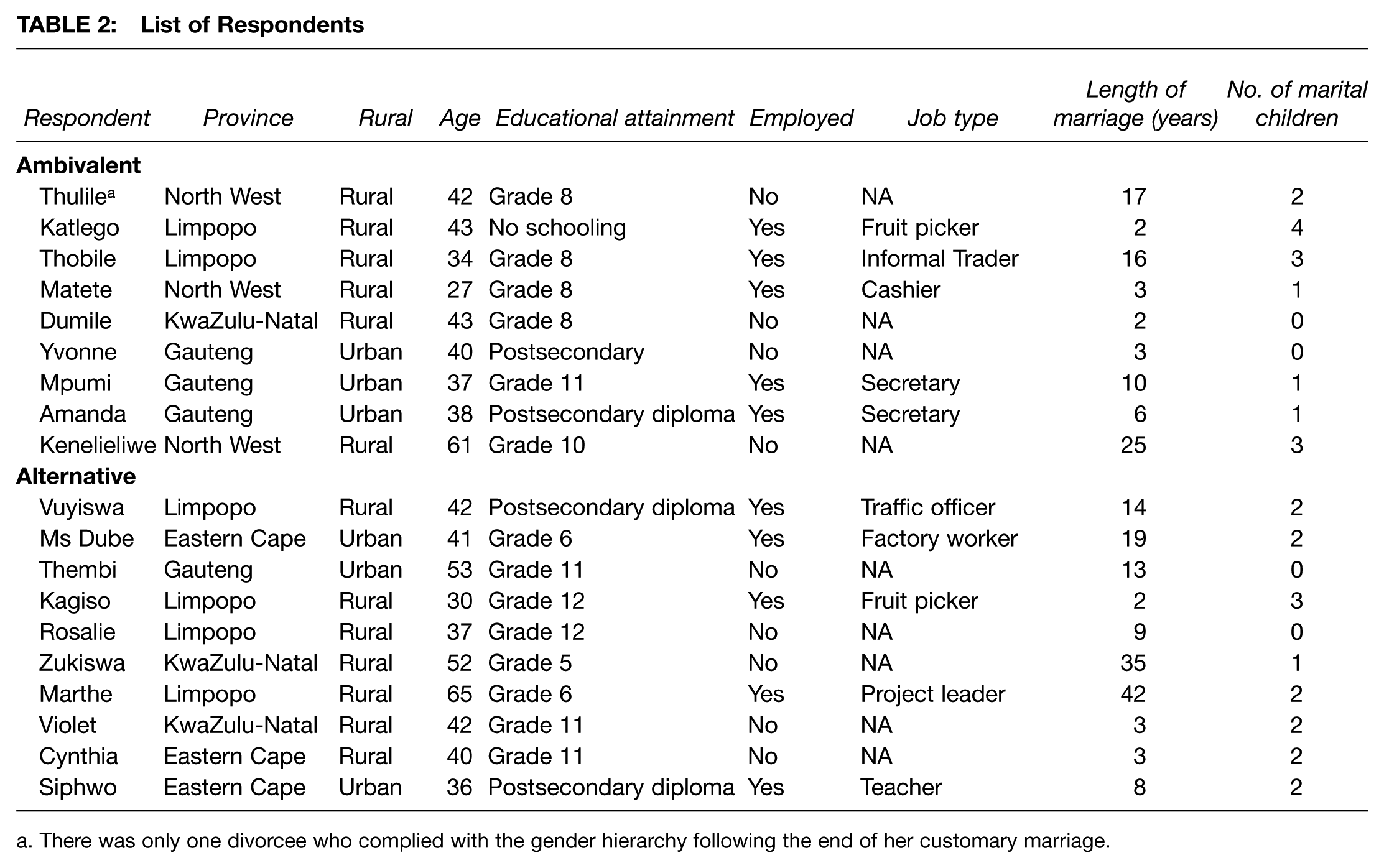
There was only one divorcee who complied with the gender hierarchy following the end of her customary marriage.
Approval for the research was sought from and granted by the Research Ethics Committee at the University of Cape Town. The research team obtained informed consent from the participants at multiple stages of the research. All major identifiers (names of individuals, specific locations) were removed from the data. In the findings that follow, pseudonyms are used. The interview guide comprised four sections, which covered aspects of the personal background of the participant, the conclusion of the marriage, the termination of the marriage, and the postseparation arrangements. The sections relevant to this article focus on the termination of the marriage and the postseparation arrangements. We asked open-ended, nondirective questions about these processes (e.g., “Can you tell me about the troubles in your marriage?” and “Who did you turn to for support?”). We prompted participants only to a minimal degree to follow up an interesting narrated experience (e.g., “Could you tell me in more detail how you experienced the consultations at his home?”).
The method of data analysis followed the “conceptual scaffoldings” approach outlined by Spencer, Ritchie, and O’Connor (2003, 213), which involves three overlapping stages. The first stage involved sorting and reducing the data by generating a set of codes. For example, I used “family meeting” as the initial broad structural code; I coded all data relating to the “family meeting” and sorted the data into different structural codes: (1) parties present, (2) method of including families, (3) reconciliation or fault based, and (4) hearing or briefing (outcome decided in advance). In the second stage of analysis, the nuances and tensions within each category were analyzed and incorporated into the analysis. For example, in some cases, the meeting was a hearing, where all parties had an opportunity to express their views, while in other cases the meeting was a briefing session, where a decision was already made. The outcome of the meeting was either predetermined or unplanned. In the third stage, a typological classification was established to capture women’s perspectives and responses to the family meeting. Two dimensions were used in the designation of categories—engagement with the family meeting and the intention of the outcome of the family meeting. The three categories established were (1) emphasized femininities, 5 (2) ambivalent femininities, and (3) alternative femininities. Those included in the emphasized femininities group included women who wanted to engage in the process and sought a resolution to the dispute that would result in reconciliation. Those in the ambivalent femininities group included women who engaged with the process and did not have any intended outcome of the meeting. Those in the alternative femininities group included women who either engaged or did not engage with the process but had predetermined the outcome of the meeting.
Forms of Femininity
Women comply or resist power and authority when negotiating (1) with their husbands (deciding to end the marriage), (2) with their husband’s families (during family meetings), and (3) the financial consequence of the separation. The women fall into three main categories of femininities: emphasized femininities is characterized by women’s compliance with women’s subordination; ambivalent femininities describes a complex combination of compliance and resistant activities in women’s practices; and alternative femininities typifies the rejection and resistance with women’s subordination.
Emphasized Femininities
One divorcee did not identify gendered processes as sources of oppression. Thulile, a 42-year-old divorcee, had been married for 17 years and had two children. She discovered her husband was having a longstanding affair with a woman who occupied the marital couple’s second home in the city. When she confronted her husband, he ended the marriage by bringing her back to her natal kin
6
: He gave me to my mother and said to her, “I brought her back for you to talk to her and advise her.” So my mother asked, “What do I do after I have done that?” And he said he would come back. The old woman has been waiting since then. No, I have never said I am going to get him.
Thulile’s family were unable to obtain a response from the husband’s family and were left powerless and frustrated, as Thulile explained: “He [her father] got very angry and I told him to wait and then he passed away.” The social power of patrilineal societies works to exclude and isolate this woman and her family, and their treatment demonstrates the weaker position of wives and their families vis-à-vis the husband’s family in resolving disputes within marriages. Thulile continued, “I told my mother to not let it bother her, we should wait on them.” Her actions and thoughts of passive resistance are limited and defined within a patriarchal set of beliefs and practices. The loss of her position entails a loss of economic and social status, so rather than step out of line and question norms, respectability, and authority, she accepted them and hopes the husband will return for her.
The former marital couple had significant assets, as they possessed two properties. Thulile did not believe that she had contributed to the marital property: Yes, I just came with my clothes. He is the one who was packing for me. I wasn’t working. When I leave, I cannot say I am taking all the things. I need to understand that I was not working. He was the one who was working so when he says we are not sharing them. I need to accept that he doesn’t want me and he doesn’t want me to take anything.
Mamashela argued that movable assets are bought with the husband’s money and therefore “belong” to him (2004, 632). Thulile did not question her husband’s actions because she did not believe she had any role to play in the decision-making process concerning the ending of the marriage, the resolution of the dispute, or the financial consequences of the separation.
Such a stance can be attributed to differentiation between husbands and wives arising from prescribed gender roles (Samuel 1999) and may shape the more unconscious aspects of their gendered subjectivity (Kandiyoti 1988). Questioning their status is tantamount to questioning customary practices in principle and figures in authority, placing a woman in a very precarious social position resulting in potential loss of her respectability (Kandiyoti 1988; Samuel 1999, 23). The observance of restrictive practices is such a crucial element in the reproduction of personal and family status that women, like Thulile, resist breaking the rules, even if observing them produces economic hardship.
Thulile has been waiting for a resolution since 2003 while living with her two children, her mother, and her brother. She was married in 1994 when she was in the eighth grade and left school shortly after. Unemployed during the marriage, she has not been employed since the separation. In many respects the husband’s treatment of her is the most immediate manifestation of her subordination. As Table 1 indicates, most black South African women reach only a low level of educational attainment and are unemployed. The gendered and racialized experience of poverty and oppression hindered Thulile’s ability to negotiate the exit of her marriage in the first place.
Ambivalent Femininities
There were eight divorcees who demonstrate practices of resistance and compliance following the end of their customary marriage. Ambivalent femininities acknowledge the coexistence and combination of compliance and resistant activities in women’s practices. Although women resist pressures to remain in an unequal marriage, in which men are adulterous or abusive, women are also fearful of spoiling social relationships with the wider family and do not contest the financial consequences of a separation.
The women in this group show their resistance by publicly displaying their dissatisfaction with the marriage in a number of ways. While some women left the family home for a period (signs of resistance) only to return again (signs of compliance), others consult traditional leaders or turn to elders as a way of publicizing their grievance and signaling their discontent with the marital relationship. Katlego, a 43-year-old divorcee, left the family home for a period of time, and upon her return she called a family meeting. Katlego, who was the second wife in a polygamous marriage, explained how she could no longer tolerate a marriage where the first wife assumed control and authority over her position: “The problem was his first wife; we used to argue a lot.” The higher status of the first wife (Mbatha, Najma, and Bonthys 2007) enabled the first wife to exercise control and mediate between the husband and Katlego. This became unbearable for Katlego and she left the marriage. The seniority and authority of co-wives is evident in this case and, unlike the nuclear family model, which is limited to fewer adult actors, there are many actors involved in this family arrangement, and authority and control are dispersed among other female family members.
Thobile, a 34-year-old mother of three, also left the marital home for a period to signal her discontent. While her return to the marital home signaled her willingness to resolve their dispute, upon her return her husband and his family responded adversely:
He loved women; he was bringing them home.
In your house?
Yes, in my house. Yes, I sat down with him and told him that something was not right. I first went home, then second month I came back to my house; I then told him that I was back and he said, “I don’t want you to come inside my room.” At the family meeting, they told me that he doesn’t want me because he’s going to marry another wife.
The family meeting did not act as a forum to resolve the dispute, and Thobile was ushered out of the marriage. Despite Thobile’s repeated efforts to seek help, the family did not act to incorporate her needs into their response. Moreover, efforts to support the wife, it seems, was something of an afterthought, with many families coming to the meeting only after the wife had demonstrated, in different ways, signs of discontent. It appears in these cases that the husbands’ families were not prepared to deal with the wives on the issue of infidelity. Their actions signify an expectation for the wife to comply with the wishes and interests of the family regardless of her interests. These findings also indicate that women who are differently placed within the family, specifically as mothers, can dominate other women because they frequently have the power to determine, through either material resources or social interaction (exclusion), whether the needs or requests of the wife are met. The hierarchy within the lineage in this instance did not break down along sex lines. Instead, the hierarchy within the lineage was, as Oyewùmí (1997) has argued, according to entry into the lineage, where lineage by marriage was disadvantaged over lineage by birth.
Matete, a 27-year-old cashier, who has one marital child and was married for five years, explained how she had to justify leaving the marriage to both her husband’s family and others in the community: He liked chasing other women, that’s why I left him. His family said I should wait for the elders to talk first and I didn’t want to listen. This woman [husband’s mother] loved her son too much. I would try to explain to her that her son was not spending nights at home, this is what he does.
In this case, the mother of Matete’s husband exerted considerable power over the marriage. As Oyewùmí (2004, 38) discussed, in many African societies, authority is more dispersed in consanguinally, multigenerationally based households in which the spheres of control for a variety of individuals, fathers, mothers, siblings, and wives are delineated. Kandiyoti (1988, 279) also explained that “older women may have a vested interest in the suppression of romantic love between youngsters to keep the conjugal bond secondary and to claim sons’ primary allegiance.” It is for this reason that “insider”–outsider family relations can be a more significant determinant for hierarchy, as experienced by Matete.
The extent to which Matete publicly and privately justified her departure highlights the social pressure she experienced to do so: “I went [to the Chief] on my own. I went to them to let them know what their son is like. I don’t want them to speculate as to why I left.” Informing the traditional leader exemplifies compliance with processes by which a marriage should be dissolved before the enactment of the RCMA. At the family meetings, many of the wives in this group opposed the wishes of the paternal families. In doing so, they resisted pressure to remain in the marriage and stepped “out of line” and left the marriage.
Dumile, the second wife in a polygamous marriage, who left the marriage after three years, returned to her family after she confronted her husband about her dissatisfaction: I was hurt. When they [co-wives] come here at home they can’t even greet me. But I stayed, I was thinking about the people in the community, they would say I’m playing with an old man, now I got what I wanted I’m leaving him. I told his family many times but I never got any help. I realized that I was just there as his helper.
Dumile complied with the arrangement “as his helper” for three years and alluded to the fact that the arrangement involved an exchange of respect for the husband and co-wives in return for security. Oyewùmí (1997, 54) argues that there are considerable benefits for senior co-wives in polygamous marriages as the responsibility of cooking and some domestic tasks devolve to the junior wife in the marriage. As such, a hierarchy among the co-wives existed; Dumile was not subordinated simply because she was female. The subordination she encountered results from her position in the family as the youngest co-wife and the most recent outsider to join the family.
Dumile’s husband was considered a wealthy man in the community. The decision to leave the marriage occurred in an environment where the range of options to secure a livelihood was extremely restricted. She had left school at age 14 and had never been employed. She put a bit of pressure on her husband to change the situation as she hoped she could, with his help, become more self-sufficient: “He doesn’t want me to work. I said he must give me at least R2,000, maybe I would buy some chickens then sell them and he said he didn’t want people coming here.” Eventually she realized that she was not well protected in the marriage, and she decided to leave. She is currently living in a household with 12 other family members and is responsible for caring for the children in the extended family: “I’m the eldest; these kids here are my sisters who were before me. Two of them died, one had eight kids, the other one had three kids; some are still at school but I’m the eldest, I am responsible for them.” The women in this group, like Dumile, demonstrate their resistance to remain in a subordinated position by leaving the marriage, even in situations resulting in loss.
The eight women in the ambivalent femininities group who left the marriage and marital home did not pursue any claim to the movable or immovable property. They left the marriage with nothing but their clothes, as Matete explained:
I left them [the property] with him.
Why?
There would have been problems. It was going to raise problems where his family says our child has worked hard, now you are taking his things and going to your family.
Matete, like others, was afraid of what others would say if she questioned customary practices and sought a more equitable share in the marital property. The social relations between the families would be spoiled if the women pursued a claim to marital property, which was not part of the customary norm, and they feared they would lose their respectability in the process, as Katlego explained: “I did not want people saying that I only married him for his assets.”
Alternative Femininities
Ten of the women in the sample engaged in ongoing resistance as they opted out of the marriage and fought for equality of income and opportunity. Similar to women in the ambivalent femininities group, the women in this group demonstrated resistance by displaying their discontent with the quality of the marital relationship. However, unlike the women in the previous group, the women in this group were unwilling to tolerate unequal outcomes of the separation. Moreover, also unlike those women, these women were less concerned about the risk of social ostracism in leaving the marriage. Essentially, they were not willing to tolerate oppressive marital relationships in exchange for security, as they saw alternatives.
Women in this category were unhappy with their husband’s marital behavior and sought to confront their husbands and their husband’s families about the matter. Kagiso, who was married for four years and had two children, confronted her husband about his affair and eventually left him because she could no longer tolerate his infidelity. In doing so, Kagiso described the challenge she had to face during the family meeting: Yes, I told my mother-in-law that I wanted to leave, but she does not approve . . . but I told her I am still young and cannot continue to be in a marriage where my husband is cheating on me.
Kagiso’s mother-in-law, holding a position of power through both lineage and seniority, demanded that Kagiso remain in the marriage and overlooked her son’s misbehavior. Her condoning of her son’s misbehavior demonstrates the way in which other women have the power to determine whether the needs of younger (outsider) women in the family are met. Kagiso, however, rejected “customary resolutions” for resolving marital disputes and the wishes of her mother-in-law. She was able to draw attention to the unacceptability of such behavior and she left the marriage.
Siphiwo, a 36-year-old recently graduated teacher from the Eastern Cape, left her marriage after eight years. After informing her family of her intentions, she then informed her husband’s family: “I first consulted my own family and I told them that I wanted to tell my in-laws. I called a meeting and I told them that I had decided I’d rather go out and do something for myself.” Siphiwo had experienced considerable hardship in the marriage because of her husband’s heavy drinking and abuse. She obtained a protection order against him and moved out of the marital home three years before obtaining a divorce. Zukiswa, an unemployed 52-year-old, said, simply, “I told them it was over” to her family and her husband’s family. The form of expression of discontent is telling, as Siphiwo and Zukiswa no longer sought a resolution but were determined to exit the marriage. The exit contributes to a larger cultural context in which changes in convention are occurring. The women’s actions may not be socially legitimated, as they do not always follow the “correct” dispute resolution path. Rather than seeking a resolution from the family, they merely inform the family of their decision. In doing so, they oppose structures of power enmeshed in principles of lineage and seniority.
Kagiso was employed, albeit as a low-paid farm worker, and was able to support herself financially after leaving the marriage. Siphiwo, too, despite facing considerable economic constraints after leaving the marriage, did not return: “When I moved out to rent my own space, the kids were not staying with me as I couldn’t afford them. I was earning R500 per month and hoping that one day I was going to be employed like now.” It is within this constrained socioeconomic context that Siphiwo and Kagiso chose to leave their marriage.
Violet, a 42-year-old unemployed wife, experienced extensive conflict and violence as her husband tried to end the customary marriage. Central to her display of discontent were practices that resisted and challenged the normative expectations posed by her husband and his mother: “He woke me up in the early hours of the morning . . . he was telling me to take everything and go back home. I told him that he won’t do that here.” Violet was called to a family meeting but she refused to leave the marital home. Her former husband was looking to marry another woman with whom he had been residing the previous year.
Ownership of the marital home and custody of a 10-year-old son were contested over six months because Violet was not willing to concede either, while the father failed to pay maintenance to the children who were residing with Violet. Violet rented out two rooms in the marital home as a way of generating income during this interim period. When her former husband found out, he returned to the house and beat her up, a form of coercion and control on which Violet’s ex-husband relied in order to impose his will. Violence was the means to secure conformity. However, Violet did not give in but obtained a protection order following this outburst and put an end to the intimidation. She also managed to obtain the right to remain in the home and the custody of both her children. She continued to rent out rooms to maintain an income.
The women in this group refuse to cooperate and accept the terms on which the couple separate. They seek redress; they employ personal strategies to enhance their economic stability postmarriage. Such strategies include hiding furniture to provide some financial security (one woman said, “When I saw that our relationship was getting worse, I used to buy and store items at my family home”); resisting pressure to return bride price by threatening a claim for maintenance and a stake in other assets; “by doing their research”—checking the terms of pension and insurance policies; and finding employment. In pursuing such strategies of ensuring economic survival, they often enlist the help of others outside the family, adding to the public nature and display of their discontent. Kagiso fought to obtain maintenance for her children and explained how she sought a garnishee order by visiting her former husband’s employer: “I went to his place of work to try and speak to him. I wanted him to sign papers that would enable him to start paying maintenance fees for his children.” While Kagiso lived in a rural village with few opportunities to improve her income, her ex-husband worked in the city and earned substantially more than her. Kagiso demonstrates an awareness of the inequality of their financial lives and actively pursues a way of rectifying it. These women overcome structures of power held not only by their husbands but by their husband’s families.
In another case, Marthe, a 65-year-old employed woman, unaware that her husband was pursuing a divorce in the courts, sought support from a community member. Marthe explained that her husband had not consulted her family and she did not accept the divorce. By rejecting the divorce and her husband’s actions, she retained the right to use the marital home, at least until the matter was heard by a traditional leader. Zukiswa enlisted the support of social workers to try and resolve the issue. Seeking support from social workers was a way of publicly shaming her husband, publicizing her protest, and achieving a fairer financial solution.
In pursing different strategies for moving out of the customary marriage and seeking equal opportunities, these women are not tolerating sexism in their interpersonal lives and are looking to improve their class position. Many of the women, for instance, negotiate the terms of their separation from their husbands, while they seek and find strategic ways of supporting themselves and open up other avenues of security and well-being.
Conclusion
A fundamental dimension of black South African women’s work in exiting a marriage, apparent in the narratives shared by these women, is a struggle to maintain a sense of self, community, and financial well-being. Coping with and surviving within systems of gender oppression is extremely difficult because the pressures for women to be respectful towards their husbands and elders are pervasive. However, gender oppression is not the only variable of power displayed upon the exit of a marriage. The struggle over what co-wives or mothers expect from others is not a superficial conflict, but it is about who gets to assert oneself over others. Given the different roles that women can assume in an African family as wife, co-wife, mother, daughter, and aunt, some women in the family are more powerful than other women in the family and some women lack power and influence over other men and women in the family. The findings show us that wives make varying choices in negotiating the complicated relationships of preparing to leave a marriage while trying to resist systems of exploitation through a mixture of gender, seniority, and lineage.
In negotiating the exit from a customary marriage with husbands, co-wives, or husbands’ families, a range of individuals can draw on and use multiple forms of coercion, such as violence, withdrawal of support (financial, housing, or child care) or social exclusion, and marginalization to assert their control and authority. Some women remain powerless in the face of external forces to comply, other women comply with aspects of the power struggle as a way of maintaining their respectability, and yet other women resist the pressure to remain in a marriage and challenge inequality. Exploring the nature of black South African women’s struggles of exploitation through gender, seniority, and lineage demonstrates the need to broaden understanding of African femininities.
However, as Oyewùmí (2004, 40) argues and the findings in this study demonstrate, women are not just women; factors of age, kinship ties, and class are central for understanding inter- and intragender relations. I point to how African women as wives reject their partner’s infidelity and demonstrate how African women as mothers excuse infidelity and ignore the requests of the wife. Paying attention to how the quest for opportunity is mediated by membership in extended families, across seniority, and in specific class contexts reveals how women are strategizing to maximize security for themselves and their children. In supporting Oyewùmí’s argument, the monofocal feminist critiques of gender oppression in African families produce a disservice to black women and a misunderstanding of the dynamics of power at play. I reveal how women’s practices resist and comply with hierarchies of power in black South African families.
Women are powerful actors in customary marriage, which allows them to overcome a range of structures of power. The wives who demonstrated ambivalent femininities do not resist the process of transitioning out of a marriage, but they do not seek equal opportunities because they are concerned about adhering to the cultural milieu and maintaining their respectability in the process. Although women make choices about leaving the marriage, these are constructed within the realms of acceptability and ideological understanding of what a customary wife should endure, and how she should exit the marriage (without any claim to the joint property). These women demonstrate a strong gender consciousness but they do not make a connection between their own deprived financial situation postmarriage and that of their husbands. The power displayed is not wholly enabling, and when we adopt a more complex, interrelated notion of power (Bakare-Yusuf 2004, 71) we find that this power is subject to and operating in the context of other forms of binding power and social control, mostly the power of lineage and social positions. This analysis of women leaving marriages to seek greater autonomy but not fighting for equality of income or opportunity provides one baseline from which women negotiate and it highlights the potentialities of their resistance.
Women who demonstrate alternative femininities are fighting a new area of struggle—the financial arena—and are attempting to renegotiate the social and economic relations among genders and families. In many instances they openly challenge and overturn the ways in which matters get resolved. This is a sign of historical transformation (belief and fight for financial compensation) that opens up a new area of struggle. These women do not see the comparison between their world and their husband’s world as legitimate. They judge the disparity unjust because it results from traditional structures that hold them back. They have a raised class consciousness as they make connections and comparisons between their own financial situation postseparation and that of their former husbands.
Many of the patterns of compliance identified in this article highlight the historical imprint of subordination that reinforces gender ideologies in which men and men’s families remain dominant in the eyes of customary wives. In contributing to the literature on the location of gender in African contexts, and in particular the arguments made by Oyewùmí (1997), this article demonstrates different dimensions of suppression resulting from the interwoven nature of gender, lineage, seniority, and class in a patrilineal setting that highlights the importance of exploring how lineage and seniority play out in contexts where the wife is an outsider and husbands’ families maintain more power. In socioeconomic environments where dependent wives rely on the support from the wider kin group, choices and actions are often the result of poverty and desperation rather than deference to patriarchal norms. Resonating with Kandiyoti’s (1988) findings, those women who are unable to accept the form of oppression, but also unable to eliminate the sources of their oppression, simply manage it as best as they can.
These findings point toward a shared struggle for the rejection of infidelity and intimate partner violence and the start of a quest for equal opportunities following the breakdown of a customary marriage. Economic disadvantage is no longer acceptable for some women, perhaps given the new era of rights and equality that arrived with the RCMA and constitutional protection. The potent mix of tradition, colonial legacy, and cultural belief in the subordination of women remains problematic. However, this article at least points to a moment of flux and transition. The emerging forms of femininities of women in customary marriages in the face of these strong patriarchal alliances could signal an emerging democratic gender politics at the intersection of class, seniority, and social positions.
Footnotes
Acknowledgements
I would like to thank the NRF Chair in Customary Law, Prof. Chuma Himonga, in facilitating and supporting this collaboration.
This work is based upon research supported by the South African Research Chairs Initiative of the Department of Science and Technology and the National Research Foundation.
The research described in this article is drawn from a larger research project on the Operation of the Reformed Customary Law in Practice: The Recognition of Customary Marriages Act and Rules of Intestate Succession introduced by the Constitutional Court in Bhe v Magistrate Khayelitsha. I am also grateful to Joya Misra and four anonymous reviewers for their insightful comments.
Notes
Elena Moore is a Senior Lecturer in the Sociology department at University of Cape Town. Her research primarily focuses on gendered family practices and the regulation of personal life. Her work has appeared in The Journal of Family Issues, Families, Relationships and Societies and Journal of Southern African Studies.