




Abstract
Gender scholars have argued that legal reforms against violence position women as victims in need of state help. Using data collected from 22 months of participant observation with survivors of domestic violence in India, I urge academics to re-theorize the relationship between legal reforms and women’s citizenship during an era of neoliberal governance. Burdened with administrative tasks, Indian law enforcement personnel manage new rights claims by displacing regulatory duties onto survivors and caseworkers. Women who have access to women’s organizations are able to take advantage of these changes and “save” themselves and other women from violence. This article shows how neoliberal governmentality, when combined with women’s organizing, has the potential to restructure women’s relationship to the state.
Hameeda’s case had run into a roadblock. 1 She had filed a domestic incident report (DIR) over a month ago under the Protection of Women from Domestic Violence Act. The Protection Officer (PO) should have forwarded her application for relief to the District Magistrate by now. 2 Instead, the PO kept stalling and refusing to complete the necessary report. Hameeda was poor, Muslim, and uneducated—factors that contributed to her marginality and made it difficult for her to move ahead. It was her caseworker, Samoli, who told her what to do: Hameeda needed to “drive her case forward.” Samoli worked with a women’s nongovernmental organization (NGO) and was herself a survivor of violence. She prided herself on helping women “save” themselves from abusive men.
The two women eventually staged a coup. They cornered the PO, demanding to know what had happened to the DIR. When the PO complained she was overburdened, Samoli cut a deal. “Madam, if you sign the report we will fill it out ourselves.” Samoli’s deal implied something quite specific and quite illegal: Hameeda and she would contact the necessary witnesses, transcribe their statements, and complete an assessment of Hameeda’s household assets. In essence, they themselves would write the PO’s report for her. All the PO would do was add her signature. Remarkably, the PO readily agreed to this illicit arrangement. She even became jovial. “We are told all our lives that girls can’t do anything, but you ladies are showing us [state officials] how to get things done!” Samoli and Hameeda giggled at the accolade and marked the encounter as a sign of success.
This particular exchange among a domestic violence survivor, a survivor turned caseworker, and a representative of the Indian criminal justice system took place in the outskirts of Kolkata a full seven years after the Indian parliament passed yet another round of legal reforms against domestic violence. This exchange provides a lens on the main issue that animates this article. Over the past 30 years, legislators across the world have extended a range of legal protections to women against gender-based violence (Schneider 2000). These protections promised to transform gender relations and reorganize citizenship by granting women previously unacknowledged rights and entitlements. How have legal reforms altered women’s relationship to the state?
Academics, lawyers, and activists have worried that laws against gender-based violence encourage protectionist dynamics. Women who fit the mold of a “good victim,” those who appear innocent and docile, are recognized as deserving of redress, while others are left out in the cold (Brown 1995; Bumiller 1987; Minow 1992). Using data collected from 22 months of participant observation with survivors of domestic violence in India, I argue that legal protections against violence may not necessarily produce victimhood. These insights emerge from a historic transformation: the gendered dynamics of neoliberal governmentality and the openings these transformations have created for state–gender relations.
Legal Reform and Gendered Citizenship
Existing work on gender and law shows how legal reforms against violence encourage women to enact victimhood in exchange for entitlements. Underlying these theorizations is the (quite accurate) understanding that despite formal rights, legal institutions remain biased against women who challenge gender norms. I urge a modification of this argument. Gender bias within the law may produce victim-subjects, but criminal justice institutions do not simply operate around norms of virtuous femininity. A growing body of literature on the gendered dynamics of neoliberal governmentality indicates that state officials are increasingly incorporating women in the daily work of governance. These transformations in administrative and regulatory functions create new openings for what kinds of feminine subjects are deemed worthy of state redress.
The Victim Subject
Delving further into theorizations of gender and law, we find a series of arguments about how seemingly emancipatory legal provisions may end up reaffirming oppressive notions of women’s victimhood. First, legal definitions continue to reflect dominant cultural values about sexuality and consent that silence complicated experiences of violation (Smart 2002). Second, mandatory provisions for arrest and prosecution wrest control away from survivors, allowing state personnel to make authoritative decisions on behalf of “vulnerable” women (Buzawa and Buzawa 2003; Dixon 2008; Hanna 1996; Suk 2006). Related research shows how legal statutes have expanded the possibilities for prosecutorial discretion (Coker 2001; Schmidt and Steury 1989). Law enforcement personnel discriminate against women who seem aggressive or angry (Bumiller 2008; Minow 1992; Scheppele 1992). Racial minorities and working-class women tend to face intense discrimination unless they narrate exaggerated and culturally demonizing stories of violation (Incite! 2007; Razack 1995).
In India, domestic violence law affirms state protectionism through explicit clauses that position state officials as guardians of women’s “modesty” and “virtue” (Agnes 1999; Jaising 2005). Ethnographic research on rape and domestic violence cases shows how gendered demands for victimhood bias legal outcomes against women, creating a lose–lose situation. Law enforcement personnel encourage reconciliation in domestic violence disputes because “good” wives are supposed to be dedicated to their husbands (Basu 2006; Dave and Solanki 2000). Simultaneously, women who violate hegemonic codes of monogamy and sexual propriety, such as prostitutes, are deemed incapable of consent or violation (Basu 2011; Baxi 2014; Bhattacharya 2009).
The production of women’s victimhood within domestic violence law is arguably embedded in a much broader set of governmental practices linked to the postcolonial character of the Indian state. It was the British imperial government who used notions of Indian women’s victimhood to rationalize colonial rule, pointing to sati (a Hindu ritual whereby a widow commits suicide on her husband’s funeral pyre) and child marriage as evidence of Indian men’s abusiveness (Mani 1998; Sangari and Vaid 1990). Indian nationalists countered the British by recycling the same equation: staking claims to sovereignty around Indian women’s putative superiority and well-being relative to Western women (Chatterjee 1999; Sarkar 2001). In the postindependence period, the image of the victimized woman has continued to rationalize diverse governmental initiatives, from India’s skirmishes with Pakistan over “abducted women” to internal battles over minority rights within family law (Das 2007; Menon and Bhasin 1993; Pathak and Rajan 1989). Even the figures of famous women outlaws, such as Phoolan Devi, who seemingly challenge the usual relationships between the Indian state and women, only serve to highlight the hegemonic gendered features of state power and the extent to which the Indian state has historically been framed around “protecting” virtuous women (Sunder Rajan 2003).
Given these insights, I expected law enforcement personnel in my research to reward women who behaved like good victims: those who were passive and incapacitated. In reality, something far more complicated unfolded on the ground. A discourse of victimhood, alluded to through the term “women’s oppression” (nari nirjatana), did float around the legal sphere. But even when this discourse was present, state officials encouraged survivors to gather evidence, round up witnesses, and confront abusers. While these institutionally based maneuvers frequently reproduced social inequality, they did not necessarily encourage women to be passive.
To a certain extent, existing analyses of victimhood acknowledge that legal reforms house unpredictable possibilities. Survivors of violence sometimes work the system to their advantage, tactically performing vulnerability to access help (Gordon 1988; James 2010; Merry 1990). The encounters I observed, however, depart from these forms of strategic empowerment. What was unexpected was the way state officials encouraged women to be assertive and aggressive. To understand why law enforcement personnel urged these alternative gendered performances, I look beyond theories of gender bias toward the transformation of bureaucratic practices under neoliberalization.
The Gendered Dynamics of Neoliberal Governmentality
States produce gendered subjects through a range of legal and administrative functions (Brush 2003; Fraser 1997; Haney 2000; Orloff 1993; Padamsee and Adams 2002; Young 2011). Citizenship is constructed not only at the level of legal policy but also through face-to-face interactions between state representatives and applicants, sites where people make claims on the state, and where policy implementation actually happens (Haney 1996; Korteweg 2003; Lipsky 2010). As a result, transformations in bureaucratic practices tend to create new possibilities for gendering and gendered citizenship. Here, the critical event we need to consider is the rise of neoliberal governmentality and the specific ways new governmental arrangements have incorporated, utilized, and worked through women.
Borrowing from Nikolas Rose, I define governance as patterns of power and regulation that direct social conduct (Rose 1999). Neoliberal governmentality involves a specific iteration of governance, a historically new modality of power that works through devolution of risk onto private enterprises, civil and locally elected bodies, nongovernmental organizations, and individual citizens (Barry, Osborne, and Rose 1996; Burchell 1996; Cooke and Kothari 2001; Leve and Karim 2001). State officials use new techniques of privatization and “governing at a distance” (Dean 2009; Rose and Miller 1992; Sorensen 2004).
In the realm of law and criminal justice, these maneuvers have involved the privatization of punishment and the rise of actuarial and risk-based assessments of crime (Garland 2012; Haney 2010; Hannah-Moffat 2010; Rose 2000; Simon and Feeley 2003). Neoliberal states encourage citizens to self-govern by emphasizing “participation” and “responsibilization” (Cruikshank 1999; Ferguson and Gupta 2002; Hindess 2010; O’Malley 2006). Private citizens increasingly perform sovereign functions, including enforcement and the exercise of lethal violence (Carlson 2013).
For this article, the most significant aspect of these broad transformations involve the particular ways states use and deploy gender in the art of neoliberal governance. In key arenas from economic development to criminal justice, practices of “inclusion” overwhelmingly target women (Alvarez 1999; Merry 2001). Even those women who are interned in correctional facilities are encouraged to become active citizens through discourses of therapy and self-management (Haney 2010; McKim 2008).
These realignments are apparent in diverse sectors in contemporary India. India began liberalizing in the 1990s with a series of political and economic reforms that deregulated trade and domestic production and decentralized power to locally elected bodies, civil society actors, and ordinary citizens (Ahluwalia 2004; Bardhan 2001; Frankel 2005; Gupta and Sivaramakrishnan 2012). Devolution of political power accompanied new developmental agendas based on women’s “participation” and “empowerment” (Corbridge et al. 2005; Sanyal 2009). Regional governments increasingly addressed social problems, such as child malnutrition and rural credit, through women’s self-help groups (Menon 2009; Rankin 2001; Tharu and Niranjana 1994). Where women’s groups had independently tackled governance issues related to violence and drugs, state officials extended public resources and attempted to imbricate themselves in movement successes (John 2005).
Linkages between the Indian state and women, where state officials govern in and through women, provide new insights on the transformations I observed within the criminal justice system. In an attempt to curtail administrative obligations, law enforcement personnel are allowing women to do their work for them. While this institutional diffusion of state power may reduce transparency and dilute responsibility, it also affords the possibility for alternative gendered practices.
Research Context
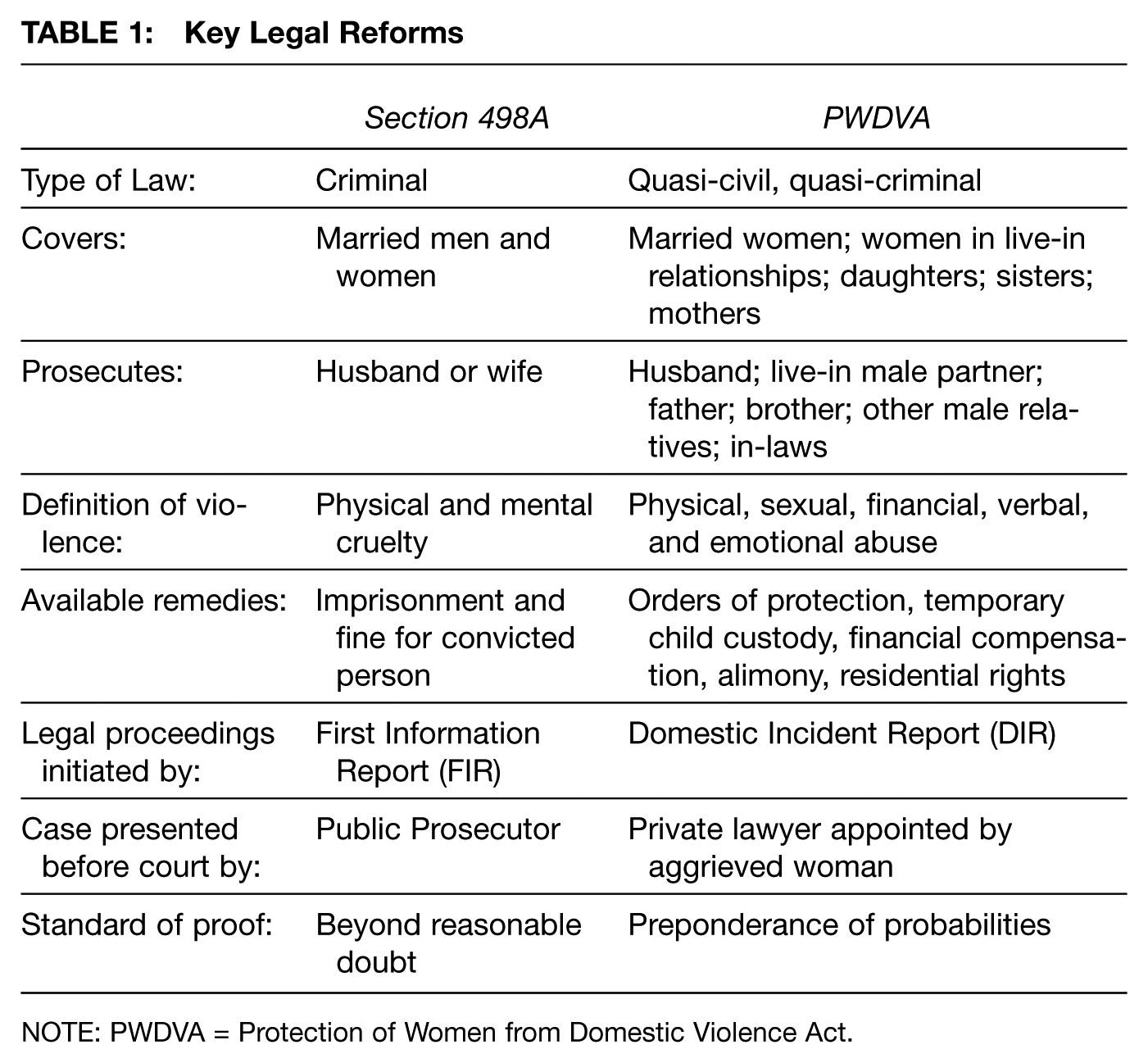
The institutional environment around domestic violence in India, dominated as it is by criminal justice incapacity on the one hand and the growing assertions of civil society organizations on the other, provides fertile ground for new kinds of interactions between women and state officials. Domestic violence became a crime in India in 1983 with the passage of Section 498A of the Indian Penal Code, which punished “physical and emotional cruelty” within marriage. 3 Another round of mobilization by the women’s movement led to further reforms in 2005. The Protection of Women from Domestic Violence Act (PWDVA) extended civil remedies to women in a range of domestic relationships. Table 1 provides a detailed comparison of these two laws.
Key Legal Reforms
NOTE: PWDVA = Protection of Women from Domestic Violence Act.
Section 498A of the Indian Penal Code stipulates mandatory arrest upon the registration of a First Incident Report (FIR). It carries a maximum sentence of three years and a monetary fine if violence is proven in court. Survivors are guaranteed access to free legal representation through the office of the public prosecutor. 498A does not, however, recognize sexual or financial violence. It restricts entitlements to legally recognized wives and does not offer civil remedies. Unlike 498A, PWDVA is gender-specific, granting reliefs only to women and thereby circumventing the possibility of abusive men using the law against women who fight back. Second, PWDVA uses a more expansive definition of violence, recognizing physical, sexual, financial, verbal, and emotional abuse. Third, PWDVA covers a larger group of survivors: married women, women in “live-in” relationships, and young girls. Aggrieved women can lodge complaints against spouses, in-laws, and their natal families. Fourth, PWDVA provides a range of civil remedies: orders of protection, temporary child custody, residential rights, alimony, and financial compensation.
Legal reforms spurred a steady rise in rights claims. Cases registered under Section 498A rose from 49,237 in 2002 to 99,135 in 2011 (NCRB 2013). Countrywide statistical data for PWDVA cases remain unavailable, but state-based surveys indicate similar upward trends over the past eight years (LCWR 2013). While the demand for legal rights increased, the capacities of the Indian criminal justice system to deal with and dispense cases remained limited. By 2011, India had an astonishing 32 million cases pending in its district and high courts, with another 56,383 cases pending in the Supreme Court (Rajagopal 2012). Pending cases sometimes remain so for very long periods indeed, with the average 498A case taking 10 to 20 years (CSR 2005). While PWDVA implementation studies indicate modest progress with case registration and processing in select places (namely, Maharashtra and Andhra Pradesh), other regions of the country, including West Bengal, where this study was conducted, continue to experience delays and negligence (Bhatia 2012; Ghosh and Choudhuri 2011).
Budgetary restrictions constrain numerous arenas of legal administration. While the United Nations recommends a ratio of one officer for every 450 civilians, India has one police officer for every 760 civilians. By 2012, a full six years after PWDVA went into effect, only 14 out of India’s 33 states and union territories had separate budgetary allocations for the law. Protection Officers (POs) lack basic support, including staff to deliver notices, photocopying machines, mobile phones, and a daily travel allowance (LCWR 2012).
Women’s organizations have increasingly stepped into this vacuum of institutional power. India saw the birth of an autonomous women’s movement in the late 1970s and 1980s, when women’s rights activists split from male-dominated political associations and expanded their own independent base (Katzenstein 1991; Purkayastha et al. 2003). A number of high-profile cases of rape and domestic abuse provided the crucial political momentum for the women’s movement to focus on violence against women. Activists took to the streets across the country and pushed for legislative reform (Gandhi and Shah 1991; Kannabiran and Menon 2007; Mazumdar 1999).
With the advent of economic liberalization and increased funding from the central government in the 1990s, parts of the women’s movement became institutionalized within NGOs while others retained a mass-based focus (Abraham 2005; Kamat 2003; Kudva 2005). Discourses of “empowerment” surfaced in diverse organizational spaces, from rural women’s groups who talked of stree-shakti (women’s power), to government-managed GONGOs (Omvedt 1993; Sharma 2008). Unlike the United States, where empowerment discourse has largely individualized women, in India women’s empowerment continues to emphasize the use of collective action and organizational resources to enhance individuals’ access to rights.
The mobilization around PWDVA provides a telling example. The Delhi-based Lawyer’s Collective helped draft PWDVA in consultation with women’s groups throughout the country, who in turn mobilized large constituencies to back the reform. Furthermore, women’s NGOs supervise individual cases: training caseworkers about law and criminal justice and providing legal aid and counseling for survivors. Partly, these initiatives are sanctioned by PWDVA itself, which recognizes women’s groups as official “service providers” with wide discretionary powers over legal aid and case registration. But this formal recognition frequently bleeds into more informal practices where organizational members help survivors carry out the law through actions that go far beyond what the law ordains.
Women’s organizing against violence has not, of course, been without its limits. Prominent critics have argued that the Indian women’s movement failed to challenge gendered notions of shame and honor, and at times used these discourses for strategic gain (Agnes 2005; Kapur 2012). Despite these limitations, organizational efforts have been key to policy reform and have played a crucial role in individual survivors’ lives.
Methods
To understand how legal protections shape state–gender relations in liberalizing India, I focused my ethnographic lens on the state of West Bengal. West Bengal was an ideal site for my research partly because I am a native speaker of Bengali. My language skills gave me direct access to research subjects and allowed me to comprehend complex legal negotiations. West Bengal also happened to epitomize the broader trends in law and governance I outlined in the previous section. By 2010, the state had the highest proportion of 498A cases in the country, accounting for 18.9 percent of all registered FIRs (NCRB 2010). Moving away from an earlier era of class-based politics, local women’s rights activists have increasingly focused on gender-based violence, pressuring the criminal justice system to respond to women’s claims (Ray 1999; Roy 2014). Simultaneously, the state government evidenced a strong trend toward localized governance and had failed to allocate the necessary budgets for legal administration and implementation (Ghatak and Ghatak 2002).
I used a snowball sampling technique to meet research subjects. I first gained entry into four separate women’s organizations where caseworkers agreed to let me shadow them. In the process, I met survivors who introduced me to other survivors. During this time, I also became acquainted with police officers, POs, and judges who then referred me to other law enforcement personnel. Proceeding through referrals helped me establish trust and gave me a unique insider/outsider status that identified me as American and a Bengali woman with local connections. This fluctuating position created power differentials that I worked hard to mitigate through repeated encounters and attempts to help survivors with their cases (Naples 1996). But given the divergent interests of survivors, activists, and state officials, my insider/outsider status also allowed me to strategically identify with different groups at different times to gain access to key information.
I spent 22 months in the field and tracked 70 “cases.” Each case involved an allegation of abuse. In 50 of these cases, survivors filed an official criminal or civil report. In the remaining 20, no official report was registered. Tracking involved observing survivors’ interactions with police, POs, court clerks, and judges. 4 While my case sample was not statistically representative, it was diverse. Table 2 provides a detailed breakdown of survivors’ social backgrounds. This diversity provided a lens on possible sources of variation in women’s interactions with the criminal justice system.
Case Selection
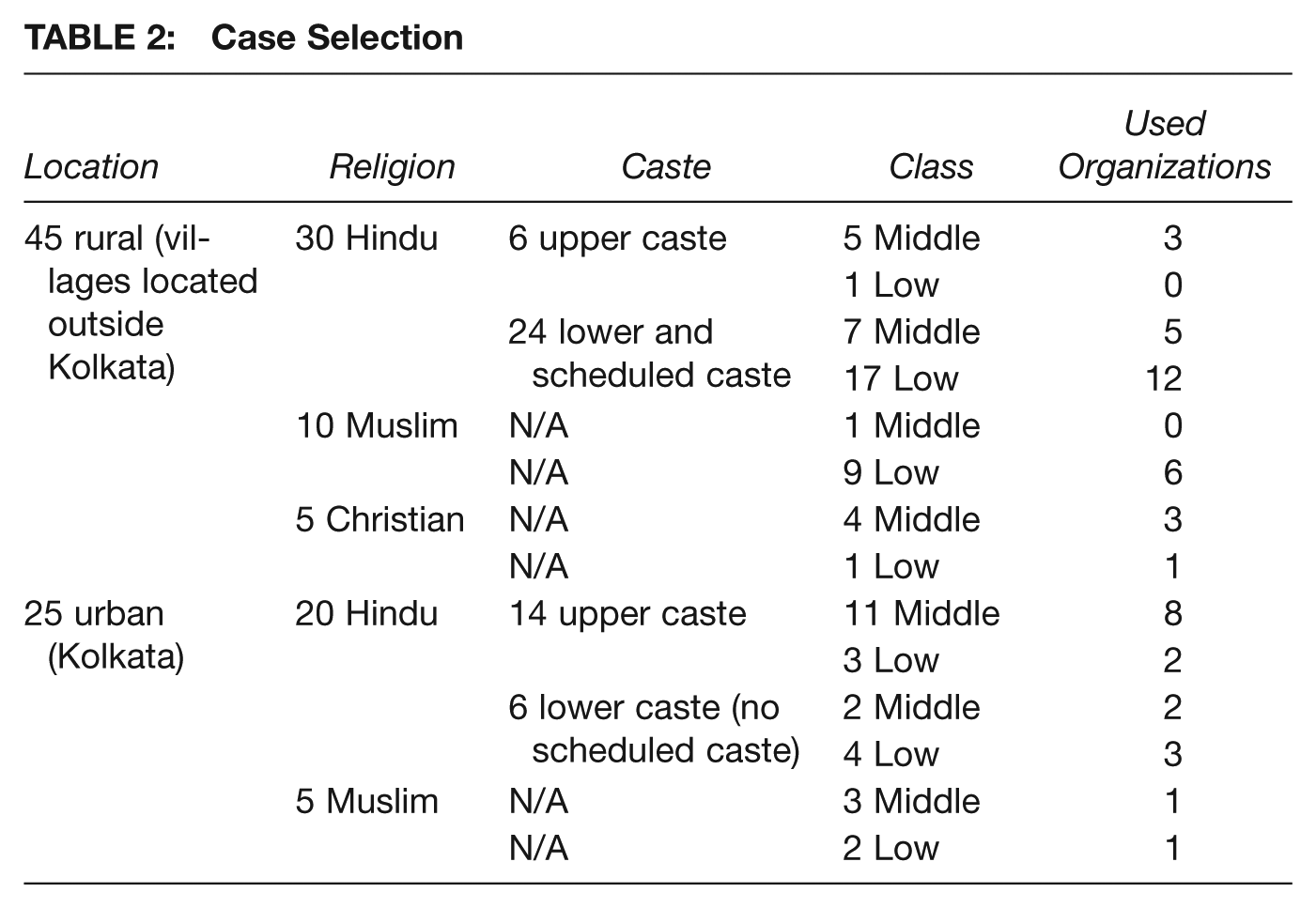
My cases varied across five demographic characteristics: the survivor’s residential location (urban/rural), religious affiliation (Hindu, Muslim, or Christian), caste (upper or lower for Hindus; not applicable for Muslims and Christians), income (middle or low), and the presence of a women’s organization in the case. Existing studies of law and gender in India indicate that these categories are particularly salient for women’s experiences of the law (Duvvury, Nayak, and Allendorf 2002; Panda and Agarwal 2005). A larger proportion of the cases came from rural areas, villages outside Kolkata, because approximately 71 percent of India’s population lived in villages when the study was conducted. 5 Similarly, a larger proportion of cases involved Hindus because, at the time of the study, 80.5 percent of India’s population was Hindu, Muslims accounted for 13.4 percent, and Christians 2.3 percent. 6
“Caste” refers to a system of social stratification among Hindus, rooted in occupational segregation and cultural notions of ritual purity and pollution. Religion and caste affiliation are ascriptive categories, inherited and maintained through endogamy. They are also legal categories in the Indian context. The Indian government classifies citizens according to religion and caste for the purposes of welfare services as well as family law (which defines rights to marriage, divorce, alimony, inheritance, and child custody). Section 498A and PWDVA apply to all citizens irrespective of religious affiliation. I assigned caste and religious categories according to research subjects’ self-identifications. “Upper” caste includes Brahmins (priestly caste) and Baidyas (merchants). “Lower” caste includes Sudras (laborers) and Scheduled Caste (untouchables). “Upper” and “lower” are socially and politically well-recognized classifications within India.
Since financial deprivation can be a feature of domestic violence, I classified survivors’ income by personal consumption: the amount of money they personally consumed on a daily basis. If the survivor reported living on $1/day or less (at the time the study was conducted, $1 was roughly equivalent to 50 rupees), I classified her as low-income. If she was living on anything between $1 and $3 (50-150 rupees) per day, I classified her as middle-income. Finally, I noted whether the survivor sought help from a women’s organization at any point on her case. Help-seeking included legal aide, counseling, legal training workshops, and case supervision. A women’s organization was present in 47 survivors’ lives.
I supplemented participant observation with 100 semistructured interviews across India: 20 additional survivors, 40 rights activists, 20 lawyers, and 20 law enforcement personnel (five judges, five POs, and 10 police officers). I used interview data to ascertain if my ethnographic observations were unique to West Bengal or part of countrywide trends. This data also provided insight on how research subjects understood and made sense of their behaviors and why they interacted with each other in the ways they did.
I use ethnographic vignettes and interview excerpts to show how state officials managed survivors’ claims by deflecting regulatory duties, and how these deflections created new possibilities for gendering depending on survivors’ organizational resources. Throughout, I anchor my argument around cases that demonstrated a key set of variations, namely, between situations where women had access to organizational resources and when they did not. By analyzing this variation, I argue that new possibilities for state–gender relations emerge at the intersection of a particular kind of liberalizing state and women’s organizing.
Emergent Citizens
Bureaucratic Deflection
Police officers, POs, and judges constantly complained about kaajer chaap (work-related pressure). To contain their workload, they did everything from dragging their feet and “misplacing” paperwork to entering informal work-sharing agreements with survivors and their representatives. Together, these containment strategies comprised a set of practices I term “bureaucratic deflection,” whereby law enforcement personnel delayed, mismanaged, and reassigned case-processing duties onto women’s shoulders.
The PO who handled Hameeda’s case provides a telling example of how bureaucratic deflection unfolded in practice. The PO delayed forwarding Hameeda’s DIR to the magistrate’s office, and let time slip by in the weeks that she avoided Hameeda’s attempts to book a second appointment. When Samoli, Hameeda, and I finally cornered her in her office, she went so far as to claim that Hameeda had never filed a DIR in the first place. It was only due to Samoli’s preemptive tactics that we had a reserve copy of the DIR to brandish against the PO’s claims.
The PO’s deflection techniques were far from unique. The Officer in Charge (OC) of Howrah police station admitted that the stations in his district registered cases that involved only life-threatening injuries and cases where survivors had “resources.” By women with resources, he was not talking about women who could hire lawyers. He referred to women who were capable of helping the police complete case-processing tasks, women who, in his words, could unearth evidence, round up witnesses, and make the criminal investigation less arduous for his constables.
If the OC’s words seem ambiguous, I observed law enforcement personnel deflecting work in far more explicit ways. During a community-building workshop attended by law enforcement, NGO caseworkers, and survivors, I listened to a PO urge survivors to take the initiative. She complained that some girls “sit back” and wait for help. But cases “do not run themselves,” the PO reasoned. It was the “active” girls who were really getting places, the ones who made sure the right people signed off on the DIR, the ones who helped gather evidence and ferried documents between government offices.
Following the PO, an Inspector of Police (IC) argued that the police “could not handle” cases where gundas (political thugs) supported alleged perpetrators. In these situations, survivors needed to work with women’s groups to “help” the police. The police officer’s words mirrored existing ethnographic renderings of police incapacity (Jauregui 2013). But his entreaties went beyond a mere articulation of his authoritative limitations to finding solutions: reassigning his tasks to civilians.
Even judges, long identified as the bastion of conservative demands for women’s victimhood in the Indian context, argued that survivors needed to be proactive. A retired member of the Kolkata High Court reasoned that the court system was too overburdened to assist women who quietly waited for relief. He provided free consultations to survivors who “did what needed to get done” and women’s rights activists who “facilitated” cases.
The tactics and maneuvers I highlight here mirror the governmental practices Akhil Gupta found in his study of government-run rural development programs (Gupta 2012). What is key, however, about deflection in the criminal justice system is the way it incorporated survivors and activists in the work of governance. Law enforcement personnel encouraged women to be “active” and engage in aggressive oppositional tactics against political thugs. These invocations were a far cry from the demands for docility and passivity that one would expect to accompany calls for victimhood.
Driving Cases Forward
Bureaucratic deflection encouraged survivors to “drive cases forward” (case challano). This phrase, used by survivors, caseworkers, and lawyers with great frequency, described the process whereby survivors actively managed their rights claims. This management went above and beyond the bare bones of legal procedure. Survivors had to do what the criminal justice system was supposed to do in order to ensure that their case moved to the next phase. But “driving cases forward” was by no means an individual endeavor. It required time, connections, political clout, legal know-how, and the ability to make threats. These were the “resources” the Howrah OC looked for when registering cases. And these were the resources survivors gained by working with women’s organizations.
Hameeda’s prolonged negotiation with the PO recounted at the beginning of this article shows how survivors used organizational resources to take advantage of the openings bureaucratic deflection created. It was Samoli, a survivor-turned caseworker, who coached Hameeda through this process. The importance of organizational resources became starkly apparent in the case histories of survivors who first approached the state alone and then used women’s networks.
Asha, a middle-aged, upper-caste Hindu woman, found herself unable to pay the electricity bill when her abusive husband abandoned her for a younger woman. A year before I met her, she registered a suit for alimony. Her case made it all the way to Kolkata’s court system, only to stall. A sympathetic clerk in the public prosecutor’s office advised Asha to “dig up” proof of her husband’s financial holdings if she wanted her case to proceed to trial. Asha, an unemployed housewife with limited education, was thoroughly disheartened by the prosecutor’s deflections. She abandoned the suit until a neighbor connected her to a women’s NGO. Asha’s ability to drive her case forward dramatically changed in the next phase of her case. Working closely with NGO caseworkers, Asha located and approached her husband’s employer and convinced him to turn over her husband’s pay stubs to the public prosecutor’s office.
In Hameeda’s and Asha’s cases, women’s organizations provided the requisite expertise, connections, and psychological support survivors needed to push a case through the legal system. At other times, women’s organizations provided political and social clout. A young, working-class, Christian woman who had spent her life in a small village outside Kolkata, Sobha consulted a local women’s group on how to best regain possession of her personal items after getting kicked out of her house by her abusive husband. The organization, run by other survivors, recommended that Sobha register a case. But when we approached the local police, the OC claimed he did not have “men to spare” for a property repossession case. After some back-and-forth, Rupa, one of the caseworkers from the women’s organization, struck a bargain. All they needed was one constable to “supervise” their progress from a distance. “We can do the rest,” she assured the OC as Sobha nodded her head in agreement. In essence, this agreement meant that Rupa’s organization would carry out an extrajudicial repossession under informal police protection.
The OC compromised for two reasons. First, he knew Rupa’s organization was capable of carrying out the tasks he had assigned them, because they had accomplished similar initiatives in the past. Second, he was wary of them: This particular organization had surrounded a nearby police station a few months back when they refused to register a First Incident Report (FIR). The OC wished to avoid any such situation. On her own, Sobha neither was capable of doing the police’s work for them nor posed a credible threat. Both of these organizational “resources” helped Sobha engage the police and also came in handy when she faced off against her abusers.
We arrived at Sobha’s house to find her husband away. Sobha’s mother-in-law, a woman who had previously hit Sobha and encouraged her son to be abusive, was reduced to meek protests in the face of a sizeable group of aggressive women. “These are mine,” Sobha shouted, grabbing a metal spatula and shaking it threateningly in her mother-in-law’s face. In the end, Sobha succeeded in “repossessing” not just her clothing and personal effects, but also a sizeable amount of household items and several ducks from the backyard. The police not only encouraged this extralegal repossession, they actively aided it to reduce their workload. Meanwhile, the entire event was organized and enabled by the power of organized women.
Forty-five of the survivors I tracked exhibited the art of “driving cases forward.” The feature these women shared in common did not involve where they lived, their religion, their caste, or their class background. Rather, all of these women worked closely with women’s organizations. Using organizational resources, these survivors undertook at least one or more of the following activities: located witnesses, illegally ferried court documents between departments, wrote a PO’s report, completed police charge sheets, gathered evidence in the form of documentation of assets or materials used during abuse, repossessed personal property, and located and threatened absconding witnesses into attending hearings. Meanwhile, women who tried to go at it alone lacked the resources necessary to move the state (Heller 2001). Like Asha in the first phase of her dealings with the public prosecutor, these survivors were unable to drive their cases forward.
Saviors
Over time, those survivors who were able to drive their cases forward inculcated a kind of gendered subjectivity that significantly departed from academic theorizations of women’s victimhood in and around the law. These women learned how to be proactive, capable, and, at times, downright aggressive. They also received a kind of recognition from state officials that they had not experienced before. Those who sat back and waited for someone to rescue them did not move forward with their claims. Those who “saved” themselves gained the greatest amount of traction.
Hameeda’s attempts to pursue a PWDVA case show how the act of negotiating with state officials encouraged women to adopt a “savior” subjectivity. What was interesting about Hameeda’s case was the way the PO’s responses shifted from negligence to support once Hameeda and Samoli convinced her they were “capable” women. Samoli reminded the PO that she had “managed hundreds of such cases.” Hameeda recounted how she financially supported her family and wished to “stand on her own feet.” In affirming Hameeda’s and Samoli’s self-narrations, the PO actively produced them as the kind of women who were qualified to rescue themselves and shifted the traditional boundaries of their relationship to the Indian state.
Over time, those survivors who repeatedly engaged the criminal justice system in league with women’s organizations came to identify themselves not as victims but as “saviors.” This reorientation was best captured by the transition survivors made from talking about themselves as nirjatito (oppressed) to describing how they “saved themselves and other women” (nijeke raksha korechi, onno der raksha kori). Some survivors went so far as to theorize their transformations in relation to the legal and social-institutional environments in which they were embedded.
Manju, a middle-aged survivor who ran a women’s group in the slum where she lived, had experienced abuse throughout her life. She had started the women’s group after completing a training program at a large women’s NGO in Kolkata. When I met her, Manju still volunteered at the NGO and attended all of their public events. Despite her history with abuse, she steadfastly refused to identify as nirjatito. “That’s not what is important to me these days,” she explained. She recounted how she had organized the women in her slum to confront the police and their abusive husbands. “Justice never came [for us]. But we got together and saved ourselves.” Manju’s words powerfully captured the dynamics of violence and injustice that underprivileged, working-class women battle in India. But her words also underscored the crucial ways bureaucratic deflection and women’s organizing came together to produce a specific kind of gendered subjectivity geared around “saving” oneself and other women.
Rupa’s trajectory from being a survivor to a caseworker and self-ascribed savior provides an evocative example of how this transformation in women’s subjectivity unfolded over time. This was the same Rupa who helped Sobha regain possession of her personal property. Ten years before I met her, Rupa had fled an abusive relationship. At the time, she claimed to have been the type of person who “didn’t know which bus to take to get to the [NGO].” These days, Rupa prided herself on being a “capable” person (haathe khomota ache). She located the genesis of her transformation in the years she had spent driving her own case forward. “I got to know people [judges, women’s rights activists]. I learned how to get things done.” Through a series of training workshops, Rupa became a caseworker and eventually led the NGO’s casework unit. Through these daily endeavors, Rupa came to believe that she was even more “capable” than the police. “The police,” she grumbled dismissively, you can’t rely on them. I’m the one who has to do their job [for them].”
Becoming a savior did not come without certain dangers. Twice, alleged abusers physically attacked Rupa. She faced recriminations from angry survivors who blamed her when cases did not go in their favor. Once women eschewed victimhood for a savior subjectivity, they became vulnerable to popular reprisals. These physical and emotional assaults illustrated an exaggerated example of the costs that women face when making rights claims (Choo 2013). Despite these risks, Rupa and Manju felt compelled to continue. Their reformulations of their own identities went hand in hand with a set of experiences that indicated that following legal procedure got women nowhere, while extralegality and the application of force worked in women’s favor.
Outside my research site, the vigilante practices of the Gulabi Gang provide insight both on the prevalence of savior mentalities among women dealing with violence in India and the structural causes of their self-identifications. Organized by Sampat Pal Devi, the Gulabis house around 400,000 women who operate in north central India. They wear pink saris, train in martial arts, and threaten and beat up alleged abusers and police officers who do not comply (Desai 2014). In interviews, Sampat Pal has articulated a similar kind of transformation as Rupa’s and Manju’s: realizing the incapacity of the criminal justice system to protect women, recognizing openings for women’s assertions, and gaining the ability to make those assertions through women’s organizing (Biswas 2007).
Conclusion
Saviors emerge within the interstices of two historically specific political and social transformations: gendered changes in the organization and administration of governance under neoliberalization, and the growth and increasing reach of women’s organizations and networks. As state officials decentralize authority and deflect governmental tasks onto women’s shoulders, women’s organizations counsel individual survivors on how to capitalize on these openings to access rights in and around the law. Survivors who find themselves at the intersection of these institutional forces end up carrying out a range of administrative tasks and, at times, go above and beyond the law to accomplish what the criminal justice system promises but rarely delivers. Over time and through repeated interactions, some survivors begin performing gender in unexpected ways. This transformation in gendered practices in turn redefines the boundaries of women’s citizenship by making new kinds of women visible, tolerable, and even preferable to state officials.
India may provide especially fertile ground for saviors because neoliberal governance accompanies a long history of dispersed sovereignty and limited state capacity (Chibber 2003; Evans 1995; Hansen 2009; Kohli 2004; Wood and Gough 2006). But the broad shifts in governance and the growth of women’s organizing that I have traced in the Indian context are prevalent in other parts of the world. Further comparative research will reveal to what extent the category of “savior” is pertinent to other developing countries, and the particular forms this identity takes in different places. The question also remains open with regard to the developed world, where the gendered character of citizenship may be shifting under criminal justice retrenchment.
Needless to say, the exact ways state functions remake gendered subjectivities will vary from context to context. But, to some extent, we can expect to see similar processes unfolding in places where states are both democratically accountable to citizens’ demands and where criminal justice systems are hard-pressed to deliver legal promises. These are the spaces where women may get drawn into regulating and governing violence themselves, and, in the process, enact a more proactive gendered subjectivity than that of a victim.
It is important to note that even within the India context, certain parts of the criminal justice system may be more open to recognizing and working with saviors. Research on rape and domestic violence cases show how legal demands for victimhood are particularly salient to trial settings (Basu 2012; Baxi 2014). Within my field site, I did find court clerks and judges responding favorably to women who “drove their cases forward.” While their words and actions indicate that the Indian criminal justice system as a whole may increasingly have openings for unexpected kinds of femininity, larger, cross-sectional surveys can tell us more about systematic differences across institutional sites.
It is also important to note that not everyone can or does become a savior. Nor is the process of becoming a savior cost-free. This particular subjectivity is more readily available to women who by luck and circumstance happen to access help from women’s organizations. And for those survivors who were able to achieve this status, their reworked gendered practices housed contradictory implications. On the one hand, they exerted new kinds of social and political authority whose importance for women cannot be underestimated. As I have detailed through my case studies, many survivors felt exhilarated and emancipated by their new engagements.
Simultaneously, the very same stories of empowerment exemplify the price that accompanies women’s newfound freedoms. Saviors shoulder a new burden of governmental labor and at times become vulnerable to new forms of violence. Rupa experienced these costs acutely, beaten up as she was by the abusive men she threatened. State officials’ deflections gave women new opportunities to seize the rights they deserved, but in the process, these maneuvers protected state officials rather than the women who had faced violence. It was the PO who ended up not having to do the work of filing a report. It was the police who avoided confronting political thugs. Second, and most troublesome from the perspective of women’s solidarity, saviors sometimes performed their new gendered identities by distinguishing themselves from “victims” and by dominating women who got in their way. In reworking herself as a savior, Manju expressed little sympathy for women who failed to be assertive. In the process of repossessing her personal property, Sobha threatened another woman: her mother-in-law.
Finally, there is a way in which the movements I have described in this article reproduce a Callicean universe where might holds sway over the rule of law. Women who have the ability to threaten, to supersede a negligent state, and to acquire rights through force and cunning are the ones who succeed in making rights claims. These pathways undermine a liberal model of rights as territorially bounded guarantees attached to the sovereignty of nation states. The degree to which these processes raise concerns depends, of course, on one’s political proclivities. But they also demand a closer inspection of the possibilities and limitations of women’s emergent practices vis-à-vis liberalizing states.
Footnotes
Acknowledgements
I would like to thank the many people in India who cannot be named, but who made this research possible by allowing me into their lives and confidences. A special thanks to Lynne Haney, Judith Stacey, Sally Merry, Steven Lukes, and Jennifer Carlson for reading early drafts of this paper, and to Rajeswari Sunder Rajan for highlighting the significance of my findings in relation to her earlier theorizations of the Indian state. Finally, a special thanks to the editors at Gender & Society for pointing out key variations in my findings and encouraging me to further nuance my theoretical arguments.
The research for this paper was made possible through funding from the National Science Foundation Doctoral Research Improvement Grant and the Fulbright-Nehru Dissertation Research Grant.
Notes
Poulami Roychowdhury is assistant professor of sociology at McGill University. Her research examines how politics influence gender inequality and the criminal justice system. Roychowdhury has written about masculinity and social movements (“Brothers and Others,” Social Problems), and international media and sexual violence (“The Delhi Gang Rape,” Feminist Studies).