



Abstract
Analyses of gender-based violence during mass conflict have typically focused on violence committed against women. Violence perpetrated against men has only recently been examined as gender-based violence in its own right. Using narratives from 1,136 Darfuri refugees, we analyze patterns of gender-based violence perpetrated against men and boys during the genocide in Darfur. We examine how this violence emasculates men and boys through four mechanisms: homosexualization, feminization, genital harm, and sex-selective killing. In line with an interactionist approach, we demonstrate how genocidal violence is gendered and argue that perpetrators committing gender-based violence perform masculinity in accordance with hegemonic gender norms in Sudan. We also show how gender-based violence enacts, reinforces, and creates meaning on multiple levels in a matrix of mutually reinforcing processes that we term the gender-genocide nexus. By extending the gender–violence link to the context of mass atrocity, this study facilitates an understanding of the mechanisms through which gender inequalities can be reproduced and maintained in diverse situations and structures.
It is not in the Sudanese culture or people of Darfur to rape. It doesn’t exist. We don’t have it.
Although scholarship on gender-based violence has emphasized violence committed by men against women, scholars have begun to consider how violence against men can also be gendered (e.g., Carpenter 2006; Jones 2006; Sivakumaran 2007; Zarkov 2001). Following this line of inquiry, we identify mechanisms through which gender-based violence in Darfur emasculates men and boys. 1 In doing so, we illustrate that rape not only occurred in Darfur but that it was one form of gender-based violence perpetrated against men. We draw upon narratives from 1,136 Darfuri refugees to analyze patterns of gender-based violence against men and boys and demonstrate how genocidal violence is gendered. In line with an interactionist approach (Connell and Messerschmidt 2005; Jakobsen 2014; Ridgeway 2009; West and Zimmerman 1987, 2009), we argue that this gender-based violence reflects a hegemonic ideal of the Sudanese man and communicates an emasculating message to individual victims and targeted social groups. Perpetrators perform masculinity through violence—“doing gender” (West and Zimmerman 1987) by reaffirming their own hegemonic dominance while simultaneously proclaiming power over ethnic victim groups. In essence, gender-based violence enacts, reinforces, and creates meaning on multiple levels to assert a dominant social order—a process we term the gender–genocide nexus.
Below, we provide a brief overview of gender-based violence during mass violence, followed by context on Darfur and details regarding the Atrocities Documentation Survey of Darfuri refugees. Next, we illustrate how gender-based violence emasculates men and boys in Darfur through four key mechanisms: homosexualization, feminization, genital harm, and sex-selective killing. Our intent is not to divert attention from women and girls but rather to examine the broad range of violent acts that occur during genocide. This allows us to theorize new connections between gender and violence. We conclude by suggesting that beyond extending the gender–violence link to the context of mass atrocity, this study facilitates an understanding of the mechanisms through which gender inequalities can be reproduced, maintained, and embedded in social structures.
Gender-Based Violence During Mass Atrocity
While gender-based violence during mass conflict has occurred for centuries, it has only recently garnered scholarly attention. This scholarship frequently employs the terms rape, sexual violence, and gender-based violence synonymously or narrowly focuses on rape, typically defined as penetration of the body (e.g., Rome Statute 2002 [1998]). Yet, rape is but one form of gender-based violence perpetrated during mass conflict (Carpenter 2006). Gender-based violence constitutes an extensive range of physical and psychological actions, including acts of penetration, sexual assault, genital mutilation, forced pregnancy, culturally inappropriate actions that sexually harass and humiliate, as well as nonsexual acts perpetrated on the basis of gender, such as sex-selective killing. Though scholars have debated how gender facilitates and patterns violence, Jakobsen (2014) notes that what is “gendered” about gender-based violence in any context remains woefully undertheorized. In her own work, she argues that gender is salient in domestic violence in Tanzania, where the “good beating” of wives is prescribed in the performance of hegemonic masculinity and femininity. This interactionist approach illuminates how violence may be “based on gender, while at another level violence may affect gender,” cycling from micro to macro-institutional levels in a matrix of mutually reinforcing processes (543). Extending this analysis to mass atrocities permits a related question: What is gendered about genocide? 2
Scholarship has addressed the gendered dynamics of genocide and associated violence (Carpenter 2006; Drumond 2012; Ferrales and McElrath 2014; Joeden-Forgey 2012; Rafter 2016; Reiter 2014), though much existing work has examined men as perpetrators and women as victims. Yet, gender-based violence can be perpetrated by women and can target men. Examining this violence is consequently important for advancing theory and adequately responding to atrocity. Accordingly, scholars have begun to explain gender-based violence against men. Some suggest that repertoires of collective violence (Tilly 2003; Wood 2009) can strategically prevent men from fathering children and/or undermine them by diminishing their status (Carpenter 2006; Diken and Laustsen 2005; Lewis 2009; Oosterhoff, Zwanikken, and Ketting 2004; Sivakumaran 2007; Zawati 2007). Violence against men may also reflect heteronormativity, defined as “culturally hegemonic heterosexuality” (Jones 2006, 451; see also Carlson 2006; Christian et al. 2012; Given 2010; Houge 2008; Lewis 2009; Onyango and Hampanda 2011; Stemple 2008). Zarkov (2001), for example, contends that the violation of Muslim men in the former Yugoslavia denied them attributes of dominant masculinity. Sivakumaran (2007) likewise argues that hegemony manifests through feminization, homosexualization, and the prevention of procreation, all of which emasculate men.
This research on gender-based violence against men is in its infancy and has faced several limitations, including a disproportionate focus on the former Yugoslavia (Carpenter 2006; Given 2010; Rosenblatt 2007; Sivakumaran 2007) and limited sources of systematically collected data (Jones 2006; but see Johnson et al. 2010 and Peterman, Palermo, and Bredenkamp 2011; see also Hagan, Schoenfeld, and Palloni 2006). It nonetheless holds great potential for advancing our understanding of gender-based violence and our conceptualization of how social factors—such as gender, age, ethnicity, sexuality, social class, and combatant status—intersect. We thus examine mechanisms of gender-based violence against men and boys in Darfur to expand theoretical linkages between gender, gender-based violence, and hegemonic masculinity and to illuminate why and how this violence occurs.
Gender and Violence in Darfur
Darfur was once a sultanate encompassing forty tribes (O’Fahey 1980). Tribes often self-identified as African or Arab, with African tribes 3 —such as the Fur, Masaleit, and Zaghawa—and Arab tribes—such as the Rizeigat and the Beni Halba—coexisting and intermarrying (Flint and de Waal 2005). Most residents practiced Islam, and many people spoke Arabic and traditional languages. The Fur Sultanate became part of Sudan in 1916, and subsequent decades were spent under Anglo-Egyptian rule. Political instability and periods of widespread drought followed Sudanese independence in 1956 (Collins 2008). The new state struggled to meet these challenges while simultaneously engaging in nation-building efforts (Doornbos 1988; Straus 2015). Nation-building continued into the 1990s, as President Omar al-Bashir—who took control of the country through a coup in 1989 and remains in power today—implemented policies of Arabization and Islamization. These ideologies and related practices privileged individuals viewed as Arab (Doornbos 1988; Flint and de Waal 2005; Fluehr-Lobban 1990) and often marginalized those viewed as African, including many residents of Darfur.
The process of constructing a national identity directly engages the construction of gender (Charrad 2001; Kandiyoti 1991; Kim, Puri, and Kim-Puri 2005; Yuval-Davis and Anthias 1989), and Sudan is no exception (Hale 1996; Nageeb 2004; Tønnessen 2007). There, the gendered project of shaping a national identity became closely tied to an “Islamist moral discourse” (Willemse 2007a, 437) and Sudanese identity became aligned with notions of ideal Muslim women and men (Hale 1996). For instance, Sudanese women were portrayed as carriers of Sudanese culture and morality, and mothers were to be engaged in the home. Heteronormative gender and sexual identities are consequently highly regulated in Sudan (Willemse 2007a). Related policies, such as those restricting women’s labor opportunities (Hale 1996), reinforced an image of the ideal Muslim man as the financial provider and ultimate guardian of the family (Al-Ahmadi 2003; Willemse 2007a, 2007b). In line with this, homosexuality is seen as an inferior identity and a crime punishable by death upon the third offense (Government of Sudan 1991; S. Martin 2007; Onyango and Hampanda 2011; UN OCHA 2008). Vigilantes have targeted suspected gay men, and state actors have publicly flogged men for wearing women’s clothes and makeup (Hartenstein 2010; U.S. State Department 2013).
These norms are prevalent throughout the country, including in Darfur, where men are positioned as protectors who should not flee from peril or stand helpless in moments of danger (Mohamed 2004; Moro 1998; Oladosu 2009). Yet, many prescribed ideals are incompatible with the realities of socioeconomic conditions in Darfur, where a dearth of economic opportunities stems from the state’s sustained neglect of the region and a national economic downturn that began in the 1970s (Willemse 2007b, 2009). Among the Fur, a dominant tribe in Darfur, the economic situation led men to migrate domestically or internationally, and thereby kept many from marrying or providing for and protecting their family. State actors constructed these behaviors as familial desertions which, according to Willemse (2007b, 2009), spurred a widespread crisis in masculinity and contributed to subsequent violence.
Widespread neglect of the Darfur region is also widely cited as a factor that contributed to conflict in the region. Darfuri leaders began voicing discontent about decades of systematic marginalization during the 1990s. Sporadic violence culminated in Darfuri rebel attacks on Sudanese military barracks in early 2003 (Tanner and Tubiana 2007). In response, the government of Sudan unleashed an unprecedented campaign of terror on Darfur’s civilians, and Sudanese soldiers and government-trained militias known as the Janjaweed began attacking villages (Flint 2009). These attacks have targeted Fur, Zaghawa, Masaleit, and other “African” civilians. For instance, predominantly “African” villages in Darfur have been obliterated, while neighboring “Arab” villages have been left intact. Racial epithets accompanying attacks—such as “this is the last day for blacks” or “we will kill all the black-skinned people”—support these assertions (Hagan, Rymond-Richmond, and Parker 2005). Since the violence seeks to destroy certain groups, it constitutes genocide by both legal and scholarly definitions (see Daly 2010; Kiernan 2007; Luban 2006; Straus 2015; Totten and Markusen 2006). And while scholars have documented much of this genocidal violence, its gendered nature has garnered less attention (though see Kaiser and Hagan 2014).
Methodology
We thus analyze data from the Atrocities Documentation Survey (ADS) to examine gender-based violence against men and boys in Darfur (see Figure 1). This project, commissioned by the U.S. State Department, documented violence in Darfur in 2003 and 2004 by interviewing 1,136 Darfuri refugees in Eastern Chad. Chad was the ideal location for the interviews because of its large refugee population (U.S. Department of State 2004), and the ADS team conducted interviews in ten United Nations High Commissioner for Refugee (UNHCR)–run camps and nine informal refugee settlements (Howard 2006).
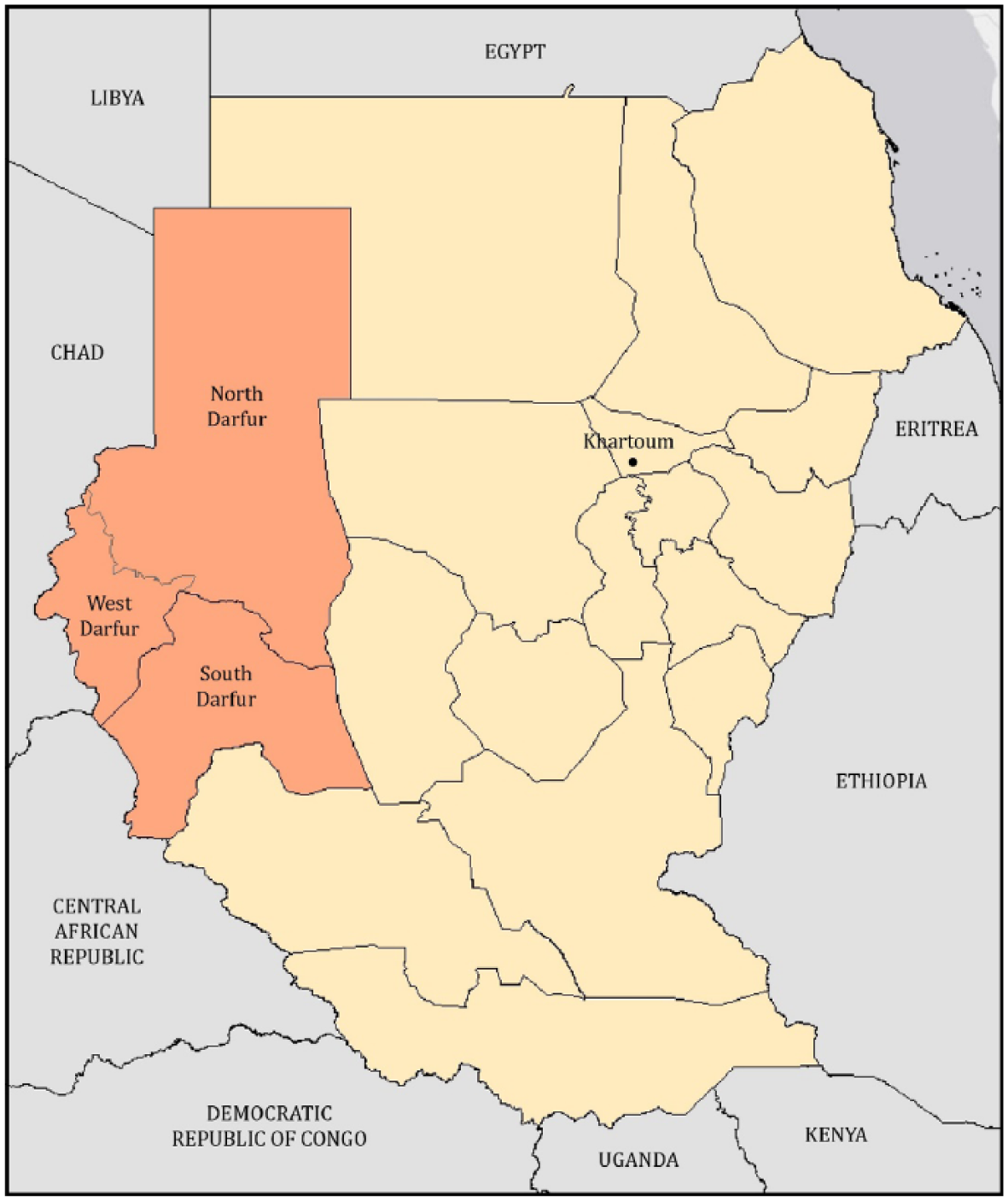
Darfur, Sudan, 2003.
Three teams of researchers conducted interviews using a multistage, systematic random sampling design to obtain a sample mirroring camp ethnic compositions. Interviews took place in private, with the respondent, interviewer, and a translator present. Questions were primarily open-ended, allowing for detailed narratives in order to document victimization (U.S. Department of State 2004). Each interview is assigned an identification number, which we use to identify respondents below. Respondents, all over the age of 18, 4 self-identified predominantly as Zaghawa (46 percent) or Masaleit (30 percent). Fewer self-identified as Fur (8 percent) or members of other “African” groups (16 percent), and slightly more than half were women (56 percent). To be clear, this is not a random sample of all refugees or civilian victims of the violence, as most respondents fled from within 50 miles of the Sudan–Chad border.
As with any interview data regarding mass atrocity, ours also reflect survivorship bias, as only those who survived were able to share their stories. Furthermore, gender-based violence is likely underreported due to stigma (Abdullah-Khan 2008; Carlson 2008; Javaid 2014; Mullaney 2007) and the criminalization of some forms of violence, such as homosexuality. One man, for example, described being detained with approximately 80 other men. The ADS interviewer suspected from the man’s body language and nervousness that he had suffered sexual abuse while detained, though the interviewee denied physical harm. After the interview, however, the man disclosed that “he suffered a ‘man beating’” but could not talk about it “because it was too humiliating” (7). Men also may not report sexual violence because of their own nonrecognition as victims (Weiss 2010). In fact, the Sudanese Criminal Code excludes sexual violence against men—as well as anal penetration and the insertion of objects—from the definition of rape (Government of Sudan 1991).
To capture forms of gender-based violence, we inductively constructed a qualitative coding scheme. Our final 70 codes included violent acts, including sex-selective killing, rape (oral or anal penetration with body parts or objects), sexual assault (sexual contact without penetration), and violence targeting the body. Codes also captured situational characteristics, such as the presence of witnesses, the number of perpetrators, and location. Following the interview guide, we included violence against the respondent as well as violence the respondent witnessed and/or heard about. The majority of responses indicated direct victimization and witnessed violence. Notably, the inclusion of hearsay and witness statements eases (though does not eliminate) some concerns about underreporting, as respondents were often willing to share what happened to others despite likely reluctance to disclose personal victimization. This allows us to gain a more complete picture of the violence, including accounts of violence against those who did not survive.
Emasculation in Darfur
The ADS data illustrate that many refugees in Chad experienced both primary and proximate gender-based violence. Primary victimization is perpetrated directly against an individual and includes actions like rape, genital harm, or sex-selective killings. While it is difficult to quantify these acts given the inclusion of witness/hearsay, the high number of deaths, and likely underreporting, it is clear that primary victimization of men was neither uncommon nor localized. We documented approximately 30 instances of rape and more than 40 instances of genital harm, while the vast majority of the sample reported sex-selective killing. Notably, these forms of violence also have been reported in other studies (Gingerich and Leaning 2004; S. Martin 2007; Onyango and Hampanda 2011). Proximate victimization, or witnessing violence perpetrated against others, often accompanied primary victimization. The vast majority of respondents witnessed violence, frequently against family members. Proximate violence is rarely prosecuted and sometimes not even considered violence, yet it can also be gendered and is thus key to a more expansive conceptualization of gender-based violence (Carpenter 2006; A.T. Goldstein 1993).
Taken together, the totality of the violence perpetrated against men and boys forms the basis of our analysis. Both primary and proximate victimization in Darfur emasculated the ethnic other—in this case, the targeted “African” tribes. Deriving from emasculare, Latin for “diminutive male” (Taylor 2000), emasculation refers to any practice that “diminishes the potency of men in the family or society more generally” (Ross 2002, 311). Following recent scholarship (Fang 2004, 6), we employ three interrelated meanings of emasculation: to castrate, to deprive of strength or vigor, or to possess unsuitable feminine qualities.
Drawing on Sivakumaran (2007), we find that emasculation in Darfur occurs through homosexualization, feminization, and genital harm. 5 Additionally, we identify a fourth mechanism—sex-selective killing. These mechanisms are neither mutually exclusive nor exhaustive but rather are complementary. They simultaneously influence and are influenced by both gender and ethnic power dynamics. To be clear, we are not able to assess the motives of individual perpetrators, and thus we do not know whether each person perpetrating the violence intended their actions to be emasculating. Likewise, we do not know if each man who was victimized felt emasculated. Nevertheless, we contend that the sum of individual actions emasculates the social group. These acts communicate the impotence of the targeted group and divest group members of their power, dominance, and collective masculine identities, as we illustrate below.
Homosexualization
Four men were raped in the village. . . . These men were then shot and killed. . . . After they killed the men, they raped them anally with sticks (287).
This 21-year-old Masaleit woman recounted a key method of emasculation: rape. Rape preceded and followed murder, and groups of soldiers and Janjaweed typically used penile penetration or objects, such as sticks and gun barrels, against groups of Darfuri men. For example, a West Darfuri man witnessed government soldiers and Janjaweed rape five men with sticks. He explained, “They tied up arms and legs and [threw] them to the ground and raped them. All burned to death in fire” (488). Much research establishes that rape is an act of power, dominance, and an assertion of strength and manhood (Weiss 2010). Rape can also be homosexualizing, which likewise can be emasculating. Similar to U.S. constructs of masculinity (Messner 2003), the Sudanese heterosexual man has long been conceptualized as dominant over women, homosexual men, and others (Willemse 2007a). The homosexual man is considered weak and less masculine—a status that carries potentially lethal consequences (e.g., Jones 2006; J. Goldstein 2001; Seifert 1994; Sivakumaran 2007)—as reflected in the Sudanese Criminal Code. Given this context, rape functions as an actual and symbolic means of masculinized dominance, or “doing difference” (West and Fenstermaker 1995), between competing ethnic or national groups (Vojdik 2014). As manhood is intimately tied to ethnic identity (Zarkov 2001), perpetrators do not just rape men—they rape ethnic men. In this sense, the Darfuri victim not only becomes “a lesser man but . . . his ethnicity is lesser” (Zarkov 2001, 78). In turn, these acts demarcate group difference, malign the ethnic outgroup, and publicly communicate hegemony, power, and control over the collective. Homosexualization thus communicates dominance and demarcates group difference.
Meanwhile, the individual rapist and his group are empowered. As Price (2001, 212) noted regarding militarized expressions of violence in Bosnia, “I AM only to the extent that you are not. . . . Your absence marks, verifies my presence and your pain becomes my power.” To be clear, the perpetrator likely does not identify as homosexual 6 but rather uses penetration to impose and elevate his dominant heterosexual status (Given 2010; Lewis 2009; Segal 1990; Zarkov 2001). Group participation in a mutually shared crime bolsters the individual attacker’s masculinity while simultaneously strengthening communal solidarity among the group (Alison 2007; Cohen 2013a, 2013b; Given 2010), sealing “allegiance in atrocity” (Morrow 1993, 48). 7 The penetration of men with objects post-mortem also desecrates the ethnic male body and his family by violating sacred spiritual norms. In Darfur, cultural norms proscribe a highly ritualized treatment of the deceased: the body is washed, wrapped in white cloth, and buried by family members without delay (Totten 2011). Rape post-mortem thus violates the deceased and his family, who are unable to complete these culturally prescribed practices (Komar 2008).
Overall, homosexualization by rape varied by age and status, and elderly Darfuri leaders appear to have been particularly targeted for rape and other forms of violence. For example, a Masaleit woman stated, “Near us, they raped 10 old men using sticks and barrels of the guns” (336). She also noted, “The imam was raped and then taken to the police station.” This represents the emasculation of one of the community’s most honored members. By contrast, there were no instances in our data of rape of boys under the age of 15, which may suggest that they are not yet viewed as hegemonic adult men and sexual beings (see Jones 2006).
Finally, while we have focused on rape, other acts of violence also homosexualized Darfuri men. For instance, perpetrators often excised victims’ penises and inserted them into the victims’ mouths. A Fur woman reported, “I saw a young boy and his father dismembered while still alive. They cut off their penises and put them in their mouths” (615). Another woman recalled how she observed the torture of seven men who were dismembered alive. Perpetrators pulled their teeth out, cut off their tongues, severed their penises, and then put them in their mouths (620). Here, genital harm emasculated the victim directly, via castration, and indirectly, via homosexualization.
Feminization
I have four wives . . . two were raped by the Janjaweed. . . . I saw this start but then had to run and hide (786).
This 50-year-old Zaghawa man’s account illuminates how feminization was also used as a related form of emasculation whereby targeted men were demeaned or devalorized on the basis of sex and gender associations. By forcibly imposing attributes and behaviors culturally associated with women, feminization constructs and maintains hierarchies of masculinities (Hooper 2001; MacKinnon 1997; Sjoberg 2015). Hegemonic definitions of masculinity require men to be strong, self-sufficient, impenetrable, dominant, and in control (Kimmel and Messner 1989). As noted above, the inability to protect oneself, one’s family, and others represents a salient transgression against masculinity in Darfur, lowering the status of the individual and the enemy group by inverting gendered constructions of the protector and the protected. 8 In essence, the feminized man (and his group) is “unmanned” and rendered weak and defenseless, contravening markers of manhood.
While feminization may be inflicted through numerous forms of violence, including homosexualization and genital harm (discussed below), we focus on demonstrative violence. This involves publicly displaying bodies to instill fear, communicate threat, and serve as an emblem of group conquest and emasculation. Instances of public victimization were replete in the data. A Fur woman recounted witnessing a man beaten, whipped, and conspicuously hung from a tree (23). Another woman shared how she witnessed two men publicly beaten for an hour with sticks (43). Others described how boys were dragged “behind running horses until they were dead” (563) or behind trucks and paraded through the village (559), illustrating their inability to defend themselves. Indeed, some suggest that defeat in mass conflict can be feminizing, as hegemonic masculinity is associated with victory (Jones 2006).
Men were also prominently shot, slaughtered, and had their throats cut, which respondents described as “extra humiliation” (7; 625; 637). Family members were also forced to watch. A newlywed woman recounted how perpetrators made her watch them kill her husband, take his clothes, and cut his body open (615). Lasting marks from violence were also significant. A Fur man described how his brother was tortured and beaten, noting he “had so many marks on his body he looked like he was branded” (19). The scars become a perennial symbol of his emasculation and the inability of the targeted group to defend themselves. As respondents explained, these marks humiliated men, symbolically castrating the victim and anathematizing the enemy. Many men likewise reported witnessing their wives, women relatives, and others being raped and sexually assaulted while they were rendered powerless to stop it, which directly attacks the Darfuri man’s duty as protector (Mohamed 2004; Moro 1998). One man recounted, “I saw ladies in the village [as I lay wounded] being raped right in front of everyone, even their fathers and their children. . . . We could do nothing, nothing. We had no way to fight” (258). A 36-year-old Zaghawa man similarly recounted, “I ran away because I couldn’t stand to see the women hurt in [the] family. . . . The men gathered in [the] yard to try to defend [them]. The soldiers shot them. The men had nothing to protect the village” (629). Another noted how his wife was beaten and whipped until she had “slashes all over her body” (552)—leaving a visible symbol of her husband’s impotence. Perpetrators also verbally mocked men while victimizing women. A 30-year-old Masaleit man noted that when he saw four girls being kidnapped, the soldiers shouted, “Come get your girls if you can . . . ” (257). Respondents likewise recalled perpetrators laughing while raping women, which likely served to taunt the men present and further underscore their inability to protect their wives, family, and property—in effect leaving them powerless. This demonstrative violence targets one of the basic attributes of hegemonic Darfuri masculinity—his ability to protect his family and community—and simultaneously forcibly imposes on men gender associations culturally associated with women.
Genital Harm
For seven days, I was detained and tortured by government soldiers. I was made to lie on my back with my hands tied behind my back, ankles tied and they would stomp on my thighs and kick me in the genitals ([and I have had] sexual problems ever since) (5).
This excerpt from a 52-year-old Fur man detained with more than 30 other Darfuri men reveals how genital harm was yet another method of emasculation. Genital harm often prevents procreation, which, when targeting a group, is a recognized crime of genocide (Genocide Convention 1948). Furthermore, because genital harm diminishes hegemonic masculinity—which is equated with virility—this form of sexual victimization emasculates symbolically as well as physically. Genital targeting was neither exceptional nor localized, and it frequently preceded death. For instance, a Masaleit woman described how five men bled to death following castration (259). Another woman recounted speaking with a man who had his “genitals cut off” (261). Others reported how sexual organs were severed during dismemberment.
Although there were several reports of injury to the testicles, genital harm often involved the pronounced targeting of the penis, signifying the elimination of a source of power. This form of emasculation has occurred throughout history within societies that construct male bodies as dominant; for example, Persian armies often displayed plates of conquered soldiers’ penises when celebrating the defeat of the enemy (Vojdik 2014). In these cases, a victim’s body represents the “corporeal embodiment” of the enemy, and the excise of the male organ functions as an extreme form of emasculation and symbolically represents the emasculation of an entire group (Sivakumaran 2007; Zarkov 2001). Likewise, as previously noted, penises were also forced into the mouths of victims during or after death, symbolically silencing the enemy group. These expressions of violence emphasize the association between men’s sexual organs and hegemonic masculinity. More broadly, this and other forms of genital harm constitute a salient form of emasculation that targets physical and cultural virility at both the individual and collective level.
Sex-Selective Killing
I saw five pregnant women have their stomachs ripped open. The soldiers removed the fetuses. If they were male, they destroyed the fetus by smashing it on the ground (615).
This excerpt from a 40-year-old Fur woman illustrates how male fetuses were targeted for sex-selective killing.
9
Similarly, a Masaleit woman described how she witnessed attackers check the sex of infants. If they were male infants, they would take the baby by his feet and “slam it against ground until it dies” (489). In line with other sources (Jones 2004), numerous respondents reported that men were also targeted for death. A Fur woman described how soldiers screamed while raping her, “I am Omar al-Bashir and I have orders to take everything, kill the men, and capture the women” (624). Another noted, “We have killed all your men—now we come for the women and the cattle” (250). These and many other statements indicate that sex-selective killing was widespread, with interviewees reporting finding numerous male corpses (e.g., 7; 19; 24). As noted above, men were also mutilated and butchered “like animals” (625). A Zaghawa woman described: They shot him in the body twice but he did not fall. Several Arab militias grabbed him, held him down, first they cut off one arm, then the other. . . . He fell unconscious as they cut off one leg. He was dead by the time they cut off the second leg (256).
Another woman remembered a man whose “arms [and] legs had been cut off with a knife or machete, and chest cut open with heart pulled out” (503). Witnesses also described how perpetrators “burned people to make them cry” (136). These sex-selective patterns, rooted in assumptions about the duties of men during violence, constitute gender-based violence (Carpenter 2006). As one respondent noted, “I also saw the bodies of about 25 young boys—it seemed they were targeting the men and boys because I heard them say ‘a puppy can become a dog’” (24), reflecting gendered associations between masculinity, aggression, and violence. The mass annihilation of men from enemy groups appropriates the power of men to provide, protect, and defend. In Darfur, targeted men and boys were literally and figuratively “unmanned” (Zarkov 2001). Moreover, as men are conceived as the bearers of ethnicity in Sudan (Daly 2010; de Waal 2009), targeting men and boys destroys existing and potential group members. It also symbolically communicates the group’s collective incapacity in the context of mass atrocity.
Conceptualizing the Gender-Genocide Nexus
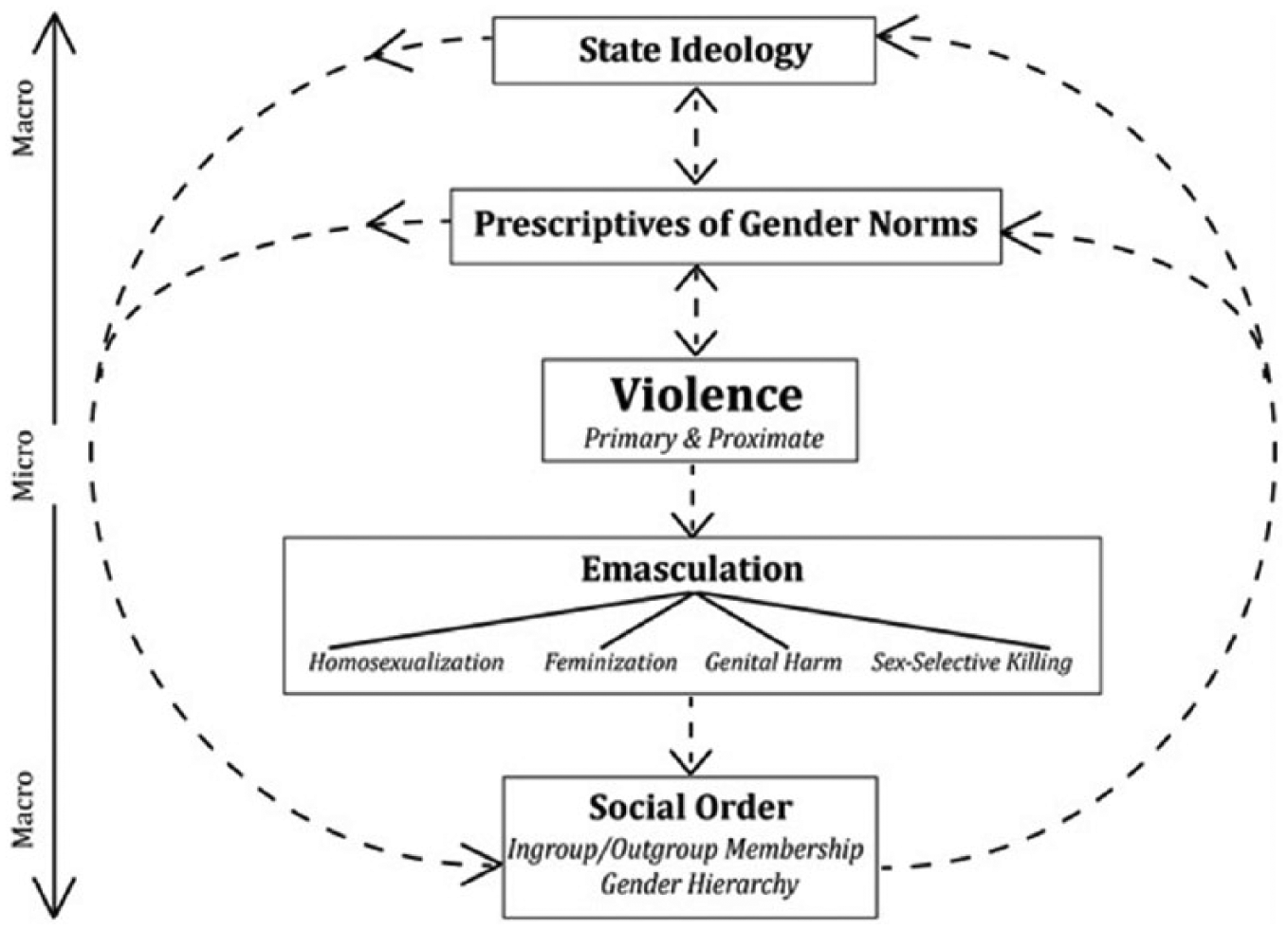
Analyzing primary and proximate forms of gender-based violence in Darfur, we have identified four mechanisms of emasculation of Darfuri men: homosexualization, feminization, genital harm, and sex-selective killing. By identifying how gendered power relations operate in the context of mass violence, this article extends interactionist scholarship on the links between violence and social constructions of gender (Alison 2007; Vojdik 2014). It also challenges the binary of men as perpetrators and women as victims 10 and begins to answer the question: What is gendered about genocide? Specifically, we conceptualize how dominant norms regarding gender influence forms of mass violence, suggesting that gender-based violence establishes, enforces, and reproduces gendered hierarchies within a broader social system where both body and gender become “highly salient organizing principles of interaction” (Messerschmidt 2002, 209). Ethnicity, age, sexuality, and other identities also pattern violence, illustrating the importance of intersectionality (Crenshaw 1991). Uncovering the relationship between gender and mass violence necessitates attention to how multiple levels interconnect, a process illustrated in Figure 2 that we term the gender–genocide nexus. While this figure does not capture all social forces involved, it delineates possible links among state ideology, gender norms, mass violence, and social order. Specifically, the gendered patterning of violence can be traced, in part, to patriarchal and heteronormative state-supported ideologies and gender constructs that position men as familial protectors and guardians. In Darfur, a state-led ideology also targeted particular groups, such that ethnicity and other social attributes interacted with gender to pattern violence.
Conceptualizing the gender–genocide nexus.
Primary and proximate forms of gender-based mass violence produce difference between groups along gender constructs that link heteronormativity, power, and ethnicity with the collective goal of eradicating the enemy group. Darfuri men were systematically denied the attributes of dominant heterosexual masculinity and demarcated as outgroup members through at least four mechanisms of emasculation. In this way, perpetration of violence constitutes a form of doing gender, where gender is salient in the manifestations of violence and the resulting subordination and attempted destruction of the targeted enemy group (Jakobsen 2014; P. Y. Martin 2003). Violence in this context is based on gender and simultaneously affects gender in a mutually reinforcing process (Jakobsen 2014, 543; see Anderson 2005) whereby a newly emerging social order excluding outgroup members may reinforce or exacerbate state ideologies and the persistence of patriarchal heteronormative ideals (hence the double arrow). An interactionist perspective elucidates how micro- and macro-level victimization occurs through mutual reinforcement (Ridgeway 2009; Ridgeway and Correll 2004). Violence can operate on multiple levels, as individual perpetrators and victims and collective ethnic groups assume divergent but interconnected roles of emasculators and emasculated. Crucially, violence perpetrated against an individual during mass conflict can be emblematic of victimization against the community. In this sense, repertoires of collective violence function to materially and symbolically demarcate group boundaries (Tilly 2003; Wood 2009).
We contend that these processes occur regardless of the intent behind individual actions. Conceptualizing gender as situated action means recognizing variation in agency, yet also recognizing we cannot fully capture differences in individual perpetrator’s motives (Miller 2002) that are not reflected in the ADS data. Likewise, our data do not capture whether each victim felt emasculated. Yet, even if an individual victim is consciously unaware of feelings of emasculation (or each perpetrator feels emboldened through his actions), it is nonetheless clear that doing gender via repertoires of collective violence reproduces social structure, consolidates power, and weakens collectives along gender and ethnic lines (Miller 2002). The sum of individual social actions nested within the structural context reproduces inequality.
While we analyze this process during a specific episode of genocide, this general model may inform the study of other mass violence. Explicating variation in the extent and form of gender-based violence across conflicts requires comparative analysis (Wood 2006), but we can nevertheless suggest several neither mutually exclusive nor exhaustive propositions regarding the factors that may influence comparatively more gender-based violence during conflict. First, gender-based violence and processes of emasculation may be more prevalent when states and other powerful actors sponsor a systematic campaign that explicitly targets sex. Second, cultural norms nested within social systems that privilege hegemonic masculinity make gendered forms of violence and processes of emasculation more likely (Enloe 2000; Vojdik 2014), just as norms may prohibit such violence in other contexts (Wood 2006). Third, conditions that exacerbate threats to masculinity, which can emerge from severe imbalances between hegemonic expectations and the opportunities to achieve them (Willemse 2009), may lead to violence as a mechanism for achieving masculinity (Kimmel and Messner 1989; Kimmel and Mahler 2003; Schrock and Padavic 2007). Lastly, gender-based violence against men may be more likely when manhood and ethnicity are intertwined. Overall, gender-based violence against men is not aberrant or confined to mass conflict but is prevalent in social systems that construct men as heterosexual and dominant (Vojdik 2014). Gendered identities—typically masculine identities that emphasize strength, aggression, and courage—are privileged in settings ranging from the United States (e.g., Copes and Hochstetler 2003) to Hong Kong (e.g., Kong 2009) to Sudan (e.g., Willemse 2009). Given this burgeoning line of literature linking myriad forms of crime with hegemonic masculinity, the patterns and processes that we identify may also inform violence in times of relative peace.
Conclusion
This study analyzes both primary and proximate gender-based violence perpetrated against men and boys during mass atrocity. Drawing upon a case of genocide, we demonstrate the multilevel processes at work in the gender–genocide nexus by highlighting the role of gender in patterning violence and illustrating how actions taken by and against individuals can hold symbolic meaning for communities. We analyze four mechanisms through which violence in Darfur emasculates men and boys, arguing that violence can be influenced by a gender ideology yet also reinforce that ideology as it fosters an exclusionary social order. Examining gender-based violence against men during mass atrocity provides an opportunity to test, evaluate, and refine existing work that focuses on violence against women—something we suggest for future scholarship. While we caution that our findings reflect the Darfur case, they nevertheless highlight the importance of gendered analyses of mass violence and of uncovering mechanisms through which gender inequalities are reproduced, maintained, and become embedded in social structures. This study further illustrates the need for national and international criminal courts to address both the scale and the nature of gender-based violence in mass atrocity by explicitly recognizing the multiplicity of victimization of men and women. An examination of diverse gendered hierarchies, including both hegemonic and subordinate masculinities, is essential for understanding the links among power, violence, and mass conflict.
Footnotes
Notes
Gabrielle Ferrales is an assistant professor of sociology at the University of Minnesota. Her research focuses on gender and mass atrocity, the criminalization of gender-based violence, and legal decision-making. Drawing from the conflicts in Darfur and Iraq, she investigates how inequalities of gender and sexuality pattern violence and legal responses to crime.
Hollie Nyseth Brehm is an assistant professor of sociology at the Ohio State University. Her research focuses on the causes of genocide, how genocides unfold, and transitional justice after violence. Apart from this research, her current projects examine subnational violence during genocide and Rwanda’s Gacaca courts.
Suzy McElrath is a doctoral candidate in sociology at the University of Minnesota. Her research engages gender, crime, and globalization, and her dissertation examines national efforts to criminalize genocide.