



Abstract
In the past few decades, a multi-billion-dollar “therapeutic boarding school” industry has emerged for America’s troubled upper-class youth. This article examines the therapeutic models prominent in these programs and the ways they conflict with dominant notions of masculinity. Using in-depth interviews and ethnographic fieldwork inside a Western therapeutic boarding school, I show how privileged young men navigate this masculinity dilemma by constructing hybrid masculinities that incorporate qualities associated with femininities and subordinate masculinities. However, these qualities are incorporated strategically and in ways that reproduce and obscure privileges associated with students’ positions as young, upper-class, white men. Using hybrid masculine styles that include humility, commitment to service, and open emotional expression, students re-assert dominant positions as leaders and as “better” men in contrast to various others.
Over the last 30 years, there has been a rapid expansion of a multi-billion-dollar industry for America’s troubled upper-class youth. At the core of this industry are therapeutic boarding schools (TBS) 1 —new residential programs that mix therapy with elite education and activities. Most are private residential communities targeting various issues such as substance abuse, violence, depression, and anorexia by integrating tenets of 12-step programs 2 and other therapeutic models. Like traditional boarding schools, what these programs usually have in common is cost. Tuition is prohibitively expensive, ranging from $4,500 to $9,500 per month. The yearly cost of attending one of these programs is typically three to four times the approximate average of $40,000 per year at traditional boarding schools. This high-priced rehabilitation has become a go-to solution for some of the nation’s wealthiest families with struggling teens. The number of TBS programs is rapidly approaching the total number of traditional boarding schools in the United States, increasing nearly three times over in the past two decades (National Association of Therapeutic Schools and Programs 2015).
Using interviews and ethnographic fieldwork, this article examines how privileged young men in a Western TBS program 3 for substance abuse, hereafter called The Canyon Foundation, construct hybrid masculinities (Bridges and Pascoe 2014) to navigate masculinity dilemmas (Wilkins 2009) that arise in the therapeutic context. The therapies that have become common in TBS programs—the 12-step program and equine-assisted therapy (EAT) in particular—promote qualities associated with femininities and subordinate masculinities 4 such as humility, commitment to service, and open emotional expression (Hochschild 1983; Moisio and Beruchashvili 2010; Wilkins 2009). These qualities conflict with dominant notions of masculinity, particularly those associated with upper-class masculinity: control, competition, and toughness (Poynting and Donaldson 2005). How do young privileged men in a TBS navigate these conflicting gender norms and expectations? While gender dilemmas have been identified among men in more typical rehabilitative contexts, there has been no research on these kinds of ruptures of masculinity among privileged youth.
I address this gap using a previously unexplored case to examine the role of privilege in the strategies used to reshape and reconstruct masculinity. Where previous scholarship shows that working-class men and men of color develop “compensatory manhood acts” or aggressive styles to (re)signify masculine selves in residential therapeutic communities (Ezzell 2012), contemporary studies of masculinities suggest that TBS students might be freer to incorporate qualities that seem out of sync with hegemonic styles of masculinity. Work on the hybridization of masculinity consistently illustrates the flexibility of identity afforded to privileged groups of men (Bridges and Pascoe 2014). Young, middle- to upper-class, white men are equipped with cultural advantages or “tools” (Swidler 1986)—dispositions, knowledge, interactional styles—that allow them to more successfully mobilize hybrid masculinities that incorporate gender identity elements coded as “feminine” or associated with subordinate masculinities in ways that reproduce power and inequality (Bridges 2014; Hughey 2012; Kleinman 1996; Messner 1993; Pascoe 2007; Thorne 1993; Wilkins 2009).
The TBS program offers a unique site to examine shifting styles of masculinity among privileged youth and how these styles operate to reproduce and conceal inequalities associated with gender, class, race, and age. In this case, hybrid masculine styles allow young men to distance themselves from configurations of hegemonic masculinity perceived as undesirable while simultaneously allowing them to assert themselves as leaders and as “better” men in contrast to various others. This article fills a gap in empirical work focused on gender issues among privileged young men. Despite a recent proliferation of research in elite contexts, studies of privileged men that interrogate intersecting dimensions of power and privilege remain limited, particularly with respect to youth.
Intersections, Hybridity, And Dilemmas Of Masculinity
A growing body of literature examines changes in contemporary masculinities, but the meanings and effects of the different ways that men perform or “do” (West and Zimmerman 1987) gender are subject to debate. Especially contentious is whether new forms of masculinity are complicit in or resistant to systems of gender inequality and whether or not they support the reproduction of hegemonic masculinity—an idealized, privileged form of masculinity that supports the hierarchical dominance of certain men over women and other men (Connell 1995). A wide swath of the scholarship that addresses men’s struggles to (re)define hegemonic masculinity focuses on how marginalized or subordinated men navigate dilemmas of asserting masculine identities (Ezzell 2012; Wilkins 2009). However, to fully unpack how hegemonic masculinity is either reworked or reproduced amid multiple and changing gender forms, it is essential to consider the experiences of privileged men as those who have perhaps the most power in shaping hegemonic masculinity (Connell and Messerschmidt 2005).
In addition to the experiences of privileged men, it is equally important to examine the elite spaces in which these privileges are embedded. These spaces—from traditional boarding schools to high-status occupations—are gendered; many remain “fundamentally . . . Anglo-Saxon and patriarchal” (Gaztambide-Fernández 2009, 160). Research on private preparatory schools where many TBS students spend formative adolescent years shows how privileged boys learn to construct “ruling class masculinities” premised on a “cool indifference” (Poynting and Donaldson 2005) and an “ease” of interaction (Khan 2011), in addition to toughness, control (particularly over emotions), self-reliance, certain types of violence, and competitive individualism (Cookson and Persell 1985; Poynting and Donaldson 2005). This context cultivates and rewards a detached, in-control masculine style, reproducing hegemonic masculinities among certain boys by subtly excluding a growing contingent of diverse youth who do not or cannot successfully embody it because of gender, race, and/or class differences (Gaztambide-Fernández 2009; Khan 2011).
Like other forms of masculinity, ruling-class masculinities are formed against a complex system of social arrangements involving gender, class, race, and age. The burgeoning “hybrid masculinities” framework is useful for examining how these arrangements play out when normative gender scripts and expectations come into conflict with gender norms in therapeutic settings. The term “hybrid masculinities” refers to the selective incorporation of qualities associated with subordinate or marginalized masculinities, and sometimes femininities, into men’s gender performance (Bridges and Pascoe 2014). Hybrid masculinities have been primarily observed among young, white, middle-class, heterosexual men, which has been linked to the “flexibility of identity” afforded to privileged men (Bridges and Pascoe 2014).
This framework underscores the notion that masculinities are not static, but contingent and negotiated. It also highlights the role of status in this negotiation. Research on children’s play, for instance, shows that higher status boys can engage in feminine play with few if any social consequences. Their status leads to an “unquestioned masculinity . . . like money in the bank, [they can] take the risk of spending because there [is] plenty where it came from” (Thorne 1993, 123). Other work produces similar findings: privileged men can more easily capitalize on “bits and pieces” of identity elements viewed as “feminine” (Kleinman 1996; Pascoe 2007; Weber 2012; Wilkins 2009), “black” (Hughey 2012), or “gay” (Bridges 2014). Research in this vein illustrates the “flexibility of patriarchy” (Johnson 2005) and how it operates vis-à-vis class, hegemonic whiteness, and the gender-binary.
Gender, race, and class are important categories for understanding differences in gender performance, but so too is age. Although those involved in this research were 18 or older, they exist within the broad category of “youth.” As such, it is important to consider the gendered codes, meanings, and norms TBS students confront as young men in particular. Kimmel’s (2008) Guyland examines the unique social and cultural world of young, predominantly white, middle- to upper-class men poised between adolescence and adulthood; it is a world that hinges upon “guyification” or the internalization or acceptance of manhood as entitled, selfish, and sometimes predatory. Although Kimmel (2008) argues that now more than ever before there are fewer opportunities for young men to “swim against the current,” other scholars find that some young men who define themselves in opposition to stereotypes associated with male youth may benefit by distancing themselves from undesirable configurations of masculinity (Pascoe and Hollander 2015; Weber 2012; Wilkins 2009). In other words, it is possible that hybrid masculinities can function advantageously as modes of distinction from other young men (Wilkins 2009) and the negative cultural perceptions associated with them (Kimmel 2008).
The potential flexibility that privileged young men have to construct and mobilize “hybrid masculinities” has important implications for the “masculinity dilemma” (Pascoe and Hollander 2015; Wilkins 2009) they confront in therapeutic contexts. Masculinity dilemmas refer to situations in which norms for masculine performance are challenged and have been documented in a variety of settings, including residential therapy. Research on hybrid masculinities, however, suggests that young men in TBS programs might use different strategies for reshaping what it means to be “men” in these contexts—particularly in contrast to working-class men and men of color who perform “compensatory manhood acts” (Ezzell 2012)—because of their ability to distance themselves from dominant forms of masculinity, “but not from the associated privileges” (Bridges 2014, 78). Important to note here is that although hybrid masculinities are implicated in the reproduction of privilege, this does not negate individual agency. The young men in this study use resources available to them creatively and strategically to make sense of who they are amid conflicting gendered meanings. However, much agentic work is reproductive of social structures (Hughey 2012).
Gender In Therapy And The Sites
Therapeutic contexts are gendered spaces largely because of the nature of the therapies they employ (Ezzell 2012). TBS programs use a variety of different therapeutic models for treating adolescent issues, but one of the most common for confronting substance abuse is the 12-step program (National Association of Therapeutic Schools and Programs 2015). This program originated in the archetypal support group of Alcoholics Anonymous (AA), offering a set of guiding principles for recovery from addiction that have become ubiquitous across treatment programs. The 12-step program employs a spiritual model of well-being (Moisio and Beruchashvili 2010) developed in consonance with Judeo-Christian religious beliefs rooted in surrender to a higher power, recognition of powerlessness, spiritual guidance, confession, and forgiveness (Travis 2009). Despite secularized understandings of the 12-steps, religious imagery has produced a particular gender orientation within the program. In many ways, the spiritual model is more consistent with a female self-concept than a male one (Moisio and Beruchashvili 2010; Travis 2009). Indeed, the emphasis on powerlessness and the mandate to “quit playing God” can be taken as a condemnation of hegemonic masculinity (Travis 2009). The model also encourages modes of emotional expression more commonly associated with femininity (Hochschild 1983; Wilkins 2009). Equine Assisted Therapy (EAT) has also become a popular treatment in TBS programs. To help students resolve emotional issues, the Canyon program uses “relationship-based riding” strategies. Equine therapists maintain that establishing a trusting relationship with an animal requires expression of emotion and congruence between feeling and action. For this reason, EAT is deemed consonant with the relational and emotional nature of wellbeing among women. One EAT practitioner writes that “the experience allows one to move from the masculine postmodern world of logic, control, and outcome production to the feminine stance of intuition, experience, and process” (Porter-Wenzlaff 2007, 531). As this practitioner suggests, EAT is geared toward stripping masculine qualities.
The Canyon Foundation encompasses two sites: The Canyon Ranch Academy and The Canyon House. The Canyon Ranch Academy is a Western boarding school and drug rehabilitation program for high school-aged boys located outside of a moderate-sized city. The site is structured as a total institution (Goffman 1961), removing students from outside life and arranging their daily activities in a rigid 7:00
Methods
This article is part of a larger study of identity transformation among young men in therapeutic boarding schools. I conducted 34 in-depth interviews and ethnographic fieldwork at The Canyon House from 2012 to 2013, which included regular visits where I participated in daily Canyon House activities and went along to off-site AA meetings with students. Only limited, infrequent observations among Canyon Ranch students were possible because of issues of researching children. Because of this, and as per Institutional Review Board protocol, my analysis here relies mainly on the interviews and observations conducted with Canyon House students, staff, and alumni who were 18 or older and consented to be involved.
Interviews were conducted at the Canyon House and ranged between one and three hours. The interview sample comprises most of the students in residence at the time (n = 25), staff members 5 (n = 5), and alumni of the program (n = 4). Except for one student who identified as “half-Black,” all were white. The lowest reported family income was $180,000. However, family income was reported by students, many of whom did not know exactly how much their parents made, stating their parents were “well-off” or “worth in the 6-digits.” Students were admitted for problems with substance abuse; thus, all are self-identified alcoholics or addicts. Many went through a treatment program before Canyon and attributed relapses to a lack of emphasis on the 12-steps. All students and alumni had at least one professional parent (business and medical professionals were most common). None of the students in the sample went to Canyon willingly; parents made the decision in all cases. The degree of resistance to attending Canyon and other characteristics of students and alumni are reported in Table 1.
Descriptive Characteristics of Canyon Students and Alumni
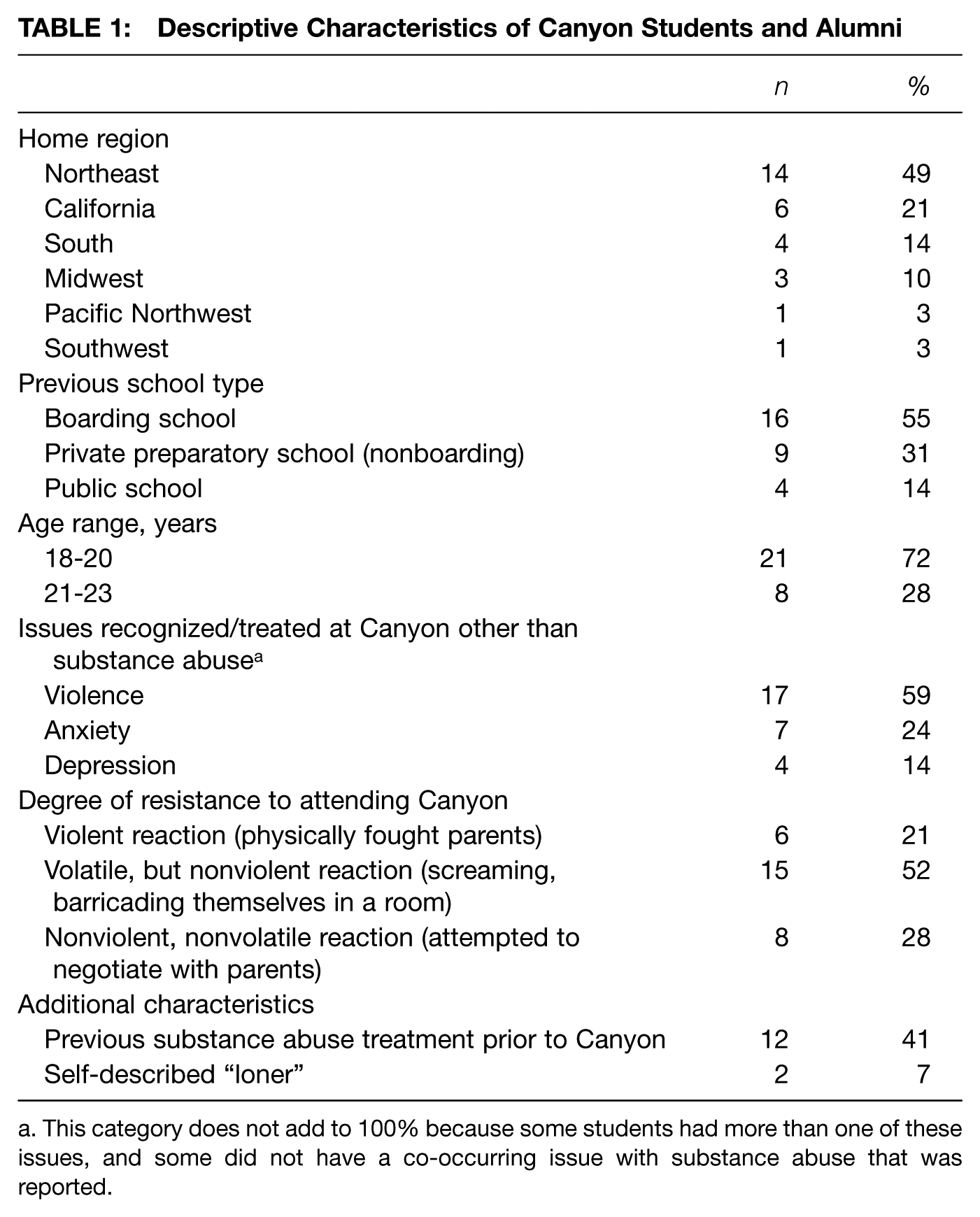
This category does not add to 100% because some students had more than one of these issues, and some did not have a co-occurring issue with substance abuse that was reported.
The data are limited in that I was not able to conduct interviews or make systematic observations at the Canyon Ranch because of issues of researching children, many of whom were going through substance withdrawal and medical interventions that dramatically increased their vulnerability. In these physical and mental states, I judged it both inappropriate and potentially counterproductive to recruit them for my research. Many Canyon House students told me that they “weren’t all there” while in the Ranch program because of withdrawal, suggesting that interviews with these students may not have produced coherent results; the experience perhaps is better understood and articulated in retrospect.
Initially interested in identity transformation across drug rehabilitation programs, I contacted several facilities via their websites. The Canyon program was the first to respond to my inquiry to interview residents about their life histories. In the recruitment email, I mentioned that I had more than 20 years of experience with an immediate family member in recovery and thus a basic knowledge of drug rehabilitation. The executive director granted access immediately, responding with enthusiasm. Rapport was built easily with students and staff who seemed to enjoy talking to someone who was not in recovery, but who was informed and interested in it. They especially enjoyed recounting experiences that they thought might surprise or shock me—experiences they also used to “one up” each other. My position as a young, white woman may have encouraged this masculine showmanship. I tried to limit this effect by constructing a “least gender identity” similar to Pascoe’s (2007), which is built upon a competitive joking interactional style and an inability to be offended or surprised.
My awareness of how young men at Canyon embodied and talked about masculinity emerged inductively from initial visits and interviews. Moving forward, I developed a semi-structured interview guide to examine changes in gendered dispositions throughout the Canyon program. I asked questions about adolescent experiences commonly understood as gendered in previous school and family contexts. Students often discussed difficulties and resistance to the Canyon program on their own. Finally, I asked about personal transformations within the program and how they shaped interactions with others. I coded interviews and field notes in an iterative, inductive-deductive manner by constructing topic codes derived from theory and inductive codes based on emergent themes in the data.
The Dilemma: Boarding School Bros And Typical Dudes
Upon arriving at The Canyon Ranch Academy, students begin a transformation of self that has been found to be common in organizations structured as total institutions (Goffman 1961). This is not a top–down process, however, and to conceptualize the masculinity dilemma students negotiate in this context it is important to consider how students struggle with and reconcile previous styles of masculinity within Canyon’s therapeutic environment. Students spoke at length about their pre-Canyon experiences, using particular terms and discourses that were markedly different from how they spoke about themselves in the present. Students described the transition into the TBS as chaotic. Wesley, a Canyon student, attributes this chaos to being “forced into the program and forced to act in ways that seemed completely insane to us.” This issue—that students are forced into the program—is important in that students face pressure to act in accordance with expectations in the program. However, this does not mean that students cannot resist. Edward, a Canyon alum and staff member, contextualizes this clash by detailing dominant styles of masculinity that undergirded his and other students’ previous experiences: Boarding schools are all the same. The personalities are like “boarding school bro.” . . . A lot of drugs, a lot of alcohol, sex, fights, and things like that. So, when guys get to the Ranch . . . it’s like testosterone overload, these guys who, myself included, are like not having it, like “you’re not the boss of me!” and inevitably someone starts a fight the first night, and . . . chaos.
Edward classifies himself and his previous classmates as “boarding school bros”—young men who engaged in excessive drinking, drug use, sex, and fighting. His account mirrors Kimmel’s (2008) vivid descriptions of the modern world of “guys”: a developmental stage and social space characterized by celebration of promiscuity, consumption, and irresponsibility. Evan provides another specific account of this chaotic transition, also noting how students’ pre-Canyon identities led to issues like addiction and caused problems upon enrollment at Canyon: I was a typical dude. I loved sports and I started lacrosse in fourth grade and I was also into extreme sports. I loved downhill mountain biking, martial arts . . . the competitiveness at school kinda bred this like need to be more extreme. You can kinda see how the drug addiction came about. I wasn’t allowed to do competitive sports [at Canyon] for a long time because they knew that it was an addiction for me . . . that was like the hardest part and why I hated it here at first.
Like Evan, who describes himself as the “typical dude,” James invokes a similarly gendered concept of the “all-American” guy to describe his previous self: I was like the guy who had it all. All-American lacrosse player . . . lots of friends who was getting recruited for D1 schools . . . grades were good. And everything was good . . . but then my father died. I never talked about it . . . cause you can’t talk about that stuff to those guys [at school]. I never even like looked at those feelings and I started using heavily. They teach you here that trauma has effects . . . but I spent months at the Ranch saying I was fine, I wouldn’t talk about anything, I’d pretend that my father hadn’t died . . . it was ridiculous like total denial. Like an allergic reaction to admitting that I was hurting.
Both Evan and James couch these past narratives in athleticism and a love of sports. Talk of sports, and particularly of being the best or most “extreme” in a certain sport, was prevalent and is consonant with literature describing the ultra-competitive nature of ruling-class masculinity (Poynting and Donaldson 2005) and athleticism among high-status boys in schools generally (Pascoe 2007; Thorne 1993). Athletics “provide a continuous realm to perform and gain status” (Thorne 1993, 155), and talk of sports functions as a sort of “currency” that can be used to reaffirm masculinity (Kimmel 2008). Even within their narratives of transformation, students talked about sports intently with each other and with me, demonstrating their masculine histories as “that guy” (Pascoe 2007) who, as James says “had it all”: athleticism, popularity, and good academic standing. Embedded in these discourses, however, is that the TBS environment precludes what it means to be “that guy”: the competitive, unemotional, promiscuous, and sometimes violent behaviors that have come to shape the stage of life between adolescence and manhood (Kimmel 2008). Within Canyon’s therapeutic environment, students begin to understand prior, perhaps normative (Kimmel 2008), masculine dispositions as pathological, marking a shift in how they understand themselves as young men. However, this process is gradual: a stark contrast in norms surrounding masculine performance at the beginning of the program erupting in chaos, fighting, and denial. It is a gender dilemma that James likens to an “allergic reaction.”
Aside from two self-described “loners,” students talked about themselves as popular kids who did well in school until drinking and drug use, partying, competitive behaviors, and sexual promiscuity caused problems. Although all students recognized these behaviors as problematic at the time they were interviewed, they report extreme resistance to thinking about them as such at the beginning of the program. Harrison recounts: “I refused to participate in stuff at the Ranch for months . . . I sat in my room and told them where they could shove this emotional crap.” The two “loner” students also recounted resistance to the therapeutic environment; one of them told me resolutely, “I wanted to kill myself when I got here . . . all these people prying into my shit.” This gradual process of re-imagining what it means to be young men involves the construction of a competing discourse built on a hybrid masculine style that casts what it means to be a “typical dude” as contrary to what it means to be a “good guy.” Students use AA and other therapeutic models to frame previous aspects of their gender identities as “defects”—incorporating humility, service, and emotionality into a reformulated masculine style to claim identities as “better” men (Weber 2012; Wilkins 2009).
The Qualities of “Good Guys”
The process of reshaping masculinity at Canyon begins with the strategies students develop to mobilize therapeutic discourse as a masculinity resource (Wilkins 2009). One of the central themes in conversations about the role of AA at Canyon was that it teaches “how to be a good guy.” Caleb, for instance, explains the 12-steps as a guide for “living right.” He said, “Here [the 12-steps are] mandatory and you have to actually show that you’re living right. Like it goes beyond . . . treatment. It’s like, ‘here is how you live a good life.’ Spelled out like that.” This way of framing the 12-steps—as a positive life philosophy instead of a tool for the sick, weak, or dysfunctional—was prevalent among students and staff. Liam, a student, elaborates on the meaning that AA takes on at Canyon: I mean I recognize AA as a good program. I don’t think it matters if you’re an addict or not I think it just matters that in your life you are a generally good person. Like saying sorry when you’re wrong and making up for your mistakes, help other people. It’s all just . . . basic stuff that good people do, you know?
Put this way, the 12-steps become a life-practice that would be, as James, another student stated, “good for anyone.” By re-framing the emotional qualities that underlie the 12-steps as qualities of good people, students understand the tenets of AA differently than the working-class men in Ezzell’s (2012) study of residential treatment who perceive them as contradictions to manhood. Canyon students, by comparison, actively incorporate the 12-steps into their narratives of emotional growth to portray themselves as “good guys,” thereby bolstering their masculinity relative to generalized notions of “other” young men (Weber 2012).
Indeed, students mobilize newfound un-entitled attitudes and humble dispositions as resources to signal the specific ways they were different from other young men. For instance, Caleb says: You know, here it’s like . . . they’re just really good guys . . . I go back home and you should see these guys. They just have these entitled attitudes, like “I can have whatever the hell I want.” Whether it’s money, women, whatever. They don’t care about anyone but themselves, and like advancing their own shit.
Here, Caleb rejects the “culture of entitlement” that has become firmly affixed to the behaviors and cultural perceptions of contemporary guys (Kimmel 2008). David echoes Caleb’s statement, using humility gained through the 12-steps as means of gendered distinction: “The 12-steps are just a basic practice of humility . . . but the guys I know are too selfish and entitled to ever admit they’re wrong.” Students like David and Caleb use their emotional transformations to claim masculinities that are “presumably more moral and desirable than the masculinities of other sorts of men” (Wilkins 2009, 260). By redefining dispositions that would previously have appeared “weak” or “suspicious” (Poynting and Donaldson 2005) as qualities of “good guys,” students set themselves apart from other, “lesser” guys.
Canyon students also develop a service orientation, but one that functions to position them as leaders. David explains that service is important at Canyon “because the nature of addiction and alcoholism is pretty selfish and just like after having like taken from society for so long, we need to give back at this point.” However, service takes on a unique and complex meaning at Canyon. When Braxton, an alum and staff member, discussed the importance of service to the AA community, through sponsorship in particular, he notes that Canyon students were asked to be sponsors more frequently than other AA members: We have all these people who have really been in there and they really know their stuff, to the book. Like you go to an AA meeting and you hear people talk and their war stories and stuff, but all you really wanna listen to is these guys [Canyon students and staff], they’re just hella good people. They even get other people to come in and ask them for sponsorship, it’s just crazy!
Braxton suggests that Canyon students are leaders and experts in the AA community. Joshua, sounding much like Braxton, says, “I’m not sure that there are a lot of other people in AA who know the Big Book like we do, we really study the stuff. I think that’s why we’re called as sponsors more.” Canyon students view sponsorship as service and as a way to “give back.” However, sponsorship also operates as a way to assert leadership positions and expertise in the AA community. In Cookson and Persell’s (1985) classic work on elite education, they note an inherent contradiction between being a “servant” and a “leader.” Like other privileged youth, however, Canyon students resolve this contradiction by learning that to “serve” is to become decision makers in society (Cookson and Persell 1985; Gaztambide-Fernández 2009).
The ways Canyon students perform service relates to their positions as young, white, upper-class men in two major ways. The first is simply that students (via their families) have the resources to participate in a program that affords them abundant opportunities, including the time and guidance to “study,” as Joshua says, therapeutic literature as if it were an academic subject, which contributes to the belief that they are the experts. Although four students recognized that they were “fortunate to be here” and that it was a function of their parents’ wealth, others did not recognize this. The few who did made no connection between being the ones who “really know their stuff” in AA and their social class or differential resources—factors that enable the close guidance Canyon provides when working the 12-steps. Secondly, Canyon students confront men (they rarely spoke of women in AA) in AA meetings as “others.” They do so explicitly in terms of class and age and implicitly in terms of race, developing a kind of “paternalistic savior” (Hughey 2012) mentality informed by negative beliefs associated with these categories. Wesley, a Canyon student, explains differences between Canyon students and other AA members in terms of sponsorship: I mean, there’s a lot of different people in AA . . . lots of people here live in trailer parks, some are homeless. . . . If there is a fifty year old dude, with a long scruffy beard that can’t dress right and he identifies himself as a recovering alcoholic . . . it’s going to look a lot differently than me, an 18 year old upper-middle-class dude that looks pretty normal saying that I’m an alcoholic. I think that in and of itself leads people to seek us out as sponsors.
Wesley employs clear class and age distinctions—that upper-middle-class men look “normal” compared to old, working-class men—suggesting this is a reason “in and of itself” that Canyon students are better suited as sponsors. As being young and being white are often thought of as “natural” or “default” categories (Lewis 2004), age and whiteness are likely factors in his perception that he is normal compared to other men in AA in this Western locale, many of whom are Hispanic. In a different exchange, Liam erects another boundary between Canyon students and AA members. He said, “We’re just in a different place, you know? Like if you look around here . . . we’re not the typical people you’d meet at AA or outpatient. We can be there to help them . . . just not hang out with them cause it might not be good for us.” Likely drawing on class differences and implicit negative cultural beliefs surrounding addicts and addiction, Liam differentiates Canyon students from “typical” alcoholics. He notes that as Canyon students, they are in a “different place,” suggesting other AA members may have a polluting influence. He can be there as an adviser to instruct other AA members, but he is not one of them.
In AA meetings, Canyon students assumed leadership positions naturally. Students were facilitators (rotating discussion moderators designated by the group) in eight of the 11 meetings I attended. On one occasion, I arrived to an AA meeting a few minutes late with Chris, a Canyon alum and meeting facilitator. Before entering the room we heard shouts and a call of “There’s our man!” Smiling and laughing, Chris sat down in a chair another man pulled out for him, greeting members by name and reaching over to pat them on the shoulder or shake hands. Amid the other members clad mostly in jeans and T-shirts, Chris stood out in a blue blazer paired artfully with a vintage button-up shirt over slacks. He moderated the discussion effortlessly, relating issues among other members to his own recovery, and suggesting solutions based on his experience while other members nodded and smiled in agreement. Throughout the meeting, Chris sat relaxed in his chair, one leg slung over the other while he casually flipped through the Big Book resting in his lap to call attention to relevant passages and interject advice as each of the members spoke in turn.
This ease of interaction that students displayed in all activities, but particularly in AA meetings, is related to what Khan (2011) calls the “ease” of privilege. One of the distinctive characteristics of the modern upper class is that success is no longer contingent on “building motes around culture . . . knowing particular things (like which is the salad fork)” (Khan 2011, 83). Instead, it is about embodying an ease that spans different cultural spaces—an expansive knowledge of how to act within a culturally varied world. For instance, Chris had no problem relating a spat with his younger brother to a long-standing issue between a 50-year-old AA member and his son, despite being half the man’s age and not having children himself. He gave advice in a way that left no room but to believe he was the authority on any given subject, even when he rarely had direct experience with the issues the men brought up. He seemed a natural leader and authority figure in the meeting, something other members recognized as well. After the meeting, Chris introduced me to Ricky, a Hispanic man in his mid-thirties who he was sponsoring. As we walked out, Ricky told me—perhaps self-consciously given their age difference—“I still can’t believe I’m taking advice from this 23 year old kid! They got something going on at [Canyon] though, tell you that.” Ricky suggests that the boundaries students draw between themselves and other AA members are upheld outside of Canyon. He notes that there is something innately different about them, something that marks them as leaders and potential sponsors. The qualities that designate them as leaders—a corporal “ease” of interaction and an expertise in AA culture and literature—are anything but natural, however. They are products of repeated experiences in elite institutions (Khan 2011) and of the students’ ability (via family resources) to attend a program like Canyon. That these differences are not attributed to status, but rather to differences of personality or something innate, operates to obscure the reproduction of privilege and hierarchy (Khan 2011).
In addition to AA, students also relate equine therapy to their personal and emotional transformations. Caleb talks about the role of EAT in his recovery: “Horses have been a big part of my recovery and transformation. . . . It makes you think about things outside of yourself and really care for something.” As with service, however, the emotional proficiencies students attribute to EAT also function as tools to assert themselves as leaders. Daniel, a Canyon student, explains: My horse taught me how to lead. By showing my emotions, communicating my true self, I was able to guide her and we built an incredible relationship. We trust each other . . . she’s helped me in so many ways . . . with this transformation into an honest, compassionate human being.
Daniel aligns “soft” emotional qualities with what it takes to be an effective leader. On one visit to the Canyon House, a group of students recognized the seeming inconsistency between these emotional qualities and the manly physicality of horseback riding and ranch work. Wesley—looking distinctly opposite of the rugged, weathered image of the American cowboy in his polo shirt, khaki shorts, and Sperry Topsider boat shoes—chuckles as he tells me: It’s kinda funny. Like, if you look around the Ranch, it’s like literally a Ranch. And you’ve got a bunch of boys walking around like a cheesy Western reenactment riding horses and shoveling shit—like cowboys. I mean like how macho could you get? But then later in the day we’re going to therapy, praying with a friend, talking about our feelings. [laughs] I guess we’re pretty sensitive cowboys.
Wesley acknowledges the emotional aspects of Canyon’s environment, and that they exist in opposition to the “macho” image of the cowboy. However, after he notes this contrast, he aligns the two, suggesting Canyon students embody a hybrid masculine construct as “sensitive cowboys.”
Emotions And Intimacy-Talk
Canyon students employ emotion work (Hochschild 1983) and intimacy talk (Wilkins 2009) in line with this hybrid, “sensitive” style of masculinity, but in ways that tend to bolster masculinity. Talk of feelings, however, was one of the topics broached with students in later stages of the TBS where a clash of gender norms at Canyon was immediately apparent. Aware of contradictions in men expressing intimate feelings (Wilkins 2009), students often made light of their open emotionality. Thomas, for instance, says that at Canyon “they make us talk about our feeeeeeelings.” Thomas’s response is consistent with how other students drew out the word “feelings,” uttering the word in a mocking tone while laughing, or, as two students did, using air quotes. Despite discursively distancing themselves from an expressive practice usually coded as “feminine” (Bridges 2014), students drew on “intimacy-talk”—an emotional vocabulary that incorporates talk of vulnerability, trust, and intimacy—to restore family bonds and assume leadership roles in their families, and also to construct other men’s aggressive and inexpressive demeanors as lesser, even vulgar (Weber 2012; Wilkins 2009). This initial discursive resistance is likely a function of the sharp disjuncture in feeling rules across Canyon and previous contexts—particularly families and schools. The majority of students described their parents as emotionally distant and emphasized the role of the emotional growth they experienced in family therapy programs (phone conversations mediated by a therapist) at Canyon in restoring family bonds. Like Grant, a Canyon student, recounts: My family was the kind where you sit at the dinner table and nobody says a word, like no communication at all. If you have a bad day, deal with it. Go scream into a pillow . . . don’t bring it up to us . . . Here you have to do these family workshops and phone sessions to talk about stuff that’s wrong. Those really help to open the lines of communication with our families. You talk through resentments. . . . There are lots of tears, but it works. I have this incredible relationship with my family now.
Joshua describes family therapy at Canyon similarly, as a highly emotional encounter that involves emotion-talk to navigate difficult relationships and solve family problems: My parents were really unemotional and strict, and I think that’s where the trust issues and emotional unavailability came from, but we dealt with it by putting it all out there in the family therapy here. Now I call my parents everyday, we talk about everything . . . we say “I love you” and it’s really good.
Grant and Joshua’s statements imply that expressing feelings to parents is something that “works” to enable communication and establish healthy relationships.
For alumni, the emotional coaching that occurs in family therapy was implicated in how they positioned themselves in their families and in their outcomes post-Canyon. Edward, an alum and staff member, explains how he interacts with his parents: I feel like when I go home I’m like the man of the house now. My parents have always had some issues and I’m the one who helps manage and talk through those at this point. The fact that I went through this program and can communicate between the two of them actually helps them with like whatever conflict is going on.
Edward asserts a “man of the house” role based on his ability to navigate conflict by facilitating communication. Similar to the ways students meld service and leadership, Edward’s ability to resolve conflict by talking things through allows him to assert a dominant position relative to his parents. For Charles, working through emotional issues with his father re-opened routes to attainment in his father’s digital marketing company: My dad and I used to have major trust issues . . . he used to threaten to kick me out, take me out of the will, all that. Now that we’ve worked through our issues and actually talk and trust each other with things, he’s talking about putting me in charge of one of the divisions of his company after I get a degree.
The emotional tools students use to rebuild family relationships take on particular importance for students given their class positions. By establishing a trusting relationship with his father, Charles is reconsidered to carry on family business—as was the case with six other students in later stages of the program and two alums. As Khan (2011) notes, family bonds are important in the intergenerational transference of wealth and resources (networks, connections, etc.). Students repair these bonds via heightened communication with parents enabled by intimacy-talk.
The other significant disjuncture in feeling rules occurred across Canyon and previous schools. Previously, several students had attended military schools, which have historically served to reform “unruly” adolescent boys (Cookson and Persell 1985). The contrast in feeling-rules was evident in accounts of previous school experiences broadly, but military schools in particular, as Liam describes: It was pretty violent . . . and there was a certain stoic-ness about it. Like it was all drilling and training . . . kind of ridiculous, like talk about discipline and punishment just for the sake of discipline and punishment . . . totally different from [Canyon]. It’s not fun. You don’t smile a lot, a lot of the time you can’t, like you will be punished for it. And to deal with stuff, you don’t ever really talk. You deal with problems . . . by just doing the routine . . . drills and training. . . . Here, like, [laughs] it’s pretty normal to see a dude crying. Or saying he’s struggling with guilt or whatever.
Although military schools exist as an extreme gendered space where masculine performances are heavily policed (Cookson and Persell 1985), research suggests that certain kinds of violence and control are “endemic” to ruling-class masculinity (Poynting and Donaldson 2005). Thomas, a Canyon student, describes the specific nature of the violence he engaged in while at school: “I got in fights all the time, but it was kind of sneaky and quiet. Me and my friends would like punish losers in the middle of the night. I was not a good guy.” This “sneaky and quiet” style of violence was used to exert control and dominance over “losers”—presumably boys who performed subordinate masculinities. The few young men who had attended public high school prior to Canyon also recounted violent dispositions, but ones that lacked the “sneaky and quiet character” that Thomas describes. Harrison, a student who attended a Northeastern public high school, remarks, “I was pretty aggressive in school, fighting was just my reaction to everything. So, I was always in the office, usually trying to fight my way out [laughs].” However, as Liam indicates, emotional communication supplants violence as a solution to problems at Canyon where it is now normal to “see a dude crying.”
Braxton touches on this reversal—from violent expression to emotional expression—mobilizing a “mature” emotional style to bolster his masculinity: At seventeen I was more mature than most of the people that I knew and I would go back home and see people my own age and go back into the school setting and . . . Yeah, I would see kids and they would be like dumb and I would think, I actually hung out and acted like these people, this is ridiculous. Like why on earth would I possibly do this? But . . . I’m able to look at things in a different light . . . when something bad happens I’m not like, “ . . . this is stupid” But I’m like, “Okay, you have your opinion.” . . . I’m not going to act out and get all mad, punch a guy or whatever. I can tell you how I feel and if you don’t understand that, it’s fine, I accept it. . . . It really helps . . . make that transition from boy to man quick.
Braxton explains that communicating feelings is a quality of true men, suggesting that aggression and violence is characteristic of immature, “dumb” kids. Like Braxton, Daniel feels that “you just can’t communicate with guys our age. That’s why [Canyon] is so influential for me . . . teaching me how to feel my feelings and how to communicate with other people and have better relationships all around.”
Braxton and Daniel use intimacy-talk as a symbol of their depth, particularly in comparison to the immaturity linked with male youth (Weber 2012). Though intimacy-talk is seen as a feminine practice that might threaten manhood, students use it to bolster their masculinity. This finding is consistent with research that has found that men’s use of emotional discourse can sometimes be used to maintain power in relationships. For instance, in Kleinman’s (1996) research in an alternative health organization, men’s emotional displays took on more value than women’s since emotional disclosure was assumed to be more difficult for them (see also Weber 2012). However, as Wilkins (2009) points out, these discourses are flexible and not only sources of power in relation to women. As in this case, intimacy-talk is used to leverage positions in many other relationships, such as in families and relative to other men. As emotionality is presumed lacking among men, especially young men (Kimmel 2008; Wilkins 2009), students’ emotional displays take on greater significance. As Wilkins (2009) states, there is a belief that “men deserve more credit for their [emotional] efforts” (363). Emotional expression, then, becomes a valuable masculinity resource with respect to various others.
The Vulgarity Of Masculinity
As students are required to work part-time or enroll in college classes during the final stages of their time at Canyon House, many students had interactions and friendships with people outside of the TBS and AA. When asked about these relationships, the overwhelming response was that they were difficult. Friendships with other young men were especially problematic. Some students, like Harrison, attribute difficulties in relationships to the fact that “most guys are into binge drinking and destructive patterns like that,” engaging with what Kimmel (2008) finds a common cultural (mis)perception that all young men drink to excess. However, when prompted about peers who did not drink problematically, students still maintained these relationships were difficult. Wesley, a Canyon student, explains why: They might not be alcoholics . . . maybe some of them are, but the stuff they engage in, like just girl after girl, or like idiotic primal displays, like “oooh, oooh, oooh” [makes noises and hits chest imitating a monkey] . . . those are symptoms of this underlying disease . . . like the problems that lead to something like alcoholism.
Wesley identifies the behaviors of young men at large as causes of issues like alcoholism. Recounting an exchange with a student, Braxton, an alum and staff member, suggests that these behaviors are driven by purposelessness: I was talking [to a student] about the way we relieve ourselves of this depression is not for personal gain, it’s to live a purposeful life . . . you could easily be out there with your high school friends, drinking and doing drugs, and casual sex, but where is the purpose in that? . . . There are not a lot of 18-year-olds that are doing service work and helping others, and that is the depth in our relationships.
Wesley and Braxton draw upon a “generic catch-all” category of the modern “guy” (Kimmel 2008), defined by excessive drinking, promiscuity, and aimlessness, to distinguish themselves from the average young man. They deem the masculine styles of “other” guys—styles they themselves embodied pre-Canyon—animalistic, purposeless, and symptomatic of a disease.
Edward, an alum and staff member, also draws on masculine stereotypes as he describes problems relating to peers: It’s incredibly difficult, like I hang out with these guys, that not to be profane, but they are like, “Yo, I fucked this bitch last night!” . . . Like what is wrong with you? How old are you? And they say 22, and I’m like . . . that makes sense. And I hate the frat life. There are not a lot of 23 year olds looking at where their abandonment issues come from. That are . . . looking at how can I help someone else today. . . . It does make interactions . . . difficult. It does put you in a unique position especially in the dating field you are different from the other guys so it makes it pretty easy for you.
Edward profanes the sexual promiscuity and derogation of women that he sees as characteristic of other guys. As a young man set upon self-reflection and helping others, he defines himself as “unique” against the backdrop of other, shallow, selfish men. These strategies are similar to what Wilkins (2009) observes in her comparative analysis of Christian and Goth men who made claims of being “better,” more “evolved” men by distancing themselves from undesirable masculine styles: being lewd, predatory, selfish. Likewise, Weber’s (2012) work shows how teen fathers maintain identities as “good guys” by relying on stereotypical assumptions that “‘all men are dogs’—except for them” (Weber 2012, 916). By similarly disavowing these configurations of masculinity in fields like dating, Canyon students claim higher relational worthiness vis-à-vis other men. Although students like Edward provided examples of how their transformations as men “worked” for them, I was able to observe this firsthand on a visit to the Canyon House. One afternoon, I ran into a girl named Emily who told me she was waiting for Daniel, a student in his final month of the program. I began talking with Emily, who had been casually dating Daniel for about two months, about the Canyon program and asked what she thought of it. She gushed about how inspiring it was to see so many young men who had “pulled a complete 180.” On her relationship with Daniel, she smiled as she told me: I’ve never met anyone like him before! I’ve had two other real relationships with guys . . . you would call “emotionally unavailable” [laughs]. But Daniel is . . . the opposite . . . like we really talk, you know? . . . And that communication is important on my end too, so it’s been really great. . . . I’m older so I was hesitant at first, but he’s amazing!
For Emily, Daniel’s emotional availability makes him a better partner than other men. Her hesitance at dating a younger man (21 to her 25) suggests that these distinctions are enabled by age. Although emotional inexpressiveness is a generalized quality of men, it is especially so among young men, making students like Daniel especially desirable compared to their counterparts in that they are rare (Wilkins 2009). This instance is illustrative of the ways hybrid masculinities operate in practice to help young men maintain privilege and reproduce relational hierarchies (Bridges and Pascoe 2014). Their co-optation of a more feminine style of emotionality allows them to maintain advantages in the dating field—making it “easy” for them to win women—and, as I discussed in other sections, to reassert leadership roles in varied contexts like AA and in families. Although these narratives of emotional transformation may seem to challenge ideals of hegemonic masculinity, they function to reinforce them by allowing young men new avenues of asserting dominance (Bridges 2014; Weber 2012; Wilkins 2009).
Conclusion
What are we to make of these “sensitive cowboys”? Scholarship on contemporary transformations of masculinities calls researchers to attend to the different configurations of masculinities in operation at various points in history to understand how gender is understood and enacted by individuals and in the larger culture (Bridges and Pascoe 2014; Messerschmidt 2016). It is particularly important to break down masculinity to understand the workings of privilege and power, not only between men and women but also within the category of “men.” This article uses a previously unexamined case to illustrate how privileged young men navigate ruptures in hegemonic masculinity by constructing hybrid masculinities. In contrast to men of different social backgrounds in similar situations who cope with threats to masculinity using “compensatory manhood acts” (Ezzell 2012), the young men in this study draw from different cultural tools and strategies to construct hybrid masculinities that incorporate identity elements associated with femininity and subordinate masculinities.
In consonance with theory and research on changes in styles of masculinities, Canyon students incorporate feminine and subordinate masculine elements selectively in ways that allow them to reassert dominance and power. Students mobilize a “sensitive cowboy” masculine style as a resource to distance themselves from certain configurations of hegemonic masculinity cast as undesirable. Using therapeutic discourse to frame themselves as sensitive and emotional young men committed to service, they are able to assert leadership roles and to distinguish themselves from other, “lesser” men (Weber 2012; Wilkins 2009). However, they continue to benefit from privileges associated with being young, white, upper-class, and male that make hybrid masculinities more available as a resource (Bridges and Pascoe 2012). This sheds light on why there might be different strategies for resolving “masculinity dilemmas” in male therapeutic contexts depending on social status.
This article extends the line of theory and research showing that masculine styles that appear out of sync with hegemonic masculinity tend to reproduce and conceal systems of power in new (“softer”) ways (Bridges 2014; Bridges and Pascoe 2014; Messner 1993; Wilkins 2009). It also contributes to research on contemporary transformations of masculinities among privileged youth—studies of whom remain limited. Also, recognition of the cultural resources and tools that inform how men of different social backgrounds respond to gender dilemmas in therapeutic contexts may aid therapeutic practitioners. This study was limited to observations of students in the later stages of one TBS program. Further research is needed to explore these processes across other programs and to discern how hybrid masculinities are implicated in outcomes post-TBS. Subsequent research must examine how well these hybrid masculine styles “stick” post-completion, particularly given that Canyon students, and likely other TBS students, do not enter these programs voluntarily and are under pressure to comply with norms and expectations. Although the few alums in this study fully embodied these emotional dispositions, they were those who remained closely involved with Canyon. Longitudinal research is necessary to explore further transformations in the masculinities of those who move out of the structure of the program and return home and to previous contexts and peer networks.
Footnotes
Acknowledgements
I would like to thank Tristan Bridges for organizing the panel and for providing helpful feedback on initial drafts. Many thanks also to Jeffrey J. Sallaz, Linda Molm, and Robin Stryker who provided comments and suggestions during various stages of the development of the larger project. I would also like to acknowledge Corey Abramson, Jennifer Carlson, Andrew Davis, Amelia Blume, and Kyle Puetz for their insights, advice, and thoughtful remarks on multiple drafts in addition to the three anonymous reviewers at Gender & Society who significantly improved the framing and clarity of the article.
This article was presented as a paper at a panel on masculinities at the 2016 American Sociological Association Annual Meeting;
This research was funded in part by a small grant from the Social and Behavioral Sciences Research Institute at the University of Arizona.
Notes
Jessica Pfaffendorf is a PhD candidate in the School of Sociology at the University of Arizona. Her research interests include culture, social psychology, inequality and stratification, and gender.