




Abstract
Intersectional feminist scholars emphasize how overlapping systems of oppression structure gender inequality, but in focusing on the gendered, classed, and racialized bases of stratification, many often overlook disability as an important social category in determining economic outcomes. This is a significant omission given that disability severely limits opportunities and contributes to cumulative disadvantage. We draw from feminist disability and intersectional theories to account for how disability intersects with gender, race, and education to produce economic insecurity. The findings from our analyses of 2015 American Community Survey data provide strong empirical support for hierarchies of disadvantage, where women and racial minority groups with disabilities and less education experience the highest poverty levels, report the lowest total income, and have a greater reliance on sources outside the labor market for economic security. By taking disability into account, our study demonstrates how these multiple characteristics lead to overlapping oppressions that become embedded and reproduced within the larger social structure.
Like race, class, and gender, disability is a social category that represents an important axis of inequality (Jenkins 1991), influencing the lives of at least 12 percent of the U.S. population (Erickson, Lee, and von Schrader 2018; Lauer and Houtenville 2018). Disability intersects with race and gender to expand the accumulation of disadvantage, shaping everything from educational attainment to the kinds of jobs people have, the neighborhoods in which they live, their access to credit markets and social services, and their health over the life course (DiPrete and Eirich 2006; Shuey and Willson 2008). However, inclusion of disability as an axis of inequality in sociology has been less explicitly feminist and intersectional (L. J. Davis 2011). Additionally, despite such diffuse effects, much of the intersectional scholarship on disability and economic inequality has primarily focused on employment and earnings (Mereish 2012; Pettinicchio and Maroto 2017; Shaw, Chan, and McMahon 2012) to the detriment of other economic outcomes. This reflects a major gap in our understanding of economic insecurity and exposure to risk (Western et al. 2012), especially when considering the numerous employment barriers faced by women with disabilities.
In light of previous research on the gendered consequences of disability for labor market outcomes, we address the following research questions: Do the gendered effects of disability extend to other areas of economic (in)security, such as poverty and total income, which includes sources other than employment earnings? And, how do these outcomes also vary with race/ethnicity and education? We use 2015 American Community Survey data to assess variation in the consequences of disability on poverty and total income in conjunction with gender, race/ethnicity, and education. Specifically, we interact six major racial and ethnic groups with gender and disability, as well as college-level education, a major determinant of an individual’s future earnings and class standing, to study the effects of disability on economic insecurity across disadvantaged groups through a process-centered intersectional model (Choo and Ferree 2010).
We situate our analyses of economic insecurity within intersectionality, feminist theory, and feminist disability studies. Intersectional and feminist researchers note that the effects of categorical group membership cannot be understood without considering the overlapping oppressions built into structures of inequality (Crenshaw 1991; K. Davis 2008; MacKinnon 2013). Feminist disability scholars have sought to extend this framework to provide an explicitly gendered analysis of disability (Garland-Thomson 2002, 2005; Hall 2011). By examining how “identity-based critical enterprises” have similarly shaped the way we think about the social construction of ethnic, gendered, queer, and disability categories, they emphasize the interactions between multiple identities and systems of inequality (Gerschick 2000; Shaw, Chan, and McMahon 2012). This perspective highlights how socially constructed meanings of disability in conjunction with race, class, and gender contribute to economic and social marginalization (Blanck et al. 2007; Doren and Benz 2001; O’Hara 2003).
We found that the negative effects of disability resulted in hierarchies of disadvantage (Pettinicchio and Maroto 2017) where women and racial minority groups with disabilities and less education experienced the highest poverty levels, reported the lowest total income, and had a greater reliance on income sources outside the labor market for economic security. However, while effects of disability on poverty were strongest for women, racial minorities, and individuals with less education, disability presented some of the strongest effects on total income among more advantaged groups, particularly non-Hispanic white men with higher levels of education, pointing to the potential ways in which disability can also undermine norms of masculinity. Framing our findings of the consequences of disability on economic insecurity through a feminist disability perspective helps situate disability within social stratification research by highlighting how the intersection of multiple social categories more broadly marginalizes certain individuals and groups.
Economic Insecurity as a Dimension of Inequality
Studies of economic insecurity expand on labor market inequality research to consider the effects of risks and shocks within stratification systems, which often depend on the amount and nature of economic resources available to weather financial hardship (Hacker et al. 2014; Osberg and Sharpe 2014; Western et al. 2012). In the United States, economic insecurity has rapidly increased since the 1970s (Hacker 2006; McCloud and Dwyer 2011). Supported by an ideology of personal responsibility, government and businesses have gradually divested themselves from the management of financial risk, limiting social insurance and employment protections and shifting risk to the individual (Hacker 2006). Declining social safety nets, market deregulation, and reductions in union strength place additional risk on workers and families. The consequences of such trends are evident in job losses and increasing debt (Seefeldt 2016), as well as rising health problems and drug abuse across groups (Bor, Cohen, and Galea 2017). Although its effects span the population, rising economic insecurity more negatively impacts already marginalized groups.
Women, racial minorities, and individuals with less education tend to face greater hardship and disadvantages than their counterparts. Despite advancements within employment and education, women, particularly single mothers, experience high levels of economic insecurity (Shuey and O’Rand 2004; Western et al. 2012)—evidence of the feminization of poverty (Bianchi 1999)—and often struggle to “build a safety net of savings” (Quadagno 1994; Willson 2003; Willson and Hardy 2002). Similarly, previous research indicates that the labor market insufficiently provides financial security for people with disabilities, even with employment discrimination protections and policies meant to retain employment and increase earnings (Jones 2008, 2011; Kruse and Schur 2003; Maroto and Pettinicchio 2014b, 2015).
As a result of persistent labor market inequality, minority groups, including people with disabilities, often rely on government support, family, and savings, to provide some level of security. Public assistance, Social Security Disability Insurance (SSDI), and Supplemental Security Income (SSI) are important resources for people with disabilities (Acemoglu and Angrist 2001; Boursquot and Brault 2013; Weidenbaum 1994). However, even with government assistance, people with disabilities struggle to “keep their heads above water” in an era of neoliberal cutbacks to disability programs and pensions (Sherry 2014). Workfare-style programs, epitomized by the 1996 Personal Responsibility and Work Opportunity Reconciliation Act (PRWORA, a.k.a. Clinton-era Welfare Reform), for example, worsen rather than help people with disabilities obtain employment that provides adequate income. This has left many struggling to achieve basic economic security, as they experience higher rates of poverty and material hardship (Parish, Rose, and Andrews 2009; She and Livermore 2007).
In light of declining social supports and a more precarious labor market, we examine how poverty status, total income, and income sources vary with disability, gender, race, and education. We specifically address how membership in multiple disadvantaged groups contributes to the accumulation of disadvantage (DiPrete and Eirich 2006) using a process-centered intersectional analysis (Choo and Ferree 2010; McCall 2005) essential to a feminist disability perspective on the production of inequality (Garland-Thomson 2002, 2005; Linton 1998a, 1998b).
Examining Economic Insecurity through a Feminist Disability Framework
Disability and gender together inform underlying norms and values about “the other,” so pervasive and deeply embedded that they transcend cultures and institutions. Drawing from the strengths of both disability studies and feminist traditions, a feminist disability perspective considers how each social category influences social interaction while simultaneously accounting for particular experiences unique to the overlap of multiple social categories (Garland-Thomson 2002, 2005). It builds on the sociopolitical analysis in disability studies, which emphasizes how the meanings society attaches to disability matter more in understanding disability as an axis of inequality than any so-called objective characteristics (Barnes 1999; Kafer 2013; Linton 1998a, 1998b). Shakespeare (1996) alluded to this when he claimed the sociopolitical model of disability challenges normative and cultural assumptions about how people come to identify as disabled, rather than how society compares disabled people to an assumed normality that largely goes undefined.
Disability is an important social category associated with the distribution of social, economic, and political resources (Maroto and Pettinicchio 2015; Parish, Rose, and Andrews 2009). Disability, however, is still less commonly understood as a source of unequal outcomes in sociological work on oppression and inequality. This is partly because of how the boundaries of disability status are constructed (Barnartt 2013). Disability represents a fluid, ambiguous, and often invisible category that incorporates both physical and social aspects (Atkins 2010; Rohrer 2005; Sommo and Chaskes 2013), making it more difficult for scholars to conceptualize and classify (Altman 2001). Individuals may come in and out of identifying as disabled over their lifetimes, making disability a “potential status” that becomes more prevalent with age (Gordon and Rosenblum 2001). As Vernon (1999) suggested, porous and contested boundaries around disability complicate the development of a politicized disability collective identity around which to mobilize sociopolitical resources against deeply entrenched structural inequalities.
In addressing disability as one of many axes of inequality, feminist disability scholars have done much to shine light on the ways in which ableism as a system of oppression intersects with racism and sexism (Gill 2015). Like women, people with disabilities receive a lower status value; they tend to be viewed as less competent and less productive than other workers, and as helpless and weak (Garland-Thomson 2002; Hirschmann 2012; Rohmer and Louvet 2012; Schwochau and Blanck 2000; Unger 2002; Vaughn, Thomas, and Doyle 2011). Thus, a feminist disability perspective provides an important framework for understanding the inequalities embedded in economic systems where women with disabilities are seen as inferior to idealized white, able-bodied men. This involves taking into account how social categories intersect to perpetuate inequalities within and between groups.
Intersectionality and Hierarchies of Disadvantage
The intersectionality of socially constructed statuses is an important mechanism that links group membership to the production of disadvantage in both feminist and feminist disability traditions. Intersectionality specifically addresses the interaction of different bases of stratification, as well as broader systems of inequality, subordination, and oppression (Choo and Ferree 2010; Collins 1990; Crenshaw 1991; MacKinnon 2013; McCall 2005). In other words, it refers to the “interaction between gender, race, and other categories of difference in individual lives, social practices, institutional arrangements, and cultural ideologies and the outcomes of these interactions in terms of power” (K. Davis 2008, 68). Thus, social categories like race and gender do not exist independently of each other. For example, beliefs regarding black men are not identical to those surrounding black women, and members of these groups hold different statuses, as evidenced by varying wages, education levels, and rates of incarceration (Browne and Misra 2003; Snipp and Cheung 2016). Vernon’s (1999, 385) point about disability and multiple intersecting identities—that “the majority [of people with disabilities] is not a homogenous mass of disabled white heterosexual middle-class young men”—provides all the more reason to account for the socioeconomic consequences of simultaneous oppressions.
Although early disability labor market research drew indirect attention to the ways in which multiple statuses influenced economic outcomes and how disability discrimination reinforced sex discrimination (Johnson and Lambrinos 1985; Luft 1975), only recently have studies begun to examine how disability directly intersects with other characteristics in shaping economic inequality. Many studies indicate that women with disabilities—“a specific category of bias” (Kotkin 2008)—face labor market outcomes that are distinct from those only of people with disabilities and only women (Acemoglu and Angrist 2001; Pettinicchio and Maroto 2017). Women with disabilities may be “twice penalized” (O’Hara 2003) or in “double jeopardy” (Doren and Benz 2001) as a result of structural and attitudinal factors associated with the intersection of both statuses. Disabled women must contend with (mis)perceptions about skills and abilities limiting access to stable income (see Jones and Sloane 2010), especially when employers make hiring, pay, and promotion decisions based on stereotypes that are about a combination of statuses (Browne and Misra 2003; Greenman and Xie 2008; Hernández 2006; Shuey and Willson 2017) resulting in multiplicative effects that perpetuate organizational inequalities (Maroto and Pettinicchio 2014a; Schur 2004; Shuey and Jovic 2013). The intersectionality of multiple statuses thus defines “modern discrimination” (Marchiondo, Ran, and Cortina, 2015) with real-life negative effects on economic security.
Recent work provides compelling evidence of the ways in which stereotypes, attitudes, and beliefs based on the intersection of multiple social categories contribute to inequality, marginalization, and disadvantage (see Best et al. 2011). For instance, Mereish (2012) found that Asian American and Pacific Islander women with disabilities were more likely to report being discriminated against in the workplace than those without disabilities. In a similar vein, Shaw, Chan, and McMahon (2012) uncovered unique clusters whereby Mexican and American Indian women with behavioral disorders were more likely to make harassment complaints. Pilling’s (2012) intersectional analysis of disability, gender, and LGBQT status found that employees were less likely to disclose mental illness, fearing that it will undermine their authenticity as LGBQT disabled people in the eyes of employers.
Intersectional work on labor market outcomes broadly illustrates how disadvantage accumulates across social categories when certain groups struggle more than others. But the effects of intersectional disadvantage do not end with the labor market. They spill into other related resources, ranging from government assistance to savings and nest eggs, on which individuals and households rely when employment support is limited (DiPrete and Eirich 2006; Hacker et al. 2014; Osberg and Sharpe 2014; Western et al. 2012). This is all the more salient in a context of declining lifelong careers and decreasing reliance on employer–employee savings plans whereby individuals must independently seek out other ways to support their well-being and survival (Hacker 2006). For these reasons, we examine how both total income and poverty status vary in regard to disability, gender, race, and education, with a particular emphasis on the ways in which membership in multiple disadvantaged groups contributes to the accumulation of disadvantage.
Methods
To investigate whether women and racial minorities with disabilities make up for inadequate labor market income and whether this helps improve their economic security, we analyzed a sample of adults from the 2015 American Community Survey (ACS). As a large cross-sectional survey that includes data on disability status and race/ethnicity, along with information on family structure, education, earnings, and other background characteristics, the ACS is ideal for analyzing intersecting disadvantage (Ruggles et al. 2017). After restricting our sample to adults age 18 and older, we obtained a full sample of 2,490,616 individuals for our analyses of poverty, and a sample of 2,233,721 individuals with at least some income for our analyses of total income.
Outcome Variables
We analyzed two primary outcome variables—total personal income and poverty status—as measures of economic security. Total personal income refers to the respondent’s total pre-tax personal income from all sources in the previous year in 2015 U.S. dollars. It includes income from the following four areas: employment income from wages and salary and self-employment from a business, professional practice, or farm; government-related income from public assistance programs, Supplemental Security Income (SSI), Social Security pensions, survivor benefits, or permanent disability insurance; savings income from an estate or trust, interest, dividends, royalties, rents received, and pensions; and “other” income sources, which likely include transfers from family members. Because total income can take on negative, zero, or positive values, we estimated logged total income for a sample of adults with positive income.
To provide a broader view of economic security for the respondent’s household, we also examined poverty status based on the respondent’s standing in relation to the government-provided poverty threshold as established by the U.S. Social Security Administration. Poverty status is assessed in relation to total family income, family size, and respondent’s age. Specifically, we used whether the respondent’s household was at or below 100 percent of the poverty threshold in the previous year. 1
As shown in Table 1, which presents weighted descriptive statistics for the sample, 15.3 percent of people had incomes at or below the poverty threshold for their area. The majority of respondents reported some income with a mean of $44,000 among those with income, and 70.2 percent reported wage and salary income with a mean of $32,400. Other types of income were less common in the sample, with 18.8 percent reporting government income from Social Security income, public assistance, or SSI; 8.5 percent reporting savings-based income; and 2.6 percent reporting other income.
Descriptive Statistics, ACS 2015
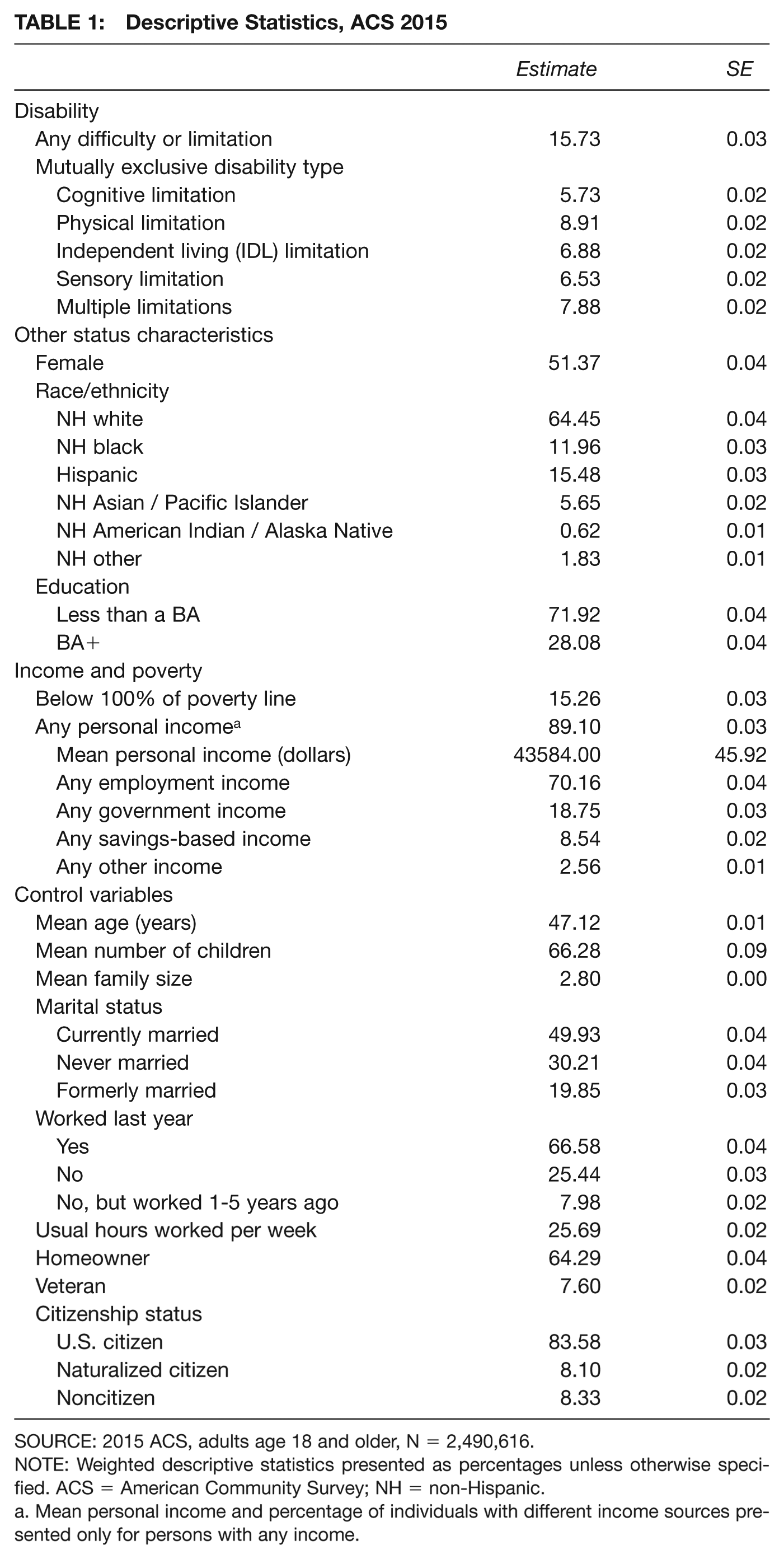
SOURCE: 2015 ACS, adults age 18 and older, N = 2,490,616.
NOTE: Weighted descriptive statistics presented as percentages unless otherwise specified. ACS = American Community Survey; NH = non-Hispanic.
Mean personal income and percentage of individuals with different income sources presented only for persons with any income.
Predictor Variables
Our key predictor variables signal membership in different categorical groups and the intersections between these social categories. We included six racial/ethnic categories—non-Hispanic white, non-Hispanic black, Hispanic, non-Hispanic Asian or Pacific Islander, non-Hispanic American Indian or Alaska Native, and non-Hispanic other. 2 Instead of relying on a more complex measure for social class, we focused on differences by education, which we operationalized as having less than a Bachelor’s degree or having obtained a Bachelor’s degree or higher. As most studies show, education is a key factor for earnings and mobility, with the largest divisions among people with and without a university-level education (Hout 2012; Leicht 2008). Finally, we measured gender through the indicated sex of male or female.
Instead of examining differences by race, gender, and education separately, we interacted these variables to create 24 groups across which we assessed the consequences of disability. We used a process-centered model or intercategorical approach for analyzing intersectional relationships across groups (Choo and Ferree 2010; McCall 2005) operationalized through the use of interaction terms. This allowed us to study the additive and multiplicative effects of membership in multiple categorical groups. It also helped to identify certain hierarchies of disadvantage. Thus, by focusing on intersections among some of the more common categorical groupings associated with race, class, gender, and disability, we were able to address group boundaries central to the distribution of resources.
We incorporated disability status based on the six questions that the ACS uses to identify the population with disabilities (Livermore et al. 2011). These six questions ask whether the respondent had a cognitive, ambulatory, independent living, self-care, vision, or hearing difficulty. Cognitive difficulties include those related to learning, remembering, concentrating, or making decisions. Ambulatory difficulties include anything that limits a respondent in one or more basic physical activities. Independent living difficulties indicate the presence of any condition lasting six months or more that makes it “difficult or impossible to perform basic activities outside the home alone.” Self-care difficulties include personal needs. Vision difficulties indicate whether the respondent was blind or had serious difficulty seeing. Finally, hearing difficulties indicate whether the respondent was deaf or had serious difficulty hearing. We measured disability status as individuals who report any disability or limitation based on these six questions, with 15.7 percent of respondents reporting any disability.
Control Variables
Our models include a series of control variables to account for differences in demographics, education, work history, and context. Because disability prevalence, income, and poverty rates are highly correlated with age, we controlled for a person’s age and included a quadratic age squared term to account for any non-linearity in these relationships. As measures of family structure and situation, we controlled for marital status, number of children, and family size. To assess participation in the labor market, which most individuals rely on for income, we included a measure for whether the respondent worked recently (i.e., worked 1-5 years ago or worked in the past year). We also controlled for veteran status, citizenship status, and homeownership, and we accounted for context by controlling for region.
Analytic Models
We used a series of descriptive comparisons combined with ordinary least squares regression models to show how disability’s consequences for income and poverty vary by gender, race, and education, using the statistical program R. Because of the large number of intersecting groups present in our data, we summarize most of our analyses in graphical form with detailed tables available on request. We applied survey-provided sampling weights to all analyses and incorporate robust standard errors.
Hierarchies of Disadvantage across Measures of Economic Insecurity
Disability and Poverty Levels
Assessing the gendered consequences of disability for economic security, Table 2 presents results from models predicting the probability of income falling below the poverty line. Model 1 controls for only the linear and curvilinear effects of age, and Model 2, the full model, controls for all covariates. Reported results in Table 2 include average marginal effects, which present the predicted percentage point difference in poverty with results averaged across the population. Controlling for only age in Model 1, persons with disabilities were more likely to have incomes that fell below the poverty line across all intersectional groups, but with varying magnitude. Incorporating control variables in Model 2 decreased disability-related poverty disparities across groups, but most remained statistically significant and the effects varied by gender, race, and education.
Results from Logit Models Predicting 100% of Poverty Line
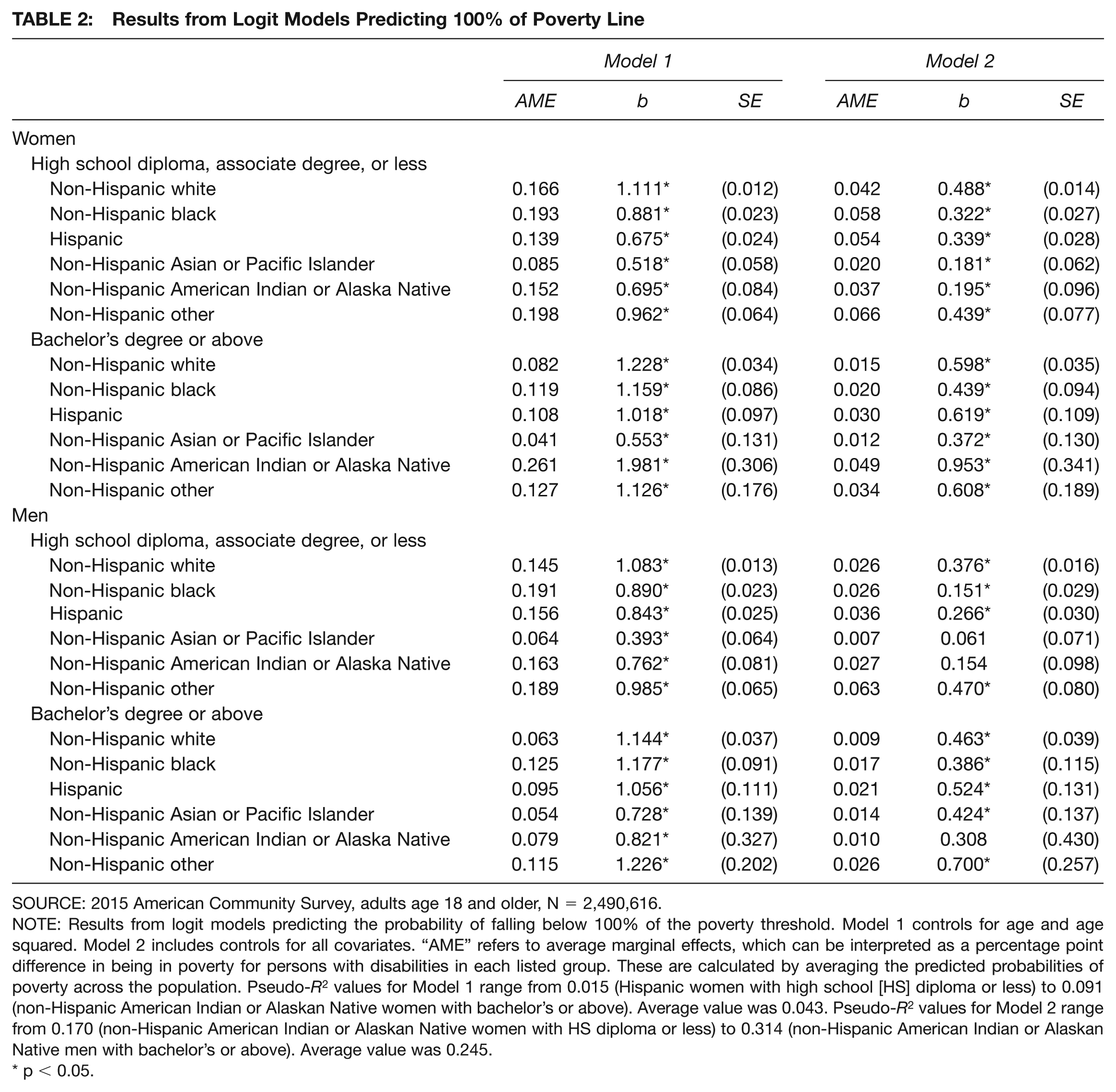
SOURCE: 2015 American Community Survey, adults age 18 and older, N = 2,490,616.
NOTE: Results from logit models predicting the probability of falling below 100% of the poverty threshold. Model 1 controls for age and age squared. Model 2 includes controls for all covariates. “AME” refers to average marginal effects, which can be interpreted as a percentage point difference in being in poverty for persons with disabilities in each listed group. These are calculated by averaging the predicted probabilities of poverty across the population. Pseudo-R2 values for Model 1 range from 0.015 (Hispanic women with high school [HS] diploma or less) to 0.091 (non-Hispanic American Indian or Alaskan Native women with bachelor’s or above). Average value was 0.043. Pseudo-R2 values for Model 2 range from 0.170 (non-Hispanic American Indian or Alaskan Native women with HS diploma or less) to 0.314 (non-Hispanic American Indian or Alaskan Native men with bachelor’s or above). Average value was 0.245.
p < 0.05.
On average, the effects of disability on poverty were stronger for women and racial minorities. For instance, disability’s effects on poverty were approximately 40 percent larger for non-Hispanic white women than for non-Hispanic white men across education categories. Additionally, disability’s effects on poverty were approximately 55 percent larger for non-Hispanic black women than for non-Hispanic white men regardless of education. However, disability-related differences in poverty were most apparent for individuals with lower levels of education. Among those with a bachelor’s degree or higher, disability was associated with higher rates of poverty by 1-5 percentage points. Among persons with less education, increases were 2-7 percentage points.
When considering statuses intersectionally, a hierarchy of disadvantage appears in two ways. First, disability generally presented the weakest effects on poverty among non-Hispanic white and Asian/Pacific Islander men with higher education levels. Disability had the largest effects on poverty among men and women with less than a bachelor’s degree and with racial identities in the non-Hispanic other category. Disparities by disability status were also larger for non-Hispanic black and Hispanic women with lower levels of education. Thus, the relative effects of disability on poverty levels tended to be greater among more disadvantaged groups.
Second, the effects of disability further compounded the effects of race, gender, and education for members of these social categories. This is evident in Figure 1, which depicts the predicted percentage of persons within each social category who would have incomes below the poverty line if all other model covariates were held at their means. Predicted poverty rates were highest among non-Hispanic American Indian or Alaska Native men and women with lower levels of education. Although disability was not associated with a statistically significant increase in poverty within these groups, estimates indicate that it likely would have been if this group was larger and better represented in the data.

Predicted Poverty Rates by Disability Status, Gender, Race, and Education
Disability and Total Income
Expanding on the findings for poverty, Table 3 presents results from regression models estimating total logged personal income. Model 1 controls for age and Model 2 includes all control variables. Reported results in Table 3 include the proportional change in total income associated with disability and model coefficients on a logged scale. 3
Results from Regression Models Predicting Logged Total Personal Income
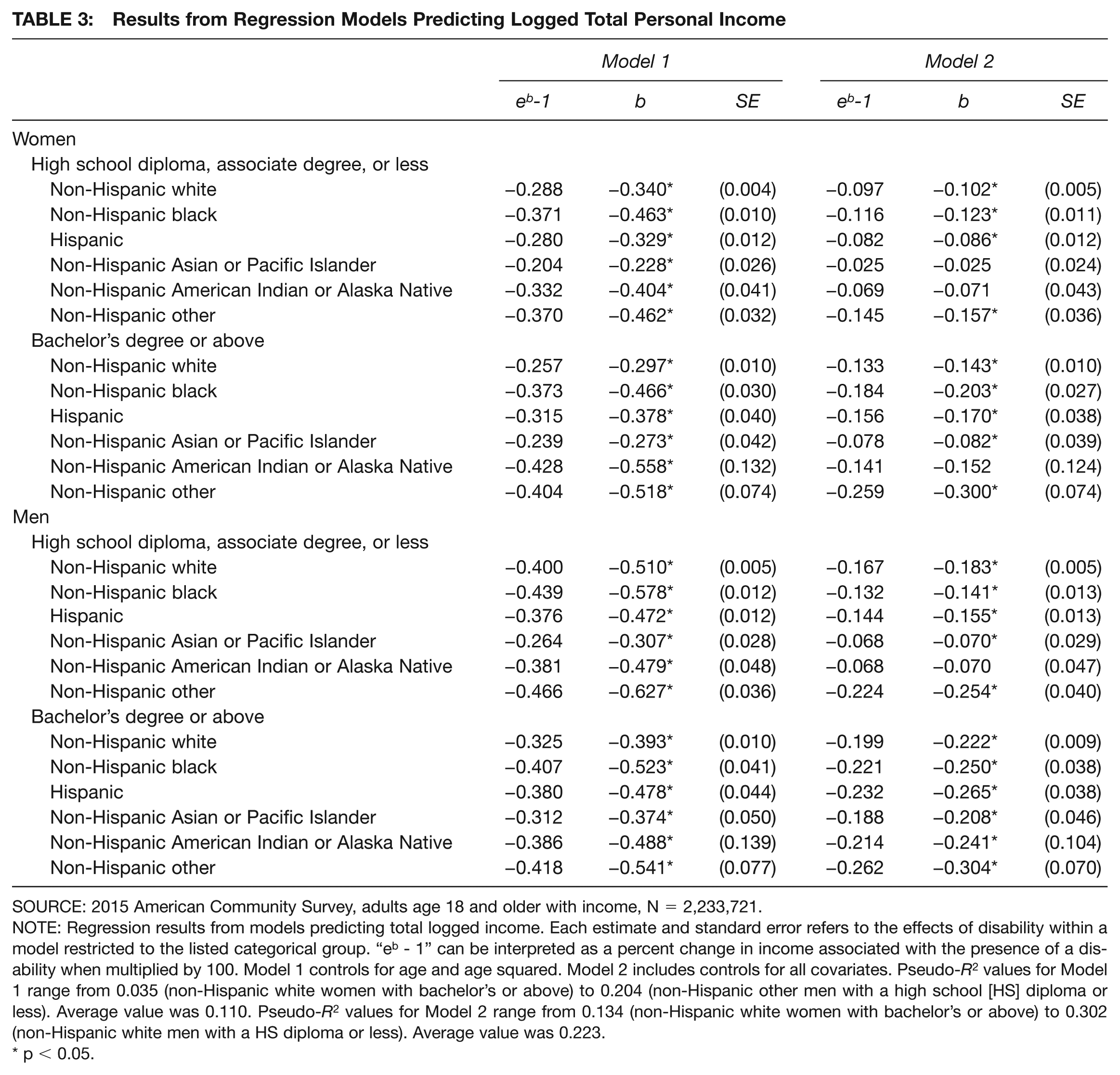
SOURCE: 2015 American Community Survey, adults age 18 and older with income, N = 2,233,721.
NOTE: Regression results from models predicting total logged income. Each estimate and standard error refers to the effects of disability within a model restricted to the listed categorical group. “eb - 1” can be interpreted as a percent change in income associated with the presence of a disability when multiplied by 100. Model 1 controls for age and age squared. Model 2 includes controls for all covariates. Pseudo-R2 values for Model 1 range from 0.035 (non-Hispanic white women with bachelor’s or above) to 0.204 (non-Hispanic other men with a high school [HS] diploma or less). Average value was 0.110. Pseudo-R2 values for Model 2 range from 0.134 (non-Hispanic white women with bachelor’s or above) to 0.302 (non-Hispanic white men with a HS diploma or less). Average value was 0.223.
p < 0.05.
Controlling for age in Model 1, disability appeared broadly disadvantageous with respect to income levels. Disability was associated with total income declines of 30-40 percent across groups in this model. Adding controls for family structure, work status, and other factors in Model 2 resulted in smaller income gaps by disability, as well as disparities that were not statistically significant for certain groups. Once we accounted for these outside factors, disability had the greatest effects on income for more advantaged groups in contrast to our findings on poverty. Men with higher levels of education tended to experience the largest disability-related income disparities associated with differences of 20-26 percent, in part because they simply had more to lose. This relationship likely stems from the greater reliance by men on employment for their economic well-being, as previous studies show larger earnings declines for men with disabilities (Pettinicchio and Maroto 2017). We also suspect that these effects are related to dominant notions of masculinity that can make disability more limiting for men who are less able to inhabit masculine roles in the labor market (Kavanagh et al. 2015; Shuttleworth, Wedgwood, and Willson 2012).
Although disability led to the greatest income disparities within more advantaged groups (i.e., men with a BA or higher), the combined effects of race, gender, education, and disability still resulted in a hierarchy of income, with less-educated women with disabilities earning the least. This hierarchy is evident in Figure 2, which plots predicted total income by race, gender, education, and disability status based on the results from Model 2 in Table 3. Women with less than a bachelor’s reported some of the lowest total income levels, with predicted incomes of approximately $30,000 per year after incorporating control variables. The disparity was compounded by disability and race, where the predicted total annual income for black and Hispanic women with disabilities was approximately $26,000 per year with other variables set at their means. This relationship further demonstrates the accumulation of disadvantage across multiple social categories, expanding on previous studies that have focused solely on gender and disability (Johnson and Lambrinos 1985; Kotkin 2008; Pettinicchio and Maroto 2017) or race and disability (Mereish 2012; Shaw, Chan, and McMahon 2012) in the labor market.

Predicted Total Income in Dollars by Disability Status, Gender, Race, and Education
Unlike studies centered on only employment earnings, we examined a broader measure of total personal income that comprises income from multiple sources—employment, government, savings, and other areas—all of which can help to improve economic security across groups (Osberg and Sharpe 2014; Western et al. 2012). Although most groups rely on the labor market for the majority of their income, others, particularly less advantaged groups, depend on sources beyond the labor market. This is especially true for persons with disabilities, as shown in Figure 3.
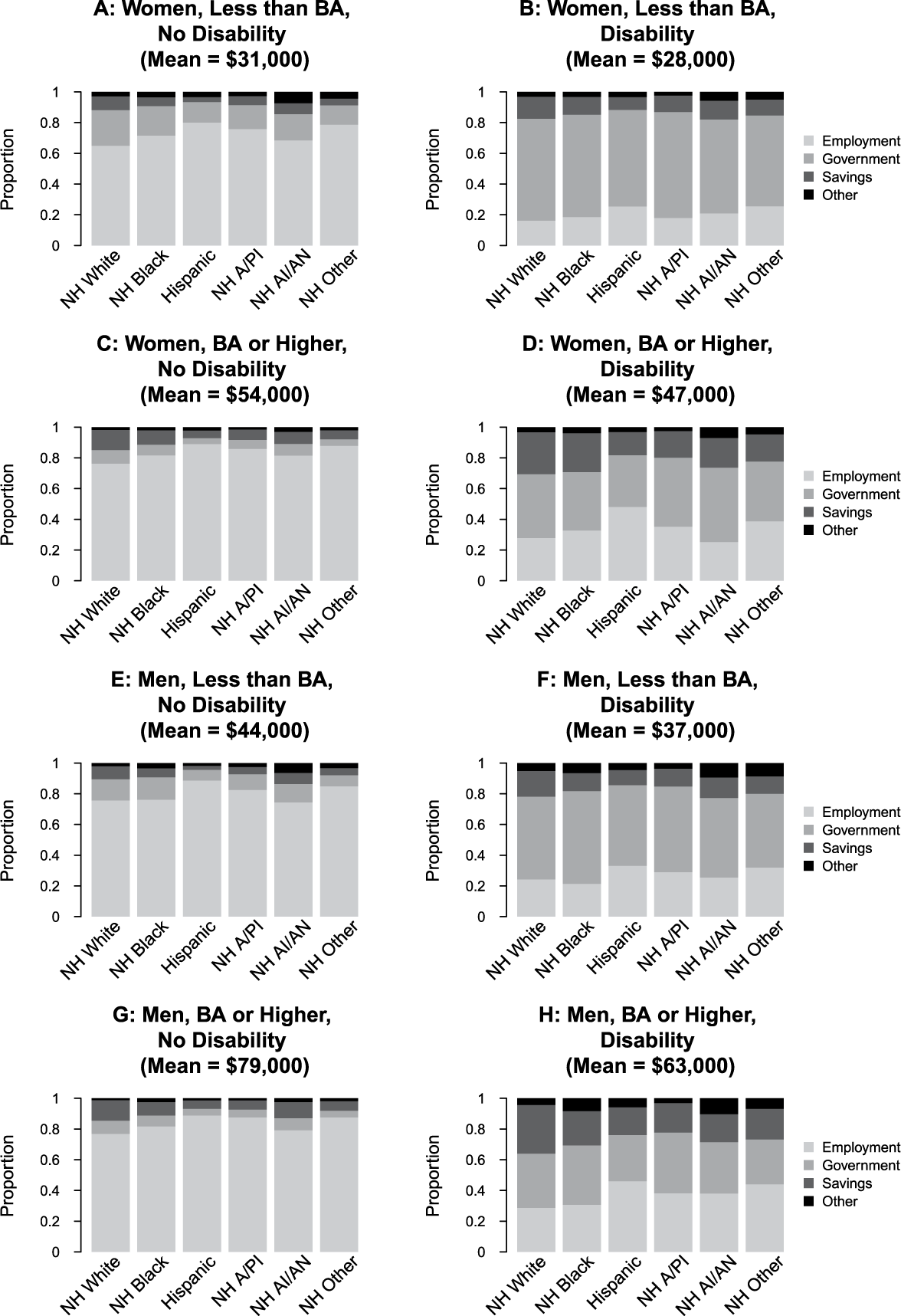
Proportion of Total Income Attributable to Employment, Government, Savings, or Other Sources
The vast majority of income for the persons represented in the first column of Figure 3, which includes race, gender, and education groups without disabilities, came from employment. This was not the case for a majority of persons with disabilities in the second column. People with disabilities, especially women with less education and disabilities in Panel B, relied on government sources for most of their limited income. Women and men with higher levels of education (Panels D and H), however, were also able to take advantage of savings to make up for limited income. Although disparities in total income by race, gender, education, and disability were readily present, government supports, savings, and other sources helped mitigate the overall effects of lower earnings. Even with such supports, economic insecurity, as evidenced by higher poverty levels and lower total income, remained an issue for members of disadvantaged groups.
Conclusion
Feminist disability and intersectional approaches synthesize key tenets rooted in both feminist (Ferree and Hall 1996) and disability studies (Linton 1998a, 1998b; Shakespeare 1996). As such, they provide a useful framework for making sense of the ways in which the effects of disability on poverty and total income are gendered, raced, and classed. Through the use of a series of intercategorical models (McCall 2001, 2005), we expand on feminist disability analyses by shedding light on hierarchies of disadvantage. Our results indicate that the intersection of these social categories is associated with economic insecurity, pointing to the ways in which certain characteristics become salient markers for inequality, how multiple characteristics lead to overlapping oppressions, and how this has become embedded within the larger social structure.
More specifically, by moving beyond employment and earnings, our analyses of poverty status, total income, and income composition revealed a hierarchy of disadvantage across measures of economic insecurity, where racial minority women with disabilities and less education had the highest rates of poverty and the lowest total income levels. We also found that members of disadvantaged groups, especially people with disabilities, do not necessarily obtain most of their income from the labor market. This alludes to the value of public assistance as an important supplement to persons with disabilities and other marginalized groups with limited employment income. Without assistance, poverty rates would be much higher for members of these groups. Yet, welfare cuts and a policy emphasis on workfare doubly stigmatize people with disabilities, first, for being “unable” to work, and, second, for receiving benefits to keep them out of poverty (Whittle et al. 2017).
Disadvantage thereby accumulates across social categories, demonstrating the need to account for the particular experiences of individuals with overlapping group memberships (McCall 2005). However, intersectional effects are not always straightforward. Although the effects of disability on poverty were strongest for the most disadvantaged groups, disability’s effects on total income were larger for more advantaged groups that include white men with higher education (see also Pettinicchio and Maroto 2017). This further highlights the importance of using intersectionality to study advantage and privilege, along with disadvantage.
Although our study goes beyond most to incorporate disability, race, gender, and education into intersectional research on economic insecurity, our results do face certain limitations. Given data restrictions, we used somewhat rough measures of race, education, gender, and disability, and we were unable to incorporate measures of sexuality or sexual identity, which are important to intersectional and feminist disability studies (Caldwell 2010; Garland-Thomson 2002; Kafer 2013). Effects also likely vary by the specific nature of a person’s disability. For instance, previous research has shown that the presence of cognitive and multiple disabilities tends to be more limiting in the labor market than sensory or physical disabilities (Maroto and Pettinicchio 2014a), which has implications for poverty and total income. Because of sample size issues, however, examining many refined categories results in groups that are simply too small to make strong conclusions because of the noise present in the sample. Despite these limitations, our study still emphasizes the importance of incorporating smaller intersectional groups—especially understudied racial minority groups and persons with disabilities.
Furthermore, it is difficult to avoid the “pitfalls of additive approaches to multiple identities” when using quantitative data to assess disadvantages across multiple groups (Bowleg 2008; Conejo 2013). We cannot fully address the overlapping structures of subordination (Cho, Crenshaw, and McCall 2013), nor are we able to directly uncover the mechanisms that produce categorical inequality. However, by incorporating a process-centered or inter-categorical model of intersectional relations, we still show where disparities exist and why it is imperative that disability be included in discussions of inequality. As we find, when disability, gender, race/ethnicity, and class status overlap, the meanings associated with membership in these categorical groups compound to expand cumulative disadvantage.
Given the evidence we present about hierarchies of disadvantage and that disability type plays a major role in determining access to resources, future work should consider how the nature of disability intersects with other characteristics to shape economic outcomes. This would also represent a step forward in elucidating the ways in which individuals access alternative sources of income to weather economic uncertainty and prevent falling into poverty. These perspectives are useful in unpacking how disability acts as both a cause and consequence of poverty, especially as it intersects with race and gender in explaining cumulative disadvantage (see Kelley-Moore and Ferraro 2004; Warner and Brown 2011; Willson and Shuey 2016).
Intersectional Feminist Disability Scholarship
The sociopolitical model of disability draws important linkages between the struggles of diverse minority groups in undermining inequalities produced by economic and political systems (Gill 2015; see also Skrentny 2002; Pettinicchio 2012, 2013, 2017). It has focused attention on the importance of identity and the social construction of “impairment specific labels” both within and outside the disability community in shaping social interaction (see Deal 2010; Oliver and Barnes 1998). Consequently, the focus on power and oppression based on the meanings associated with disability (Tremain 2000, 2013) has been mutually beneficial to feminist, disability, and stratification research.
Intersectional feminist scholarship has been important to the development and expansion of disability studies (Sommo and Chaskes 2013; Mauldin 2017), especially because disability is a fluid status and the disability community a heterogeneous one. Theorizing disability through a feminist lens underscores the ways in which disadvantage is reproduced in all social organizations within a “disability/ability system” that associates disabled bodies (much like female bodies) with inadequacy and weakness, saying “that there’s something wrong with them” (Garland-Thomson 1994; 2002, 5; 2005; Hirschmann 2012; Linton 1998b). This perspective further exposes disability as a social category, highlights its pervasiveness and mutability and, importantly, emphasizes interaction with other identities, which sheds light on inequality’s durability based on the norms, labels, meanings, and values attached to overlapping identities.
A central feature guiding each of these constantly evolving frameworks involves the interaction of individuals with social institutions and organizations governed by oppression and marginalization at both the micro and macro levels. Early feminists challenged male-centric Marxist understandings of power relations, domination, and oppression (Acker 2006), and intersectionality scholars criticized feminist theory for its heavy reliance on the experiences of white middle-class women, ignoring the racialized bases of gendered inequality (McCall 2005). In that vein, feminist disability studies did not simply—to modify a phrase from Ferree and Hall (1996, 929)—“add disability and stir” but rather has sought to revise sociological understandings of oppression, inequality, and disadvantage. Process-centered models described by Choo and Ferree (2010), for example, consider the effects of intersecting statuses like disability with gender on economic outcomes vis-à-vis the main effects of disability and gender. Thus, by uncovering the gendered, racialized, and classed aspects of disability’s impact on total income and poverty, we link intersectionality to cumulative disadvantage, showing how the multifaceted relationships between multiple identities influence economic insecurity.
Footnotes
Authors’ note:
This research was partially supported by a SSHRC Insight Grant (#435-2015-0382).
Notes
Michelle Maroto is an associate professor of sociology at the University of Alberta. Her research focuses on inequality and economic insecurity across credit and labor markets with an emphasis on the accumulation of disadvantage across households and time.
David Pettinicchio is assistant professor of sociology and affiliated faculty in the Munk School of Global Affairs and Public Policy at the University of Toronto. He teaches and writes on political sociology, social movements, inequality, social policy, and disability. His forthcoming book examines the dynamic relationship between policymaking and movement mobilization shaping the evolution of disability rights in the United States.
Andrew C. Patterson is an assistant professor of sociology at MacEwan University. His current research focuses on the political and macroeconomic determinants of population health.