




Abstract
Workers in predominantly female occupations have, on average, lower wages compared to workers in predominantly male occupations. Compensating differentials theory suggests that these wage differences occur because women select into occupations with lower pay but more fringe benefits. Alternatively, devaluation theory suggests that these wage differences occur because work performed by women is not valued as highly as work performed by men. One theory assumes that workers choose between wages and benefits. The other assumes that workers face constraints that restrict their wages and benefits. To examine whether female occupations pay less but offer more benefits, I used individual-level data from the Medical Expenditures Panel Survey and occupation-level data from the American Community Survey and from the Occupational Information Network. Contrary to compensating differentials theory, results from multivariate regression analysis provide little evidence that benefits explain wage differences between male and female occupations. Instead, consistent with devaluation theory, workers in female occupations are less likely to be offered employer health insurance coverage and are less likely to have retirement plans compared with workers in male occupations.
Today nearly half of all working women (or men) would have to change jobs in order for the gender distribution of occupations to match the gender distribution of the labor force as a whole (Blau, Brummund, and Liu 2013; Weeden, Newhart, and Gelbgiser 2018). Numerous studies find that the average wages of workers in predominantly female occupations are lower than the average wages of workers in predominantly male occupations (England 2010). Not only do these wage differences contribute to half of the overall gender gap in wages, prior studies have demonstrated that they persist after controlling for workers’ individual and occupational characteristics (England 1992; England, Allison, and Wu 2007; England et al. 1994; Kilbourne et al. 1994; Levanon, England, and Allison 2009). As a result, researchers continue to be drawn to the question: What explains the lower relative pay of female occupations?
The microeconomic theory of compensating differentials offers one possible explanation for the lower relative pay of female occupations. The theory holds that wage differences between workers in occupations that require similar levels of skills, experience, and training arise because jobs have different attributes and workers differ in their willingness to forego wages in order to obtain (or avoid) jobs with certain attributes. Nonpecuniary attributes that are likely to influence wages can range from working conditions, such as physical discomforts and hazards, to flexible work hours, the interest in the work being performed, and the availability of fringe benefits; fringe benefits are the central focus of this study.
Fringe benefits are compensation in addition to wages that a worker receives directly from an employer or indirectly from employer contributions to a government-sponsored program. This study focuses on major fringe benefits including health insurance coverage, paid leave, and retirement plans. These benefits accounted for two-thirds of employers’ nonwage employment costs and 21 percent of total employment costs in 2016 (Bureau of Labor Statistics 2017).
Compensating differentials theory holds that because employers are concerned about the total cost of employment, workers can substitute benefits for wages based on their preferences. If men and women differ in their preferences for benefits, and they select into jobs that match these preferences, then it is possible that scholars observe a negative relationship between female representation and wages, because workers in female occupations receive a greater portion of job compensation in the form of benefits relative to workers in male occupations.
Of course, it is also possible that benefits augment rather than mediate wage differences between male and female occupations. Along these lines, demand-side theories such as gendered devaluation contend that female occupations pay less than male occupations net of differences in individual and occupational characteristics because employers view work performed by women as less valuable than work performed by men (England 1992; England et al. 1994). If women’s weaker positions in the labor market constrain the labor market rewards that they are able to receive for their work, then it is possible that female representation in an occupation affects total job compensation (i.e., wages and benefits), not just wages.
Although compensating differentials theory and gendered devaluation theory provide different explanations for the lower relative pay of workers in female occupations, both suggest that a more comprehensive understanding of how female representation in an occupation contributes to gender inequality in the labor market requires consideration of fringe benefits. However, prior research is limited. Thus far, some studies have examined how gender differences in benefits contribute to the gender wage gap (Cowan and Schwab 2016; Daneshvary and Clauretie 2007; Levy 2006; Solberg and Laughlin 1995), but few have examined whether these differences explain the lower relative pay of workers in female occupations. Other studies have examined how work conditions and skill requirements might contribute to wage differences between male and female occupations (England 1992; England, Allison, and Wu 2007; England et al. 1994; Kilbourne et al. 1994; Levanon, England, and Allison 2009), but few have considered the role of benefits, and their findings were inconclusive (Glass 1990; Lowen and Sicilian 2009).
For example, Glass (1990) found that as the percentage of female workers in an occupation increased, wages neither increased nor decreased but workers were less likely to have benefits. In essence, Glass provided some support for gendered devaluation theory, though no hypothesis was explicitly tested. In contrast, Lowen and Sicilian (2009) found that as the percentage of female workers in an occupation increased, wages decreased but workers were more likely to have benefits. In essence, they provided some support for compensating differentials theory. However, Lowen and Sicilian also found that the positive association between female representation and benefits did not explain the lower wages of workers in female occupations—a finding more consistent with devaluation theory than with compensating differentials theory.
These studies differed on several other key factors: Glass (1990) considered only major fringe benefits, whereas Lowen and Sicilian (2009) considered a broader set of family-friendly and family-neutral benefits. Glass treated benefits as part of the pay differential between male and female occupations, whereas Lowen and Sicilian treated benefits as a compensating factor. Glass did not consider how controlling for benefits affected the relationship between female representation and wages, whereas Lowen and Sicilian used that as their primary test for evidence of compensating differentials.
At the same time, these studies had similar limitations. Both tested for evidence of compensating differentials, but neither explicitly tested for evidence of gendered devaluation theory. Both used a continuous measure of female representation, but neither provided much, if any, detail about whether their findings were sensitive to alternative specifications of the relationships between female representation and wages and benefits. Finally, both used data collected several decades ago, and their findings are now quite dated.
This last point is especially relevant given that much about the labor market has changed over the last 20 years. One change has been a rise in “precarious” employee–employer relations, accompanied by wage stagnation and declines in employer-provided benefits in many sectors (Howell and Kalleberg 2019; Kalleberg 2009). Another change has been to women’s commitment to the labor force, which has grown stronger even as employee–employer relations have weakened (Pugh 2015). Today, nearly half of all workers are women, and, in the last two decades, the number of female workers in the labor force has remained stable, while the number of male workers has declined (Copeland 2018). Consequently, the relationships between female representation and wages and benefits may look quite different today.
This study contributes to current conversations on what explains the lower relative pay of female occupations by continuing to explore how female representation in an occupation is related to wages and benefits. Drawing on data from the Medical Expenditures Panel Survey Household Component (MEPS-HC), the American Community Survey (ACS), and the Occupational Information Network (O*Net), I use multivariate regression analysis to compare average levels of wages and benefits for workers in male and female occupations, controlling for workers’ demographic and job characteristics. Several limitations of the prior research are addressed by using highly precise estimates of the percentage of female workers in an occupation, by considering alternative specifications of the relationships between female representation and wages and benefits, and by using more recent data covering the period from 2007 to 2013, which may reveal gains or continued constraints for workers in female occupations relative to male occupations.
This study also makes a theoretical contribution to the literature by testing for evidence of gendered devaluation along with compensating differentials. To the extent that female representation in an occupation is negatively associated with wages and positively associated with benefits, the findings will be consistent with compensating differentials and the assertion that nonwage compensation can explain wage differences between male and female occupations. To the extent that female representation in an occupation is negatively associated with wages and benefits, then the findings will be consistent with gendered devaluation and the argument that women’s lower social status depresses wages and benefits in female occupations. In either case, both theories tell us that measuring the relationship between female representation in an occupation and wages without considering nonwage compensation risks not telling the full story of how the occupational structure contributes to gender inequality in the modern economy.
Compensating Differentials
Compensating differentials theory predicts a negative relationship between benefits and wages. The theory assumes that because the total costs of employment are constant, employers are indifferent to how compensation is divided between wages and benefits. The theory also assumes that the utilities individuals receive from working are positively influenced by both wages and benefits, so that workers select jobs that allocate total compensation in ways that maximize their utilities. As a result, workers’ preferred combinations of wages and benefits fall along the same line with a slope of −1, so that those who prefer an additional dollar of benefits are expected to have their wages reduced by a dollar in return (Currie 1993).
Empirically, it has been difficult to find strong evidence of an inverse relationship between wages and benefits. Early studies such as those by Leibowitz (1983) and Monheit et al. (1985) found a positive association between wages and benefits, but these findings have been attributed to the use of cross-sectional data and a failure to account for unobserved preferences and abilities that affect workers’ selection into jobs with more benefits and higher wages (Currie and Madrian 1999). However, even more rigorous studies using longitudinal data and quasi-experimental designs have produced limited evidence of a wage–benefit tradeoff. For instance, in studies focused on workers who changed jobs, Simon (2001) and Levy and Feldman (2001) found that workers who gained wages also gained benefits, whereas workers who lost wages also lost benefits. Conversely, Miller (2004), who also examined job changers, found that workers who gained health insurance coverage “paid” for this benefit through lower wages.
Although it is not always clear that workers substitute benefits for wages, prior studies do indicate that female workers have stronger preferences for benefits than do male workers (Lluis and Abraham 2013; Monheit and Vistness 1999), and that these preferences contribute to gender differences in wages at the individual level (Daneshvary and Clauretie 2007). Gendered preferences for benefits may also contribute to gender differences in wages at the occupation level. Timmerman (2005) argues that occupational choice (vocation) should reflect workers’ preferences for benefits because selecting into an occupation where most employers provide a benefit maximizes the chances of obtaining that benefit. Assuming that workers choose their occupations and that employers are responsive to the preferences of workers, if female workers prefer benefits to wages and male workers prefer wages to benefits, we would expect female occupations to offer more benefits than wages and vice versa.
Empirical evidence of an inverse relationship between wages and benefits at the occupation level is limited. Lowen and Sicilian (2009) examined the relationship between female representation in an occupation and several types of benefits; they found that female representation was positively associated with paid leave, flexible work schedules, and child care—some evidence of occupation-level gender differences in benefits. However, compensating differentials would predict that higher levels of benefits would explain the lower wages of workers in female occupations, and Lowen and Sicilian found that the positive association between female representation and benefits did not explain the negative association between female representation and wages.
Gendered Devaluation
Where supply-side theories, such as compensating differentials, assume that workers choose jobs that match their wage and benefit preferences, demand-side theories, such as gendered devaluation, offer an alternative explanation for the lower relative pay of female occupations. Gendered devaluation theory holds that employers and society view work performed by women as worth less than work performed by men. As a result, workers’ wages are lower when female representation in an occupation increases over time (England, Allison, and Wu 2007; Levanon, England, and Allison 2009) or when occupations require work that is associated with “female” traits such as nurturing and care-taking (England 1992; England, Budig, and Folbre 2002; England, Thompson, and Aman 2001; Kilbourne et al. 1994).
Scholars typically cite the negative association between the proportion of female workers in an occupation and wages as evidence of devaluation (England et al. 1994). This relationship persists after controlling for workers’ levels of education, skills, and experience (England 1992; England, Allison, and Wu 2007; England et al. 1988; England et al. 1994; Kilbourne et al. 1994; Levanon, England, and Allison 2009). It also persists after controlling for occupational characteristics such as skill and education requirements, work conditions, and unionization (Baron and Newman 1990; England et al. 1994; England, Reid, and Kilbourne 1996; Jacobs and Steinberg 1990; Kilbourne et al. 1994; Lowen and Sicilian 2009; Macpherson and Hirch 1995). 1
Devaluation of women’s work might result in a lower supply of benefits to workers in female occupations in addition to lower wages. This could occur at the point of hiring, if employers view female work as less valuable than male work and offer less generous compensation packages (England 1992). This could occur over time as well. As members of a subordinate group, workers in female occupations may lack the political power and market positions necessary to bargain for improvements in wages and benefits or to organize when an employer threatens to withdraw workplace protections such as health insurance coverage and retirement plans (Catanzarite 2003; Tomaskovic-Devey 1993). An increase in female representation in an occupation over time has been associated with work reorganization processes, including deskilling (Baron and Bielby 1980), limiting opportunities for promotion (Baron and Bielby 1984; Bielby and Baron 1984), and moving toward nonstandard work arrangements characterized by fewer hours and fewer to no benefits (Kalleberg, Reskin, and Hudson 2000).
In sum, the existing scholarship points to different processes when considering the lower relative pay of female workers. Compensating differentials theory orients us toward the individual and assumes that workers choose between wages and benefits. Gendered devaluation theory orients us toward broader cultural and structural processes and assumes that workers face constraints that restrict their wages and benefits. In the following sections, this article considers the empirical support for these theories by (re)examining the relationships between female representation in an occupation and wages and benefits.
Data and Methods
Data
This project uses data from the 2007–2013 Medical Expenditures Household Survey Household Component (MEPS-HC) full-year consolidated files. The MEPS-HC is a nationally representative longitudinal survey conducted by the Agency for Healthcare Research and Quality designed to gather information about individual and household medical events and expenditures (AHRQ 2015a). The MEPS-HC is ideal for this analysis because, in addition to containing detailed information regarding employer-provided health insurance coverage, the data contain information about other benefits such as sick leave, paid leave, and a retirement plan.
In each MEPS-HC panel, approximately 30,000 individuals in 13,000 households are interviewed for a total of five rounds over two years, with a new panel of households selected each year (AHRQ 2015b). Because of this panel structure, individuals contribute observations to more than one annual consolidated file. The full year consolidated files contain data collected from individuals at rounds 3, 4, and 5 of the prior-year panel and rounds 1, 2, and 3 of the current-year panel (AHRQ 2015a).
Sample
From the annual files, I identify individuals between the ages of 16 and 65 years who were employed and not previously retired in December of that year (n = 99,826 person-years). I then limit the analytic sample to individuals who were employed full time (35 or more hours per week) in year-round jobs for at least six months (excluded n = 34,509), and who do not have missing observations for any of the variables used in the analysis (excluded n = 10,430). In the analytic sample, 34,698 individuals contribute 54,887 person-year observations, with an average of 7,841 observations per year.
The analytic sample is limited to full-time year-round workers because they are more likely to have benefits compared with part-time and temporary workers (Kalleberg, Reskin, and Hudson 2000) and because part-time and seasonal workers may have a different set of preferences regarding wages and benefits. Additionally, newly employed workers may have a probationary period before their benefits come into effect. Of individuals in the full sample, 22 percent were part-time workers, 8 percent were seasonal or temporary workers, and 5 percent had been employed for less than six months.
Distributional differences between the full sample and the analytic sample are reported in Table 1. The analytic sample has more male workers, workers with college degrees, and married workers and fewer Hispanic workers and workers with children. However, in sensitivity analyses detailed below, findings from the analytic sample and the full sample yield similar conclusions.
Sample Characteristics
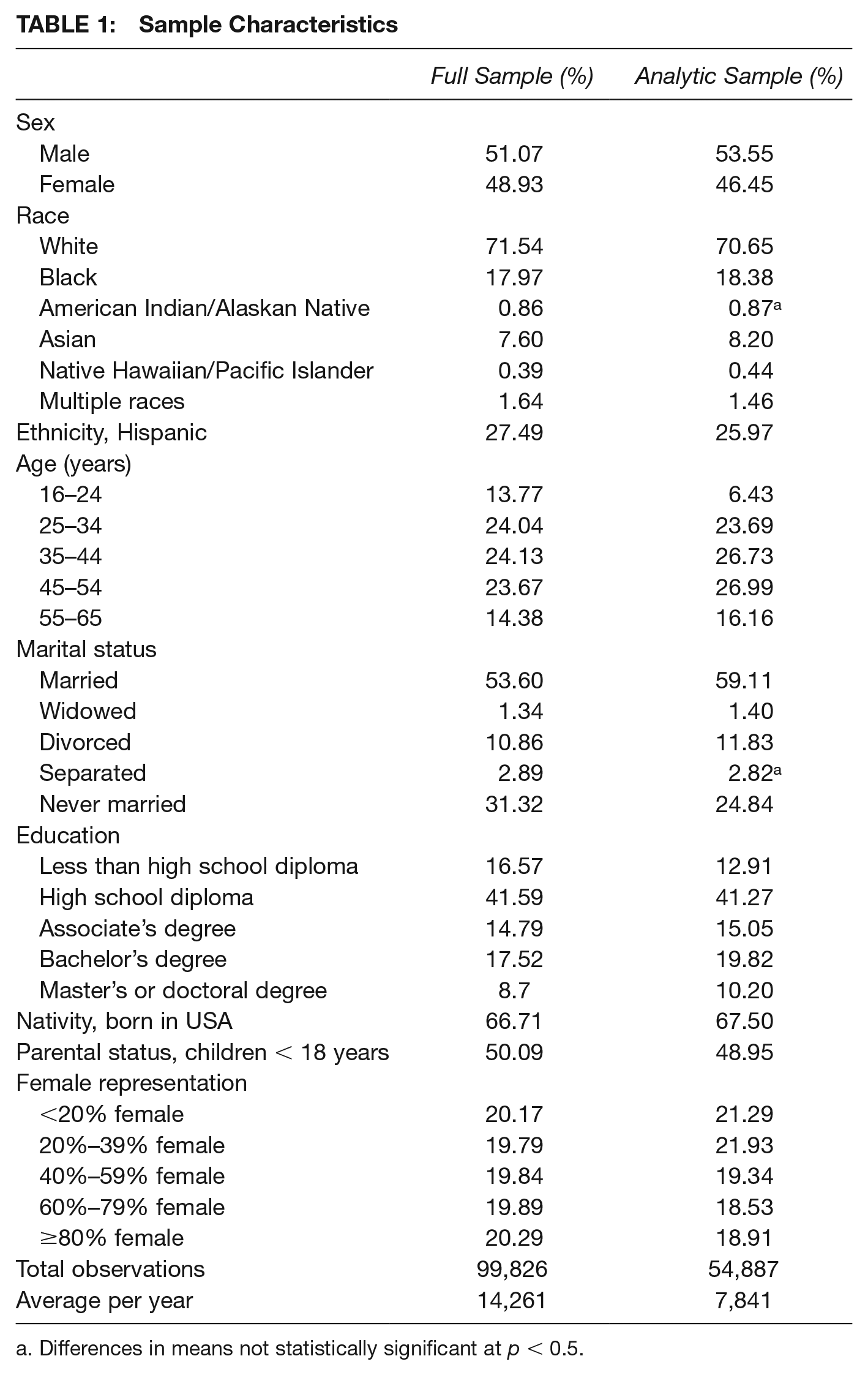
Differences in means not statistically significant at p < 0.5.
Variables
Job compensation
The outcomes of interest are measures of job compensation. The natural log of hourly wages is used to measure wage compensation. 2 The benefits measures include binary indicators of whether an individual’s employer offers health insurance coverage (EPHI) and whether an individual has a paid vacation, sick leave, and a retirement plan from their current main job. In the MEPS-HC data, individuals who reported having EPHI at their current main job were coded as being offered coverage (AHRQ 2015a). Individuals who reported not having EPHI were asked additional questions including whether they had the choice of taking coverage and whether coverage was offered to any other employees, in order to create an indicator of whether an individual’s employer offered EPHI (AHRQ 2015a). The questions related to having benefits were as follows: On this job, do you get paid vacation? On this job, do you have paid time off if you are sick? Not including Social Security or Railroad Retirement, are you covered by a pension or retirement plan or do you have a 401K plan on this job? (AHRQ 2015a).
Female representation
The primary explanatory variable of interest is female representation in a worker’s occupation. Prior studies have demonstrated that the magnitude of the relationship between an occupation’s gender composition and wages increases as the occupational classification becomes more detailed (see, e.g., Blau, Brummund, and Liu 2013). Therefore, American Community Survey (ACS) 1-year samples from the Integrated PublicUse MicroData Series (Ruggles et al. 2015) are used to construct estimates of female workers as a percentage of all workers ages 16 to 65 years in a four-digit occupation group for each year from 2007 through 2013. The ACS samples include about 3.5 million housing units per year and provide very precise estimates of female representation in an occupation (U.S. Census Bureau 2019). Because workers’ detailed occupations are not available in the MEPS public-use files, these estimates were merged to the individual-level data in a secure computing environment.
From the continuous measure of percentage female workers in an occupation, I create five categories of female representation: occupations with less than 20 percent female workers (referred to hereafter as male occupations), 20 to 39 percent female workers, 40 to 59 percent female workers, 60 to 79 percent female workers, and more than 80 percent female workers (referred to hereafter as female occupations). Examples of “male” occupations include grounds maintenance workers, carpenters, construction laborers, and truck drivers, whereas “female” occupations include elementary and middle school teachers, registered nurses, and home health aides (see Table 2).
Large Occupational Groups by Female Representation
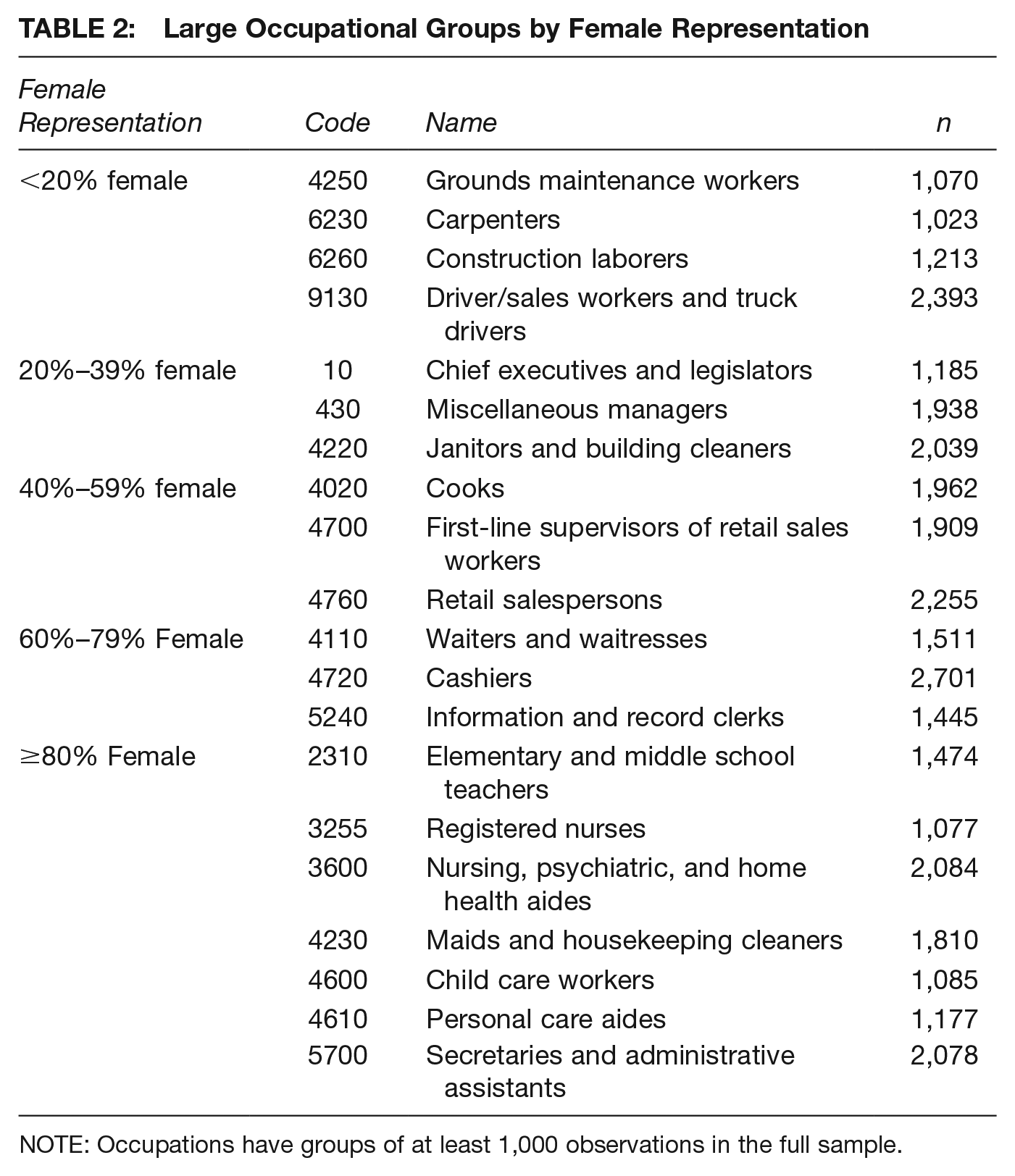
NOTE: Occupations have groups of at least 1,000 observations in the full sample.
These five categories are used to capture the nonlinearity of the relationship between female representation and wages. Following Cotter, Hermsen, and Vanneman (2004), I demonstrate this nonlinearity by showing a moving average of hourly wages by percent female workers in an occupation and fitting the data using polynomial regression (see Figure 1). As the curved line shows, wages increase fairly steadily and are the highest as occupations near 40 percent female workers. At 40–80 percent female workers, wages decline, but are similar to or slightly lower than those of workers in male occupations. After 80 percent female workers, wages fall consistently below those of workers in male occupations.
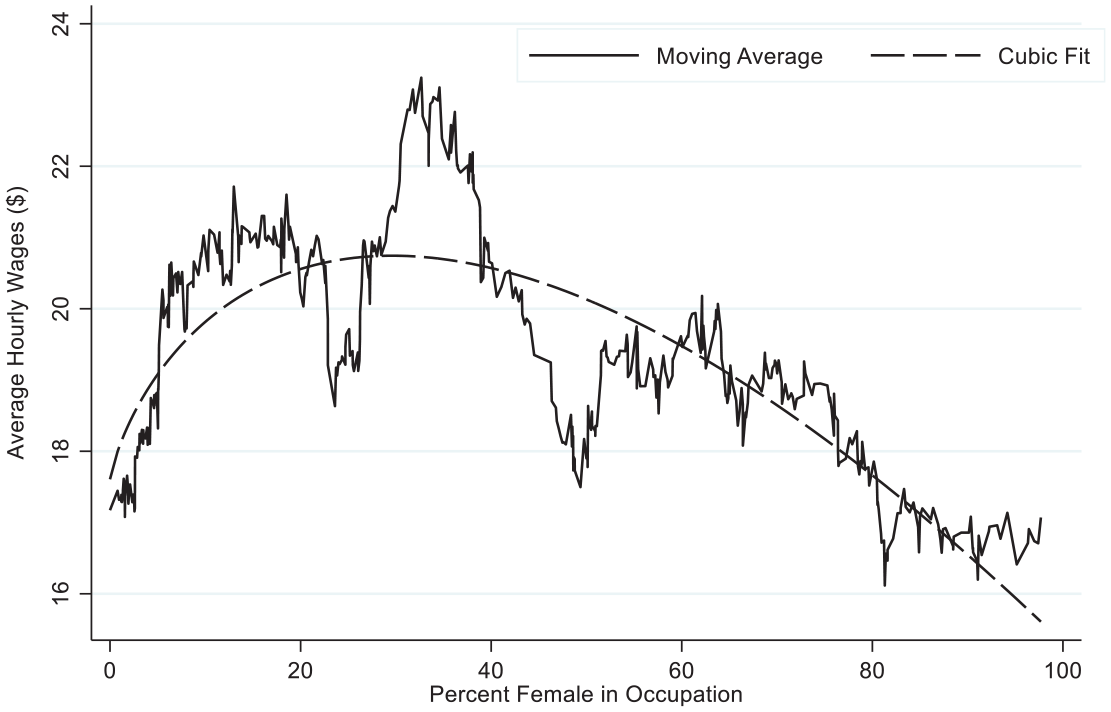
Average Hourly Wages by Percent Female in Occupation
Other individual and occupational characteristics
Differences in occupational characteristics may influence the relationships between female representation, wages, and benefits (Black and Spitz-Oener 2010; Macpherson and Hirsch 1995). O*Net data are used to construct several measures of occupational characteristics including the average importance of using a computer and the average importance of working in hazardous conditions (both measured on a scale of 1–5, with 1 being least important and 5 being most important), and the likelihood that an occupation requires education beyond a high school diploma, more than one year of on-the-job training, more than one year of plant training, and more than one year of related work experience.
Other explanatory variables include binary indicators of sex (female = 1), race (white, Black, American Indian/Alaskan Native, Asian, Native Hawaiian/Pacific Islander, and multiple races), Hispanic ethnicity, age (16–24, 25–34, 35–44, 45–54, and 55–65 years), marital status (married, widowed, divorced, separated, and never married), education (less than a high school diploma, a GED or high school diploma, associate’s degree, bachelor’s degree, and master’s degree or more), nativity (U.S. born = 1), parental status (children under 18 years in the household = 1), union membership, and industry (12 categories).
Analytic Approach
To examine whether benefits explain the lower relative pay of workers in female occupations, I begin by estimating the bivariate relationship between female representation and each measure of job compensation. This descriptive approach provides a general idea about average levels of wages and benefits for workers in male occupations and female occupations and a starting point for examining whether compensating differentials or gendered devaluation are at play.
However, a key challenge is isolating the relationship between female representation and wages and benefits from other factors that may also affect wages and benefits. Glass (1990) notes that one obvious factor is sex. Male workers, who are more likely to prefer wages, are concentrated in male occupations, and female workers, who are more likely to prefer benefits, are concentrated in female occupations. Other factors might include levels of union membership, levels of educational attainment, and occupational skill and educational requirements.
Therefore, as a stronger test for whether benefits explain the lower relative pay of workers in female occupations, I use multivariate regression analysis to estimate the relationship between female representation and each measure of job compensation, controlling for other observable factors that may be correlated with wages and benefits. Equation 1 shows the model specification for the multivariate analyses when the outcome is a continuous measure of wage compensation:

In equation 1, for each worker (i) in occupation (j) in state (s) at time (t),
Equation 2 shows the model specification when the outcome is a binary indicator of nonwage compensation:

In equation 2,
I report coefficients from ordinary least squares (OLS) regression models based on equation 1 and marginal effects from probit regression models based on equation 2. The marginal effects can be interpreted as the expected change in the predicted probability of having a benefit because of a discrete change in the category of the independent variable, holding all other variables at their means. All models include individual-level weights constructed for each MEPS-HC annual consolidated file. Clustered robust standard errors are estimated to account for repeated person observations across years.
The directions and statistical significance of the coefficients on female occupations, estimated relative to male occupations in each of the multivariate models, are used to evaluate the following hypotheses (H):
Hypothesis 1. Compensating differentials: If workers in female occupations are compensated for their lower wages with more benefits, then working in a female occupation will be negatively associated with wages and positively associated with the probability of being offered EPHI and with having paid vacation, sick leave, and a retirement plan.
Hypothesis 2. Gendered devaluation: If “women’s work” is not valued as highly by employers as “men’s work,” then working in a female occupation will be negatively associated with wages and negatively associated with the probability of being offered EPHI and with having paid leave, sick leave, and a retirement plan.
As an additional test for compensating differentials, I follow Lowen and Sicilian (2009) and examine whether the coefficients on female representation are sensitive to the inclusion of the benefits measures in the model predicting hourly wages (Equation 1). The coefficients on these measures should capture the individual-level tradeoff between wages and benefits, but they are likely to be biased because of unobserved differences in ability and productivity that affect workers’ selection into jobs with better pay and more benefits. Nevertheless, if benefits are important for the interpretation of the wage effect of female representation, then the coefficients on female representation should be sensitive to their inclusion in the models, so that:
Hypothesis 3. Additional test for compensating differentials: If workers in female occupations are compensated for their lower wages with more benefits, then there will be no statistically significant association between working in a female occupation and wages once benefits are taken into account.
Results
Descriptive results indicate that fringe benefits may explain the lower relative pay of workers in female occupations. Figure 2 shows average wages and the percentage of workers with each type of benefit for female occupations (80 percent or more female workers) and male occupations (less than 20 percent female workers). Seventy-one percent of workers in female occupations report being offered EPHI compared with 66 percent of workers in male occupations, and more workers in female occupations report having paid vacation, sick leave, and a retirement plan.
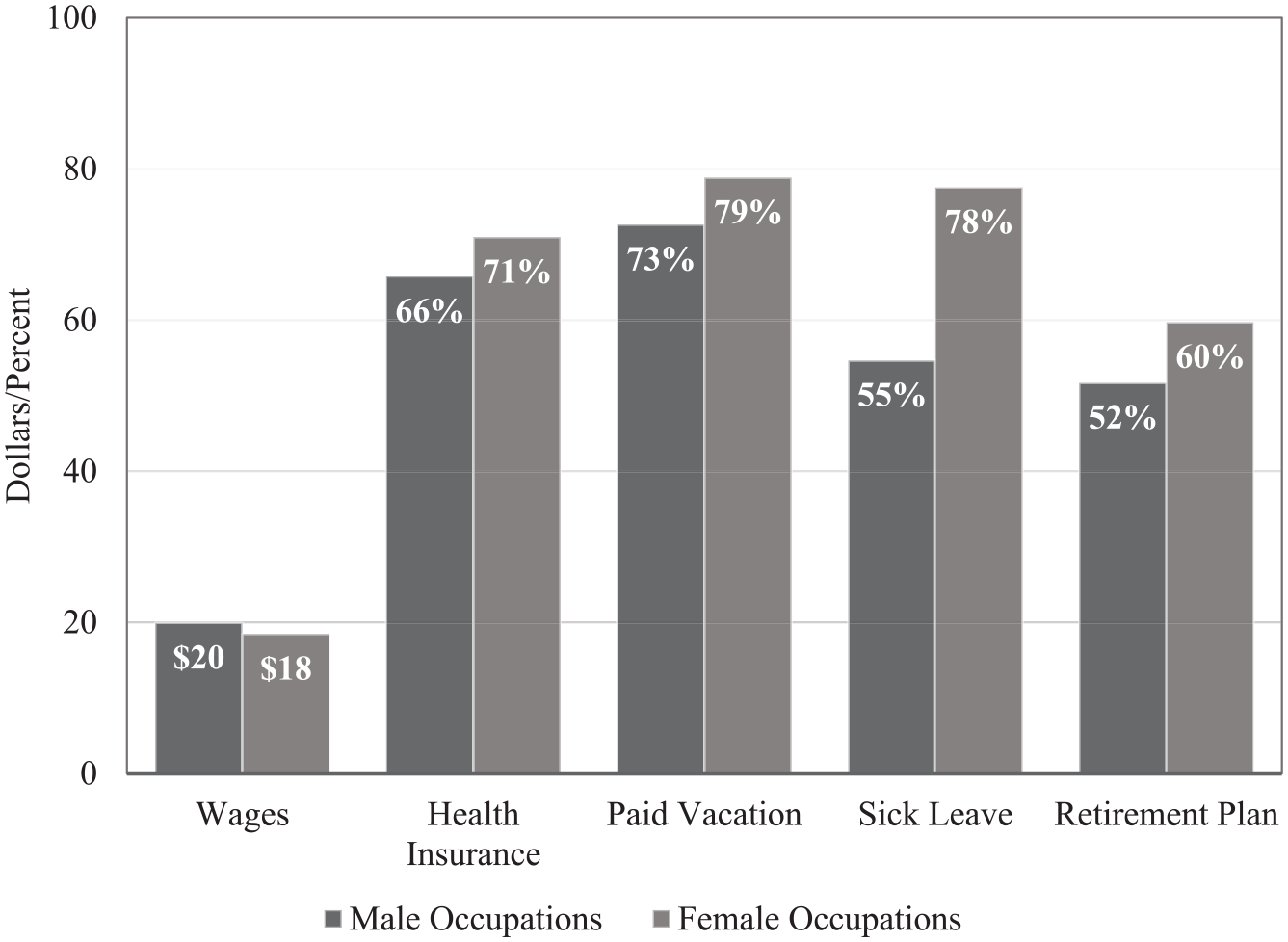
Average Levels of Wages and Benefits for Workers in Male Occupations and Female Occupations—Descriptive
Differences in wages and benefits for the other categories of female representation are shown in Table 3. Consistent with the nonlinearity of the relationship between female representation and job compensation, average wages and rates of EPHI, paid vacation, and retirement plans are the highest among occupations with 20–40 percent female workers. Table 3 also shows that female workers have lower wages than male workers, on average, but have higher levels of EPHI, paid vacation, sick leave, and retirement plans. Because sex is highly correlated with the sex composition of an occupation, the differences in wages and benefits between male and female workers may be contributing to the differences in wages and benefits between male and female occupations.
Descriptive Differences in Job Compensation by Female Representation and Sex

NOTE: N = 54,887.
Differences in means are not statistically significant at p <0.5.
Multivariate regression analysis is used to isolate the relationship between female representation and wages and benefits from other factors, including sex, that may be related to wages and benefits. In contrast to the descriptive results, the regression-adjusted results indicate that benefits do not explain wage differences between male and female workers. Instead, consistent with gendered devaluation theory (hypothesis 2), workers in female occupations have lower wages than workers in male occupations, and fewer benefits. Relative to male occupations, average wages are 11 percent lower in female occupations (Table 4, column 1). 3 Furthermore, workers in female occupations are 3 percentage points less likely to be offered EPHI and 3 percentage points less likely to have a retirement plan. There is no statistically significant difference in having paid vacation or sick leave between workers in female occupations and workers in male occupations.
Modeling the Relationship Between Female Representation and Job Compensation Using Discrete Categories of Female Representation
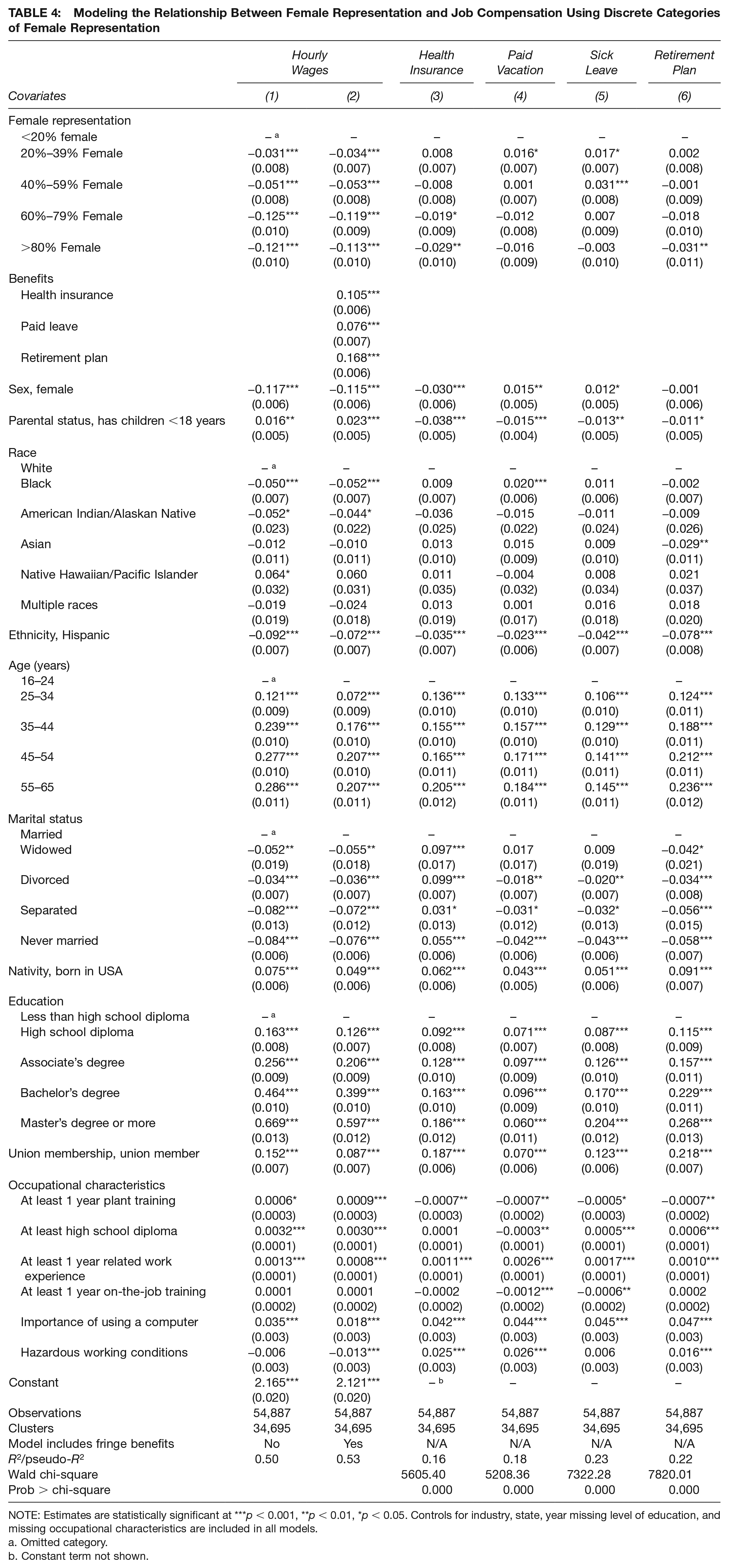
NOTE: Estimates are statistically significant at ***p < 0.001, **p < 0.01, *p < 0.05. Controls for industry, state, year missing level of education, and missing occupational characteristics are included in all models.
Omitted category.
Constant term not shown.
For comparison with the descriptive results, Figure 3 shows average levels of job compensation for workers in male and female occupations using predicted values from Equations 1 and 2. Plotted this way, the differences between workers in male and female occupations are modest. More than two-thirds of workers in both groups are offered EPHI, have paid vacation, and have sick leave. More than half of workers in both groups have retirement plans. Nevertheless, after controlling for individual and occupational characteristics, workers in female occupations earn about $2 less per hour than workers in male occupations, and there is no indication that they are compensated for these lower wages with more benefits.

Average Levels of Wages and Benefits for Workers in Male Occupations and Female Occupations—Regression Adjusted
The relationships between the control variables and wages and benefits from the multivariate regression models are also shown in Table 4. Female workers have lower wages than male workers, net of the sex composition of their occupations. Female workers are also less likely to report being offered EPHI but more likely to report having paid vacation and sick leave. Parental status is associated with higher wages, but a lower likelihood of having benefits. Compared to white workers, African American workers have lower wages but are more likely to have paid vacation. Hispanic ethnicity is negatively associated with wages and with each benefit. Wage and nonwage compensation increase with age, educational attainment, and union membership. Occupation-level educational requirements and work experience are positively associated with wages and benefits, as is computer use. Hazardous working conditions are negatively associated with wages, but positively associated with benefits.
Finally, as an additional test for compensating differentials, I examine whether the relationship between female representation and wages is sensitive to nonwage compensation (Table 4, column 2). Following the third hypothesis, if workers’ preferences for benefits explain the lower relative pay of workers in female occupations, then the coefficient on female occupations in the multivariate model should attenuate and become statistically insignificant. After controlling for EPHI, paid leave (paid vacation and sick leave combined), and retirement plans, which are all positively associated with wages, the coefficient on female occupations remains negative and statistically significant and is similar in magnitude to the coefficient from the base model (Table 4, column 1). Taken together, the main findings provide support for gendered devaluation theory rather than compensating differentials theory as an explanation for the lower relative pay of workers in female occupations.
Sensitivity Analyses
To ensure that the conclusions from the main analyses are not sensitive to different specifications of the relationship between female representation and wages and benefits, I consider three alternative specifications: a continuous measure, three categories (less than 33 percent, 33–66 percent, and more than 66 percent female workers), and two categories (less than 50 percent and 50 percent or more female workers). Results from these analyses are consistent with the main findings and do not alter the conclusions of the paper (see Appendix Table A1). They also demonstrate how using a continuous measure of female representation—the specification used by Glass (1990) and Lowen and Sicilian (2009)—obscures the nonlinearity in the relationships between female representation and wages. With a continuous measure, an increase in the percentage of female workers in an occupation at any level of female representation is associated with lower wages (see the top panel of Appendix Table A1). In contrast, the main findings show that wages are higher for workers in 20–40 percent female occupations compared to workers in male occupations (see Table 4).
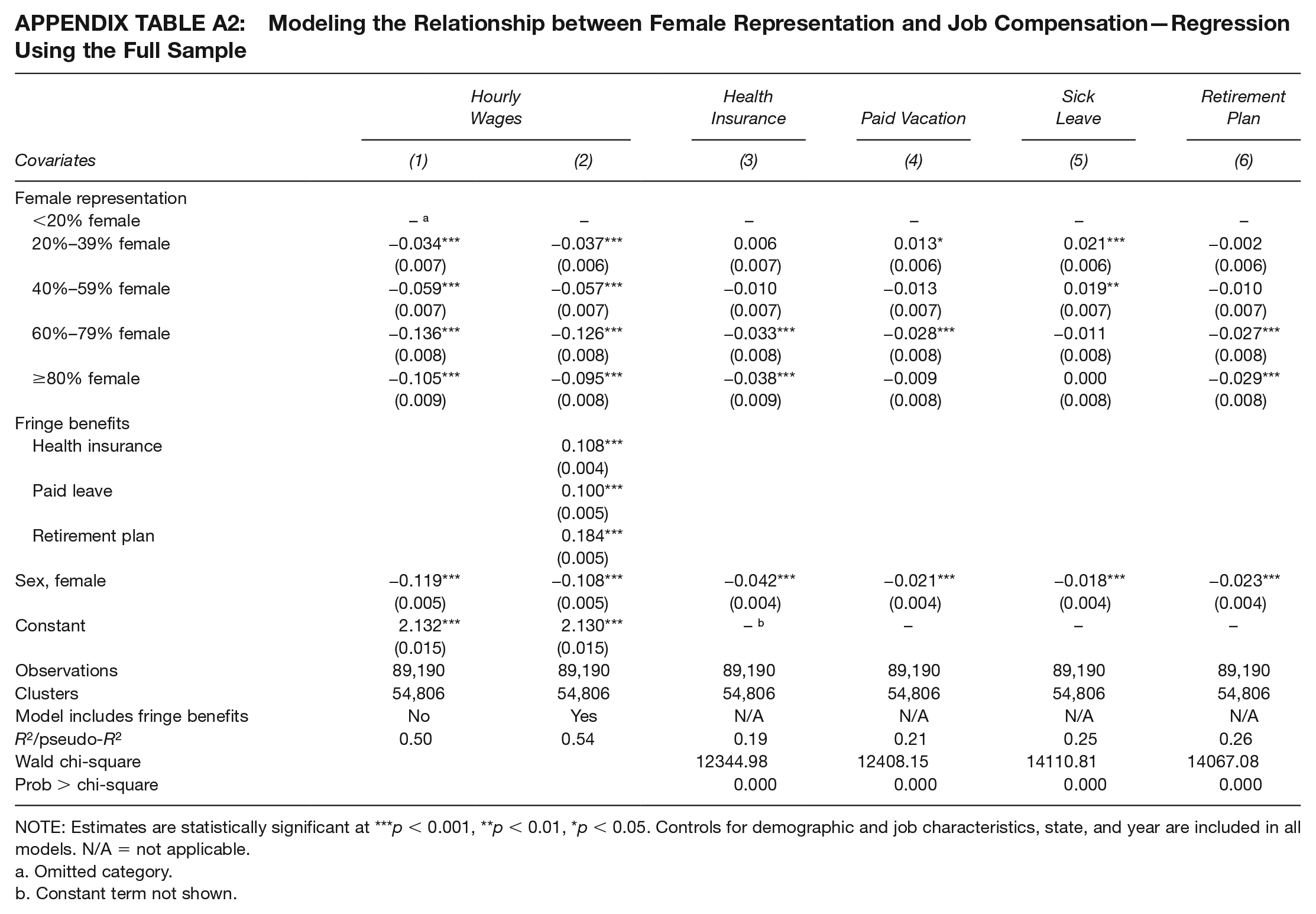
To ensure that the conclusions from the main analyses are not sensitive to sample selection criteria, the multivariate regression analyses are replicated using the full sample, which includes part-time workers, seasonal workers, workers with shorter job tenures, and workers with missing values for explanatory variables. The results yield similar conclusions. Female representation is negatively associated with wages, with being offered EPHI, and with having a retirement plan (see Appendix Table A2). In the models predicting paid vacation and sick leave, the coefficients on female representation are not statistically significant.
Discussion
The negative relationship between female representation in an occupation and wages has been well documented (England 2010). Yet policy solutions to address the lower relative pay of workers in female occupations, such as comparable worth, remain contentious, partly because of competing theoretical explanations for these pay differences. Compensating differentials theory holds that the lower relative pay of workers in female occupations can be explained by gender differences in workers’ preferences for wage and nonwage compensation. Gendered devaluation theory holds that the lower relative pay of workers in female occupations can be explained by the lower status of women in society, which leads to lower returns to women’s work.
To contribute to current conversations on what explains the lower relative pay of workers in female occupations, this study examined the relationships between female representation in an occupation and wages and benefits. Contrary to compensating differentials theory, I found little evidence that benefits explained pay differences between workers in female occupations and male occupations. Rather, consistent with devaluation theory, workers in female occupations were less likely to be offered health insurance coverage and were less likely to have paid vacation or retirement plans relative to workers in male occupations.
Overall, the main findings appear to corroborate the prior evidence in support of gendered devaluation theory and suggest that the inequalities between workers in female occupations and male occupations are greater when measured by total job compensation than when measured by wage compensation alone—a conclusion made stronger by this study’s use of more recent data and consideration of alternative specifications of the relationship between female representation and job compensation.
Of course, to the extent that other nonpecuniary factors, including other types of benefits, affect wages and systematically differ across occupations, compensating differentials theory cannot be ruled out. It may be the case that women prefer benefits that help them balance work and family demands and choose occupations based on these preferences. This study considered two family-friendly benefits, paid vacation and sick leave, and found no statistically significant difference in levels of these benefits between male and female occupations.
Still, other important family-friendly benefits not captured in the MEPS data and other unobserved occupational characteristics may influence the wages and benefits of workers in male and female occupations. Prior studies have used occupation-level fixed effects to account for time-invariant unobservable factors that affect an occupation’s sex composition and average wages (Catanzarite 2003; England, Allison, and Wu 2007; Levanon, England, and Allison 2009; Lowen and Sicilian 2009). It would certainly be beneficial for a future study to apply this same approach to examine how changes in female representation in an occupation are related to changes in levels of benefits over time. However, the MEPS data would be of limited use for such an analysis, because the approach requires several decades of data. Nevertheless, the findings from this study have important implications that extend beyond theory to the real-world experiences of women in the labor force. Today women are staying in the labor force longer (Hollister and Smith 2014), completing college at the same or higher rates as men (Ge and Yang 2013), and having fewer children and/or delaying childbirth (Shreffler 2017). Yet women, particularly those in female occupations, remain economically vulnerable. In this study, workers in female occupations earned $2 less per hour on average than workers in male occupations, and they were less likely to be offered health insurance coverage or retirement plans compared with workers in male occupations. Given that workers in female occupations earn less and have fewer benefits, promising approaches to strengthening women’s positions in the labor market might include publicly funding programs to provide benefits such as health insurance (i.e., going beyond a health care coverage mandate to a single-payer system that is not contingent on one’s employment) and renewed attention to comparable worth as a viable policy option for reducing gender disparities in compensation.
Footnotes
Appendix
Modeling the Relationship between Female Representation and Job Compensation—Regression Using the Full Sample
| Covariates | Hourly Wages |
Health Insurance |
Paid Vacation |
Sick Leave |
Retirement Plan |
|
|---|---|---|---|---|---|---|
| (1) | (2) | (3) | (4) | (5) | (6) | |
| Female representation | ||||||
| <20% female | – a | – | – | – | – | – |
| 20%–39% female | −0.034***
(0.007) |
−0.037***
(0.006) |
0.006 (0.007) |
0.013*
(0.006) |
0.021***
(0.006) |
−0.002 (0.006) |
| 40%–59% female | −0.059***
(0.007) |
−0.057***
(0.007) |
−0.010 (0.007) |
−0.013 (0.007) |
0.019**
(0.007) |
−0.010 (0.007) |
| 60%–79% female | −0.136***
(0.008) |
−0.126***
(0.008) |
−0.033***
(0.008) |
−0.028***
(0.008) |
−0.011 (0.008) |
−0.027***
(0.008) |
| ≥80% female | −0.105***
(0.009) |
−0.095***
(0.008) |
−0.038***
(0.009) |
−0.009 (0.008) |
0.000 (0.008) |
−0.029***
(0.008) |
| Fringe benefits | ||||||
| Health insurance | 0.108***
|
|||||
| Paid leave | 0.100***
|
|||||
| Retirement plan | 0.184***
|
|||||
| Sex, female | −0.119***
|
−0.108***
|
−0.042***
|
−0.021***
|
−0.018***
|
−0.023***
|
| Constant | 2.132***
|
2.130***
|
– b | – | – | – |
| Observations | 89,190 | 89,190 | 89,190 | 89,190 | 89,190 | 89,190 |
| Clusters | 54,806 | 54,806 | 54,806 | 54,806 | 54,806 | 54,806 |
| Model includes fringe benefits | No | Yes | N/A | N/A | N/A | N/A |
| R2/pseudo-R2 | 0.50 | 0.54 | 0.19 | 0.21 | 0.25 | 0.26 |
| Wald chi-square | 12344.98 | 12408.15 | 14110.81 | 14067.08 | ||
| Prob > chi-square | 0.000 | 0.000 | 0.000 | 0.000 | ||
NOTE: Estimates are statistically significant at ***p < 0.001, **p < 0.01, *p < 0.05. Controls for demographic and job characteristics, state, and year are included in all models. N/A = not applicable.
Omitted category.
Constant term not shown.
Author’s Note:
Funding for this research was provided by the University of Missouri Population, Education, and Health Center. Support for this research was provided by the Institute for Research on Poverty, the Agency for Healthcare Research and Quality (AHRQ), and the Federal Statistical Research Data Centers network. Data analysis was conducted at the University of Missouri Research Data Center and the Wisconsin Research Data Center. The results and conclusions in this article are those of the author and do not indicate concurrence by AHRQ or the Department of Health and Human Services. The author would like to thank Colleen Heflin, Joan Hermsen, Peter Mueser, Rajeev Darolia, and Maria Cancian for their comments and suggestions and Jacob Cronin, Ray Kuntz, and Robert Thomas for data support.

2.
3.
The estimated coefficient (b) for female occupations is −0.121. A discrete change from male occupations to female occupations results in a
Leslie Hodges is a postdoctoral research associate at the Institute for Research on Poverty at the University of Wisconsin–Madison who studies how families make ends meet. She specializes in the use of survey and administrative data to examine patterns in employment, health, and well-being for different population groups and to inform evidence-based policy making on public programs including child support, unemployment insurance, and SNAP. She has published in Social Science and Medicine and Population Research and Policy Review.